Pacific Press Publishing Company · New York · May 23, 1895
THE POPE'S LETTER TO THE ENGLISH PEOPLE.
Pope Leo XIII. has written a letter to “the English people who seek the kingdom of Christ in the unity of the faith.” All professed Christians seek the unity of the faith, and therefore the pope addresses all the professed Christians of England.
This is not the first time the papacy has attempted to persuade the English people to return to the “unity of the [Roman Catholic] faith.” A notable attempt was made just three hundred and seven years ago this month.
In May, 1588, the papacy sent one hundred and fifty messengers to England to argue with the English people and persuade them to return to the Roman Catholic faith. Twelve of these messengers were named after the twelve apostles, and others were named after the “saints.”
While these messengers were apostolic in name, and were commissioned by the professed vicar of Christ, Pope Sixtus V., they were not apostolic men armed only with the “sword of the Spirit, which is the Word of God,” but instead they were huge battle ships, armed and equipped with 2,088 galley slaves, 8,000 sailors, 20,000 soldiers, 2,650 cannon, 123,790 rounds of shot, and 517,500 pounds of powder.
Beside being equipped with these ordinary death-dealing arguments of war, these papal messengers, which history calls the “Spanish Armada,” and which Roman Catholics were pleased to call the “Invincible Armada,” were equipped with still other papal arguments which were to be used to restore the unity of the faith in special cases, wherein the ordinary war arguments failed. These special arguments were the torture instruments of the “Holy Office of the Inquisition;” and to insure the effective application of these arguments, Don Martin Allacon, Administrator and Vicar-General of the “Holy Office,” accompanied these satanic instruments of cruelty.
However, this Armada argument was but one in a series of papal measures intended to persuade the English people to return to their allegiance to the pope. Before sending the Armada, and with a view to weakening the loyalty of the English people to the queen of England as a preparation for it, the pope hurled a bull of excommunication against the queen, from which the following is extracted:—
We do, out of the fullness of our apostolic power, declare the aforesaid Elizabeth, being a heretic, and a favorer of heretics, and her adherents in the matter aforesaid, to have incurred the sentence of anathema, and to be cut off from the unity of the body of Christ. And, moreover, we do declare her to be deprived of her pretended title to the kingdom aforesaid, and of all dominion, dignity, and privilege whatsoever. . . . And we do command and interdict all and every the noblemen, subjects, people, and others aforesaid, that they presume not to obey her or her monitions, mandates, and laws; and those that shall do the contrary, we do strike with the like sentence of anathema.
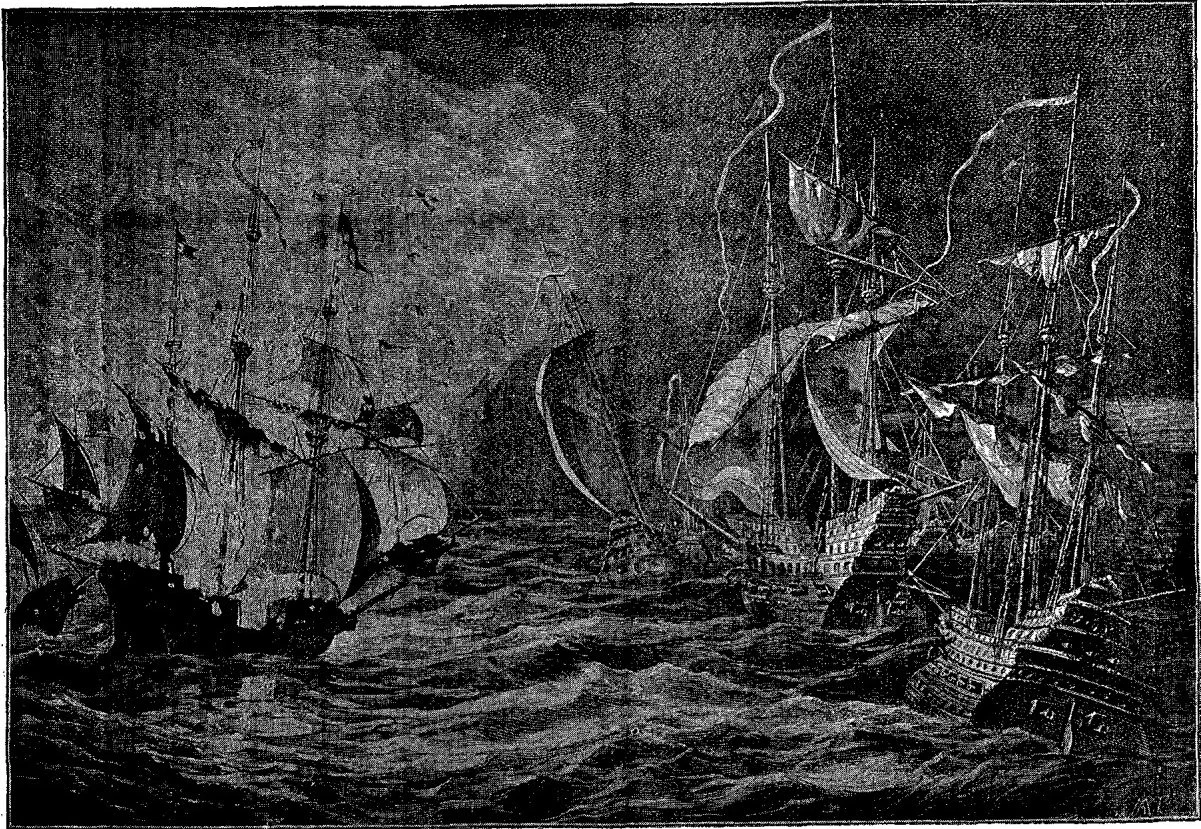
This excommunication was followed by papal attempts to assassinate the queen, and then came the pope-blessed “Invincible Armada,” which was heroically fought and finally defeated and driven off by the much inferior navy of England. Our illustration shows one of the stratagems used by the English to save themselves from the choice of a terrible death or unity with Rome. On the night of August 7, the English loaded eight ships with combustible material, smeared their masts with tar, sailed them near the Spanish fleet and then set them on fire, with the hoped-for result that the Spaniards took flight and sailed away, after which the English ships and a terrible storm completed their defeat and almost complete destruction.
The Spanish Armada Inviting the English People to the “Unity of the Faith.”
This is a brief description of the failure of an old papal method of securing the unity of the faith. But why does not Pope Leo XIII. now use the methods of his “infallible” predecessor, Pope Sixtus V.? Why don’t he send an Armada instead of an “Apostolic Letter”? It cannot be because the papacy has discarded162these antichristian methods, for this is impossible, since Pope Leo X. “infallibly” condemned Luther’s proposition that “to burn heretics is contrary to the will of the Holy Ghost,” thus “infallibly” sanctioning the practice of burning heretics. Again, Pope Pius IX., the immediate predecessor of the present pope, as late as 1851, “infallibly” condemned the proposition, “The church has not the power of availing herself of force or any direct or indirect temporal power.”
No; the papacy has not disavowed and cannot disavow the methods used in the Middle Ages to secure the “unity of the faith,” without destroying the doctrine of “infallibility” which it has “infallibly” proclaimed.
Why is it then that Leo XIII. now speaks to the English people with “the deep tones of sympathetic feeling” instead of with the deep-toned roar of Spanish cannon?
Since it cannot be because of a change in the papacy it must be because of a change in circumstances. Here lies the truth. When the Spanish Armada attempted the destruction of Protestantism in England, the papacy controlled the greater part of western Europe. Spain was a great naval power, while England was much inferior in naval resources, with only about four million people. To-day the papacy is shorn of its temporal power, Spain though still Roman Catholic has lost its naval prestige, while England is the strongest naval power in the world.
That Rome would do the same now as she did in the sixteenth century is also made evident by present papal practices in Catholic countries. In Roman Catholic South America Protestant missionaries are persecuted. And when the Methodist ministers of Chicago petitioned Satolli a few months ago to petition the pope to secure religious liberty for Protestant missionaries in that country, Satolli coolly replied by sending them a copy of the pope’s letter calling the governments and people of the world back into the Roman Catholic Church, thus in reality saying, “You can have religious freedom in Catholic South America only by joining the Catholic Church.”
Again, Protestant missionaries have been mobbed and driven from the Caroline Islands by Roman Catholics; and only a few weeks ago, Roman Catholic Spain peremptorily denied the request of the Government of the United States that American missionaries be allowed to return to the Caroline Islands.
And almost simultaneously with the pope’s letter to England, he sent one to Hungary commending the organization of a distinct Roman Catholic political party with the object of securing the repeal of liberal measures recently passed in that country, placing all religious denominations on an equal footing before the law. But the pope, acting in that country in accordance with his recent encyclical to America, demands “in addition to liberty, the favor of the laws and the patronage of the public authority.”
For these and other reasons that might be cited, the English people ought not to be deceived by this letter which the New York Sun’s Rome correspondent, himself a Roman Catholic, says is written “with delicate tact, in the most flattering tone,” and “drawn at long sight” with “infinite ecclesiastical ambition.” It is the papal policy to use force when in power, and flattery when seeking power; and it is astonishing that so many Protestants are so credulous and short sighted as not to see in the flattery and the “deep-toned sympathy” of the pope, a deep-laid plot “drawn at long sight,” to regain the supremacy of the world.
And it is only a false charity that would silence the cry of warning because the plottings of the pope for the world’s supremacy are carried on with “delicate tact,” instead of defiant temerity; with the “flattering tone,” instead of the “Invincible Armada.”
May God save the Protestants of England and the world from being deceived by this siren song and flattering tone of the pope into compromising with Rome. And may the same God save Roman Catholics themselves from the tyranny which will follow the triumph of their own system. To this end we labor and pray.
CIVIL LAW AND THE RIGHTS OF CONSCIENCE.
The following letter from the editor of the American Monthly Microscopical Journal will be read with interest by all. Mr. Smiley’s position is unique; he insists upon obedience to laws which he confesses are unjust. But his candid tone leaves no doubt of his entire sincerity; hence his views are entitled to respectful consideration:—
Washington, D. C., May 6, 1895.
EDITORS AMERICAN SENTINEL: I have read carefully your issue of April 11, upon the Sunday question and freedom of conscience. Your people ought not to overlook, as they do, that human laws are to be obeyed whether right or wrong by the people who choose to live under them. Society is dependent for its maintenance on the execution of the will of the majority as expressed in laws. When those laws come into serious conflict with the views of certain citizens, as in the case of the Seventh-day Adventists and others, the liberty of conscience cannot rightfully be set up as a justification for breaking the laws. Your only resort is to submit under protest or go away from a society which tolerates such oppressive laws and establish or find one that is not so. Take the Mormon doctrine of polygamy as parallel. Many Mormons hold as conscientiously to plural marriages as you do to Saturday rest. But their religious views, however conscientious, cannot be set up as a defense for violating law (just or unjust is not the question at all). For my own part I consider all Sabbath laws (Saturday or Sunday) as infringements of personal liberty and would gladly vote to abolish all such laws; but while they exist they must be respected. To defy them is anarchy. Elder Colcord is an anarchist to the extent of defying one human law, and he can have no word to utter against the thief who says and does steal conscientiously. Many now believe that property laws are contrary to God’s laws and could as conscientiously defy them as did the Adventists defy the Sunday law. I would join them in seeking to undo wicked laws of which we have hundreds, but so long as these infamous laws stand, Elder Colcord and the rest do wrong in violating them. He will not say that two wrongs make one right. If our nation is so foolish as to adhere to wicked laws, and it doubtless will to many of them, you and I owe it to humanity to go away, as did our forefathers, to a new land and establish an asylum for the oppressed of all peoples. America once was. To-day it is not. It is more cruel than France in its religious oppressions and is going to be worse than it is now after a few years. I hope you will submit these views to the calm and careful consideration of your readers, and cease to put your people forward as justified in violating (bad) laws.
Yours truly,
CHAS. W. SMILEY, Editor.
Mr. Smiley’s first proposition is more in keeping with the theory of law and government that prevailed in Rome under the Cæsars than with the principles of the Declaration of Independence. According to Mommsen “the whole duty of man, with the humblest and greatest of Romans, was to keep his house in order, and be the obedient servant of the State.” But the American theory of government makes the State the servant of the people, created by them for the conservation of their rights. The Declaration of Independence sets forth as a self-evident truth the proposition that all men are by their Creator endowed “with certain unalienable rights;” and that “to secure these rights governments are instituted among men, deriving their just powers from the consent of the governed.” Nor was this conception of government and of human rights original with the framers of the Declaration of Independence. As quoted in this paper last week, Blackstone had, eleven years previous to the signing of the Declaration, published to the world a very similar statement of the same principle, in these words:—
Those rights which God and nature have established, and are therefore called natural rights, such as life and liberty, need not the aid of human laws to be more effectually invested in every man than they are; neither do they receive any additional strength when declared by the municipal laws to be inviolable.
An inalienable right cannot be destroyed or alienated by any law. It may be invaded by despotic power, its exercise may be denied, but it is none the less a right; and this has been recognized as preeminently true of rights of conscience.
January 19, 1829, the Senate of the United States adopted a report by the committee on post offices and post roads, in which this truth is set forth in the following stirring words:—
What other nations call religious toleration we call religious rights. They are not exercised in virtue of governmental indulgence, but as rights, of which government cannot deprive any portion of citizens, however small. Despotic power may invade those rights, but justice still confirms them.
About a year later, March 5, 1830, the National House of Representatives concurred in a similar report from the House Committee on post offices and post roads, in which occurs this passage:—
The framers of the Constitution recognized the eternal principle that man’s relation with his God is above human legislation, and his rights of conscience inalienable. Reasoning was not necessary to establish this truth; we are conscious of it in our own bosoms. It is this consciousness which in defiance of human laws, has sustained so many martyrs in tortures and in flames. They felt that their duty to God was superior to human enactments, and that man could exercise no authority over their consciences. It is an inborn principle which nothing can eradicate. The bigot, in the pride of his authority, may lose sight of it; but strip him of his power, prescribe a faith to him which his conscience rejects, threaten him in turn with the dungeon and the fagot, and the spirit which God has implanted in him rises up in rebellion and defies you.
Observe that the Constitution did not create this right, but merely recognized it; therefore it exists wherever man exists, whether recognized or not by anybody. Constitutional law may deny it, statutory law may override it, as it does in Tennessee, but it is none the less a right, and he who through fear of consequences fails to assert this right and to exercise it, is disloyal alike to true manhood and to God who claims his highest allegiance.
Thomas Jefferson, than whom no man ever better understood the principles of free government, said:—
The religion of every man must be left to the conviction and conscience of every man; and it is the right of every man to exercise it as these may dictate. This right is in its nature an unalienable right. It is unalienable, because the opinions of men, depending only on the evidence contemplated in their own minds, cannot follow the dictates of other men. It is unalienable, also, because what is here a right towards men is a duty towards the Creator. It is the duty of every man to render to the Creator such homage, and such only, as he believes to be acceptable to him. This duty is precedent, both in order of time and in degree of obligation, to the claims of civil society. Before any man can be considered as a member of civil society, he must be considered as a subject of the Governor of the universe.
But even were the rights in question merely constitutional rights instead of being as they are, both constitutional and natural rights, any invasion of them would still be a nullity, and the individual might still violate any law made in contravention of them without becoming thereby an anarchist. Hon. James Brice, M. P., from Aberdeen, author of “The163Holy Roman Empire,” says of acts of Congress, in his recent work, “The American Commonwealth”:—
Their validity depends on their being within the scope of the law-making power conferred by the superior authority [the Constitution] and as they have passed outside that scope they are invalid. They ought not to be obeyed or in any way regarded by the meanest citizen, because they are not law.
This being true of acts invading merely constitutional rights in civil things,—substantial rights to be sure, but not trenching upon the domain of conscience,—how much more is it true of inalienable, God-given rights of conscience!
Nor is it alone by statesmen and publicists that this principle has been seen and enunciated. President Fairchild, of Oberlin College, says:—
It is too obvious to need discussion, that the law of God, the great principle of benevolence, is supreme, and that, “we ought to obey God rather than men,” in any case of conflict between human law and the divine. It is often urged that the right of private judgment, as now maintained, in reference to obedience to the laws of the land, will subvert government and introduce confusion and anarchy. The danger, however, is greatly over-estimated. Government is never the gainer in the execution of a law that is manifestly unjust. Conscientious men are not the enemies, but the friends, of any government but a tyranny. They are its strength, and not its weakness. Daniel, in Babylon, praying, contrary to the law, was the true friend and supporter of the government; while those who, in their pretended zeal for the law and the constitution, would strike down the good man, were its real enemies. It is only when government transcends its sphere, that it comes in conflict with the consciences of men.
But it is objected that the example is corrupting, that a bad man will violate a good law, because the good man refuses to obey a wicked law. The cases are just as unlike as right and wrong, and any attempt to justify the one by the other, is gross dishonesty. Unquestionably, the principle can be abused by the wicked, and so can any truth whatever, but the principle of unquestioning obedience to human law is false, and needs no perversion to make it mischievous. Practically, the cases are few, in well-established governments, where the law encroaches upon the rights of conscience; but if the principle be surrendered, the cases will multiply. The most grievous of all imperfections in government, is the failure to secure the just and good result. Injustice and oppression are not made tolerable by being in strict accordance with the law. Nothing is surer, in the end, than the reaction of such wrong, to break down the most perfectly constituted government.—Fairchild’s Moral Philosophy, pp. 178-186
The Adventists of Tennessee, as well as of other States, act upon this principle. They refuse to obey Sunday laws, not from reckless disregard of civil authority, but from conscientious conviction of sacred duty. No matter how utterly at variance with their ideas of justice a law might be if it did not invade the realm of conscience, if to obey it did not involve disobedience of the law of God, no Adventist would disobey. They would submit even, as did the Saviour, to the imposition of an unjust tax (Matt. 17:24–27); but they, like “Peter and the other apostles” (Acts 5:29), feel that they must “obey God rather than men.”
It is very true that government cannot permit men to do whatever they may claim is done by them conscientiously. As our correspondent says, some men are conscientiously opposed to laws guarding property rights, and some are conscientious in the matter of plural marriages. But there is a touchstone to which all such questions can be brought and by which they can be infallibly settled; it is the rule given by Christ himself: “Render therefore unto Cæsar the things which are Cæsar’s; and unto God the things that are God’s.”
This draws the line between our duties to God and our duties to our fellow-men, and that is just where all just government must draw it. Whatever trenches upon the equal right of another may be forbidden, and everything else is outside the domain of human legislation. Said Abraham Lincoln: “I believe each individual is naturally entitled to do as he pleases with himself and the fruit of his labor, so far as it in no wise interferes with any other man’s rights.”—Political Speeches and Debates, page 83.
Lincoln’s words are in exact accord with these words from Thomas Jefferson:—
Our legislators are not sufficiently apprised of the rightful limits of their power; that their true office is to declare and enforce only our natural rights and duties and to take none of them from us. No man has a natural right to commit aggressions on the equal rights of another; and this is all from which the laws ought to restrain him; every man is under the natural duty of contributing to the necessities of the society; and this is all the laws should enforce upon him.—American State Papers Bearing on Religious Legislation, p. 69.
Jefferson’s rule, which is first of all the divine rule, and secondly the American rule, would exclude all laws requiring the observance of real or supposed holy days; but it would not exclude from the domain of proper civil jurisdiction laws prohibiting polygamy; because the marriage relation necessarily involves the rights not only of the contracting parties but of their offspring and of society. It would be impossible to permit polygamy anywhere in the United States without thereby jeopardizing the rights of every woman in every State in the Union, and in every country in the world; for with plural marriages legalized anywhere, any man who wished to do so might go to that place and there marry other wives without regard to the rights of his first wife who had married him with no thought of any such thing. This is but one point of the many at which polygamy trenches upon civil rights that civil government is in duty bound to safeguard, and to vindicate when infringed.
We take our stand on this question with the Fathers of the Republic and declare with Alexander Hamilton that “justice is the end of government. It is the end of civil society. . . . In a society, under the form of which the stronger faction can readily unite and oppress the weaker, anarchy may as truly be said to reign as in a state of nature, where the weaker individual is not secure against the violence of the stronger.”—Federalist LI.
Professor Colcord is not an anarchist, nor is any man an anarchist simply because he enters a practical protest against tyranny. President Fairchild well says: “Conscientious men are not the enemies, but the friends of any government but a tyranny. They are its strength, and not its weakness. Daniel, in Babylon, praying contrary to the law, was the friend and supporter of the government; while those who in their pretended zeal for the law and the constitution, would strike down the good man, were its real enemies.” And so to-day Elder Colcord and his brethren are the real friends of law and order in Tennessee, while those who would prostitute the law to the base ends of bigotry and intolerance are the enemies of all just law, the betrayers of soul liberty.
“Who dares not follow Truth where’er
Her footsteps lead,
But says, ‘Oh, guide not there nor there,
I have not strength to follow where
My feet would bleed;
But show me worn ways, trodden fair
By feet more brave’—
Who fears to stand in Truth’s broad glare,
What others dared not will not dare,
Is but a slave.”
THE “MONITOR” CRITICISES THE CARDINAL’S LATIN.
By Editor
Some time ago, the Catholic Monitor accused the AMERICAN SENTINEL of “steady and unlimited abuse of the pope of Rome.” To this we replied that “the only mention that we have had occasion to make of the pope has been in connection with his scheme to unite the Roman Catholic Church with the power of the United States Government, to do with this nation now as ‘the church’ has done with other nations in the past, and so to bring Europe and all humanity once more under the power of the papacy; and in doing this we have only stated the facts as given from the pope through Catholic channels.” But that “these plain facts, however, plainly stated, set the papacy in such a wicked light before the country that it is easy enough for Catholic papers to see in it only ‘steady and unlimited abuse of the pope of Rome.’”
We further said that “the only other occasion that we have had, or used, to discuss the pope was when, last year, he addressed ‘the Princes and Peoples of the Universe,’ and gravely informed us that ‘WE [that is himself] hold the regency of God on earth.’”
In our use of the address, “The Princes and Peoples of the Universe,” the Monitor thinks it has found evidence of great obtuseness,164if not both ignorance and heresy. It accordingly reins us up, in its own vigorous style, as follows:—
This refers to one of the pope’s encyclicals. Now let us tell the American Sentinel that there is no encyclical addressed to the princes and peoples of the universe. There is one addressed Principibus Populisque Universis, but any school boy who has got as far as hic haec hoc would be able to tell it that this does not mean the princes and peoples of the universe. If the American Sentinel is not able to interpret the title to a modern document written in so simple a language as Latin, how can we expect it to interpret prophecies which have been written in every corrupt dialect from the vulgar Chaldee of Daniel to the Hellenistic Greek of St. John?
It may be that our knowledge of Latin is so defective as not to be able in all things to bear the Monitor’s superior criticism. It may be, indeed, that we have not “got as far as hic haec hoc,” and it may be, therefore, that we are, indeed, “not able to interpret the title to a modern document written in so simple a language as Latin.” But whatever may be our knowledge or lack of knowledge of “so simple a language as Latin,” we were not quite so simple as to suppose that our own translation of a Latin passage from the pope would be accepted by Catholics as correct,—especially when such translation was used as the text for a criticism of the vital claim of the pope which is but the claim of the papacy.
In this matter, therefore, we did not attempt any translation of our own; but thought to use one obtained from such an authority in Latin that even Catholics themselves would not question its correctness. And thinking that Cardinal Gibbons was probably well enough acquainted with “so simple a language as Latin” to translate the encyclical, we thought that a translation certified by him could safely be used. Accordingly we waited until a standard Catholic paper had printed the authorized translation from the Cardinal himself. The Northwestern Chronicle was the first such paper in which we found the authorized translation, and this is the one we used. In the issue of that paper dated July 20, 1894,—page 5,—the Cardinal’s authorized translation of the encyclical is printed in full with introduction by the editor, and note by the Cardinal. This introduction, note, and the opening words of the encyclical are as follows:—
We present below an exact English translation of the Latin text of the encyclical recently issued by his holiness, Pope Leo XIII, obtained through the courtesy of Cardinal Gibbons. It is accompanied by the following note thereon from the cardinal:—
“It is not easy to do justice to all points of this very beautiful, suggestive and far-reaching apostolic message of the holy father without reading and rereading it, as all may do with profit and delight.
“The admiration inspired by the broad and noble Christianity which marks this supreme appeal of the venerable pontiff to unity, charity and Christian peace cannot but be mingled with amazement if we recall the advanced age of its august author and consider the clearness of style, the simplicity and force by which the message is distinguished.
“But it is the lofty thought so admirably expressed by Leo XIII. in this encyclical that will most arrest the attention of the princes and peoples to whom it is addressed. Looking back upon the eventful past of his pontificate as from a height, the holy father seems to embrace all races and all nations in his charity. His appeal to the Greek Catholics and the Protestants may meet with no immediate response, but it will hardly fall upon deaf ears.
“Most significant, and to us Americans of peculiar interest, is the holy father’s definition of the lines which should mark the respective spheres of the civil authorities of Christian States. In this and in mutual tolerance lies the best hope that the world will some day see the promise realized: ‘Fiet unum ovile et unus pastor.’ J. CARD. GIBBONS.”
The encyclical reads as follows:—
“APOSTOLIC LETTER.
To the princes and peoples of the universe: Leo XIII., pope. Greeting and peace in the Lord.”
These are the identical words that we copied, and which we used, when we said that the pope “last year addressed ‘the Princes and Peoples of the Universe’ and gravely informed us all that ‘WE [that is himself] hold the regency of God on earth.’” The translation is the official one and authorized by Cardinal Gibbons himself; and the Latin address is translated, “To the Princes and Peoples of the Universe.”
Now as this is not the AMERICAN SENTINEL’s translation at all, but the Cardinal’s, or at least that of the Cardinal’s official translator and authorized by the Cardinal, let us read the Monitor’s broadside over again with the application not to the AMERICAN SENTINEL where it does not apply at all, but to Cardinal Gibbons where it really applies. So read it runs thus:—
Now let us tell Cardinal Gibbons that there is no encyclical addressed to the princes and peoples of the universe. There is one addressed Principibus Populisque Universis, but any school boy who has got as far as hic haec hoc would be able to tell him that this does not mean the princes and peoples of the universe. If Cardinal Gibbons is not able to interpret the title to a modern document written in so simple a language as Latin, etc., etc.
That is the true reading of the passage from the Monitor. But is it true that Cardinal Gibbons is not able to interpret the title of a modern document written in so simple a language as Latin? Is it true that Cardinal Gibbons has not got as far as hic haec hoc? And is it therefore true that there is no encyclical addressed to the princes and peoples of the universe? These questions and their answers lie between the editor of the Monitor and Cardinal Gibbons.
HARRISON'S PEN AND CLEVELAND'S HOOK.
On Sunday, May 11, President Cleveland, with two cabinet officers, went fishing near Leesburg, Va. They fished from 7 o'clock in the morning to 6 o'clock in the evening, catching among them seventy trout, of which number twenty-eight were caught by the President.
This completes the ruin of the “American Sabbath” which the Sunday-law crusaders persuaded the National Government to make in 1892.
On Feb. 29, 1892, the United States Supreme Court decided that “this is a Christian nation,” citing Sunday laws as one proof.
On July 19, 1892, the Congress of the United States followed the lead of the Supreme Court and passed a Sunday bill.
On August 5, this bill was signed by President Harrison and became a law. The pen with which it was signed was begged from the President and carefully treasured in the archives of the American Sabbath Union; and we were told in great glee that the sacredness of the “American Sabbath” was permanently assured. But what man can sanctify, he can desecrate, and so—
On March 3, 1895, the same being Sunday, Congress “desecrated,” by spending the day in legislative session, what its predecessors had sanctified.
On April 7, the same being Sunday, the United States Supreme Court “desecrated” the Sunday of this “Christian nation” by sitting in executive session and attending to business as secular as any business ever performed by a Seventh-day Adventist on that day. And finally—
On May 11, the same being Sunday, Grover Cleveland, President of the United States, spent the day catching trout, and “desecrated” with his hook what his predecessor had sanctified with his pen; and thus completed the ruin of the Government-made “American Sabbath.”
Against all this the Sunday-law crusaders are entering a vigorous protest, and threaten to “turn the rascals out.” Although the State-sanctified Sabbath is ruined, the “Sabbath of the Lord” still stands.
THE SABBATH.
By Charles Foley
[By Charles Foley, in Patriot Phalanx, May 9.]
I UNDERSTAND J. B. C., in his article of April 25, to contend, in substance, that the fourth commandment is merely a civil labor regulation, a day set apart for rest and recuperation from toil. I think it is not a civil labor regulation at all, for the reason, that before the ground was cursed and Adam was banished from the garden and told, “In the sweat of thy face shalt thou eat bread,” God had “blessed the seventh day and sanctified it; because that in it he had rested from all his work.” Gen. 2:3. Thus it is seen that the seventh day was blessed and distinguished165because of what God himself had done, and not as a civil labor regulation for man, for up to that time man was not under the curse, had not labored and was not tired.
Later, man being under the curse, came the command from Sinai applicable alike to those not needing, as well as those needing, rest: “Remember the Sabbath day, to keep it holy,” and particularly designating the day that is the Sabbath, and mentioning that God created the universe in six days and rested on the seventh, and blessed and hallowed it. Ex. 20. In Ex. 16:23, the Lord is quoted as speaking of the seventh day as being, “the holy Sabbath;” and in Ex. 31:12-17 inclusive, the seventh day is mentioned as being the Sabbath “holy unto you,” and as being “holy unto the Lord,” and as being a sign throughout the generations and a perpetual covenant, and the death penalty was pronounced against those who defiled the same by working thereon.
In the above-mentioned scriptures, the doing of work seems to be the only defilement of the Sabbath prohibited, but in Isa. 58:13, 14, we find the greatest rewards conceivable are promised those who abstain from seeking pleasure, after human ways, on that day.
In the light of the above scriptural references, I conclude that the biblical idea of Sabbath observance is, that it is a religious obligation imposed on man for the honoring of God, a sign between man and God for a perpetual covenant, and that it was not instituted as a labor and sanitary regulation.
I fully agree with J. B. C. when he says, “It follows that if Church and State are to be kept separate, and Sabbath observance is a religious duty, that the civil government should not enforce Sabbath rest or punish Sabbath work.” This declaration should not concern those laws and regulations for the protection of public assemblies from disturbance, and for the preservation of public order. All lawful public assemblies, whether religious or not, are equally under the protection of law and should be.
A great contest is now on in this country between the friends of religious liberty and those who want laws enacted to compel other people to conform to their views and practices relative to the observance of the first day of the week commonly called Sunday. The contest is being silently waged, and considering its importance is attracting comparatively little public notice. How it will end no man can tell. The indications all point to a disturbance and upheaval of the strata of society in the near future. I believe the better way in State policy is to adhere to the principle that was dominant in the minds of the framers of the Constitution of the United States, and in the adoption of the First Amendment thereto; that is, protection equally to all persons in their religious beliefs and practices from interruption from all other persons, and the favor by law of none. The Supreme Court of Ohio speaks much truth in the following words: “United with government, religion never rises above the merest superstition; united with religion, government never rises above the merest despotism; and all history shows us that the more completely they are separated the better it is for both.”