The Youth’s Instructor, Vol. L, No. 40

What Shall We Read?

The Youth’s Instructor

October 9, 1902

Review and Herald Publishing Company · Battle Creek, Michigan · October 9, 1902

What Shall We Read?

EDUCATION is but a preparation of the physical, intellectual, and spiritual powers for the best performance of all the duties of life. The powers of endurance, and the strength and activity of the brain, are lessened or increased by the way in which they are employed. The mind should be so disciplined that all its powers will be symmetrically developed.
Many youth are eager for books. They desire to read everything that they can obtain. Let them take heed what they read as well as what they hear. I have been instructed that they are in the greatest danger of being corrupted by improper reading. Satan has a thousand ways of unsettling the minds of youth. They can not safely be off guard for a moment. They must set a watch upon their minds, that they may not be allured by the enemy’s temptations.
Satan knows that to a great degree the mind is affected by that upon which it feeds. He is seeking to lead both the youth and those of mature age to read story-books, tales, and other literature. The readers of such literature become unfitted for the duties lying before them. They live an unreal life, and have no desire to search the Scriptures, to feed upon the heavenly manna. The mind that needs strengthening is enfeebled, and loses its power to study the great truths that relate to the mission and work of Christ,—truths that would fortify the mind, awaken the imagination, and kindle a strong, earnest desire to overcome as Christ overcame.
Could a large share of the books published be consumed, a plague would be stayed that is doing a fearful work upon mind and heart. Love stories, frivolous and exciting tales, and even that class of books called religious novels,—books in which the author attaches to his story a moral lesson,—are a curse to the readers. Religious sentiments may be woven all through a story-book, but, in most cases, Satan is but clothed in angel-robes, the more effectively to deceive and allure. None are so confirmed in right principles, none so secure from temptation, that they are safe in reading these stories.
The readers of fiction are indulging an evil that destroys spirituality, eclipsing the beauty of the sacred page. It creates an unhealthy excitement, fevers the imagination, unfits the mind for usefulness, weans the soul from prayer, and disqualifies it for any spiritual exercise.
God has endowed many of our youth with superior capabilities; but too often they have enervated their powers, confused and enfeebled their minds, so that for years they have made no growth in grace or in a knowledge of the reasons of our faith, because of their unwise choice of reading. Those who are looking for the Lord soon to come, looking for that wondrous change, when “this corruptible shall put on incorruption,” should in this probationary time be standing upon a higher plane of action.
My dear young friends, question your own experience as to the influence of exciting stories. Can you, after such reading, open the Bible and read with interest the words of life? Do you not find the Book of God uninteresting? The charm of that love story is upon the mind, destroying its healthy tone, and making it impossible for you to fix the attention upon the important, solemn truths that concern your eternal welfare.
The nature of one’s religious experience is revealed by the character of the books he chooses to read in his leisure moments. In order to have a healthy tone of mind and sound religious principles, the youth must live in communion with God through his word. Pointing out the way of salvation through Christ, the Bible is our guide to a higher, better life. It contains the most interesting and the most instructive history and biography that were ever written. Those whose imagination has not become perverted by the reading of fiction will find the Bible the most interesting of books.
Resolutely discard all trashy reading. It will not strengthen your spirituality, but will introduce into the mind sentiments that pervert the imagination, causing you to think less of Jesus and to dwell less upon his precious lessons. Keep the mind free from everything that would lead it in a wrong direction. Do not encumber it with trashy stories, which impart no strength to the mental powers. The thoughts are of the same character as the food provided for the mind.
The Bible is the book of books. If you love the word of God, searching it as you have opportunity, that you may come into possession of its rich treasures, and be thoroughly furnished unto all good works, then you may be assured that Jesus is drawing you to himself. But to read the Scripture in a casual way, without seeking to comprehend Christ’s lesson that you may comply with his requirements, is not enough. There are treasures in the word of God that can be discovered only by sinking the shaft deep into the mine of truth.
The carnal mind rejects the truth; but the soul that is converted undergoes a marvelous change. The book that before was unattractive because it revealed truths which testified against the sinner, now becomes the food of the soul, the joy and consolation of the life. The Sun of righteousness illuminates the sacred pages, and the Holy Spirit speaks through them to the soul. To those who love Christ the Bible is as the garden of God. Its promises are as grateful to the heart as the fragrance of flowers is to the senses.
Let all who have cultivated a love for light reading, now turn their attention to the sure word of prophecy. Take your Bibles, and begin to study with fresh interest the sacred records of the Old and New Testaments. The oftener and more diligently you study the Bible, the more beautiful will it appear, and the less relish you will have for light reading. Bind this precious volume to your hearts. It will be to you a friend and guide. MRS. E. G. WHITE.

Why God Answers Children’s Prayers

THAT the Lord does answer the prayer of childhood, no one who has faith in God, and has observed the matter, will for a moment doubt. I have often been impressed with the readiness with which such prayers are answered. There is a reason for this, and it is found in connection with the truth that whosoever shall humble himself as a little child, is greatest in the kingdom of heaven. The innocence and simplicity of childhood are the best representation of Christian character that we have about us. Until it has been deceived, the child trusts and believes unquestioningly.
The custom of teaching children a routine prayer, which they are required to repeat without knowing the meaning or expecting any answer is likely to lay the foundation for faithless prayers in days to come. When a child has been taught about God and the privilege of prayer, his mind at once goes to the throne of grace for relief in trouble, and he expects it to come. And we are thankful to know that such prayers are heard.
Not long ago a little fellow saw that his mother was in trouble. He looked at her with deep pity. “Is you sick, mama?”
“Yes, child, I am real ill.”
“I will pray for you,” he said, at once; and down he dropped upon his knees. “Please, God, make mama well. Amen.” With the sweet assurance of faith he looked up and said, “You is well, now, mama, isn’t you?” And sure enough she was.
I can not tell how many such cases have come under my notice, but they are many. God loves the prayers of childhood because they are genuine. He would love our prayers if they were so. One little boy of six said, the other day, “Mama, see this ugly wart on my hand. Can you get it off?”
“No, Norman, I can not.”
“Can God take it off?”
“Yes, he can if he will.”
“I will ask him,” replied the child, and he at once carried out his purpose. The next day he triumphantly held up his hand, and said, “See, mama; it’s gone.” And there was no trace of a wart. He prayed at another time for each member of the family, especially for his brother, who was a little larger than he. But his prayer contained this reservation: “But don’t make him any stronger, please, for he’s most too much for me now.” We are often inclined to smile at the simplicity of children’s prayers, and at the unvarnished human nature they display; but this does not disqualify them in our Saviour’s sight. Let the children pray. Let us be more childlike when we pray.
G. C. TENNEY.

— Mabel Earle

Vespers

From yonder steeple, gray above the trees, No bell is calling yet to praise and prayer, But all the world is hushed in heavenly peace, And noiseless chimes are pulsing on the air. Beside the garden fence the poplars wait With lifted hands of worship, grave and high. A robin on the branches by the gate Swings dark against the sky.
The far-off fields are purple now and dim, Where shadows creep across their upland slope. Sudden and sweet rings out the robin’s hymn, A golden orison of love and hope. Light thrills go trembling through the clustered trees, As angel feet were passing o’er the sward, And saintly lilies, swaying to the breeze, Bow down before the Lord.
Ring out, pure chimes, across the bowering green; The world has heard your message, ere ye spake. Sing on, sweet chorister, in leafy screen, Till holy moonbeams thro’ the branches break. Above the shadowed eastern hill-crest far, Unseen a silent acolyte has trod, And lighted on His altars, star and star, The vesper lamps of God.

— Mabel Earle

Caltha Palustris

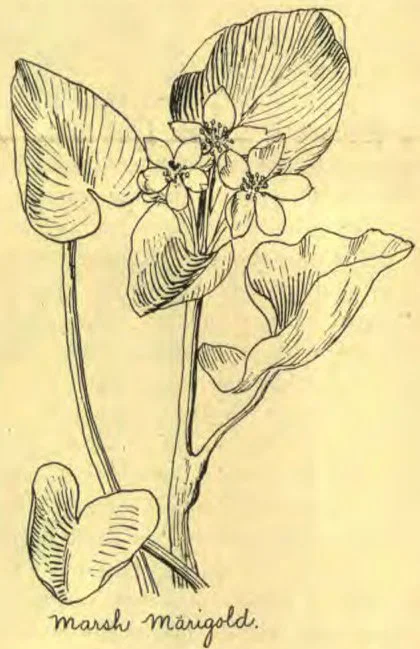
Marsh Marigold

DIFFERING widely from the larkspurs and the aconites, is the innocent Marsh Marigold, whose showy yellow flowers deck the marshes in spring. Doubtless nearly all who live near marshy places are acquainted with this plant, as it is usually common in such localities. It is often, but erroneously, called cowslip.
The stem, which is from one to two feet high, bears one or more rounded or somewhat kidney-shaped leaves, and a few flowers. Corolla absent. Calyx yellow, about one and one-half inches across. The flowers are followed by a cluster of pods, each containing many seeds. Let us examine one of these clusters carefully, and see what we can learn from it.
Each pod is a simple pistil, since it contains but one cavity, or cell. By opening the pod we find that it quite closely resembles a small leaf-blade with its margins turned inward and united to form a closed case, called the ovary. The line which corresponds to the united margins of the leaf is called the ventral suture, since it is always on the inner side, or the side which faces the center of the flower. The line on the opposite, or outer side, corresponding to the midrib of the leaf, is called the dorsal suture. The seeds are borne along the ventral suture. All simple pistils are formed on the plan of the one just described, while a compound pistil consists of a number of simple ones united.
Fruit of Caltha Palustris
One of the chief purposes served by fruits of all kinds is the development of seeds to produce new plants. It is therefore necessary that some provision be made for the escape of the seeds from the ripened ovary, and we find that this is provided for in various ways.
There are many fruits which do not open at maturity for the purpose of scattering their seeds. Such fruits are said to be indehiscent. Fleshy fruits, as apples and pears, stone fruits, including peaches, plums, etc., and many of the dry fruits, are of this class. Their seeds are liberated only by decay of the surrounding tissues, or by the various animals that feed upon the fruits.
Some fruits open in various ways, but without any regularity. Others split open along certain lines. Fruits of this class are said to be dehiscent. They usually contain several or many seeds.
The pods of the Marsh Marigold differ from those of leguminous plants, such as peas and beans, in that they open only along the ventral suture. A fruit of this kind is called a follicle. The peonies, larkspurs, and milkweeds have similar fruits.
The young plants of the Marsh Marigold are often boiled for “greens,” but care should be taken that some poisonous plant is not mistaken for this, as cases of severe poisoning have arisen in this way.

Paeonia Officinalis—Common Peony

The beauty and splendor exhibited by many members of the Crowfoot Family culminate in the magnificent peony, with its great, showy flowers of various colors, sometimes single, but often very double.
marsh Marigold.
marsh Marigold.
The leaves are large, ternately decompound, and the leaflets coarsely divided. Each stem bears but one flower, which opens in spring. The fruit consists of downy, leathery pods, containing many large, somewhat fleshy-coated seeds.
There are many species and varieties in cultivation, some having smaller flowers than Paeonia Officinalis, while others have very large flowers. Paeonia Moutan, the famous Tree Peony of China, is a shrubby plant two or three feet high, with flowers six or more inches across, and of various colors.

Questions

  1. Describe the Marsh Marigold.
  2. In what places does it grow?
  3. What is its character?
  4. What is a simple pistil?
  5. What is meant by the ventral and dorsal sutures?
  6. What is meant by indehiscent fruits?
  7. What are dehiscent fruits?
  8. What is a follicle? How does it differ from the pods of leguminous plants?
B. E. CRAWFORD.

El Hafed

Upon the banks of Indus long ago El Hafed dwelt, with modest wealth content. His orchard trees their weighted boughs hung low; His grain-fields caught the sunbeams’ golden glow; His money was for honest gain well lent; A gentle wife sat ’neath his rooftree’s shade, And happy children in his garden played.
There came one day, within his door to rest, A Persian priest, El Hafed’s countryman; And, as he entertained his welcome guest, The conversation, howe’er it began, Always on diamonds, ere it ended, ran. “One diamond, though no larger than your thumb, Would buy your fields and orchards, fair and wide,” The priest declared; “of many such, the sum Would make you lord of all the countryside.”
El Hafed listened long; and as he heard, His acres shrank; he felt that he was poor. To discontent his tranquil soul was stirred, Until his heart with envious longing burned, And all his slowly gotten wealth he spurned. And to the priest he said: “Now tell me where Others have found these gems in richest store, And I will journey far to seek them there.”
“Where rivers deep o’er beds of white sand flow, ’Twixt mountains high—there are the diamonds found.”
So spake the priest. In anxious haste to go, His host disposed of orchard, house, and field To one content with sure though moderate yield; And soon ’twas known through all the country round El Hafed to the diamond-fields was bound.
Long years he wandered, and in many lands; Looked on the pyramids, and later trod, Always with searching eyes and empty hands, The regions hallowed by the Son of God. He passed to Europe; where proud rivers flow ’Neath mountain crags crowned with eternal snow His quest he urged, in valleys far and nigh Sought vainly for the diamond’s flashing eye.
At last he stood by Barcelona Bay. Heart-broken, weary, hungry, bowed with care: Gazed long where sunlit waters stretched away, Whose calmness seemed to mock his own despair. “No more for wealth I long; but peace I crave,” El Hafed sighed, and sought it ’neath the wave; And the blue sea smiled on above his grave.
One day there came again the Persian priest, El Hafed’s countryman and former guest, And sat within the door to rest himself, And glancing idly round the room, espied A gleam of light from something on a shelf. “And has El Hafed then returned?” he cried, “With wealth to purchase all the countryside? Yon diamond’s flash betokens prosperous quest.”
But he who dwelt there calmly made reply: “That is no diamond; ’tis a stone I took From out the sand beside the garden brook. One day I led my camel down to drink; And, as I waited there upon the brink, This point of light flashed out and caught my eye; I had forgotten that I laid it by.”
Forth to the brook in haste the Persian came, Followed his host; and, as they stirred the sands Lo, other gems more precious than the first, Kissed by the sunlight, into splendor burst Or unresponsive lay within their hands. El Hafed’s garden held within its bound The wealth he sought afar, but never found. Its owner made himself an honored name, That still is read upon the scroll of fame.
Why “point a moral” when there is no need, Since ’tis so plain that “he who runs may read”?
—Susan E. Gammons, in Christian Endeavor World.

A Lesson from the Chicken-Yard

IN our back yard we keep a few chickens. When a hen hatches her brood of chicks, we put them all into a small coop by themselves. Thus they are easier watered and fed, as the coop is so made that the larger chickens can not get in to take all the food from the little ones.
Our greatest trouble is in the watering. We put the water into a small can, so that the little fellows can reach it. If we place the can outside the coop, the larger chickens soon upset it; if we nail the can fast, the water becomes foul; and if we put it inside, the hen upsets it. At last we arranged a sliding board in the front of the coop, which lowers upon the edge of the can, and holds it in place, thus preventing the hen inside from upsetting it, or the chickens outside from getting at it.
But there is one old hen which thinks that can must be moved inside, so that all can get a drink at once. To attain this result, she gets into it with both feet, and scratches it about, and upsets it, with the consequence that all go dry for a while.
Presently I am out looking after the little chickabiddies, and hear them “Peep-peep!” for a drink. I look in, and see that the can has been scratched off into an almost inaccessible part of the coop, upside down, and all the chicks dry. “You naughty old hen!” I say, “I gave you plenty of water only half an hour ago. I’ve a notion to let you go thirsty.” But no; I have compassion upon the suffering chicks and the careworn Biddie, and renew the water again and again during the day.
Daily there is drawn for us a precious draught from the “wells of salvation;” but often, in our efforts at self-help, we upset God’s plans for us, disdaining the offered water of life, and flurried, careworn, and thirsty, cry for help. Will God be less compassionate with his children who hunger and thirst after righteousness than I with the thirsty chicks?—No! He is more tender than the most loving earthly father, and his ear is ever open to the need of the least of his children.
E. L. PAULDING, M. D.

Luther Burns the Pope’s Bull

WHEN Luther nailed his theses to the door of the Wittenberg church, neither he nor anybody else had any idea whereunto this thing would grow. The pope, when news of the matter first came to him, laughingly treated it as the squabble of some jealous monks, and turned aside to his favorite pursuits. When the dignitaries of the church at length realized how great a fire this little spark had kindled in Germany, and how it was threatening to spread through all Europe, and destroy the vast edifice of papal claims, it was too late to quench it. Three years had passed since the posting of the theses. Luther had become increasingly bold in his opposition to the corruptions of the Roman Church, and the decision had been reached that he must be excommunicated as a heretic, and that all possible means must be used to secure his utter destruction.
But Luther was not at all daunted by these preparations. On the contrary, he was roused to more active and strenuous contest with the evils in the church, and with those who upheld these evils. Pamphlet after pamphlet from his busy pen issued from the press, each dealing heavy blows against his adversaries. Finally he determined to burn all his bridges behind him, and so to defy the papal power as to make it impossible that he should ever be forgiven. On the morning of Monday, Dec. 10, 1520, the following notice appeared on the bulletin-board of the University of Wittenberg:—
“All friends of evangelical truth are invited to assemble about nine o’clock at the church of the Holy Cross beyond the city wall. There, according to ancient, apostolical usage, the godless books of the papal constitutions and the scholastic theology will be burned, inasmuch as the presumption of the enemies of the gospel has advanced to such a degree that they have cast the godly, evangelical books of Luther into the fire. Let all earnest students, therefore, appear at the spectacle; for it is now the time when antichrist must be exposed.”
There were then nearly a thousand students at the university, and they, together with many of the townsmen, turned out to witness the promised spectacle. Near the church named in the notice was an open square, and during the recent visitation of the plague it had been the custom to burn there infected clothing and other articles. Here a pyre was built. Luther, dressed in the robes of a doctor of theology, solemnly placed on his pyre a number of books, including the Decretals, on which imprudent forgeries the power of the papacy had been built up, and the Canon Law, by which its authority was chiefly supported. A master of arts of the university came forward, and lighted the fire; and when the pyre was well ablaze, Luther threw into it the pope’s bull of excommunication, saying in a loud voice: “Because thou dost trouble the Holy One of the Lord, may eternal fire consume thee.”
In a book that many doubtless have read, “The Schönberg-Cotta Family,” after an account of this scene it is added: “Not a word broke the silence until the last crackle and gleam of those symbolical flames had ceased, and then gravely but joyfully we all returned to our homes.”
Just the contrary was what really happened. Those who have seen several hundred college students in New York or Philadelphia, celebrating a football victory, can imagine pretty well what was done. Doctor Luther and some of the sober citizens very likely returned home “gravely but joyfully;” but students of the sixteenth century were very much like those of the twentieth, and they broke into noisy and irrepressible demonstrations of rejoicing.
MARTIN LUTHER
MARTIN LUTHER
First they gathered about the pyre and sang dirges, and danced while the books were being consumed. Then it occurred to them that it was a pity to have only one bonfire, where material was so abundant, so they scoured the city for books written by Luther’s opponents, and finally collected a wagonful. These they brought to the square, where they were burned with all the fantastic exercises that the ingenuity of the students could suggest. So uproarious were the students that on the following day when he delivered his university lecture, Luther felt constrained to administer a public rebuke.
For to him, and to all who realized the gravity of the occasion, this was no frolic, but a solemn religious ceremony, and at the same time a declaration of war against the greatest power in the world. It was an announcement that the Reformation could not be stopped, indeed, that it must go much farther. And at no hour in Luther’s life does he appear to better advantage, never did his courage seem higher, never did he so unmistakably stand forth as the hero of the German nation, as on the day when, by this significant symbol, single-handed, he defied the powers that were gathering to crush him.—Selected.

A Tedious Job

Whenever a new United States treasurer is appointed, all the money in the Treasury has to be counted afresh. If this were not done, the new incumbent could not give his receipt in full for all the cash in Uncle Sam’s coffers, as he is obliged to do. The silver is reckoned by weighing it, while the gold coin is counted. The paper money is likewise counted, every bit of it, all of the bundles being opened, and duly resealed after ascertaining that the contents are correct as represented by the label on the outside.
The counting is a tremendous job, occupying sixty experts for two or three months. Nearly always it has come out exactly correct, but one of Mr. Roberts’s predecessors was obliged to refund three cents that was missing, and in another case nineteen dollars had to be made up by the treasurer, some weeks elapsing before the lost dollars were swept out of a corner of a vault.—René Bache, in the Christian Endeavor World.

Playing With Temptation Will Never Conquer It

PLAYING with temptation will never conquer it.

Battles Between Truth and Falsehood

STUDY PREPARED FOR THE YOUNG PEOPLE'S MEETINGS

Lesson XXIII—God Rules

(October 12-18)
How to Study These Lessons.—(1) Read the lesson story; (2) try to recall or find scriptures in proof of each statement; (3) study the texts; (4) see how many missing links you can supply; (5) give the lesson to some one else. You will keep only what you give away.
In the long struggle between Christ and Satan, our Champion has always been the victor. Not once has Satan triumphed. Sometimes it might seem, for a while, that the prince of evil was having things his own way; but God has made all things work to the good of his children, and the glory of his own name.
As god and prince of this world, Satan claims the power and right to set over the nations the men of his choice; but he has never succeeded in placing on the throne any other than the man of God's choosing.
God “raised up” the cruel and unprincipled Pharaoh, to the throne of Egypt. He was one of Satan's servants, but he was compelled to do service for the great Ruler. Like Satan, his master, he could do nothing against the truth, but must work for it.
When God can use them best, he sets up the basest of men as rulers; but when they no longer serve his purpose, Satan is powerless to keep them a moment on the throne.
In the days of Daniel, God gave the dominion of the earth to Nebuchadnezzar, king of Babylon. This man finally yielded to God, and was used to send a knowledge of the true God to all peoples.
Succeeding kings failed to carry out God's purpose, and were removed. When Babylon could no longer be used to his glory, God gave the dominion to Cyrus the Persian.
Cyrus did not know God, but God knew him, and called him his servant a hundred years before Cyrus was born.
All down through the ages God has arranged the nations and their rulers with reference to the best good of his children. And just as truly as he ruled in Babylon, Persia, and Rome, just so surely is he ruling in England, China, and the United States.
We shall see this more fully in succeeding lessons.

Outline

In the first battle Christ was victor. Rev. 12: 7-9.
All things work for good to God's children. Rom. 8: 28.
God sets up kings, and all rulers. Dan. 2: 20, 21; Ps. 75: 6, 7.
He sometimes exalts the worst men. Dan. 4: 17.
God raised Pharaoh to the throne. Rom. 9: 17.
God gave the earth to Nebuchadnezzar. Dan. 2: 37, 38; Jer. 27: 5, 6.
Cyrus was God's servant, though he knew it not. Isa. 44: 24–28; 45: 1–4.
We plead with God for a perfect kingdom. Matt. 6: 10.
In the days of the present intermarried kings, we shall see the answer. Ps. 2: 1–12; Rev. 11: 15; Dan. 2: 44.

Notes

As the purchase of the blood of Jesus, every man is dear to God. God overrules to place each person in the best position to be saved. God loves every person, whether slave or ruler.
Neither men nor demons can do anything but good to God's children. They may intend to harm them, but God overrules it, and makes it work for them, instead of against them.
God is power.
God is wisdom.
God is love.
Not until his power, wisdom, or love can be successfully impeached, can anything but good come to God's children.
Every person is free to choose whether he will serve God or not. But if we choose not to serve him, he will make our evil deeds to praise him. To the proud sea waves God says, Thus far, then stop; to the wrath of man or demon he commands, As far as it will glorify me, but no farther. Ps. 76: 10.
Every child of God is surrounded by a charmed circle, that no power in earth or hell can break. No knife is sharp enough to cut through it; it can not be pierced by the most powerful cannon; not even a frown or a harsh word can enter this circle, unless God opens the “hedge,” and lets it in. And when he does this, it is because the intended harm will be the greatest blessing. Ps. 32: 7; 34: 7; Job 1: 9, 10; Ps. 27: 1-5; 31: 20; 3: 5, 6.
Never did Satan plan a more Heaven-daring sin than when he led Herod, Pilate, and the chief priests to condemn and put to death the innocent Redeemer; but never did he so fully work for the glory of God and the good of his children. Acts 4: 24–28.
As surely as we connect with the conquering Jesus, we shall be continual victors. He causes us always to triumph. We are more than conquerors through him that loved us. Do you have this experience? If not, why not? Surely it were a shame and a pity to be beaten by a conquered foe. 2 Cor. 2: 14; 1 Cor. 15: 57; Rom. 8: 37.

Among the Young People in Ontario

During the six months that I have worked in Ontario, my efforts have been directed chiefly toward arousing and strengthening the interest to educate our children and youth. Children, youth, and parents showed their interest by uniting to sell as many of the “Object Lessons” as possible, hoping to see their industrial school started this fall.
In this field there are about one hundred youth who should be receiving a training for God’s work. A few realize the need of this training, and anxiously await the opening of a school where they can get it. More do not realize the need, and require a work done for them at their homes, to show them its vital importance. If encouraged and wisely directed, the Young People’s Society work might be the means of doing this for these youth.
With this object in view, I advised the Sabbath-school and church officers to encourage the forming of Young People’s Societies, and assist the youth to make them what these societies should be. In April a society was organized at London, and has since held weekly meetings with some good results. In July one was started at Belleville, which I trust is doing good work. I believe our youth in Toronto have also organized. I encouraged these young people to take up studies on the Rise and Progress of the Message, Our Missions and Other Missions, besides the regular INSTRUCTOR lessons. The London Society has begun this work, having a mission study one week and a Bible study the next. I hope other societies will follow their example, and that all will keep at it.
At our June camp-meeting it was my privilege to conduct meetings for the young people. Before camp-meeting closed, with but one or two exceptions, all acknowledged themselves children of God, some giving their hearts to him for the first time, and several were baptized into Christ. Dr. Paulson was with us two days, and his heart-searching words and work inspired all to a better life.
It would be hard to find more intelligent young people anywhere than those of Ontario. My constant prayer is that God will inspire them with a sense of their possibilities and opportunities. Here is a text that inspires me: “One thing I do, forgetting the things which are behind, and stretching forward to the things which are before, I press on toward the goal unto the prize of the upward calling of God in Christ Jesus.” R. V.
JOEL C. ROGERS.
Continue reading: Mission Notes