The Youth’s Instructor, Vol. 37, No. 5.

THE EARLY USE OF COAL

The Youth’s Instructor

Jan 30, 1889

S. D. A. Publishing Association · Battle Creek, Mich. · Jan 30, 1889

THE EARLY USE OF COAL.

Two or three months ago, a series of articles on the nature of coal, and the process by which it is mined, were commenced in the INSTRUCTOR, but were discontinued through sickness and other causes. We are glad to be able to resume them now, hoping to follow the uses of coal into its various industrial connections.
Coal was first employed for general purposes in England. As long as timber was plentiful in that country, no one thought of using coal, although its presence was well known. But in the fourteenth century, the people of Edinburgh began a limited use of it. Learning this, the land-owners of Newcastle, under whose lands were large deposits of the mineral, tried to get a charter from the government, giving them the sole right of mining and selling the “coles,” with which they were so plentifully surrounded.
But about the same time a great prejudice arose against its use, and but little was bought or sold for a long time. The people declared that the fumes of the burning coal were poisonous, and would certainly cause a pestilence in any neighborhood where it was used. Upon this, King Edward issued a proclamation, sternly prohibiting its use to all but those engaged in manufacturing. Some buildings from which the dreaded coal-smoke was seen issuing were pulled down, with the sanction of the king.
These strange proceedings will not be so much wondered at, if we call to mind that, in those days, instead of having chimneys in which to carry off smoke, fires were built on “hearthstones,” and the smoke from them curled about the heads of the inmates, before finding its way out of the house through cracks and crevices, or through doors and windows, as they chanced to be opened.
Of course this was not pleasant to endure, so houses had to be altered to admit the building of chimneys. But even after that, so we learn from Mr. Stowe, prejudice against the use of coal was so strong that “nice dames of London” would not enter a room where it was burning, nor eat meat roasted by its fire. And so late as the days of Queen Elizabeth, it was forbidden to be used during the sitting of Parliament, lest its fumes should affect the health of the country members, who were only accustomed to the use of wood or charcoal.
But as the number of people increased, and the forests were cut down, it was found that coal fires must be endured. It was learned, too, that coal was a very necessary article, and that its use did not kill off the inhabitants as fast as was expected. Still, it was only after the invention of steam power, and the introduction of gas for lighting purposes, that the demand for coal became as great as we now see it. Then mines were opened in every direction in England, and an immense and profitable coal trade was developed in our own country.
The contrast in the coal business between our time and that of two centuries ago is wonderful. Then just a few tons of coal were annually taken from the few mines opened, and this was carried on pack-horses to ships or to purchasers. Now, in every part of the world, millions upon millions of tons of coal are produced, and used on railroads, in making gas, in steam navigation, in mining operations, and for all kinds of manufacturing purposes, as well as for the comfort of the household. In fact, it would be hard to find anything to take the place now filled by this once almost valueless mineral, which underlies so much of the earth’s surface.
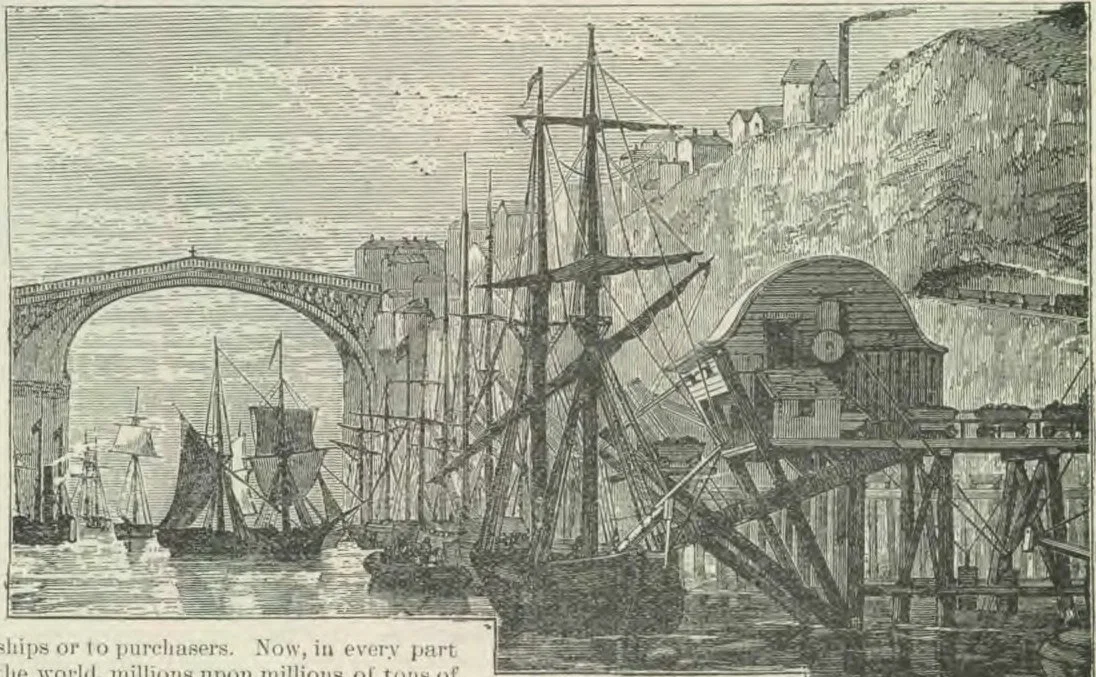
The cut accompanying this article represents a coal mining town, with the conveniences for loading coal-trading vessels. The car loads of coal are seen standing on the bridge, which has been built much higher than the deck of the vessel. By this means a long spout reaching from the bridge to the vessel allows the coal to pass rapidly down its length into the vessel. At Elizabethport, in our own country, these spouts, or shoots, as they are called, are so placed that one end of them reaches up under the center of the loaded car, and connects with a trap door. This, at the proper time, is allowed to drop, and the entire car load of coal slides into the shoot, and through it on board the vessel.
The whole operation takes but a few moments, when the empty car is pushed aside, and another quickly takes its place, and in the same way deposits its load on the ship. In this way only a few hours are consumed in loading a large vessel, when it looses its moorings, and puts to sea. Its place is quickly taken by another vessel, which has been waiting its turn, and which is soon disposed of in the same way. Thus business is kept up at the “coaling slips” during the entire year.
J. O. C.

Meyer Anselm Rothschild: An Honest Start in Life
whom Wilhelm, Landgrave of Hesse, exclaimed in his enthusiasm, “Such honesty never has been known in this world!” Not only was Meyer Anselm poor, but he belonged to the then despised and persecuted race, the Jews. Living in this later day, when much of the hatred and prejudice felt against the Jews has given way to more just and liberal sentiments, we can hardly understand with what extreme contempt and loathing they were treated in young Anselm’s day. As a specimen of it, however, we read that in Frankfort-on-the-Main, the city where he was born, the Jews were so detested by the other inhabitants that they were compelled to live in a certain quarter which was shut in by gates. During the day they might go about, but at night they must all retire to their own quarter, and there the gates were locked, so that they should not venture out again until morning. If by any chance a Jew was found outside the “Judengasse” after a certain hour, he was put to death. Think what chance a poor little lad like this had of becoming one of the wealthiest and most distinguished personages of his age! Yet he did it, and that, too, by no other means than behaving with the utmost uprightness and honesty.
To add to his other misfortunes, young Anselm found himself at the age of eleven an orphan. Now his prospect was darker than ever; for the Jews are nearly always kind to their children, and do all that they can to give them a start in the world. In some way or other, however, he secured some little education, and as a young man we find him employed in a banking house in the town of Hanover. He was in no hurry to go into business for himself, as so many young men are, so it is not until he is in his thirtieth year that we find him back in Hanover, established as a broker and a money-lender, with red shield (Rothschild) as a sign hung over his shop. Here he did an excellent business, establishing the reputation for honesty that led to his good fortune. Yet all his dealings were not in prosaic stocks and bonds and other securities representing money; he found time to interest himself in what we now call “numismatics,” and finally he became known as a dealer in, and one of the best authorities upon, rare and ancient coins. Among his customers for these was Landgrave William of Hesse. American boys will remember this William, the Elector of Hesse, as he afterwards became, as the ruler who hired his soldiers to the king of Great Britain, who sent them over here to help his red-coats fight against us in the war of Independence. Not all the soldiers of King George, I think, caused such dismay among the simple farming folk in our New England valleys as these bearded Hessians, with their strange German speech. But a terrible calamity was in store for William of Hesse. Napoleon’s armies invaded his land, he was driven from his high place, and all his great wealth pronounced forfeit to the French crown. In his despair he placed all the money he could gather (it amounted to over a million dollars) in the hands of the honest banker Anselm for safe keeping.
We all know the story of Napoleon’s terrible downfall, how the allied armies crushed the great warrior, and Europe began to draw breath, and hope for rest and peace and security after her terrible experiences. The Landgrave of Hesse returned to his home. What was his astonishment when, a few days later, the eldest son of Meyer Anselm presented himself before him, and placed in the astonished ruler’s hands more than a million and a half of dollars, this being the amount to which the original sum intrusted to his father had been increased through judicious care and profitable investment! Do you wonder that the astonished Landgrave uttered the exclamation quoted at the beginning of this sketch? In his delight he knighted the young man at once, and for a long time his principal subject of conversation was the honesty and integrity of the banker. Of course his fame grew. People having money to invest were one and all anxious to place it in his hands. Soon he became the accredited agent of governments having loans to place, and from a simple German banking house the firm opened branches in several of the great cities of Europe. So enormous is the amount of business done, and the influence exerted by the Rothschilds, that it is currently said of them that on two or three occasions they have successfully exerted themselves to preserve the peace of Europe. Their house now has its establishments in London, Paris, Vienna, and Frankfort, and its agencies in New York and other great cities in both hemispheres. Their name is now a synonym for wealth, as in earlier days it stood, and still stands, for fair dealing.
What finer illustration could we have of the grand old adage that, “honesty is the best policy”? What a very simple matter it would have been in that time of panic and confusion for Meyer Anselm to have retained, or at least made an unfair accounting of, the sum William had secretly placed in his care. Not so; he returned to his sovereign all he had given him, and all that had been won by its skillful management while in his hands. His reward was enduring fame, and the largest fortune ever in the possession of a single family.
Surely this is not an unjust world, or one where integrity and patient well-doing are not rewarded, when simply through honesty and hard work, young Meyer Anselm, of the Judengasse in Frankfort, may rise to the position occupied by the Baron Rothschild.—Harper’s Young People.

EVEN FOR US.

“WHITE little lambs, when the snowflakes fall, And up and down the harsh winds call; When fields have turned from green to brown, And trees have lost their leafy crown,— Where will you go? what will you do? Poor little lambs, I pity you!”
“Fair little child,” a voice replied, “Even for us He will provide.”
“Dear little birds that with us stay, When all your mates have flown away, How will you brave the icy storm? No downy nests will keep you warm. I’ve seen your footprints in the snow, What will you do? where will you go?”
“Ah! little child,” a song replied, “Even for us He will provide!”
White little lambs, dear little birds, What joy is in those hopeful words! Though dead leaves through the forest sweep, And brooks have sung themselves to sleep. A trusting heart shall still be mine, And never shall these lips repine! God’s children, in his world so wide, For you, for me, he will provide!
—George Cooper.

THE FOUNDER OF THE HOUSE OF ROTHSCHILD.

Few boys ever started in life under more unfavorable circumstances, and with less prospect of fame and fortune than Meyer Anselm, the founder of the great banking house of Rothschild, and the man of

RICHES AND POVERTY.

Not many years ago, there lived a young girl who was exceedingly fortunate.
Her home had massive walls and towers, with a great dome, beautifully ornamented, through which the light came with ever-changing effects. She had a large fortune, and among her jewels were a golden crown that no one could imitate, and a very large diamond and a great many smaller ones. There was, besides, a great gold locket with a picture in it; while she had more pearls than she could use.
Surrounding her home was an immense park that abounded in wild game and beautiful trees and flowers. Every one who came to see her brought a precious gift. Some even brought her everything they had to give. Every year she took a long journey, and saw the most beautiful sights. Her traveling trip never tired her in the least.
Would you not like to have been in the place of this fortunate young girl?
In that same locality there lived a girl who, you will think, had a hard time of it.
She lived in a log hut in the woods, and dressed in coarse clothes. She had to work hard, for her mother was ill a great deal of the time; and as she was an only child, a large share of the household duties fell to her. Then every day she had to search the woods for their cow, and milk her; and in their season she had to gather blackberries and raspberries and blueberries to help out their scanty supplies. Would you not dislike to have such a fate? How much you would rather live like the first girl I spoke of! But what would you say if I should tell you they were both one and the same person? Let us see how that may be.
The massive walls and towers of which I spoke were the grand, high mountains around her valley home; and the great dome was the sky, which was just as much hers as though it had been created especially for her. Her great fortune consisted of youth, health, sunshine, pure air, good looks and good nature, flowers and fruits, and a thousand and one of the best things of this world.
That golden crown you will guess to have been her beautiful golden hair, of which I am afraid she was a little vain. Her diamonds were the sun and stars, and she never worried for fear they would be stolen. Her golden locket was the moon, and the picture the one we all can see in it. Her pearls were dewdrops; the precious gift that every one brought was love, and this she well deserved. The long journey she took every year was the wondrous journey around the sun to Springland, Summerland, Autumn, and back to icy Winter. Every night revealed new glories in the heavens; every morning brought renewed life and health.
Now, if you wish a moral to my story, search carefully, and perhaps you may find it.—St. Nicholas.

The Bible: Languages and Division of Scriptures

THE BIBLE.—NO. 3.

Last time I told you that the men who wrote the Bible did not write in English, because that language was then neither written nor spoken. The Bible was written in the Hebrew, the Aramaic, and the Greek.
The Jews divided the Old Testament into twenty-two books, or parts, by combining some of the smaller books into one book. These twenty-two books they divided into three general parts, called the Law, the Prophets, and the Scriptures.
The word “scriptures” means “writings.” In the New Testament the word applies often to the entire Old Testament writings. Jesus told the Jews to “search the Scriptures,” for they testified of him; that is, the prophecies of the Old Testament pointed to him as the Saviour of mankind. John 5:39. When the apostles went to preach the gospel in a certain place, the people searched the Scriptures every day to see if what these men told them was true. Acts 17:11. This was right. We should search the Bible carefully to know what the Lord would have us do.
Timothy, a minister of Christ, from a child knew the Holy Scriptures. 2 Tim. 3:15. I wish every young person would follow this example, and study the Bible diligently, in order to know it as thoroughly as did Timothy. These three places I have referred to—John 5:39, Acts 17:11, and 2 Tim. 3:15—all show that the word “scriptures” means the Old Testament; for when Timothy was a child, the New Testament was not written. The same can be said of the time when Jesus and the apostles taught the people.
Of the three parts into which the Jews divided the Old Testament, I spoke of the Law, the Prophets, and the Scriptures. The Law was composed of the first five books of the Bible. This part was called the Law because in it we have the account of the giving of the ten commandments on Mount Sinai, and because the other laws that regulated the worship of the Jews, as the sacrifices to be offered, and the laws that governed them in other things, are all particularly laid down in these books.
The books of the Prophets were twenty-one in number, and instructed the people in their present duties and in things to come.
The last division, the Scriptures, was composed of Psalms, Proverbs, Job, and ten other books. So these three divisions were made up of the thirty-nine books of the Old Testament, the same as at present.
The New Testament has twenty-seven parts, or books. Matthew, Mark, Luke, and John are the first four, and are called the Gospels, because they contain the good news of the salvation Christ brought to the world, telling us of his birth, his words, how he comforted and helped people, of his death, and of his coming to life again. These Gospels are four different accounts, or histories, of Jesus while here on earth. The book of Acts tells what the apostles, those men sent by Jesus to preach his gospel, did as they went among the people declaring that he was the Saviour, and that men ought to believe in him.
The Epistles are the letters the apostles wrote to the different churches they had raised up. The letters instructed these Christians in various things, and warned them of their sins.
The book of Revelation, the last one in the New Testament, was given by Jesus himself to John, one of the apostles, while on a desolate island, to which he had been sent by a wicked ruler because he was a Christian. In vision Jesus revealed to John the wonderful things the book speaks of. He tells of many great events to take place from the time John was shown them, till the second coming of Christ and the end of the world. Many of these things have come to pass already; indeed, the most of them have, and Jesus soon will come. Let us all strive to be prepared for him when he comes.
N. J. BOWERS.

A BOY HERO.

There was a boy whom we will name Luke Varnum. He was fifteen years old, and he was lame of his left foot. So when every other boy in No. 5, and every man, old and young, shouldered his firelock, and marched off to join General Stark and go and fight the Hessians at Bennington, Luke was left at home. He limped out and held the stirrup for Lieutenant Chittenden to mount, and then he had to stay at home with the babies and the women. The men had been gone an hour and a half when three men galloped up on horseback; and Luke went down to the rails to see who they were.
“Is there anybody here?” said one of them.
“Yes,” said Luke, “I am here.”
“I see that,” said the first man, laughing. “What I mean is, is there anybody here who can set a shoe?”
“I think I can,” said Luke. “I often tend fire for Jonas. I can blow the bellows, and I can hold a horse’s foot. Anyway, I will start up the fire.”
So Luke went into the forge, and took down the tinder-box and struck a light. He built the fire and hunted up half a dozen nails which Jonas had left, unintentionally, and he had even made two more, when a fourth horseman came slowly down, on a walk.
“What luck,” said he, “to find a forge with a fire lighted?”
“We found one,” said Marvin, “with a boy who knew how to light it.”
And the other speaker threw himself off the horse meanwhile. And Luke pared the hoof of the dainty creature, and measured the shoe, which was too big for her. He heated it white, and bent it closer to the proper size.
“It is a poor fit,” he said; “but it will do.”
“It will do very well,” said her rider. “But she is very tenderfooted, and I do not dare trust her five miles unshod.”
And, for pride’s sake, the first two nails Luke drove were those he had made himself. And when the shoe was fast, he said,—
“Tell Jonas that I heat up the forge and put on the shoe.”
“We will tell him,” said the colonel, laughing, and he rode on.
But one of the other horsemen tarried a minute, and said,—
“Boy, no ten men who left you to-day have served your country as you have. It is Colonel Warner.”
When I read in the big books of history how Colonel Warner led up his regiment just in time to save the day at Bennington, I am apt to think of Luke Varnum.—E. E. Hale.

DO YOU WORK?

Did you ever know a great man or a successful man who did not work? Very clever people are sometimes indolent, but they never do great deeds, or identify themselves with the great things of life.
The boy who starts out in his career in pursuit of a “soft snap” in the way of a situation never gets very far up the ladder of life. He may have had a good deal of natural ability to begin with, but of what avail is natural ability to the boy who won’t work?
I once knew of a boy who went away from home to fill a situation in a store, secured him by a relative.
At the end of a couple of weeks, the boy wrote home to a schoolmate:—
“I tell you, Will, I’ve got a soft snap here, and do pretty much as I please. I don’t get down town till after the other clerks, and the boss don’t say beans about it. I set back on my dignity a good deal, and let the other fellows do most of the work, and they are chumps enough to do it. It takes me to pull the wool over their eyes.”
There was a good deal more of the letter in the same vein, but it was the last one the accomplished boy wrote from that store; for he came home a day or two later, informing his friends that the place “didn’t suit him.”
The fact was, that he had been politely but tersely informed that his services were no longer needed.
I don’t know anything about his career after that, but I think I can easily forecast his future, and the future of all boys who have this abominable “soft-snap” idea too greatly developed.
There are no “soft snaps” in the real successes of life, and when you hear of a successful man, you can set it down that he has been a worker.—Exchange.

John Wesley on Fretting and Cursing

JOHN WESLEY said: “I dare no more fret than curse or swear.”

A PAPER HOUSE.

We often hear men in carts calling, “Rags!” “Old iron!” These men collect all the rags they can find, and send them to buildings called paper-mills, that stand by rivers.
There they are boiled into paste, and spread out very thin. When dry, it is paper.
When we hear wasps humming, perhaps they are getting wood instead of rags, for tiny pieces of wood and bark are what they pick up. Then their jaws put these pieces into little mills in their mouths; there it is made into a paste.
Then the wasps fly under the eaves of a porch or other building, and spread out this paste. As soon as it dries, it looks like paper. That is what a number of wasps did one summer in my porch. Out of this paste they built a paper house. It was the shape of half an egg, and as large as a cabbage.
Inside of this house were three stories, hung together with wax. In each story were dozens of little rooms called cells, in each of which they placed an egg. One day the eggs opened, and in them the wasps saw baby wasps, which were wrapped up in folds of silk. As they did not have any legs or wings, they remained in the small rooms, while the old wasps went hunting. They killed tiny bugs, and ate part of them; then, after taking a drink of honey from the flowers, and a taste of berries, they returned home, and fed their babies on the juice of what they had eaten. The baby wasps did not want to eat at a certain time, so the old wasps placed a white cap over each of their heads, and left them to sleep. While they were sleeping, their legs and wings grew. When they awoke and took off their caps, they flew out into the sunshine, and drank honey from the flowers.—Nina Stevens Shaw.

LITTLE BY LITTLE.

WHEN Charlie woke up one morning and looked from the window, he saw that the ground was deeply covered with snow. The wind had blown it in great drifts against the fence and the trees. Charlie’s little sister Rosey said it looked like hills and valleys. On the side of the house nearest the kitchen, the snow was piled higher than Charlie’s head. Mamma said she did not know how Aunt Patsey could get through it to bring in the breakfast.
“There must be a path cleared through this snow,” said papa. “I would do it myself, if I had time. But I must be at my office early this morning.” Then he looked at Charlie. “Do you think you could do it, my son?”
“I, papa! Why, it is higher than my head! How could a little boy like me cut a path through that deep snow?”
“How? Why by doing it little by little. Suppose you try; and if I find a nice path cleared when I come home to dinner, you shall have the sled you wished for.”
So Charlie got out his wooden snow-shovel, and set to work. He threw up first one shovelful, and then another; but it was slow work.
“I don’t think I can do it, mamma,” he said. “A shovelful is so little, and there is such a heap of snow to be cleared away!”
“Little by little, Charlie,” said his mamma. “That snow fell in tiny bits, flake by flake, but you see what a great pile it has made.”
“Yes, mamma; and if I throw it away shovelful by shovelful, it will all be gone at last. So I will keep on trying.”
Charlie soon had a space cleared from the snow, and as he worked on, the path grew longer. By and by it reached quite up to the kitchen door. It looked like a little street between snow-white walls.
When papa came home to dinner, he was pleased to see what his little boy had done. Next day he gave Charlie a fine blue sled, and on it was painted its name, in yellow letters, “Little by Little.”
The boys all wanted to know how it came to have such a name. And when they learned about it, I think it was a lesson to them as well as to Charlie.—Our Little Ones.

LEGGINS AND MOCCASINS.

Old Tiger lived in a dismal swamp down in Florida. He was very old, as you might think from his name, but not so fierce as his name would imply. He was, indeed, a very gentle old man, though in his younger days he had been a great fighter.
The white people wanted the land he lived on, and he fought to defend it. The war lasted seven years, and in the end the strangers drove Old Tiger into the swamp, where he lived when I saw him. He was very brave, and his people made him a chief. He had killed a great panther once, with his knife, and from this fact his Indian brothers gave him his name. They call the panther a tiger. It sometimes kills their cattle.
What has Old Tiger got to do with the leggins and moccasins? Just this; he made them.
One day, hungry and very tired, I reached the little Indian village where Tiger lived. He was sitting in his doorway, smoking deer-skins. After the Indians kill a deer, they strip off his skin and prepare it so it is soft and nice. After tanning it, they rub it over a log till it is very soft, and then smoke it over a little fire of leaves in a hole in the ground. This is what Tiger was doing when I reached his hut. He didn't even look up when I spoke to him, but grunted out, “Howdy?”
He meant to say, “How do you do?” but it was too much trouble to say the whole of it.
“Take seat,” he said.
I sat down and watched him; and then I thought how nice it would be to have my Indian friend make me something from the deer-skins. So I said to Tiger, “What can you make me from those skins?”
“Make moccasin, make leggin,” answered he.
Then I told him to make me a pair of leggins and a pair of moccasins.
“Sticky out um foot,” he grunted.
I put out my foot, and he wrapped a skin around it, cut it here and there with his sharp knife, and then did the same with the other. Cutting a slender strip from one of the skins, he rolled it up into a cord, and sewed them up in a very few minutes.
“Want um leggin?”
“Yes, certainly.”
At this he drew a skin around my leg, and marked the size of it with his knife. With a long thong he sewed it up on one side, commencing at the top and running the skin thread the whole length of the leg. Another was made to match it; and then I had a pair of Indian leggins and shoes, all made in less than half an hour.
“S'pose want um look good, hey?”
“Oh, yes,” said I, “make them look nice.”
With his knife he then cut the edges of the leggins so as to make a kind of fringe at the sides and bottom. Having done this, he held out his hand,—“Gi' me dollar.” I gave him the dollar, and he went on with his other work. The moccasin, or deer-skin shoe, is the only kind the little Indian child ever wears. These shoes are sometimes prettily ornamented with colored beads, and then look very gay. The moccasins I had made were only for hunting in, to use in the woods, and were much better without ornament.—Frederick A. Ober.

THE BETTER WAY.

So many letters in the Budget close up with, “I am trying to be good, so I can have a home in the new earth,” or, “I want to be good, so I can be saved,” that I thought I would like to talk with you a little, to see just what you mean by these words, or, if there are not other words that will tell it more nearly as it is.
It is all right to want to be good, and to want to be saved, but it is ever so much better to try to be good; and indeed you never can be saved unless you do try your very best to be good. But it is true, too, that if any of you are ever saved, it will not be on account of your own goodness.
Do you think that is queer reasoning,—that you cannot be saved unless you try to be good, and yet that none will be saved on account of their being good?
Let us see. It was for one sin that Adam was driven out of the garden of Eden, and that meant that he had lost his right to heaven. And you, too, whether you have committed many sins, or only one sin, have lost your right to heaven; and though you should do just as nearly right as it is possible for one to do, all the rest of your life, it will not mend that broken place in God’s law.
We are to be judged by the law, and it requires us to be perfect all the time. We can never be good enough to get some credit to apply on an old debt of sin. No matter how good we are, those sins of the past rise up to condemn us.
Do you wonder, then, who can be saved?
Well, a merciful God, just because we could not be good enough to meet the demands of his perfect law, sent One who was perfect, who had never sinned, to pay the debt for us. You all know that it was Jesus Christ who did this. He took our sins upon himself, making it as though we had not sinned. If he had not been perfect, he could not have done this.
Then how is it that we are to be saved? We have broken God’s law, which requires us to be perfect. There is no one who can pay the debt but Christ. First, we must be sorry for our sins; then we must confess them to God, and to any one we may have injured; and if we are truly sorry, we can believe that God, for Christ’s sake, has forgiven them, and that the Saviour has made it right between ourselves and God on account of his broken law.
Can we then go on and sin more and hope to be saved?—No, it is only by lovingly obeying the best we know how that we can keep Christ’s favor.
Then don’t you think it ever so much the better way to say, “I want to be good all the time to please my dear Saviour, who saves me from my sins”? or, “I am trying to be good to please him who has done so much for me”? or something of that kind? How much better it is to do right because it is right to do so, and because it pleases that dear Friend who left his beautiful home in heaven to make a way for us to go and share it with him! Oh, let us be his loving, obedient children every day, and be careful not to grieve him by our naughty ways, then I think we shall give more unselfish reasons for wanting to be good.
M. J. C.

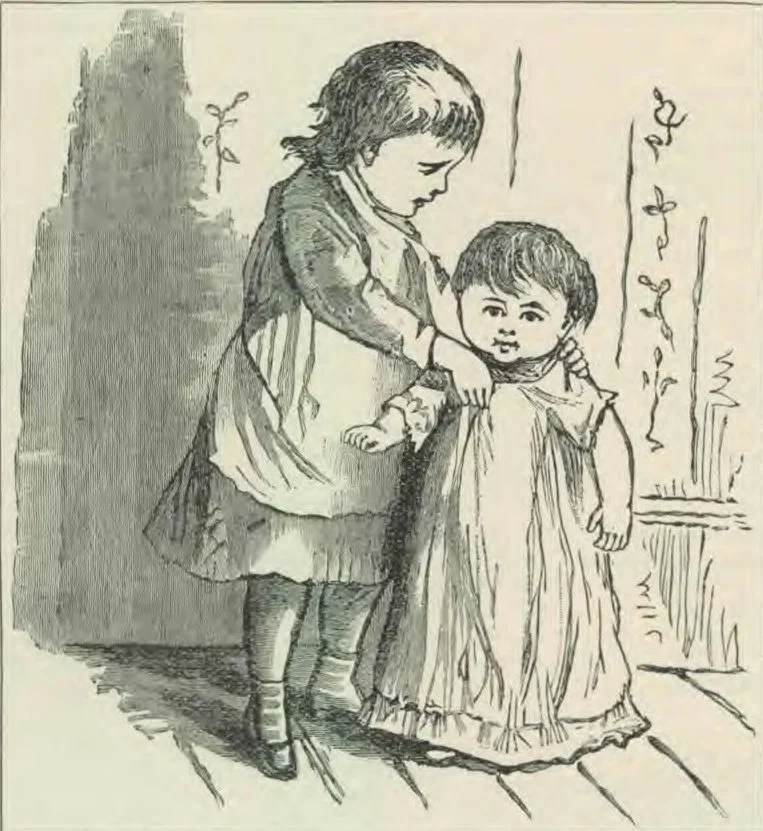
A TROUBLESOME COMFORT.

He's sort of a bother when we want to play, The Baby. He's sure at the wrong time to get in the way, The Baby. He always will tell when we play hide and seek. The place where we've hidden, by coming to peek, No matter how much he's been told not to speak! The Baby.
He always wants things that he ought not to eat. The Baby. Especially everything sticky and sweet. The Baby.
Sometimes I feel ready to run quite away, And wish that in some place a year I could stay, Where he could not spoil any hours of the day. The Baby.
Yet that's rather long not to see him,—a year, The Baby. To think of it once makes a person feel queer: The Baby.
Although it's a bother to hunt for his ball, And pick him up after his fortieth fall, I guess I do want him around, after all. The Baby.
—Clara Louise Burnham.
Continue reading: OLD TESTAMENT HISTORY