The Youth’s Instructor, Vol. 63, No. 50.

Biblical Word Picture—A Carousel in a Palace

The Youth’s Instructor

Dec 14, 1915

Review and Herald Publishing Assn. · Takoma Park Station, Washington, D. C. · Dec 14, 1915

Biblical Word Picture—A Carousel in a Palace

THE night is about to come down on a great city. The gilded towers and gates of brass glitter in the splendor of the setting sun. The streets and squares are lighted and thronged with people. The doors of theaters and galleries of art are open. Scenes of mirth and riot are on every hand, for it is a godless city. Chariots rage in the streets, and there is to be a royal feast in the palace of the king. Ladies dressed in silks and decorated with jewels are escorted into the banquet hall.
The picture of the scene in the banquet hall is one that appeals to the senses. The richest food is on the table. The cups are of burnished gold, and silver baskets are laden with the choicest fruit. Richly chased decanters foam with red wine, and gorgeous banners float on the perfumed breeze. The windows are open into a garden in which are fountains of ivory and statues of marble. The cry, “O king, live forever!” is heard, and wine cups are drained, decanters rattle, and wild laughter bursts from the lips of princes.
Another act in the drama: A moving picture on the wall. A hand appears, and writes strange words that no one can read. The music stops. A strange silence rests upon the assembly. Goblets fall from trembling hands, and hundreds of voices cry, “What is it? What is it?”
The next scene: A modest-looking man stands before the king. The words he utters send a thrill of horror to every heart, for they are prophetic. Death comes in with the rush of a great army. Torn banners, dead men and women, broken wreaths and dishes, upset tankards and overturned tables, are everywhere. The king is dead.
Who was he? What was the writing on the wall? Who read it? Who captured the city? What was the name of the city? What was the name of the river on which it was built? Why was the city destroyed? ELIZA H. MORTON.

Porcelain Clay Found

NEWS has been sent to the Bureau of Foreign and Domestic Commerce, at Washington, D. C., that the war is not to cause a doll famine in the United States next Christmas. Thousands of dolls made in Germany and intended for American children have been detained by the war; but the United States Geological Survey men have discovered a clay in America suitable for the manufacture of porcelain, and a large concern in Philadelphia is molding dolls' heads from this material on a large scale that insures an ample supply. In 1914 this country imported dolls and dolls' heads to the amount of $1,816,000, and the making of this product at home promises to be a highly important industry.— Young People's Weekly.

Miscellaneous Selections and Reflections

LOVE is the taproot of righteousness.
“Let not speculation take the place of revelation.”
“The religion that comes from God is the only religion that can lead to God.”—“Testimonies for the Church.”
Too busy seeking a livelihood to seek eternal life!
The scientist’s conclusions are frequently delusions.
To be under God’s protection, be subject to his direction.
God will not accept donations as a substitute for obedience.
“Any effort that exalts intellectual culture above moral training is misdirected.”—Ellen G. White.
“Actions repeated make habits; habits make character; and character decides destiny.”—“Testimonies for the Church.”
The Bible fortifies and purifies—fortifies against temptation and purifies from sin.
People in poor health generally need a change of habits more than a change of climate.
GEORGE M. POWELL.

Things Good and Bad

USE only that which is good, and always refuse that which is of itself bad, as being detrimental to health and personal prosperity.
There can be no reason given why we should indulge even moderately in whatever is of itself harmful.
The least indulgence in that which is intrinsically bad is detrimental to one’s health and general good, the harm done being in proportion to the extent of the indulgence.
That which is intrinsically good can do harm only when used to excess, at improper times, or in wrong combinations.
Excess, or otherwise improper use of things which are of themselves good, may do as much harm as the moderate use of that which is of itself bad.
Study to become intelligent concerning the good and bad qualities of foods and drinks in general; then invariably accept the good in moderation, and reject the bad even to its total abstinence. J. W. LOWE.

Woman Suffrage Wins Ballots in Three States

IN Massachusetts, New York, and Pennsylvania, old, conservative, and disinclined to political innovations, 1,000,000 men recorded their very practical belief in the political equality of women, by casting their ballots for woman suffrage.
A GROUP of girls in the Portland, Oregon, church have organized a missionary sewing circle. They make things to sell for the support of a native girl in school in India. One little girl has already sold about seven dollars’ worth of her work.
FORTY-THREE American physicians and sanitary engineers have been decorated by Crown Prince Alexander in recognition of their services in stopping epidemics in Serbia. The Americans are representatives of the Rockefeller Foundation and the Red Cross.

The Harvest Call

O’ER the world’s fast ripening harvest There resounds a message clear, From each land and distant island, From the far and from the near.
And the rivers in their courses, And the winds of every clime, Echo back the warning message, Haste! prepare for harvest time!
Consecrate your every talent For the work that you must do; Though there’re many round about you, None can fill your place but you.
See that mighty host of evil, Writhing, struggling on their way, Groping blindly in the darkness, Soon to face a judgment day.
Look again! Behold the reapers Laboring on amid the strife And confusion that surround them, Yielding oft their very life.
They have borne the heat of battle And the noontide’s sultry glare, And the lowering sun beholds them, Faithful still, on duty there.
But the harvest must be garnered Ere the close of earth’s short day; Urgently then comes the message, Glean the fields while yet you may.
If you cannot speak like angels, If you cannot preach like Paul, You can tell the old, old story, You can say, “He died for all.”
Onward go where duty leads you, Fear no foe nor stormy gale; List the promise, “Lo, I’m with you, In my strength you cannot fail.”
Gird thine armor on, be ready In the springtime of thy youth; Let the world know that you’re standing On the vantage ground of truth.
Then whate’er the future bringeth, Or what call comes o’er the sea, Quickly then will come the answer, “Here am I, O Lord, send me!”
— Rolla R. Werline.

Glimpses of Burma

Crows

R. B. THURBER
Ask any traveler who has been in India or Burma what sound is the most common and universal, and he will tell you the caw of a crow. With all their millions of people, these lands actually seem to have more crows than human beings. They flock like sparrows in both town and country, and flap themselves into every view.
The crows of the East are in size about halfway between the large crow of America and the blackbird. They are prolific and long-lived; and, being ever alert and quick of movement, they are not easily destroyed. It is said that a few years ago they became so numerous in some places as to be an extreme nuisance; so the government offered a small premium for their heads. Then the natives began raising them in captivity in such large numbers that it was a paying industry; so this method of extermination had to be abandoned.
But the crows are one of the greatest blessings of this country. They are its chief scavengers, and are worth more than a thousand doctors and sanitary inspectors. There is nothing that forms a breeding place for germs that crows will scorn as food. In the land of filth producers the crows are filth destroyers. There is no doubt that should these “black wings” be cut off, epidemics would gather a much larger toll of human life than they do at present. It is impossible to estimate their true value as scavengers. Because of this, and also for religious reasons, attempts are seldom made to kill them.
In the outlying districts they may be seen by the hundreds, tumbling over one another in the furrows as they follow the plow to eat the exposed grubs. They ride on the backs of the patient and slow-moving bullocks and buffaloes, deftly keeping out of the way of the swishing tail, and snapping up the insects that swarm about the beasts. They form a mutual benefit society with a cow; and as bossy lies quietly in the shade, chewing her cud, they perch on her nose or ears and pick at the insects and vermin, only having to look sharp when the bovine resents a too-familiar intrusion on her nasal or auditory property rights.
As soon as a train stops at a station, the crows alight with impunity on the cars, and make common cause with their fellow scavengers, the pariah dogs, in seeing which can be first to grab the discarded food thrown from the windows. And many a battle royal is fought between these two for the prize. The dogs have the strength, but the crows have the wings and the wits. When the pariah gets there first, often the crows will unite in a body to attack him. And what strategy! Some approach from behind and persistently nag till he makes a dash to drive them off. Then, like a flash, those in front pounce on the morsel and are away with it.
For all the good they do, it is difficult to have patience with them about the house. Ever cawing and ever watchful, they perch at the edge of safety zone about the back veranda. They are thieves of the bold bandit variety. A caw, a swoop, a grab, and a swift retreat are the order and method of their predatory raids. Let the housewife or the servant relax vigilance, and through the window comes Mr. Crow, and with a low swish of wings is onto the dining table. There is a rattle and a bang as a dish falls, and a rush to the rescue reveals broken glass, an article of food gone, or the butter suddenly showing its age by crow’s-feet lines.
Any small article that shines looks edible to the crow. So it often happens that valuable pieces of jewelry, scissors, and thimbles disappear from the table; and the servant gets the blame. There is no time for the robbers to investigate closely before the raid, and so, since the trinket is indigestible, it is treated as the proverbial pearls are treated by the proverbial swine, and the owner never sees it again. One invalid lady, who was confined to her bed, was horrified at being compelled to lie still while a crow deliberately carried off her false teeth from the table in the room.
One day we were riding in a cart that toiled slowly through the deep sands of the Irrawaddy River bottom, when we came across a number of huge vultures which were drying their feathers in the hot sun after a dip in the river. They stood on the sands and spread their wings wide, fully ten feet from tip to tip. A number of crows hovered about to catch the insects that swarm around these ugly carrion eaters. For greater convenience, the crows stood on the outstretched wings of the vultures. The added weight was disconcerting to say the least, and the big birds began to take those wild and awkward leaps that are characteristic of these clumsy creatures when on the earth. To see the crows bobbing back and forth trying to keep their balance on the wings, and the strenuous but vain efforts of the vultures to dislodge them, was indeed mirth-provoking; and we greatly enjoyed viewing the maneuvers when a scavenger plagues a scavenger.
Like all common and unavoidable annoyances, the crow soon ceases to attract notice, and we almost forget its presence. But should I go to the ends of the earth and never return to this land, the raucous caw of a crow would ever remind me of Burma’s blessing and bother of the genus Corvus.

The Flood

THE apostle Peter informs us that “in the last days” some will scoff at the idea of Christ’s second coming, because they are “willingly ignorant” that there has been a deluge that destroyed the world as it before existed. Such a catastrophe must have wrought wonderful changes in the strata of the rocks. In opposition to the fact of a universal deluge, they assert, “All things continue as they were from the beginning of the creation.” 2 Peter 3:4.
Scientists, when stating their claims, use almost the exact words of Peter. As a sample, I quote from Dana’s Geology, page 351: “All mechanical and chemical processes are still working as they have always worked.” Of the claims made by some scientists, Geikie says, “These advocates speak as certain of the origin and sequence of the rocks as if they had been present at the creation of the earth.”
Believers in the Scriptures do not question the Mosaic record of the deluge, and the destruction of the form of the world that then was. It, “being overflowed with water, perished.” As collateral proof that there was such a flood, we have the tradition of most nations and tribes of antiquity, who received this knowledge, not from the Bible, but from their own traditions. Of these, in our limited space, we note a few:—
Berosus, the Chaldean historian, following the most ancient writings (as Josephus affirms), has related the same things as Moses, of the deluge, and of mankind’s perishing in it; and likewise of the ark in which Nochus, the restorer of the human race, was preserved, being carried to the mountains of Armenia. Hieronymus, the Egyptian, Nicholas of Damascus, and many others mention these things, as Josephus testifies.
Plutarch, in his “Sagacity of Animals,” observes that a dove was sent out by Deucalion, whose entering into the ark again was a sign of the continuance of the flood, but whose flying away afterwards was a sign of serene weather.
Lucius mentions more than once the great deluge in Deucalion’s time, and the ark which preserved the small remnant of humankind. He describes also the particulars of Deucalion’s flood, after the example of Noah’s flood: The present race of men was not the first, but the former generation were all destroyed; the second race sprang from Deucalion; the former was a wicked and profligate generation, for which reason great calamities befell them; the earth gave forth abundance of water, great showers of rain fell, and rivers increased, and the sea swelled to such a degree that all things were covered with water, and all men perished. Deucalion was left for a second generation, on account of his prudence and piety, and he was preserved in this manner: He built a great ark, and entered into it, with his wife and children, and to him such creatures as the earth maintains came in pairs into the ark, and in friendship they sailed together in the ark as long as the waters prevailed. At the beginning and the end of Lucius’ record, he says he obtained it from the Grecians. He could not then be accused of copying from the Scripture record.
The ancient “orthodox” Persians believed in a flood, also the Burmese and the Chinese, so also the Goths, Druids, Mexicans, Peruvians, Brazilians, Nicaraguans, the Cree Indians of the polar regions of North America, the Otaheitans and the Sandwich Islanders before their conversion to Christianity.
For this list we are indebted to Horne’s “Introduction to the Study of the Scriptures.” He gives the book, page, etc., where the record of these ancient traditions of the flood can be read. Surely the fact of the flood is so well established that, as stated by Peter, they who doubt it must be “willingly ignorant.”
J. N. LOUGHBOROUGH

Where “Necessity” Invents

DURING the dry season the two deep wells at our Solusi Mission station, in Bulawayo, Rhodesia, nearly dry up, and furnish only sufficient water for the two cottages. Some means had to be devised to get water for the school. For some years one of the farm wagons was used to draw water in tanks from a spring about half a mile away, but this necessitated unloading the wagon after each trip, taking a good deal of time. Finally, a two-hundred-gallon tank was made: some old wagon axletrees from Bulawayo, with blocks of wood bolted to them, formed the frame; and sections of a large log, bored out for the axletrees, furnished the wheels. This tank on wheels, with half a dozen yoke of oxen to supply the motive power, was named the “Solusi Water Express.” The most difficult step in the whole process was boring the holes in the solid wheels. We had no suitable auger, and boring into the end of the wood was difficult. Finally, we were obliged to resort to a small bit, and then burn the holes to the required shape and size to fit the axletrees. The wood being green made the job long and tedious. Nevertheless, in this far-off land, in a wilderness nearly forty miles from a town, we proved again the truth of the old saying, “Necessity is the mother of invention.”
Sometimes we read of traction engines used in more favored countries to break the land, prepare the soil, sow the seed, and harvest the crops; and sometimes we even see pictures of these wonders. But so far we rely on our forty yoke of oxen, six mules, and my saddle horse, for motive power. We are slow, but sure.
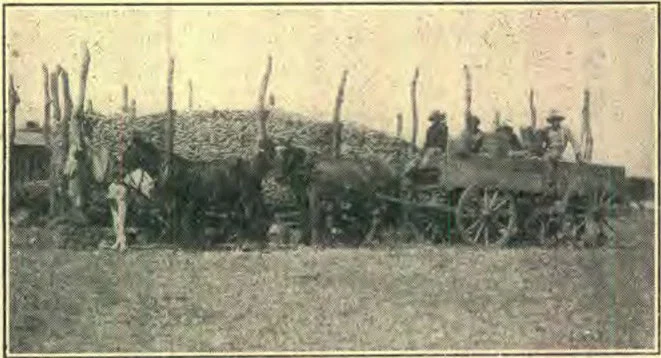
THE FOUR-MULE TEAM OF OUR MISSION
The four-mule team shown in the picture, is our mainstay for getting around “light;” when we have heavy hauling to do, the oxen are used. For “running over to Bulawayo” for supplies for the mission workers and goods for the “store,” which is operated on the mission property, and for visiting our outschools, this mule team is invaluable. When not on the trail these animals are used for general farm work, such as hauling corn from the fields. The corn is husked on the stalk, and drawn to the ingalonas, or cribs, and then stored until it is thoroughly dry, and ready for the market.
When we go for a trip to visit our outschools, we put some hay in the wagon, with our camping outfit, grain for the mules, and food and bedding for ourselves. Two native boys go with us to drive and care for the mules and look after the camp. We usually plan to be away for about two weeks, driving from one school to another, and staying a day or two at each. Here we look over the teacher’s work, and visit with and prescribe for the natives who flock to us with all sorts of ills. We must extract teeth, give treatments, do minor surgical work, and prescribe simple medicines for their ailments.
During a two weeks’ trip we often travel nearly two hundred miles, frequently camping in the open, beside a fire, sometimes sleeping on the hay in the wagon, and often on the ground, wrapped in our blankets. When we can, we call the natives together and preach to them, and sometimes show the stereopticon pictures. Mrs. Walston usually accompanies me on these trips.
Our friends often ask if we are not afraid of the wild animals and the snakes, which are so numerous here. To this we must answer No. The Lord is just as able to care for us in the wilds of Africa as anywhere else, and we trust him and fear not.
W. C. WALSTON.

“The Stone of Life”

THERE are some picturesque and graphic phrases in the Sintebele tongue. Sintebele is the name of the language spoken by the Matabeles. This giving of one name to the tribe and another name to the language is very common in Africa.
Talking with Brother George Hutchinson, at Somabula, I learned the name of the stone which is a part of every household outfit in native South Africa at least. More important even than the house is the grinding stone on which the women grind out the meal for the daily food. It is usually a flat stone, hollowed out by months or years of the grinding process. The smaller stone, smooth and flat, is the upper millstone, while the large slab below is the nether. Back and forth the small stone flies, and the corn or other grain is quickly turned to flour.
“What do they call the stone?” I asked Brother Hutchinson; for I had learned from him that many a pleasant surprise lay hidden to me in the vernacular phrase.
“They call it,” he said, “iitje logusila. Iitje means stone, and logusila means life. It is the ‘stone of life.’”
“Good!” I said; “that is a fine name! We call bread the staff of life, and surely the stone on which the meal is ground out should be the stone of life.”
When the kraal or village moves, the stones usually move along with it. I suppose the Matabele housewife gets to love the well-worn stone just as our housewives love the old paring knife, worn to the right shape by years of use. No new one could replace it.
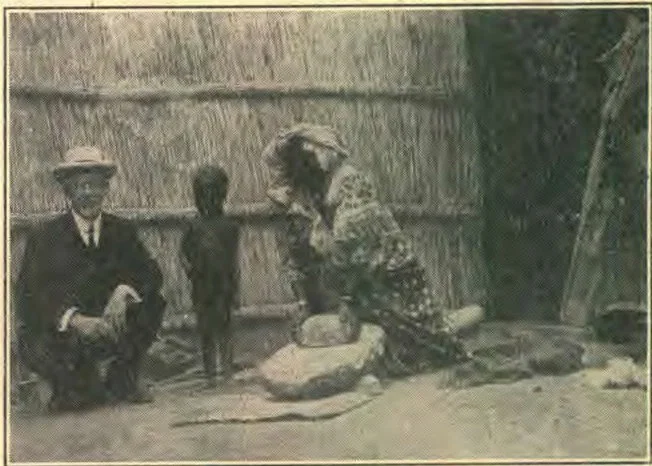
A BASUTO WOMAN GRINDING GRAIN
Yet in visiting a deserted kraal location near the Glendale Mission, in Mashonaland, one day, I saw an old grinding stone that had been left behind. Perhaps the hands that had ground out the meal for the bread of life upon it had long ceased their toil. Somehow the old forsaken “stone of life” seemed unworthily treated, to be left lying about among the rocks and rubbish.
The accompanying picture shows a woman grinding away for the daily bread. This scene is in Kolo, Basutoland; and many will recognize the missionary included in the picture, as Elder W. B. White, president of the South African Union Conference.
W. A. SPICER.

The Habit of Prayer

FELIX NEFF, in speaking on the subject of prayer, has forcefully remarked: “When a pump is frequently used, small effort is necessary to obtain water; it flows out at the first stroke, because the water is high. But if the pump has not been used for a long time, the water gets low, and when it is wanted, one must pump a great while, and the stream comes only after great efforts. And so it is with prayer. If we are instant in it and faithful to it, every little circumstance awakens the disposition to pray, and desires and words are always ready. But if we neglect prayer, it is difficult for us to pray, for the water in the well gets low.”
The thought is full of suggestions. The human heart is a leaky vessel; and in a world like this, the tendency of spirituality, like that of water, is downward. If we neglect prayer, little by little we soon lose its spirit; and its spirit declining, its habit is soon laid aside, or retained only in the form. The form itself will soon be given up, the soul becoming prayerless, and the heart and life consequently weakened.
ERNEST LLOYD

The Slipperiness of the Snake

THE Spaniards seem to have known what they were about when they called the cut Culebra, or the “Snake.” We were too previous when we tried to change the name to “Gaillard,” after the gallant colonel who was supposed to have conquered it. For this old earthworm, this subterranean monster of the slime, is still alive and wriggling. Every week the Canal Record reports 200,000 cubic yards of dirt dug out, and every week as much more flows in to fill the ditch. The dipper dredge “Gamboa” races day and night with her sister, the “Paraiso,” for the championship of the isthmus, but still no ground is gained. Their names may soon be changed to “Sisyphus” and “Tantalus.”
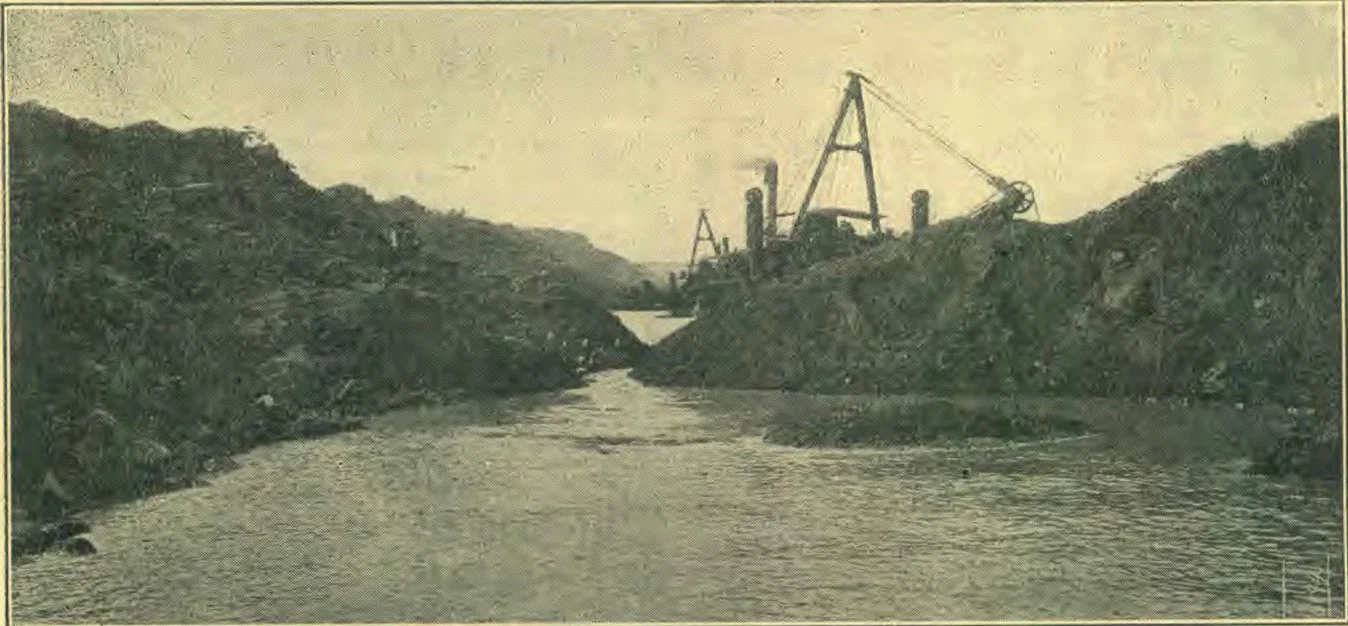
HOW THE LATEST LANDSLIDE CHOKED THE PANAMA CANAL
Not content with pouring in soil from both sides, old Culebra humps its back in the middle, and suddenly an island fifteen feet high arises in the midst of the canal. The earth breaks into waves like water, and one follows another into the excavated prism. Any one who has tried to walk across one of those big pneumatic mattresses which amuse the Midway crowds, will understand how it works.
The stuff of which this ground is made is tough enough to dig; but once soaked up with tropic rains, it begins to flow like molasses in cold weather or tar in hot weather, under the unbalanced pressure of the hills on either side. There are 175 acres of land now mobilized, and they are advancing on the front of more than half a mile.
It is no wonder that the “angle of repose” has not yet been found, because it is very small. Some of these landslides have been propelled by an inclination of one in ten. What a lucky thing for us that President Roosevelt rejected the advice of the foreign consulting engineers, and decided on a lock canal instead of a sea level. If we had had to cut down eighty-seven feet deeper, the Canal Zone would hardly have been wide enough for the slope of its sides, and the working force might have settled down in Panama for life. As it is, the situation is bad enough. The area in motion is estimated at 10,000,000 cubic yards, and if removed at 200,000 yards a week—but there is no use trying to figure out when the canal will be open to traffic. There are too many X’s in the problem.
Meantime, Uncle Sam is in an embarrassing position. Having invited the nations of the world to celebrate the opening of the Panama Canal, he finds it closed. The tourists who started for San Francisco by water found themselves obliged to cross the isthmus ignominiously by rail, as they could have done any time in the last fifty years. A hundred vessels are waiting at Balboa and Cristobal for passage, or, having given it up in disgust, have gone on around by the Strait of Magellan. Fruit from California and Hawaii is spoiling by delay. Miles of switch yard tracks in New Jersey are clogged with cars loaded with locomotives and munitions to be sent to Vladivostok for use in Russia. A million-dollar shipload of wool from Australia, much needed by the mills of Massachusetts, was held up by the blockade.
The seal of the Canal Zone bears the boast, “The land divided, the world united.” But nature has vetoed this. What we see now is the land united and the seas separated.—The Independent.

Why Are There Poor Heathen?

WHOSE fault is it that there are any poor heathen? A speaker at a recent meeting of the Laymen’s Missionary Movement drove this question into the consciences of his Christian hearers. If your father left in his will an inheritance for you and your brother, and your brother, being at a distance, could only receive his inheritance if you sent it to him, should you feel free to decide whether to send it to him or not? and if you did send it to him, should you take considerable credit to yourself for doing so? That’s foreign missions. People talk complacently about the poor heathen. Why “poor”?—Because the heathen have not received their share of the inheritance which the Father left us to give them.—The Sunday School Times.

Pleasure Must Be Sinless and Moderate

PLEASURE must first have the warrant that it is without sin; then, the measure, that it is without excess.—H. G. Adams.
Continue reading: The Story of the Rebellion Against the Government of King Jehovah