The Youth’s Instructor, Vol. 31, No. 10.

THE GOOD KING JOSIAH

The Youth’s Instructor

Mar 7, 1883

S. D. A. Publishing Association · Battle Creek, Mich. · Mar 7, 1883

THE GOOD KING JOSIAH.
Josiah, the fifteenth king of Judah, lived about 550 years before Christ. He began to reign when he was very young,—only eight years old. His father, Amon, and his grandfather, Manasseh, were both very wicked kings, and led the people of Judah into many sins. Josiah, however, seems to have been very different from them; for from his earliest years “he did that which was right in the sight of the Lord, . . . and turned not aside to the right hand or to the left.” Perhaps he had a good mother, who taught him the fear of the Lord.
In the eighth year of his reign, when he was but sixteen years old, he began to seek after the Lord with all his heart; and in the twelfth year of his reign, he set about destroying the idols, and the high-places and groves used in their worship, with which Jerusalem had been filled by his wicked fore-fathers. He then went throughout his kingdom in person, and caused the destruction of all the false gods and their priests and altars, and so far as it seemed possible, cleansed the land from idolatry.
In the eighteenth year of his reign, Josiah commenced to repair the temple of the Lord in Jerusalem. While this was in progress, a book of the law of the Lord, written by Moses, was found by Hilkiah the priest. Now the people of Judah had gone so far into idolatry and wickedness that this book had probably been lost and forgotten; for when its words were read before the king, he wept, and rent his clothes. He knew that his people had not kept this law; and when he heard the terrible threatenings that were pronounced upon those who should do as they had done, he was greatly distressed. So he sent some of the priests and scribes to Huldah, a prophetess who dwelt in Jerusalem, to inquire of the Lord in regard to the fate of his people. She told them to tell the king that the Lord would indeed bring upon them all the judgments that were written in the book, because they had forsaken him and worshiped other gods; but because Josiah’s heart was tender, and he had humbled himself before the Lord, and tried to rid the land of idolatry, the evil should not come in his day.
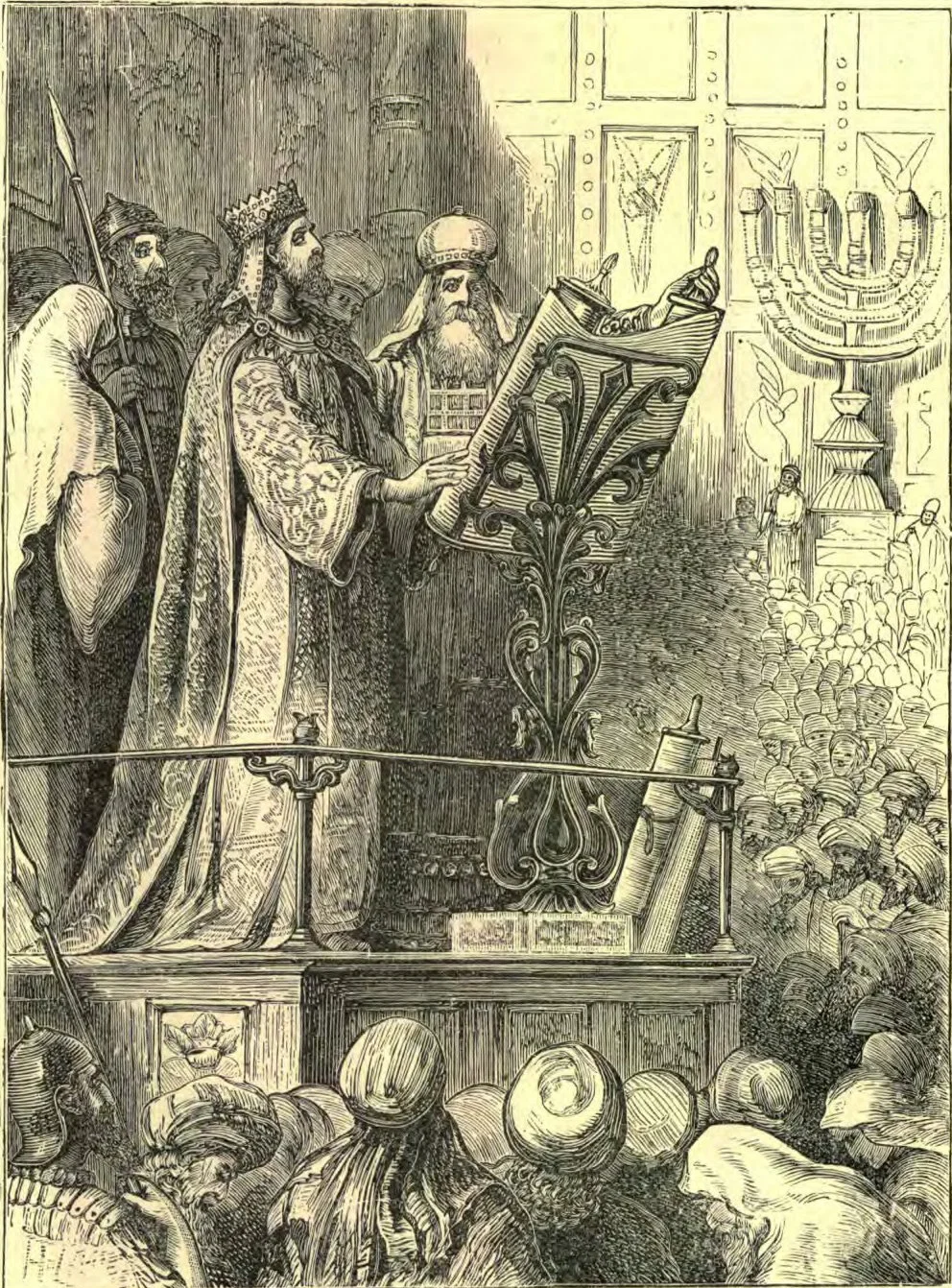
And King Josiah sent and gathered the elders of the people, and all who dwelt in Jerusalem, both great and small, to the temple of the Lord; and he read to them all the words of the law that was written in the book which had been found. In the picture on this page we see him, arrayed in his kingly robes, with the high-priest by his side, reading to the multitude around him from this book of the law. The books of those days were simply long strips of parchment written on one side and rolled up. It is from such a book that the king is reading. At his left is the golden candlestick, which stood on the south side of the holy place; and on the walls may be seen the forms of the cherubim which were carved there.
When he had finished the reading of the law, the king stood by a pillar, in the presence of all the people, and made a solemn covenant before the Lord, promising to keep his commandments with his whole heart, and to obey all that was written in the book. And he made all the people present promise to stand by this covenant.
The Passover that followed was the greatest that had been held since the days of Samuel, the prophet; and there was never another like it. To the poor people who were present, the king gave thirty thousand lambs and kids, and three thousand bullocks. The princes, following his example, also gave liberally, so that all the people were supplied with animals for sacrifice.
After this, Josiah foolishly went out to withstand Pharaoh-necho, king of Egypt, at the pass of Megiddo, and there lost his life. 2 Chron. 35: 20-25. He died in the thirty-first year of his reign, and the thirty-ninth of his age, and was greatly mourned by all the people. “And like unto him there was no king before him, that turned to the Lord with all his heart and with all his soul and with all his might, . . . neither arose there any after him.”
The good prophet Jeremiah lived in the days of Josiah, and was doubtless a strong helper to the pious king in his work of ridding the land of its idolatries, and establishing the down-trodden worship of the true God. We may imagine the grief of the prophet at the sudden and untimely death of his beloved king,—the sole prop and pillar of God’s cause in the land. There is great fullness of meaning in the simple words of the record, “And Jeremiah lamented for Josiah.” E. R. C.

WHERE ARE YOU GOING, YOUNG MAN?

Where are you going so fast, young man, Where are you going so fast, With the cup in your hand, and a flush on your brow? Though pleasure and mirth may accompany you now, It tells of sorrow to come by-and-by; It tells of a pang that is sealed with a sigh; It tells of a shame at last, young man,— A withering shame that will last.
Where are you going so fast, young man? Where are you going so fast? In the flush of that wine there is only a bait— A curse lies beneath that you'll find when too late; A serpent sleeps down in the depths of that cup; A monster is there that will swallow you up; A sorrow you'll find at last, young man,— In wine there is sorrow at last.
There's a reckoning day to come, young man; A reckoning day to come, A life yet to live, and a death yet to die, A sad, parting tear and a parting sigh; A journey to take, and a famishing heart, A sharp pang to feel from Death's chilling dart; A curse if you drink that rum, young man,— The bitterest curse in that rum. —Selected.

A HAPPY THOUGHT.

“What a looking room!” exclaimed Olive Kendall, as she came in from school and added to the confusion of the sitting-room by throwing her satchel on the lounge. “Why doesn’t somebody fix it up?” But no one answered. Only Leila and Nora were there to answer, and both their heads were bent over a geographical puzzle.
Olive threw herself into an easy chair and looked out of the large bay-window. It was pleasanter to turn her head that way than to look around the disordered room. She only wished she could turn her thoughts away from the room as easily, but she could not, so long as that voice kept saying:—
“You know that Bridget is out with the twins, and that Kate is busy getting dinner, and that there is no one but yourself to put the room in order—you and your little sisters. Why not go to work and have a surprise for mamma when she comes in?”
“Leila and Nora, we really ought to fix up the room,” said Olive, with a half-yawn. “The twins have scattered their things. Won’t you help?”
“In a minute,” answered Nora. “We only want a little crooked piece to go right in there.”
“Yes,” responded Leila, “it’s Finland.”
Olive looked about the room in a hopeless, helpless sort of way. “With Leila and Nora both in Finland,” she thought, “I may as well give up expecting their help. If it were only a game”—
She stood a moment in thought. Her face suddenly brightened. She went to mamma’s desk and cut six slips of paper, then wrote a word on each.
“Are you getting some strips ready for Consequences?” asked Leila, a new interest in her face, as she looked up from the pieces of map.
“No, but you’ve guessed pretty well,” admitted Olive, “for it’s a game—a new one.”
“A game! A new one!” echoed the little sisters, not only losing interest in Finland, but letting the whole of Europe fall apart. “Let’s play it! I’m tired of this map-puzzle.”
“Yes, Olive, tell us how,” pleaded Leila, “and then we’ll help with the room. We truly will.”
“I don’t think you’ll like the game,” said Olive, “but I’m sure that mamma will.”
“Then we shall, of course,” said Nora, very decidedly. “Let’s begin it now.”
So Olive laid the slips on the table—the written side downward. Then she said, “Now, we are to draw in turn, the youngest first. Come, Nora!” Nora looked at the different pieces of paper, put her finger on the last, and then suddenly changed her mind, and took the one nearest her.
“Don’t look at it yet, Nora,” said Olive.
“Oh, I shall certainly look, if Leila doesn’t hurry,” said Nora, excitedly, shutting her eyes very tight, but soon opening them to ask, “Is there a prize, Olive?” and jumping up and down as Olive nodded.
After Leila had settled upon one of the slips, she and Nora made Olive shut her eyes while they changed about all the papers that were left, for fear that Olive, having made them, might choose a better one than they. At last they all had slips.
“Now read!” signalled Olive.
“Table,” said Nora, consulting her paper.
“Chairs,” read Leila, from hers.
“Carpet,” announced Olive.
“Now what?” asked Nora. “Do I pass mine on to Leila?” But Olive was on her knees, picking up a lot of playthings.
“Mine was carpet,” she said, as she hastily put a handful of toys into a little cart belonging to the twins, “so I’m to take everything off the carpet that doesn’t belong there. You are to put in order whatever your paper tells you, and the game is to do it as well and as quickly as you can.”
Nora flew to the table. She ran into the hall with Teddy’s hat, and into the nursery with Freddy’s whip. Then she got a brush and prepared to sweep off the table cover. To do this she piled some books on one of the chairs.
“My paper says chairs,” cried Leila, “and there are eight of them! If you put those books there, I’ll never get through.”
“The other table is yours also, Nora,” said Olive, as she straightened the rug in front of the fire. “Look on your paper.”
Sure enough, there was an “s” that Nora had overlooked! So the books found a place on the little stand while the big table was brushed, and then were piled nicely up, and the magazines and papers laid together, after which Nora stood off and viewed the effect with such satisfaction as almost to forget the smaller table.
She was reminded of it, however, by Leila, who was flourishing a duster about as she went from one chair to another, fastening a tidy here and shaking up a cushion there, until she was ready to say, “The whole eight are done.”
“I’ve finished, too,” said Olive, as she brushed the hearth and hung the little broom at one side of the open fire-place. “Now, we all draw again.”
Nora chose quickly this time, and went right at work when she saw the word “Mantel,” hardly hearing Leila say “Desk,” and Olive, “Lounge.”
“Well, what do you think of the game?” asked Olive, a while after, as, having left the room to put away her school-satchel, she returned and found Leila and Nora putting the finishing touches to their tasks, and rejoicing over the finding of Finland in mamma’s desk.
“Why, we think it a great success—don’t we, Nora? And we see now why you didn’t know the name,” added Leila, laughingly.
“Here comes mamma up the walk,” announced Nora from the bay-window.
“Well, don’t say anything, and see if she notices the room,” suggested Leila. Mamma came to the sitting-room door, and looked in. No wonder she smiled at the picture,—the room a model of neatness, the winter’s sun streaming in at the window, the fire crackling on the hearth, and three faces upturned for a kiss.
“So Bridget is home,” said mamma, in a tone of relief, as she glanced about the room. “I left her getting rubbers for the twins, and feared she wouldn’t return till dinner-time.”
“She isn’t home, mamma,” said Olive, while Nora and Leila exchanged happy glances, and Nora couldn’t keep from saying (though she said afterward she tried hard not to tell),—
“We fixed it, mamma. It’s Olive’s game!”
Then of course mamma had to hear all about it, and papa, too, when he came to dinner. Otherwise he might not have brought up those slips of red card-board that he did that evening, nor have seated himself in the midst of them all, and said, “Now, I propose we make a set of cards in fine style,” as he proceeded to write on each the word that Olive or Leila or Nora would tell him.
“And now, what shall we call the game?” asked papa, with pen ready to put the name on the other side of the six bright cards.
“How would the ‘Game of Usefulness’ do?” suggested Olive.
“Or ‘Daily Duty?’” put in Leila; “for we’ve promised to play it every day.”
“Wouldn’t ‘Helping Hands’ sound well?” asked mamma. And they probably agreed upon that, for, when Nora went up to bed, one of her plump hands held the new cards, and the name that mamma had proposed was written on each.
“I wonder what the prize was?” she asked Leila the last thing that night.
“I guess it must have been mamma’s smile when she looked in,” said Leila.
And was not that a prize worth trying for?—St. Nicholas.

SURE SIGNS.

Solomon said, many centuries ago, “Even a child is known by his doings, whether his work be pure or whether it be right.”
When I see a boy slow to go to school, and glad of every excuse to neglect his books, I think it is a sign that he will be a dunce.
When I see a boy in haste to spend every penny as soon as he gets it, I think it is a sign that he will be a spendthrift.
When I see a boy hoarding up his pennies, and unwilling to part with them for any good purpose, I think it is a sign that he will be a miser.
When I see a boy or a girl looking out for “number one,” and disliking to share good things with others, I think it a sign that the child will grow up a selfish person.
When I see boys and girls quarreling, I think it is a sign that they will be violent and hateful men and women.
When I see a child obedient to his parents, I think it is a sign of great future blessings from God.
When I see a boy fond of the Bible and knowing it well, I think it is a sign that he will be a good and happy man.

DON'T FAINT AWAY.

A LITTLE girl saw hanging in her Sabbath-school this text on an illuminated card: “Let us not be weary in well-doing; for in due season we shall reap, if we faint not.” She caught the idea of its teaching, and in attempting to repeat it at home she gave a somewhat free rendering in this form: “Don’t you get tired of doing good; for if you don’t faint away, by-and-by you’ll get your pay.”
The truth as she put it is worth bearing in mind.
—Selected.

Better to Keep Out of a Quarrel

BETTER keep out of a quarrel than fight your way through it.

SCENES IN THE LIFE OF CHRIST.

LESSON III.—JESUS APPEARS TO THE DISCIPLES.

On the same day that Jesus rose from the dead, two of the disciples went out to the village of Emmaus, about sixty furlongs northwest of Jerusalem. As they journeyed, they talked about the wonderful things that had just happened; and while they were thus walking and talking, Jesus drew near and went with them; but they did not know him, because their eyes were holden. When he asked them what they were talking about, and what made them sad, one of them said, “Art thou only a stranger in Jerusalem, and hast not known the things which are come to pass there in these days?” Jesus said, “What things?” They said, “Concerning Jesus of Nazareth, a prophet mighty in word and deed; how the chief priests and rulers condemned him to death, and have crucified him.” They also said that they had hoped that he was the one who should deliver Israel. They told him that it was now the third day since the crucifixion of Jesus; and that on that very morning some of the women belonging to their company had visited the sepulchre where he had been laid, and could not find his body, but saw some angels who said that he had risen, and was alive. They also said that some of the disciples on visiting the sepulchre found it empty, as the women had said; but they did not see Jesus nor the angels. Then Jesus reproved them for being so dull as not to have understood that the prophets in speaking of Christ had foretold these very things; and taking up the writings of Moses and the prophets, he expounded the meaning of what had been written concerning the Messiah.
As they came near to the village, he made as though he would go further; but they urged him to stop with them, saying, “Abide with us; for it is toward evening, and the day is far spent.” So he went in with them; and when at supper, he took bread, and blessed it, and gave to them, their eyes were opened, and they knew him; but he immediately vanished out of their sight. Then they said to each other, “Did not our heart burn within us by the way, while he opened to us the Scriptures?”
The disciples were so astonished at what they had seen, that they returned that very evening to Jerusalem, where they found the eleven disciples gathered together for fear of the Jews, and some others with them, who said that the Lord was risen indeed, and had appeared unto Simon. Then the two disciples told their story of how Jesus had talked with them on their way to Emmaus, and had been made known unto them in the breaking of bread. While they were thus talking, Jesus himself appeared among them; but they were so terrified that they thought him a spirit. Then Jesus said, “Why are ye troubled? and why do thoughts arise in your hearts? Behold my hands and my feet, that it is I myself: handle me, and see; for a spirit hath not flesh and bones, as ye see me have.” But they wondered, and could hardly believe that their Lord was really alive. Then Jesus said, “Have ye here any meat?” And when they gave him a piece of broiled fish, and a piece of honey-comb, he took the food, and ate it before them.
And when Jesus had convinced them that he was their Lord, he said, “Peace be unto you; as my Father hath sent me, even so send I you.” After speaking these words, he breathed on them, and said, “Receive ye the Holy Ghost.”
But Thomas, sometimes called Didymus, although he was one of the twelve, was not with them at that time; so when he came in, the other disciples said to him, “We have seen the Lord.” But he said, “Except I shall see in his hands the print of the nails, and put my finger into the print of the nails, and thrust my hand into his side, I will not believe.”
Eight days after this, when the disciples were gathered together, and Thomas with them, Jesus appeared among them, and said, “Peace be unto you.” Then addressing Thomas, he said, “Reach hither thy finger, and behold my hands; and reach hither thy hand, and thrust it into my side; and be not faithless, but believing.” When Thomas had seen these proofs, he said, “My Lord and my God.” Then Jesus said, “Thomas, because thou hast seen me, thou hast believed; blessed are they that have not seen, and yet have believed.”

QUESTIONS.

1. Who went out to Emmaus on the day that Jesus rose from the dead? Luke 24 : 13.
2. Where is Emmaus situated?
3. What did they talk about, as they journeyed?
4. Who drew near, and went with them?
5. Did they know him?
6. Why not?
7. What did he ask them?
8. What did one of them say?
9. How did Jesus respond to these questions?
10. What explanation did the disciples then make?
11. What bright hopes had they entertained concerning Jesus?
12. How long had it been since Jesus was crucified?
13. What had been reported by some women who went to the sepulchre that very morning?
14. How had the report of the women been confirmed?
15. For what did Jesus reprove these disciples, when they had told their story?
16. What instruction did he give them?
17. What did he do as they came near to the village?
18. How did they persuade him to stop with them?
19. What did he do when he sat down with them to supper?
20. What happened as soon as their eyes were so opened that they knew him to be their Lord?
21. What did they then say to each other?
22. What did these two disciples do that very evening?
23. Whom did they find gathered together there?
24. Why had the disciples shut themselves up in this way?
25. What news did they have to tell as soon as the two disciples from Emmaus had come in?
26. Who appeared among them as the two disciples were telling their story?
27. What did they think him to be?
28. What question did Jesus ask them?
29. How did he try to convince them that he was not a spirit?
30. When he found that for joy they could still hardly believe that he was their Lord, what further proof did he give them?
31. What did he say to them when he had convinced them that he was not a spirit? John 20 : 21.
32. After speaking these words, what did he do?
33. With what words did he accompany this action?
34. Which one of the disciples was absent at this meeting?
35. What did the other disciples say to Thomas when he came in?
36. How did he show his want of faith?
37. On what occasion did Jesus appear to them when Thomas was present? John 20 : 26.
38. What did he say as he appeared among them?
39. How did he address Thomas?
40. After receiving this proof, what did Thomas say?
41. What gentle reproof did Jesus give him?

NEW-TESTAMENT HISTORY SERIES.

LESSON 125.—REVIEW: FROM OUR LORD'S THIRD PASSOVER TO THE RAISING OF LAZARUS.

1. WHY did not Jesus attend the third Passover after his baptism? John 7:1.
2. How did he reprove some of the Pharisees, who, on returning from the Passover, condemned his disciples for eating with unwashed hands? Mark 7.
3. Tell how the daughter of a Syro-Phenician woman was healed. Matt. 15:21–28; Mark 7:24–30.
4. Tell how the four thousand were miraculously fed.
5. After returning to the west side of the Sea of Galilee, how did Jesus reprove the Pharisees and Sadducees for their lack of spiritual discernment? Matt. 16.
6. In what way did he warn his disciples against false doctrines, as they again crossed over to the northeast shore of the lake? Mark 8:14–21.
7. What confession did Peter make, as Jesus and his disciples were on their way to Cæsarea Philippi? Mark 8:27–30.
8. What did Jesus at this time reveal to them concerning the sufferings that were to come upon him and his followers? Mark 8:31–38; Matt. 16:21–28.
9. Describe the transfiguration. Matt. 17; Luke 9; Mark 9.
10. In what trouble did Jesus find his disciples when he came down from the mountain?
11. What lessons of forgiveness does Jesus teach in the eighteenth chapter of Matthew?
12. Describe our Lord’s final departure from Galilee. Luke 9:51, 52; John 7:2–10.
13. What happened on the way? Luke 9:53–62; 10:1–11; 17:11–19.
14. What doom did he pronounce upon the impenitent cities? Matt. 11:20–24; Luke 10:12–16.
15. Give a few of the leading points in our Lord’s experience and teaching at the Feast of Tabernacles. John, chaps. 7–10.
16. Describe the return of the seventy. Luke 10:17–24.
17. Relate the parable of the good Samaritan. Luke 10.
18. What visit did our Lord make in the village of Bethany? Luke 10:38–42.
19. How did he encourage perseverance in prayer? Luke 11:1–13.
20. On what occasion did he severely reprove the Pharisees? Luke 11:37–51; Matt. 23:4–39.
21. How did Jesus try to inspire faith and hope on the part of his disciples? Matt. 10:26–33; 6:25–34; Luke 12:22–39.
22. Relate the parable of the rich man who knew not where to bestow his goods. Luke 12.
23. How did Jesus teach the necessity for repentance on the part of all? Luke 13.
24. How did he rebuke the hypocrisy of those who found fault with him for healing on the Sabbath-day? Verses 11–16.
25. What feast did Jesus attend in the winter? John 10:22.
26. How was he treated at this feast?
27. How did Jesus prompt his disciples to be diligent and faithful? Luke 13:23–30.
28. What parables are recorded in the fifteenth chapter of Luke?
29. What parables are recorded in the sixteenth chapter of the same book?

FAITHFULNESS IN LITTLE DUTIES.

It is a secret worth knowing and remembering, that the truest, and indeed the only preparation for life's duties or trials is made by simple fidelity in whatever each day brings. A day squandered anywhere may prove the dropped stitch from which the whole web will begin to ravel. One lesson neglected may prove to have contained the very knowledge for the want of which, far along in the course, the student may fail. One opportunity let slip may be the first step in a ladder leading to eminence and power, but no higher rounds of which can be gained because the first was not taken. We never know what is important in life. The most insignificant duty that offers may be the first lesson in preparation for a great mission. Indeed, every hour of life holds the keys of the next, and possibly of many hours more.
Continue reading: THE PRIMARY TEACHER’S WORK