Your ShelfYour Projects

Review and Herald, Vol. 76, No. 3.

THE GREAT SUPPER

Review and Herald

Jan 17, 1899

Seventh-day Adventist Publishing Association · Battle Creek, Mich. · Jan 17, 1899

THE GREAT SUPPER.

MRS. E. G. WHITE.
UNDER the parable of a great supper, Christ shows that many will choose the world above himself, and, as the result, will lose heaven. He said: “A certain man made a great supper, and bade many: and sent his servant at supper-time to say to them that were bidden, Come; for all things are now ready.”
Long before the feast, the invitations had been given; and when the supper was ready, the servants went to call the guests. But those bidden did not appreciate the invitation. “They all with one consent began to make excuse. The first said unto him, I have bought a piece of ground, and I must needs go and see it: I pray thee have me excused. And another said, I have bought five yoke of oxen, and I go to prove them: I pray thee have me excused. And another said, I have married a wife, and therefore I can not come.”
Again the king sent to those who had refused the invitation, giving them every opportunity to reflect, and to accept the gracious call. “Behold,” he said, “my oxen and my fatlings are killed, and all things are ready: come unto the marriage. But they made light of it, and went their ways, one to his farm, another to his merchandise: and the remnant took his servants, and entreated them spitefully, and slew them.”
When the servant came and showed his lord these things, the master of the house was angry. He turned from those who had thus insulted the bounty offered them; and invited a class who were not full,—who were not in possession of houses and lands, but were poor and hungry, and would appreciate the bounties provided, and in return would render to the master sincere gratitude, unfeigned love and devotion. He said to his servants: “Go out quickly into the streets and lanes of the city, and bring in hither the poor, and the maimed, and the halt, and the blind. And the servants said, Lord; it is done as thou hast commanded, and yet there is room.”
The command was then given: “Go out into the highways and hedges, and compel them to come in, that my house may be filled. For I say unto you that none of those men which were bidden shall taste of my supper.”
The greatest privilege of the Jewish nation lay in their possession of light concerning the kingdom of God. To them had been entrusted the oracles of God. When others were in darkness, and knew not God, they were entrusted with a revelation of God’s will. The truth was committed to them in clear lines, to be communicated to others; but instead of feeling the obligation they were under to God to impart to others all they had received from him, they were filled with self-complacency. They made the boast that they were the only favored people of God, and were therefore more exalted than other nations.
The outward sign is of no value with God, if the heart and mind and strength are not devoted to him. If these are used to exalt and favor self, all claims to superior wisdom will be as nothing in his sight. “Let not the wise man glory in his wisdom,” he says, “neither let the mighty man glory in his might, let not the rich man glory in his riches: but let him that glorieth glory in this, that he understandeth and knoweth me, that I am the Lord which exercise loving-kindness, judgment, and righteousness, in the earth: for in these things I delight, saith the Lord.”
When Christ sent forth his disciples, first twelve, and later seventy, declaring, “The kingdom of heaven is at hand,” the gospel message was not accepted. Those bidden to the feast would not come. These servants were sent out later to say: “Behold, I have prepared my dinner: my oxen and my fatlings are killed, and all things are ready: come unto the marriage.” This was the message borne to the Jewish nation after Christ was crucified; but the nation that claimed to be God’s peculiar people rejected the gospel brought to them in the power of the Holy Spirit. Many did this in the most scornful manner; while others were so exasperated by the offer of salvation—the offer of pardon for rejecting the Lord of life and glory—that they turned upon the bearers of the message, stoning Stephen, killing James by the sword, and committing men and women to prison.
Then the third call was made, in the highways and hedges,—a compelling call to the marriage supper of the Lamb: “Go out into the highways and hedges, and compel them to come in, that my house may be filled.”
In the work of the servants in the highways and hedges is represented the call to the Gentiles. The Jews had despised the message, and cruelly treated the messengers; yet the wedding was furnished with guests. Paul and Barnabas declared to the Jews: “It was necessary that the word of God should first have been spoken to you: but seeing ye put it from you, and judge yourselves unworthy of everlasting life, lo, we turn to the Gentiles. For so hath the Lord commanded us, saying, I have set thee to be a light of the Gentiles, that thou shouldest be for salvation unto the ends of the earth. And when the Gentiles heard this, they were glad, and glorified the word of the Lord: and as many as were ordained to eternal life believed.”
The scene changes. The king comes in to examine the guests; and he sees one who has come to the table without the wedding garment, which he himself has provided for every guest. He is clothed in his old citizen’s dress. Why should he insult his lord by refusing to wear the dress that has been prepared for him? Addressing the one who has thus dishonored him, the king says: “Friend, how camest thou in hither not having a wedding garment? And he was speechless. Then said the king to the servants, Bind him hand and foot, and take him away, and cast him into outer darkness; there shall be weeping and gnashing of teeth. For many are called, but few are chosen.”
This parable correctly represents the condition of many who profess to believe in Christ. The Lord has sent them an invitation to the supper that he has prepared for them, at great cost to himself; but worldly interests look to them of greater importance than the heavenly treasure. They are invited to take part in things of eternal interest; but their farms, their cattle, and their home interests seem of so much greater importance than obedience to the heavenly invitation, that they overpower every divine attraction. These earthly things are made the excuse for disobedience to the command, “Come; for all things are now ready.” Those invited to the heavenly feast look at their worldly possessions, and say, “No, Lord; I can not follow thee; I pray thee have me excused.”
The very blessings that God has given to these men, to prove them, to see if they will render unto God “the things that are God’s,” they use as an excuse for refusing to obey the claims of truth. They grasp their earthly treasure, and say, “I must take care of these things; I must not neglect the things of this life; these things are mine.” Thus their hearts become as unimpressible as the beaten highway. They close the door of their hearts to the heavenly message, but throw it open to the world’s burdens and business cares; and Jesus knocks in vain for admittance.
All who have had the light of truth are being tested, as were the Jews. As a people, we have been exalted to the highest privileges. The Lord has been revealed to us in ever-increasing light. Our privileges are far greater than were the privileges of the Jews. We have not only the great light committed to ancient Israel, but we have also the increased evidence of the great salvation brought to us through Christ. That which was type and symbol to the Jews is reality to us. They had the Old Testament history; we have that and the New Testament also. We have the assurance of a Saviour who has come,—a Saviour who has been crucified, has risen, and has proclaimed over the rent sepulcher of Joseph, “I am the resurrection, and the life.” In our knowledge of Jesus and his love, the kingdom of God has been placed in the midst of us. Christ has been proclaimed to us in sermons and chanted to us in songs. The spiritual banquet has been set before us in rich abundance. We have had presented to us by the messengers of God the richest feast,—the righteousness of Christ, justification by faith, the exceeding great and precious promises of God in his word, free access to the Father by Jesus Christ, the comforts of the Holy Spirit, and the well-grounded assurance of eternal life in the kingdom of God. We ask, What could God do for us that he has not done in preparing the great supper, the heavenly banquet?
The glory, riches, and honor offered by the Son of God are of infinite value; it is beyond the power of men, or even of angels, to give any just idea of their worth. If men, plunged in sin and degradation, refuse these heavenly benefits, refuse a life of obedience, scorn the gracious invitation of mercy, and choose the paltry things of earth, Christ will carry out the figure used in the parable. Such will not taste of his glory, but the invitation will be extended to another class. Those who choose to make excuses, and continue in sin and conformity to the world, will be left to their idols. There will be a day when not one will beg to be excused. When Christ shall come in his glory, and in the glory of the Father, with all the heavenly angels surrounding him, there will not be one indifferent spectator. Speculations will not then engross the soul. The miser’s piles of gold, which have feasted his eyes, will no longer be attractive. The palaces which the proud men of earth have erected, and which have been their idols, they will turn from with loathing. No one will then plead his lands, his oxen, or the wife he has just married, as a reason why he should be excused from sharing the glory that bursts upon his astonished vision. All will want a share, but know it is not for them.
In earnest, agonizing prayer they call for God not to pass them by. The kings, the mighty men, the lofty, the proud, the mean man, alike bow together under a pressure of woe, desolation, misery inexpressible. The heart-anguished prayer is wrung from their lips, “Save us from the wrath of an offended God.” But a voice, terrible in its majesty, answers them: “Because I have called, and ye refused; I have stretched out my hand, and no man regarded; but ye have set at naught all my counsel, and would none of my reproof: I also will laugh at your calamity; I will mock when your fear cometh.”

I SHALL BE SATISFIED.

WHEN I shall wake on that fair morn of morns, After whose dawning never night returns, And with whose glory day eternal burns, I shall be satisfied.
When this vile body shall arise again, Purged by Thy power from every taint and stain, Delivered from all weakness and all pain, I shall be satisfied.
When I shall gaze upon the face of him Who for me died, with eye no longer dim, And praise him in the everlasting hymn, I shall be satisfied.
When I shall call to mind the long, long past, With clouds and storms and shadows overcast, And know that I am saved and blest at last, I shall be satisfied.
When every enemy shall disappear,— The unbelief, the darkness, and the fear,— When Christ shall smooth the brow and wipe the tear, I shall be satisfied.
When every vanity shall pass away, And all be real, all without decay, In that sweet dawning of the cloudless day, I shall be satisfied.
— Horatius Bonar, D. D.

ARE YOU IN TUNE?

F. M. ROSSITER, M. D.
(Battle Creek, Mich.)
Some time ago I heard one of the finest orchestras in America. It seemed like the expression of a single inspired soul. Could Wagner have been present, he must have been deeply impressed with the grandeur of his own composition. Whence came this beautiful music?—From a hundred instruments, but all in tune. For nearly half an hour I sat idly watching the “tuning up.” Most of this time was spent in reaching perfect harmony. As the mighty volume of music swept over that vast concourse of people, at times almost moving them to their feet with its wonderful martial energy, again becoming so soft and subdued that every one was breathless, the thought came to me: Suppose the musicians had put off the tuning up until after the concert. Everybody would have left in disgust, and the reputation of the leader would have been ruined. But is not this what Christians are doing constantly,—failing to put themselves in harmony with the divine orchestra, until the work of the day is done? How beautiful the music would be if all God’s children would take advantage of the Lord’s early morning visit to tune their souls with his!
It is said that Mendelssohn once went to see the great Freiburg organ. The custodian, not recognizing the musician, would not let him touch it. When, after much persuasion, the old man allowed the persistent youth to play a few notes, he stood entranced; never before had he heard such melody. At length he asked the player his name; and when he was told, he stood humiliated and self-condemned. A greater Musician than Mendelssohn has, unknown to us, stood by the human organ, which very possibly has given out only “wolf-notes” before the world, pleading with us to let him touch the keyboard, and bring out divine music. Many have refused till age, disuse, and misuse have almost rendered the instrument unfit to produce harmony, even at the touch of the divine hand.
The strings of the human heart need faithful tuning. We are all naturally out of tune. There is no harmony between the natural heart and heaven. Some strings are pitched too high; others, too low. It may be that the string of sympathy or kindness is flat, or that the string of charity sharps a little. We need to be tuned by the great Master himself, so that every string may have its proper pitch, and be in harmony with the vibrations of his own heart. Then we shall be in accord not only with him, but also with all human instruments like-tuned, so that we may have a part in the beautiful symphony of human lives to be heard by men and angels.
Instead of this, most of us wait until the work of the day is over, and it is time to sleep. Then we hastily read a chapter in the Bible, perhaps only a verse, nodding over that; regret confusedly and sleepily that we haven’t been better Christians; but excuse ourselves from further thought about it because we are “so tired,” and have been so busy, possibly doing the Lord’s work. God is given the fag-end of the day. The mind and the physical energies are freshest in the morning.
How can one be tuned so as to be in harmony with heaven?—as a perfectly tuned instrument in a room will vibrate to accurate tones produced in some other part of the room, so the true follower of Christ will respond in melodious vibrations to tones from the courts above. In order, then, to be daily in tune, it is necessary to pray,—to pray much,—to pray at the beginning of the day. The Bible should be studied in the morning. Let us give God our best moments, that our lives may make one music with his.

CHARACTER-BUILDING

D. H. KRESS, M. D.
“The brain nerves, which communicate with the entire system, are the only medium through which Heaven can communicate to man, and affect his inmost life.” By means of certain nerves, sensations of pain are communicated to the brain, to warn of danger. Through the nerves of the eyes, impressions are constantly being made upon the brain cells. The brain itself may be compared to a kodak; snap-shots are continually being taken. Character is determined by the nature of the impressions thus received. By beholding, we are becoming changed. It is therefore of the utmost importance that we make a covenant with our eyes, and refuse to behold evil in any form, and study and look only at that which is good and pure.
The thoughts of man are made up of mental impressions thus received. As a man “thinketh in his heart [mind], so is he.” It is through the nerves communicating with the brain, the eyes, the ears, etc., that the Spirit of God communicates with man, and makes divine impressions, and transforms the character. Paul says, “Be not conformed to this world: but be ye transformed by the renewing of your mind, that ye may prove what is that good, and acceptable, and perfect, will of God.” Rom. 12: 2. The first step is a change of habits. “Let the wicked forsake his way.” “Who among us shall dwell with the devouring fire [the refining fire, that consumes the dross in the character]?”—“He that . . . stoppeth his ears from hearing of blood, and shutteth his eyes from seeing evil.” Isa. 33: 14, 15. “Thine eyes shall see the King in his beauty: they shall behold the land that is very far off.” Isa. 33: 17.
Our only safety lies in keeping our eyes on the Pattern, studying the life of Christ, beholding “the Lamb of God,” “the King in his beauty,”—in enduring “as seeing him who is invisible.” In a dark night, by looking at a bright light directly ahead, we are unable to behold objects near by, which could otherwise be clearly discerned; likewise, by keeping our eyes on Christ, the evils of this world will make no impression on our minds. Like the disciples who were with Christ on the mount of transfiguration, we shall see only Jesus. It is necessary to keep on beholding until we see him as he is, and are like him.
The ear is designed as another channel through which the Spirit of God communicates with the soul of man to transform the character. “He that hath an ear, let him hear what the Spirit saith unto the churches.” Every good or evil thing whispered in the ear makes an impression on the mind of the listener, and in time will be revealed in his life by look, word, or act. “Out of the abundance of the heart the mouth speaketh.” Hear evil of no man.
“Be not deceived: evil communications corrupt good manners.” 1 Cor. 15: 33. “Therefore whatsoever ye have spoken in darkness shall be heard in the light; that which ye have spoken in the ear in closets shall be proclaimed upon the housetops.” “There is nothing covered, that shall not be revealed; neither hid, that shall not be known.” Luke 12: 3, 2. These mental impressions will even be revealed in the face. “The show of their countenance doth witness against them; and they declare their sin as Sodom, they hide it not.” Isa. 3: 9.
On the other hand, it will not be long until the Father’s name, or character, will be clearly revealed in the faces of those who guard well the avenues to the soul,—those who refuse to look on evil, or read trifling and frivolous books, but only behold the King in his beauty,—those who refuse to listen to evil, the things spoken in secret, but have their ears open to what the Spirit says. The glory of the Lord will be seen upon them.
Not only do we want good impressions made on the brain, but we want them distinct and clearly outlined. If the brain cells and the nerves communicating with them are benumbed, stupefied, or partially paralyzed, with morphine, alcohol, tobacco, or some milder stimulant, such as tea, coffee, or the uric acid found in meats (this acid has a similar effect to the caffein found in coffee), indistinct impressions are made on the brain. As a result of taking wine, Nadab and Abihu were not able to discern between the sacred and the common fire. Leviticus 10. On account of gross habits of life, we may have eyes, and still not be able to see or appreciate eternal truths; we may have ears, and not be able to hear what the Spirit says.
“Perfection and the spirit of holiness can not be attained with a diseased body and mind.” To elevate morals, we must begin by cleansing ourselves from all filthiness of the flesh, correcting our physical habits. The inside of the platter must be cleaned as well as the outside. The blood must be cleansed and kept clean from all poisons, irritants, or stimulants. “For I will cleanse their blood that I have not cleansed.” Joel 3: 21. The circulation may be equalized by proper dress and exercise, so that the brain will not have too much or too little. By exercising carefulness in these respects, we are simply guarding the citadel of the soul, so as to make it possible to discern sacred truths, through which we are to be sanctified, elevated, and made fit for the society of heavenly angels.

Cultivating a Forgiving Spirit Instead of Malice

“It is useless to pray for a forgiving spirit while cultivating a memory for injuries. God never quenches a fire for a man who persists in feeding it with oil. He who really desires to keep malice out of his heart will try to keep inflaming thoughts out of his head.”

The Welsh Origin of the Word Dad

“We are all familiar with the childish word ‘dad’ for father; but it is not generally known that it is a pure Welsh word, the Lord’s prayer in Welsh beginning ‘Ein Dad.’”

HOLD THOU ME UP.

MRS. L. D. AVERY-STUTTLE.
Father, I’m losing hold of thee; Bear thou me up; I can not see; My foolish heart seems filled with sin, And evil triumphs oft within; My wayward feet go stumbling o’er The snares where I have fallen before: I have no strength, my God, and so The same dear sins of long ago, Like a sweet morsel still I roll Beneath my tongue; cleanse thou my soul; For I have only strength to cry: “Save, or I perish! must I die?”
Father, I’m losing hold on thee; Sin separates ’tween thee and me. Still thy reproving voice I hear; Thou callst me with thy love so dear: And yet, O Christ! the cares of life So fill my hands with ceaseless strife, So fill my heart, so numb my hand, With power I may not understand, That, O my God! before I know, I loose my hold, and let thee go. I have no strength to cling to thee; O pitying Christ! cling thou to me!
· · · · · · ·
He heard my cry; O, praise his name, He heard, and to my rescue came! His love I can not understand; I saw my name upon his hand,— His piercéd hand,—and heard him cry: “I’ll hold thee up, thou shalt not die, But in my kingdom thou shalt shine; Fear not; I love thee; thou art mine.”

The Morning Breaks: A Hymn of Gratitude

THE morning breaks, And earth in her Maker's smile awakes; His light is on all, below and above,— The light of gladness, and life, and love. O, then, on the breath of this early air, Send up the incense of grateful prayer! — Henry Ware.

THE SPECTRUM.

L. A. REED.
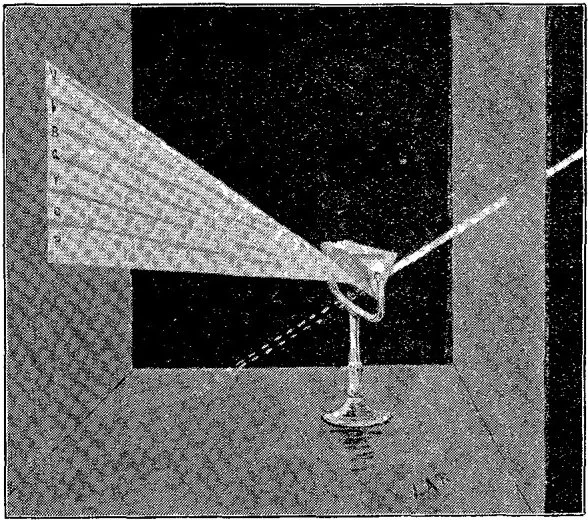
We find in the rainbow various colors,—red, orange, yellow, green, blue, indigo, and violet. We say that these colors are produced by the analysis of light. All these colors are in the single ray of sunlight; and the rain-drop analyzes it, and reveals its hidden nature and beauty.
With a prism we can produce much the same effect. Light is complex. It is composed of different kinds of light,—red light, orange light, yellow light, etc. When these are united and blended into one, light appears white; when analyzed, separated into its parts, it gives us the colors of the rainbow, or of the spectroscope.
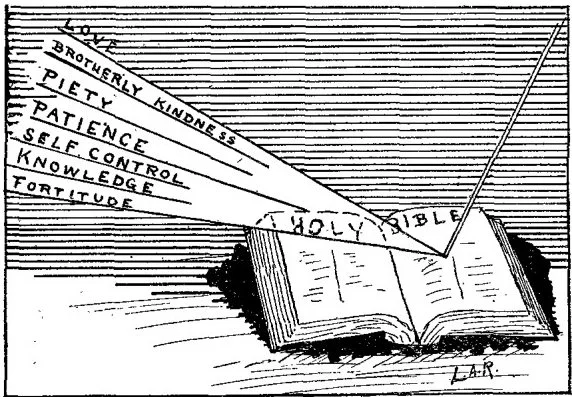
Now this ray of light—this bundle of colored lights—passes through a glass prism. Each color is acted upon by the glass in a slightly different manner. Red is affected the least, and goes almost straight through the glass; still, it is bent a little out of its path. The orange is influenced a trifle more than is the red, and is bent slightly more; and when we place a piece of white paper in their path, we see the two colors lying side by side. The red lies inside, having been bent out of its course but little; the orange lies just outside and beside the red, having been bent just a little more than the red when passing through the glass; but the yellow bends more than did the orange, and is seen on the paper just outside and beside the orange. The green is bent more than the yellow, the blue more than the green, the indigo more than the blue, and the violet most of all; and so they lie side by side on the paper,—seven colored lights. Thus the white ray of light passes through the prism, and is broken up, its various parts being laid one alongside of the other, forming bands of colored light; and this we call the spectrum, or the rainbow, as the case may be.
And I see no reason to doubt that the rainbow about God’s throne is formed according to the same laws that operate in the ray of light. But this glory we are for the present shut away from, until we have been clothed with the character of God, and are made ready for the fulness of the shining of God’s beauteous light.
And even in this character we find something similar to the spectrum, or rainbow.
Now with a glass prism we can not analyze the character of God, as revealed in the Word: the prism will do only for the material aspect of his glory. But in the Word, the spiritual prism, we do find an analysis. This analysis of his character shows that what seemed to be a single whole, is, like the light, a whole made up of different parts; and these different parts are distinguished by their own peculiar manifestations. As analyzed by the Word, these are, virtue, knowledge, temperance, patience, godliness, brotherly kindness, charity; or, according to another translation, fortitude, knowledge, self-control, patience, piety, brotherly kindness, love.

“OVERTIME”—WHY?

South African Sentinel.
THE government frequently employs men to work overtime in order to meet a special emergency. Manufacturers, also, in order to supply their customers and increase their own profits, pay their employees for extra hours.
But why should men be required to work overtime in an English arsenal, when, according to her recent proclamation of neutrality, England is at peace with the world? Does she expect war? If we interpret her actions correctly, as shown by an article in the London Evening News, we should say, YES, and that soon.
“Prepare war. . . . Beat your plowshares into swords,” says the prophet; and the nations respond: We are doing this, even employing men overtime, and night and day, in our preparations.
But while the nations are working night and day in arming for the fray, how many of God’s people are putting in extra hours in preparing for the final contest? How many have already fully removed their “filthy garments,” and put on the “garments of salvation”? How many are now wearing the “whole armor of God,” standing day by day “against the wiles of the devil,” and thus assuring their own souls of victory when the struggle is over?
The results of national victory are not to be compared with the triumph of a single soul over sin; and if, in the present excitement and preparations for war, men are led to see the coming overthrow of all the nations, and the establishment of the kingdom of Christ, and to obtain the “wedding garment,” which will insure them an entrance into the city of God, then will the power of the gospel to redeem men and to preserve them unto the coming of the Lord, be still further demonstrated.
But here is what the News says:—
“‘Wars and rumors of wars,’ is an ancient prophecy, with nearly two thousand birthdays; and judging from the strange stories that are floating about just now, the latter part of the prophecy is being fulfilled with a vengeance. Eyes at this moment naturally turn toward the government dockyards and factories, and any extra activity in them is attributed to impending warfare.
“Woolwich Arsenal is extremely busy at present,—busier than it has been for probably half a century. For two years, at least, work at the arsenal has not ceased day nor night in several of the departments. One good reason for this is the keen competition of the rival powers. Altogether, there are at the arsenal some seventeen thousand employees, about four thousand of whom are engaged in night-work, beginning at six in the evening and stopping at five in the morning. Three of these hours are overtime, and the day-workers are doing about the same extra work.
“In the torpedo factory, four hundred men are working overtime; there are the same number in the fuse factory; and so far as can be ascertained, other departments are proportionately busy.
“But overtime at the arsenal is not a novelty, and causes the employees no trepidation nor anxiety. The more work, the more pay.
“A casual visitor to Woolwich, having the China situation in mind, might see in the bright glare at the arsenal the beacon of a coming warfare, in which all nations of the earth shall participate. Those who live at Woolwich are used to this, however; for they have seen the factories lighted up for the last two years or more. Nevertheless, the employees at the arsenal are working with increased energy just now. The war office has ordered half a million cartridges a week in excess of last year, bringing the total weekly output up to two million. In the fuse factory the men are making two thousand five hundred fuses of one kind, and one thousand eight hundred of another; and orders have been received to push along with the quick-firing guns.”

One Inch of Rain Equals Hundred Tons Per Acre

“An inch of rain means one hundred tons of water on every acre.”
Continue reading: WE ARE OUR BROTHER'S KEEPER