The children had been waiting with some little patience to come into mother’s bed, but it was late when she awoke, and they were met with a decided refusal. Her husband’s warning of the previous evening had been outweighed by the attractions of the book she was reading, which had engaged her weak sight and vivid imagination till a late hour of the night, resulting in nervous headache.
And now the duties of the day loomed up before her like a nightmare, and she felt positively panic-stricken before beginning. There were so many ways to turn she could not think of accompanying the family at the breakfast table, and almost grudged the time consumed by the morning’s devotions.
The children had never been so trying. She scolded them until she was ashamed of herself, which fact they were not slow to perceive, nor to adjust their conduct and estimates accordingly.
The whole day was one anxious scramble to accomplish the Friday’s work in time for the Sabbath, and left her with nerves tense and muscles quivering. The last straw seemed to have been added when her husband came home and blamed her for having undertaken so much. Why had she not let things go? Then she collapsed entirely and sought the retirement of her own room, leaving the family to begin the Sabbath as they had begun the day, without her. Everything looked the blackness of despair. The children were incorrigible, her husband unsympathetic, the Lord very far away, and she herself a wreck.
Thanks to a night’s rest, heaven seemed nearer in the morning sunlight as she read in the loved faces about her the devotion she could never in any sane moment have questioned. But the lesson must not be repeated.
During all the coming week she planned for the Sabbath, so that the following Friday morning did not find her confronted with such a full program. And better still, it found her leaning on the promise, “As thy days, so shall thy strength be.” Thus fortified, her spirits were calm, and the battle half won.
The children were taken into bed for a few moments, and admitted to mother’s arms and her plans for the day, until converted into active and aggressive allies.
At breakfast and prayers the family presented a solid front most disheartening to the domestic mischief-maker. The children proved amenable, and mother received discernment to see before becoming exhausted where still other things could be abbreviated in the day’s program.
When the father returned, he found the family singing round the piano, and all together ready to welcome the Sabbath in peace and happiness. Mrs. Pooley resolved by God’s help never to begin another day without the strength promised for that day.
Takoma Park, D. C.
Opportunities at Home
THE gift we should pray for is vision. Missionary work lies all around us. The story is told of a German girl in a large American city who prayed for years that she might be sent to a foreign land as a
Let There Be Light
By Worthie Harris Holden
WORTHIE HARRIS HOLDEN
BREATHE, Breath of God, upon my soul
to-night,—
Wake up my slumb’ring mind,—let there
be light!
Break off the fetters binding down my
soul,
Give liberty and sight, and make me
whole.
Restore my mind from blight that sin
hath given,
That I may comprehend the thoughts of
heaven:
Unfold as to a child thy grace divine.
And teach me how to claim thy promise
mine.
Unloved, untaught, thou yet didst die for
me!
I fain would fathom more of Calvary.
I, unknown, unsought, thou lovedst me as
thine own!
Unto my finite mind such grace make
known.
Thy love as boundless as the mighty deep
O’erwhelms me ere I lay me down to
sleep;
I wake to find my daily bounties given
As surely as the boon of light from
heaven;
And every hour new mercies throng my way
Through each unfolding of the unknown
day.
May all my life but magnify thy name,
And all my song thy gracious love pro-
claim;
May every word and every deed make
known
The matchless grace that thou to me
hast shown.
Breathe, Lord, upon my suppliant soul
to-night,—
Reveal thyself, O God,—let there be
light!
Portland, Ore.
Twice Born
By Addie S. Bowen
ADDIE S. BOWEN
Jesus said, “Ye must be born again.” John 3:7. In order to see the kingdom of God, we must be born a second time. The first birth is independent of our will or choice; the second is entirely dependent upon our decided choice and will. God’s will is that all shall be born again, born from above, that they may see his kingdom; yet his arrangement is that each individual shall decide for immortal life or eternal death. God wills that every one shall have his own way in this question of supreme importance. He invites to a home of bliss; man accepts or refuses, and takes the consequences. Could there be real salvation, real happiness, in any other way?
We, when born from above, have a new life, a new spirit, the mind of Christ, and walk in newness of life. We also choose the will of the Father. We are new creatures, a “new creation,” and see something of the kingdom of God even now, in his works, in his ways of working. We have the beginning of life that will reach into the real kingdom of God when his plan is complete, even the eternal, everlasting life of which Jesus spoke in John 6:47, 54. If we have Christ abiding in us, if we are born with his life, his Spirit, and do not lose him out of our lives, we shall finally receive immortality when he comes. “He that hath the Son hath life; and he that hath not the Son of God hath not life.” 1 John 5:12.
The Lord be praised that the privilege and right of choice has been given poor sinful mortals,—the choice to be born again,—and that the Son of God suffered death that we might have immortal life.
Bradford, Pa.
Fellowship of Heart with Heart
“’Tis always in the time of deepest stillness
That heart finds deepest fellowship with heart.”
Among the Zapotecan Indians of Mexico
By G. W. Caviness
G. W. CAVINESS
It was my privilege a short time ago to visit our company of believers in Salina Cruz on the Pacific side of the Isthmus of Tehuantepec. This is the place where a company of about twenty Sabbath-keepers was raised up about two years ago by reading. I found the most of this company still faithful, although a few had given up, and some had moved to other places. Two new ones were added to the church by baptism while I was there.
ZAPOTECAN INDIAN GIRL OF MEXICO
With the leader of this company I visited Espinal and Ixtaltepec on the Pan-American railroad, about three-hours’ ride from Salina Cruz. At the former place there are a few who are keeping the Sabbath. We held a meeting in this place, which was attended by over thirty persons, including the leading people of the village. There is an interest here which our Spanish laborer stationed at Salina Cruz will follow up.
Ixtaltepec is only about a mile and a half distant from Espinal, and here also there is a very inviting field. Several years ago a young man saw a portion of our Spanish paper, and became deeply interested. He did not know how to obtain the paper, as the part he found did not give him any clue as to the place of publication. A few years later some one sent him a copy, and he immediately subscribed, and has been a constant reader ever since, that is, for the last four years. He has also written me many times asking questions on Bible themes. I had never seen him until I met him in his father’s house. I found that he had printed the law of God by hand in large letters and had it hung up in the house. His brother said that he had been holding meetings and explaining the Bible to his relatives and friends.
We held a meeting with them, and more than sixty were present, and many stood outside at the windows listening. I never spoke to a more serious and interested-appearing company. They gave the best of attention, and seemed exceedingly friendly.
These people are Indians, and among themselves they speak the Zapotecan language. But Spanish is taught in the schools, and all business is done in Spanish. Their own language has a grammar and a very few books, but they say that only a few of them can read it. In the district of Juchitan there are about fifty thousand of these people, and in other parts of the country adjoining there are as many more. Many of them have their own little farms, and are much more independent than most of the poorer or humbler classes of Mexicans. Morally and socially they are also superior to the ordinary inhabitant of this country. They are intelligent, and religiously inclined, it seems to me. The message has made a beginning among them, and we hope to see it spread. The9Bible says the last message must go to “every nation, and kindred, and tongue, and people.” Here is a tribe that must hear it.
The young man previously mentioned as well is twenty-seven years old, of good address and quite well educated. He has been offered a position as bookkeeper and assistant treasurer in the office of the government. His brother is a telegrapher at a railroad station. There are seven children, and the father and mother still live. Quite a number of uncles, with large families, live near by, and several of these attended our meeting. The young man wants us to send a laborer down to that part of the country, and it is his desire to go with him and learn the truth and how to labor. He desires to join us in giving the message to his people. Shall we not have such a laborer to send, that we may enter this field? Is not the Lord going out before us and calling us to advance?
This part of Mexico is very warm in summer, but there are several months that one accustomed to colder climates can spend down there each year without serious inconvenience.
STREET IN TUXTEPEC, SOUTHERN MEXICO
Some one who understands Spanish should go to this field in October, and spend four or five months laboring for the people, and instructing this young man and also the leader of the company at Salina Cruz, so that they can carry on the work all the year round.
For the most part, these people lead simple lives. They farm with oxen, and use the big lumbering two-wheeled cart, the wheels being made of solid wood about six inches thick. The good people kindly took us to the station in one of these carts. We were about three hours in going five or six miles. I got out to walk for a change and a rest, but soon found myself so far ahead of the cart that I was compelled to wait a long time for it to catch up. As it was night and the road unknown, I did not care to venture too far, lest I might turn from the right road.
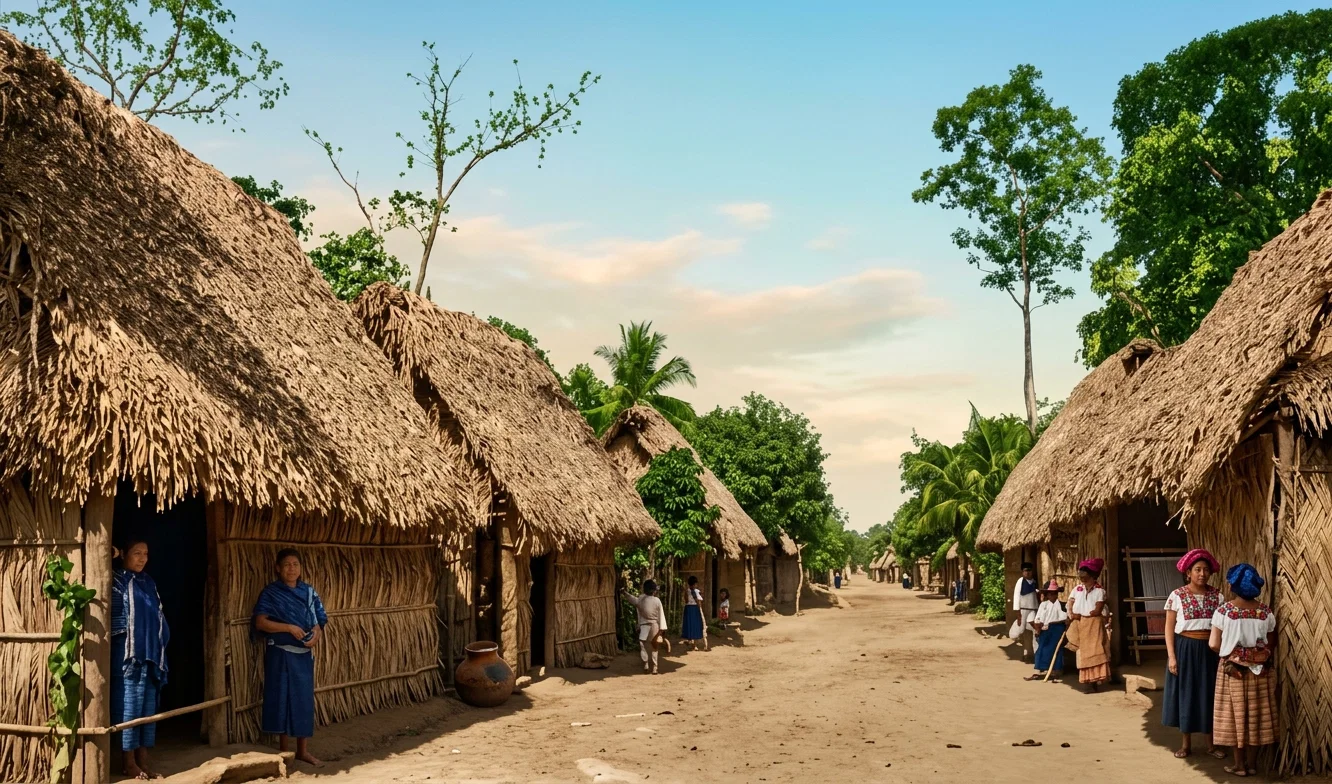
Their houses are for the most part made of small canes set very thick and plastered outside and in with mud. The wall thus formed, a steep roof is made of a framework of poles, and thatched with palm leaves. At a little distance one of these villages looks like a large number of haystacks, each about twice as long as wide. Some of the well-to-do have brick houses, with floors. I did not have to sleep on the ground here, because these people have cots and hammocks. I saw many tables, chairs, and benches made of mahogany in their huts. This wood grows in that part of the world, and is not so costly as it is when brought out to civilization.
The dress of the women in the larger villages and towns is somewhat peculiar. The waist or blouse is usually of very bright-colored material, with arms left bare. The skirt is of dark-colored cloth down to the knee, the rest is pure white. The head-dress stands out from the head a foot or more, much like the tail of a peacock.
The brethren in this field subscribed for one hundred copies of our Spanish paper to circulate among their friends and neighbors.
We need a good man who understands Spanish to be stationed at the city of Oaxaca to take the oversight of the work in the southern part of this great field. Here he can live and work during the warmer months of the year, spending the cooler season among the Indians of this tribe, instructing and training the native workers. May the Lord direct in this matter, so that the work may be carried forward in this part of the Master’s vineyard, and many of this people hear the message and be saved in the soon-coming kingdom!
Tacubaya.
Missionary
missionary. One morning, after her usual prayer, it seemed almost as if the Lord were talking to her, and her thoughts ran something like this:—
“Where were you born?”
“In Germany.”
“Where are you now?”
“In America.”
“Who lives in the room next to yours?”
“A Swede girl.”
“Is she a Christian?”
“No.”
“Who lives in the flat below?”
“An Irish family.”
“Christians?”
“No.”
“Who lives next door?”
“Italians.”
“Christians?”
“No.”
“Have you ever done any missionary work in this neighborhood?”
And she was obliged to answer with shame and humiliation, “No.”
In a foreign land, in the midst of foreigners who knew nothing of God, she had not recognized her opportunity. Is she the only one of whom that could be said? How is it with you?—The Youth’s Comrade.
Ten Helpers for You
POLITENESS — will attract attention.
Cheerfulness — will make friends.
Honesty — will strengthen friendship.
Faithfulness — will be appreciated.
Thoughtfulness — will avoid trouble.
Intelligence — will be respected.
Enthusiasm — will bring good results.
Diligence — will insure success.
Regularity — will retain friends.
Consecration — will win souls.
— Selected.
Brief Hints for Bright Girls
SOME one has suggested several things that every girl can learn before she is fifteen. Not every one can learn to play or sing or paint well enough to give pleasure to her friends, but the following “accomplishments” are within everybody’s reach:—
Shut the door, and shut it softly.
Keep your own room in tasteful order.
Have an hour for rising, and rise.
Learn to make bread as well as cake.
Never let a button stay off twenty-four hours.
Always know where your things are.
Never let a day pass without doing something to make somebody comfortable.
Never come to breakfast without a collar.
Never go about with your shoes unbuttoned.
Never fidget or hum so as to disturb others.
Never fuss or fret or scold.— Kind Words.
ANOL GRUNDSET
By Anol Grundset
Abyssinia
ANOL GRUNDSET
I BELIEVE it will be of interest to have a few lines from this part of the world-wide field. I arrived here to take charge of the Abyssinian Mission in October, 1909, and have been very busy ever since. The two brethren here had occupied their time the past two years in learning the language of the people, and this is of much help. They have not yet fully mastered it, but a good beginning has been made. Remember, we are grappling with one of the most difficult languages to be found anywhere. We who have more recently come, are busily studying it. But, since the alphabet contains about two hundred fifty-six characters, not one of them in any way resembling those of our alphabet, their pronunciation very difficult, requiring every conceivable twist of the tongue to produce, we can not advance as rapidly as if learning a more modern language. But God being our helper, we are confident that we shall be able to fully master it, and thereby be able to make known to the people the same precious truths that have made you, my brethren and sisters, glad in the faith.
There are many problems here difficult of solution, and our way is by no means clear. But we know that he who has summoned us to this place will adjust every hindrance, and further his own cause. The people hold very firmly to their own faith and beliefs, which, so far as I have found, are a mixture of a little truth and much paganism and heathenism. The priests have a strong hold. We anticipate many and varied experiences in presenting the message, but believe that it will captivate the honest of even the Abyssinians, and that in this vast throng representatives will be found soon, to surround the throne. What a gathering that will be! A saved people from all of earth’s varied nations! Will you and I be in that number? Our daily life is now testifying as to how that question will be answered. If properly answered by victory over sin, we shall find there our final reward. “He that overcometh shall inherit all things; and I will be his God, and he shall be my son.” Rev. 21:7. God help us all now to be daily, yes, momentarily, overcomers.
The climate is fair. The fever districts are not far away, but there is no fever where we are located. We are about seven thousand feet above sea-level, and above the fever line. The days are very warm, but the nights often get quite cold. Vegetation is very scarce for seven or eight months of the year, because during that time it does not rain. However, trees, vegetables, and flowers will grow the year round, if watered. Trees two or three years old will live through the dry season without being watered. The whole country about here is desolate, and to one accustomed to seeing grass and green fields, presents everywhere an almost discouraging spectacle. There are pieces of land in the valleys, that, if tilled and watered, would produce well. We are thankful that even here old mother earth, weighted doubly under the curse of sin, will yet, as the reward for persistent toil, give something in return. But there is no comparison between conditions in this country and the land in the States which is blessed so abundantly with rain and snow. One may travel long distances here, and find no water. We believe we shall find plenty on our mission farm, and for this we are very thankful.
Recently, at the time of Elder L. R.10Conradi’s visit to us, we purchased a piece of land of about sixty-five acres, about one mile and a half from Asmara. This had practically no buildings on it, and we are at this writing very busy erecting a double dwelling-house, schoolhouse, and a barn. We are also digging a well. This will be our first mission station. We believe the Lord has helped us in securing this property, and given us much favor with the officials of the government, even though our getting it was opposed by some.
We hope later, if our dear people by their contributions and help will make it possible, to open another station. Our buildings are not expensive, being made of stone, of which there is plenty on the place. Tin sheeting is used for roof, and cement for floors. Lumber is so high that we can not afford to use it, except for doors and windows. Even the other materials are quite expensive. The people are very poor, and we often wonder how they live on their meager resources; but they live very simply, and many are in an almost wild state.
At this writing we are well, and thankful to God, who has brought us safely over the seas, kept us in health, and given us a humble part to act in the great closing message proclaiming to every nation, tongue, and people the glad tidings of the coming King. We are of good courage. We can not boast of being blessed with the abundant luxuries of the home land. What one would call necessities would here be termed by many an abundance. But we are content. When we think of Jesus, who left his royal home on high and came to earth and was forsaken and opposed by even his own people, dying on Calvary’s cross after his life of self-denial and sacrifice in our behalf, we are glad we can endure a little for his sake. To you in the land of such abundance, let me say, Give of your entrusted means to speed the everlasting gospel, the message so dear to us, to these millions of souls in Africa’s error and darkness. Speed the Saviour’s return by finishing that which he has given us to do. Already the sun is fast setting on the western horizon of time. Signs are thickening and fulfilling everywhere about us. Therefore, let us, wherever God has stationed us—you in your place, we in ours—be faithful. Watch and pray. The time of our redemption hasteth. Be ready. And while we wait, let us also labor, for the night cometh, when man’s work is done. We ask your prayers and co-operation for the proclamation of present truth to Abyssinia.
Asmara, Eritrea, East Africa.
A Short Visit to Japan
By E. H. WILBUR
E. H. WILBUR
On Friday, February 4, my wife and I and two children sailed from Hongkong for Seattle, on the steamship "Minnesota." Our first stop was at Nagasaki, Japan, where we arrived on the morning of the eighth. Here we found Brother Walter Foster and family, and their sister, Miss Cornish, who are hard at work studying the Japanese language. We also met Brother M. Tsukamoto, who has had considerable experience as a teacher. We were glad to find our workers there of good courage. Brother Foster reports that he has gained twenty-five pounds in weight during his stay of a year and a half in Japan.
Nagasaki is a beautiful city, situated on the hillsides around the harbor. It is the coaling station for many large Pacific steamers, and is the terminus of a railroad. It is also quite a missionary and educational center. We have had a church organization there for several years, but, unfortunately, have no church house as yet. We never had a European laborer working there until a few months ago, when Brother Foster moved there.
On Friday morning, February 11, we arrived at Kobe, where we were hospitably entertained at the home of Brother John Herboltzheimer. That evening we attended prayer-meeting in our own neat little church. About thirty were present. I was pleased to notice that, while the congregation was gathering, those present occupied the time in the study of the Sabbath-school lesson. The prayer-meeting was conducted by the elder, Brother K. S. Noma. Several took part in prayer and testimony. I could not understand what was said, but it was evident that the Spirit of the Lord was present. They sang such familiar tunes as "The Gate Ajar," "This Is My Story."
On Sabbath morning, at half-past nine, the brethren and sisters met for Sabbath-school. Brother Fukaziva is superintendent, and Sister Fukaziva, organist. They use the same lessons as are used in America; although one quarter late, on account of having to print them in Japanese. One noticeable feature was the almost complete absence of children, the little ones having their school at 4 P. M. At 10:45 A. M. the writer gave a talk upon the progress of the message in China. One of the brethren acted as interpreter. All seemed much interested to hear. On Sunday evening I was privileged to speak to them again, the subject being the state of the dead.
On Sunday afternoon, in company with Brother Herboltzheimer and family, we were invited to dine with Brother and Sister Noma at the Japanese Sanitarium, or Kobe Eisein, as they pronounce it. The dinner was vegetarian, hygienically prepared, and served in Japanese style. We met Dr. Noma more than seven years ago, on our way to China. She then had a small hospital in Nagasaki. Then, we had no church or sanitarium in Kobe; now, although the sanitarium for Europeans has been closed, yet this institution for the Japanese, which is operated by them, seems to be doing excellent service. A nurses' training-school is operated in connection with it. There is a liberal patronage. I could not help wishing that we had such institutions in China, and I have faith that we shall have erelong.
The following Tuesday, at noon, our ship sailed out of Kobe harbor. At 10 A. M. the next day we sighted the beautiful snow-capped Mt. Fuji, which is 12,370 feet above the sea-level. At 4 P. M. we arrived at Yokohama. Dr. and Mrs. W. R. Dunscombe kindly came to meet us, and I returned to Tokyo with them the same evening. The following morning I went to Brother W. D. Burden's home, several miles distant, in another part of the city. A part of their house is used by the mission, for school and chapel and publishing purposes. We found a Bible school in progress, with about twenty men and women in attendance. Besides Elder Burden and family, we were pleased to meet Elders F. W. Field, H. Kuniya, and T. H. Okohira. These brethren are laboring hard to establish the truth in this important center. They are anxious to open treatment-rooms, and to erect a church, and surely should have these buildings.
I was astonished at the size of Tokyo. It extends over a large territory, and has a population of 1,818,655. It is about eighteen miles from Yokohama, with which it is connected by steam and electric cars. The railroad depot reminds one of some of our union stations in America. There are many electric lines crossing the city in various directions. They have broad business streets, with modern buildings.
Thus we had the privilege of meeting all our European missionaries in Japan, except Brother and Sister H. F. Benson. While we were glad to see so good a company of representatives of the message, yet this is but a handful, comparatively, for a land having nearly half as many people as the United States.
Every Part of the Bible Is Profitable
To illustrate how different portions of the Bible appeal in a peculiar manner to different nationalities, it is said that the first chapter of Matthew, giving the genealogy of the Lord, is held in much reverence by the Chinese. They have reverential regard for ancestral genealogy. This chapter, as one of them said, “takes us back to our Chinese Hsia dynasty.” It is also said that the Moslems are especially interested, as all should be, in the book of Genesis, which they correctly term, “the history of the creation of the world.” One Bible translator was a little anxious as to the effect of the long ritual chapters upon the Nepalese people. He was much surprised to find that his assistant, belonging to this people, considered this the most interesting portion of the Old Testament. God’s Word is all profitable, and while different people manifest special interest in particular portions of the Bible, as illustrated above, we are further reminded by these facts that there are no non-essentials in the Book God has written: nothing that needs editing out or written in by human hands. Salvation essentials are all there, and all are needed.
No Mysticism
By Editor
Editorial
No Mysticism.—From the earliest days the advent testimony was a protest against mysticism. The modern mystical ideas of heaven and the future life have obscured the healthy and truly spiritual view of the Christian’s hope. The message of the second advent proclaims anew the “blessed hope” of apostles and prophets, and inspires us to warfare and pilgrimage with the saints of old who “looked for a city which hath foundations, whose builder and maker is God.”
The Heavenly Land.—It was a real country toward which the early believers set their faces in the advent movement. The only poem printed in the little volume of Present Truth, our first paper, was a hymn characteristic of this faith in the reality of heaven. Concerning the hymn, a note in the paper said:—
Some may be interested in learning the origin of the hymn on the first page of this number. In the spring of 1845, the author of the vision published in this paper was very sick, nigh unto death. The elders of the church were finally called, and the directions of the apostle (James 5:14, 15) were strictly followed. God heard, answered, and healed the sick. The Holy Spirit filled the room, and she had a vision of the “city,” “life’s pure river,” “green fields,” “roses of Sharon,” “songs” of “lovely birds,” the “harps,” “psalms,” “robes,” “crowns,” the “mount” Zion, the “tree of life,” the “King of that country,” mentioned in the hymn. A brother took up his pen, and in a very short time composed the hymn from the vision. It has been published in two or three second advent papers, Smith’s collection of hymns, and finally found its way into the “Advent Harp,” published by J. V. Himes in 1849. Let those who “despise prophesyings,” and reject the fulfilment of God’s word in visions of the “last days,” remember when they sing this hymn, that it was composed from a vision.
Here is the hymn (now in our “Hymns and Tunes,” No. 1010), “The Better Land,” written by W. H. Hyde:—
“We have heard from the bright, the holy land,
We have heard, and our hearts are glad;
For we were a lonely pilgrim band, And weary, and worn, and sad.
They tell us the saints have a dwelling there;—
No longer are homeless ones;
And we know that the goodly land is fair,
Where life’s pure river runs.”
“They say green fields are waving there,
That never a blight shall know;
And the deserts wild are blooming fair,
And the roses of Sharon grow.
There are lovely birds in the bowers green,
Their songs are blithe and sweet;
And their warblings, gushing ever new,
The angels’ harpings greet.
“We have heard of the palms, the robes, the crowns,
And the silvery band in white;
Of the city fair, with pearly gates,
All radiant with light.
We have heard of the angels there, and saints,
With their harps of gold, how they sing:
Of the mount, with the fruitful tree of life,
Of the leaves that healing bring.
“The King of that country, he is fair,
He’s the joy and light of the place;
In his beauty we shall behold him there,
And bask in his smiling face.
We’ll be there, we’ll be there in a little while,
We’ll join the pure and the blest;
We’ll have the palm, the robe, the crown,
And forever be at rest.”
A Companion in Trouble
By W. A. S.
IN the early days of Methodism, a minister of the Welsh Calvinistic Methodist Church, John Jones, of Flintshire, was traveling on horseback through a desolate region in northern Wales. According to his account, reprinted years ago in the London Christian Herald, he observed a rough-looking man, armed with a reaping hook, following him on the other side of a hedge, aiming to come up with him at a gate where it was necessary for the horseman to dismount.
The minister had a bag of money which he had collected for chapel building, and felt that not only the money, but possibly his life, was in danger. He stopped his horse, and bowed his head to pray for special aid and protection. The horse was restive to go on, and on looking up after a moment of silent prayer, Jones saw a horseman on a white steed immediately alongside. He was surprised and unable to account for the sudden and welcome appearance of a companion at such a moment. He says:—
I described to the stranger the dangerous position in which I had been placed, and how relieved I felt by his sudden appearance. He made no reply; and on looking at his face, I saw that he was intently gazing in the direction of the gate. I followed his gaze, and saw the reaper emerge from his concealment, and run across a field to our left. He had evidently seen that I was no longer alone, and had given up his intended attempt.
All cause for alarm being now removed, I endeavored to enter into conversation with my deliverer, but again without the slightest success. Not a word did he give me in reply. I continued talking, however, as we rode toward the gate, though I utterly failed to see any reason for, and indeed felt rather hurt at, his silence. Only once did I hear his voice. Having watched the reaper disappear over the brow of a neighboring hill, I turned to my companion, and said, “Can it for a moment be doubted that my prayer was heard, and that you were sent for my deliverance by the Lord?” Then the horseman uttered the single word, “Amen.” Not another word did he give, though I continued endeavoring to get from him replies to my questions, both in English and in Welsh.
We were now approaching the gate. I hurried on my horse for the purpose of opening it, and, having done so, waited for him to pass through; he came not. I turned my head to seek for him—he was gone. I was dumbfounded. I looked back in the direction from which we had just been riding; he was not to be seen. He could not have gone through the gate, nor have made his horse leap the high hedges which on both sides shut in the road. Where was he? Could it be possible that I had seen no man or horse at all, and the vision was but a creature of my imagination? I tried hard to convince myself that this was the case, but in vain; for unless some one had been with me, why had the reaper, with his murderous-looking sickle, hurried away? No; this horseman was no creature of mine. Who could he have been?
I asked myself this question again and again, and then a feeling of profound awe began to creep over my soul. I remembered the singular manner in which he first appeared. I recollected his silence, and then again that the single word to which he had given utterance had been elicited from him by mentioning the name of the Lord, and that this was the only occasion on which I had done so. What could I then believe?—But one thing, and that was that my prayer had been heard, and that help had indeed been sent me at a time of peril. Full of this thought, I dismounted, and throwing myself on my knees at the side of the road, offered up a prayer of thankfulness to him who had so signally preserved me from danger.
I then mounted my horse and continued my journey. Through the years that have elapsed since that memorable July day, I have never for an instant wavered in the belief that I had a special providential deliverance.
There is the ring of genuineness in this testimony. Not a few times in the Bible story were human eyes opened to see the presence of the angel messengers. But our faith in the ministry of angels rests on no visible signs or impressions of the senses. We have the far surer word of the Lord that all the angels are ministering spirits, sent forth to minister to the heirs of salvation. It is a comforting thought that the same angels who appeared to men in Bible times, and who12have been the agents of God’s overruling providence in all these six thousand years of human history, are gathering round this little earth to-day for the final crisis in the great controversy. They that are with us are more than they which are against us. W. A. S.