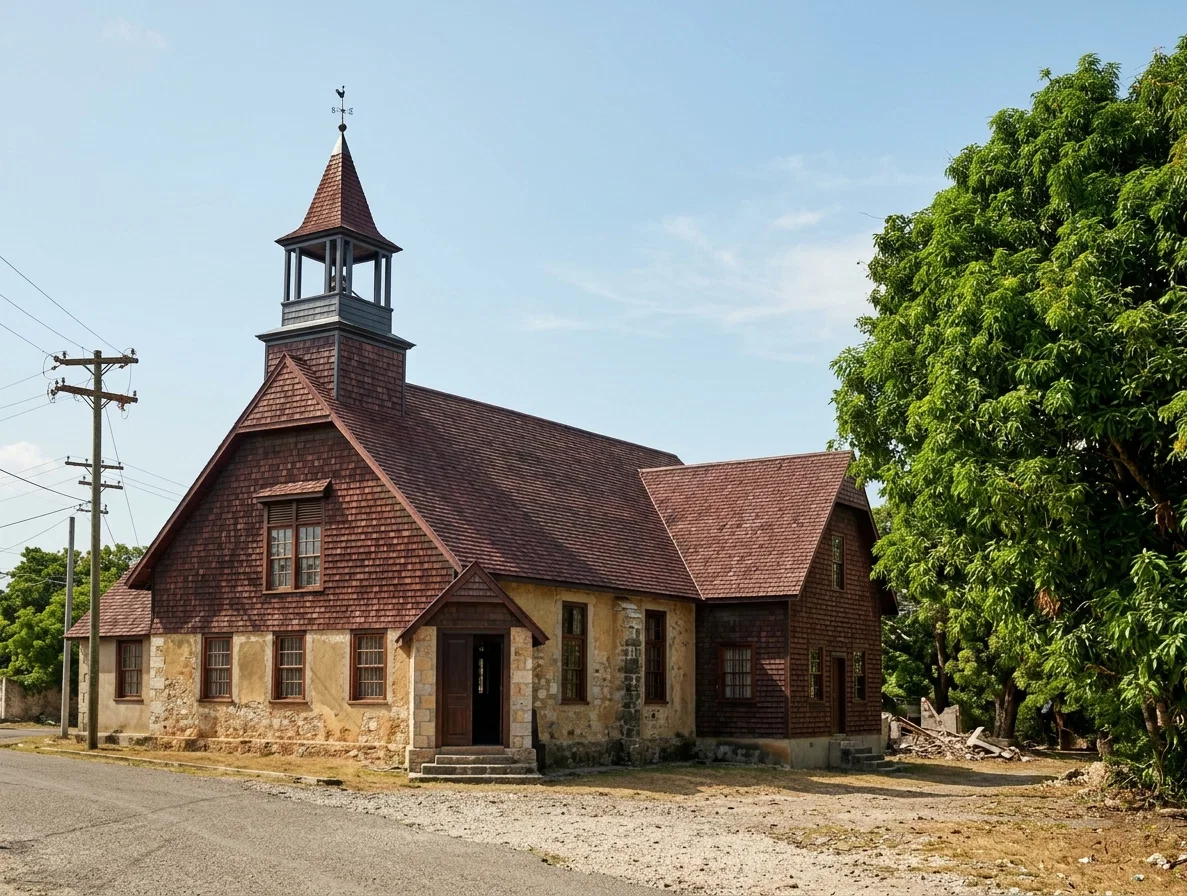
THE seventh annual session of the Jamaica Conference was held at Kingston, Jamaica, December 31 to January 9. The meetings were held in a church building that has been recently erected. The ruins of the old building, destroyed in the earthquake, are still standing. During the conference, meals were served here. This new building shows a spirit of advancement; for our people, who are very poor, have been obliged to put forth strenuous efforts to erect it. It is very neat and commodious, and speaks well for the work of the builders.
SEVENTH-DAY ADVENTIST CHURCH AT KINGSTON, JAMAICA
Elder D. E. Wellman, the conference president, had put forth very earnest efforts to make this meeting one of real educational value, and an excellent program had been arranged. The work of each department of the conference received careful study. Papers had been prepared. and talks were given concerning the interests of each department. As this is the first time such a systematic effort has been made to educate the people of the conference concerning the various phases of our work, it was of special value to the delegates and friends. As the result of these studies, our brethren entered heartily into all plans looking toward the advancement of all departments of the work. Elder Wellman was re-elected president of the conference, and but few changes were made in the staff of officers who work with him. He has the love and entire sympathy and support of his fellow workers, and a spirit of courage is felt as they start on the new year's service.
Jamaica has a population of but eight hundred thousand, and yet we have thirty-one churches on the island. During the past year two churches have been added to the conference, and the total list of Sabbath-keepers is now 1,934. The tithe receipts for the past year were $4,845; this is an increase of $523 over that of last year. The total offerings for foreign missions were $1,075, which is an increase of $319 over that of the preceding year. While these tithes and offerings are not large as compared with reports from some of our other conferences, yet in view of the financial condition of the people of the island as a whole, and our people in particular, and in view of the disastrous earthquake, which came to the island about three years ago, they are certainly commendable. Every department of the conference presented an encouraging report of progress. We have but few conferences with the population of Jamaica where the truth has so strong a foothold, and where we have so many churches established; but the work on the island is not yet finished, as was witnessed by the cheering reports of the laborers. Honest souls are continually accepting the truth, and there is a great work yet to be done.
An excellent spirit prevailed throughout the entire session. Several revival meetings were held, confessions were made, and a spirit of love and consecration was manifest. The last Sabbath of the conference was notable in its spiritual uplift. The good Spirit of the Lord was especially witnessed in the workers' meetings, which were held daily from twelve to one. They were a means of drawing the hearts of the laborers into the close union. The evening meetings were well attended by the people of the city, who seem to feel very kindly toward our people and work.
Elder U. Bender, president of the West Indian Union Conference, and the writer, from the General Conference, were in attendance at the meeting, from outside the conference.
FREDERICK GRIGGS.
New Guinea
By S. W. Carr
BRITISH NEW GUINEA comprises 90,000 square miles, 2,700 of which constitute the islands to the east of the mainland. Its length is about 800 miles, and the width at each end is about 200 miles, but only about 50 miles in the center. The coast line of the mainland is 1,700 miles long, and of the various islands 1,900 miles. Most of these islands are mountainous, the highest being 8,000 feet; and they are of volcanic origin, with rich soil and dense tropical vegetation.
Papua is a land of mountains, rivers, and swamps. The main range, called the Owen Stanley, begins at the eastern point and runs westward through the Central Division, then northward into German New Guinea. Quite a number of peaks range from 10,000 to 13,000 feet high, and thus New Guinea has a good variety of climates. The Western Division contains most of the marshy and swamp land, also the Fly River, which is the largest in Papua, and has been navigated for a distance of 600 miles in a launch. Its estuary, which is 50 miles across, contains many islands, one being 50 miles long; one hundred miles farther up, the river is about four miles wide.
The people of Papua are as varied as the country and climate. In the west they are tall, dark, and savage, and still carry on their tribal wars and cannibal feasts; farther to the east the Papuan is smaller, lighter, and more peaceable, largely through missionary effort and government influence.
But whether the people are dark or light, large or small, savage or quiet; whether they live in the hot lowlands or malarial swamps or the cooler but difficult mountain districts, we are debtors to them all, and they must each have opportunity to know that there is a loving Saviour who died for both black and white, who wants them to hear, believe, and follow him, and be ready also to meet him when he comes.
S. W. CARR.
Bible Workers' Training-School
By R. D. Quinn
IN response to the urgent call for Bible workers to enter the large cities of the East, a Bible training-school has been established in New York City, with a view to qualifying workers in a very practical way to bring the truth prominently before the multitudes living in the great centers of population. A three-story modern house has been secured in a very desirable locality in the outskirts of the city, in which the work will be conducted.
In a recent testimony from Sister E. G. White relating to the work here, and the establishment of a training-school for workers, the following instruction is given: “We need a sanitarium and a school in the vicinity of New York City, and the longer we delay in the securing of these, the more difficult it will become. It would be well to secure a place as a home for our mission workers outside of the city. It is of great importance that they have the advantage of pure water free from all contamination. For this reason, it is often well to consider the advantages of locating among the hills. . . . Such a home would be a welcome retreat for our workers, where they may be away from the bustle and confusion of the city.”
We are glad to report that such a location has been found. While every part of the city is within easy access by means of rapid transit, still the school is located near the country, in the immediate vicinity of the Zoological Park, Botanical Gardens, and an extensive natural park through which the Bronx River flows. This park is situated among the hills, much of which is covered by a beautiful hemlock grove. The water and air in this part of the city are excellent, and the general surroundings are very beautiful and admirably adapted to this work.
In consideration of the great need of earnest laborers among the multitudes dwelling in the city, and in view of the fact that God has said that many more laborers should be trained for service, there should be many who will gladly respond and take advantage of the opportunity now offered. Those entering the school will receive daily instruction from experienced laborers, and will also unite in the general public efforts put18forth.
All applications to enter the school should be addressed to the superintendent, Elder E. A. Merrell, 2342 Crotona Ave., New York City, N. Y.
R. D. QUINN,
Pres. Greater New York Conf.
Cumberland Conference
By P. G. Stanley
Since our union conference held in Atlanta, January 10-19, we have, in connection with our various official duties, been pushing vigorously the $300,000 Fund. We are pleased to report at this writing that we have our entire quota raised, with three hundred dollars in advance. We still have a few small companies and isolated members to help us swell this amount. We have also raised a substantial fund to purchase a new outfit for our camp-meeting dining-tent, which will be run this year on the cafeteria plan.
March 6-13 we held a most successful canvassers' institute in Cleveland, with nineteen workers present; a number of these are in the field, and are doing excellent work.
We have dedicated one church, and organized another of sixteen members at Athens. Our tithe is coming up, and new life and inspiration is taking hold of our people. All our workers are of excellent courage, and are having success in their work.
Two of our faithful canvassers have awakened an excellent interest for a tent-meeting in Whitwell, a town of four thousand inhabitants, located in the Sequasia Valley. A Methodist minister near this city has become deeply interested in the truth by reading our books. He has voluntarily offered us the privilege of preaching the truth in twelve churches now under his jurisdiction. We expect to step into this opening, and ask an interest in the prayers of our people for the success of the work.
P. G. Stanley,Pres. Cumberland Conf.
Western Pennsylvania
By J. W. Watt
FORD CITY.—I began a series of meetings at this place February 25. Three dear souls have taken a stand to keep the Sabbath, two others have said they would keep it, and still others are deeply interested. We hope to see quite a number walk in the light.
There are three or four persons in this vicinity who have kept the Sabbath in a way for several years, but have not felt free to identify themselves with us, as they do not believe in organization. These persons have attended our meetings some, and we hope they also will see the whole truth.
Brother Harvey Zach has been canvassing in this vicinity for a few months, and has placed in the homes of the people more than three hundred copies of “Daniel and the Revelation.” The writer is spending some time canvassing for “Object Lessons” for the benefit of our school at Indiana, Pa. Up to date thirty-two orders have been taken. By going out with this excellent book, “Object Lessons,” I find many opportunities to hold Bible talks with the people which I would not otherwise have. Although in my sixtieth year, having spent thirty years in the ministry, I thank the dear Lord for a reasonable degree of health and a humble place in his precious work. I praise his name that he gives me the blessed privilege of seeing a few souls embrace the truth from time to time. Let us all be faithful, for we are almost home. Pray for the work at this place.
J. W. WATT.
Solusi Mission, Africa
By M. C. Sturdevant
THE work is moving forward here. Never have the blessings of God been more manifest at this mission than during the past year. The number of our native boarders has now reached seventy-five. We have twenty-four girls—more than we ever had before. We have a very good class of students.
Yesterday, December 25, was a blessed day with us. While the world generally was given up to pleasure, twenty-four souls gave themselves wholly to God, and were baptized in the river, one mile from the mission home. It was a precious season. About one hundred fifty natives gathered about us. We had three short discourses. Brother Victor Wilson spoke first, laying before the people the great gospel call, urging them to give themselves to Christ in this, the acceptable day. Mark Gangazi followed, with most stirring words on Romans 6. Jim Duba then presented the wonderful gift of God, showing how he wants us to grow up as “trees of righteousness.” After this the writer led the candidates into the water.
One special feature of the occasion was that most of these were the fruits of our out-station effort. This was encouraging to our native teachers, many of whom were in from their schools at this time. Another feature encouraging to us was that two of the old native mothers, widows, were baptized with these young people. They said they could not let all the young people go to the home above, and they be left out. They had long ago given up their snuff and wine, and the worship of other gods. I can assure you, this makes our hearts glad, as these were the first-fruits of the old natives. Others desired baptism; but we asked them to wait a little longer, that they may more fully learn the ways of God. Past experience has taught us to go carefully in this matter. All who received the rite, except the two aged women, know well how to read and study the Bible.
The home school, and also our seven out-schools, have done well this past year, far better than any previous year. The temporal wants of the mission have also been graciously supplied by our Heavenly Father. To him we give thanks. This planting season has been very late, and we have had little rain so far, yet we have planted two hundred forty acres, mostly to corn, with peanuts, Kafir peas, sweet potatoes, beans, etc. All are coming on nicely at the present. We can truly say God is good, and it is most pleasant to serve him. Pray for us. M. C. STURDEVANT.
Canvassing in South Carolina
By T. H. Jeys
A COMPARISON of the tabulated reports given in the REVIEW from time to time reveals the fact that South Carolina is an excellent canvassing field. The territory has not been worked over again and again by agents for other houses. The people are kind, hospitable, and look with favor upon the evangelistic canvasser.
We want many helpers, and gladly welcome those who have a burden for souls. We are not specially anxious to invite persons who have nothing to do where they are, or who have a burden to deal in land speculation as a side issue. There is much land all over South Carolina, but our message is more important than the land.
Now, just now, while the doors of thousands of homes are open, we wish to enter with the life message. H. B. Gallion, Anderson, S. C., is our State missionary agent. Write him for information.
T. H. JEYS,
Pres. South Carolina Conf.
In the Rhenish Conference
By Guy Dail
HERE in Elberfeld the last annual session of the Rhenish Conference, which has been assembled since Wednesday, closed, evening after the Sabbath, January 29. The forenoon service took the form of a revival, and a number manifested their desire to reconsecrate themselves to the Master. This afternoon was solemnized by the ordination of Brother E. Gugel to the gospel ministry. In the social service that followed the ordination, about five hundred took part within half an hour, giving short, earnest testimonies. The congregation was divided into many groups, so that this was made a possibility. The help of Brethren L. R. Conradi, J. H. Schilling, and O. Itzman, and Dr. E. Behn of Friedensau, was appreciated.
The Rhenish field is compact. It is composed of Rhenish Prussia, and is situated in the beautiful Rhine Valley. This is one of the great industrial centers of the German empire. It contains such cities as Cologne and Duesseldorf, Aix-la-Chapelle and Bonn, and Elberfeld-Barmen, Essen, Saarbrucken, and Crefeld, in all of which we have churches or companies of believers. The population of Rhenish Prussia is seven million, very largely devoted to the manufacture of silks, cottons, and hardwares.
Two hundred sixty-six were received by baptism and vote last year. Three new companies were received into the conference at this meeting. After the auditing was done, there was sufficient surplus in the treasury to warrant the voting of three hundred dollars toward the West German Union Mission fields — Austria, Dalmatia, and Holland and Flemish Belgium — and one hundred dollars for the union conference educational fund. Forty copies of “Ministry of Healing” were sold at the meeting. The book sales for the year amount to nearly $8,120, a little less than in 1908.
There was harmony in the business transactions throughout. Elder J. G. Oblander was re-elected president. He will be assisted by nearly twenty workers the coming year. The evening lectures were well attended, many being obliged to stand during the entire service.
We bespeak for this conference, with its wide-awake people, its unentered cities, its largely Catholic inhabitants, and its great harvest-fields, an interest in the sympathies and in the prayers of our brethren in all parts of the world.
GUY DAIL.
Ten Swedes Accept the Sabbath Truth
As a result of work done last winter among the Swedes at Kansas City, Mo., ten have accepted the Sabbath truth.
Does It Pay Seventh-day Adventists to Operate Sanitariums?
By W. A. George, M. D.
WITH over two and a half million dollars invested in some eighty sanitariums, and these institutions operated at large expense, and sometimes at a loss, the question may arise, Does it pay? This question might receive either an affirmative or a negative answer, according to the standpoint from which we view it. From the worldly standpoint of a money-making business, our sanitariums can never hope to be made great financial successes. Our sanitariums, which are more than self-supporting and are making good gains, are paying salaries which the people of the world would consider too small for the kind of work performed. If the wages in our institutions were in proportion to wages for similar work in other institutions, none of our institutions could hope to make expenses.
So from the financial standpoint, the answer would be, No; it does not pay to operate sanitariums. This same answer might be given to the question, Does it pay to run our schools and colleges? Does it pay to run publishing houses? Does it pay to send out ministers and Bible workers? Does it pay to go into the canvassing work? In each case we would find that from the worldly standpoint, our work is a financial failure.
But there is a much broader side to this question, and it is the object of this paper to call attention to some of the reasons why it does pay Seventh-day Adventists to operate sanitariums. First, however, let us compare briefly the workers engaged in our sanitariums and those under conference pay, as ministers, licentiates, and Bible workers. In the Year Book for 1908 the number of conference-paid laborers is given as 1,786. In the Year Book for 1909 the number of conference-paid laborers is not given, but the total number of workers in our sanitariums is given as 1,786, exactly the same as the paid conference workers given in the previous Year Book. The tithe per annum is given as about one million dollars. This, of course, is distributed among these paid conference laborers. A fair estimate of the wages of all the workers engaged in our sanitariums would be seven hundred thousand dollars a year. Although our medical workers and our conference workers are not engaged in the same kind of work, and have talents quite different, yet we believe that the former will compare favorably as workers, both in mental training and in faithfulness to the work in which they are engaged, with the latter. We see, then, that for an equal number of workers the medical work is being conducted at an expense of about three hundred thousand dollars a year less than the conference work. It seems safe therefore to conclude that from the standpoint of wages to sanitarium employees, this line of work is being conducted economically. It should be remembered also that these employees are self-supporting missionaries in the majority of cases.
Another item which amounts to over sixty-seven thousand dollars a year is the charity work done. Our sanitariums actually earn over sixty-seven thousand dollars more each year than they are given credit for. Many are taken in who are unable to pay anything, or at most only a small fraction of the expense for their care. This represents actual work done, but it is credited to the discount and charity account. If this item were cut out in some of our institutions, they would become self-supporting, whereas they are now running behind.
But what are our sanitariums doing? What is their work? Are they doing any good in the world? Are they doing that for which they were established? We answer, Not all for which they were established, but to some extent at least they are fulfilling the purpose of God in doing their part to carry the third angel's message to the world. The influence of our sanitariums has become world-wide. There is scarcely an intelligent person in many communities even hundreds of miles from a sanitarium who does not know something of Seventh-day Adventists through the work of the sanitariums. Our health workers reach a class of people not easily reached by other workers. They reach both the rich and the poor. They reach those who, in their condition of ill health, would not listen to the truth if it were taken to them by other workers; but when brought in contact with the truth lived out in our institutions, they are susceptible to its influence.
While our sanitariums can not report large numbers coming into the truth, yet they sow the seed, which is often watered and the harvest gathered in by other workers. Many times the minister comes into a new field, and among the first individuals to become interested in the truth are those who have been to a sanitarium. They know something of Seventh-day Adventists, and they respect this people because of their sanitarium work. Many persons of influence who would look with disdain upon our methods of work in going from place to place with a tent, or in sending out men and women to canvass for our books, are led to respect our work by means of our sanitariums.
The Year Book for 1909 gives the total number of patients treated in our sanitariums during the past year as nearly twenty-two thousand. It would be safe to say that the majority of these patients spent, on an average, several weeks in one of these institutions, and that they had opportunity every day to attend worship, and several times during the week to attend other religious services. It is true they do not all attend, but there is a constant sermon preached to them by the workers. It is very common to hear patients say, “How kind these helpers are to one another! I never hear them speak a cross word.” When the work is closed down on Friday evening, it is not necessary to preach the Sabbath to these people. It is a weekly sermon without saying a word. Our workers become truly epistles, known and read of all men. Many leave our institutions, having fully accepted our views, and others carry away favorable impressions, which will ripen into fruit later on.
While the physicians and many persons of the world would not admit it, we believe it is safe to say that the influence of our sanitariums has given rise to many of the great reforms in regard to health principles which we find being taught in different parts of the world. So there is a great influence going out to enlighten the masses.
Not a small part of the work of our sanitariums is the help rendered to our own people. Undoubtedly many lives among our people have been saved through the ministration of our sanitariums, and many workers are now in the field, who, without these institutions, would have been in the grave. What estimate can we place upon the value of these lives?
These institutions are not only conducted as medical institutions, but are educational. They are continually training and sending out nurses who are carrying not only health principles, but the light of the third angel's message, into many of the best homes of the world. They find entrance to homes where the minister and the Bible worker could not find entrance. Undoubtedly many of these nurses are not doing all they could, but on the other hand, many of them are faithfully carrying the gospel of Christ to their patients.
As the work of the third angel's message advances, it will undoubtedly be necessary to erect many more sanitariums. We trust, however, that those who are instrumental in starting these institutions will profit by the mistakes and failures in other institutions, and also by the excellent instruction given by the spirit of prophecy, and will be more cautious in investing large sums in large sanitariums. The light is that we should start small sanitariums in many places; that these institutions will grow. If this instruction had been followed, there would be fewer institutions burdened with heavy debts.
But the present situation confronts us. Many of our institutions are crippled by these large debts, and we believe that the Lord would have something done by this people by which these debts can be diminished and finally wiped out. This has been done for other institutions, and we believe it can be done for our sanitariums. We are glad to know that in the present campaign with “Ministry of Healing,” definite plans are laid not only to diminish these debts on the present institutions, but to hasten forward the medical missionary work in all parts of the world. W. A. GEORGE, M. D.
Medical Missionary Department
By W. A. Ruble; D. H. Kress; L. A. Hansen
Conducted by the Medical Department of the General Conference
W. A. RUBLE, M. D. — Secretary
D. H. KRESS, M. D.; L. A. HANSEN — Field Secretaries
A Recipe for a Day
TAKE a dash of water cold
And a little leaven of prayer,
A little bit of sunshine gold
Dissolved in morning air,
Add to your meal some merriment
And a thought for kith and kin,
And then, as a prime ingredient,
A plenty of work thrown in,
But spice it all with the essence of love
And a little whiff of play;
Let a wise old Book and a glance above
Complete a well-spent day.
—Selected.
West African Training School
By T. M. French
IT has seemed at times that our educational work here in Freetown was not making the headway that it should, my time being so taken up with other branches of the work; but last week, in summing up the actual results obtained, I was reminded that the Lord accomplishes his purposes even under unfavorable conditions. From our school work in Freetown, twelve have been baptized, all young people from unbelieving parents. Some have had severe opposition from their parents, but have stood firmly for the truth. Last week one young man was called to his home, and the entire family, with several prominent outside ministers, tried to induce him to leave us; but he bravely told them, “No.” He is only about seventeen years of age.
Last spring we had a very interesting experience with a young man of sixteen years. He heard of our school while attending school at Cape Coast Castle, Gold Coast. We sent word to Brother Thompson at Axim to secure passage for him and another Appolonian young man, and a Fanti. They entered our school, and after quite thoroughly studying the truth in the Bible doctrine class and in our religious exercises, were baptized. In the meantime the father traced the young man, and wrote me to return him home, or he would take legal action against us. We prayed earnestly over the matter, and I wrote to his father, asking that he would allow the young man to remain until the end of the year; but he was very persistent in having him returned, stating that he was a Wesleyan, and that his son must be a Wesleyan. We had to part with the young man. I talked with him about being steadfast in obeying God, and gave him a copy of “Steps to Christ” and some tracts. In a month or two I received a letter from him stating that his father told him he must give up his Saturday-keeping. He prayed earnestly that God might open up the way for him to keep the Sabbath, and the Lord answered his prayer. However, a few weeks afterward the father changed his mind, and bound the young man under contract to work for a mercantile company, thus depriving the young man of the Sabbath. However, he stood firmly for the truth, and was released, and is now teaching for us at Kickam, Gold Coast. He was also instrumental in bringing into the truth a local minister and a school-teacher at his home.
We have had three or four similar experiences with our students. It seems remarkable, since there is so little real firmness among the people here. But where sin abounds, grace doth much more abound.
Last year six students in our training-school were baptized, and four are now engaged in teaching. Four of our schoolchildren at Freetown and at Waterloo have been baptized. One of our students in the training-school is waiting for baptism, a young man about seventeen years old. When he came to us, it seemed there was little hope for him. He was wild, reckless, and very changeable; but in our last quarterly meeting, after I had spoken of the sufferings of Christ, dwelling on the fifty-third chapter of Isaiah, he broke down, and gave a good testimony, taking part also in the ordinances. Since then he has been a changed boy.
Our prospects are very bright for another year. We shall not be able to accommodate all who apply for entrance to our home. It is a week until our opening for the new year, and we have ten young men with us, and five more will be here soon. Several have spoken to me about their boys, but we do not have accommodations for them at present. Besides, a goodly number in all grades from the village will attend. I think our attendance will be about fifty at the opening. Of course that seems rather small when we think of the three hundred or more students who would enroll the first week at Union College, but we are at the very beginning of our work here.
When Elder D. C. Babcock returned from the General Conference, he said there were good prospects of getting a physician and opening up medical work. A better location for a sanitarium could not be found than our school site at Freetown; so after counseling over the matter, we thought best to remove our school to a farm, stopping a large portion of our expense in maintaining our boarding students, and thus providing for our medical work. You see we are obliged to meet the expenses of nine out of ten of our students, since the people are very poor, and many unbelievers would not care to pay their children’s expenses; so trying to conduct our school without a farm would simply be limiting the scope of the school. I have always believed that when an institution is founded upon right principles, the Lord will add his blessing and make it a success. We have experienced this since moving here. All our work has seemed to be marked with God’s blessing. We have a nice small farm just out of Waterloo, with a large stone house, which we use as a home building. Two mountain streams run through the farm. It is a very beautiful and healthful location. The soil seems very fertile. We are just harvesting our first crop. I put out a lot of bananas and plantains when I first came, and they are doing nicely. We also have several cocoanut and breadfruit trees growing, as well as oranges, limes, mangoes, and pineapples.
We are planning for a girls’ school, but I will write later concerning it. It is absolutely necessary here to have separate schools for boys and girls.
I have arranged a course of study which we are following in our work. We hope to bring out a catalogue of our school soon.
We are well, and are enjoying our work. We have attacks of the African fever, but manage to keep going. I hope we can stay by the work in West Africa until it is finished. T. M. FRENCH.
A Refreshing for the Church
By Chas. Thompson
There is nothing more needed in all our churches than a genuine refreshing from the presence of the Lord. To such a time Seventh-day Adventists have looked forward through their entire experience. The Lord instructs us to “ask of the Lord rain in the time of the latter rain.” Zech. 10:1. We all understand this to be figurative language, which will be fulfilled in the outpouring of the Holy Spirit in a marked manner just preceding the second coming of Christ. The figure is indeed beautiful. We all have witnessed the falling rain as it poured its refreshing moisture upon the earth. It seems the windows of heaven open, and the showers gently come down; and vegetation, apparently dead and worthless, is refreshed and springs forth to a renewed life of beauty and usefulness. Thus it will be when the church receives the refreshing that comes from the presence of the Lord.
In connection with this I think of the Lord’s promise in Mal. 3:10: “Bring ye all the tithes into the storehouse, that there may be meat in mine house, and21prove me now herewith, saith the Lord of hosts, if I will not open you the windows of heaven, and pour you out a blessing, that there shall not be room enough to receive it.” This text states a condition that would exactly fulfil the figure used, to “ask of the Lord rain in the time of the latter rain.”
We are under obligation to aid to the extent of our ability in answering our own prayers. Therefore let us do all in our power to clear the way so God can fulfil his promise.
He says, “Bring ye all the tithes into my storehouse, . . . and prove me now herewith, saith the Lord of hosts, if I will not open you the windows of heaven, and pour you out a blessing,” full and running over. This would certainly be a refreshing from the Lord, the latter rain. And this seems to be a condition upon which it will be given, and one that all can meet. Certain it is that, coupled with judgment and mercy, it is necessary that we be honest in handling that which belongs to another, entrusted to us as stewards.
I think of Achan. He got what belonged to God mixed up with his stuff. He stole what belonged to God’s treasury, and as a result Israel was defeated, lost a victory, and was chased before their enemies. In “Testimony,” No. 31, page 153, we read: “If the presence of one Achan was sufficient to weaken the whole camp of Israel, can we be surprised at the little success that attends our efforts when every church and almost every family has its Achan?”
Dear reader, do you not believe these statements point out why we do not receive a more copious shower of God’s Spirit? Would you like to see your church refreshed? Then see to it that you are not an Achan. Fathers and mothers, would you like to enjoy more of the Spirit of God in your homes, and have its power to aid you in instructing your children? If so, examine your accounts, and be sure you haven’t the Lord’s money among your “stuff;” or, in other words, see that you are not an Achan. If we will attend to this matter individually, we can enjoy the refreshing collectively. CHAS. THOMPSON.
Christian Education
By Frederick Griggs
Conducted by the Department of Education of the General Conference
FREDERICK GRIGGS - - - - Secretary
Fret Not Thyself
THE little sharp vexations,
And the briers that catch and fret,
Why not take all to the Helper
Who has never failed us yet?
Tell him about the heartache,
And tell him the longings, too;
Tell him the baffled purpose,
When we scarce know what to do.
Then, leaving all our weakness
With the One divinely strong,
Forget that we bore the burden,
And carry away the song.
— Phillips Brooks.
“Judge Not”
By Gertrude Flather
“Judge not;” thou knowest not all
things. Stay
Thy hasty, bitter word;
Err, rather, by indulgence; leave
All judgment to thy Lord.
“Judge not,” the lowly Saviour said.
Wouldst thou his word obey?
Then have no eyes for others’ faults;
Look well to thine own way.
“Judge not;” thou knowest not all
things, nor
Canst ever read the heart,
Nor fathom secret anguish deep
With which some soul may smart.
“Judge not;” thou knowest not what the
load
Thy brother’s life may bear;
Wouldst try to help him lift it right?
Remember him in prayer.
“Judge not;” thou knowest not all;
sometimes
The brightest smile conceals
A heart the while with anguish torn,
Sore pressed beneath life’s ills.
“Judge not;” we know not all things.
Ah!
Did we but know, how oft
No scathing criticism,—but
Would prayer be borne aloft!