The Youth’s Instructor, Vol. 28, No. 34.

A STORY OF THE FLOWER MISSION

The Youth’s Instructor

Aug 18, 1880

S. D. A. Publishing Association · Battle Creek, Mich. · Aug 18, 1880

A STORY OF THE FLOWER MISSION.

A PINK rose-vine grew over the corner of a pretty cottage in a quiet quarter of the town, and on this particular morning, so full of the radiant beauty of spring, it was adorned with buds and blossoms. One slender spray, bearing three lovely-tinted buds, reached out across a front window, and nodded to the occupants of the room inside.
A pretty room it was,—comfortably furnished, and made bright and cheery by pictures upon the walls. A young girl with a discontented look upon her face, sat idly scribbling at a table covered with books and papers, and occasionally addressed a remark to her mother, who, seated at an open window, with her work-basket beside her, was sewing busily.
“I wish that I knew what to do with myself this morning,” Kitty exclaimed at length, after fidgeting restlessly in her chair for a few minutes.
“It would be a very good thing if you would sew awhile on this skirt,” said her mother; “I do not believe that I can get it finished to-day.”
“O mother, don’t ask me to do that! You know how I hate to sew, and I don’t care if it is not done to-day.”
“I wonder what you would do, if you had all your own sewing to do yourself,” her mother remarked, and then went quietly on with her work, apparently unmindful of Kitty’s mood.
The girl made no reply to her mother’s remark, but tapped her foot on the carpet, bit the end of her pencil, and knit her brows into a very unbecoming frown. At length she jumped up, went to the window, and looked down the street.
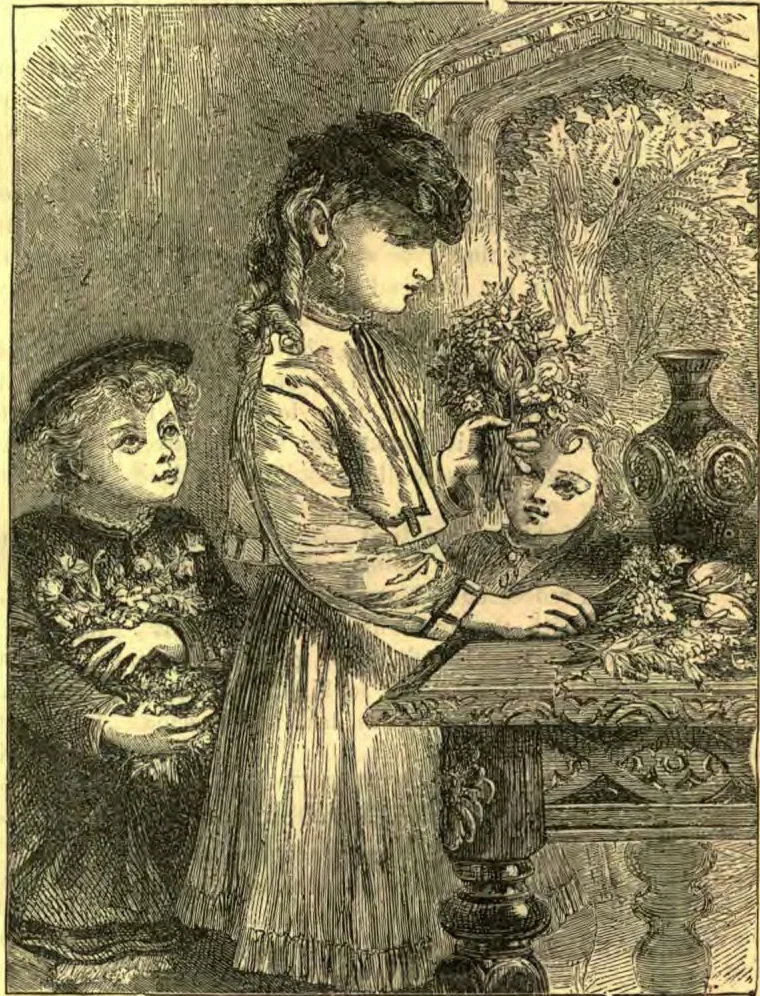
“Just then the rose-spray nodded again, and Kitty caught sight of it. A new thought flashed into her brain. “I know what I will do! I’ll go and help the girls at the Flower Mission. Laura Greer has asked me to, several times.”
She was soon ready, and having filled a small basket with roses, syringas, honeysuckles, and pansies, she covered them from the light, and was soon on her way. On reaching the rooms where the committee met, she made her way to Laura Greer’s table.
“Well, if there isn’t Kitty!” exclaimed that young lady, as she saw her coming. “I had given up expecting ever to see you here.”
“I don’t always do as people expect me to,” laughed Kitty, “but I had nothing to do this morning, and was lonesome, so thought I’d come and bring a few flowers, and help you make bouquets.”
Laura assured Kitty that they were glad to have her help, and hastened to get things together for her to set to work.
There were heaps and heaps of flowers that morning. Roses in endless profusion, baskets of hot-house blossoms, scarlet and pink geraniums, verbenas of every color, and even a few of the dear little lilies of the valley. Then there were apple-blossoms from the country, blue larkspurs, and bright yellow dandelions so dear to the hearts of the children. Kitty was very fond of flowers, and it was a delight to see all this variety. The work went swiftly on, accompanied by the merry chat of the girls, interspersed with frequent exclamations of “Oh, how lovely!” “Isn’t that beautiful!” as some particularly pretty flower or bouquet would be brought into notice.
At length the bouquets were all made, the baskets filled with them, and the girls started out, Laura taking Kitty with her. They soon reached the children’s hospital, where they received a cordial welcome. They went slowly down the aisles, past the little white beds, stopping at each one to bestow a bright nosegay upon its occupant; and it warmed Kitty’s heart to see the look of pleasure which would light up the young faces when they received them. It amused her to see the common, homely flowers which some would choose when they espied them, in preference to the prettier ones that were offered.
Again they were in the street, and after walking a few blocks, and stopping at several doors to give flowers to eager children—most of them sick ones—Laura said, “Now we are coming to the place where I like best of all to go.”
Before Kitty could ask who they were going to see, she knocked at the door of a little house. It was opened by a middle-aged, kind-faced woman, to whom Laura said, “Good morning, Mrs. Bates; how is Elsie to-day? I have brought a friend of mine to see her.”
“She is as well as usual, thank you, ma’am; and I’m glad you have come. Walk in.”
They entered the invalid’s room, and there, on a neat little bed, Kitty saw a young girl of apparently sixteen years, with a fair, delicate face, who looked up with a sweet smile out of a pair of dark brown eyes, and gave them a warm welcome. Laura gave her a bouquet, which was gratefully received; and then Kitty gave her a small nosegay of apple-blossoms, with one of the pink buds gathered from her rose-vine laid against it, a spray of green leaves for a background, and a tiny stem of lilies of the valley nestled in front.
As the young girl’s eye rested on it, she reached her hand for it eagerly, exclaiming in a delighted tone, “Oh, that lovely pink rose-bud! I am so glad to see one again! We had a vine of just such roses in our dear old country home, and I have never seen any like it since we have been in the city.”
Laura asked questions about Elsie’s health and her work, some of which was lying beside her; and to Kitty’s astonishment she found that this frail, delicate girl, propped with pillows into a half-reclining position, sewed, day after day, on little dresses and other plain garments for children, to help maintain herself.
“Don’t you get very tired of such work?” she asked.
“My arms often get tired and ache so that I have to stop awhile; but I like to do the work. I would be miserable if not employed, and I cannot read all the time. Then I would be such a burden to others if I did nothing to help myself.”
After a little more conversation, the girls took their leave, and as Kitty said good-bye, Elsie drew her down and kissed her warmly, thanking her for the visit, and for the pleasure which her bouquet had given, and exacting a promise that she would come again.
As Laura and Kitty separated to go to their homes, Laura said, “Come again some day soon, and help us.”
“You may be sure I will,” answered Kitty; and as she walked home alone, she was very thoughtful, for she had learned a lesson from the poor lame girl which her mother soon saw the effects of in her increased willingness to sew, or to busy herself in any useful employment, often going to the lame girl’s room, and helping her an hour or two with her work. She soon ceased complaining of not knowing what to do with herself, and lost her restlessness and discontent.
And all through that bright spring day, the pink rose-bud looked smilingly at little Elsie, talking to her of happy scenes and hours when she was a child. At eve it opened into a full-blown rose, and the next day dropped its petals and died; but it had fulfilled its mission, and Kitty had found hers.—LICHEN, in Arthur’s Home Magazine.

HOW TO TREAT BROTHERS.

Girls, be kind to your brothers. Don’t be afraid you will spoil them by showing them plenty of sisterly attention. They are tiresome fellows sometimes, important and overbearing, treating their sisters like inferior beings. But never mind that, girls; carry with you the two bears,—bear and forbear. The consequential age generally passes off with the growth of the incipient moustache, and when real manhood dawns upon them, they will realize how gentle and kind their sisters have been.
Make home pleasant to them; let them see and feel you enjoy their company sometimes as well as that of some other girl’s brother. If you sing or play on the piano, do your best for brother Will or Ned, or whatever his name may be, and reward him with a smile when he turns over your music or gives up his seat to you, just as you would any other gentleman. Lay aside your work or book to have a pleasant chat or innocent game with your brother; draw out of him with whom and where he spends his evenings outside of the family circle. Encourage him to speak of his associates. A sister often has more influence with a brother than a parent. If he can confide in his sister regarding his friends and amusements, you need have no fear of how he spends his time when away from you. Let him see that you take an interest in his studies or his business. When he asks you to sew on a button or mend his glove, don’t put on an aggrieved air; do it cheerfully, willingly. He will reward you in his secret heart with a wealth of brotherly love, though he may not show it, for some think it unmanly to display affection. Treat his friends with politeness, even if they are not of your style. Throw all the safeguards you possibly can around your young brothers, by sisterly kindness and forbearance. Try to make home the happiest and dearest place on earth.—Christian at Work.

Making Yourself Useful to Others

ALL boys and girls should try to make themselves useful to others. We were placed here to do good.

COAL-OIL JOHNNY.

Coal-oil Johnny was, twenty years ago, a well-known character in New York and Philadelphia. He was the son of a poor widow who owned a barren tract of hill-land in Western Pennsylvania. Oil was discovered upon it, and the widow and her boy became, in the course of a month, the possessors of millions.
Johnny was an ignorant fellow, scarcely able to write his name, and had never owned a decent suit of clothes. He repaired at once to Philadelphia, and applied for a room at the Continental Hotel. The clerk, eyeing him suspiciously, refused it unless he first made a deposit. The young Croesus went out in a rage, went to a tailor-shop, and, fitting himself with a fashionable suit, hired a carriage and eight horses and a brass-band, and so paraded down the street back to the hotel.
For two years Johnny remained in the city, flinging his money about like the fabled princes of the “Arabian Nights.” Diamond rings, houses, gold watches, were the presents which he bestowed upon anybody who drank or smoked with him, and, as may be supposed, he never lacked a companion.
His favorite fancy was to astonish a cab-driver, whose society pleased him, by a gift of the cab and horses which he drove; an Irish laborer who brought him home when tipsy was rewarded by a check for twenty thousand dollars.
Coal-oil Johnny now drives a cab in the city of New York, and is, unfortunately, not the owner of it. This is an extreme case of the squandering of money, but it is a typical one.
Americans who make their money easily too often forget to give their sons social standing-ground upon anything better than money. The lad who has neither education, refinement, nor moral worth to command notice, is apt to try to force it by lavish display, and is in degree as much an object of derision and pity as Coal-oil Johnny.—Youth’s Companion.

WHAT TO GIVE.

WE were so much interested in a little incident which we read recently, and it contained such a good lesson, that we will tell it to our readers as nearly as we can remember it.
Little May Ellis' Aunt Kate had just returned from heathen lands, and May never grew weary of hearing auntie tell about the dark-eyed women and children whom she had taught about Jesus. She often wished that she could do something for them, but what could a little girl do?
Among other things that Aunt Kate told in regard to that far-off heathen land was about the rats,—what large ones there were, and how mischievous they were, having spoiled a nice dress once to make them a nest. May listened with much interest. Suddenly a bright light shone in her eyes, and she said, “I can do something, after all.”
“What can you do?” asked Aunt Kate.
“I can send one of my kitties to eat up the rats,” said the little girl. “I will send White-nose, for I can spare her just as well as not.”
“How about Gray-back?” asked auntie; “won’t you send her?”
“Oh, I can’t spare her; she’s the nicest little kittie that ever was. No, I couldn’t spare her, but I’d send White-nose.”
Perhaps you smile, as did auntie. But, soberly, is not May a good deal like a great many children, and grown people too? What they prize most they do not give to God. They give what they “can spare,” and that “just as well as not,” to help lead souls to Christ.
Oh, think what God has given for us! His only Son! Think with what we have been redeemed! Not with gold and silver, but with the precious blood of Christ! Christ gave his life! He gave it for us. What have we given to him? What we “can spare,” or what is dear and precious to us? V. A. M.

LESSONS FOR CHILDREN.

LESSON LXXXVI.—NEBUCHADNEZZAR'S DREAM.

Soon after Daniel and his fellows began to stand among the counselors before the king, “Nebuchadnezzar dreamed dreams, wherewith his spirit was troubled, and his sleep brake from him. Then the king commanded to call the magicians, and the astrologers, and the sorcerers, and the Chaldeans, for to show the king his dreams. So they came and stood before the king. And the king said unto them, I have dreamed a dream, and my spirit was troubled to know the dream. Then spake the Chaldeans to the king in Syriac, O king, live forever; tell thy servants the dream, and we will show the interpretation. The king answered and said to the Chaldeans, The thing is gone from me; if ye will not make known unto me the dream, with the interpretation thereof, ye shall be cut in pieces, and your houses shall be made a dunghill. But if ye show the dream, and the interpretation thereof, ye shall receive of me gifts and rewards and great honor; therefore show me the dream, and the interpretation thereof. They answered again and said, Let the king tell his servants the dream, and we will show the interpretation of it. The king answered and said, I know of certainty that ye would gain the time, because ye see the thing is gone from me. But if ye will not make known unto me the dream, there is but one decree for you; for ye have prepared lying and corrupt words to speak before me, till the time be changed; therefore tell me the dream, and I shall know that ye can show me the interpretation thereof. The Chaldeans answered before the king, and said, There is not a man upon the earth that can show the king’s matter; therefore there is no king, lord, nor ruler, that asked such things at any magician, or astrologer, or Chaldean. And it is a rare thing that the king requireth, and there is none other that can show it before the king, except the gods, whose dwelling is not with flesh.
“For this cause the king was angry and very furious, and commanded to destroy all the wise men of Babylon. And the decree went forth that the wise men should be slain; and they sought Daniel and his fellows to be slain.”
Then Daniel inquired why the decree had been so hasty, and asked the king to give him time, that he might interpret the dream for him. The king granted the favor, and Daniel and his companions prayed earnestly to God to show them the dream and its meaning. “Then was the secret revealed unto Daniel in a night vision.”
When Daniel was called in before the king, he told him that it was not in the power of men, however wise, to make known or interpret his dream; but that the God of Heaven had revealed the secret to him. He then proceeded to relate the dream as follows:—
“Thou, O king, sawest, and behold a great image. This great image, whose brightness was excellent, stood before thee; and the form thereof was terrible. This image’s head was of fine gold, his breast and his arms of silver, his belly and his thighs of brass, his legs of iron, his feet part of iron and part of clay. Thou sawest till that a stone was cut out without hands, which smote the image upon his feet that were of iron and clay, and brake them to pieces. Then was the iron, the clay, the brass, the silver, and the gold, broken to pieces together, and became like the chaff of the summer threshing-floors; and the wind carried them away, that no place was found for them; and the stone that smote the image became a great mountain, and filled the whole earth.
“This is the dream; and we will tell the interpretation thereof before the king.”

QUESTIONS.

  1. What happened to disturb the mind of Nebuchadnezzar soon after Daniel and his fellows began to stand among the king’s counselors? Dan. 2:1.
  2. What command did the king then give?
  3. What did the king say to these men when they had come before him?
  4. What did they ask him to do, in order that they might interpret the dream?
  5. Why did not the king relate the dream?
  6. What did he threaten to do to the wise men if they did not tell his dream?
  7. What reward did he promise them if they would tell it?
  8. Of what did he accuse them, when they still insisted on his relating the dream?
  9. What did they say of his requirement?
  10. What decree did he then make?
  11. Who hindered the carrying out of the decree?
  12. What did he inquire?
  13. What favor did he ask?
  14. When the favor was granted, what did Daniel and his companions do?
  15. How did the Lord show his mercy for them?
  16. What would have been their fate if he had not revealed the secret to them? Verse 13.
  17. When Daniel was called in before the king, what did he say about the interpretation of the dream?
  18. What did Daniel say the king had seen in his dream? Verse 31.
  19. What did he say about the form and brightness of the image?
  20. Of what material were the different parts of the image made?
  21. Where was the image smitten?
  22. What was the effect?
  23. What became of the other parts of the image?
  24. What did the stone become?

BIBLE LESSONS FOR YOUTH.

LESSON CXII.—RECAPITULATION.

We have now passed over four thousand years of the history of our race, giving particular attention to the dealings of God with his people. We have noticed the creation of the earth, and all things in it; the institution of the Sabbath; the loss of Paradise; the first shedding of human blood; the sacrifices that typified the offering of Christ; the translation of Enoch; the preaching of Noah; the destruction of the wicked by the waters of the flood; the bow of promise; the confusion of tongues; the calling of Abraham; the trying of his faith; the spotless life of Isaac; the sins of Jacob, and his consequent banishment; his hard service for Laban; his wrestling with the angel; the death of his beloved Rachel; the cruel conduct of his sons, in selling their brother as a slave; Joseph's integrity and faithfulness; his gift as an interpreter; his exaltation by Pharaoh; the famine, and the visits of his brothers, who came to Joseph for food; the removal of his father and all his family to Egypt; and the cruel bondage to which they were subjected after the death of Joseph.
Then Moses is born, and soon after, adopted by the king's daughter; when grown to mature manhood, he prefers to join his despised countrymen rather than to be a prince in the house of the mighty Pharaoh; his indignation at the cruel treatment practiced upon his brethren causes him to slay an Egyptian, and for this, he goes into banishment forty years.
Then the Lord speaks to him from the burning bush in Horeb, and commissions him to return to Egypt, and deliver his people. The plagues are inflicted to show the Egyptians that the God of the Israelites is infinitely superior to the gods they worship, and that he is able to destroy them at will; the passover is instituted; the first-born are slain; the Red Sea is crossed, and the hosts of Pharaoh destroyed.
The Israelites are supplied with bread from Heaven, and water from the rock. On arriving at Sinai, they covenant to obey the voice of God, and he gives them his Law,—the ten commandments. They remain at Sinai nearly a year, while the tabernacle is building, and then set forward toward the promised land. In a few days they near its border, and send spies forward to reconnoiter. The people believe the evil report of the spies, murmur and rebel against God, and are condemned to complete forty years wandering in the wilderness. Moses instructs and solemnly warns the people, and having ordained Joshua to succeed him, dies upon Mount Nebo.
Joshua leads the host through the divided waters of the Jordan, takes Jericho and Ai, defeats five kings at Gibeon, overruns southern Palestine, conquers the king of Hazor and many other kings in a great battle by the waters of Merom, and in a few years completes the conquest of almost the entire land.
Then the people of God were for many years under elders and judges, sometimes forsaking God, and falling under the dominion of cruel and oppressive enemies; and again repenting, and finding deliverance by the mighty hand of Him to whom they had been so untrue.
Finally the people clamored for a king, and were ruled successively by Saul, David, and Solomon, each of whom reigned forty years. After the death of Solomon the kingdom was divided; ten of the tribes from that time were known as the kingdom of Israel, and the others, as the kingdom of Judah. The twenty kings of Israel were all wicked and idolatrous men, and after existing about 250 years the nation was entirely subdued, and carried into captivity by the Assyrians. Some of the kings of Judah were noble, God-fearing men, but many more practiced all the abominations of the heathen nations around them, refusing to heed the admonitions of the prophets whom the Lord had sent to warn them. So they were finally abandoned to their enemies, and carried away to Babylon, where they remained captives seventy years. The temple was destroyed, and Jerusalem lay in ruins; but soon after the Medes and Persians conquered Babylon, Cyrus gave the Jews permission to return to their own country, and rebuild Jerusalem and the temple. Zerubbabel, Ezra, and Nehemiah were leaders among the Jews at that time, and were very zealous in restoring the ancient customs and forms of worship, and in bringing the people into strict obedience to the requirements of the law. Malachi was the last of the prophets, and a synopsis of the events occurring between his time and the life of Christ is found in the last part of Lesson 110.
NOTE.—This lesson should be recited as a synopsis, one reciting a portion, and then another, without questions. The teacher may then ask such questions as the subject and the circumstances seem to demand. G. H. BELL.

Earnestness in Teaching Captures a Class's Attention

“What shall I do,” said a teacher, the other day, “to catch and hold the attention of my class?” “Be in earnest,” was the answer. Earnestness always arrests attention and holds it. The man who cries “fire,” or “murder,” with the earnestness of conviction, does not fail to rouse every one that hears the cry. Let us utter the great truths of the Bible as though we believed in their reality, and no one then will be listless or indifferent.

LETTER BUDGET.

St. Charles, Mich. DEAR EDITORS: I am a little boy eight years old. I keep the Sabbath with pa and ma, and go to Sabbath-school nearly every Sabbath. I love to go where I can hear them talk of our Lord. I have a little sister five years old. I guess you can't read this, so I will get my Uncle John to copy it. I hope I shall live so as to meet all the INSTRUCTOR family on the new earth. WARREN MATHEWSON.
Forestville, Cal. DEAR EDITORS: This is the first letter that I have ever written to the INSTRUCTOR. We have been taking the paper seven or eight years. I like it very much. I go to Sabbath-school. I was eleven years old last June. My parents came out under the labors of Elds. Loughborough and Bourdeau. I want to be a good girl and meet all the INSTRUCTOR family on the new earth. Pray for me. ALICE J. ROSS.
Bull City, Kan. DEAR EDITORS: I am ten years old. I keep the Sabbath with my parents. I have had the privilege of hearing read and reading the INSTRUCTOR all my life, and like it very much. I go to Sabbath-school every Sabbath. My mother died when I was three years old, but my father was married again three years ago. I am trying to be a good girl, so that I can meet all the INSTRUCTOR family in the earth made new. ANNA M. NEAL.
Williamstown, Mich. DEAR EDITORS: As I have never written for our little paper, I thought that I would write a few lines now. I keep the Sabbath with my mother, two brothers, and one sister. I take the INSTRUCTOR and like it very much, especially the Children's Corner. My father and oldest brother do not keep the Sabbath, but we hope and pray that they soon will. We have Sabbath-school at home. WILLIAM MARTEN.

CATCHING THE TIGER.

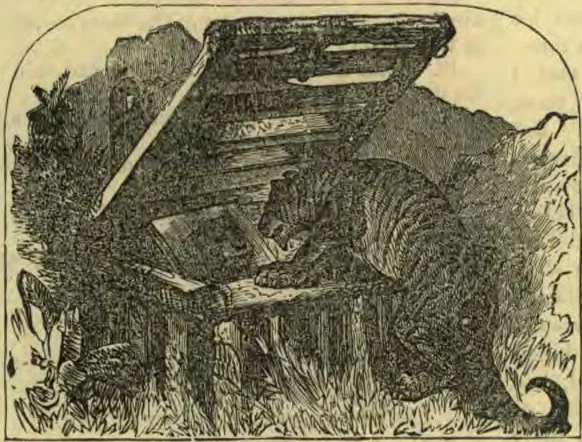
There are many ways of catching tigers. The cut on this page shows one way,—with a looking-glass trap. The tiger sees his reflection in the glass, and his curiosity leads him to examine the strange object. Perhaps he sets up a roar, when the tiger in the glass gives back a roar of defiance. Resenting this insult, the real tiger makes a spring at the sham tiger in the glass, when the heavy trap falls upon him, and he is caught.
I will tell you of another ingenious plan for catching this beast. It is practiced in Oude, and in some of the other provinces of India, where they manufacture a very sticky kind of bird-lime, by means of which numbers of those ferocious animals are destroyed.
The first thing is to find out the tiger’s lair. This discovered, a few hundred broad tropical leaves, covered on both sides with the bird-lime, are spread about. The hunters then retire to a safe distance to await the appearance of the tiger.
By-and-by he comes sauntering along to where the bird-lime is strewn, and presently a big leaf sticks to his paw. When a vigorous shake will not release it of the clammy thing, he tries what a whisk at the side of his head will do, and succeeds in smearing an eye. By this time each paw is furnished with an unwelcome slipper, and perhaps his tail is festooned with several, likewise. He now loses his temper, becomes furious, bites at the limed leaves, and rolls among them till both eyes are blinded, and his body covered with a network of leaves,—a leafy coat-of-mail, not weapon proof. At the sound of his terrible roars the trappers rush up, and dispatch the blind beast with a shower of bullets.—Sel.

Mazarine Bible.

The new Lenox Library, in New York City, contains a magnificent copy of the Mazarine Bible, printed in Metz, by Guttenberg, in 1455. It is the first book printed from movable types, and yet, strange to say, it is one of the noblest monuments of the “art preservative of all arts” in existence. There are only two copies of this Bible on this continent, the other being owned by the heirs of the late George Brenley, of Hartford, Conn. The last copies sold at the Perkins sale, London, June 6, 1873, brought $17,000 for the one printed on vellum, and $13,550 for the one on paper.

WHAT A CHILD’S KISS COULD DO.

IN a prison at New Bedford, Mass., there is now a man who is called Jim, and who is a prisoner on a life sentence. Up to last spring he was regarded as a desperate, dangerous man, ready for a rebellion at any hour. He planned a general outbreak, but was “given away” by one of the conspirators. He plotted a general mutiny or rebellion, and was again betrayed. He kept his own counsel, and while never refusing to obey orders, he obeyed like a man who only needed backing to make him refuse to.
One day in June a party of strangers came to the institution. One was an old gentleman, the others ladies, and two of the ladies had small children. The guide took one of the children on his arm, and the other walked until the party began climbing the stairs. Jim was working near by, sulky and morose as ever, when the guide said to him, “Jim, won’t you help this little girl up the stairs?”
The convict hesitated, a scowl on his face, but the little girl held her arms out to him and said, “If you will, I guess I’ll kiss you.”
His scowl vanished in an instant, and he lifted the child up as tenderly as a father. Half-way up the stairs she kissed him. At the head of the stairs, she said, “Now you’ve got to kiss me, too.”
He blushed like a woman, looked into her innocent face, and then kissed her cheek, and before he reached the foot of the stairs again, the man had tears in his eyes. Ever since that day he has been a changed man, and no one in the place gives less trouble.—Arthur’s Home Magazine.

DARE TO DO RIGHT.

One pleasant Sabbath morning, a boy neatly dressed, with books in his hand, was seen walking briskly along one of the avenues in — City, on his way to Sabbath-school. As he approached the corner of the street which led to the church, he heard the voices of several boys, and on turning, found them busily playing at marbles. They at first tried to persuade him to join them; then they ridiculed him, and finally as he went on, they shouted after him, “You dare not stay away from Sabbath-school!” “No,” said the boy, turning round and looking them full in the face, “No, but I dare go, even if you laugh at me!”

“DON'T GIVE UP THE SHIP.”

YOU'RE on the sea of life, boys, Your ship is staunch and strong; You're sailing smoothly now, boys, But storms will come ere long. But boldly furl your sail, boys, And let the tempest “rip,” Stand bravely by the helm, boys, And “Don't give up the ship!”
Though clouds o'er cast the sky, boys, The sun is bright behind; And though the waves roll high, boys, They'll soon calm down, you'll find. So always keep up heart, boys, With cheerful eye and lip; And let your watchword e'er, boys, Be “Don't give up the ship!”
Beyond the raging sea, boys, You'll find at last a rest, If only on your trip, boys, You do your “level best.” There waits for such, a crown, boys, So take a manly grip; There waits for all eternal life Who “Don't give up the ship.”
HESTER HUNT, in Interior.

You have reached the end of this edition.

The Youth’s Instructor · Aug 18, 1880