INTRODUCTION.—After the fulfillment of the seven days’ punishment upon Miriam, as noticed in the preceding lesson, the people “removed from Hazeroth, and pitched in the wilderness of Paran,” a large tract of desert extending from Sinai on the south to the foot of the mountains of Palestine on the north, and from the Gulf of Akabah on the west to the shores of the Dead Sea on the east. From this place the spies were sent to search out the land of Canaan, but not from their next encampment after leaving Hazeroth, as we find from Num. 33:17–36 that there were twenty stations between Hazeroth and Kadesh-Barnea, the locality from whence the spies took their departure.
Questions, with Scripture Texts, and Notes.
1.When Moses, according to the command of the Lord, selected twelve men to spy out the land of Canaan, what directions did he give them?
“And Moses sent them to spy out the land of Canaan, and said unto them, Get you up this way southward, and go up into the mountain: and see the land, what it is; and the people that dwelleth therein, whether they be strong or weak, few or many; and what the land is that they dwell in, whether it be good or bad; and what cities they be that they dwell in, whether in tents, or in strongholds; and what the land is, whether it be fat or lean, whether there be wood therein, or not. And be ye of good courage, and bring of the fruit of the land. Now the time was the time of the first ripe grapes.” Num. 13:17–20.
Concerning the route taken by the twelve spies, Dr. Clarke, in his Commentary, gives this note: “The spies having left Kadesh-Barnea, which was in the desert of Paran (see verse 26), they proceeded to the desert of Tsin, all along the land of Canaan, nearly following the course of the River Jordan, till they came to Rehob, a city situated near Mount Libanus, at the northern extremity of the Holy Land, toward the road that leads to Hamath. Thence they returned through the midst of the same land by the borders of the Sidonians and Philistines, and passing by Mount Hebron, rendered famous by the residence of Abraham formerly, and by the gigantic descendants of Anak at that time, they passed through the valley of the brook of Eshcol, where they cut down the bunch of grapes mentioned in verse 23, and returned to the Israelitish camp after an absence of forty days.”
2.What evidence did they find of the fruitfulness of the land?
“And they came unto the brook of Eshcol, and cut down from thence a branch with one cluster of grapes, and they bare it between two upon a staff; and they brought of the pomegranates, and of the figs.” Verse 23.
There is nothing extraordinary in what is said in this verse concerning the size of the cluster of grapes brought back to the Israelitish encampment, since it is a well-known fact that even at the present time, in countries suited to their growth, single clusters of grapes often attain a prodigious size. It seems probable also that they were carried as mentioned in this verse more for the purpose of preserving them in good condition for presentation at the Israelitish camp, than to lessen the burden of their weight. Their size would appear all the greater in contrast with the grapes of Egypt, the only ones with which the Hebrews were familiar, which are said to have been very small.
3.How long were they on their mission?
“And they returned from searching of the land after forty days.” Verse 25.
“It is very probable,” says Dr. Clarke, “that the spies received their orders about the beginning of August, and returned about the middle of September, as in those countries grapes, pomegranates, and figs are ripe about this time.”
4.When they returned, what did they say of the fruitfulness of the land?
“And they told him, and said, We came unto the land whither thou sentest us, and surely it floweth with milk and honey; and this is the fruit of it.” Verse 27.
5.What did Moses afterward say of the land?
“For the Lord thy God bringeth thee into a good land, a land of brooks of water, of fountains and depths that spring out of valleys and hills; a land of wheat, and barley, and vines, and fig trees, and pomegranates; a land of oil olive, and honey; a land wherein thou shalt eat bread without scarceness, thou shalt not lack anything in it; a land whose stones are iron, and out of whose hills thou mayest dig brass. When thou hast eaten and art full, then thou shalt bless the Lord thy God for the good land which he hath given thee.” Deut. 8:7–10.
6.What did the spies say of the people?
“Nevertheless the people be strong that dwell in the land, and the cities are walled, and very great: and moreover we saw the children of Anak there. The Amalekites dwell in the land of the south: and the Hittites, and the Jebusites, and the Amorites, dwell in the mountains: and the Canaanites dwell by the sea, and by the coast of Jordan.” Num. 13:28, 29.
7.Notwithstanding the promise of the Lord, that he would bring them into the land, what did the spies say?
“But the men that went up with him said, We be not able to go up against the people; for they are stronger than we. And they brought up an evil report of the land which they had searched unto the children of Israel, saying, The land, through which we have gone to search it, is a land that eateth up the inhabitants thereof; and all the people that we saw in it are men of a great stature. And there we saw the giants, the sons of Anak, which come of the giants: and we were in our own sight as grasshoppers, and so we were in their sight.” Verses 31–33.
On verse 32, Dr. Scott comments as follows: “Some suppose that there was a great mortality in the land just at that time, by which the Lord was weakening his enemies and fighting for Israel; but which the spies perversely ascribed to an unwholesome climate. At the same time that they represented the country fruitful and populous, and all the people of great stature, and powerful and prosperous, they inconsistently speak of the land as eating up its inhabitants!”
8.How did this report affect the people?
“And all the congregation lifted up their voice, and cried; and the people wept that night.” Num. 14:1.
9.What foolish and wicked murmuring did they indulge in?
“And all the children of Israel murmured against Moses and against Aaron: and the whole congregation said unto them, Would God that we had died in the land of Egypt! or would318God we had died in this wilderness! And wherefore hath the Lord brought us unto this land, to fall by the sword, that our wives and our children should be a prey? were it not better for us to return into Egypt?” Verses 2, 3.
10.What did they propose to do?
“And they said one to another, Let us make a captain, and let us return into Egypt.” Verse 4.
The action of the Israelites on this occasion shows how completely the impulses of their evil hearts had driven out of their minds all considerations both of manliness and prudence; for deprived as they would have been of the provisions God had made for their food and drink, they must inevitably have perished in attempting to return to Egypt, and it would certainly have been more manly to die in the attempt to gain possession of the promised land than to return to their former abject condition of slavery. The narrative contains a lesson for all on the folly of taking counsel of passion and impulse, regardless of the dictates of the sober judgment.
11.What report did Caleb and Joshua bring?
“And Joshua the son of Nun, and Caleb the son of Jephunneh, which were of them that searched the land, rent their clothes: and they spake unto all the company of the children of Israel, saying, The land, which we passed through to search it, is an exceeding good land. If the Lord delight in us, then he will bring us into this land, and give it us; a land which floweth with milk and honey.” Verses 6–8.
12.How did they seek to encourage the people?
“Only rebel not ye against the Lord, neither fear ye the people of the land; for they are bread for us: their defense is departed from them, and the Lord is with us: fear them not.” Num. 14:9.
“And Caleb stilled the people before Moses, and said, Let us go up at once, and possess it; for we are well able to overcome it.” Chap. 13:30.
13.How did the people regard them for their truthful report?
“But all the congregation bade stone them with stones. And the glory of the Lord appeared in the tabernacle of the congregation before all the children of Israel.” Num. 14:10.
14.What proposition did the Lord make to Moses, because of the stubborn unbelief of the people?
“And the Lord said unto Moses, How long will this people provoke me? and how long will it be ere they believe me, for all the signs which I have showed among them? I will smite them with the pestilence, and disinherit them, and will make of thee a greater nation and mightier than they.” Verses 11, 12.
15.How did Moses show his disinterested love for the people, and for the honor of God?
“And Moses said unto the Lord, Then the Egyptians shall hear it, (for thou broughtest up this people in thy might from among them;) and they will tell it to the inhabitants of this land: for they have heard that thou, Lord, art among this people, that thou, Lord, art seen face to face, and that thy cloud standeth over them, and that thou goest before them, by day time in a pillar of a cloud, and in a pillar of fire by night. Now if thou shalt kill all this people as one man, then the nations which have heard the fame of thee will speak, saying, Because the Lord was not able to bring this people into the land which he sware unto them, therefore he hath slain them in the wilderness.” Verses 13–16.
16.What request did he make?
“And now, I beseech thee, let the power of my Lord be great, according as thou hast spoken, saying, The Lord is long-suffering, and of great mercy, forgiving iniquity and transgression, and by no means clearing the guilty, visiting the iniquity of the fathers upon the children unto the third and fourth generation. Pardon, I beseech thee, the iniquity of this people according unto the greatness of thy mercy, and as thou hast forgiven this people, from Egypt even until now.” Verses 17–19.
17.What answer did the Lord make?
“And the Lord said, I have pardoned according to thy word: but as truly as I live, all the earth shall be filled with the glory of the Lord.” Verses 20, 21.
18.What did the Lord say should become of those who had so often shown their unbelief and rebellion?
“Because all those men which have seen my glory, and my miracles, which I did in Egypt and in the wilderness, and have tempted me now these ten times, and have not hearkened to my voice; surely they shall not see the land which I sware unto their fathers, neither shall any of them that provoked me see it.” Num. 14:22, 23.
“And the Lord’s anger was kindled the same time, and he sware, saying, Surely none of the men that came up out of Egypt, from twenty years old and upward, shall see the land which I sware unto Abraham, unto Isaac, and unto Jacob; because they have not wholly followed me.” Chap. 32:10, 11.
19.Who only did he say should reach the promised land?
“Save Caleb the son of Jephunneh the Kenezite, and Joshua the son of Nun: for they have wholly followed the Lord.” Num. 32:12.
It seems from verse 29 that those under twenty years of age were not reckoned in the number of the Israelitish men of war, and perhaps for that reason did not take an active part in the rebellion at Kadesh-Barnea. Dr. Scott says that the Levites, who were numbered from a month old, were not included in this sentence against the people, and that the women were also excepted.
20.How long did he say the people should wander in the wilderness?
“But your little ones, which ye said should be a prey, them will I bring in, and they shall know the land which ye have despised. But as for you, your carcasses, they shall fall in this wilderness. And your children shall wander in the wilderness forty years, and bear your whoredoms, until your carcasses be wasted in the wilderness. After the number of the days in which ye searched the land, even forty days, each day for a year, shall ye bear your iniquities, even forty years, and ye shall know my breach of promise.” Num. 14:31–34.
21.What became of the ten spies who brought an evil report?
“And the men, which Moses sent to search the land, who returned, and made all the congregation to murmur against him, by bringing up a slander upon the land, even those men that did bring up the evil report upon the land, died by the plague before the Lord.” Verses 36, 37.
22.When the people heard the Lord’s sentence against them, how did they feel?
“And Moses told these sayings unto all the children of Israel: and the people mourned greatly.” Verse 39.
23.What did they then propose to do?
“And they rose up early in the morning, and gat them up into the top of the mountain, saying, Lo, we be here, and will go up unto the place which the Lord hath promised: for we have sinned.” Verse 40.
The same spirit which prompted the people at first to refuse to go up against the Canaanites led them afterwards to take an equally perverse position on the opposite side of the question. It clearly indicated that their repentance had not been genuine.
24.What counsel did Moses give them?
“And Moses said, Wherefore now do ye transgress the commandment of the Lord? but it shall not prosper. Go not up, for the Lord is not among you; that ye be not smitten before your enemies. For the Amalekites and the Canaanites are there before you, and ye shall fall by the sword: because ye are turned away from the Lord, therefore the Lord will not be with you.” Verses 41–43.
25.How much better was their courage now than their cowardice before?
26.What was the result of their presumption?
“But they presumed to go up unto the hilltop: nevertheless the ark of the covenant of the Lord, and Moses, departed not out of the camp. Then the Amalekites came down, and the Canaanites which dwelt in that hill, and smote them, and discomfited them, even unto Hormah.” Verses 44, 45.
27.What exhortation, based upon this lesson, is given to us?
“Let us therefore fear, lest, a promise being left us of entering into his rest, any of you should seem to come short of it. For unto us was the gospel preached, as well as unto them: but the word preached did not profit them, not being mixed with faith in them that heard it.” “Let us labor therefore to enter into that rest, lest any man fall after the same example of unbelief.” Heb. 4:1, 2, 11.
“Canaan was a type of God’s kingdom; and the wilderness through which the Israelites passed, a type of the difficulties and trials to be met with in the present world. The promise of the kingdom is given to every believer, but how many are discouraged by the difficulties in the way! A slothful heart sees dangers, lions, and giants everywhere, and therefore refuses to proceed in the heavenly path. . . . Here and there a Joshua and a Caleb, trusting alone in the power of God, armed with faith in the infinite efficacy of that blood which cleanses from all unrighteousness, boldly stand forth and say, ‘Their defense is departed from them, and the Lord is with us; let us go up at once and possess the land, for we are well able to overcome.’ We can do all things through Christ strengthening us. He will purify us unto himself, and give us that rest from sin here which his death has procured and his word has promised.”—Clarke.
NOTICE FOR COLORADO.
By Geo. O. States
At our late State meeting, I was appointed State agent. I then went to the Minneapolis institute, and am now at Ottawa, Kan., trying to fit myself for the work. I expect to return to Colorado about May 20, and want to go to Leadville with a company of canvassers. I hope to hear from all our canvassers now in the field, and any others who may wish to enter the work. I expect to have my wife with me; and if any of our sisters wish to join the company, I would be glad to hear from them. The next few months will be the harvest time for the mining towns of Colorado, and I hope to get a strong company in Leadville, and perhaps in Aspen also. Address me at 812 Nineteenth Ave., Denver, Colo. GEO. O. STATES.
THE PENNSYLVANIA CAMP-MEETING.
By L. C. Chadwick
Since writing my former notices for the REVIEW, we have made different arrangements with the railroads for reduced fare. Those who come to our meeting will secure their certificates of the ticket agent where they buy their ticket for Williamsport, instead of my sending them from here. Go early to your ticket agent, and buy your ticket for Williamsport, and ask him to give you a certificate, stating that the reason you want it is to enable you to secure reduction on return passage from our meeting.
I wish especially to ask all district secretaries and librarians who attend this meeting to bring their account books with them, as we shall need them. I also request all church clerks who have money due them from the members for books or papers, to bring a list of such indebtedness, or better still, to bring their order-book and due-bill book to the meeting, so we can ascertain just how our accounts stand.
Those who are owing the State tract society, or who have unpaid pledges to any of our different funds, will confer a favor on the society by bringing the money for the same, as far as possible, to this meeting, as we shall need all the money we can raise to meet our bills and expenses. If those who desire to take books with them from the meeting will make out lists of what they want and leave them at the book-stand as early as possible, it will assist us in filling the orders and getting the books ready for you. L. C. CHADWICK.
ITEMS REGARDING THE IOWA CAMP-MEETING.
Location: The meeting this year will be held in a suburb of North Des Moines, known as Oak Park. The grounds are nicely shaded, well situated for the purpose, and are near the terminus of the new steam motor line, or “Belt Line Railway.” Trains will pass to and from the grounds every half hour, and the fare, including passenger and baggage, will be five cents. Those coming by rail should, on arriving in the city, go to the City Hall, corner of West Second and Locust Sts., from which point all trains leave for Oak Park. The City Hall is only a few minutes’ walk from any of the depots in the city.
Reduced rates: Those who pay full fare in going to the meeting, and who secure a certificate (or receipt) therefor from the ticket agent, by request, at the time of purchase, will be returned over the same road, between same points, at one-third fare. Where the journey is made over more than one line, it will be necessary to purchase separate local tickets, and procure certificates in connection with same for each line traversed. As in the past, failure to procure or to present certificates, will make it impossible to get the benefit of the reduction. Certificates will be good from May 25 to June 14.
Reports: Both the Register and the Leader (dailies) will contain a report of each day’s proceedings of the meeting proper. Our brethren will be expected to take subscriptions for these papers as in the past; for we get the privilege of the reports by securing subscriptions. Price of each, mailed postpaid to any address, fifteen cents.
Tents: Our Conference will have a number of tents to rent. These will be pitched during the workers’ meeting, and will rent for $2.00, $2.50, and $3.00, according to size, running from 10x12, 12x14, to 12x16. Engage your tents at once by writing to L. T. Nicola, 603 East 12th St., Des Moines, Iowa.
Remarks: Every preparation possible is being made to secure the comfort and benefit of those who attend. The best assistance has been promised by our General Conference Committee, and best of all, we have the comforting assurance that God will grant his rich blessing in his acceptance of our mutual efforts to advance his work.
IOWA CONF. COM.
News of the Week.
FOR WEEK ENDING MAY 11.
DOMESTIC.
—The new suspension bridge at Lockport, N. Y., was opened Tuesday morning.
—Off St. Andrews, New Brunswick, Saturday afternoon, a sloop containing six persons capsized, and all were drowned.
—The jury in the case of Irving Latimer, on trial at Jackson, Mich., for the murder of his mother, returned a verdict Monday of murder in the first degree.
—Three alternating-current electric dynamos, to be placed in the penitentiaries at Sing Sing, Auburn, and Clinton, to be used for the killing of condemned criminals, were purchased Tuesday by the State of New York.
—An election at Lafayette, La., Monday, was prevented by white regulators, armed with rifles, who refused to permit negro citizens to cast their ballots. The sheriff ordered the polls closed, and reported to the governor. The election was for mayor and councilmen.
—From Jamestown, Dakota, it is reported that after a peculiar looking cloud which had been hanging over the city had disappeared, a precipitation of frogs occurred, hundreds of them hopping about in the principal street of the city. It is believed that the cloud, which was of cyclonic formation, sucked the batrachians out of a neighboring pond.
—At Findlay, Ohio, Thursday morning, the Bellaire Goblet Works were destroyed by fire. The loss is $115,000.
—The sixteen buildings of the Johns Hopkins Hospital, at Baltimore, have been finished, at a cost of $2,050,000.
—A switch-engine on the Michigan Central Railroad struck a street-car in Kalamazoo, Mich., Wednesday evening, killing six women and injuring four others.
—Fire at Danville, Vt., Thursday afternoon wiped out the business part of the town, including the post-office and all the mail. The loss is about $50,000, and the insurance $20,000.
—A heavy wind-storm prevailed Friday in Southern New York, Eastern Pennsylvania, Maryland, Delaware, Connecticut, and Massachusetts. Much damage was done to property, and several persons received fatal injuries.
—Mr. A. M. Cox, of Duluth, Minn., recently adopted a novel method of settling a proposed strike. He gave his employees notice that he would raise the wages of the married employees in his broom factory, and that the single men would not be wanted after June 1. If they are married by that time, they will be retained at increased wages.
—The town of Beaver Dam, Ohio, was visited Monday night by a fire which destroyed the entire business portion of the town, besides many residences. The loss is estimated at between $80,000 and $100,000, with an insurance of only $15,000. It is not thought that the burned district will be rebuilt. The town of Waldron, Mich., was similarly visited on the same night, the loss being $60,000.
—Immense damage has been done during the past week by forest fires, to farm and village property in parts of Michigan, Wisconsin, and Minnesota. Many persons have been rendered homeless, and several lives have been lost. Among the villages wholly or partially destroyed are those of Bruce’s Crossing, O’Brien, Spalding, Stambaugh, and Sullivan, Mich., and Elba, Minn.
—The project for removing the famous Confederate Libby prison from Richmond to Chicago was rudely interrupted Monday by the wrecking of the train on which it was being carried, near Springdale, Ky. The bricks and timbers of the famous war relic were profusely scattered around the track, and furnished hundreds of residents who flocked to the scene with fragments for their private collection of curiosities.
—After a long period of acknowledged pre-eminence in point of speed, the Cunard line of transatlantic steamships has been forced to yield the palm in this respect by the performance of the “City of Paris,” of the Inman line, which reached Sandy Hook Wednesday forenoon, having covered the distance from Queenstown in five days, twenty-three hours, and seven minutes, lowering all previous records. She also made the longest run recorded for a single day—511 miles.
FOREIGN.
—In Holland the authorities have decided that a woman cannot serve on a school board. In Sweden it has been decided that she can.
—Father Damien, the celebrated leper priest at Molokai, Sandwich Islands, died on the 10th of April. For the last sixteen years he had been laboring in the leper settlement.
—Two hotels, a half-dozen stores, the Jewish synagogue, and other buildings at Winnipeg, Manitoba, were burned Monday. The Zion Methodist church and other structures were badly damaged.
—The rice output in the Indies is reported 908,360 bags short of last year, and stocks in England and the European continent are said to be less than two-thirds the amount on hand at the same dates during the past two years.
—Whipping of criminals is again proposed in the British Parliament as an appropriate method of punishment for many offenses. Fifty strokes for an adult and twenty-five for a boy is the limit, though a sentence may provide for several whippings.
—It is stated that Germany will consent that Malietoa be reinstated as king of Samoa, provided the United States Government purchases the German plantations, or guarantees the payment if Samoans purchase them. Germany will further waive her demands for the punishment of Mataafa, if the relatives of the Germans who were slain are amply compensated. Germany will not claim political preponderance.
—The opening of the Exposition at Paris occurred May 5, and was attended with a most sensational incident. A man who gave his name as Perrin, a petty official, with some trifling grievance, fired at President Carnot, when the latter was leaving the Elysée Palace to attend the centenary celebration at Versailles. The man claims that he did not try to kill the President, and only desired to attract attention to his own grievance. The crowd was intensely excited, and made strenuous efforts to lynch the offender.319
RELIGIOUS.
—Evangelist Moody has just closed a very successful Bible institute in Chicago, the work of which he expects to continue in the fall.
—The Presbyterian Board of Foreign Missions received during its last fiscal year the sum of $901,181.80, a great advance over any previous year.
—At New York, Thursday, the seventy-third annual meeting of the American Bible Society was held. The cash receipts were $499,823, and the disbursements $555,989.
—About eighteen and a half million persons, it is estimated, pursue the scheme of study laid down by the International Sunday-school Lesson Committee. This committee recently held its nineteenth session at Saratoga, N. Y.
—At the recent review of the Salvation Army forces in Chicago, Marshall Booth claimed that within twelve years no less than 1,000,000 men and women have been rescued from the slums and transformed into self-supporting Christian citizens by its work.
—Mrs. Royal E. Fox died at her home in Syracuse, N. Y., Tuesday, from what outsiders believe to be “faith cure.” She had been subject to bilious attacks for several years, and during her final illness her friends refused to call a physician, telling her that strong faith was all that was necessary.
—The statistics of the polygamous Mormon Church, as read by Geo. Q. Cannon at the recent Mormon conference, are as follows: 12 apostles, 70 patriarchs, 3,719 high priests, 11,805 elders, 2,069 priests, 2,292 teachers, 11,610 deacons, 81,899 families, 115,915 officers and members, and 49,302 children under eight years of age; a total Mormon population of 153,911.
—In the Protestant church of Spain there are to-day 112 chapels and school-houses, 111 parochial schools, with 61 male and 78 female teachers, 2,545 boys and 2,095 girls. There are 80 Sunday-schools, with 183 helpers and 3,231 scholars. The church work is in the charge of 56 pastors and 35 evangelists. The number of regular attendants at church service is 9,164; of communicants, 3,442.
Appointments and Camp-Meeting Announcements
Appointments.
“And he said unto them, Go ye into all the world, and preach the gospel to every creature.”—Mark 16:15.
PROVIDENCE permitting, some minister from Battle Creek will be with the church in Ceresco, Mich., next Sabbath, May 18. Let there be a good attendance.
THE next annual session of the New York Health and Temperance Society will be held at Rome, N. Y., June 11-18, in connection with the camp-meeting. M. H. BROWN, Pres.
THE next annual session of the N. Y. Sabbath-school Association will be held in connection with the camp-meeting at Rome, N. Y., June 11-18. A. E. PLACE, Pres.
THE Iowa Health and Temperance Society will convene in annual session, at Des Moines, Iowa, June 4-11, in connection with the camp-meeting. W. H. WAKEHAM, Pres. Ia. H. and T. Society.
THE next annual session of the Dakota Sabbath-school Association will be held in connection with the camp-meeting at Madison, June 25 to July 2. We trust the schools will be largely represented. W. B. WHITE, Pres.
THE next annual session of the Dakota Conference will be held at Madison, Dak., in connection with the camp-meeting, June 25 to July 2. We trust all delegates will be present early in the meeting, that the work may not be hindered. DAKOTA CONF. COM.
THE next annual session of the Dakota Tract Society will be held in connection with the camp-meeting at Madison, June 25 to July 2, for the election of officers and the transaction of such other business as may come before the meeting. W. B. WHITE, Pres.
The Pennsylvania Health and Temperance Association will hold its annual meeting in connection with the camp-meeting at Williamsport, Pa., June 4-11. We hope to see all the members present, that more effective plans may be made in this important branch of the work. K. C. RUSSELL, Pres.
THE next annual session of the New York Conference of S. D. Adventists will be held at Rome, N. Y., in connection with the camp-meeting, June 11-18. The first meeting of the Conference will convene at 5 P. M. Tuesday. All churches should elect delegates at once, if they have not already done so. N. Y. CONF. COM.
THE next annual session of the Iowa Sabbath-school Association will be held at Des Moines, Ia., June 4-11, in connection with the Conference. We hope every Sabbath-school in the State will be represented. Special instruction will be given to S. S. workers. Eld. Owen will be present to assist. W. H. WAKEHAM, Pres. Ia. S. S. Ass’n
THE Lord willing, I will meet with the brethren in Dist. No. 11, Mich., as follows:—
Elmira, Otsego Co., — May 31 to June 2
Spencer Creek, — June 3-5
Kingsley, — “ 6
Wexford, — “ 7-9
Cleon, — “ 10-12
Bear Lake, — “ 14, 15
R. C. HORTON.
MEETINGS will be held in Michigan, as follows:—
Carson City, — May 13-15
Mount Pleasant, — “ 17-19
Sherman City, — “ 20, 21
Manistee Mill, — “ 22, 23
Harrison, Clare Co., — “ 25, 26
Hartwick, Osceola Co., — “ 27, 28
Tustin, — “ 29, 30
The brethren at or near Harrison should arrange for their meetings to be held in the most convenient place to accommodate all the Sabbath-keepers in Clare County. We hope to meet all of our brethren within a reasonable distance at these meetings. Come, brethren, meet with us, and let us seek God together.
M. B. CYPHERS.
R. C. HORTON.
Travelers’ Guide.
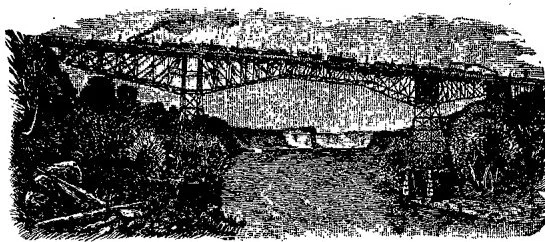
MICHIGAN CENTRAL NEW CANTILEVER BRIDGE, NIAGARA FALLS.
MICHIGAN CENTRAL
“The Niagara Falls Route.”
EAST — STATIONS
Mail
Day Express
N. Y. Express
Atlantic Express
Night Express
Kal. Accom’n
Local Pass’gr.
Chicago
am 5.00
am 9.00
pm 3.10
pm 10.10
pm 9.10
pm 4.40
Michigan City
am 11.03
4.54
am 12.23
11.27
6.57
Niles
8.37
pm 12.10
5.49
1.50
am 12.55
8.20
Kalamazoo
10.20
1.40
6.58
3.35
2.27
pm 10.00
pm 5.30
Battle Creek
11.15
2.18
7.33
4.25
3.15
7.55
6.25
Jackson
pm 1.20
4.15
8.49
5.75
4.45
9.35
8.20
Ann Arbor
2.43
5.37
9.41
7.50
6.00
10.40
Detroit
4.10
6.45
10.45
9.20
7.90
11.50
Buffalo
am 3.35
am 6.15
pm 4.55
pm 8.05
Rochester
6.50
9.10
8.00
11.45
Syracuse
9.30
11.35
10.15
am 2.15
New York
pm 7.00
pm 8.50
am 7.20
11.15
Boston
10.00
10.50
9.35
pm 2.50
WEST — STATIONS
Mail
Day Express
Chicago Express
Pacific Express
Evening Express
Kal. Accom’n
Local Pass’gr.
Boston
am 8.30
pm 3.00
pm 9.10
New York
10.30
6.00
11.30
Syracuse
pm 7.40
am 2.10
am 5.05
Rochester
9.55
4.20
11.30
Buffalo
am 12.15
6.15
pm 1.30
Detroit
am 7.30
9.10
pm 1.20
pm 1.05
pm 3.00
pm 4.00
Ann Arbor
8.51
10.40
2.24
11.35
9.15
5.40
Jackson
10.13
11.45
3.27
am 12.54
10.55
7.10
am 7.25
Battle Creek
pm 12.09
pm 1.16
4.38
2.15
am 12.27
8.52
7.55
Kalamazoo
12.50
1.55
5.15
3.07
1.20
pm 9.45
8.40
Niles
2.27
3.20
6.27
4.32
3.07
am 4.45
Michigan City
3.48
4.35
7.32
5.43
4.32
8.03
Chicago
6.10
6.40
9.30
7.45
7.00
10.20
O. W. RUGGLES,
General Pass. & Ticket Agent, Chicago.