The Youth’s Instructor, Vol. 29, No. 22.

BIRDS AND THEIR NESTS

The Youth’s Instructor

Jun 1, 1881

S. D. A. Publishing Association · Battle Creek, Mich. · Jun 1, 1881

BIRDS AND THEIR NESTS.

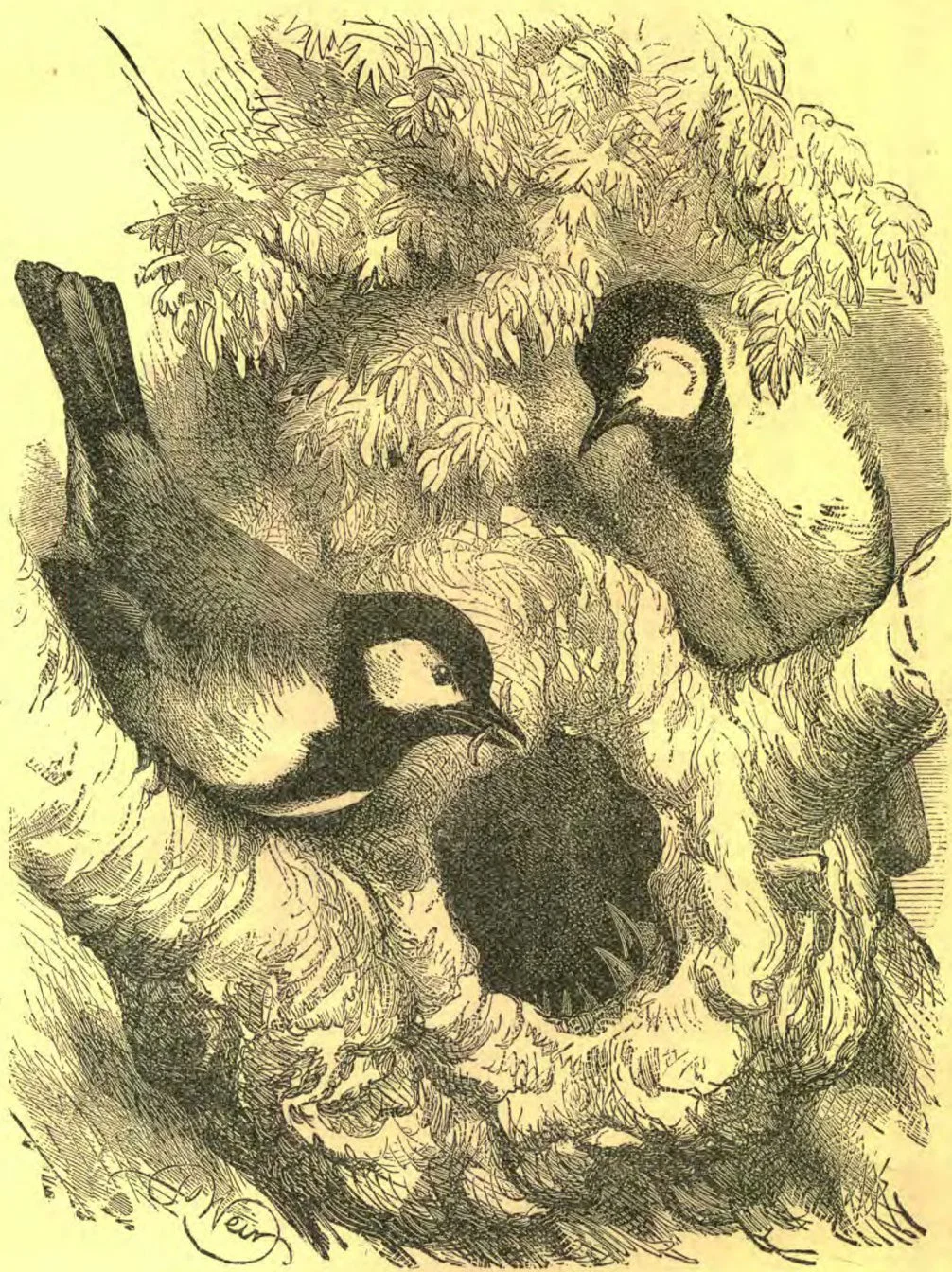
Whoever lives in the country without studying the birds, shuts out one source of enjoyment at least; for no one thoroughly enjoys them without in some way cultivating their acquaintance. I believe in bird’s-nesting, though I do not uphold the cruel boys who rob and destroy the homes of the small feathered people; but there is a privilege of bird’s-nesting, however, with which even the most tender-hearted need not be shocked. I will risk any boy or girl who carries a good heart, in any lane or hedge-row; and I will suffer them to discover and enjoy twenty bird’s nests, if they are fortunate enough to find them, without any wanton destruction of eggs or birds, or any damage to their own sensibilities. If you are a real student of Nature, you will look reverently on all her wonders, as one who remembers that the Lord of creation has made special mention of his care over them. “A sparrow shall not fall on the ground without your Father.”
“The American robin, which the naturalists call Turdus Migratorius, comes early in the spring, and is found during the summer throughout the whole of North America. This little favorite of both old and young is the most familiar of all our birds, and seems to seek to place its nest where it will be under man’s protection. His arrival is hailed with joy, as an unerring harbinger of spring. But sometimes the season is late, and he finds snow and ice on his coming; but he is a brave bird, and though he goes about chirping sadly (thinking perhaps of the mistake he made in leaving his sunny southern home so early) he flies swiftly around, looking sharply with his keen brown eyes for the remaining berries on the sumach, mountain ash, and red cedar; for he well knows that “brighter days will come at last.” As soon as it comes warmer, he is busy making a new home or repairing his old one; for the robin is a social little fellow, and seems to like to build in the same place year after year. That last year’s nest of moss and clay has stood the storms of fall and winter, and is as round and trim as ever, and with a few repairs, a bit of fresh clay here and there, and a new lining of fine dried grass from the hillside, is every bit as good as new. Then come four blue eggs, a few weeks of watchful care, four open mouths to feed; and Sir Redbreast and lady have all they can do to support their little family for the next six weeks.
Another sociable bird is the oriole, who often hangs her pretty cradle on the end of an apple-bough. Sometimes you may find one of these wonderful hanging nests three or four feet long, sometimes only about seven inches, and nearly as wide. At the bottom of it you will find four spotted eggs,—blue, if it is an orchard oriole; pink, if it is a Baltimore oriole’s nest. This nest is most elaborately woven into a fabric like a plaited straw hat. A gentleman counted the stitches which an oriole had made with one long wisp of hay, and found that it had passed through thirty-four times. A lady suggested that the bird might be taught to darn stockings.
Nothing can be more confidential than the habits of the swallows, who glue their bits of masonry by scores in our very chimneys. If you pass along the river bank, or wherever sand-hills lie, look for the bank-swallow, or sand-martin’s nests. Hundreds of them burrow into the perpendicular bank, sometimes to the depth of three or four feet, and at the further end construct a nest of a little straw.
The woodpecker’s nest is ingeniously built. She sounds her hammer along the limb of a tree till she finds one that betrays decay; then she bores a hole down deep into the heart of the bough, and lays her four pure white eggs on the dust at the bottom. One nest was found where the bird had dug forward five inches, and then downward twice that distance, through solid black oak. At the bottom of this hole the little woodpeckers first saw twilight—daylight would hardly be expected in such a place. This is the great red-headed woodpecker, who may be seen in all his magnificence, sunning himself on the fence-rails at almost any time.
The house wren (*Troglodytes Ædon*) is a familiar and interesting little bird, common in all parts of the United States from April until the beginning of October, when it retires to the South; but the place where it winters seems yet to be unknown. The wren is sprightly, active, and diligent. Its nest is formed with coarse sticks and shreds of bark and wood, in some cavity, such as a hollow stump, or the vacant space at the foot of a brace in the frame of a building. You would not think of finding a bird’s nest in a coat sleeve, but a wren once built there. A mower hung up his coat in a shed by the barn, where he left it two or three days. On putting it on again, he found the sleeve filled with rubbish, as he called it. He pushed it out, and behold! a wren’s nest, just ready for housekeeping. The poor little owner flew about in great trouble and surprise, but was made satisfied with an old hat nailed to the weather-boards, where she built again. Look under the eaves of the porch, or in any snug corner, for a neat little nest, quite round, with a small hole on one side; and you have a wren’s nest. In it you will find from six to eight little flesh-colored eggs, with purple spots. The wren is a very persevering little creature; and when its nest is destroyed, will rebuild it time after time in the same place.
Perhaps you have never heard the fable of the eagle and the wren. When the world was young, there arose a great contention among the birds as to which should be king. The eagle drew himself up in pride, flapped his monstrous wings, and in a voice that terrified the smaller birds and frightened Lady Magpie so badly that she fainted away, exclaimed: “Let this dispute be settled in this wise: We will all start together; the one who soars the highest will forever remain your acknowledged king.” They all agreed; very soon the eagle had outstripped them all, and was only a mere speck between the earth and sun. Then out spoke the bold eagle, “Behold, I am king.” Just then a little shrill voice exclaimed, “I beg your pardon; I am above you, therefore, I am king.” The astonished eagle looked over his shoulder and saw a tiny wren perched upon his back. He was very wroth and dashed the frightened little bird from him, exclaiming, “Go down to earth for your folly; you shall never fly higher than a man’s head.” The moral is good. We should never aim to fly higher than our own wings will carry us.
These are only a few of the many things that might be related about the birds and their queer ways; but those who will take the pains to watch the little warblers, may, before this summer is over, learn many curious things in regard to them. You will find interest enough in seeking their haunts and watching their habits without any intrusion upon their rights. Nothing pays young people better than that culture of eye and ear which springs from such rambles. COM.

BEAUTIFUL THINGS.

BEAUTIFUL faces are those that wear— It matters little if dark or fair— Whole-souled honesty printed there.
Beautiful eyes are those that show, Like crystal panes where hearth-fires glow, Beautiful thoughts that burn below.
Beautiful lips are those whose words Leap from the heart like the song of birds, Yet whose utterance prudence girds.
Beautiful hands are those that do Work that is earnest, brave and true, Moment by moment, the long day through.
Beautiful feet are those that go On kindly ministries to and fro— Down lowliest ways, if God wills it so.
Beautiful shoulders are those that bear Ceaseless burdens of homely care With patient grace and daily prayer.
Beautiful lives are those that bless— Silent rivers of happiness, Whose hidden fountains but few may guess.
Beautiful twilight, at set of sun, Beautiful goal, with race well won, Beautiful rest, with work well done.
Beautiful graves where grasses creep, Where brown leaves fall, where drifts lie deep, Over worn-out hands—oh, beautiful sleep! —Ellen P. Allerton.

HOW KELSEY LEARNED.

“I can do it. I tell you I am big enough. You needn’t be afraid to trust me to do a little thing like that.”
This was what Kelsey Wright was always saying.
He was an ambitious boy. He hated to be thought a little boy. He liked to be intrusted with work such as older people did. He was really capable and trustworthy for his age; therefore he was trusted a good deal. It was a great mortification to him to fail. He never would fail, if he could help it; he would leave no stone unturned by which success might be attained.
These were very good and hopeful qualities in a little boy; and his parents often said of him,—
“Kelsey will be successful in business when he is a man, because he is smart and persevering.”
How he learned, that, even in a good cause, he must not do evil, I am going to tell you.
One day Mr. Wright was called away from home suddenly. Fire was raging in Bruin’s Woods, and the neighbors were called to help put it out.
“Fred must go with me.—Kelsey, you must drive the cows to pasture, and clear up the barn. I’ve fed the horse already. He’ll need nothing more but drink. Give him water by-and-by. I presume I shall get home by noon.”
He went away, and Kelsey went manfully about his work, which he did in a very thorough manner. Before noon, the barn was as neat as shovel and broom, and plenty of clean sand, could make it. Everything was in its own proper place.
“I wish you’d come out, mother, and see how nice the barn looks,” said Kelsey, who liked to have his work praised.
“I’m very busy, dear. Father will see when he comes. I’ve no doubt you’ve done it well,” said she.
Kelsey went back to look once more, and make sure he had left nothing undone.
Noon came; but the father did not come as he expected. Dandy was whinnying in his stall for his noon feed of cut hay. The hay-cutter stood there; but there were standing orders that no boy was ever to meddle with it. Cutting the hay was the father’s work, and he would have no help about it: that was well understood.
Two o’clock, and Mr. Wright had not come yet. Kelsey came into the barn every few minutes, and every time he came, Dandy whinnied.
“It’s time he had his hay; father always gives him hay at noon. He isn’t coming home, and I ought to give it to him,” said Kelsey.
He knew well enough that it wasn’t essential that Dandy’s hay should be cut for him, though the horse liked it better so, and usually had it so. He wouldn’t listen to a little voice within, suggesting that it would be better to give it to him uncut than to disobey orders; he wouldn’t heed the thought that he had better ask his mother what it was best to do. “Dandy must have his cut-feed;” that was all he would allow himself to think.
He climbed upon the mow, and threw down the hay. Then he came down and began to put it into the hay-cutter; then he took hold of the handle, and began to turn. It worked delightfully. Why wasn’t his father willing to let him cut hay? It was the easiest, most interesting work.
He was proving himself able to do it, quite to his own satisfaction, and had almost finished the work, when a coarse bit of brier obstructed the working of the machine. He put his hand over to remove it.
He never knew how it happened; but in half a minute he was running to his mother with a white, scared face, and the blood dripping from his forefinger, which was shortened almost an inch.
“It cost me just that forefinger to learn to obey orders,” Mr. Kelsey Wright tells his own little boys.—JOY ALLISON, in Well-Spring.

A Sweet Temper in the Household

A SWEET temper is to the household what sunshine is to trees and flowers.

GENTLE WORDS.

HAVE you ever watched a rill, Trickling down Through the crevice of the hill Bare and brown,— Trickling, trickling, trickling bright, Day and night? Though it falls so soft and sweet On the hard rock at your feet, You will find a hollow there. Trickling, trickling night and day, It has worn the rock away,— Gentle words fall thus, they say. —Our Little Ones.

Cultivating Good Manners at Home

Study good manners at home, and they are all the easier observed when abroad.

THE THREE MARTYRS.

In East Bourn, on the coast of Sussex, England, when the tide is out, may be seen three iron stakes driven firmly into the sand. They are very old and rusty, the largest one, which is out in the sand at low-water-mark, being nearly rusted off. The second in size is about half-way between the low and high water-marks, and the smallest is not far from the shore.
Many, many years ago a father and mother and their little daughter, because of their religion, were chained to those stakes when the tide was out, and told that if they did not renounce their faith, they would be drowned by the rising tide.
The father was chained down where the waves washed his feet, and priests stood by him, arguing with and cursing him until the rising water drove them back and he was drowned. Then they stood around the mother and child and tried to persuade them to give up the truth and so save their lives, but they would not.
Slowly the waves crept up to the mother and rose above her feet, and knees, and shoulders; and the little girl saw her mother drown as she had seen her father.
Then all the priests gathered around her, and asked her questions, and promised her a happy life if she would give up her religion. But though she was a gentle, timid child by nature, and had sat on the cold sand six long hours, and was weary, and the dashing waters shocked and chilled her, she asked God to give her courage and strength to suffer and die rather than give up his truth. Then his sweet, strengthening grace came into her heart, and she said, “If you give me all the world, I would not deny my Saviour. He will give me eternal life if I am faithful.” And after a big wave had washed over her head and nearly strangled her, they said, “You may be saved if you will recant.” But she said, “No, no, I will die for Jesus. He died for me.”
And thus she died; but the angels know where she rests, and when Jesus comes and awakes all the dead, and sends his angels to gather his dear saints, they will take that little girl, with her father and mother, and bear them away to meet their Saviour in the skies.
“I beheld, and lo, a great multitude which no man could number, of all nations, and kindreds, and peoples, and tongues stood before the throne, and before the Lamb, clothed with white robes, and palms in their hands. These are they which have come out of great tribulation and have washed their robes, and made them white in the blood of the Lamb. Therefore are they before the throne of God, and serve him day and night in his temple: and he that sitteth on the throne shall dwell among them. They shall hunger no more, neither thirst any more; and God shall wipe away all tears from their eyes.” Rev. 7.—
Sarah K. Taylor.

“SUMMER IS NOW NIGH AT HAND.”

“Now learn a parable of the fig-tree; when her branch is yet tender, and putteth forth leaves, ye know that summer is nigh.” Although we do not have the fig-tree in our country to tell us that summer is nigh, yet we have other means by which we are made aware of its approach. We watch for the return of the birds from the warm sunny south, and the putting forth of the leaves on our own native trees. The first bird that returns is the crow. We can hear his “caw, caw” about the first of March; next come the blue bird and the robin to cheer us with their happy songs. After a few weeks the earth puts on a coat of living green; and as we see all nature springing into life, we see and know, of our own selves, that “summer is now nigh at hand.” Then as we go to Sabbath-school on a bright Sabbath morning in early spring, and listen to the singing of the birds and the ripple of the rills, as they sparkle on their way; our hearts swell with gratitude to God; then we remember our Saviour’s promise to come again; and we long to see him coming in the clouds of heaven to receive us to himself. Surely “summer is now nigh at hand.” A. L. P.

SUMMER

BEAUTIFUL, beautiful summer, With coronet royal, and wand, You, the Great King in his glory, Has proclaimed the queen of the land.
O bright and magnificent summer, All winning and lovely and dear, We rejoice in your perfume and beauty, And hail you fair queen of the year.

The Sabbath-School.

SECOND Sabbath in June.

SCENES IN THE LIFE OF CHRIST.

LESSON 19.—VISIT TO NAZARETH.

Soon after the healing of the nobleman’s son at Cana, our Lord seems to have gone to Nazareth, the place where he had been brought up, to spend a short time. It is said to have been a custom among the Jews for any one who wished to read in the synagogue on the Sabbath-day, to make his wish known; when he would be allowed to read in the hearing of the people whatever portion of Scripture he chose. It was probably in accordance with this custom that Jesus “went into the synagogue on the Sabbath-day, and stood up for to read.” And they gave unto him the book of the prophet Esaias [Isaiah]. “And when he had opened the book, he found the place where it was written, The Spirit of the Lord is upon me, because he hath anointed me to preach the gospel to the poor; he hath sent me to preach deliverance to the captives, and recovering of sight to the blind, to set at liberty them that are bruised, to preach the acceptable year of the Lord. And he closed the book, and he gave it again to the minister,” or the one who had the care of the synagogue, “and sat down,” as it was customary for the Jewish rabbis to do when they taught the people. “And the eyes of all them that were in the synagogue were fastened upon him,”—they listened to him very attentively.
Jesus then went on to make known to the people that he was the one to whom the prophet Isaiah referred in the scripture he had just read to them; and that by his preaching and his works of mercy he was fulfilling that prophecy. He said to them, “This day is this scripture fulfilled in your ears.” At first they seemed glad to hear what he had to say, and wondered at the “gracious words” which he spake to them. They were so interested in his talk that for a time they seemed to forget that he was one who had been brought up among them; but soon they began to say one to another, “Is not this Joseph’s son?” He then said to them, “Ye will surely say unto me this proverb, ‘Physician, heal thyself’; whatsoever we have heard done in Capernaum, do also here in thy own country.” By this they very likely meant the healing of the nobleman’s son at Capernaum, and wondered why he did not heal their sick also.
But he said to them, “No prophet is accepted in his own country;” and then he gave examples to prove the truth of this saying. He said, “But I tell you of a truth, many widows were in Israel in the days of Elias [Elijah] when the heavens were shut up three years and six months, when great famine was throughout all the land; but unto none of them was Elias sent, save unto Sarepta, a city of Sidon, unto a woman that was a widow. And many lepers were in Israel in the time of Eliseus [Elisha] the prophet; and none of them was cleansed saving Naaman the Syrian.”
Now the people felt condemned by the words of Jesus; “and all they in the synagogue, when they heard these things, were filled with wrath, and rose up, and thrust him out of the city, and led him unto the brow of the hill, (whereon their city was built,) that they might cast him down headlong. But he, passing through the midst of them went his way.”

QUESTIONS.

  1. Where did Jesus go soon after the healing of the nobleman’s son at Capernaum? Luke 4:16.
  2. When the Sabbath was come, what did Jesus do?
  3. In accordance with what custom was this?
  4. What book was handed him?
  5. From what chapter of Isaiah did he read to them? Chap. 61.
  6. Repeat the words which he read. Luke 4:18, 19.
  7. What did Jesus do when he had finished reading?
  8. How did his reading affect the people who listened? Verse 20.
  9. What did Jesus then make known to the people?
  10. How was this prophecy of Isaiah fulfilling in their ears?
  11. How did they at first accept what he had to say to them?
  12. What did they finally begin to say one to another?
  13. What did Jesus anticipate they would ask him to do? Verse 23.
  14. To what was reference most likely made in the words, “Whatsoever we have heard done in Capernaum”?
  15. What proverb did Jesus then quote to them? Verse 24.
  16. What examples did he give to prove the truth of this saying?
  17. Who was Elijah?
  18. In the reign of what king did he live?
  19. Tell the story of this famine to which Jesus referred. 1 Kings 17.
  20. Tell the story of Elisha’s healing Naaman, the Syrian. 2 Kings 5.
  21. How did the people feel when they heard these words of Jesus? Luke 4:28.
  22. What did they do?
  23. How did Jesus escape from them? Verse 30.

NEW-TESTAMENT HISTORY.

LESSON 32.—CHRIST ACCUSED OF CASTING OUT DEVILS THROUGH BEELZEBUB.

It seems that our Lord about this time made another tour through Galilee. In the eighth chapter of Luke we read as follows:—
“And it came to pass afterward that he went throughout every city and village, preaching and showing the glad tidings of the kingdom of God; and the twelve were with him, and certain women, which had been healed of evil spirits and infirmities, Mary called Magdalene, out of whom went seven devils, and Joanna the wife of Chuza, Herod’s steward, and Susanna,—and many others which ministered unto him of their substance.”
“And they went into an house. And the multitude cometh together again, so that they could not so much as eat bread. And when his friends heard of it, they went out to lay hold on him; for they said, He is beside himself.”
“Then was brought unto him one possessed with a devil, blind and dumb; and he healed him, insomuch that the blind and dumb both spake and saw. And all the people were amazed, and said, Is not this the son of David? But when the Pharisees heard it, they said, This fellow doth not cast out devils but by Beelzebub, the prince of the devils. And Jesus knew their thoughts, and said unto them, Every kingdom divided against itself is brought to desolation; and every city or house divided against itself shall not stand; and if Satan cast out Satan, he is divided against himself; how shall then his kingdom stand? And if I by Beelzebub cast out devils, by whom do your children cast them out? Therefore they shall be your judges. But if I cast out devils by the Spirit of God, then the kingdom of God is come unto you.”
Jesus then continued to show how unreasonable it was to suppose that devils can be cast out through the authority of the prince of devils. He says, “How can one enter into a strong man’s house, and spoil his goods, except he first bind the strong man? and then he will spoil his house.”
“He that is not with me is against me, and he that gathereth not with me scattereth abroad.”
“And whosoever shall speak a word against the Son of man, it shall be forgiven him; but unto him that blasphemeth against the Holy Ghost, it shall not be forgiven.”
“Either make the tree good, and his fruit good; or else make the tree corrupt, and his fruit corrupt: for the tree is known by his fruit. O generation of vipers, how can ye, being evil, speak good things? for out of the abundance of the heart the mouth speaketh. A good man out of the good treasure of the heart bringeth forth good things; and an evil man out of the evil treasure bringeth forth evil things.”
“But I say unto you, That every idle word that men shall speak, they shall give account thereof in the day of judgment. For by thy words thou shalt be justified, and by thy words thou shalt be condemned.”
“Then certain of the scribes and of the Pharisees answered, saying, Master, we would see a sign from thee. But he answered and said unto them, An evil and adulterous generation seeketh after a sign, and there shall no sign be given to it, but the sign of the prophet Jonas [Jonah]. For as Jonas was three days and three nights in the whale’s belly, so shall the Son of man be three days and three nights in the heart of the earth. The men of Nineveh shall rise up in judgment with this generation, and shall condemn it; because they repented at the preaching of Jonas, and, behold, a greater than Jonas is here. The queen of the south shall rise up in the judgment with this generation, and shall condemn it; for she came from the uttermost parts of the earth to hear the wisdom of Solomon, and behold a greater than Solomon is here.”

QUESTIONS.

  1. What tour did Jesus make about this time?
  2. What is said about this in Luke 8:17?
  3. Who accompanied him on this tour?
  4. Tell how the multitudes crowded upon him. Mark 3:19, 20.
  5. What course did his friends pursue? Verse 21.
  6. What noted miracle did our Lord then perform? Matt. 12:22.
  7. How did this miracle affect the people?
  8. What did the Pharisees say when they heard of it?
  9. What was our Lord’s first argument to show that such a theory must be false?
  10. What question did he propose to them?
  11. If they were forced to admit that Jesus cast out devils by the Spirit of God, what conclusion would inevitably follow? Verse 28.
  12. What further illustration did Jesus give? Verse 29.
  13. What important statement is made in verse 30?
  14. How might this statement find an application at the present time?
  15. What sin has no forgiveness? Verses 31, 32; Luke 12:10.
  16. By what striking figure did Christ show that a man’s character is known by his deeds? Verse 33.
  17. How did Christ then address his hearers? Verse 34.
  18. What question did he ask them?
  19. What statement did he make, to show what determines the character of our words?
  20. How did he explain this statement? Verse 35.
  21. What did he say about idle words?
  22. By what statement did he show that men are to be judged by their words as well as by their deeds?
  23. What answer did Jesus make, when the scribes and Pharisees asked for a sign?
  24. Why will the men of Nineveh rise in the judgment to condemn the generation that heard Jesus teach, and saw his miracles?
  25. Why will that generation be condemned by the example of the queen of Sheba?

Correction to Sabbath School Lesson Numbering

CORRECTION.—Several weeks ago there was a mistake made in the numbering of the lesson, there being two lessons numbered 27. It is to correct this error that this lesson is numbered 32, while last week's was 30.

NOTES ON THE LESSON.

VERSE 27. “By whom do your children cast them out. Children, or sons of the prophets; meaning the disciples of the prophets; and children or sons of the Pharisees, disciples of the Pharisees. From Acts 19, it is evident that there were exorcists among the Jews; and from our Lord’s saying here, it is also evident that the disciples of the Pharisees did cast out demons, or at least those who educated them wished to have it believed that they had such a power.”—Clarke.
“There were those among the Jews who, by invocation of the name of the Most High God, or the God of Abraham, Isaac, and Jacob, did sometimes cast out devils. Josephus speaks of some in his time that did it; we read of Jewish exorcists (Acts 19:13.), and of some that in Christ’s name cast out devils, though they did not follow him. (Mark 9:38), or were not faithful to him, chap. 7:22. These the Pharisees condemned not, but imputed what they did to the Spirit of God, and valued themselves and their nation upon it. It was therefore merely through spite and envy to Christ, that they would own that others cast out devils by the Spirit of God, but suggested that he did it by compact with Beelzebub.”—Matthew Henry.
VERSE 38. “We would see a sign from thee,—that is, we wish now to see thee work a miracle.
VERSE 42. “The queen of the south. In 1 Kings 10:1, this queen is said to be the queen of Sheba, or Saba, which was a city and province of Arabia Felix, to the south or southeast of Judea.”—Clarke.

SPIRITUAL POWER.

Suppose we saw an army pitching tents before a granite fort, and they told us they intended to battle it down—we might ask them how? They point to the cannon-ball. Well, there is no power in that. It is heavy; but if all the men in the army hurled it against the fort, they would make no impression. They say, “No, but look at the cannon.” Well, but there is no power in that; a child may play with it; it is a machine, and nothing more. “But, look at the powder.” Well, there is no power in that. A child may spill it; a sparrow may pick it. Yet this powerless powder and powerless ball are put into the powerless cannon; one spark of fire enters it, and then, in the twinkling of an eye, that powder is a flash of lightning, and that ball is a thunderbolt, which smites as if it had been sent from heaven. So it is with our church and Sabbath-school machinery; we have all the instruments necessary for pulling down the strongholds; but, oh, for the baptism of fire!—William Arthur.

TEACHERS’ MEETINGS.

If the school be small, the superintendent can know every scholar personally. If the school be large or changing, he cannot note the individual scholars. Through the teachers he must work. We need a teachers’ meeting in every Sabbath-school in the land. Well, but you say, “Philadelphia is peculiar; we cannot succeed here.” I go to Providence; and they say, “This place is a little peculiar.” I go to a little village in the woods, and they say, “Our circumstances are peculiar.” And so it is everywhere.
If I could get only five teachers to attend, I would meet with that number and strive to build them up. To secure success, remember a teachers’ meeting is not a debating club, and that good brother who is disputatious must be gently but decidedly and firmly quenched, because he is killing the meeting. The teachers’ meeting is for earnest prayer to God, and for earnest work.—S. S. World.

KEEP AWAY FROM THE WELL.

In a pleasant farm-house among the hills of Vermont lived Earl and Linnie Winslow. All around the house were nice shade trees, and on two sides was the large old orchard, with its bent and gnarled apple-trees. Every May the trees were crowded with beautiful blossoms, and later in the summer the low white house was almost hidden in a sea of green. Then in the autumn when the apples were ripe, what fine times the children had, helping to gather the fruit—brown, red, and golden! What fun it was to toss the leaves about, and heap the apples up in little mountains! And then when father came along with the team, the children would help to put the apples in the baskets and bags, and finally ride away on the load to the house, where the precious fruit was stored in the cellar for the winter.
Beyond the orchard were the meadows, where the children went to gather violets and hunt bird’s nests; and still beyond were the woods, where early in the spring they went with their father to the sugar-camp. Then after a few weeks they went again, to gather the “May Flowers” and “Spring Beauties” which grew there so plentifully.
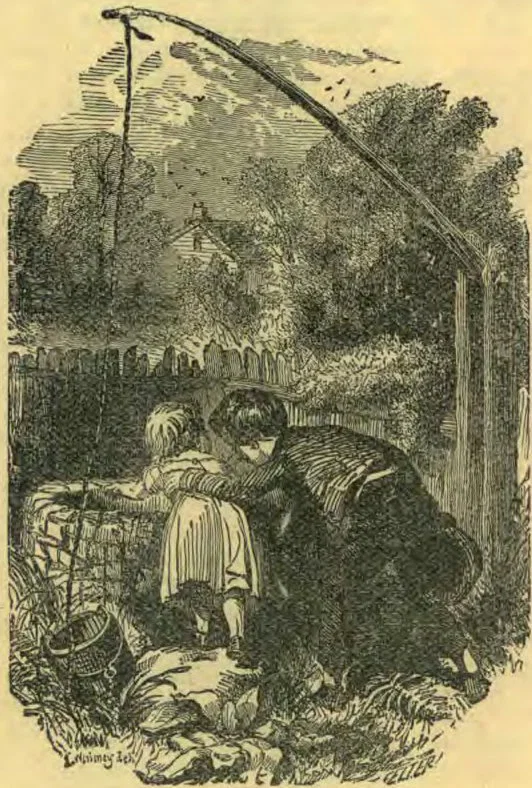
On the east side of the house was the garden, with its fresh vegetables, nice strawberry bed, and long rows of currant and gooseberry bushes. And just beyond the garden fence was the well, with an old-fashioned stone curbing around it. The well was left open, and the water was drawn with what they called a “sweep,” to which was fastened a strong bucket. The well had been dug many years before, when the old log house had stood near it. After awhile the new house was built over in the orchard, and the old log one torn away. But they could not move the well; and as the water was so clear and cool, they still came there to draw, though it was quite a way from the house.
So you see the children, Earl and Linnie, had many nice places to play. Earl was eight years old, while Linnie was only five; and he was very proud that his mother should trust him to take little sister with him to play in the fields and orchard. But time and again the mother had said to them as they went out to play, “Now, be sure to keep away from the old well; you might fall in!” But one day as they were at play in the backside of the garden, Earl began to wish he could go through the fence where the well was. He had been there with father many times, and had never fallen in; and wasn’t he big enough to take care of Linnie? To be sure, mother had told them not to go there; but, then, he was sure they would not get hurt, and he wanted to go so much, just for a few minutes, this once.
So he unfastened the gate, and leading the little girl by the hand, he disobeyed his mother and went on to the forbidden ground. He had not intended to go very near the well; but after awhile he crept cautiously up and peeped over the top of the curbing. How pretty and cool the water looked way down there so deep! And as Linnie came up beside him, he put his arm about her, and together they stood leaning over the well, looking at the mossy stones and watching the reflection in the water of their own faces and the shadow of a tall tree which grew near the well. They were very much interested, and leaned over farther and farther, when all at once—they never knew how—Linnie lost her footing and went over—down, down into the dark water!
Earl did not know what to do, but his screams soon brought his father and the hired men, who were working in a field near by. When they found what had happened, the father got into the large bucket, and the men let him down. Linnie was just rising for the last time; and reaching down his strong arms, he took her out of the water, and they were soon drawn up.
The little girl was cold and white, and Earl thought she was dead. But after they had worked over her some time, she opened her blue eyes and finally began to breathe. Then they carried her into the house to mother, who had all this time been busy getting supper, and knew nothing of the terrible thing that had happened.
Earl’s joy knew no bounds when his little sister could sit up and talk to him once more. He was so sorry for what he had done that his father and mother thought he had been punished enough; and they were all so thankful to have their little girl back alive that no one said much to him about his fault. But he learned a lesson that day which he has never forgotten, though he has now grown to be a man and has little boys and girls of his own. He often tells them the story, and always says that he, as well as his little sister, fell into a well that day; though it was not a well of water. Do any of you know what well it was?
Continue reading: SWEETER THAN THE HONEYCOMB