The Youth’s Instructor, Vol. 48, No. 26.

THE HAWAIIANS

The Youth’s Instructor

Jun 28, 1900

Review and Herald Publishing Company · Battle Creek, Mich. · Jun 28, 1900

THE HAWAIIANS

Native Dress
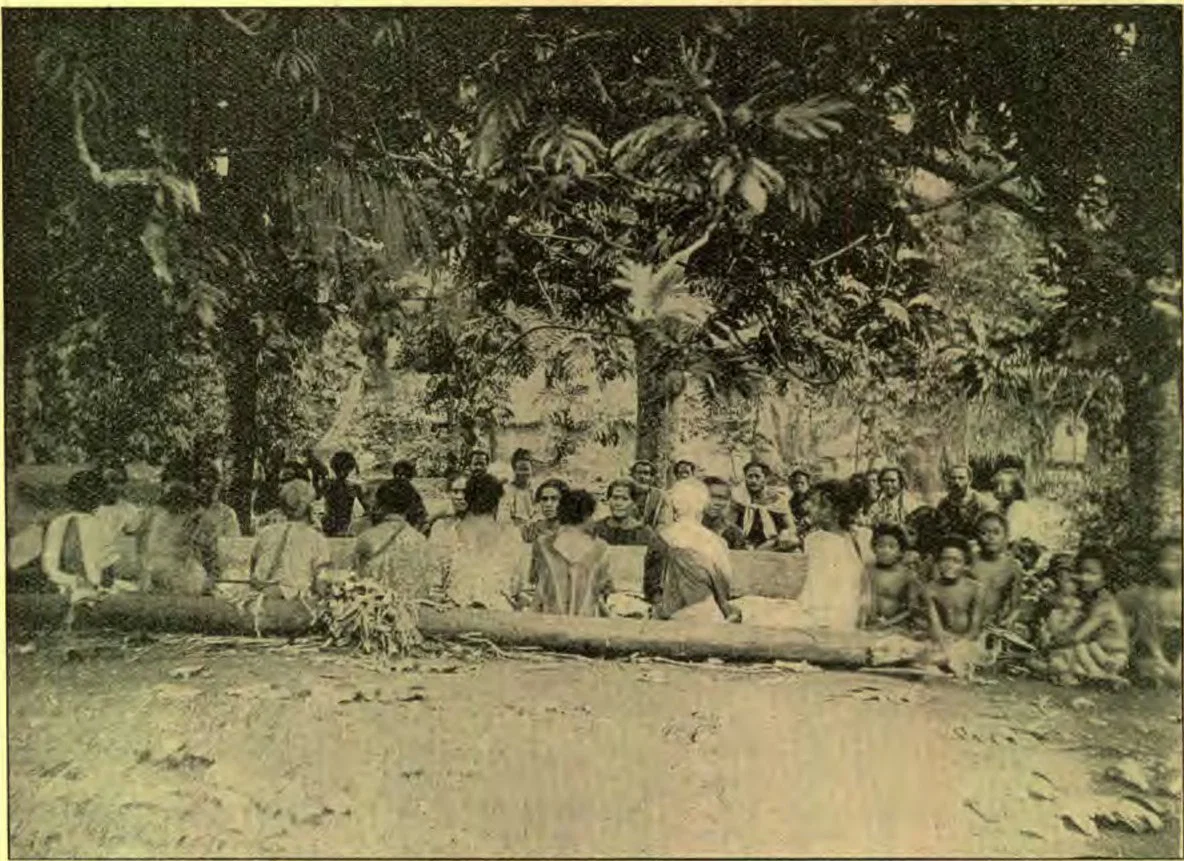
After six thousand years of the curse, nature still provides, in a crude state, all that man needs to sustain life, and make him comfortable. She comes to the assistance of the indolent children of tropical climes, and kindly takes upon herself much of the labor that is required of those in cooler countries, where exercise and activity are not only necessary to supply physical needs, but also to maintain that physical health which, in its turn, adds mental and moral vigor. Perhaps nowhere is she more lavish of her gifts than in Hawaii, where are the most brilliant of sunsets, the brightest skies, the bluest waves, and the most gorgeous rainbows. Many tropical fruits grow without cultivation, and many more may be obtained with slight exertion: yet even here the word spoken to Adam after he sinned,—“In the sweat of thy face shalt thou eat bread, till thou return unto the ground,”—is literally fulfilled.
While the paper-mulberry and mamake trees supplied the bark for the manufacture of the kapa (cloth) from which the scanty garments of the native Hawaiians were made, still some labor was necessary in its manufacture. This labor was performed by the women. Strips of bark were peeled from the trees, and the outer coat was scraped off with shells. The strips were then soaked in water, laid upon smooth logs, and beaten with grooved mallets made of hard wood. The strips were united by overlaying the edges, and beating them together.
The fabric thus made was then stained or bleached white, and either left plain or impressed with bamboo stamps in a great variety of patterns, and in many different colors,—gray, red, different shades of blue, pink, green, etc. After this it was glazed with a kind of gum, or resin.
In general the kapa could not be washed, and lasted only a few weeks. Some of it was very fine, while other kinds resembled wash-leather. Many varieties and patterns may be seen at the Bishop Museum, and one can not but wonder at the ingenuity displayed in the manufacture of this curious fabric.
Besides the pāʻū of the women and the girdle of the men, the kihei was sometimes worn by both sexes. This was about six feet square.
MAKING KAPA
MAKING KAPA
The sleeping kapa consisted of five layers of common kapa, and was several yards square. The outside layer was generally stained or painted.
Besides the garments made of kapa, there were the magnificent feather cloaks, or robes of state.
The groundwork of these was a fine netting of olon, or native hemp, to which very small feathers of bright yellow or scarlet were attached so as to overlap one another like the scales on a fish.
The birds from which these feathers were taken are jet-black, with long, curved bills, and a tuft of yellow feathers under each wing.
In order to obtain them, the natives would decorate trees with the bird’s favorite flowers, and then smear the branches with a sticky gum. Seeing the flowers, the birds would light on the branches, where they were caught.
These choice yellow feathers were reserved for royalty, inferior chiefs wearing smaller and less expensive capes.
Several of the larger cloaks, or robes of state, are on exhibition in the Bishop Museum. One of these was the royal garment of Kamehameha the Great, and was used by him and all succeeding monarchs of Hawaii as a royal emblem. This cloak is about five feet long, all of yellow mamo feathers, and very beautiful. The bird from which the feathers were taken is now nearly extinct, and this cloak is the only one of the kind in existence. Another, equally beautiful, is made of yellow feathers, with a design on the back outlined and filled in with small, bright-red feathers. Still another has a border of yellow feathers mixed with red.
The cloak of Nahienaena, the daughter of Kamehameha the Great, is also on exhibition. It is eleven feet long and sixty inches wide, and is made of small yellow feathers, and lined with peacock-blue satin. It was worn by the princess, perhaps for the last time, on the occasion of Lord Byron’s visit in 1824. Since her death it has been used as a royal pall.
The Hawaiian kahilis, or plumed staffs of state, are rods from ten to thirty feet long, topped with feather cylinders from one to two feet in diameter, and from one to four feet in length. Some are of pink feathers, with just a suggestion of white near the edges. Others are of jet-black, pure-white, green, purple, and gray, and still others are of mixed colors. The lower parts of the cylinders are closed with beautiful satins of corresponding or contrasting colors. These are drawn down, gathered around the staffs, and tied with long satin ribbons.
The elegant feather helmets were made of wicker-work covered with small, delicate red or yellow feathers. The one we saw was of yellow, with a band of scarlet extending over the top from the front to the back. There is also an ancient feather helmet from Vancouver’s collection, which was obtained by exchange with the British Museum. The colors are very dull in comparison with that first described.
Wonderfully beautiful bands of feathers, several inches in width, are used as leis on hats.
The present dress of the native Hawaiian is almost invariably the holoku, a long, flowing dress similar to the American woman’s Mother Hubbard. A holoku without a train is a thing almost unheard of. On account of the warm climate, the material is generally quite light; and the Hawaiian woman, with one hand holding up the superfluous length, swings along with an ease and freedom of movement unknown to the wearer of high-heeled shoes and fashionable clothing.
When upon the street, most of the women known as “half whites,” as well as many of the younger Hawaiian ladies, dress in the same manner as do the white ladies; while many of the latter spend their mornings arrayed in the cool and comfortable dress just described.
LENA E. HOWE.

JULY STUDY OF THE FIELD

PART I: "EDUCATION IN CHINA"
  • (July 1-7)*
1. Basis of Study.—Since the real stimulus of education in China is the hope of obtaining office and honor, the rigid methods of preparing for examinations and the conducting of the same, will no doubt be read with interest by our young people. As a description of the common schools appeared in the INSTRUCTOR of May 3, our notes this week are confined almost wholly to the work that follows the common school education. A brief description of the examination halls in which China’s sons labor for their degrees appears in the INSTRUCTOR of March 29, but we have treated the question more fully in the notes this week.
2. A Mania for Degrees.—Despite the fondness for titles in this country, it is scarcely possible for Americans to realize the mania of the Chinese for literary degrees. The highest ambition of every family is to have at least one of its members pass examinations, and get a degree. If none are inclined voluntarily to study for a degree,—which, however, is seldom the case,—the father will select one, and compel him to do so. Sometimes actual force is needed to effect this. In one case a young man was kept by his father a prisoner for five years, with no companion but a tutor, to force him to prepare for the examination. At last he succeeded in passing the first examination, and getting the first, or bachelor’s, degree. In this he rejoiced; for he supposed it would mean the end of his imprisonment. But it meant no such thing. The father quickly returned him to his cell, and bade him study for the second, or master’s, degree. The prospect of this, and of then being similarly forced to study for the third, or doctor’s, degree, so disheartened the young man that he hanged himself.
3. Easy Examples.—These examinations are interesting, especially in mathematics and what Western nations consider practical sciences. For example: “If eight thousand piculs of rice are carried for thirteen taels [cents] a picul, and the freight is paid in rice at two and one-half taels a picul, how much rice goes to pay the freight?” Imagine such a problem in mathematics gravely given out to college students as the crux of their final examination for the baccalaureate degree! And then imagine only one among ten thousand being able to solve it! And the question of the superficial area of a globe eighteen inches in diameter proved a still worse stumbling-block.
4. Persistence in Securing Degrees.—The thousands of unsuccessful candidates do not give up hope. They return to their work at the next examination, and again and again, until they either pass or die of old age. We read recently of an examination where three of these successful candidates were from one village. One was a boy of fourteen or fifteen years, and another an old man of nearly eighty years, who had been trying to pass at each year’s examination since he was a boy. The whole village was wild with enthusiasm over his final success at his sixty-first trial, although the mandarin who conducted the examination declared he was not really entitled to pass, but was allowed to “slip through” because he had been trying so long, and there was danger that he might not live to attend the next year.
5. Examination Halls.—As the candidate enters the examination hall, his name, family, age, and place of residence are recorded; and he is given a slip of paper, on which is written the number of the passageway and cell he is to occupy for the next three days and nights. These cells, about seven feet high, four feet wide, and three feet deep, are entirely devoid of furniture, invariably very dirty, and almost as hot as ovens in the summer, when the examinations are held. After three days and nights the students are given a recess of three days. A second confinement of three days and nights follows; then a second recess; and finally a third confinement, or nine days and nights in all, which concludes the examination. In entering the second time, each one draws new numbers for his cell and alley, care being taken each time that no candidate shall occupy the same cell that he was in before. All communication with the outside world is as completely cut off as if the men were in prison. Watch-towers are erected, where soldiers are on duty with orders to shoot any one who tries to communicate with persons outside the walls. Besides this, an outer wall twenty feet from the inner one would seem to prevent any such attempt. Each student must supply himself with provisions, candles, fuel, and bedding, or else go without such comforts until three days are passed, unless it may be that, as is sometimes done, a little boiled rice is distributed by the authorities. It is by no means an unheard-of thing for candidates to die in their cells, sometimes from exhaustion, sometimes from the bites of venomous serpents, and sometimes from wounds deliberately self-inflicted in despair of getting through the examination. There are three examinations,—first for the bachelor’s degree; second for the master’s degree; and third for the doctor’s degree; and each is more rigid and exacting than the preceding. But all who pass any of the three examinations form a class apart from the rest of the nation—a ruling class, superior in social rank, as well as in politics and religion.
6. Our Opportunity.—The fact that the Chinese everywhere have a great admiration for learning, and that they have great respect for the printed page, so that nothing of that kind is trampled underfoot, should be an incentive to a large number of young people to consecrate their lives to the carrying to this people of the closing message of mercy in the printed page. Dare we say that the statement that “the silent messengers of truth should be scattered like the leaves of autumn” refers only to the United States, when the Chinese receive eagerly books of all kinds? Scores of them, who might have been saved in the kingdom of God, will be eternally lost because vile and trashy literature came into their hands instead of the word of God. These people have great respect for education, and their ambition to become acquainted with the English language has led thousands to study the word of God in that tongue, with the result that many have been converted. Can we close our eyes to these opportunities? Again and again has the appeal been made that young men and women fit themselves for foreign work. The condition of affairs in China to-day should lead us to ask, “Lord, what wilt thou have me to do?” Soon the work that might have been performed in peace and comparative prosperity may need to be done under the most trying, forbidding circumstances.

THE “STAFF OF LIFE” IN SYRIA AND PALESTINE

THE loaf of bread in Syria and Palestine is made in two shapes. The first is a round cake, about five or six inches in diameter. The dough is rolled out thin, about a quarter of an inch in thickness, placed in a hot oven, and baked. When it comes out of the oven, the upper part is separated from the lower, leaving a hollow space between the upper and lower crusts. The dough is sometimes mixed hard, and sometimes soft; it is prepared in the houses, and sent to some special bakery to be baked. This kind of bread is generally made in the cities and towns. It will keep good for two days, but on the third day it becomes dry, and is not so palatable.
The other kind of bread is used in the villages of Galilee and its environments. The loaf here is circular in shape, and from fifteen to twenty inches in diameter, flat as a wafer, and one sixteenth of an inch in thickness. After the loaves are baked and cooled, they are placed in the bread-basket, one on top of another, and covered over tightly, in order to exclude the air. When this precaution is taken, the bread will keep soft and fit for use for from ten to fifteen days. A large quantity is baked at one time, because the bread is made at home. Every family has an oven, and it is desirable to avoid heating the oven oftener than necessary. When this kind of bread is exposed to the dry air of that country, it becomes hard and brittle. The bread in the cities is generally made of wheat flour. The country bread is sometimes made of the same, but for the most part it is made of rye or something similar. Sometimes, in Galilee and other places, it is made of barley or of white corn.—Sunday-School World.

They Also Serve Who Only Stand and Wait

“God doth not need either man's work or his own gifts. Who best bear his mild yoke, they serve him best; his state is kingly; thousands at his bidding speed, and post o'er land or ocean without rest. They also serve who only stand and wait.”

BISHOP'S-PURSE

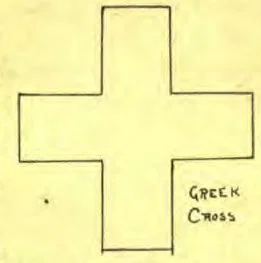
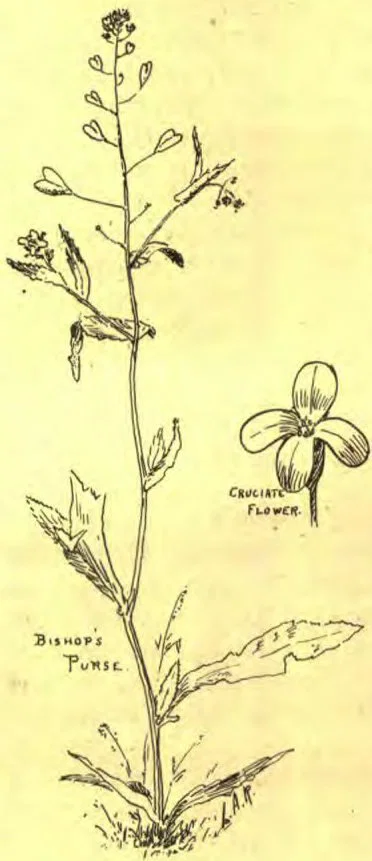
The Bishop's-purse is one of the most common of our wayside weeds. One can walk scarcely a block along any of our city or village streets, where grass finds room to grow, without finding at least a few specimens of bishop's-purse. The Latin name of the plant is bursa pastoris, which, in literal English, is “purse of a pastor, or bishop.” It takes its name from the peculiarly shaped seed-pouches. These grow at the end of the flower-stems, and soon assume the shape of the three-cornered, triangular purse once carried by bishops. This little plant belongs to the order Cruciferæ, which means “bearing a cross,” from the fact that there are in this order of plants but four petals, set somewhat in the position of the four arms of the Greek cross. To this order belong such plants as mustard, radish, turnip, peppergrass, the sweet alyssum, and cress.
L. A. REED.

THE ARTISTIC SIDE

To treat the subject of artistic photography exhaustively would require more space than the editor has allotted to this entire series. Even if it were allowed, I should simply come to the end of my knowledge of the subject; for the subject itself is inexhaustible. All I can do here is to give a few simple rules for composition, and leave the reader to study out the why and wherefore by applying them to every painting, engraving, or photograph he sees. But remember that there are exceptions to all rules.
The interest in a photograph should, and usually does, center in some particular object. That object should never be in the middle of the picture, but about one third the distance from one side or the other. You must be careful about your center of interest. Very often the object that catches and holds the attention is one that should be subordinate. Many a good landscape has been spoiled by introducing a figure in incongruous costume and attitude. More often than otherwise, this figure is posed directly in the middle of the picture, and staring straight at the camera. Figures in landscapes are extremely difficult to handle, and should be avoided by a beginner.
The horizon ought never to cut the picture in halves. For some subjects it should be about one third the distance from the top of the picture; while for others it is better to have it one third from the bottom.
When you have anything with well-marked lines, such as a stream, a road, or a fence, do not allow it to run directly across your picture, nor straight up and down from bottom to top. Aside from these points, the lines may occupy almost any position; their arrangement will admit of a great deal of latitude without violating the rules of good composition.
In photographing a building do not plant your camera directly in front of it. Get a position where you can see one end as well as the front, and that will give you the building in perspective. When you photograph tall buildings, be careful to adjust your swing-back, or the upright lines may converge toward the top.
In taking a street scene, a view of a road through the woods, or a lane with shade-trees or hedges on each side, do not stand in the middle of the road. To be sure, your lines will not run directly from bottom to top, even if you do (because of the principle of perspective, they will converge from either side to the vanishing-point on the horizon); but such a subject will give a V-shaped sky, and unless the lines can be broken by some irregularity in the sky-line, the point of the V should be about one third the distance from one side of the picture.
There are many other rules for landscape composition, but most of them are more complex. If you become thoroughly familiar with these simple directions, you will have an excellent foundation for artistic success with subjects of this class.
When you are called upon to take portraits, I advice you to refuse. A beginner can not expect, with his tools, to equal the portrait work of the professional photographer; and it is seldom that he can satisfy his patrons. You will lose fewer friends by refusing to take portraits under any circumstances than you will by taking them whenever you are asked. Sometimes, however, you may be with a group of friends who do not see this matter as you do, and under such circumstances it might be quite rude flatly to refuse to take their pictures. Of course it would then be best to make the effort.
If you do attempt a group, try to select some plain background, such as a thick hedge or grassy hillside. Direct sunlight will not do for portraits; so unless the weather is cloudy, you must find a shaded spot. Do not arrange the group in a straight, unbroken line. A pyramidal form is much better.
When your group picture is finished, do not give away your prints. Tell your friends that you can not spend the Lord’s money to flatter their vanity, and charge them as much as they would pay a professional photographer. They will think more of you for it.
J. Edgar Ross.

Wonders of Nature's Garden This Season

Every nook and corner of nature's garden is filled with wonders at this season.

A LESSON FROM THE BIRDS

“Just as sweet! Just as sweet!” The little wren said, As she squinted her eye in the side of her head, Looking down the big throats of the wrenlets she fed; “Just as sweet! Just as sweet!”
“Not at all! Not at all!” Cawed the crow far above; “Your blind little wrens are too tiny to love; Down the throats of my fledglings your whole brood I could shove; Such I love! Such I love!”
“’T is n’t size! ’T is n’t size!” Dame robin put in, “Or young turkey-gobbler our affection must win. ’Tis the pretty red napkin tucked under the chin, Such as mine! Such as mine!”
“Not agreed! Not agreed!” Chirped the birds that were pied; And they wrangled so long in their motherly pride That a jury of owls was called in to decide Which was right, Which was right.
“All are wrong! All are wrong! If the truth we must tell, You all look alike when you hatch from the shell; And God loves us all, and equally well, Let us learn! Let us learn!”
“He is good, He is good.” All at once did declare; “No creature too small for his love and his care!” So a jubilee grand they all sang in the air, And were glad, And were glad.
Dear children, Dear children, Of every kind, Look sharp at this story; and if you should find Any lesson you think it is best you should mind Heed it well, Heed it well.
J. A. L. DERBY.

WAIT-A-BIT

THERE is a little vine that I know in the South, which is commonly called “wait-a-bit;” and the title is not only poetical, but prophetic as well. In walking through the hummock, on every side you encounter trees, odd plants, creeping vines, and bright, unfamiliar blossoms. At first, among so many things that are strange and beautiful, you may not notice the dainty little vine, with its smooth, green leaf. But perchance you brush against it, and you are arrested at once—not merely by reason of its beauty, but because it has laid detaining hands upon you; for at intervals along the slender stem, half hidden by the dainty leaves, are sharp thorns that curve in all directions, and hold you fast. You can not easily tear yourself away; for the hasty movement will cause more of the thorns to grasp you than you have released; but you must patiently unloose each tiny finger.
And so the little vine, like all else to seeing eyes and thinking minds, has its lesson for humanity. “Be patient,” it says; “wait a bit.”
There are obstacles in the life-path that have to be overcome. We can not avoid them; they must be met fairly and squarely. We can not tear ourselves away from them without receiving more or less injury. Is it not better to deal patiently with them, to meet them little by little, and at last come out of the ordeals no worse, but possibly better and stronger, than when we encountered them?— M. Palmer Sweet.

THE PRICE OF OUR REDEMPTION

V
At the time of the Passover the Jews and their adherents from far and near were drawn to the Hebrew capital; and it was in God’s appointment that the crucifixion took place at this time. Universal interest must be attracted to the plan of redemption. Matters of eternal interest must now become the theme of conversation. The Old Testament must be searched as never before for the evidence of the work and character of the long-looked-for Messiah. Minds must be convicted, and led to ask, “Is not this the Christ?” God knew that every transaction in Christ’s life—his trial, his condemnation, his crucifixion, and his resurrection—would become a matter of the deepest interest.
As Adam and Eve were banished from Eden for transgressing the law of God, so Christ was to suffer without the boundaries of the holy place. He died outside the camp, where felons and murderers were executed. There he trod the winepress alone, bearing the penalty that should have fallen on the sinner. How deep and full of significance are the words, “Christ hath redeemed us from the curse of the law, being made a curse for us.” He went forth without the camp, thus showing that he gave his life not only for the Jewish nation, but for the whole world.
Look at the superscription above the cross. The Lord arranged it. Written in Hebrew, Greek, and Latin, it is a call for all, Jew and Gentile, bond and free, hopeless, helpless, and perishing, to come. Thus Christ declared to all nations, tongues, and peoples: “I have given my life for you. Look unto me, and be ye saved, all the ends of the earth.”
As by his own choice Christ died in the presence of an assembled nation of worshipers, type met antitype. He is a true high priest; for after enduring humiliation, shame, and reproach, after being crucified and buried, he rose from the dead, triumphing over death.
When Christ died on the cross, Satan triumphed, but his triumph was short. The prophecy made in Eden was fulfilled, “I will put enmity between thee and the woman, and between thy seed and her seed; it shall bruise thy head, and thou shalt bruise his heel.” Christ was nailed to the cross, but he gained the victory. The whole force of evil gathered itself together in an effort to destroy him who was the Light of the world, the Truth that makes men wise unto salvation. But no advantage was gained by this confederacy. With every advance move, Satan was bringing nearer his eternal ruin. Christ was indeed enduring the contradiction of sinners against himself. But every pang of suffering that he bore helped tear away the foundation of the enemy’s kingdom. Satan bruised Christ’s heel, but Christ bruised Satan’s head. Through death the Saviour destroyed him that had the power of death. In the very act of grasping his prey, death was vanquished; for by dying, Christ brought to light life and immortality through the gospel. Never was the Son of God more beloved by his Father, by the heavenly family, and by the inhabitants of the unfallen worlds, than when he humbled himself to bear disgrace, humiliation, shame, and abuse. By becoming the sin-bearer, he lifted from the human race the curse of sin. In his own body he paid the penalty of that on which the power of Satan over humanity is founded—sin.
Not that sin might become righteousness, and transgression of the law a virtue, did Christ die. He died that sin might be made to appear exceeding sinful, the hateful thing that it is. By his death he became the possessor of the keys of hell and of death. Satan could no longer reign without a rival, and be reverenced as a god. Temples had been erected to him, and human sacrifices offered on his altars. But the emancipation papers of the race have been signed by the blood of the Son of God. A way has been opened for the message of hope and mercy to be carried to the ends of the earth. Now, whosoever will may take hold of God’s strength, and make peace with him. The heathen are no longer to be wrapped in the darkness of superstition. The gloom is to disappear before the bright beams of the Sun of righteousness.
“Who is this that cometh from Edom, with dyed garments from Bozrah? this that is glorious in his apparel, traveling in the greatness of his strength? I that speak in righteousness, mighty to save. Wherefore art thou red in thine apparel, and thy garments like him that treadeth in the winefat? I have trodden the winepress alone, and of the people there was none with me.” “Arise, shine; for thy light is come, and the glory of the Lord is risen upon thee. For, behold, the darkness shall cover the earth, and gross darkness the people: but the Lord shall arise upon thee, and his glory shall be seen upon thee. And the Gentiles shall come to thy light, and kings to the brightness of thy rising.”
MRS. E. G. WHITE.

HOW HE LEARNED TO PRAY

One evening not long ago two gentlemen walking down the street came to a small group of gospel workers praying. As they paused for a moment on the edge of the crowd, one of them removed his hat, and bowed his head. Later in the evening, when asked why he had done so, he told the following story:—
“Late one fall about fifteen years ago, I was with a hunting and fishing party up in northern California. The hunting was good; and so one afternoon when all the rest were off fishing, I took my rifle, and went out in search of game. I had gone several miles over a rough country, when a light snow began to fall. ‘About time I was making for camp,’ I said to myself, and started to retrace my steps. But as it grew darker, the snow thickened, and I lost my way.
“It was growing bitterly cold; and though I looked everywhere for shelter, I could find none. The night was intensely dark, and the snow was blinding. I knew that if I stayed where I was, I should certainly freeze to death. There wasn’t a living soul within five miles, and the trees on the mountain afforded no shelter.
“Well, my mother had taught me to pray; and I got down there in the snow, and, for the first time in years, told God all about it, and solemnly promised that if he would lead me to safety, I would be a better man.
“When I got up, I felt impelled to go ahead. I didn’t know which way I was going, but I just went on, perhaps a hundred yards, when splash! down went my foot in a pool of water. ‘Worse luck yet,’ I thought; ‘that may mean a frozen foot.’ But as the water soaked through my shoe, I found it was warm. I knew then that I had chanced across a hot spring. Losing little time, for I was becoming chilled, I found a place where the water was deep enough to cover me, and sat down in it. All that night I sat there, thanking God for the way he had saved my life. In the morning the rest of the party found me, and brought me dry clothes.
“Ever since then I have been a firm believer in the power of prayer; and whenever I come where people are praying, I am impelled to bow my head in reverence to the power there represented.” EDISON J. DRIVER.

LADDIE, THE LEADER

AMONG my neighbors at a lake resort last summer was a bright little boy called Laddie. He was a dear little fellow, but like all three-year-olds and some sixteen- and thirty- and fifty-year-olds, he once in a while became tired and impatient. We dined at the same small hotel table. One day we were all a trifle late in taking our places, and were not waited upon promptly. When we ordered fruit ice at the close of the meal, the waitress was long in bringing it. Laddie was much concerned. He remembered one other day, when the ice was all gone before the late-comers were served. He was quite sure it would be so this time. He was afraid that the waitress had forgotten us. He was afraid that if it did come, it would all be melted. In fact, he was very unhappy about it.
I looked sober, and said, in an anxious voice, “I wonder if I shall have any ice to-day! I do like it so much, and I don’t see why it is not brought.”
Instantly Laddie’s face brightened, and his voice rang out cheerily. “Don’t you be afraid! I’m pretty sure there is some left. She’ll bring you some pretty soon. I think you’ll have a good, big dishful.” And during the long waiting he reassured me every minute or two with some such remark. When at last it came, he was radiant. “What did I tell you?” he asked. “You see it wasn’t very long, after all!”
Another time, when we were returning from a late walk, Laddie was very tired, and there was nobody in the party strong and sure-footed enough to carry him over the woodland path. It was a weary, weary tramp for him until he was sent ahead to be our guide. Then the tired little form straightened, and the dragging feet were lifted clear; while his musical voice rang out, in caution, “You must not turn down there, or you will get lost. You must just follow me.”
Now why do you suppose I have remembered these little incidents so clearly, and put them on paper for you?—Because they show so plainly that when we are thinking of others, our own worries and troubles are lightened, or disappear altogether. And also because, although we may stumble and falter and walk carelessly when we think only of ourselves, if we realize that we are showing another the way, and that he is looking to us for guidance, we do our best, and do it easily, too. It is with us as it was with Laddie,—the hard time seems short; and we can say, as he did, “You see it wasn’t so very long, after all!”—Clara Dillingham Pierson.

THOUGHT

Thought is a little child; Let him but have his way, He’ll be the king, and you his slave, Forever, as to-day!
Thought is a little child; But mold him to your will, Whatever be the time or place, You’ll be his master still!
— Emma C. Dowd.

VACATION

Come, put the book and slate away, For June is here, and school is done; And oh, the long, bright days for play! And oh, the hours and hours for fun! But in our fun we will be kind, And in our play we will be true; And every day we'll surely find Some loving, helpful act to do.
Come, put away the slate and book,— No lessons now to stay our feet,— And run with me down to the brook, Where I have found a swinging seat,— A see-saw board, where we may ride Now up, now down, the morning long, Yet never leave that spot beside The rippling brook, with fairy song.
Come, put away the book and slate: The berry-vines are glowing red, The rose-bush bends beneath its freight; The cherries ripen overhead. Oh, there are things to hear and see, Vacation will not be in vain,— But ah! what dunces we should be If school should never keep again!
ELIZABETH ROSSER.
Continue reading: TEDDY'S LESSON