The Youth's Instructor, Vol. XLIX, No. 30

UNDER THE APPLE TREES

The Youth's Instructor

July 25, 1901

Review and Herald Publishing Company · Battle Creek, Mich. · July 25, 1901

UNDER THE APPLE TREES

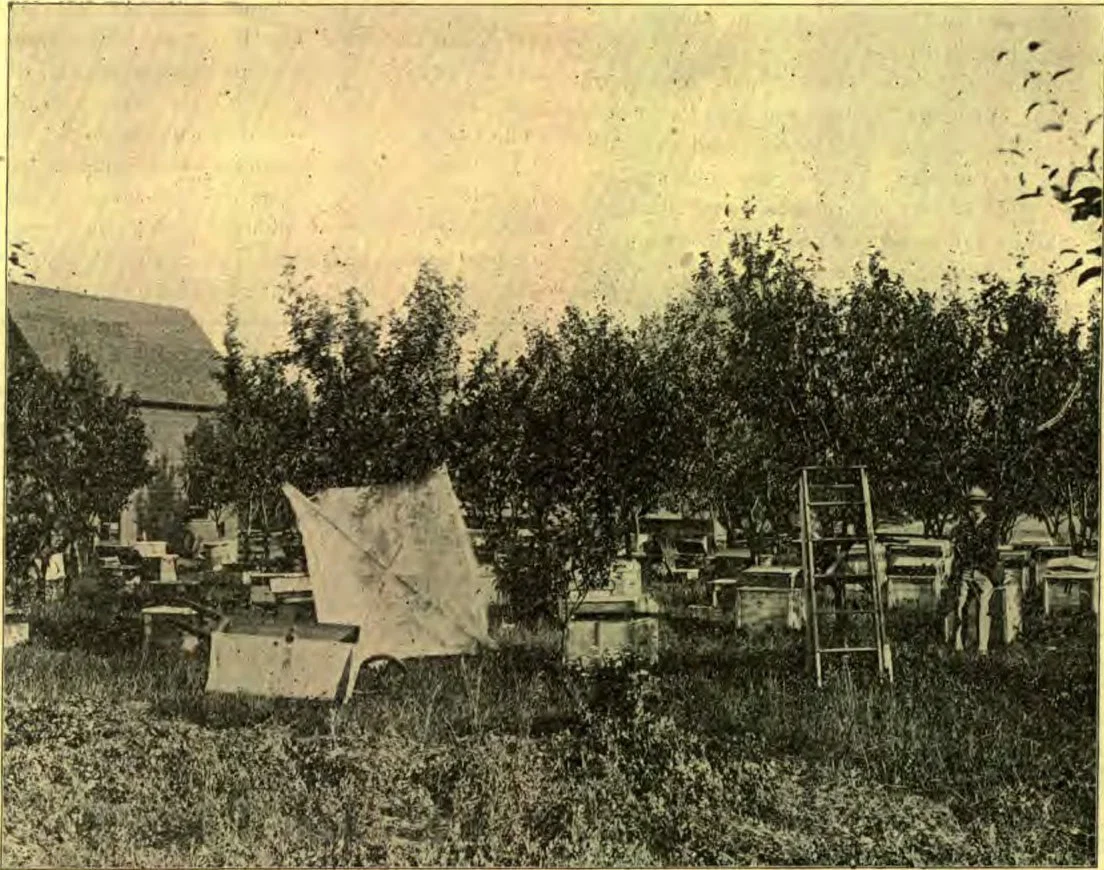
Under the apple trees in front of my home is a row of white houses. In each house are thousands of beings, little, to be sure, and, to those who do not know them, scarce worthy of regard. They are sometimes misjudged and even insulted by persons unacquainted with them. To those who love them, they are among the most wonderful of all created things. Whole books could be written of them, and still something would be left unsaid. To write the biography of a single honey bee is to write that of millions of the same family. And were one in writing to make a single misstatement, these millions, in a wordless protest, would correct the error.
In the soft spring air, when the buds on the apple trees are breaking their hearts with delight, these people in my row of white houses send their doorkeepers to peep out. I smile into their small, intelligent faces, and say, “Welcome to the best we have; for the best has come.” From this time on, and all through the long summer, they are my friends, my daily companions, my nearest neighbors, creatures whom our dear God thinks about. They are everywhere upon tree and flower and spilled sweetness, singing as they go. I have many times picked a bee from the city pavement, where she had fallen exhausted from a long flight, and taken her to a safe resting-place, lest she be trod upon. Footsteps of passers-by are so heavy and careless, unless the brain which is above the feet takes notice.
The honey bee, like every other created thing, be it animate life or plant, has once a—

BABYHOOD

The doorkeepers, peeping out at the spring, return to their comrades, and say, “It is time to be at work.” They know this by instinct, not by experience, for they have never seen a spring before. Born in late autumn, by a forethought of Mother Nature, that they might survive the winter unworn by toil, they proceed joyously to their tasks. The empty combs, made on purpose of the right size for the baby bees to grow in, are carefully looked over and made clean. In one of the wax cells, or cradles, a tiny egg is placed. It is one of thousands, but we will leave the rest, and watch just one.
The egg is no larger than the point of a girl’s hat-pin, but it grows. In a few days it becomes a little white maggot, or worm. It has a large mouth, like a baby bird, and is very hungry. It is fed constantly with bee-bread from the lips of a nurse bee. In a little while it has filled the cell with its soft white body. And then it requires to be fed no longer. The old nurse looks at it, and seems to say, “Poor little dear, you are sleepy!” Then she spreads a coverlet of some suitable stuff which she makes on purpose, and which has never been used before, all over the top of the cell, and the baby is tucked in. No one can see it, so securely is it housed, but the nurse bee listens. She hears a sound. By it she knows that the little creature of her care is all right, and she goes away to look after the other babies.
THE HOME OF LITTLE MISS APIS
In about three weeks from the time the egg was placed in the cell, if one is on good terms with the bees, and will lift the house roof to look in, one will see the top of the cell, or the waxen coverlet, break gently. Then a tiny face peeps through the opening. If one is accustomed to the look of bees, one will notice that this is a baby face in its expression. It has the innocent, wondering look of many infantile beings, such as birdlings and young animals. It turns about and looks around, seeming to take in its new situation with wonder. Then it puts two hands on the broken rim of the cell, and lifts itself. Little by little one may see it emerge from its cradle until it stands on the comb outside.

LITTLE MISS APIS

She is pale-yellow in color, if of Italian stock, but she is a perfect bee. She is wet, and her wings are in folds, like the wings of a new-born butterfly. She hastens to dry herself, and to adjust her dress. There are too many helpless maggot babies in the nursery to spare a nurse for Miss Apis. She must wait upon herself, and begin her busy life in real earnest. She stretches her wings and her limbs to make herself as full-grown as possible, and they expand in drying, seeming to increase in size. All about her, hundreds of nurse bees are fanning the air with their wings, and this helps in the drying. The hard work of putting herself in order makes her hungry, and she helps herself to honey from an uncovered jar, left in her way on purpose. The honey makes her strong. “Eat as much as you like,” say the nurse bees, “and then come and help us at the nursing.”
And this last is the first duty of little Miss Apis. She is not quite accustomed to herself, nor is she wise enough to go out into the honey world. She must remain for a time in the home, and make herself useful in the nursery, just as little sisters take care of their baby brothers and sisters in the human world. She goes to the bee-bread boxes, and brings food, and puts it in the large mouths of the little infant maggots, just as she herself was fed but a short time ago. As she works, she learns, and the pale color of her body takes on the deeper brown of the mature bee,—the brown with the golden bands. She belongs to a royal household, and wears its insignia of dress. She gradually loses her childish look, and longs to do what she sees the old workers doing. She smells the breath of the flowers, when she follows the old bees to the door, and sees them bring back the nectar and the pollen. She spreads her wings, and tests them on the threshold. Then she flies.

A BUSY WORKER

Every morning she goes out to her labors. She hums at her work or on the wing as if life were a delight to her. She clings with her dainty feet to the cups of the flowers, and sips the nectar from their pockets. She carries always with her a long-handled dipper, which we call her proboscis, that she may reach into the heart of sweetness. She tells many a human wanderer, by the way, which of the plants he may touch. She puts the nectar in her pouch, or honey-bag, and takes it home with her. Sometimes her load is heavy, and she falls by the way. But she is soon up and flying again.
Arrived in the house, she seeks an empty cell, and deposits her harvest. When she has filled the entire cell, or jar, by many excursions to the honey fields, she does not close it over, or put the cover on the jar of preserves, until the nectar has “ripened,” or turned to a nutritious thickness.
Sometimes, if one watches at the bee-house door, one will see her come home with balls of yellow or white or red pollen on her thighs, upon which are baskets for that very purpose. She has dived into the deeper flowers, and covered herself all over with the powder with which the blossoms are wont to dust themselves in making their toilet. It adheres to the fringed hairs which thickly cover her like down; and she is very careful of the precious stuff; for well she knows it is needed for baby food. She packs every particle into her baskets. Once in the nursery, other bees help her to pull it out of the baskets, knead it into paste, and put it into the wax pots, just as any woman kneads her bread, and puts it in the pans.
At another time she brings home a sort of glue called “propolis,” which she collects to seal the cracks of the hive, and to cover all over the underside of the roof, to keep the house warm and dry. This glue is resinous and dark of color, and is not used for food. Many a time in a storm I have gently tested the cover of the hive to be sure that the roof can not blow off. The bees have anticipated the weather, and glued the roof to the walls.
One can see this woman bee inserting her dipper into the torn rents of such fruit as the kind birds have made an opening in. She could not possibly make an aperture for herself, for her proboscis is delicate, and unsuited to boring. Foolish persons who meet her in the fields or on the road she is traversing run away from her, and scream that she will “sting.” They do not know that the honey bee never stings away from home unless she is pinched. She will let you smell of the flower from which she is gathering sweets, and sing you a hymn while you admire her. She stings only in defense of home and family, and stores which she has gathered with so much labor.
House-cleaning occupies a great part of this busy worker’s life. Her house is always clean, whether it be found in a decayed tree stump or in a choice hive made by the carpenter. No untidy thing is permitted to lie about on the floor, or in the nursery, or on the walls. She is neat in dress and habit, as any one can see who watches her at her toilet. When it is cold, the bees keep a constant fanning with their wings to warm the brood, which is so delicate that a few seconds of exposure to the outside air would destroy it. When it is warm, they keep on fanning to make the air comfortably cool. One can hear this fanning by placing the ear close to the hive. Always it is kept at an even temperature; for it is really an incubator. It is with the bees as with some people, who “blow their tea to cool it,” and “blow their hands to warm them.”
So all day long and all night long our dear bee works, never resting, toiling not for herself but for others, for she seldom partakes of her harvested stores.

WHEN LONG FLIGHTS ARE OVER

Some day in midsummer one can see that the edges of her wings are a little frayed. But still she flies short trips to the honey fields, or, if one places a saucer of sweet at the door, she will go no farther. She often sips water at a puddle or a city trough. One with a kind heart will not frighten her away, but will watch the frail tongue sip the water eagerly, as if she were thirsty, as indeed she is. Without water she could not live.
A few more days, and she can fly no longer. She has literally “worked herself to death.” She still goes out to the door, and smells the flowers, but her wings are jagged and broken with her long flights. Her body has lost its gloss of brown and gold, though but two or three short months have passed since she was a baby in the cell cradle, tucked in by an old nurse bee. She still strives to make herself useful among the little ones, but she is slow and “in the way,” and the younger bees do not want her. She creeps out to the doorstep for one more whiff of the fragrance she loves, and falls in her attempt to fly.
When the time comes that she is too weak to creep to the door, and is but a cumberer of the ground, then the strong bees, two or three of them, take hold of her, and, pulling her from the door, drop her over the edge of the platform upon which the hive rests. She falls among the grass or in the dust, and the workers go back to their duties, to take their turn at old age and decay not many days hence. In her fall from the house doorstep, our bee may have slipped into a crevasse between foundation boards, and there she lies buried, as I have seen a Kiowa Indian in a natural cleft of his native rock. She is but one of many hundreds in a summer time from the same hive, who ask no favor of any, unless it be a kind thought when the honey-comb is broken at the tea table.—Elizabeth Grinnell, in Young People’s Weekly.

A LESSON FROM THE RAINBOW

Pure light is absolutely white, and yet it is really a combination of every color with which we are familiar.
The most striking illustration of this, one which will come home with pleasing remembrance to all, is the rainbow. The white light, passing through the raindrops, separates into seven colors,—red, orange, yellow, violet, blue, indigo, and green; or, as some put it, into three primary colors,—red, blue, and orange,—which, in various combinations, make up all others. This same white light shining through a prism—a three-cornered pencil of glass—upon a white wall in a dark room, separates into the colors of the rainbow, or the prismatic colors.
Sometimes rainbows are formed by the spray of a fountain or hose throwing drops on the side of the observer farthest from the sun.
The same beautiful separation of light is seen in the flowers and all vegetation. A red flower absorbs all the light that comes from the sun except the red rays, which it reflects; the little for-get-me-nots, like the sky, absorb all but the blue; the purple flower absorbs all but the red and the blue, for purple is a combination of red and blue rays. The variegated flowers absorb all the light except that which composes their colors. The white flowers reflect all the light; the black absorb it all.
And so it is with the thousands of different flowers and the variously tinted foliage. God alone can so form these wonderful substances of vegetation as to absorb some colors and reflect others.
These same beauties and glories are caused by cloud and sunshine. Upon the dark storm cloud, which seems to threaten destruction, God writes his bow of promise. Into all lives some rain falls; some clouds form, often black and foreboding. In his wisdom God permits the tears to flow, the black clouds to form, the more manifestly and clearly to reveal his beauty. He is able to change blackness to glory, and to “paint on the cloud his covenant bow.”
Believing this, and realizing that all the clouds and sorrows of life have their place, we can more fully appreciate and join in the prayer of Moses: “Let thy work appear unto thy servants, and thy glory unto their children. And let the beauty of the Lord our God be upon us.”
God will reveal in his own way just that excellence of character which pleases him best. In his own life he reveals all beauty. He can not reveal all in each one of his children, because of our limitations. We are finite, he is infinite; yet he gives to all a share.
He is the one altogether lovely. We can not show all his loveliness, but we may each reflect some of his excellences and virtues; for “ye are a chosen generation, a royal priesthood, an holy nation, a peculiar people; that ye should show forth the praises [excellences, virtues] of him who hath called you out of darkness into his marvelous light.”
KATHRINA BLOSSOM WILCOX.

INCENSE

By “incense” is meant the aroma, or perfume, arising when certain gums, resins, woods, barks, and flowers, used in religious ceremonies, are ignited. Literally, “incense” and “perfume” are identical in meaning, meaning the aroma given off in the burning of any odoriferous substance; but of late, the definition of the word “perfume” has been widened to include anything sweet in smell, while the word “incense” is restricted almost entirely to the aromatic frankincense, which, because of the ease with which it can be procured in European countries, has come to be the only incense used; hence it is spoken of as the only “true,” or “genuine,” that is, “franc,” incense.
Frankincense, or olibanum, the latter term appearing in ecclesiastical Latin in the tenth century, is a gum resin obtained from certain trees of the genus Boswellia. The gum is obtained from the tree by making an incision, somewhat similarly to the tapping of a sugar-maple. It requires about three months for the gum to acquire the necessary consistency. The gathering period lasts from May until the September rains. The large, clear globules are then scraped into baskets, the inferior portion, which has run down the trees, being gathered separately.
W. S. CHAPMAN.

A SUMMER MORNING

SWEET summer morning, bright and glad! Refreshed with crystal dew, All nature, smiling, greets the light; The earth looks fresh and new.
Bring morning sacrifice to God, While birds their chorus raise, And gentle breeze and warbling brook Are echoing his praise.
Morning amid the trees and flowers! Sweet breath of Eden passed! Too swiftly glide the happy hours, Too bright are they to last.
My soul, awake these lovely morns, And be attuned to praise; Thou art redeemed; sing Jesus’ love, In joyful, happy lays.
MRS. P. ALDERMAN.

THE COLLEGE PLACE SOCIETY

AFTER a careful consideration of the Testimonies calling for some united effort of the young people in the work of the Master, our Society of Christian Volunteers at College Place, Wash., began its work soon after the opening of Walla Walla College last fall. Naturally, the larger portion of the members were students attending the college, but it has been the continual aim to make our work only one branch of the work of the church.
From the first, our object has been the salvation of souls, especially the souls of Seventh-day Adventist young people. To some extent, at least, we have realized that no greater nor more promising mission field will ever open before us than the one in which we found ourselves in school, surrounded, as we were, with many young people brought up in the truth, but still out of Christ. It has often been remarked in our meetings that the most important part of our training for a place in this message is not to be found in books, but in personal experience in working for others.
We have met every Friday evening in one of the larger recitation rooms of the college, and after enjoying a season of prayer, in which a number usually participate, a short study is taken up. For some time these studies were taken from “Early Writings,” and as a company we were led to a deeper love for the third angel’s message as we learned of the trials of those connected with it in the early days, and became assured of its final triumph. After the study the remainder of the time is well filled with testimonies from those present. Occasionally instead of the study we have a talk on some branch of the work for this time, or some missionary subject. Sometimes we have enjoyed a sentence prayer-meeting, where, in one or two sentences each, a very large number have presented some definite petition.
The meetings are made as informal as possible, our object being to devote our energies to the mechanical work as little as may be, that our hearts and hands may be free for the spiritual work, and especially for individual work for those out of Christ.
That we may become thoroughly acquainted with our work from its beginning, we have begun a series of programs, given perhaps once a month, and taking it up, historically, from the first, considering the various mission fields as they have been opened. A knowledge of these fields will lead to an interest in them, and we hope to the consecration of many lives to service therein.
Occasionally following the Sabbath preaching service, the active members have been called together for a special season of prayer and consecration, and we number some of these among the most precious seasons we have ever enjoyed. At the one held the last Sabbath of the school term, the Spirit of the Lord came very near as, in rapid succession, the members consecrated themselves to God, not only for the summer, but for life.
Only a few of our eighty members are left at College Place this summer, but the meetings continue with good interest; for strength is not in numbers, but in individual connection with divine power. We have tasted the sweetness of personal efforts in saving souls, and it makes us determined to consecrate our hearts and lives to this work, not only while at school, but wherever we may be. LULU T. WHITE.

THE OBJECT OF OUR WORK

Not long ago I received a letter from a brother who is very much interested in the young people's work. He stated that in his home church, young people's meetings had been held for several months, and the young people attend regularly, and seem interested. “But,” he wrote, “is that all there is to it? It seems as if we really ought to accomplish something, but I hardly know what to work to.”
What say you, young people,—is the holding of interesting meetings all there is to this work? Shall we try to accomplish any definite result? If so, what? The success of your work depends upon your answer to these questions.
Let us study the subject together for a few minutes. Here are two extracts from the Testimonies upon the subject; and although many others might be given, they would be but a repetition in different form of these statements:—
“Young men and young women, can not you form companies, and as soldiers of Christ enlist in the work, putting all your tact and skill and talent into the Master’s service, that you may save souls from ruin? Let there be companies organized in every church to do this work. Will the young men and young women who really love Jesus organize themselves as workers, not only for those who profess to be Sabbath-keepers, but for those who are not of our faith?”
“Let young men and women and children go to work in the name of Jesus. Let them unite together upon some plan and order of action. Can not you form a band of workers, and have set times to pray together, and ask the Lord to give you his grace, and put forth united action? You should consult with men who love and fear God, and who have an experience in the work, that, under the movings of the Spirit of God, you may form plans and develop methods by which you can work in earnest and for certain results.”
Let us see if we can find in these extracts the answers to the following questions:—
What should be formed in each church?
For what purpose are such companies to be formed?
For whom are those “who really love Jesus” to work?
What are the “set times” appointed for?
Who should be consulted?
What are the “certain results” to be worked for?
Can simply the holding of meetings which are entertaining, or even instructive, accomplish the object set before us?
What else is needed?
I have searched carefully through all the instruction that has been given us upon this subject, but nowhere do I find a single expression that would indicate that any other object should be kept in view than the twofold one revealed here; namely, a deeper work of grace in each heart, and united action in behalf of others.
Then is it not plain to all that every meeting that is held, and every plan that is laid, should serve directly toward the attainment of the object set before us? We shall thus effectually shut out everything that will lower the standard. That which is light and frivolous, or merely entertaining, or simply social in its nature, may appeal to some as being all that is desirable, and those “who really love Jesus” will need to be on their guard, lest these things come in and mar the work.
The enemy will undertake to defeat this work in two ways: He will hinder some from attempting it at all; and where he can not do this, he will try to pervert the work, and cause it to be carried forward in a way that will bring reproach upon it, and thus discourage all who have any part in it. It is only by following humbly and prayerfully in the path that is marked out for us, that we shall win success, but success is possible for each band of workers. God is calling to our young people. By his Spirit he has said: “Young men and women, God calls upon you to work, work for him. Make an entire change in your course of action. You can do a work that those who minister in word and doctrine can not do.”
I wish especially to call attention to the statement that our young people should in this work seek counsel of those who love and fear God. The entire work should be under the loving guardianship of the church. The officers of the church should be as much concerned for the success of your work as they are for any department of church work. This does not imply that they should personally conduct all your meetings, and carry all the responsibility, but that they should counsel, encourage, and help as you have need. Their advice will be invaluable in the work of appointing a leader, a secretary, and such committees as you may deem necessary, and in planning the program for your meetings.
I shall be glad to hear from all who have begun this work, or who desire to begin it. Let us counsel together, move forward together, and help on the work in every way that we can.
MRS. L. FLORA PLUMMER.
705 Northwestern Building, Minneapolis, Minn.

STUDIES IN THE CHRISTIAN LIFE

Chapter V — Consecration

(July 28 to August 31)
“CONSECRATE yourselves to-day to the Lord.”
1. What is consecration? Jer. 29:13; Luke 14:26, 27.
2. Exodus 29 gives an account of a special consecration service. How long did it take?
3. What is our condition that makes it necessary for us to surrender? 2 Tim. 2:26; Isa. 1:5, 6.
4. How great a battle must be fought? Prov. 16:32.
5. What kind of submission is acceptable to God? Isa. 1:18; Joshua 24:15.
6. How much does God ask us to give up? Luke 14:33; Matt. 13:46.
7. What does the Bible say about the giving up of riches? of honor? of reputation?
8. What instances do you find of men who refused to give their service to God?
9. How much has been given to us? A good answer may be found in the parable of the prodigal son.
10. How much is being given to us? John 10:11.
11. Why need I go in penitence and humiliation before I can have the assurance of my acceptance with God? Ps. 113:5, 6, suggests an answer to this question. Compare 2 Cor. 5:21 with Isa. 53:12.
12. What do we give up when we give all? Mark 7:21–23 contains a good list. There are three other similar lists mentioned in the Scriptures. Where are they?
13. What verse of the Bible sums up the divine requirements?
14. What thought in Lam. 3:33 shows that God’s requirements are reasonable?
15. How am I to make the surrender of myself to God? Joshua 24:15. G. E. A.

GIVE AWAY IN ORDER TO RECEIVE

For years I felt that if I should submit, as far as I was capable, all my plans, purposes, and youthful ambitions, to be controlled, directed, and guided by God, the first thing the Lord would require would be for me to do some cranky or fanatical thing, in order to test the sincerity of my surrender; and second, I felt that he would deprive me of the little enjoyment and happiness that I was managing to obtain on this sin-cursed earth.
One day while admiring the beauty and fragrance of a lovely rose, I became deeply impressed with the thought that that was an illustration of what God always does when he has an opportunity to carry out his purposes. I partially grasped the thought that if I could become as perfectly submitted to his providences as was that plant, he would produce in my life a beautiful, harmonious, and elevated character; and the words, “He shall grow as the lily,” came to my mind with a new significance.
When I read in “Steps to Christ,” page 56, that “God does not require us to give up anything that it is for our best interest to retain,” and, on page 57, that “our Heavenly Father does not close the avenues of joy to any of his creatures, . . . requiring us to perform only those duties that will lead our steps to heights of bliss to which the disobedient can never attain,” it became the overmastering ambition of my life continually to submit myself a little more perfectly into his hands. And just to the extent that I have learned this lesson, have sweetness, joy, and happiness come into my life, and opportunities opened before me to benefit humanity that I never even dared dream of or hope for a few years before.
The surrendered soul will meet difficulties and hardships, but they are essential to his present good and for his future happiness. He who is most perfectly submitted to God will grasp most clearly the thought that the same loving hand that presses the bitter cup to his lips in this life, will pluck for him the roses and lilies and pinks in the future life; and that in reality, one is as great a blessing as the other. One who has fully grasped the thought that every circumstance that comes into his life is permitted by the hand of divine love, will begin to enjoy some of the sweets of heaven while still on this earth. He will not go through this world like a crippled mourner, but like a triumphant warrior, bravely and, valiantly engaging in the battles that he must meet, his faith and confidence fixed in him who never lost a battle.
DAVID PAULSON, M. D.

WITH POWER AND GREAT GLORY

Christ's second coming will be in marked contrast with his first coming. Then his glory was veiled with the garb of humanity. He came with no outward manifestation of glory. When he comes the second time, his divinity will not be concealed. He will come with his own glory and the glory of his Father. He will come as One equal with God, as his beloved Son, the Prince of heaven and earth. Instead of a crown of thorns, he will wear a crown of glory. Instead of a garment of humility, he will be clad in a garment of royalty. Upon his vesture will be written the name, “King of kings, and Lord of lords.”
At his first coming, Christ was denied and rejected by men, and by them dragged as a criminal to Pilate's bar, where they charged him with blasphemy. He was scourged and crucified. Nails were driven through his hands and feet. For three hours he hung on the cross, while his enemies said, tauntingly: “He saved others; himself he can not save. If he be the King of Israel, let him now come down from the cross, and we will believe him. He trusted in God; let him deliver him now, if he will have him: for he said, I am the Son of God.”
At his second coming, the scene is changed. He is acknowledged by all as the King of glory. At the name of Jesus every knee shall bow, and every tongue shall confess that Jesus is the Christ, the Lord of heaven and earth, to the glory of God the Father. The angels bow in adoration before him. His enemies see the mistake they have made, and every tongue confesses his divinity.
Christ's glory did not appear when he was upon this earth. He was then a man of sorrows and acquainted with grief. Men hid their faces from him. But he was following the path God had marked out for him. Still bearing humanity, he ascended to heaven, triumphant and victorious. He has taken the blood of his atonement into the holiest of all, sprinkled it upon the mercy-seat and his own garments, and blessed the people. Soon he will appear the second time to declare that there is no more sacrifice for sin. His believing ones have made their calling and their election sure. They come forth at the first resurrection, and by innumerable voices is sung the song: “Behold, the tabernacle of God is with men, and he will dwell with them, and they shall be his people, and God himself shall be with them, and be their God. And God shall wipe away all tears from their eyes; and there shall be no more death, neither sorrow, nor crying, neither shall there be any more pain: for the former things are passed away.”
Christ is soon to come in the clouds of heaven, with power and great glory. Are we preparing to meet him in peace, to be among that number in whom, when he comes, he can be admired? “Beloved, now are we the sons of God, and it doth not yet appear what we shall be: but we know that, when he shall appear, we shall be like him; for we shall see him as he is.”
Mrs. E. G. White.

True Freedom Is to Share Others' Chains

Is TRUE freedom but to break Fetters for our own dear sake, And with leathern hearts, forget That we owe mankind a debt? No! true freedom is to share All the chains our brothers wear, And, with heart and hand, to be Earnest to make others free. They are slaves who dare not speak For the fallen and the weak; They are slaves who will not choose Hatred, scoffing, and abuse, Rather than in silence shrink From the truths they needs must think; They are slaves who dare not be In the right with two or three. —James Russell Lowell.

Divine Providence in Individual Lives

EACH of you can best tell what has marked his individual life—how often he has been evidently led, he knew not why; and in what singular positions he has been placed. Certainly, wherever we look, nothing is more evident than the truth of a Providence—a Power above us, interested in us, overruling all. A consoling faith in this truth is one of those blessings which are added unto us, we having sought first the kingdom of heaven and the righteousness of God.—Edwin H. Chapin, D. D.

Health, Work, and Private Prayer

“How can a Christian be healthy who never works? How can a man’s faith be strong who never enters his closet?”

SHODDY FOLKS

Do you know what, up to an hour ago, I thought shoddy was?—I thought it was some substitute for wool; something not wool, yet made to look like wool, and sold as if it were wool. I should not be surprised if a good many people are making the same mistake.
For shoddy is wool. That is where the mischief of it comes in. A clothier may assure you with perfect honesty that the suit of clothes you are buying is “all wool,” and you may be able to see for yourself that he is speaking the truth, and you pay for it a high price, and yet that suit of clothes may be shoddy. For shoddy is simply old wool used over,—wool that has once been woven into cloth, and the cloth made into garments, and the garments worn out, then passed to the ragman, and sold by him to the shoddy manufacturer, who puts it through an ingenious machine, which tears it apart and puts it together again—cloth as good as new.
As good as new?—No, indeed! For the shoddy manufacturer will utilize what is hardly more than wool dust. “Anything long enough to have two ends” he accepts gratefully, and behold—an overcoat! How much wear you will get out of such an overcoat, I leave you to guess. But it is all wool?—Oh, yes; it is all wool.
Now that is the reason, brethren, why shoddy people are so mischievous in the world,—they have all the appearance of the genuine article, of “real folks,” and they deceive the keenest eyes; but they won’t “wear well.”
If it is a shoddy teacher, he knows some things well, he makes a brilliant surface show, but he stopped studying ten years ago, and since that time he has been weaving over and over again, into no one knows how many suits of clothes, the knowledge he possessed at that time. Of course, he doesn’t wear well in the schoolroom.
It may be a shoddy clerk. The first week he is all attention, wide-awake, brisk, affable, shrewd, the very man for the place; but by the end of the month he is all frayed out, comes lounging in ten minutes late, keeps his customers waiting, loses his temper at trifles, and goes to pieces in general.
It may be a shoddy friend. He seems to have all the characteristics of a noble friend, and truly he has, only—the threads are so short. He is thoughtful, and kind, and generous, and sympathetic, and tactful, and brave. He is sincere, too, and thoroughly honest. But that was yesterday. To-day the ends prove short. A mean suspicion, perhaps, has torn a great rent in his friendship. He is shoddy.
And so I have learned that it is not enough to discover that a man has fine qualities, but I must go on to ask of him, Have his fine qualities the faculty of endurance? Are they new wool, or are they shoddy?
“To ask of him,” did I say?—Yes, in faith, and to ask it of myself!—Christian Endeavor World.

SECRET THOUGHTS

I HOLD it true that thoughts are things Endowed with being, breath, and wings; And that we send them forth to fill The world with good results or ill.
That which we call our secret thought Speeds to the earth’s remotest spot, And leaves its blessings or its woes Like tracks behind it, as it goes.
It is God’s law; remember it In your still chamber as you sit With thoughts you would not dare have known, And yet make comrades when alone.
These thoughts have life, and they will fly, And leave their impress, by and by, Like some marsh breeze, whose poisoned breath Breathes into homes its fevered death.
And, after you have quite forgot, Or all outgrown some vanished thought, Back to your mind, to make its home, A dove or raven, it will come.
Then let your secret thoughts be fair: They have a vital part and share In shaping worlds and molding fate, God’s system is so intricate.
—Ella Wheeler Wilcox.

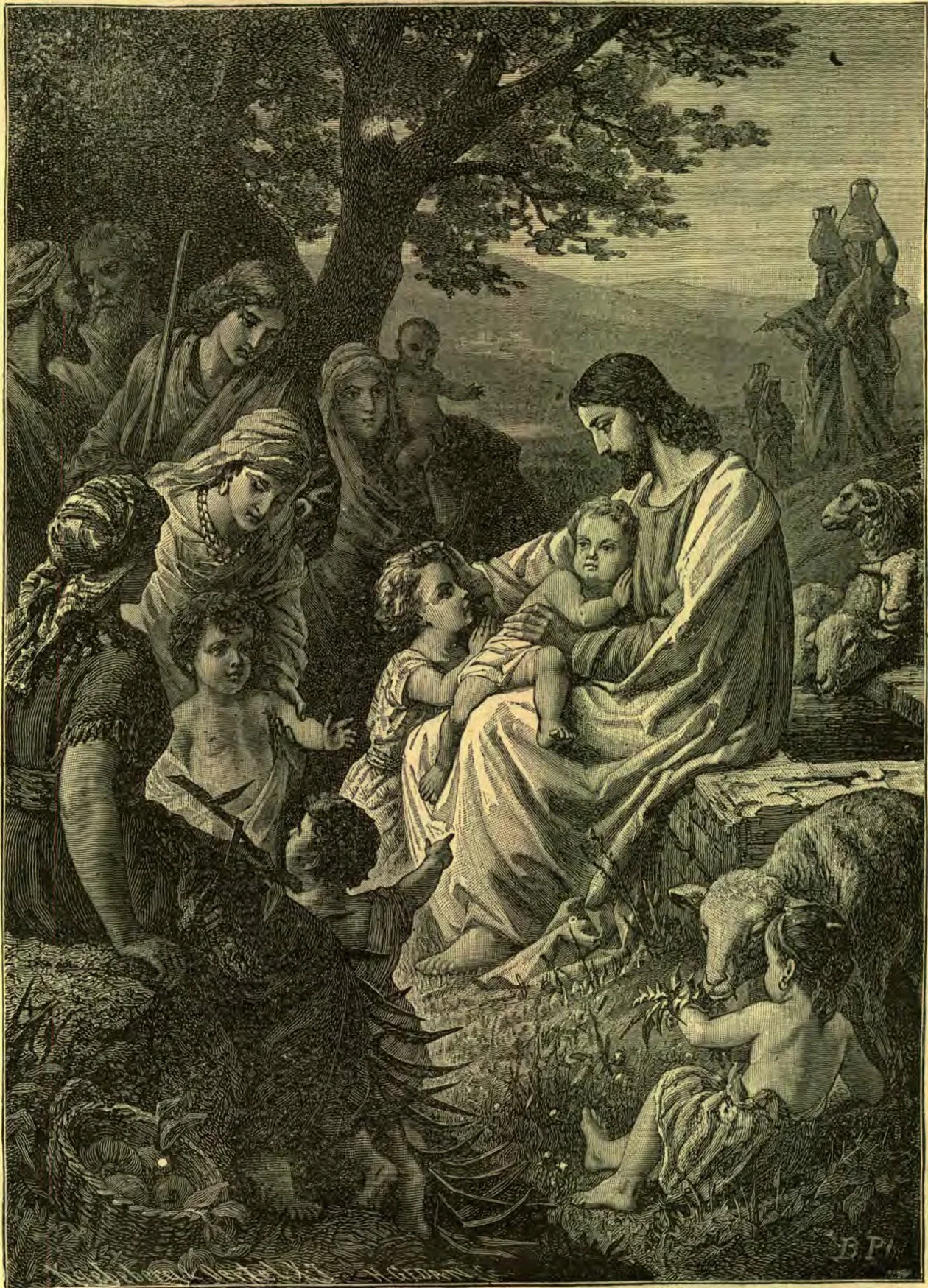
THE LITTLE ONES HE BLESSED

I WONDER if ever the children Who were blessed by the Master of old, Forgot he had made them his treasures, The dear little lambs of his fold. I wonder if, angry and willful, They wandered afar and astray,— The children whose feet had been guided So safe and so soon in the way.
And my heart can not cherish the fancy That ever those children went wrong, And were lost from the peace and the shelter, Shut out from the feast and the song. To the day of gray hairs they remembered, I think, how the hands that were riven Were laid on their heads when he uttered, “Of such is the kingdom of heaven.”
“OF SUCH IS THE KINGDOM OF HEAVEN”
He has said it to you, little darling, Who spell it in God’s word to-day; You, too, may be sorry for sinning, You also believe and obey. And ’twill grieve the dear Saviour in heaven If one little child shall go wrong, Be lost from the fold and the shelter, Shut out from the feast and the song.
— Margaret E. Sangster.
Continue reading: LITTLE JOE