Canadian Clergy's Political Influence and Church Authority
sition is not available; and it seems that the last extremity of terror now at the command of the Church is that which she awakens by the threat of excommunication. Inasmuch as Bishop Blais has explicitly announced that he will excommunicate every person who votes contrary to his instructions, it seems that he has about exhausted the resources of his communion as a factor in politics, and all that Bishop Lafleche can do is to prove an honorable second in the premises.
THE political activity of the Canadian clergy is largely the fruit of indulgence, although, as already stated, it originates in the position of extraordinary strength and serenity guaranteed to the Roman Catholic Church by the treaty of cession from France to England. The latter country, as that acute observer, “Max O’Rell,” has pointed out, uses the Catholic Church to save it expense in keeping order. The emoluments are preserved, and the price of them is paid regularly. If a robbery is committed, no secrets of the confessional are betrayed, but the self-accused sinner is urged, if not commanded, to give himself up and make restitution. If a young man is too dilatory in his courtship, the “father” orders him either to marry the girl or make way for another less timid or sluggish. And so on. Of course, the English government is doing a serious injustice to its Canadian subjects when it takes their money from them in the form of taxes and then uses a portion of what is thus collected to pay certain men for keeping them in the spiritual slavery which these conditions manifest. It is not at all surprising that a ruling power which thus violates the fundamental principles of justice and true political economy should find itself in danger of losing a valuable territory altogether as a result of its policy. Strong in their treaty-rights, encouraged by the connivance of the ruling power at their encroachments on individual rights and freedom, the priests are ever alert, keen and aggressive in the political life of British America.
“RIEL’S rebellion,” which at one time threatened to sever Manitoba from the Empire, was caused by clerical intermeddling with the civil administration of that province, carried to an extreme that was fairly unbearable. Riel’s rebellion was suppressed with some difficulty and bloodshed. It failed mainly because the oppressed people were at heart attached to the mother country and could not be dissuaded from their reliance on her general fairness, and their confidence that, sooner or later, she would, of her free will, remedy their heavy grievances. To some extent their hopes were justified by the event; but quite recently, the “fine Italian hand” of the Church has been deeply inserted in the coffers of the Manitoba school fund, and the agitation over this proceeding was intense at the last Parliamentary election, spreading, indeed, all over Canada, and shaking the Houses of Parliament at London. It appears that the Church won a substantial victory on that occasion, and we are informed that the settlement finally reached has greatly encouraged the bishops elsewhere in their work of “bossing the job” of the people at the polls. Canada is the country which some people would like to see annexed to the United States.
APROPOS of annexation, I am reminded of a little episode. A certain New York daily was honestly and fairly conducted, in the true interests of the people, for many years. It made mistakes sometimes, like all papers and all men. But it had such a hold on public confidence that it was always credited with doing so honestly, by those whom it failed to mislead. It was a morning daily. There came a time when its proprietors desired to print an evening edition. In order to do this, they borrowed a large sum of money from a certain estate whose interests were inextricably entangled with those of our “Pacific railways.” It is not too much to say that this ended the usefulness of the journal as a servitor of the people’s welfare. Among other things in which it betrayed their interests and sought to bring trouble into the already too much troubled politics of the United States, was its strenuous advocacy of Canadian annexation. This it urged, because those to whom its soul, as well as body, was apparently mortgaged, had a formidable competitor in the Canadian Pacific line, and they looked upon annexation as a prelude to their getting control of that road, and “consolidating” it under the same management as their own, and thus depriving people of the benefits of competition between the two.
IN the course of its performance of the work assigned to it by its masters, this journal was called upon to deal with the question of a united Church and State. The treaty rights, and the resultant position of the Roman Catholic Church in several provinces, were pointed out by some authorities in Canada as insuperable obstacles in the way of an organic union with our country—“for,” said they, “you cannot have an established church in the United States.” Hastily the paper in question flew to the rescue. It assured the Canadians that they could come into our union with their church in each province established, because the Federal Constitution prohibited only a Federal church, and left the States free to unite themselves individually with any church, in the work of government! This is true. But what are we to think of a paper capable of thus pointing out an unfortunate omission in our fundamental law and inviting people to join our union whose institutions are utterly incompatible with the spirit of our American system—and all for the sake of “wrecking” a railroad?
OF late years there has been a noticeable tendency to carp at the Christian Bible. The authorship of its various books; the authenticity of its historical accounts; the question of how far each part is entitled to the adjective217“inspired;” the character, as allegorical or otherwise, of many statements; etc., etc.—all of these matters and many like them have been and are still being threshed over in a spirit of decidedly hostile criticism by many writers.
THE latest conspicuous clerical attempt to weaken the Bible has been made by “Rev.” Lyman Abbott, who occupies the pulpit formerly filled by the famous Henry Ward Beecher. Mr. Abbott has officially stated that he does not believe the narrative of Jonah and the whale. There was no particular reason, apparent on the surface, why Mr. Lyman Abbott should have chosen a certain occasion to disavow belief in this story. As far as known he had not been asked by anybody whether he believed it or not. Certainly there were plenty more things in the Bible about which a man of his intelligence might have talked in the pulpit besides Jonah and his adventure. It is hardly conceivable that the reverend gentleman had exhausted all other texts, or his ability to deal with them to the edification of his hearers. Why Jonah and the whale just now?
THERE is an answer to this question which is plausible enough to consider, if it be not very creditable to the gentleman in question. It is a fact that among the numerous evils which the cheapness of publication and the development of sensational journalism have brought upon mankind, the cultivation of a morbid craving after notoriety is one of the worst. The desire to have one’s name known—to be talked about—of course existed and played its part in human action from the beginning. But before the printing press came this desire could not have more than a comparatively limited gratification. At present, if one does anything curious or remarkable, or out of the way, next morning millions of men will be eagerly discussing the affair in all its phases, and thousands will avail themselves of the first opportunity to see—and, if he is a preacher, to hear—the man who, under other conditions, would neither know nor care anything whatever about him.
THE human mind is so constituted that nothing seems to it more curious and remarkable than to find a man discrediting his own calling. If a very prominent allopathic physician, for example, were to suddenly “come out” in an “interview” repudiating all the standard works of his profession, denying their statements, denouncing their theories, condemning their advice, and yet continue to practice according to his chosen system, people would certainly like to read all about it, and he would be covered with cheap “glory” of the modern newspaper sort. It is just the same way with a preacher who repudiates the Bible or impeaches its authority, and still goes on preaching. Every one recognizes this as a remarkable phenomenon in the world of mind. The man’s words acquire an importance that is largely factitious, the dailies print them with flaming head-lines, and the free advertising thus obtained is nearly co-extensive with civilization.
OUR friend “Bob Ingersoll” goes around the country lecturing on “Why I Am An Agnostic.” But the good-natured colonel labors under an hallucination when he imagines that very many persons care a particle to learn why he is an agnostic. There are plenty of agnostics outside the churches, and, for that matter, such may be found, occasionally, in some pews of a Sunday. No doubt all of them have reasons sufficient to themselves for being agnostics. An agnostic outside of the church is not sufficiently rare to be interesting. Even an agnostic in his pew on Sunday may be explainable. But an agnostic in a Christian pulpit is indeed a great curiosity and mystery.
POSSIBLY it was a mere coincidence. But very soon after the “Associated Press” and the “United Press” had flashed to San Francisco and Europe the information that the Rev. Lyman Abbott did not believe the story of Jonah and the whale and was anxious for us all to know it, the Rev. Lyman Abbott went forth to lecture. A man of his position would probably draw a fair audience if he appeared under competent auspices, in a large city, purely on his merits. But, coming as he did to a southern town, in the character of an independent Bible critic, who had just been preaching Ingersollism in his own church, he commanded at least ten times as much attention as he could possibly have gotten had he arrived unheralded save by the paid announcements of his proposed lectures in the advertising columns of the newspapers.
THE reverend gentleman said nothing new in the course of his lectures, and did not, according to the dispatches, put the old truths of life and death and sin and suffering and redemption in any specially forcible or striking way. Only one remark seems to call for notice. It is reported that he proclaimed it to be the duty of government to find out what is the will of God, and to enact that will into laws! This is the political philosophy at present accepted by a class of profound thinkers out in the grand old State of Kansas, and they are now trying their very best to apply their theories to the work of practical legislation. The first step in this direction has been the introduction of a bill whereby it is “enacted by the legislature of Kansas: Thou shalt have no other gods before me”! and so on, through the rest of the Decalogue.
THE Rev. Lyman Abbott would admit at once the absurdity if not the blasphemy of such a legislative act as this, were it brought to his attention. Yet it is nothing218but a sincere effort to do just what he says ought to be done—to “enact the will of God into laws.” Nobody doubts that Mr. Walters, who introduced this bill, and declares that he did so in all seriousness, and desires to see it passed—no one doubts the verity of his belief that the Decalogue is “the will of God;” and so his performance is directly in accordance with Mr. Lyman Abbott’s advice. The fact is, the learned clergyman gave this recommendation under the dominating influence of that old notion that law, somehow or other, is connected with morality. Blackstone blundered in precisely the same way—but that is another story, and will do for next week.
News, Notes, and Comment.
By Editor
A DISTINGUISHED prelate recently lectured in a neighboring city on the Cretan difficulty. Needless to say, he handled his subject altogether from a sectarian standpoint. Among other things it is reported that he dwelt with eloquent and impressive emphasis on the story of “the famous banner carried by the Bishop of Pelos, which led the Greeks to victory in 1821, and which is now being carried by the noble army of Christians who are advancing on Thessaly against Turkey.” It is added that “a picture of the banner, with its Greek inscription created an outburst of enthusiasm.” This makes very interesting reading in the nineteenth century of “Christian” civilization. When we bear in mind that the purpose of the “advance” made by this “noble army” was to despoil a neighboring country of its territory, and that the “noble army” counts on accomplishing its aim not by square fighting or its own valor, but through extorting support from some stronger power than its own government as the result of international jealousies which its action will arouse—when we remember that such conduct, prompted by such motives, is undertaken in the name of Christianity, we may well wonder what the inscription may be which appears on that “famous banner,” and “aroused enthusiasm” in a Christian assembly.
IS IT, perchance: “Whatsoever ye will that men should do unto you; do ye also unto them”? Is it “Peace I leave with you, my peace I give unto you”? Or, “Thou shalt love thy neighbor as thyself”? Or, “The fruit of the Spirit is love, joy, peace, longsuffering, gentleness, goodness, faith, meekness, temperance”? Or, “Be ye kind one to another; tender-hearted, forgiving one another”? Or is it possible that the “famous banner” that once led the Greeks to victory and was borne by a “Christian” bishop and is now again in the field had upon it another inscription; and was the enthusiasm of the lecturer’s audience aroused by reading the Greek equivalent of these English words: “Put up again thy sword into his place; for all they that take the sword shall perish by the sword”?
WELL, well! Since the pagan Constantine “conformed,” and the “Christian” clergy “went into politics,” the same old story has been told over and over again, as this learned lecturer told it. In buildings called “churches,” built and kept by the State, men called “clergymen,” employed and paid by the State as adjuncts of its police, have, from time to time, as their superiors commanded, blessed banners that were to be carried at the head of regiments, in order to subserve the same purpose for which soldiers are sometimes given infusions of gunpowder and tobacco in whisky—namely, to excite them to a nervous frenzy, so as to make them at once indifferent to their own safety, and ravenous for the life-blood of their antagonists. The first “famous banner” of this sort to be upraised in the name of Christianity was made and sent upon its wicked mission by this same pagan, Constantine, after he and the bishops of his time had consummated the first union of the State with the “Christian” Church. It was called “the labarum.” It is upon record that Constantine’s soldiers fought harder, killed and wounded more men, and attacked with more recklessness after they got that banner than they did before; and thus was the Prince of Peace obeyed and served by the National Church militant, even as he is to-day.
AND, so, if war eventuate between Greece and Turkey, and the news shall be wired to Athens that the Turks have sustained a great defeat, and thousands of them have been killed, and thousands more of them cruelly maimed for life, the Greek churches will be thrown open, and the priests therein will sing “Te Deum”s in their joy. Te Deum, laudamus for battle and murder and sudden death! Te Deum, laudamus for desolated fields, destroyed cities, ruined homes, and robbery, rape and rapine! Te Deum, laudamus for slaughtered and mutilated men, for widowed and outraged women, for orphaned children, wandering far and wide!
THE Greeks ought to have a “National Christian Hymn” to supplement the work of their National Christian Banner, in the spreading of Christianity and the gospel among those unbelieving Turks. The poem from which the following stanzas are taken would fill the bill admirably. It was written years ago and dedicated to “the war clergy” of another country far away from theirs:—
“O God of battles! Once again,
With banner, trump and drum,
And garments in Thy wine-press dyed,
To give thee thanks we come!
Teach us to hate, and so to fight,
To rob, to maim, to slay,
And when the last red drop is shed,
We’ll kneel again—and pray!”
A VACANCY has occurred in the Canadian Parliament, and in due course a “writ” was issued to authorize a new election, in order that it might be filled. A dispatch informs us that the government has been requested to withdraw the writ and inform the Parliament that this action has been taken because a free election is impossible in the city of Quebec, which is a part of the district or province at present without a representative. The reason given for this request and statement is that the Roman Catholic bishop of that diocese, Monsignor Lafleche, is likely to exceed his colleague, Bishop Blais, of Bonaventure, in the exercise of his spiritual influence over the voters. It is a little difficult to understand how this could be done, even with the utmost zeal on the part of the good bishop first named. In these days the Inqui-
The Indian Congress.
By D. A. Robinson
[From our Calcutta Correspondent.]
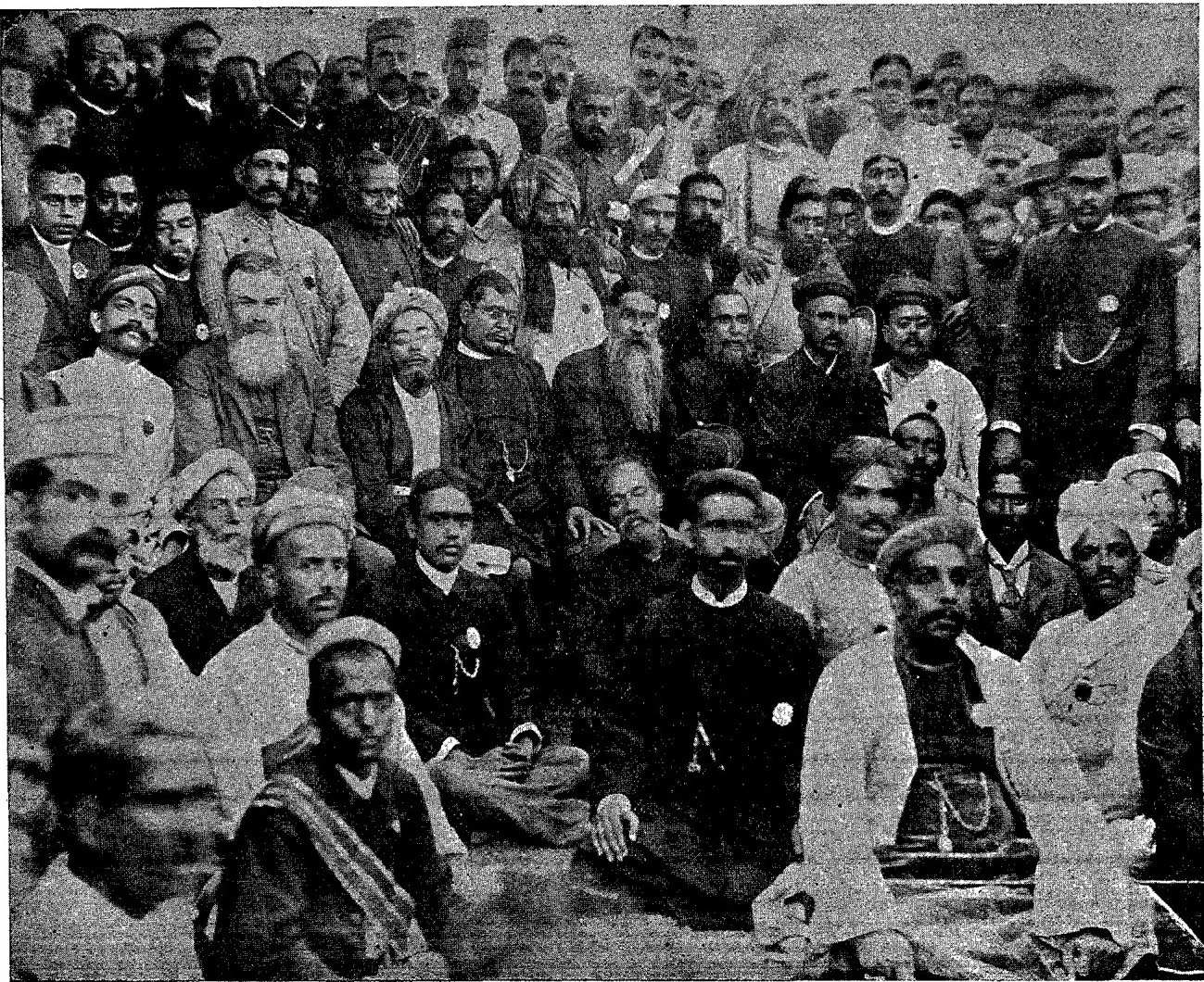
In March, 1885, one year before the AMERICAN SENTINEL began its career, it was decided to hold a conference of representatives from all parts of India at Poona during the Christmas holidays. The object of this conference was “to enable earnest laborers in the cause of national progress to become personally known to each other, and for discussing and deciding upon the political operations to be undertaken during the ensuing year.” Certain Indian gentlemen consented to act as a reception committee. Near the time for the conference to meet the cholera broke out at Poona and the place of meeting was transferred to Bombay. The actual number of representatives present was seventy-two.
GROUP FROM THE INDIAN CONGRESS, CALCUTTA, INDIA.
Of that meeting an Indian writer said: “In the history of a nation there is always a day which is marked above all the rest, which sows the first seeds of progress, and which lays the foundation of all future greatness. Such was the day when the patriotic barons of England assembled on the little island of Runnymede to induce their king to sign their great charter of freedom. Such was the day when the American patriots sat in the assembly of delegates, and vowed to die for the independence of their country; and such was the day when seventy-two Indian patriots first assembled in Gowalia Tank House to promote the good of their common country. This union of Indian people after ages of separation and ill-feeling was a great historical event.”
At a preliminary meeting of the reception committee the name of the conference was changed to congress.220
The gathering this year, which I was privileged to attend, was the twelfth annual session, and was held in Calcutta. The actual number of representatives from all parts of India holding certificates was 703. Besides these, hundreds from the country were daily in attendance. An immense pavilion over two hundred feet long by one hundred wide was erected in Beadon square, in which the meetings were held. This pavilion was packed full, and to show something of the enthusiasm among the people, I may say that after the first day when tickets of admission were one rupee each, they were sold to all who could get in at five rupees (about $1.50) each.
The congress has already secured considerable warm sympathy and support from Englishmen of influence. A glance at the resolutions gives an idea of the object of the congress, and I refer to them here not to discuss the political situation in India, but to show the agencies which are in training and the danger that this vigorous body of intelligent and educated Indians stand in of being captured by the religio-political movement already at work in this country.
The congress appeals to the Indian government and also to the Imperial government through a British committee which it has in the House of Commons for, (a) Separation of Judicial and Executive Functions. They say as matters now stand the chief magistrate is often the judge as well as the head of other governmental departments. (b) Provincial Finance. This is designed to prevent extraordinary expenses being thrown onto the country in the creation of which it had no voice. (c) Public Service Examinations. They demand that these shall be held, not in England alone as at present, but in this country at the same time. (d) A recasting of the Educational Service. (e) Extension of Trial by Jury, (f) Abatement of the Salt Tax. Many of the speeches made on these questions were decidedly eloquent.
At the close of the congress, the Indian Social Reform Congress, which is really an adjunct of the one already mentioned, held a meeting. The gathering was not so large, because many Hindoos are opposed, as yet, to the discussion of the questions usually before it, but it is growing in influence year by year. The topics under consideration were: Evil of Child Marriage; Remarriage of Widows; Education of Women; The Curtailing of Extravagant Expenses at Marriages; The Encouraging of Foreign Travel; and an appeal for a law for the better control of religious endowments.
I will not take the time here to speak of this matter of religious endowments; suffice it to say that if the petitioners get the law they are asking for it will be pretty sure to result in a lot of mischief in this country. In 1858, the Queen’s Proclamation which referred especially to this country, said, “And we do strictly charge and enjoin all those who may be in authority under us, that they abstain from all interference with the religious belief or worship of any of our subjects, on pain of our highest displeasure.” Since then the government has generally avoided religious questions. But at the present time it is being fairly besieged by the Christian element for a law in behalf of Sunday observance. Up to the present time the government has refused to listen. Of course the so-called Christian population of India is but the merest fraction of the whole, say two millions out of nearly three hundred millions.
Now let the Hindoos themselves demand and secure a law upon a religious question—their demand for the present is refused—but let them get it and then the precedent is established, the way is open for making other laws on religious questions; and then the Sunday movement will the more easily find its way to power in this country, and it will be no marvel to see a bargain struck between Hindoo and Christian over the two questions.
The Lord’s Day Union for India, now in its fourth year, in one of its publications, says:—
“Great Victory in America. A great object lesson has just been afforded by the battle at the World’s Fair in Chicago. That city is largely dominated by foreigners, and a desperate attempt has been made to keep the Fair going on Sunday. But we now learn that this attempt has failed. Two great opposing petitions were sent to the Directory of the World’s Exposition. Eighty thousand persons asked that the gates should be open; but no less than twenty-five millions demanded that they should be shut. The number were: for Sunday opening, 87,507 against 25,825,086. This clearly shows that the American people are still of the same mind as one of their judges who wrote a defense of Sabbath laws, in which he said: ‘The Anglo-Saxon race is marching on as an army with banners, and far advanced among them is the banner upon which is engraved, REMEMBER THE SABBATH DAY TO KEEP IT HOLY.’ The peoples of Asia should know that there are the deepest reasons for this custom of Sunday observance, which is one of the most characteristic features of the new civilization now overspreading their ancient continent. The most progressive portions of Europe and America are precisely those where Sunday is most reverenced. Asia will make little progress till she too has a Sabbath rest.”
This same publication referred to, again delivers itself thus:—
“But why should the call of the church bells be ignored and the voice of religion disregarded? Men may affect to think they can make what laws they choose for the employment of their time, but the fact remains that God has claimed the day for His service. The first, the most binding, and the most powerful argument for the Sunday rest is that it is commanded by the authority of our Maker himself. Thus runs the fourth commandment of the Decalogue: ‘Remember the Sabbath day, to keep it holy. Six days shalt thou labor and do all thy work: but the seventh day is the Sabbath of the Lord thy God; in it thou shalt not do any work, thou, nor thy son, nor thy daughter, thy manservant, nor thy maidservant, nor thy cattle, nor thy stranger that is within thy gates; for in six days the Lord made heaven and earth, the sea, and all that in them is, and rested the seventh day; wherefore the Lord blessed the Sabbath day and hallowed it.’ Ex. 20:8–11. This is the law of God, and the man that breaks it brings himself under the sweep of an inevitable retribution. It has been well described as the221earliest law against vagrancy; against cruelty to animals; in favor of aliens; in favor of working men. A curse will cleave to every man who uses his influence to oppose this divine enactment.”
But what has all this to do with Sunday rest? Who can tell us what is the method of logic which makes the fourth commandment “the first, the most binding, and the most powerful argument for the Sunday rest”? The fourth commandment in the most definite terms declares that the seventh day is the Sabbath, while everybody knows that Sunday is the first day of the week.
D. A. ROBINSON.
Calcutta. Feb. 17, 1897.
Notes from Canada.
By Eugene Leland
[By Our Toronto Correspondent.]
SEVERAL occurrences having a bearing on the subject of religious liberty have transpired quite recently in the Dominion of Canada. The first event to which we will call attention is the coming of the papal ablegate, Mgr. Raphael Mery Del Val, who comes to this country ostensibly for the purpose of securing a settlement of the Manitoba School question more favorable to the Catholic minority. The arrival of the distinguished visitor in the city of Montreal was made the occasion of quite a display. The following announcement was issued at the Archbishop’s palace:—
“His Excellency Mgr. Raphael Mery Del Val, apostolic delegate for Canada, will arrive at Montreal, Dalhousie-square, Thursday evening, at 7.55. by the Canadian Pacific train coming from Quebec.
“On this occasion, the priests of the city and neighboring parishes are requested to have the church bells rung from 8 to 8:30 o’clock, P. M. All the clergy and the faithful of the diocese are specially invited to the official reception which will take place at the Metropolitan Church immediately after the arrival of his excellency.
“By order of the vicar capitular,
“ALFRED ARCHAMBAULT,
“Canon, Chancellor.”
IN a speech in the Dominion House of Commons on the settlement of the School Question and the mission to the Pope concerning it, Mr. W. F. McLean said, as reported in his paper, the Toronto World, of April 1:—
“I am glad to see that the Prime Minister accepts the responsibility of the settlement which has been made. The Liberals as a party accept the responsibility of the settlement, and, speaking of parliamentary responsibility, I come to another point. . .
“I say that the Government and their party must take full responsibility for that mission to Rome. They cannot escape that responsibility. They have said that it is on behalf of their party that they went there, and, seeing that we are governed by the principle of Parliamentary responsibility, they must accept that responsibility before the people. They say that they went to Rome to vindicate the civil liberties of the people of Quebec. Mr. Speaker, while I sympathize with them in their efforts to conserve their political liberties, I do not agree with them in the authority to which they went to protect those liberties. It is not in St. Peter’s, it is not in the Vatican, it is not in the Seven Hills of Rome that the political, the civil liberties of British citizens are conserved. If there is a temple sacred to British liberty, if there is a place where our rights are to be protected, that temple is within these walls of Parliament. The shrine of our liberties is on the floor of the House, and we, the members of the House, are the sacristans of that temple; we are the priests, the ministers at this shrine; we, worthy or unworthy as we may be, are the men who must protect the civil liberties of the people.
“What will happen to gentlemen on the other side of the House if it turns out that the ablegate now in this country does not come to their relief and does not pronounce in their favor and guarantee their civil liberties, which they now profess they seek to protect? They will have to come down here to defend and protect these liberties if they are assailed. . .
“I must take objection to the statement of the Solicitor-General (Mr. Fitzpatrick) last night in the comparison he made between His Holiness and Her Gracious Majesty. We who are Canadians say that there is no one but Her Majesty to appeal to in the protection of the civil liberties of British subjects the world over. She is the guardian of our civil liberties, not His Holiness of Rome. . . When we read the history of the unification of Italy, when we recall the names of Garibaldi and Mazzini, and the other heroes of that struggle, he is not the man whose name should be quoted by the Liberal party in the vindication of the liberties of the people of this country.”
EUGENE LELAND.
TO OUR PATRONS:
By Editor
Write names plainly.
Remit by P. O. Money Order, or Express Order, or by Bank Draft on New York. Personal checks are not desired.
Make all Orders and Drafts payable to Pacific Press Publishing Co., not to the editor or any other individual.
We will receive Postage Stamp in small quantities and any kind of good money. Defaced coins will not be taken. If paper money or coin is sent, register the letter.
AMERICAN SENTINEL
American Sentinel: Organ of the International Religious Liberty Association
Set for the defense of liberty of conscience, and therefore uncompromisingly opposed to anything tending toward a union of Church and State, either in name or in principle.
Published Weekly by Pacific Press Publishing Co.
ORGAN OF THE
International Religious Liberty Association.
Single Copy, Per Year, - - - - $1.00.
“ ” Six months, 50.
“ ” Three ” 25.
ADDRESS. AMERICAN SENTINEL,
39 Bond Street, New York.
“LAW OF GOD AS CHANGED BY THE PAPACY.”
THIS chart has been thoroughly revised, and contains some of the more recent utterances of this great apostate power.
The plan of the chart is the same as the old one. On either side are telling quotations from Catholic authorities admitting and boasting of the change, while the “Commandments as Changed by the Papacy” occupy a central position.
It is a forcible presentation of the subject, and will be a valuable help to Bible workers and ministers. Size 36x48 inches. Price $1.00. Printed on thin paper for inclosure in letters and miscellaneous distribution, 50 cents per 100.
PACIFIC PRESS PUBLISHING CO.,
39 Bond St., New York,
Kansas City, Mo. Oakland, Cal.
AMERICAN STATE PAPERS
A MOST valuable work on the subject of religious legislation in the United States, from the foundation of the Government to the present time.
It includes the various prominent acts, both State and national, relating to subjects of religion, such as Bills of Rights, Amendments, Treaties, Sunday Observance, etc. In it are found various Memorials, Petitions, and Remonstrances; House and Senate Reports on Sunday Mails; documents on “The Sphere of Civil Government,” “The Rights of the Jew,” “Religion in the Public Schools,” “Civil Laws Against Blasphemy,” “Christianity and the Common Law,” “Sunday Legislation,” etc., etc.; Judicial Decisions on Sunday Laws and the Bible in the Public Schools. It also contains in an appendix the provisions in the Bills of Rights of all the States, relating to the rights of conscience, and
The Sunday Laws, Complete,
OF ALL THE STATES AND TERRITORIES.
There are also running footnotes all through the book, containing the comments and statements of eminent men.
368 pages. Price, best binding, $2.00. Cheap edition, $1.25.
PACIFIC PRESS PUBLISHING CO.,
39 BOND STREET, NEW YORK.
Kansas City, Mo. Oakland, Cal.
The TWO REPUBLICS.
By Alonzo T. Jones
Of Great Importance to Every American Citizen.
By ALONZO T. JONES.
A COMPARATIVE HISTORY OF THE TWO GREATEST REPUBLICS, Rome AND THE United States
The study of years and elaboration of many volumes, are presented in a concise and pleasing manner. In reviewing the history of the Roman Republic, the rocks upon which she stranded have been clearly pointed out. It contrasts the principles underlying enforced religious observances, with the true principles of RELIGIOUS FREEDOM FOR EVERY MAN, which are guaranteed by the Constitution of the United States. The “Two Republics” comprises 896 octavo pages, and is printed from clear, new electrotypes, on fine, tinted paper, beautifully and substantially bound, and is illustrated with 67 full-page engravings. The work is furnished in the following styles of binding:—