The Youth’s Instructor, Vol. 27, No. 33.

A HUMANE ELEPHANT

The Youth’s Instructor

Aug 20, 1879

S. D. A. Publishing Association · Battle Creek, Mich. · Aug 20, 1879

A HUMANE ELEPHANT.

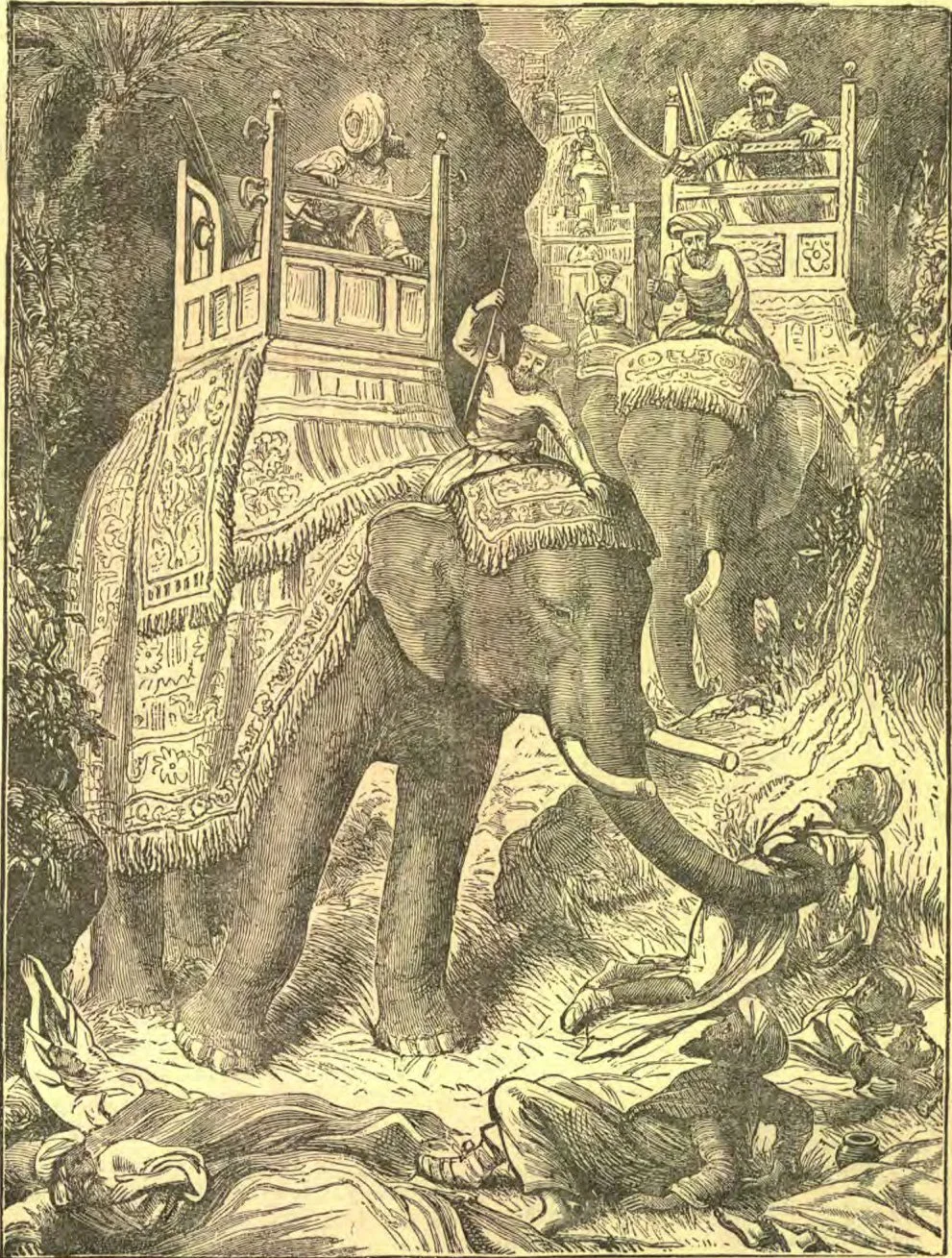
A HUNTING excursion in India, upon the backs of elephants, is rare sport; and the rajahs, or governors, sometimes invite their friends to make up a party, and take their spears and hunting-equipments for a chase after tigers and other wild animals.
The men in this picture are hunters. How gorgeously they are mounted! See the gay housings or saddle-cloths of the elephants, with heavy, rich fringes falling over the head and sides of the animals! And what a fine seat the rajah has in his square “castle in the air”! He could not expect any one to disobey orders from such a commanding position. The driver sits upon the elephant’s neck, with a sharp-pointed stick to spur up the animal, or guide him to the right or left. This party have been coming down that ravine between the rocks upon a brisk trot; when all at once the turbaned riders are brought to a “halt” without orders.
The leader in the chase, a noble elephant, suddenly comes upon this group of sick people in the grassy meadow, where they are lying in the sunshine and fresh air to recover from battle-wounds and fever. Some have lame feet, and can just raise themselves upon their elbows; others stretch their hands imploringly above their heads; while some are too weak to help themselves at all. One mother looks up in terror, with her sick child clinging to her arm, so that she cannot even remove the jar of cool water, or stir from the spot.
The cruel rajah sees all these sufferers, and will make the whole party trample over them if he can. He orders the driver of the leading elephant to urge him forward, but on reaching the first sick man the sagacious animal will not advance another step.
In angry fury the rajah shouts, “Stick him in the ear!” The driver goads, and the riders shout, “Go ahead!” But all in vain: the elephant, more humane than his cruel master, will not trample upon the sick people; he turns his eyes first upon one side, and then the other, as if to say, “Don’t be afraid; I won’t step on a single one of you.” And the kind animal actually lifted them gently to the right and left as he passed along, thus clearing a path for the whole party to pass, without doing any harm to the frightened, helpless people.
I hope this noble animal had his hurt ear nicely bathed; for an elephant’s ear is very useful to him, not only to hear with, but as a fan to brush away insects, and a handkerchief to wipe his eyes. The rajah should have given orders for a nice bunch of the most luscious bananas for this elephant’s dessert, and he deserved something more golden for observing the Golden Rule that his master had yet to learn. I do not wonder that ignorant people worship the elephant, if he is so much more merciful and intelligent than man. In Siam the rank and title of “king” is given to the white elephant; and he is called the “Pure King,” “Wonderful King.” His tusks are ornamented with gold rings, and gold chains are hung upon his head.
People in India and Siam are learning to worship the Creator, and not the creature; and they will “love mercy and deal justly” when they have learned the religion of Jesus.—Well-Spring.

WAIT AND SEE.

WHEN my boy, with eager questions, Asking how, and where, and when, Taxes all my store of wisdom, Asking o'er and o'er again Questions oft to which the answers Give to others still the key, I have said, to teach him patience, “Wait, my little boy, and see.”
And the words I taught my darling, Taught to me a lesson sweet; Once when all the world seemed darkened, And the storm about me beat, In the “children's room” I heard him, With a child's sweet mimicry, To the baby brother's questions, Saying wisely, “Wait and see.”
Like an angel's tender chiding Came the darling's words to me, Though my Father's ways were hidden, Bidding me to wait and see. What are we but restless children, Ever asking what shall be? And the Father, in his wisdom, Gently bids us, “Wait and see.”
—Sel.

FILIAL LOVE.

Love for one's parents is a touch-stone of a lovely character. It is Heaven-born and Heaven-commanded. If we cherish a proper love for our parents, we shall also love our Heavenly Father. The development of filial love is a brighter jewel than wealth or fame. Not only is it an ornament in this world, but it will make bright our passport to the skies.
Children, please read and remember the following touching incidents—related by T. L. Cuyler—and learn that to be truly great and noble, we must love our parents, and in doing this we love God also.
There is a touching story of the famous Dr. Samuel Johnson, which has had an influence on many a boy who has heard it. Samuel's father, Michael Johnson, was a poor bookseller in Litchfield, England. On market day he used to carry a package of books to the village of Uttoxeter, and sell them from a stall in the market-place. One day the bookseller was sick, and asked his son to go and sell the books in his place. Samuel, from a silly pride, refused to obey.
Fifty years afterward, Johnson became the celebrated author, the compiler of the “English Dictionary,” and one of the most distinguished scholars in England, but he never forgot his act of unkindness to his poor, hard-toiling father; so when he visited Uttoxeter he determined to show his sorrow and repentance.
He went into the market-place at the time of business, uncovered his head, and stood there for an hour in a pouring rain, on the very spot where the book-stall used to stand. “This,” says he, “was an act of contrition for my disobedience to my kind father.”
The spectacle of the great Dr. Johnson standing bareheaded in the storm, to atone for the wrong done by him fifty years before, is a grand and touching one. There is a representation of it (in marble) on the Doctor's monument.
Many a man in after-life has felt something harder and heavier than a storm of rain beating upon his heart, when he remembered his acts of unkindness to a good father or mother now in the grave.
Dr. John Todd of Pittsfield, the eminent writer, never could forget how, when his old father was very sick, and sent him away for medicine, he (a lad) had been unwilling to go, and made up a lie, that the druggist had no such medicine.
When little Johnny came in, the old man was just dying, and said to him, “My boy, your father suffers great pain for want of that medicine.”
Johnny started in great distress for the medicine, but it was too late. On his return the father was almost gone. He could only say to the weeping boy, “Love God, and always speak the truth, for the eye of God is always upon you. Now, kiss me once more, and farewell.”
Through all his after-life, Dr. Todd often had a heart-ache over that act of falsehood and disobedience to his dying father. It takes more than a shower of rain to wash away the memory of such sins. Dr. Todd repented of that sin a thousand times.
The words, “Honor thy father and thy mother,” mean four things,—always do what they bid you; always tell them the truth; always treat them lovingly; and take care of them when they are sick or grown old. I never yet knew a boy that trampled on the wishes of his parents who turned out well. God never blesses a willfully disobedient son.
When Washington was sixteen years old he determined to leave home and be a midshipman in the colonial navy. After he had sent off his trunk he went to bid his mother good-by. She wept so bitterly because he was going away that he said to his negro servant, “Bring back my trunk; I am not going to make my mother suffer so by my leaving her.”
He remained at home to please his mother. This decision led to his becoming a surveyor, and afterward a soldier. His whole glorious career in life turned on this one simple act of trying to make his mother happy. And happy, too, will be the child who never has occasion to shed bitter tears for any act of unkindness to his parents. Let us not forget that God has said, “Honor thy father and thy mother.”
L. McCoy.

TEXAS

OUR young friends who would like a glimpse of the sunny South are invited to join us in a two days' ride from Denison, Texas, to Dallas, a distance of seventy miles. We have only two carriages, but as no room is required for imaginary passengers they can all be accommodated.
We set off on the seventh of March, a lovely, spring-like day, such as sometimes come to us at the North the last of April. Our road for a few miles lay through the “Cross Timbers,” which extend in a north-easterly direction through the State, but beyond this the country is a rolling prairie, dotted here and there with farm-houses, fresh green wheat-fields, and brown cotton fields.
The peach, plum, and cherry trees are now in full bloom, and as we remember that the snowflakes are still flying around our Northern homes we feel that this, at least, is a pleasant contrast.
The leafless branches of many forest trees are enlivened by green tufts of the mistletoe, a curious and interesting plant. Although an evergreen, it is not, like the pine, spruce, etc., covered with “needles,” but with small, thick, smooth leaves. The mistletoe is a parasite. This word means, “eating at the table of another,” and is given to the mistletoe because, instead of growing out of the ground, it fastens itself to the branches of a tree, sends its roots under the bark, and lives on the nourishment thus obtained. It is supposed that the seeds are carried to the trees by birds that feed on the mistletoe berries, and then wipe off on the bark the seeds that adhere to their bills.
It is too early for flowers, but in their season some beautiful varieties grow wild here, and many others in wonderful profusion farther toward the south. Among these are mimosas, wax plants, cardinal flowers, trumpet flowers, lilies, geraniums, asters, dahlias, verbenas, and many other flowers cultivated at the North. In the southern part of the State the oleander grows to the height of over twenty feet. It is often planted in rows, forming hedges, like immense green walls.
The rivers, or creeks, of this country have wide channels, from fifteen to thirty feet deep. Few of the streams are bridged. The road usually winds down the steep bank, and along the bed of the stream, to a good fording place. When swelled by heavy rains, they are impassable.
Occasionally we pass a plantation occupied before the war by slaveholders, the large house of the master being still surrounded by the negro cabins. Many houses have one peculiar feature,—the chimneys, which are very large, to give room for fireplaces, are on the outside of the building. We saw one large white house which had a huge red brick chimney at each end, and another in front!
But our “corner” is full, and we must reserve the remainder of our description for another time. M. A. B.

Reflections on Knowing the Future, Past, and Present

OF the future we know nothing, of the past little, of the present less; the mirror is too close to our eyes, and our own breath dims it.—Walter Savage Landor.

LESSONS FOR CHILDREN.

LESSON XXXIII.—SAMUEL ANOINTS DAVID.

“So Saul took the kingdom over Israel, and fought against all his enemies on every side,—against Moab, and against the children of Ammon, and against Edom, and against the kings of Zobah, and against the Philistines; and whithersoever he turned himself he vexed them. And he gathered an host, and smote the Amalekites, and delivered Israel out of the hands of them that spoiled them. . . . . And there was sore war against the Philistines all the days of Saul; and when Saul saw any strong man, or any valiant man, he took him unto him.”
At last, Saul became very careless, and took his own way, instead of doing as the Lord told him. Then the Lord told Samuel to go to the home of Jesse the Bethlehemite, and anoint one of his sons to be king over Israel. And Samuel went to Bethlehem, and when Eliab was presented to him, he said, “Surely, the Lord’s anointed is before him. But the Lord said unto Samuel, Look not on his countenance, or on the height of his stature; because I have refused him: for the Lord seeth not as man seeth; for man looketh on the outward appearance, but the Lord looketh on the heart.” So Jesse brought seven of his sons before Samuel, one after another, but Samuel said, “The Lord hath not chosen these. And Samuel said unto Jesse, Are here all thy children? And he said, There remaineth yet the youngest, and, behold, he keepeth the sheep. And Samuel said unto Jesse, Send and fetch him; for we will not sit down till he come hither. And he sent, and brought him in. Now he was ruddy, and withal of a beautiful countenance, and goodly to look to. And the Lord said, Arise, anoint him; for this is he. Then Samuel took the horn of oil, and anointed him in the midst of his brethren; and the Spirit of the Lord came upon David from that day forward. . . . . But the Spirit of the Lord departed from Saul, and an evil spirit from the Lord troubled him.”
Then Saul’s servants advised him to send for a cunning player on the harp, that he might be quieted by the sound of sweet music. “And Saul said unto his servants, Provide me now a man that can play well, and bring him to me. Then answered one of the servants, and said, Behold, I have seen a son of Jesse the Bethlehemite, that is cunning in playing, and a mighty valiant man, and a man of war, and prudent in matters, and a comely person, and the Lord is with him.” Then Saul sent for David, and when he came, Saul was greatly pleased with him, and made him his armor-bearer. And when the evil spirit was upon Saul, David took his harp and played, and Saul was refreshed, and the evil spirit departed from him.

QUESTIONS.

  1. With whom did Saul fight? 1 Sam. 14: 47.
  2. What success did he have?
  3. With what nation did he have the most wars?
  4. What kind of men did he take to be his servants, and to fight for him?
  5. What course did Saul finally pursue toward the Lord? Chapter 15.
  6. What did the Lord then tell Samuel to do? 1 Sam. 16: 1.
  7. Which of Jesse’s sons was first presented to Samuel?
  8. What did Samuel think of him?
  9. What did the Lord say about him?
  10. How do men look upon people?
  11. How does the Lord look upon them?
  12. What did Samuel say, when Jesse had presented seven of his sons, one after another?
  13. What did Jesse say, when Samuel asked him if these were all his children?
  14. What did Samuel tell Jesse to do?
  15. Describe David’s appearance, as he was brought before Samuel.
  16. What did the Lord tell Samuel to do?
  17. What came upon David as soon as he was anointed?
  18. What change took place in the character of Saul about this time?
  19. What did his servants recommend to quiet his mind?
  20. Who was pointed out as a skillful player?
  21. How was David described by the servant who recommended him?
  22. How did Saul regard David when he was brought before him?
  23. To what service did he appoint him?
  24. What effect had David’s playing upon Saul’s mind?

BIBLE LESSONS FOR YOUTH.

LESSON LIX.—THE CONQUEST OF CANAAN.

1. WHEN all the people throughout the land knew the fate of Jericho and Ai, what did they do? Josh. 9: 1, 2.
2. What course did the king of Jerusalem pursue when he heard that the Gibeonites had joined themselves to the Israelites? Josh. 10: 1–5.
3. What did the Gibeonites then do? Verse 6.
4. How did Joshua respond to their call? Verses 7–9.
5. Who gained the victory at Gibeon? Verse 10.
6. Describe the pursuit.
7. By what means were more men slain than were slain by the armies of Joshua?
8. What miracle did Joshua perform?
9. What was the fate of the five kings? Verse 26.
10. What conquests did Joshua next make? Josh. 10: 28–43.
11. By whom were the kings of the North united to fight against Israel? Josh. 11: 1–5.
12. Where did they gather a vast army?
13. How did the Lord encourage Joshua?
14. What was the result of the battle? Verse 8.
15. What did Joshua do to Hazor and the other cities whose kings had come out to fight against Israel? Verses 10–13.
16. How did he show his faithfulness in the work which had been given him to do? Verse 15.
17. What did he do after nearly the whole land had been conquered? Verse 23.
18. When Joshua had grown old, what charge did he give the people? Josh. 23: 6, 11.
19. What did he have the people do? Josh. 24: 19–25.
20. How old was Joshua when he died? Verse 29.

SYNOPSIS.

The fate of Jericho and Ai was known throughout the land, and all the people prepared for war. When Adoni-zedek, king of Jerusalem, heard that the Gibeonites had joined themselves to the Israelites, he feared greatly; for Gibeon was a great city, and its inhabitants were mighty men. So he stirred up the king of Hebron, and three other kings, to join with him to go up against Gibeon. When the Gibeonites heard of this, they sent in haste to Joshua to come and help them. And Joshua and his men of war went up by night to Gibeon, and fought against the five kings, and discomfited them, and slew them with a great slaughter, and chased them along the way that goeth up to Beth-horon. And the Lord cast down great stones from heaven upon them, and they were more which died with hailstones than they whom the children of Israel slew with the sword. “Then spake Joshua to the Lord and said in the sight of Israel, Sun, stand thou still upon Gibeon; and thou, Moon, in the valley of Ajalon. And the sun stood still, and the moon stayed, until the people had avenged themselves upon their enemies. And there was no day like that, before it or after it.” The five kings hid themselves in a cave, but were afterward brought out and hung. Then Joshua went to the cities over which these kings had ruled, and conquered them, and all the cities near them, utterly destroying their inhabitants; and so he kept on until nearly all the southern and middle parts of Palestine were subdued.
The king of Hazor, hearing of this, united all the kings of the North, and gathered a great army at Merom. The Lord told Joshua not to fear; for he would give him victory over this mighty host. So Joshua marched upon the enemy, and defeated them, and burned the city of Hazor, and destroyed the inhabitants of all the cities whose kings had come out to fight against the children of Israel.
Joshua left nothing undone of all that the Lord had commanded Moses. He took all the land, and slew all the kings that ruled in it. “Joshua made war a long time with all those kings. There was not a city that made peace with the children of Israel, save the Hivites, the inhabitants of Gibeon; all other they took in battle. . . . . So Joshua took the whole land, according to all that the Lord said unto Moses; and Joshua gave it for an inheritance unto Israel according to their divisions by their tribes. And the land rested from war.”
When Joshua had grown old, he called all the people together, and gave them a solemn charge. He said, “Be ye therefore very courageous to keep and to do all that is written in the book of the law of Moses, that ye turn not aside therefrom to the right hand or to the left. . . . . Take good heed therefore unto yourselves, that ye love the Lord your God.” He had the people renew their covenant with the Lord, “And it came to pass after these things, that Joshua the son of Nun, the servant of the Lord, died, being a hundred and ten years old.”
G. H. BELL.

Things to Remember.

INFLUENCE scholars by precept and example.
Set an example of punctuality, regularity, diligence, reverence, and piety.
Pray for your minister, for your superintendent, for each pupil, and for yourself.
Study diligently, thoroughly, and prayerfully, the Sabbath-school lesson, so as to instruct and interest your pupils and win them to Christ.
Visit each pupil at stated times, and also immediately after any absence.
Consider that the great object of Sabbath-school instruction is to bring children to Christ, to the church, and to prepare them for life on earth and in eternity.—S. S. World.

A Fearless Writer's Picture of a Rural Sunday-School

A FEARLESS writer gives this quaint picture of a small rural Sunday-school: “Teacher knew very little. Boys knew less. Teacher taught but little. Boys paid no attention to that little. Teacher languidly asked questions. Boys listlessly read the printed answers. Teacher got done. Boys glad. Teacher gazed around the room and out of the window. Boys yawned and caught flies. Hymn given out. Teacher did not sing it. Boys did not care about it. Teacher said she would not be there next Sunday. Boys said they guessed they would not either. Teacher did not seem to care much. Boys did not seem to care at all. School dismissed. Net result of the afternoon’s work, nothing,—worse than nothing.”

Talent Versus Energy in Youth

DR. ARNOLD, whose long experience with youth at Rugby gave weight to his opinion, declared that the difference between one boy and another consists not so much in talent as in energy.

LETTER BUDGET

LODI, WIS. Dear Editors: The monthly INSTRUCTOR has been taken in our family eighteen years, and was liked very much. We now take the weekly. I am keeping the Sabbath with my pa, ma, two brothers, and two sisters. I am eleven years old, and I have a twin brother. I was baptized in Madison last year, by Bro. Olsen. May God bless his people, and help us to be overcomers, and at last save us in his kingdom. Pray for me. MARY JORDAN.
BIRMINGHAM, MICH. Dear Editors: I am a little boy seven years old. I have been keeping the Sabbath with my father and mother nine months. I have been taking the INSTRUCTOR three months, and like it much. I cannot write very much this time, for this is the first letter I have ever written. Since I commenced my letter, I have been very sick. EZRA MATHEWSEN.
NEVADA, IOWA. Dear Editors: I go to day-school and Sabbath-school both. I like the weekly INSTRUCTOR very much. We have it in our Sabbath-school. I keep the Sabbath with my papa, mamma, and little brother. I am a little girl eleven years old. I ask God to keep me from all harm. I am trying to live a Christian life. Pray for me. Yours truly, MINNIE CALHOUN.
STERLING, KANSAS. Dear Editors: I am a little girl nine years old. I have been a reader of the INSTRUCTOR three years. I never want to be without it. I am trying to keep the Sabbath, and I go to Sabbath-school whenever I can. Pray for me, that I may be a good girl, and at last meet you all in Christ’s kingdom. VIDA SEAWARD.

GO, BECAUSE IT RAINS.

I suppose that you won't go to Sabbath-school to-day, Lucy," said a mother, one stormy Sabbath, settling herself to some reading after breakfast.
“Please let me go to-day, mamma; I want to go, because it rains.”
“Why, Lucy, that is my excuse for staying at home. How can you make it a reason for going?”
“Our teacher always goes, mamma, in all weather, although she lives so far away. She told the class that one Sabbath, when she went through the storm, she did not find a scholar. She asked us if we did not go to day-school when it rained harder; and she said, while we must always do as our parents thought best, perhaps if we asked them pleasantly to let us go, and were willing to wear our thick boots and waterproofs, they would be willing if we were well. Please let me go to-day, mamma; you know if it rains ever so much to-morrow, I shall have to go to school to keep my place in my class.”
“Well, I am willing, if you wear your school suit; go and get ready.” But when the mother heard Lucy singing softly as she dressed herself to go out, she no longer felt interested in her book. When her husband, who was a lawyer, came in soon after from his library, she said, smiling,
“Lucy is going to Sabbath-school especially because it rains, that her teacher may be encouraged by the presence of at least one pupil. What say you to our going to church ourselves for the same reason, if we do not for any better?”
“I am agreed, my dear. I was just thinking I could never plead a cause to a vacant court-room, and that our minister must find it hard work to preach to empty pews.”—Sel.

Children's Voices: Learning to Speak Distinctly

CHILDREN'S VOICES.—NO. 2.

Dear Children: Can you tell me how you use your voices the most? I fancy I hear scores of merry voices shouting back the answer: “We use them the most in talking.” Very true. Conversation is the foundation of speech, and children should early learn to talk correctly.
I know some little boys, and girls too, who have nearly spoiled their voices by whining. They whine for this thing, and whine for that; they begin the day with whines, and end it with whines. I hope none of the INSTRUCTOR family are thus injuring their voices and annoying their friends.
Some children mumble their words, and talk as if their mouths were filled with food. This habit, if not overcome in youth, will prove a source of mortification in after-life. Remember that whatever is worth saying, is worth saying well. You should ever strive to pronounce your words distinctly. Your organs of speech are now pliable, but as you grow older, they will become fixed, and it will then be very difficult to acquire a correct articulation. I will give you a few exercises for practice. Read the following sentences slowly and distinctly, and increase your rate of utterance until you can repeat them very rapidly and distinctly:—
I saw a man saw six sleek, slim saplings. Such shoes and socks shock Susan. The heights, depths, and breadths of the subject. Fleet firefly, flit, flash, and fly. Jack Jackobin jumped into jail. Six brave maids sat on six broad beds and braided broad braids. She sells sea-shells. Do you sell sea-shells? The sun shines on the shop-signs.
When you speak to your playmates, endeavor to give each word its proper sound, and do not clip syllables, jumble words together, nor half express your meaning. It is close attention to little things that gives success.
It is quite a common fault among children to hurry, when reading in school or elsewhere. This is owing to the fact that they are afraid to hear their own voices, and therefore desire to get through as quickly as possible.
This foolish fear spoils the sound of the reading, and prevents improvement. The only remedy is to read slowly, and in quite a loud tone of voice. If you do this, your confidence will increase, and you will soon be able to control the voice at will.
Pay strict attention to the instructions given by your teachers, and endeavor to read naturally, as you would talk. Avoid a “school-room drawl,” and do not pitch the voice too high. Watch every word that falls from your lips, and endeavor to give its proper pronunciation, emphasis, and inflection. If you follow these rules, you will soon become good readers.
ELIZA H. MORTON.

Ancient Palm-Leaf Bible at Gottingen University

There is a Bible in the library of the University of Gottingen, written on 2476 palm-leaves.

THE CHILD'S WORLD.

GREAT, wide, beautiful World, With the wonderful water round you curled, And the wonderful grass upon your breast, World, you are beautifully dressed.
“The wonderful air is over me, And the wonderful wind is shaking the tree; It walks on the water and whirls the mills, And takes itself off to the top of the hills.
“You friendly Earth! how far do you go With the wheat-fields that nod and the rivers that flow, With cities and gardens, and cliffs and isles, And people upon you for thousands of miles?
“Ah! you are so great, and I am so small, I tremble to think of you, World, at all; And yet, when I said my prayers to-day, A whisper inside me seemed to say,—
“‘You are more than the Earth, though you are such a dot: You can love and think, and the Earth cannot!’”
—Sel.

A LITTLE RULE.

Good and true and happy, I may be, Walking in the sunshine, Glad and free, If I but remember Every day What the Bible tells me,— “Watch and pray.”

You have reached the end of this edition.

The Youth’s Instructor · Aug 20, 1879