The Youth’s Instructor, Vol. 37, No. 21.

BLOSSOM-TIME

The Youth’s Instructor

May 22, 1889

S. D. A. Publishing Association · Battle Creek, Mich. · May 22, 1889

BLOSSOM-TIME

What pipes the merry robin To yonder glistening blue? What sings the brook of silver The daisied valley through? What hums the breeze so cheery But this one sweet refrain?— "Oh, days so bright!" Oh, rare delight! 'Tis blossom-time again!"
In morning's dew and sunshine, The orchard's trees, a-row, Seem tangled in a cloudlet Of fragrant, rosy snow; And every breeze that passes Shakes out a jeweled rain; While bird's a-wing Are caroling. "'Tis blossom-time again!"
Bright gold of dandelions, New grass-blades, twinkling gay, Little wayside vines, dew-crystaled, Wee, snowy lambs at play. Soft echoes from far uplands Speak but one language plain: "Oh, days so dear Of all the year, 'Tis blossom-time again!"
My heart sings with the robin, The silver flashing rill, And carols with the breezes In joy's delicious thrill; With flowers and grass and lambkins, It joins the glad refrain: "Oh, fairest days! Oh, rarest days! 'Tis blossom-time again!"
—George Cooper.

THE MAID OF ORLEANS.

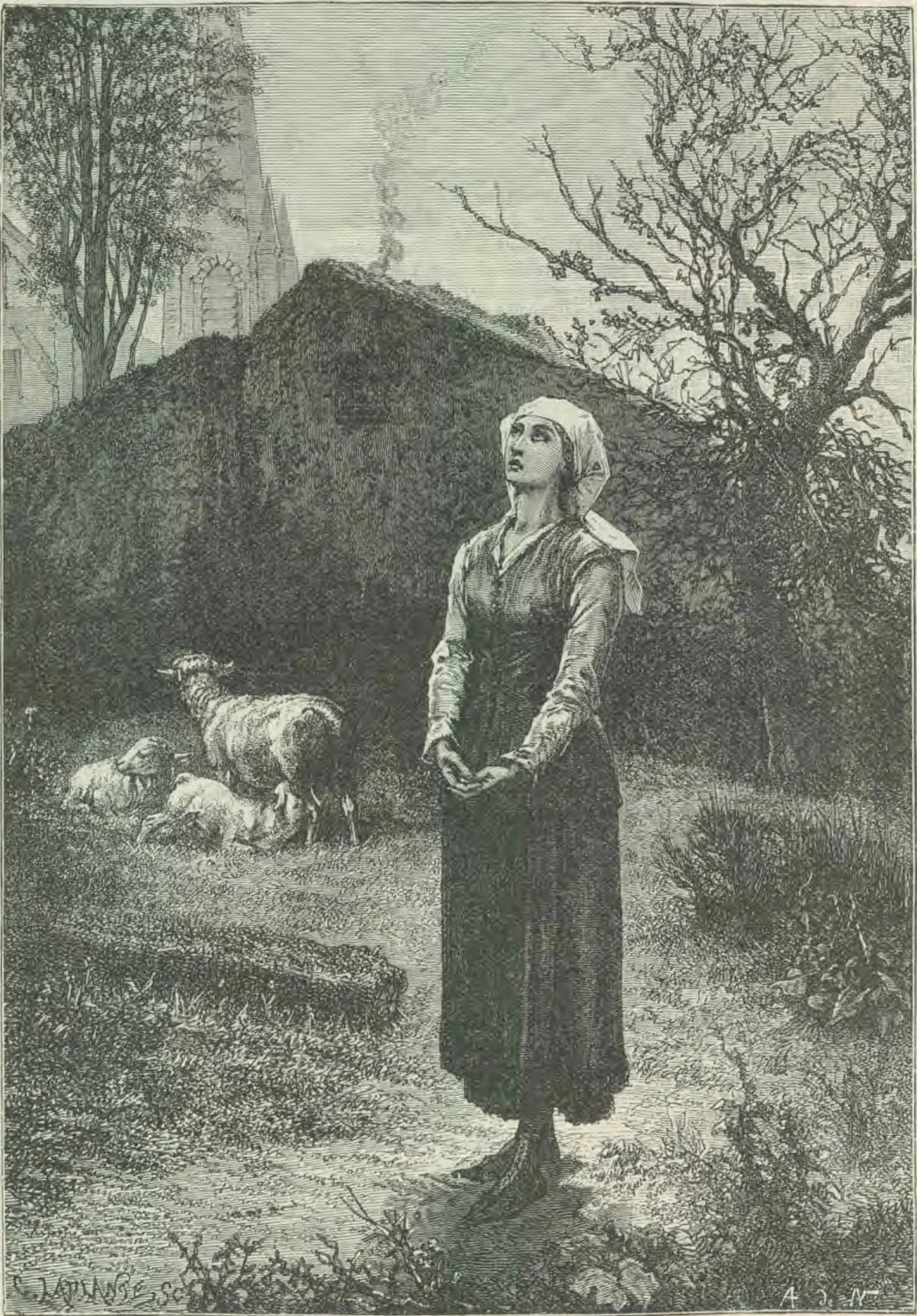
On the eastern borderland of France, among the wild hills of Lorraine, lived the girl we shall learn about in this story. She was a humble peasant; but she was a good girl, and often dutifully tended her father's sheep and cattle upon the bleak hills, as the peasant girls of that country were in the habit of doing. It was not pleasant work always, you may be sure; and no doubt she would sometimes have preferred to stay in the house; for we are told that she was a very skillful housekeeper, and the finest needle-woman in the town. But she was conscientious and faithful, and there is no reason to believe she did not do her duty cheerfully, even if it was unpleasant. She was so unselfish and kind-hearted, and so good to her parents, that every one loved her. It was more than two hundred and fifty years ago that this girl lived, in the village of Domremy. Her father's name was Jacques D'arc, and the girl's Joan D'arc, or Joan of Arc.
There was war then between England and France; indeed, there was quite apt to be a contention of some kind between these two countries. England wanted to rule France; but the French preferred to have a king from their own nation and to rule themselves. So sometimes when the English king happened to be a man who could hardly rule his own affairs, the French got the upper hands in government; but when an aggressive ruler happened to be upon the English throne, there was apt to be trouble between the two nations.
Joan dearly loved her country, and she felt very sad to see the French king giving up inch by inch, and the English overrunning the land. She thought about it constantly while tending the flocks on the hills.
By and by the French king died, and his wife Isabella, instead of trying to keep the kingdom for her son, disinherited him, and gave the country into the hands of Henry V. of England, who had married her daughter Catherine. But Henry V. did not live long after he had gained France. When he died, he left an infant son, Henry VI. Of course, while Henry VI. was a young lad, some one had to be appointed as regent to take charge of the kingdom for him, ruling in his name. There was a great deal of trouble in deciding which duke should be appointed for this purpose, and who should have the regency of France. While these matters were adjusting, the dauphin, as the oldest son of the French king was always called, thought it was a good time for him to assert his claims to the throne.
He did so, and the events which followed in consequence opened up war with England. There is not space to tell you how these wars progressed, but at length the English gained such victories that the dauphin thought of flying to Scotland or Spain. Just then something happened to change affairs.
There was an old prophecy of an enchanter named Merlin, which was still told by the superstitious peasantry. This prophecy declared that the calamities which should befall France through the depravity of one woman would be removed by a good young woman; and it also said that this woman should come from Domremy. Ever since Joan was a little girl, she had heard this prophecy, and believed it; and as she grew older (she was now twenty), and saw the evils that had befallen France through Isabella's management, she felt very sad, and wished she could do something to help her country. She was very courageous and energetic. She remembered this old prophecy; and as she led the sheep day after day upon the lonely hills, she thought she heard voices calling and telling her to deliver France. She said St. Michael appeared to her in an unearthly brightness, and commissioned her to go.
Her father and mother were greatly distressed when she told them that she was sent by Heaven to crown the young dauphin at Rheims and to relieve the city of Orleans, which was then about to fall into the hands of the English. Her old father told her it was her fancy, and not the voices; that called her, and that she would better stay at home and lead a quiet life, as other girls did. Whether Joan really heard the voices, or whether it was her imagination, I do not know. There is no doubt but that she believed everything she claimed. At last she set out on her mission, accompanied by an old uncle, who believed in the voices as much as Joan herself did. She had to make a fatiguing journey, and encounter a great many difficulties before she could see the young king; for people would not believe what she said. But when a council of priests examined her, and said they found nothing in her contrary to the Catholic faith, and that they thought she was the one who was to fulfill the old prophecy, the people changed their minds.
An army of four or five thousand men was put under her charge, and donning a suit of armor, she rode off at their head to raise the siege of Orleans. It was not thought so strange then for a woman to go to battle as it is now, because the ladies sometimes did go to war dressed as pages, so as to be with their friends in peril.
Joan gained the victory at Orleans, after some very hard fighting. When the battle went well, her soldiers believed in her claims; but when the English seemed to be getting the upper hands, they doubted her. This victory, however, settled the matter, and every one believed her.
After some other battles, in which the French were victorious, the king was persuaded to go to Rheims to be crowned. It would have been much better for Joan if she had gone back to her sheep-tending among the hills as soon as the coronation was over. But the king would not hear to it; he had made up his mind that she was a very useful person, and he made her stay near the court.
Joan went to many battles after that, and helped the generals fight. All went well for awhile; but in one of them the English beat, and took Joan prisoner. King Charles was a lazy man, and he did not like to go to the trouble of getting her free; so he let the English keep her. He did not even act as if she had been of the least help to him. Probably he had found her so difficult to manage that he did not care if she was shut up.
Poor Joan was kept in prison a long time. I am sure she must have wished many times that she had never seen the French court, or the king, or had gone to fight the English, but had stayed at her father's humble home, tending sheep.
After a time the English delivered her into the hands of the Inquisition, where her persecutors tried to make her repent of ever doing what she had done. They cross-questioned her, and harassed her, and tortured her, until she was nearly distracted, and at last confessed that she had never heard any voices, but had lied about it, and that all her miraculous help had come from the Devil. Then they made her promise she would not put on a man's clothes again. They condemned her to imprisonment for life, "on the bread of sorrow, and the water of affliction."
But by and by Joan thought she heard the voices again. And I am sure that being kept on bread and water and in a dark prison, did not tend to make her any less fanciful than she would have been if things had been pleasanter. One day she forgot her promise, and put on a suit of men's clothes that had been purposely left in the cell, to entrap her. Then her tormentors took and tried her for a heretic, and she was burned at the stake, in the market-streets of Rouen.
Poor Joan had learned, through bitter trials, how ready people are to cast aside and forget those who have been useful to them, when they have ceased any longer to be of service to them. She found that more happiness lay in humbleness and obscurity than in greatness and fame. “From the moment of her capture, neither the French king nor one single man in all his court raised a finger to save her. . . . But it is no wonder that they who were in all things false to themselves, false to one another, false to their country, false to Heaven, false to earth, should be monsters of ingratitude and treachery to a helpless peasant girl.”
“In the picturesque old town of Rouen, where weeds and grass grow high on the cathedral towers, and the venerable Norman streets are still warm in the blessed sunlight, though the monkish fires that once gleamed horribly upon them have long since grown cold, there is a statue of Joan of Arc, in the scene of her last agony, in the square to which she has given its present name. I know some statues of modern times—even in the world's metropolis, I think—which commemorate less constancy, less earnestness, smaller claims upon the world's attention, and much greater impostors.” W. E. L.

HANDLING TRUST FUNDS.

Stepping into the store of a Christian business man one day, I noticed that he was standing at his desk with his hands full of bills, which he was carefully counting as he laid them down, one by one.
After a brief silence I said, “Mr. H—, just count out fifty dollars from that pile of bills, and make yourself or some other person a life member of the Christian Giving Society.”
He finished his count, and quickly replied, “I’m handling trust funds now.”
His answer quickly flashed a light on the entire work and life of a Christian, and I replied to his statement with the question, “Do you ever handle anything but trust funds?”
If Christians would only realize that all that God gives us is “in trust,” what a change would come over our use of money!
“I’m handling trust funds now.”
Let the merchant write the motto over his desk, the farmer over the income of his farm, the laborer over his wages, the professional man over his salary, the banker over his income, the housekeeper over her house-expense purse, the boy and girl over “pocket-money,”—and what a change would be made in our business.
A business man who had made a donation of one hundred thousand dollars to a Christian enterprise once said, in the hearing of the writer, “I hold that a man is accountable for every cent he gets.”
There is the gospel idea of “trust funds.”
Let parents instruct and train their children to handle “trust funds” as the stewards of God’s bounty, and there will be a new generation of Christians.—Christian Giver.

OKLAHOMA

By the proclamation of the President, issued March 27th, the Indian Territory ceased to be exclusively occupied by the Indian tribes who have been granted homes there by the government. By this proclamation, which was issued under acts of Congress and treaties with two of the Indian nations, the Creeks and the Seminoles, a tract of two million acres of land, in the very center of the Indian Territory, was opened for settlement by the whites.
This tract of land, which is more than fifty miles distant from the nearest territory now settled by whites—the State of Kansas—is bounded east, south, and west by land occupied by Indian tribes. It is the district originally known by the name of Oklahoma. This name will doubtless be applied to the whole tract which will ultimately be opened, and to the Territory which it is proposed to organize.
In the last Congress a bill was passed by the House of Representatives, but not by the Senate, for the organization of such a Territory, lying to the westward of the civilized Indian nations in the eastern part of the Territory, and for the opening to settlement of such portions of it as were not actually occupied by the Indians.
Though this bill failed to become a law, it was well known that provision had been made for the opening of the “Oklahoma” tract in the center of the Territory, and, in expectation of the issue of the President’s proclamation, thousands of people gathered on the border in Kansas, prepared to sweep in and occupy homesteads.
Many of these intending settlers would not wait for the President’s Proclamation, but crossed the border, and were expelled by United States soldiers. With the issue of the proclamation, a rush set in across the intermediate lands.
If all the land opened for settlement were occupied in farms of one hundred and sixty acres each, there would be room upon it for more than two thousand farmers with their families. And all those people in the heart of the Indian Territory will, pending an act of Congress, be without any form of local government except such as they may themselves set up.
The history of the Indian Territory is one of continued reduction of the territory occupied by the Indians, at the same time that more and more Indians have been colonized upon it.
The Territory proper first came into the possession of the United States in 1803, with the purchase of Louisiana from France. An act of Congress of 1834 declared that “all that part of the United States west of the Mississippi River, and not within the States of Missouri and Louisiana or the Territory of Arkansas” should be considered “the Indian country.”
At about the same time (1833 to 1839), the Indian tribes of the South, east of the Mississippi, the Creeks, Choctaws, Chickasaws, and Cherokees, were removed thither, and many other tribes have since been colonized there, while States and Territories have been formed out of the unused land.
Several of the Indian tribes, and notably those whose names have just been given, have attained a very considerable degree of civilization, maintaining many schools, attended by more than six thousand pupils, and, until lately, more churches than any other Territory. Through the Territory the traffic in liquor is absolutely forbidden.
The pressure of the whites to enter and settle in the Territory may be said to have begun in 1878, when the civilized Indians protested against the settlement of any more wild tribes from the West on their borders.
At the session of Congress in 1878-79, a bill was introduced to establish the Territory of Oklahoma, setting up over the whole of the Indian Territory an ordinary Territorial government.
In 1880, President Hayes found it necessary to remove by force many squatters upon the lands in the center of the Territory, and since then the pressure of intending settlers upon the public lands there has been almost continuous.
None of the legislation now proposed looks toward the removal or disturbance of any of the Indians settled in the Territory. They will remain where they are, and will continue to possess by far the best lands in the Territory. The region now opened to settlement is not as fertile as the eastern part of the Territory, and is much more subject to drought.
Away in the northwestern part of what is given upon ordinary maps as the Indian Territory, is a narrow strip known as “No Man’s Land,” which was ceded by Texas to the United States, and which is now occupied by several thousand white settlers, who live without a government.
This tract, with “Oklahoma” and a large tract of intervening and bordering country, will, without much doubt, at an early date be organized into a new Territory.—Youth’s Companion.

THE BURNING ROCKS OF COLORADO

For the INSTRUCTOR.

THE BURNING ROCKS OF COLORADO.

Very few are aware of the many wonderful objects to be seen in Colorado. A short time since, I was, in company with Elder G. O. States, on the cars en route to Kansas, and in the course of an interesting conversation in reference to the marvels of this region, he showed me a brief article he wrote for a local paper, which I copy in full, believing the readers of the INSTRUCTOR will peruse it with pleasure:—
“I recently took a trip down the Gunnison River, to where it pours into the Grand. The first point of interest was the bridge, which is the only bridge of any kind on the reservation. It is almost an impossibility to bridge the Gunnison, on account of such high water during the spring freshets, and it takes much money and eternal vigilance to keep the bridge from being swept away. A person living in the East has no idea of the turbulent streams in this mountainous country. In 1884, while a passenger train was crossing the bridge, it went down, and the cars floated off, and for weeks the only way of crossing was in a skiff.
“However the bridge was rebuilt in a substantial manner, and the Railroad Company have spent thousands of dollars building stone piers for controlling the turbulent waters during spring freshets. Much of the way from Delta to the Grand River the Gunnison River is canyoned up, occasionally widening out enough to make room for one or two ranches, the water being raised by means of large water-wheels. I went down the Grand twelve miles to Fruita, which is indeed a beautiful place.
“One thing about Colorado is that wonders never cease. There is always something of interest to behold. I had a friend with me from Ohio, and so I took him out on the river floats, covered with rocks of all kinds, shapes, and colors. I gathered a few sticks, and built a fire, and piled on certain kinds of rocks, and soon my friend stood in wonderment, as I took away the wood, and left nothing but the rocks burning. We staid there for hours looking at them. There is a mountain fifteen miles north that is covered with them. On the evening of the news of Harrison's election, load after load was drawn from the river up town, and set on fire, making a blaze over twenty feet high.
“A ‘tenderfoot’ from the East built a fire-place of them in his cabin, and the first thing he knew, his chimney was on fire. These rocks are usually flat, and of different sizes.” W. S. C.

“WHAT CAN YOU DO?”

My boy, if you are poor, thank God and take courage; for he intends to give you a chance to make something of yourself. If you had plenty of money, ten chances to one it would spoil you for all useful purposes.
Do you lack education? Have you been cut short in the text-books? Remember that education, like some other things, does not consist in the multitude of things a man possesses. What can you do? That is the question that settles the business for you.—Dr. J. G. Holland.

Origin of the Word Almanac

ALMANAC is derived from two Arabic words meaning “to count.” The first almanac was issued at Buda, and the compiler handsomely rewarded by the king of Hungary.—Kerr Schwartze, found in Lambeth Palace.

A MAY SONG.

THE orchard is a rosy cloud, The oak a rosy mist, And oh, the gold of the buttercups The morning sun has kissed! There are twinkling shadows on the grass Of a myriad tiny leaves, And a twittering loud from the busy crowd That build beneath the eaves.
Then sing, happy children, The bird and bee are here, The May time is a gay time, The blossom time o' the year.
A message comes across the fields, Borne on the balmy air,— For all the little seeking hands, There are flowers enough and to spare. Hark! a murmuring in the hive! List! a carol, clear and sweet! While feathered throats the thrilling notes A thousand times repeat.
Then sing, happy children, The bird and bee are here, The May time is a gay time, The blossom time o' the year.
—St. Nicholas.

THE CRAB FAMILY.

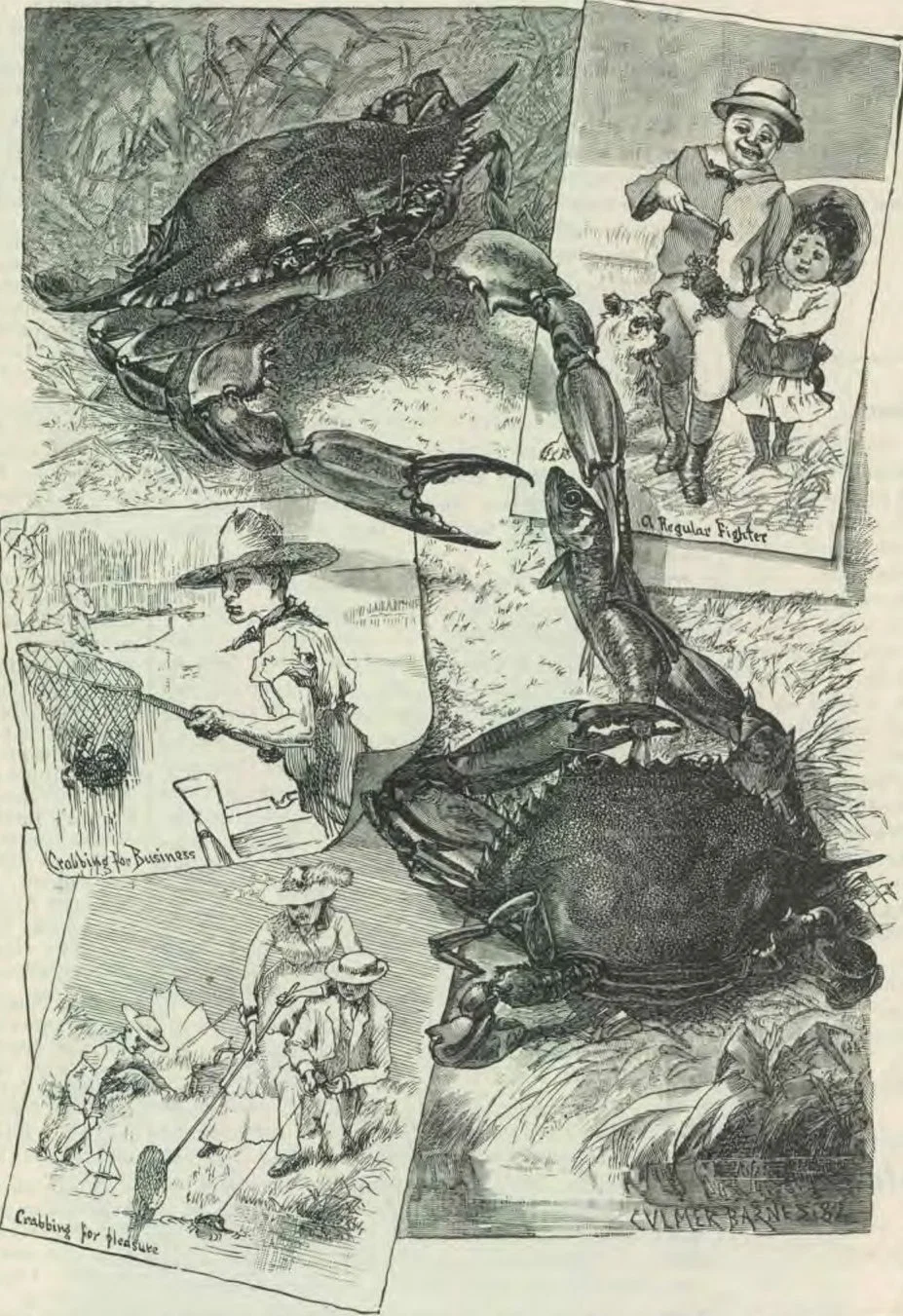
“CRUS-TA-CEA!” This is a hard name for little boys and girls to speak, I know; but it is the name of a very interesting family of animals. They were called by this name because their bodies and limbs are covered with a hard, shell-like crust. Crabs, lobsters, shrimps, and some other animals are branches of this family. We have on this page a picture of crabs, so may be you will like to learn of their curious habits.
How many of you have ever seen a crab? I am almost sure some of you have not, because you do not live near streams or bodies of water, and this animal most always lives in the sea or in the brooks. There is one kind of crab, though, called the Land Crab, that lives in the mountains, sometimes ever so far from the sea; but its home is not in this country.
Like little boys and girls, it takes the crab several years to grow to its full size. Inside of his hard coat he has a soft body. It is this that grows. His shell does not grow. You would not think it strange if his coat should sometimes pinch him, would you?
Well, it does, and so it is his fashion to change his dress every year. The old one bursts open, and Mr. Crab creeps out of it. For awhile he has nothing to protect his soft body, so he hides away, and grows as fast as he can; and while he does this, the lime in the water, and something that comes out of his body, makes a new crust, or coat.
When the crab is done growing, he does not change his shell any more. He has a great deal of trouble after that, though; for sea plants and animals fasten themselves right to his back. He tries to shake them off, but they won't go, and he has to carry them around the rest of his life.
I have told you that the Land Crab lives in the mountains. Well, even he makes a visit to the sea once every year. These animals form into a long procession, sometimes three miles long and 150 feet wide, and all go together. The first thing they do when they reach the sea is to take a bath. Then they lay their eggs in the water, after which they find hiding places where they can creep out of their old coat, and stay until a new one forms.
After their eggs hatch, and the little crabs are big enough to travel, they too, go to the mountains. Very many crabs lose their lives in these long journeys to and from the sea.
While on their march, they make a great clatter with their bony claws, to make people afraid of them. It is said that they sometimes crawl right into people's houses.
In the land of cocoanuts there is a crab that feeds on those nuts. People used to think he climbed the tree, and picked them for himself; so they gave him the name of Robber Crab. Now it is thought that he only eats what he picks up on the ground. But they do say that he lugs nuts up on to some high place, and lets them fall upon the stones below, to break them.
One crab is so quarrelsome he has been given the name of Fighting Crab. One of his claws is ever so much larger than the other. When it runs, it holds up the large claw, and moves it in a way that looks as if he were motioning to something to come to it, so it has had another name given it,—that of Calling crab.
The little Pea Crab, which lives in oysters, you may have seen. Then there is the Swimming Crab, that floats about on the seaweed.
The largest is the Japanese Crab, which lives in deep water. It is really a Spider Crab. It has nippers five feet long, and measures ten feet between the ends of the nippers. One in the British Museum is said to measure eighteen feet between the tips of the first pair of legs.
The Spider Crab acts as a scavenger, and eats the decaying animal matter that is always found in the sea. He has a way of flinging his food into his mouth as regular, and as fast, as a Chinaman puts his food into his mouth with his chop-sticks.
Some of the Spider crabs do not keep their coats very clean, and so they have to carry around a load of plants and animals which grow to their backs.
But the most curious of the crabs is one called the Hermit or Soldier Crab. The forepart of his body has a hard covering, but the back part is soft; so he has no way to protect himself from danger only by getting into somebody else's house. This he will live in until he outgrows it, when he has to go house-hunting again.
He is very hard to please. Sometimes he will handle a great many shells, turn them about, take a peep into them, try them with his feelers, and if they do not suit, try another. If he finds one to his liking, it makes no difference to him if it already has an owner; for he turns him outdoors, and likely as any way, eats him up.
The Hermit Crab has a way of carrying his stolen house around with him when he likes. May be it is to keep some other thief out of it.
In those countries where crabs are used for food, fishermen make it their business sometimes to catch them. They make use of a kind of basket called a crab-pot.
You do not need a baited hook to catch crabs; for they will bite at almost anything placed before them, and will be pulled out of the water before they will let go. They bring a high price in the market.
Boys sometimes go to the seashore in low water, and with a long stick to which is fastened a hook, pull them off from the rocks.
But the monkey's way for catching them is the most comical. After looking about the rocks until he finds a crab hole, he puts his long tail down into it, when Mr. Crab, thinking an enemy has come, fastens his claw to the monkey's tail. No sooner does he do this, than the monkey pulls him out and makes a meal of him. I have not space to give you the names of all the crabs. You must read books that tell of the wonderful things in the sea, and you will learn about them.
M. J. C.

A HARD LESSON.

It was a hard lesson, but since it taught Fred to obey, it was not to be regretted. Fred was visiting Uncle Harry, and a delightful time he was having in the rambling old country house, with grandpa and grandma to pet him, and Uncle Harry to amuse him. Uncle Harry was an amateur taxidermist, and it was Fred’s great delight to watch him stuff the birds and animals which came in his way. Unfortunately, Fred’s eyes seemed to be in the ends of his fingers; for whatever he saw, he wanted to handle. Uncle Harry did not like this trait in his little nephew; for he was afraid that some of his instruments might hurt the boy, or that he might upset some of his bottles.
He was very careful never to let Fred go into his room alone; for he did not know what the consequences might be if there was no one to caution him against using his meddlesome fingers too freely. One day he was called away for a short time, just as he was about to begin to stuff a bird that lay on his table.
“Fred, I would rather you would not stay in here while I am gone,” he said to his nephew rather reluctantly. “I am afraid you will touch something.”
“Oh, no, indeed I won’t,” Fred protested eagerly. “I won’t touch a thing. I will just sit here in the window and read till you come back.”
Uncle Harry did not entirely like this arrangement, but he did not like to seem to suspect Fred’s word, so he went on his way, leaving Fred with his book, curled up in the broad, low window-seat.
For a time all went well. Fred was interested in his story, and had no desire to pry into his uncle’s things; but when he had finished his book, he wandered over to the table, with his hands in his pockets, just to look at things, he said to himself.
“I wonder what’s in that bottle anyway,” he thought, full of curiosity. “It looks just like water. I’m just going to smell it. It won’t matter if I touch that one thing; for I surely can’t hurt it.”
He was raising the bottle when somehow it slipped from his grasp, and fell upon the table, breaking into a dozen pieces. The colorless liquid proved to have a strong odor, and in a moment a stream of the contents trickled against Fred’s other hand, which was resting upon the table.
A scream of agony escaped him; for it burned like liquid fire. Darting across the room, he plunged his hand into a pitcherful of water, only to find that this increased his suffering.
By this time grandma had hastened up stairs, and the strong smell of carbolic acid and the broken bottle explained Fred’s tears, even before he sobbed out his story.
Grandma led him to the medicine closet, and put a cooling salve upon the burned fingers, and bound them up in soft cotton wool, but it was hours before the burning sensation grew less.
The dear old lady uttered no word of reproach, though she knew that disobedience lay at the bottom of the trouble, for she thought that Fred had been punished sufficiently. When Uncle Harry came in, and learned of the accident, and saw Fred’s pale, tear-stained face, he blamed himself for having left the bottle where Fred could find it, but the boy spoke up bravely,—
“No, it was my fault, Uncle Harry. If I had minded what you told me, and had not been meddling with other people’s things, I would not have been burned.”
It was a long time before Fred was able to use the burned hand freely; and in the long days that followed, when he could not indulge in any of his favorite sports, he had plenty of time to profit by the lesson that had cost him so dear.—Minnie E. Kenney.

OLD TESTAMENT HISTORY.

LESSON 23.—THE SIN OF MOSES.

INTRODUCTION.— Between the events recorded in this and the preceding lessons, a wide gap intervenes, variously estimated at from eighteen to thirty-seven years, which the sacred historian passes over in silence. The second entrance of the Israelites into the desert of Zin occurred in the first month of the fortieth year after their departure from Egypt, as appears from a comparison of Num. 20:1 with 33:38.

QUESTIONS WITH NOTES AND COMMENTS.

1. WHEN the Israelites came to Kadesh, in the wilderness of Zin, what took place? Num. 20:1.
Miriam at the time of her death is supposed to have been one hundred and thirty years of age. This event occurred four months before the death of Aaron, and eleven months before that of Moses.
2. From what did the people suffer? Verse 2.
3. What did they do and say? Verse 3.
In this act of murmuring, the younger generation of the Israelites proved themselves to be no better than their fathers, who had murmured at the same place and for the same reason thirty-eight years before.
4. What did they charge Moses with doing? Verse 4.
5. What did they say of the place where they then were? Verse 5.
6. Whom did they blame for bringing them out of Egypt? Verses 3–5.
7. Who had really brought them from Egypt? Ex. 20:1, 2.
8. Then to what was their murmuring equivalent? Ans.—To a denial that God had anything to do with their wonderful deliverance.
9. What does the psalmist say of them? Ps. 106:21, 22.
10. While the sin of the Israelites was exceedingly great, is it an uncommon one?
11. What did Moses and Aaron do in this extremity? Num. 20:6.
12. What directions did the Lord give them? Verses 7, 8.
13. When the people were gathered before the rock, what did Moses say? Verse 10.
14. What does the psalmist say of this occurrence? Ps. 106:32, 33.
15. How did it go ill with Moses? Num. 20:12.
16. In what particular did Moses and Aaron trespass against the Lord? Deut. 32:51.
Moses was not commanded to smite the rock, but only to speak to it; and the language which he used—“must we bring you water out of this rock?”—directly tended to justify the representation of the murmurers that it was only Moses, and not God, who had led them in their wanderings through the wilderness.
17. When Moses allowed the Israelites by their rebellious words to provoke his spirit, what position toward God did he also assume? Num. 20:24; 27:14.
18. Do we have any intimation that the Lord in any degree excused his sin because he labored under great provocation?
19. In this giving way to anger, of what grace did Moses show a lack? 1 Cor. 13:4, 5.
20. What evidence have we that, although Moses was prohibited from entering the promised land, he repented of his sin, and was fully forgiven? Deut. 34:5, 6; Jude 9; Matt. 17:1–3.
The sin of Moses was a great one, even greater than that of the people; for he had all the light that they had, and more. It is true that the people were the cause of his fall, yet that did not in the least relieve him from responsibility. The real cause, after all, was in his own heart, otherwise nothing that the people could have done would have moved him. The Lord cannot tolerate sin, no matter in whom it appears, yet he is “the Lord God, merciful and gracious, long-suffering, and abundant in goodness and truth; keeping mercy for thousands, forgiving iniquity and transgression and sin.” Ex. 34:6, 7. That Moses repented, and was abundantly pardoned, is shown by the fact that after his death he was raised and taken to heaven, and was commissioned to come on a message of love to Christ. From this we are warranted in concluding that if it had not been for this one sin, he would not only have been permitted to enter the land of Canaan, but would, like Elijah, have been translated without seeing death.
21. Then what must even the best of men say to the Lord? Ps. 130:3, 4.
We are often prone to excuse some sin in ourselves, on the ground that it is the only time we ever committed it; or that we but seldom fall into it, and only under the greatest provocation. Many seem to think that if a person has great provocation, he can commit a sin with impunity. But that reasoning would have made it right for the Saviour to yield to Satan’s temptations in the wilderness; for no man ever suffered so fierce temptation. The truth is, there is no excuse for sin, and anger is not admissible under any circumstances. When the translators of our common version of the Bible wrote that charity “is not easily provoked,” they were evidently moved by some consideration for the weakness of the flesh. They seem to have the idea that a man might have charity, and still be provoked to anger, providing he was not very easily provoked. But they did great injustice to the truth; for the words as Paul wrote them are simply, “is not provoked.” True charity does not get provoked under any circumstances.

LITTLE HELPERS.

WE are merry children, Happy all the day, Faithful in the work we do, Joyful at our play.
Glad to help each other Every day we can, Trying to be good and true Is our honest plan.
What we do for others Helps us to be strong; Striving always for the right, We shall conquer wrong.
All are old enough to try, If they have the will; Growing wiser day by day, We our part may fill.
—Sabbath Visitor.

HOW INSECTS MAKE MUSIC.

THE katydid has a wing that is very curious to look at. You have seen this little insect, I have no doubt. Its color is light green, and just where the wing joins the body, there is a thick ridge, and another on the wing. On this ridge there is a thin and strong skin, which makes a sort of drumhead.
It is the rubbing of these two ridges, or drumheads, that makes the queer noise you have heard. There is no music in it, surely. The insects could keep quiet as well as not, and they must enjoy doing it.
The katydid usually makes three rubs with its drumheads, sometimes only two. You can fancy she says “Katy did,” and “She did,” or “She didn’t.” The moment it is dusk, they begin. Soon the whole company are at work. As they rest after each rubbing, it seems as if they answered each other.
Did you know that bees hum from under their wings? It is not the stir of those beautiful light wings we hear. It is the air drawing in and out of the air-tubes, in the bee’s quick flight. The faster a bee flies, the louder the humming is.
Don’t you believe insects feel? Indeed they do! They have nerves all over them, even through their wings, and out to the end of every feeler. They suffer just as much as you do when hurt. You must remember this, and be kind to all the little insects God has made.—Mrs. G. Hall.

Strictness Is a Sign of Character

There is a wide difference between strictness and narrowness. It is quite commonly said, in disparagement of a man's conduct, that he is too strict. But the truth is, no one can ever be too strict. A strict man may or may not be a narrow man. A narrow man may or may not be a strict man. Indeed, a man who has character enough to be strict—to live strictly up to his principles—is likely to be broad, catholic, and liberal in those principles; while a man who has not character enough to be strict in his conduct is likely to be narrow and ill-defined in his principles. True strictness is a sure sign of character; and no one can have character without having clearly defined principles. It takes character to be liberal; it takes character to be broad; it takes character to be strict. Little character is needed to be loose or to be narrow. If you would be a man of principle, broad or narrow, see to it that one of your principles is to be strict in living up to your principles.
Continue reading: Letter Budget