The Youth’s Instructor, Vol. 27, No. 11.

THE YOSEMITE VALLEY

The Youth’s Instructor

Mar 12, 1879

S. D. A. Publishing Association · Battle Creek, Mich. · Mar 12, 1879

THE YOSEMITE VALLEY.

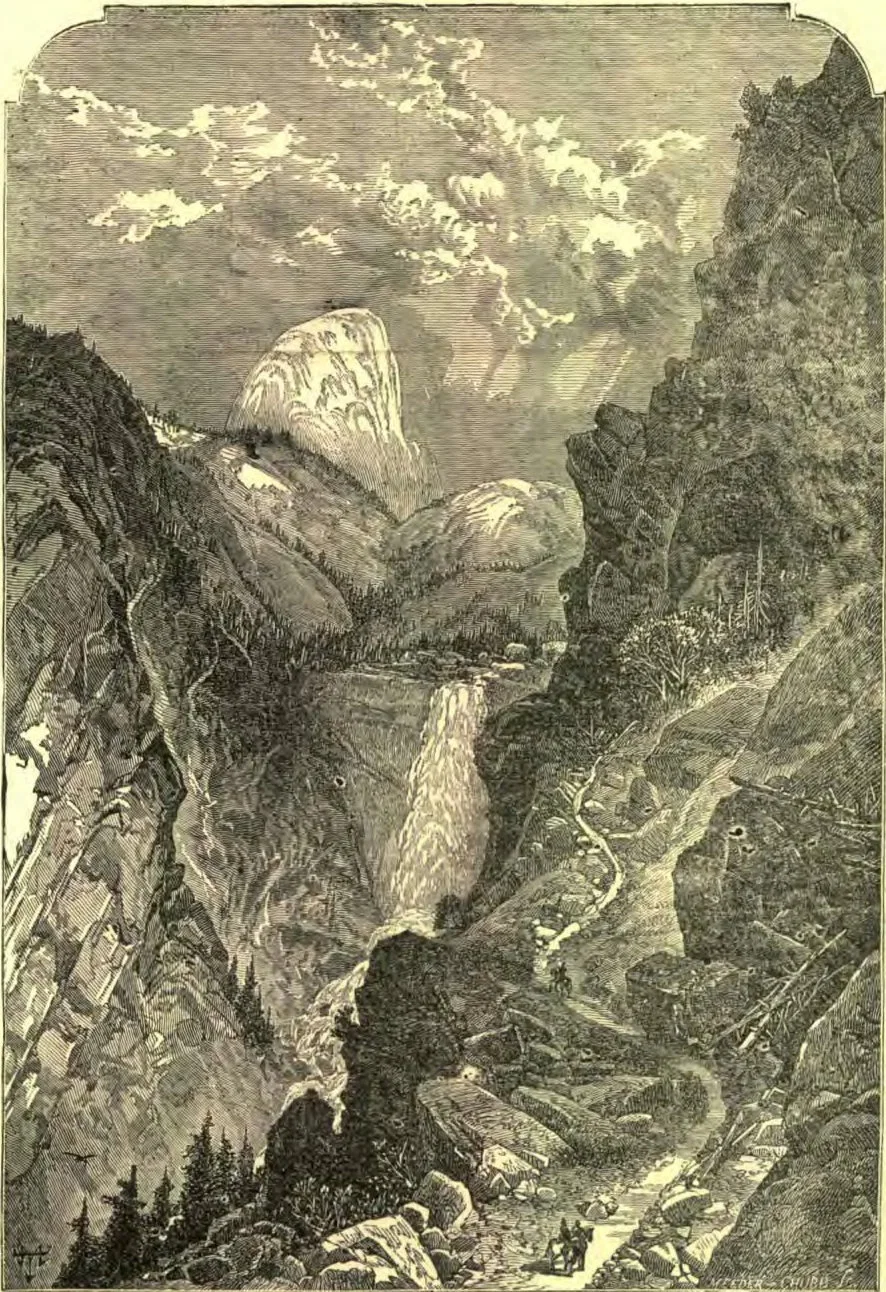
Some of the grandest scenery on the American continent is to be found on the Pacific coast. The most celebrated is the famous Yosemite valley, visited by thousands of tourists, as a source of constant wonder to the lovers of the grand in nature, and a fruitful field for the pencil of the artist. Its numerous water-falls, its lofty peaks and precipitous cliffs, afford abundant material for charming pictures, whether painted by the brush of the artist, or the vivid pen descriptions of the ready writer.
The scene given in our illustration is one of the many which the hand of the artist has reproduced, and represents the Vernal Falls, on the middle or main fork of the Merced River. It is somewhat difficult of access, as one would readily infer from a glance at the picture; but when once reached, the view amply repays all the effort. The full volume of Merced River leaps in an unbroken stream, and falls 350 feet. When it is remembered that the great fall of Niagara is but 163 feet high, it will be seen that the Vernal is in point of height the successful rival of the celebrated cataract, although much inferior in breadth and volume. In the sunshine, its misty vapors reflect the dazzling colors of the rainbow, and here, as at Niagara, by braving the drenching spray, the sight-seer may behold the complete or circular rainbow, which is thus described by a tourist:—
“There were two brilliant rainbows of usual form—the crescent, the bow proper.
But while I looked, the two horns of the inner or lower crescent suddenly lengthened, extending on each side to my feet—an entire circle, perfect as a finger ring. In two or three seconds it passed away, shrinking to the first dimensions. Ten minutes later it formed again; and again as suddenly disappeared. Every sharp gust of wind showering the spray over me revealed for the moment the round rainbow. Completely drenched, I stood for an hour and a half, and saw fully twenty times, that dazzling circle of violet and gold, on a groundwork of wet dark rock, gay dripping flowers, and vivid grass. I never looked upon any other scene in Nature so beautiful and impressive.”
Probably the devout observer would recall the “bow of promise” which gladdened the eyes and hearts of the family of Noah, as they emerged from their tempest-tossed voyage in the shelter which the mercy of the Lord had provided for them, in the days when the “long-suffering of God waited,” as it now waits in mercy to the world as yet not fully warned. May all our readers be sheltered from the storm which no “rainbow of promise” will avert when the warning message has done its work.
W. C. G.

THE BEAUTIES OF NATURE.

The beauties of nature, How charmingly bright; How lovely and pleasant Are they to the sight! The lofty peaked mountains In garments of snow; The billows of ocean, The brilliant rainbow;
The tall, towering trees In vestments of gold, Point up to far heaven, Where beauties unfold. In the far, flaming West At the closing of day, As the sun sinks behind The sea's silver spray—
Ah, the grandeur that then Unfurls to the view! The curtains of amber Are tinted with blue; And the white, fleecy clouds All bathed in the light, Melt all their bright hues With the dark shades of night.
We then gaze at the heavens With eager delight, And think of a haven Where cometh no night; A haven where cometh No darkness or death; “Where all the saints enter,” The Holy One saith.
—F. H. Phillips.

SOMETHING TO DO.

ONE of the most important things the young have to do is to gain knowledge that shall prepare them for the duties of future life. Besides the employment of school hours there are many leisure hours at home that should be devoted to study. There is so much to be learned, such unlimited stores of interesting and valuable truths to be gained by all who are willing to work, that no one can afford to remain in ignorance,—no one can afford to waste the precious hours, which, by study, can be turned to more than golden account.
“How much better is it to get wisdom than gold! and to get understanding rather to be chosen than silver!” So said the wise man, and it is generally admitted to be truth.
Dear children, do not be satisfied, when in school, to stand lower than the best. Not in envy, but in true love of excellence, put forth your best efforts in study. Industry and perseverance will enable even ordinary minds to excel in scholarship. With the school facilities of our country there is little excuse for not having at least a common education. Should circumstances forbid school privileges, remember that diligence and perseverance at home often produce the best of scholars. Improve your leisure hours. Keep always at hand some book that will give you useful information.
How many in mature years feel and express bitter regret that they did not better improve their time and opportunities in youth; and all who are truly successful will testify that faithful industry and studious habits were the secret of their success.
Soon our precious youth-time will be past. If wasted, what a sad loss! How keenly we shall feel the lack of a due preparation when we come to some important duty and find ourselves all unprepared—when the most desirable positions lie just before us, and yet are closed against us because we are wholly unqualified!
Then let us appreciate the value of every hour, for the wealth of knowledge it can impart when used aright. Remember, dear children, that we cannot afford to waste time when there is so much to do that will affect our success and happiness in all our after life. Each hour as it passes should leave in our store some valuable information. A faithful review at the close of each day would soon so impress the mind with the worth of time as greatly to assist in improving the hours as they pass.
S. M. SPICER.

THE AIR A MEDIUM OF SOUND.

On pleasant evenings, the sky appears to be studded with stars, and children often speak of them as being in the air. This is a mistake; the stars are thousands of miles above the air, in a vast ocean of space which no man has been able to fathom.
Sound is produced by the vibration of the air. If there were no air, there would be no sound; consequently, above the air it must be as still as the grave; and if the sun were to explode, it would do so in silence.
A gun fired on the summit of a high mountain sounds no louder than a firecracker. In deep mines it is just the reverse, and the air is so dense that the workmen are obliged to talk in whispers, otherwise their voices would sound unpleasantly loud. In the arctic regions the air is so clear, cold, and still, that it carries sound a great distance, and persons one and a half miles from each other can converse together.
Wood is a good conductor of sound. In Sweden, deaf men and women may be seen sitting in church holding in their mouths long wooden sticks which touch the pulpit. By doing this they are enabled to hear much of the sermon. There is a difference in individuals in their power of hearing.
The bat makes a low, crying noise which thousands of people cannot hear. One writer says that he believes there are “sounds in the air of which we have no idea; and if our ears could be quickened we would hear the songs of angels, whereas we now hear only the feeble accents of our own broken prayers.” He says, “All nature tends to music. A bullet whistling through the air sings as sweetly as a bird. The murmur of the leaves of the trees in the breeze, the rumble of the great city, the rushing of waters, the singing of birds, the sighing of the wind, and all the confused noises of nature, when softened by distance, are said to be upon one pitch—the key of F.”
Damp air is a better conductor of sound than dry air; hence music sounds best in the night. When sound strikes a hard surface it is sent back, and the reflected sound is called an echo. In a certain place in Scotland, there is a remarkable echo. If a tune is played or sung, the echo repeats it correctly, and then keeps repeating it in a lower key until it dies away. An echo in Italy repeats the same sound thirty times. When a cannon is fired on the shores of Echo Lake, in New Hampshire, the sound produces an echo which is like a peal of thunder. In St. Paul's church, in London, a whisper at one side of the dome is carried a considerable distance to the opposite side.
If it were not for the resistance of the air, all bodies would fall to the earth with equal rapidity. If there were no air, a bullet and a feather would fall to the ground in the same space of time. This may seem strange to you, but it is a well-established fact. ELIZA H. MORTON.

“THE LORD, HE IS THE GOD.”

In the days of the kings the land was filled with idols, and the majority of God’s people gave themselves over to idolatry. It was then that Elijah the Tishbite appeared, and was an instrument in the Lord’s hands of proving who is the God. Children, read that thrilling story in the eighteenth chapter of the first book of Kings. The proof was so convincing that all the people cried, “The Lord, he is the God; the Lord, he is the God.”
In this land of Bibles and Christians it would be considered very disgraceful were we to set up an image and pray to it, calling it our God. But there is very much of idol worship even in American homes; for any object which takes our affections from the Supreme Being becomes an idol. Some make a god of their wealth, some of their learning, some of their appetite, and some worship themselves. But the Lord, he is the God, and should be worshiped.
When God’s “judgments are in the earth, the inhabitants of the world will learn righteousness.” How so? Because it is then proved again that “the Lord, he is the God.” God’s judgments are now in the land to an alarming extent. The noisome pestilence, and disasters by sea and by land fill the world with woe. Will the people receive instruction? Many will, and prepare themselves to escape the greater calamities which shall come upon the wicked as a destruction from the Almighty. But many more will be convinced that “the Lord, he is the God,” a little too late to be delivered by him.
“The Lord, he is the God;” and who so great as He who can deliver from the plagues threatened upon the last generation? He has promised that those who make him their refuge shall be covered with his feathers, so that, though a thousand fall around them, no evil shall befall them, and no plague come nigh their dwelling; for he shall give his angels charge over them, to keep them in all their ways.
May none of us have any gods before the Lord; and may we not be at peace with ourselves only as we have the evidence that the great and mighty God is our God.
M. J. C.

BIBLE LESSON FOR YOUTH.

LESSON XXXVII.—THE TABLES RENEWED.

  1. What did Moses do after he had destroyed the golden calf?
  2. What did he say to the people?
  3. What did he bid those to do who had taken their stand for the Lord?
  4. How many fell that day?
  5. What did Moses say to the people the next day?
  6. Repeat the words of Moses as he besought the Lord to forgive the people. Ex. 32:31, 32.
  7. What reply did the Lord make? Verse 33.
  8. How did the people humble themselves? Ex. 33.
  9. How did they seek God?
  10. What precious promise did the Lord finally make to Moses?
  11. After this what did the Lord bid Moses to do?
  12. How long was Moses in the mount without food or water?
  13. Describe his appearance when he came down from the mount?
  14. What did the people say to Moses at the Red Sea after witnessing all the wonders which the Lord had performed in Egypt?
  15. How long was it after they passed through the sea, before they murmured again?
  16. What miracle was performed at Marah?
  17. Describe their murmuring in the wilderness of Sin.
  18. What miracles were wrought for them in that place?
  19. Where did they next show a rebellious spirit?
  20. What astonishing miracle was performed at Rephidim?
  21. What awful manifestations were witnessed on Mount Sinai?
  22. What crowning act of disobedience and rebellion did the people here perform, while the glory of God was continually manifest before their eyes?

SYNOPSIS.

After Moses had destroyed the golden calf which the people had worshiped, he went and stood in the gate of the camp, and cried, saying, “Who is on the Lord’s side? Let him come unto me.” He then sent those who came to him into the camp, to slay, without respect to friendship or kindred, those who had led on in this idolatry; and there fell of Israel that day about three thousand men. Thus were they punished for their sin.
The next day Moses said to the people, “Ye have sinned a great sin, and now I will go up unto the Lord, peradventure I shall make an atonement for your sins.” He besought the Lord to forgive the people, saying, “Yet now, if thou wilt forgive their sin—; and if not, blot me, I pray thee, out of thy book which thou hast written.” So God listened to his earnest cry, and regarded his unselfish prayer. He told Moses that he would send his angel before the people to the land which he had promised them; nevertheless he said that their sin should yet be visited upon them.
After this, the Lord bade Moses hew out two tables of stone like those he had broken, and bring them up unto him in the mount. God then wrote his law upon the tables as before, and delivered them to Moses. Moses staid there in the mount forty days and forty nights, and during the whole time he neither ate bread nor drank water. When he came down from the mount, his face shone with the glory of God, so that the people were afraid to come nigh him.
The children of Israel had witnessed all the wonders which the Lord performed for them in Egypt, but when they were overtaken by their enemies at the Red Sea, they murmured against Moses, and asked him if it was because there were no graves in Egypt, that he had brought them forth into the wilderness to die. Then God led them through the sea on dry land, and destroyed their enemies before their eyes.
We would surely think that after witnessing such a marked manifestation of the divine power, they would have confidence in the God who was leading them. But only three days after, they murmured at Marah because the water was bitter. God there performed a miracle in healing the waters; but only a few days after, we find them crying out against the Lord because they had no bread. Here he gave them flesh, and rained them bread from heaven. The manna was continued to them throughout all their wanderings, so here was a daily miracle, to continually remind them of the great Giver of all their good.
In a few days they again cried out against Moses because they had no water, and even accused him of bringing them out into the wilderness to kill them with thirst. God satisfied their wants by bringing them water from the rock. Here at Rephidim he also discomfited the Amalekites, who had come out to fight against them.
Now they had come to Mount Sinai, and had heard the voice of God from out the thick darkness, speaking in awful majesty the words of his law. They had entered into a solemn covenant to obey that voice; that covenant had been duly ratified; but now that Moses was gone from them a few days, they forgot all the wonders and miracles which had been wrought for them; and, even while the glory of God rested like consuming fire upon the top of the mount before them, they had engaged in idolatry, one of the very things expressly forbidden in the law of God as given from Mount Sinai.
G. H. BELL.

LESSONS FOR CHILDREN.

LESSON XI.—REVIEW QUESTIONS.

1. Who brought the children of Israel out of Egypt?
2. Who led them in the wilderness?
3. Who led them into the land of Canaan?
4. Why was not Moses permitted to do this?
5. Where did Moses die?
6. Where was he buried?
7. Who buried him?
8. What did the Israelites have to cross to go into Canaan?
9. When did they cross this stream?
10. Which way did they travel in coming from the Red Sea to Jordan?
11. On which side of the Jordan is the mountain where Moses died?
12. How did Israel find a way to cross the Jordan?
13. Was this in time of low water, or in time of high water?
14. What did Moses set up in the bed of the river, where the priests stood with the ark?
15. What did the twelve men carry up out of the river?
16. What use was made of these stones?
17. What was done on the fourth day after they crossed the river?
18. Why was the passover kept? Read Ex. 12.
19. Who appeared to Joshua in the plain of Jericho?
20. Who is captain of the Lord’s host?
21. How was the city of Jericho taken?
22. Do you think the Lord’s host helped Joshua to take Jericho?
23. What wicked thing did Achan do at the destruction of this city?
24. Why was it wrong for him to take these things for himself, since the owners were slain?
25. Who were saved alive at the siege of Jericho?
26. Why were their lives spared?
27. Why were the children of Israel driven back the first time they went up against the city of Ai?
28. How did Joshua find out that some of the people had done wickedly?
29. How did he find out who were the guilty ones?
30. What was done to Achan?
31. How was the attack made on Ai the second time?
32. Who planned this battle?
33. What was the result of it?

Report of New England S. S. Association for Quarter Ending Dec., 1878.

NAMES OF SCHOOLS Names of Superintendents Membership Average Attendance No. Under 14 No. Over 20 No. of Classes Held Before Meeting No. Instructors Taken
Westmoreland, N. H. James B. Mason 7 6 ... 7 1 No ...
Francestown, " Mrs. C. W. Bixby 8 6 1 6 2 yes ...
Washington, " S. A. Farnworthy 29 21 12 17 3 " ...
New Ipswich, " Robt. B. Thomas 14 14 0 12 1 No ...
Amherst, " Freeman Nichols 20 ... 7 10 2 yes ...
Cornish & Newport, ... H. P. Wakefield 7 7 1 6 2 " ...
Newburyport, ... Mass. E. J. Harris 41 33 4 31 4 " ...
South Amherst, " E. G. Bolter 23 20 6 11 3 " ...
South Boston, " A. H. Wentworth 10 6 ... 10 1 " 5
Danvers, " A. P. McDuffee 96 80 24 51 9 " 45
Ipswich, " Joseph E. Cowen 23 1 0 19 2 " 5
Haverhill, " Mrs. S. N. Peabody 9 8 ... 9 1 " ...
South Lancaster, " Minard Wood 51 40 14 30 7 " 21
Curtis Corner, ... R. I. E. P. Holly 16 ... 3 8 3 " ...
Lafayette, ... Eld. P. C. Rodman 17 12 ... ... 2 " ...
Vineland, ... N. J. Mrs. Ella Frost 25 17 6 9 4 " 5
No. Schools, ... 16 Totals, ... 396 281 78 236 47 14 81
The schools at Dartmouth, Mass., and Norfolk, Conn., failed to report this quarter.
Mrs. M. A. BUZZELL, Sec.  D. A. ROBINSON, Pres.

Report of New York S. S. Association for Quarter Ending Dec., 1878.

Names of Schools Names of Superintendents Membership Average Attendance No. Under 14 No. Over 20 No. of Classes Held Before Meeting No. Instructors Taken
Adams Centre M. H. Brown 62 30 13 42 5 13
Frankfort & Litchfield J. A. Hardiman 27 20 9 14 3 yes
Genoa E. S. Lane 25 15 20 1
Mannsville N. L. Burdick 27 20 4 18 3 11
Newfane M. Duncan 30 20 8 22 4
Otter Creek P. Olmstead 25 20 9 12 3
Rosevelt Wm. Treadwell 35 20 7 29 3
No. Schools: 7 Totals 231 145 50 157 22 3 24
Names of schools that have failed to report this quarter:—
Bangor, Oswego, Rome,
Ellisburg, Pierrepont, Norfolk,
Eagle Harbor, Silver Hill, Buck’s Bridge,
North Creek, Pulaski, Pierrepont Hill,
Lancaster, Chittenango Falls,
Names of churches not yet heard from that ought to have Sabbath-schools:—
Brookfield, Keene, Parish,
Fine, Kirkville, Pitcairn,
Glensdale, Middle Grove, Ridgeway,
Gouverneur, New Connecticut, Vermillion,
Hermon, Olcott, West Monroe,
Parma.
Mrs. E. E. WALSWORTH, Sec.                 M. H. Brown, Pres.

Report of Iowa S. S. Association for Quarter Ending Dec., 1878.

Names of Schools Names of Superintend’ts. Membership Average Attendance No. Under 14 No. Over 20 No. of Classes Held Before Meeting No. Instructors Taken
Bentonsport B M Patten 25 20 9 16 4 yes ...
State Centre H P Roe 60 45 15 20 8 ” 25
Lisbon J T Mitchell 41 30 15 23 4 ” 10
La Porte City O S Ferren 26 ... 7 17 3 ” 4
Mt Pleasant Jas Houseman 73 58 23 26 6 ” 20
Emmettsburgh Je Olsen 12 7 ... 0 4 ” ...
Waukon J P Farnworth 22 15 1 6 4 No 4
Osceola Daniel Glunt 42 29 16 20 4 yes 12
Brighton R M Caviness 0 17 8 15 3 ... ...
Woodburn C W Neal 4 ... ... ... ... ... 5
Knoxville S B Hare 8 50 ... ... ... ... 10
Bonaparte A D-twiler 35 19 19 10 4 ” 12
Hook’s Point G W Bard... 33 18 12 15 3 ” 3
Sigourney C G Johnston 70 58 29 20 9 ” 12
Pilot Grove Leroy T N cola... 63 44 20 21 8 ” ...
West Union ... 26 ... ... ... 3 ” 10
No. Schools,... 16 Totals,... 679 410 193 219 67 14 127
Names of schools that have failed to report this quarter:— Belvidere, Nevada, Afton, Elk Horn, Logan, Oskaloosa, Marion.
Names of churches not yet heard from that ought to have Sabbath-schools:— Peru, Richland, Decatur, Smithland, Onawa, Marshalltown, Davis City, Adel, Clarence, Oxford Mills, Winterset, Monroe, Hampton, Sandyville, Lansing.
L. T. NICOLA, Sec.
L. McCoy, Pres.

ATTENTION, CANVASSERS!

We publish again our valuable list of prizes which we offer to canvassers, and would add that the extra offer of a $5.00 Bible to the one who should obtain the greatest number of subscriptions in a month will hold good until April 1, 1879. Shall we not see and rejoice in the fruit of your labors for the next four weeks?
The children will remember Uncle Peter, who wrote them a letter from Moss Point, Miss., a few weeks ago. Well, he writes again under date of Feb. 17, thus:—
“I have been canvassing for nearly a week, and have obtained fifty subscribers for the INSTRUCTOR.” Where he has canvassed, he says the people are delighted with the paper and Poems. He has also secured several subscriptions for Good Health, and he hopes “to obtain many more subscribers for our periodicals.”
Those who make a business of canvassing seem to be very successful. They enter heartily and thoroughly into the work, and seem to accomplish a great deal in a very little time. Are there not others who could spend a week in the same manner as did this Southern friend? Who will go and do likewise?

LIST OF PRIZES.

If you will send us EIGHT new subscribers for the INSTRUCTOR, we will send you your choice of the three volumes of Golden Grains: The Hard Way, The School-Boy’s Dinner, Grumbling Tommy.
For TWELVE new subscribers, your choice of Vol. 1, 2, or 3 of Sabbath Readings, or the Game of Life.
For TWENTY new subscribers, your choice of The Life of Captain Joseph Bates, or the Bible Atlas and Gazetteer. Price of each, $1.00.
For FORTY new subscribers, your choice between the “Bird’s-Eye View of Palestine,” a beautiful chart of the Holy Land, price $2.50, and a Pearl Oxford Teacher’s Bible, with Index, Concordance, and Maps, price $2.00.
For FIFTY new subscribers, your choice of a Nonpareil Oxford Teacher’s Bible, with Index, Concordance, and Maps, price $3.50; or the three books, Climbing the Mountain, Old Red House, and Story of a Pocket Bible. M. J. C.

LETTER BUDGET.

Washington, D. C.
Dear Editors: I am thirteen years old. I have three sisters younger than myself. We keep the Sabbath with our mother, and have a Sabbath-school at home. We use the Song Anchor, and often sing, “Blessed are they that do His commandments.” Father does not keep the Sabbath, but we hope he will sometime. We take the weekly INSTRUCTOR, and like it much. I want to be a good boy, and keep all of God’s commandments, that I may be saved when Jesus comes.
From your friend,
Alfred M. Cook.
Washington, D. C.
Dear Editors: I am trying to be a good girl. I am eight years old. My duty is to love God and everybody. I try to keep God’s commandments. This is the first time I ever wrote to the INSTRUCTOR. I have two sisters, Ethel and Josephine. I love them very much. I also love my brother Alfred. If I am saved, I will be glad to meet you all.
Minnie Cook.
Romeo, Mich.
Dear Editors: I am ten years old. I have been keeping the Sabbath with my ma since Eld. Lane came here with the tent. I like the INSTRUCTOR very much, and have obtained six subscribers for it. They all think the prize very nice, and the paper too. I want to live up to its teachings, and meet you all in Heaven.
Gertie Durham.

A BEAUTIFUL ANSWER.

LITTLE child in India, who had listened to the preaching of the missionaries, became converted. Her parents had never told her about God and the Bible, or how Jesus came down from Heaven to earth and died a cruel death, that all, even little children, might believe on him and be saved.
She had been taught to bow down to idols of wood and stone, as we do to God; but now she had heard the sweet story of Jesus’s love, and given her heart to him, and found peace and comfort in believing.
Her friends tried hard to turn her back to her former worship, and after offering her presents, which she refused, some one asked, “How do you know there is such a God as the missionaries speak of? You have not seen him.” The little one looked thoughtful a moment, and then replied, “How did you know a camel and not a man passed your tent last night?” “Because I saw his tracks, which were those of a camel and not of a man,” was the ready answer.
“In the same way,” replied the little one, “I know there is a God;” and, pointing with her finger, she said, “Look at yonder sun, and see how it shines. That is the track of God, and not of a man. He lives up there, and looks down on us here.” Noble answer! Children, ever remember the reply of the little Hindoo girl, and when tempted to do wrong, think that there is a God in Heaven who looks down on you and sees all your actions. J. O. C.

A LETTER.

DEAR CHILDREN: Perhaps some of you, like ourselves, live away from a church of Sabbath-keepers, and I am going to tell you how we contrive to pass the Sabbath pleasantly and profitably. Some time in June last, we proposed to have a Sabbath-school; and I am ashamed and grieved to say that in this city of one hundred and fifty thousand inhabitants, there were but three ladies and three children to compose the school.
We open our school at 3 P. M. with singing from the Song Anchor. The acting superintendent then reads a chapter from the Bible, when all pray, after which we sing again, and each recites a passage of Scripture. Then come the lessons.
Unlike the fashionable churches around us, we have congregational (?) singing. We always close with the doxology. We strive to make up in zeal what we lack in numbers, and when we all join in singing, “Praise God from whom all blessings flow,” we feel as happy and blest as if we were a school of sixty scholars instead of six.
Our State S. S. Secretary has asked all schools in the State to report. Now, children, how shall I go to work to report such a small school as this? You see, when one has told who the officers are, there isn’t much more to say.
L. E. ORTON.
Buffalo, N. Y., Feb. 21, 1879.

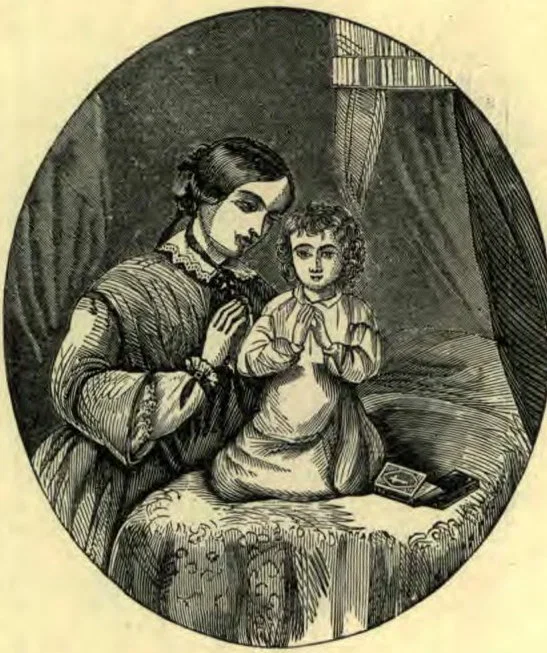
CHILD'S MORNING PRAYER.

Gladly now I ope my eyes And from my little bed arise; I thank thee, Lord, I've sweetly slept, And through the night been safely kept; From thoughts and actions wrong, this day O keep, dear Lord, thy child, I pray; And as I older grow, Teach me thy will to know. Amen.

Cherish Kindly Feelings, Children

Cherish kindly feelings, children, Nurse them in your heart; Don't forget to take them with you When from home you start. In the schoolroom, in the parlor, At your work or play, Kindly thoughts and kindly feelings Cherish every day.

Sacred Money.

Some years ago a gentleman heard two children talking earnestly about their “sacred money.” The expression interested him, and he learned, upon inquiry, that these children were in the habit of faithfully setting apart at least one-tenth of all the money which came into their hands, and using it for Christian work. They each kept a purse for this fund, and an account of all that was put into it and paid out of it. Their father said that they themselves had developed the expression, “sacred money.” They would often give much more than a tenth to this fund, but never less.

You have reached the end of this edition.

The Youth’s Instructor · Mar 12, 1879