Your ShelfYour Projects

Signs of the Times, Vol. 42, No. 12.

Significant Developments in Turkey

Signs of the Times

Mar 23, 1915

Pacific Press Publishing Association · Mountain View, California · Mar 23, 1915

Significant Developments in Turkey

The Turkish Power Driven from Europe—Does It Mean the End of the World?—What Are the Prophecies upon the Subject?
By E. E. Andross
According to diplomatic information received at Rome, the decision of the Turks to transfer their capital to Brusa, Asia Minor, was in direct opposition to Germany, which wished the transfer, if made, to be to Adrianople. The prophet’s mantle, together with all the important relics and treasures, already has been removed to Brusa, where the sultan’s harem also has been sent.”—Los Angeles Times, March 1, 1915.

Is It Probation’s Close?

Day by day such reports as the above are appearing in the papers, leading many to inquire if the departure of the Turk from Europe, which seems so imminent, will not be followed immediately by the close of probation and the beginning of the reign of Christ, and if Seventh-day Adventists have not taught thus in the past.

To Stand in Jerusalem

The last verse of the eleventh chapter of Daniel, and the first verse of the twelfth chapter, read as follows:
“And he [the king of the north] shall plant the tabernacles of his palace between the seas in the glorious holy mountain; yet he shall come to his end, and none shall help him. And at that time shall Michael stand up, the great prince which standeth for the children of thy people; and there shall be a time of trouble, such as never was since there was a nation even to that same time: and at that time thy people shall be delivered, every one that shall be found written in the book.”
© Underwood & Underwood Forts on the European side of the Bosporus. This is one of the objective points toward which the fleets of the allies have directed their efforts in the naval battle that has been in progress on the Dardanelles.
Seventh-day Adventists have long believed that Turkey was the power to which this scripture refers, and that eventually its seat of government would be removed from Constantinople to Jerusalem. They have believed that when the seat of the Ottoman power finally was established at Jerusalem, the next event to occur in the order of the prophecy would be the standing up of Michael, or the beginning of the reign of Christ. Dan. 12:1.

The Events in Their Order

In one of their most widely circulated books, “Daniel and the Revelation,” by Uriah Smith, bearing the imprint of the Review and Herald Publishing Company, Battle Creek, Michigan, 1897, the following comment on Dan. 12:1 occurs on pages 293 and 294:
“A definite time is introduced in this verse, not a time revealed in names or figures which specify any particular year or month or day, but a time made definite by the occurrence of a certain event with which it stands connected. ‘At that time.’ What time?—The time to which we are brought by the closing verse of the preceding chapter,—the time when the king of the north shall plant the tabernacles of his palace in the glorious holy mountain; or, in other words, when the Turk, driven from Europe, shall hastily make Jerusalem his temporary seat of government.
“We noticed, in remarks upon the latter portion of the preceding chapter, some of the agencies already in operation for the accomplishment of this end, and some of the indications that the Turk will very soon be obliged to make this move. And when this event takes place, he is to come to his end; and then, according to this verse, we look for the standing up of Michael, the great Prince.
“This movement on the part of Turkey is the signal for the standing up of Michael; that is, it marks this event as next in order. And to guard against all misunderstanding, let the reader note that the position is not here taken that the next movement against the Turks will drive them from Europe, or that when they shall establish their capital at Jerusalem Christ begins His reign without the lapse of a day or an hour of time.
“But here are the events, to come, as we believe, in the following order: (1) Further pressure brought to bear in some way upon the Turk; (2) His retirement from Europe; (3) His final stand at Jerusalem; (4) The standing up of Michael, or the beginning of the reign of Christ, and His coming in the clouds of heaven. And it is not reasonable to suppose that any great amount of time will elapse between these events.”
This clearly states the position held by thedenomination regarding the order of events as revealed in Daniel’s prophecy. They have never, as a people, believed or taught that immediately upon the departure of the Turk from Europe Christ would come to earth, or that He would begin His reign and probation would close.
They have understood that some little time might elapse after the capital of the Turkish power was removed from Constantinople till it was established in Jerusalem; that it might find a temporary home in one or more places before being located in Jerusalem; that during this interval, the gospel message would be given with Pentecostal power; and, further, that when the Turk finally was located at Jerusalem, it did not necessarily follow that “Christ begins His reign without the lapse of a day or an hour of time.”
They have, however, believed most ardently, and have proclaimed vigorously, both with pen and with voice, that as we see the signs of the early departure of the Turk from Europe, we may know that the end is approaching, and that soon the kingdoms of this world will become “the kingdoms of our Lord and of His Christ.”

On His Last Fateful Journey

To-day we have reason to believe that the last fateful journey of the Turk from Constantinople to Jerusalem is about to begin, and that we should make haste to prepare for the end. We do not believe in trying to drive any one to the service of God through fear; but we do believe that our loving Father will use every means to awaken the people from their deathlike slumber, and by a revelation of His goodness lead them to repentance.

The Restoration of the Papacy

There are several important prophecies that have not yet reached their complete fulfillment, and these must be fulfilled ere the end can come. Prominent among these is the restoration of the papal power to a position of supreme religious homage, as seen by the prophet John. But already we are far on the way toward the end predicted by this prophecy, as the readers of this paper must know. Recent developments along this line are indeed portentous, and they forecast approaching events of the greatest magnitude. We reasonably may expect that “the final movements will be rapid ones.”
The message of Revelation 14 rapidly is sounding through the earth. It is swelling into a loud cry.
Fires, floods, and earthquakes, with war and carnage among the great nations of earth, are causing the hearts of men to fail them “for fear, and for looking after those things which are coming on the earth,” as foretold in Luke 21:25, 26. Surely, perilous times have come, and the end is near.

What His Coming Means

All Business at an End—Everlasting Happiness Begins—A Mighty Message Proclaims It
By I. C. Colcord
NINETEEN hundred years ago, when Jesus was living among men, He taught the people, on more than one occasion, that He was not to remain long with them. He had work to do in heaven that must be accomplished before He would be ready to receive them to Himself. He said: “I go to prepare a place for you. And if I go and prepare a place for you, I will come again, and receive you unto Myself; that where I am, there ye may be also.”

THE END OF ALL BUSINESS

The coming of Christ means the literal fulfillment of that promise, a promise in the concrete. It also means the end of every kind of business on this earth in its sin-cursed condition. Buying, selling, and bartering in articles of necessity or luxury will then eternally cease. Manufacturing will stop. Great mills and factories will shut down, never more to resume operation. The millions of busy toilers employed in office, factory, mine, on farm, railway, or steamship, will stop work, and there will be an everlasting suspension of commercial activities, and the vaulted moneys and securities uncalled for. Letters by thousands, containing important news, will be left in mail pouches or pigeonholes in mail cars, never to be opened or read. The mail carrier's work will be done, and the messenger boy will have made his last rush telegram call.
The most startling and awe-inspiring scene that this world has ever witnessed, the most awful and yet the most glorious time, will have come—the coming of Jesus the second time according to His faithful promise.

NEVER-ENDING HAPPINESS BEGINS

To the righteous, Christ's coming means the beginning of never-ending happiness. It will be the day when God's people will meet and see their Saviour face to face. “Then the eyes of the blind shall be opened, and the ears of the deaf shall be unstopped.” “And the ransomed of the Lord shall return, and come to Zion with songs and everlasting joy upon their heads: they shall obtain joy and gladness, and sorrow and sighing shall flee away.” Isa. 35:5, 10.
To the wicked, Christ's appearing means destruction “with the brightness of His coming.” 2 Thess. 2:8. It means a day of awful, indescribable fear, which death alone can dispel. Those who have terrorized others, now will be terrified; those who have caused others to cringe, will be cowed; those who have made the beggarly poor, will now beg for mercy; and those who have been the cruel monsters and bloodthirsty demons of earth, shall drink of the rivers of blood of dead men. Rev. 6:15-17; 16:4; Matt. 7:2.

A MIGHTY MESSAGE GOING

While we are in the “tarrying time,” there is a present truth being given to the people, and that message is ringing in the ears of the world with no uncertain sound, a message of warning and preparation, that Jesus is coming again “the second time without sin unto salvation.” And the momentous events now occurring all around us, both in the home land and abroad, tell us His coming is near at hand.
Surely, reasoning from analogy, if God warned the world of the Flood; of the destruction of Sodom and Gomorrah, the cities of the plain; of Christ's first coming,—He will surely warn the people of all nations, tribes, and kindreds, of the final end of the world. This announcement is the present truth for this generation. It will be the greatest event this world has ever known, and there is nothing about it but that which is desirable. “And I will shake all nations, and the desire of all nations shall come.” Haggai 2:7.

OUR FACULTIES SHOULD BE ON TENSION

Our eyes should be open for the vision of His coming, our ears waiting to catch the sound of the voice of the Archangel, our hearts beating in anticipation of its infinite joy, and our appetites sharpening for the marriage supper. We cry out for the living God, and long to come into His presence. No news would be more welcome than the announcement that the command has gone forth from the Lord to His angels, that they gather quickly God's elect. We must be among the number. We must exchange the toil-worn, dusty girdle of our pilgrimage for the glorious vesture of immortality, and see to it that some one now in darkness is brought into the marvelous light of the third angel's message.
“Cast not away therefore your confidence, which hath great recompense of reward. For ye have need of patience, that after ye have done the will of God, ye might receive the promise. For yet a little while, and He that shall come will come, and will not tarry.” Heb. 10:35-37.

The Love of God

“AND the third angel followed them, saying with a loud voice, If any man worship the beast and his image, and receive his mark in his forehead, or in his hand, the same shall drink of the wine of the wrath of God, which is poured out without mixture into the cup of His indignation; and he shall be tormented with fire and brimstone in the presence of the holy angels, and in the presence of the Lamb: and the smoke of their torment ascendeth up forever and ever: and they have no rest day nor night, who worship the beast and his image, and whosoever receiveth the mark of his name.” Rev. 14:9-11.
Do you say, Where is the love of God in the scripture cited? Look again, dear reader. The beast and his image stand for principles opposed to the government of God, and thus to the character of God, therefore working against the eternal welfare of the human family, to whom God revealed His love in the gift of His Son to redeem them. Should you be connected with these corrupt principles in the day of final reckoning, your doom is read in the warning message. Surely the love of God is seen in warning the world's inhabitants of dangers so great, before He brings the final end.
Remember that in the warning is a promise of escape for him who will. “And I saw as it were a sea of glass mingled with fire: and them that had gotten the victory over the beast, and over his image, and over his mark, and over the number of his name, stand on the sea of glass, having the harps of God.” Rev. 15:2. A. M. DART.

Two Classes of Worshipers

The Pharisee and the Publican—The Self-Righteous Can Get No Help—The Most Dangerous Sin—The Penitent Who Lays Hold of Omnipotence
By Mrs. E. G. White
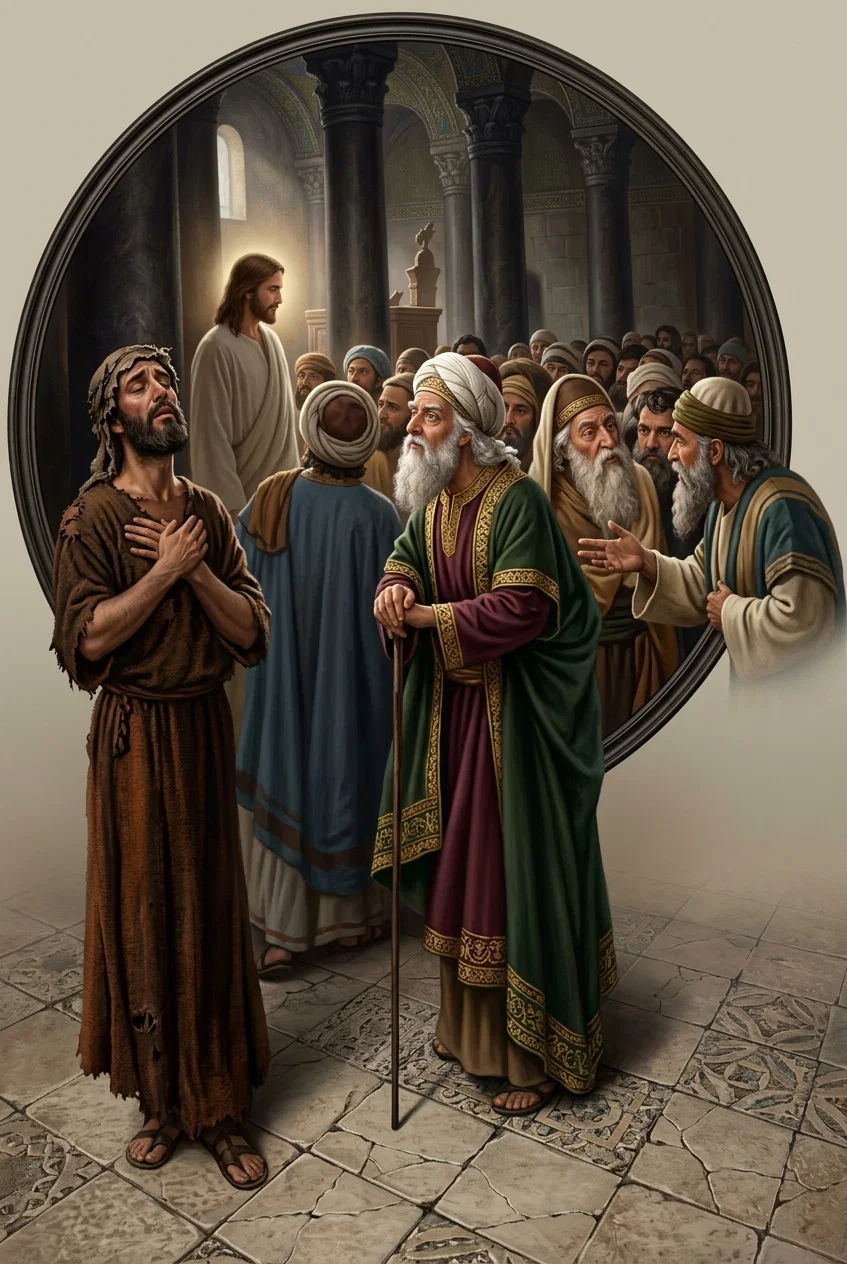
Unto certain which trusted in themselves that they were righteous, and despised others (Luke 18:9), Christ spoke the parable of the Pharisee and the publican. The Pharisee goes up to the temple to worship, not because he feels that he is a sinner in need of pardon, but because he thinks himself righteous, and hopes to win commendation. His worship he regards as an act of merit that will recommend him to God. At the same time it will give the people a high opinion of his piety. He hopes to secure favor with both God and man. His worship is prompted by self-interest.
And he is full of self-praise. He looks it, he walks it, he prays it. Drawing apart from others as if to say, “Come not near to me; for I am holier than thou” (Isa. 65:5), he stands and prays “with himself.” Wholly self-satisfied, he thinks that God and men regard him with the same complacency.

SECRET OF HIS SELF-SATISFACTION

“God, I thank thee,” he says, “that I am not as other men are, extortioners, unjust, adulterers, or even as this publican.” Luke 18:11. He judges his character, not by the holy character of God, but by the character of other men. His mind is turned away from God to humanity. This is the secret of his self-satisfaction.
He proceeds to recount his good deeds: “I fast twice in the week, I give tithes of all that I possess.” Verse 12. The religion of the Pharisee does not touch the soul. He is not seeking Godlikeness of character, a heart filled with love and mercy. He is satisfied with a religion that has to do only with the outward life. His righteousness is his own,—the fruit of his own works, and judged by a human standard.

COULD NOT EVEN HOPE FOR PITY

The publican had gone to the temple with other worshipers, but he soon drew apart from them, as unworthy to unite in their devotions. “Standing afar off,” he “would not lift up so much as his eyes unto heaven, but smote upon his breast,” in bitter anguish and self-abhorrence. Verse 13. He felt that he had transgressed against God, that he was sinful and polluted. He could not expect even pity from those around him; for they looked upon him with contempt. He knew that he had no merit to commend him to God, and in utter self-despair he cried, “God be merciful to me a sinner.” He did not compare himself with others. Overwhelmed with a sense of guilt, he stood as if alone in God’s presence. His only desire was for pardon and peace, his only plea was the mercy of God. And he was blessed. “I tell you,” Christ said, “this man went down to his house justified rather than the other.” Verse 14.

PETER A LESSON TO BOTH

The Pharisee and the publican represent two great classes into which those who come to worship God are divided. For each of these classes there is a lesson in the history of the apostle Peter. In his early discipleship Peter thought himself strong. Like the Pharisee, in his own estimation he was “not as other men are.” When Christ on the eve of His betrayal forewarned His disciples, “All ye shall be offended because of Me this night,” Peter confidently declared, “Although all shall be offended, yet will not I.” Mark 14:27, 29. Peter did not know his own danger. Self-confidence misled him. He thought himself able to withstand temptation; but in a few short hours the test came, and with cursing and swearing he denied his Lord. When the crowing of the cock reminded him of the words of Christ, surprised and shocked at what he had just done, he turned and looked at his Master. At that moment Christ looked at Peter, and beneath that grieved look, in which compassion and love for him were blended, Peter understood himself. He went out and wept bitterly. That look of Christ’s broke his heart. Peter had come to the turning point, and bitterly did he repent his sin. He was like the publican in his contrition and repentance, and like the publican he found mercy. The look of Christ assured him of pardon. Now his self-confidence was gone. Never again were the old boastful assertions repeated.
Christ after His resurrection thrice tested Peter. “Simon, son of Jonas,” He said, “lovest thou Me more than these?” Peter did not now exalt himself above his brethren. He appealed to the One who could read his heart. “Lord,” he said, “Thou knowest all things; Thou knowest that I love Thee.” John 21:15, 17.

CONFIDENCE IN HIS RESTORATION

Then he received his commission. A work broader and more delicate than had heretofore been his was appointed him. Christ bade him feed the sheep and the lambs. In thus committing to his stewardship the souls for whom the Saviour had laid down His own life, Christ gave to Peter the strongest proof of confidence in his restoration. The once restless, boastful, self-confident disciple had become subdued and contrite. Henceforth he followed his Lord in self-denial and self-sacrifice. He was a partaker of Christ’s sufferings; and when Christ shall sit upon the throne of His glory, Peter will be a partaker in His glory.

THE MOST HOPELESS SIN

The evil that led to Peter’s fall, and that shut out the Pharisee from communion with God, is proving the ruin of thousands to-day. There is nothing so offensive to God, or so dangerous to the human soul, as pride and self-sufficiency. Of all sins it is the most hopeless, the most incurable.
It was necessary for Peter to learn his own defects of character, and his need of the power and grace of Christ. The Lord could not save him from trial, but He could have saved him from defeat. Had Peter been willing to receive Christ’s warning, he would have been watching unto prayer. He would have walked with fear and trembling lest his feet should stumble. And he would have received divine help, so that Satan could not have gained the victory.
The same compassion that reached out to rescue Peter is extended to every soul who has fallen under temptation. Every provision has been made for our infirmities, every encouragement offered us to come to Christ.

LAYING HOLD UPON OMNIPOTENCE

The prayer of the publican was heard because it showed dependence reaching forth to lay hold upon Omnipotence. Self to the publican appeared nothing but shame. Thus it must be seen by all who seek God. By faith—faith that renounces all self-trust—the needy suppliant is to lay hold upon infinite power.
No outward observances can take the place of simple faith and entire renunciation of self. But no man can empty himself of self. We can only consent for Christ to accomplish the work. Then the language of the soul will be, Lord, take my heart; for I cannot give it. It is Thy property. Keep it pure, for I cannot keep it for Thee. Save me in spite of myself, my weak, unchristlike self. Mold me, fashion me, raise me into a pure and holy atmospherewhere the rich current of Thy love can flow through my soul.

THE POWER OUTSIDE OURSELVES

It is not only at the beginning of the Christian life that this renunciation of self is to be made. At every advance step heavenward it is to be renewed. All our good works are dependent on a power outside of ourselves. Therefore there needs to be a continual reaching out of the heart after God, a continual, earnest, heart-breaking confession of sin and humbling of the soul before Him. Only by constant renunciation of self and dependence on Christ can we walk safely.

KINGS SHALL SEE AND ARISE

At every advance step in Christian experience our repentance will deepen. It is to those whom the Lord has forgiven, to those whom He acknowledges as His people, that He says, “Then shall ye remember your own evil ways, and your doings that were not good, and shall loathe yourselves in your own sight.” Eze. 36:31. Again He says, “I will establish My covenant with thee; and thou shalt know that I am the Lord: that thou mayest remember, and be confounded, and never open thy mouth any more because of thy shame, when I am pacified toward thee for all that thou hast done, saith the Lord God.” Eze. 16:62, 63.
Then our lips will not be opened in self-glorification. We shall know that our sufficiency is in Christ alone. We shall make the apostle’s confession our own, “I know that in me (that is, in my flesh,) dwelleth no good thing.” Rom. 7:18. “God forbid that I should glory, save in the cross of our Lord Jesus Christ, by whom the world is crucified unto me, and I unto the world.” Gal. 6:14.
“Thus saith the Lord, the Redeemer of Israel, and His Holy One, to him whom man despiseth, to him whom the nation abhorreth, ... Kings shall see and arise, princes also shall worship, because of the Lord that is faithful, and the Holy One of Israel, and He shall choose thee.” Isa. 49:7.
“For every one that exalteth himself shall be abased; and he that humbleth himself shall be exalted.” Luke 18:14.

Politicians in the Pulpit

We Need the Salvation of the Bible and Not of Politics — Intolerance and Church and State Union Threatened
By S. B. Horton
The following from the Texas Farmers’ Educational and Cooperative Union will be found very interesting reading matter at this time when “National Reformers” are using such strenuous efforts to change the character of our American system of government from the strictly civil to the religious. We commend these spicy paragraphs to the consideration of all concerned.

Political Preachers

“Our attention has been called to a considerable number of ministers who have endeavored to answer from the pulpit and through the press our recent article on ‘political preachers.’ In the communication complained of we were careful to address ourselves only to pulpit politicians. We quote from the offending article:
“We address ourselves exclusively to that coterie of political clergymen who prostitute their high calling by capitalizing their reputation and by lending their occupation to designing politicians.”
“We did not know that there were so many preachers belonging to that class in Texas.
“The vindictive spirit and bitter resentment shown in these replies corroborates the necessity for, and the wisdom of, the challenge we gave the political ministers to return to the pulpit. We want to thank that large body of consecrated ministers who refuse to be lured from the pulpit by the lust of power, for the righteous indignation they feel over the attitude of their associates who have entered the political arena.
“Now that the inflammable material has all exploded and the smoke has cleared away, we will, at the hazard of being tried for heresy, apply ourselves to the remedy, and invite all who desire to preserve the sanctity of the pulpit unsullied, to cooperate in the work.”

The Warning of Our Forefathers

“The difficulty of keeping the preacher in the pulpit is as old as religion. Christ encountered it in the temple when He drove the priests from the bargain counter back to the pulpit. Our Pilgrim Fathers met it when, through the influence of the clergy, a witch court was established at Salem, Massachusetts, in 1692, that precipitated a legal holocaust, threatening to reduce the population to ashes, and which was extinguished by the laymen uniting and forcing the preachers back to the pulpit. Our noble sires anticipated it when they wrote in three constitutions of Texas a paragraph warning the ministry against political activities. In all of these constitutions the following language appeared:
“Ministers of the gospel, being by their profession dedicated to God and the care of souls, ought not to be diverted from the great duties of their functions; therefore, no minister of the gospel or priest of any denomination whatever shall be eligible to the legislature.”

The Embezzlement of Power

“The embezzlement of power on the part of the ministry in the present age reached the zenith of its folly when an ecclesiastical court established a few weeks ago to distribute political patronage was exposed in the now famous McClure case, which will go down to posterity as one of the boldest efforts of the ministry to acquire control of the government in the religious-political history of Texas, and which will shame us in the memory of our children.
“We are hurrying toward a crisis that approaches in intolerance the Spanish Inquisition, which for more than three centuries terrorized the conscience of the people, and it is well for the friends of religion to pause, and consider the distance we have traveled toward a union of church and state.”
“Returning to a discussion of the constitution, it appears that the good behavior of the preachers caused the precaution so wisely taken by our forefathers to be considered unnecessary in making the present constitution; but the ministry has violated this confidence, and we now find political high priests manipulating conventions, ecclesiastical courts assuming jurisdiction over candidates, ministers of the gospel participating in political caucuses, and our pulpits oftentimes loaned to office-seeking politicians to the disgrace of the ministry and the shame of the church.

Preachers Should Be Regulated

“We think a ministerial clause should be written in the present constitution, and suitable legislation enacted rigidly regulating the conduct of political preachers, making it a penal offense for a preacher or a combination of preachers to seek to manipulate political conventions, or endeavor to distribute patronage, and legislation should also be enacted preserving the sanctity of the pulpit from political vandalism.
“How a preacher votes on any subject should be a matter of no concern to the membership, and he should not be encouraged to reveal his political affiliations; but a preacher has no more right to preach his politics to his congregation than a school-teacher has a right to teach his politics to his pupils. No matter how adroitly the minister may approach his subject, nor how well he may fortify his position with precedent and false logic, he can no more preach a political sermon without converting his pulpit into a political rostrum than he could sell intoxicating liquors from the altar without converting the church into a barroom. He can no more purify politics by playing the game than he can sanctify gambling by running a lottery. He will no more control the government without making the state serve the church than any other special interest would control government without making it serve their purpose.”

Salvation Not in the Statute Book

“It is our opinion that when this world is saved, it will be through religious sermons and not through political speeches. Salvation must come to us from the Bible and not from the statute book. It will come through the counsels of consecrated ministers and not from caucuses of political preachers.
“The country is suffering from a negative religion. We think ‘Thou shalt’ is as important a command as ‘Thou shalt not.’ The world never needed a religious ministry more or political preachers less than it does to-day. Our rural civilization is withering for the blessed influence of divine messengers of life. The farmer needs the personal touch of the religious pastor. He seldom comes in direct contact with his hallowed influence except when he is baptized, married, and buried. It is a time-honored custom for our pastors to visit their rural congregations once a month, preach a sermon, take up a collection, eat dinner, and hurry back to the city. We approve it all except hurrying back to the city.”

The Preacher Must Live with Us

“A preacher who will not live with us and share our trials and tribulations can never hope to interpret the life of the farmer or construct Christian character in the community.It is as much a part of the duty of a pastor to inspire us to own a home on earth, as it is to exhort us to build a mansion in the skies; to persuade us to fill the mud-holes in the road from our homes to the church, as to preach of the golden streets of the New Jerusalem; to help us lift the market basket and aid in the solution of our own problems, as it is to convert a heathen or coerce an anti. Let us get our religion from out of the skies and bring it down to mother earth. Give us a religion we can farm by, as well as die by. We know how to vote.”—Fort Worth (Texas) Semi-weekly Record, June 5, 1914.
It is rather unfortunate that the ministry should be served with such a lecture from the laity; but if good can be accomplished through efforts of this character, this rebuke from the farmers will be a blessing in disguise, and the farmers who have thus written may occupy a place equal to that of Aquila and Priscilla, who rendered valuable service to Apollos, “an eloquent man, and mighty in the Scriptures,” expounding “the way of God more perfectly.”

The Inconsistencies of Rome

Teaching Contradictory Doctrines — Yet Claiming Infallibility
By G. W. CAVINESS
LATELY I have been very much interested in reading the Bible in Latin together with the translation into Spanish, by Felipe Scio, of San Miguel, and his notes and comments on the text. This work is authorized and approved by the Catholic Church, so it ought to be good Roman Catholic doctrine.
Almost the first note on the New Testament is on Matthew 1, and is with reference to the genealogy of Christ. He says, “As Jesus Christ came to save sinners, He did not refuse to be born of sinners.” Then he calls attention to the fact that among the ancestors of Christ were a number of bad men and women, some of whom were of another race than the Jews.
This note is in harmony with what the Bible teaches in other places; that is, that Jesus Christ took upon Himself the nature of man, that He was tempted in all points as we are, but that in spite of His human nature, He lived a perfect life, showing that it is possible for human beings to live a holy life here in the world.

CONTRADICTS IT NOW

But the Roman Church, although having approved this teaching, which was written some time ago, now teaches an entirely different and contradictory doctrine. She teaches the immaculate conception of Mary the mother of Jesus. She teaches that Mary was born holy, like Christ Himself, and sinless by nature. If this be true, then Christ was not born of sinners, and did not partake of the sinful nature of man, and could not have been tempted in all points as we are.
There is here an out-and-out contradiction, and both doctrines have been taught and approved by the Church of Rome. She declares herself infallible; but one has only to read the doctrines and teachings of Rome at one time, and compare them with her doctrines and teachings in another age of the world, to see that far from being infallible, she is the most fallible, contradictory, and unreliable church or sect that has ever existed.

BOTH REPUDIATES AND AFFIRMS THE COUNCILS

On reading farther, I came to Matt. 7: 28, 29, “When Jesus had ended these sayings, the people were astonished at His doctrine: for He taught them as one having authority, and not as the scribes.” Commenting on this passage, this Catholic writer said as follows: “The scribes and Pharisees based their teachings and doctrines on the opinions of their great men and teachers of the past, and on the decisions of their councils, and on traditions, which, said He, were purely human. Hence the great difference in their teaching and the teaching of the Greatest, who based His doctrines on the Scriptures.”
If the opinions of learned men and traditions among the Jews were entirely human, it is true also in our time that doctrines based on traditions and the opinions of men and councils are purely human. It is certainly just as true now as it was then; and the Roman Catholic Church, which bases so much, indeed almost all its doctrines and practices, on tradition, and decrees of councils and popes, has no other than a purely human foundation.
The early writers of the Catholic Church understood the matter very well, but those of our time have degenerated very much from first principles.

WHY THEN PRAY FOR THE DEAD?

On Matt. 24: 44, where it says, “Be ye also ready: for in such an hour as ye think not the Son of man cometh,” this learned author says: “This has application primarily to the end of the world, and the signs that are to take place at that time. But for every one, the day of death is uncertain, and every one should take heed and be prepared, that it may not overtake him unprepared; for the condition in which death finds us fixes our destiny forever.” If the destiny of every one is fixed forever at the time of his death, then what can be the use of saying masses for one after he is dead?
The Catholic Church has made a great deal of money by saying masses for the dead in order to get them out of purgatory. In the city of Mexico, after nearly four hundred years, they are still saying masses for the repose of the soul of Cortez, although his destiny was settled at the hour of his death. All these masses have been useless; and indeed from their own action in the matter, it seems that they are not of much value, being said for such a length of time, and still going on without end.
Cortez left some property, with the proviso that the interest on it should be spent for masses for the repose of his soul. I suppose that as long as the property lasts, masses will continue. But certainly Cortez will be no better because of them; for the Bible says that the prayer of him who turns away his ear from hearing the law, is an abomination to God. Prov. 28: 9.

WAS RIGHT ON BAPTISM

In his comment on Acts 8, the Catholic translator says that during the time of the apostles, and for a long time afterwards, baptism was administered by immersion only.
It is a fact that many of the early writers of the Catholic Church explained the Scriptures just as we do now. In later time they have gone far away from the truth as taught in the early church. A wonder is that a church which claims to be infallible can sanction teachings that are entirely contradictory; but such is the case.
In explaining the prophecies, they take the same position we take with reference to the beasts of Daniel, and say that the little horn of Dan. 7: 25 represents antichrist; but they do not attempt to explain it any further. When they reach that point, apparently they dare not go further.
Certainly there is a reason for this.
Continue reading: The Epistle Written by Christ Himself