DID you ever have the feeling that you wanted to do something really great and good, something so great that, compared with it, all the other actions of your life would appear small and insignificant? Doris Earl had that feeling strong within her one evening as she stood on the porch overlooking the garden.
“I must do something,” she said—yet after all what was there for her to do?
Doris had graduated the year before from the Bridgeport High School. Since then the days had passed on in monotonous regularity, each bringing its daily round of little duties—duties performed most willingly by Doris, but which seemed to have no end.
“If I could only do something different,” she sighed, “something truly great!”
She remembered some words of Charles Kingsley’s she had learned from her mother when a small child: “Make a rule, and pray God to help you keep it, never, if possible, to9lie down at night without being able to say, ‘I have made one human being at least a little wiser, a little happier, or a little better this day.’ You will find it easier than you think, and pleasanter.”
Doris brought back that day before her mind. How had she spent it? She had weeded the flower garden for her mother and helped her to prepare dinner. The afternoon had been spent in mending for her two small brothers. She sighed regretfully. “No, I can never do anything great. My whole life will be made up of just such days as this has been.”
She looked across the road and saw a very small child struggling to free the wheel of a baby carriage from a crack in the walk. Mechanically she crossed over to help the little lad. As she went toward him, she picked two roses from their leafy bush, and these she handed to the blue-eyed baby in the buggy.
The child laughed gleefully, and the little boy trudged away, while Doris walked back to the porch and began again her dissatisfied longings.
In a moment she was interrupted by the opening of the gate. Mr. Merton, the clergyman, came up the path, and heartily shook Doris’ hand.
“Mother is not at home, Mr. Merton; but sit here and rest—you must be tired from your long walk.”
The old man sat down. “Well, Doris, and how have you spent your summer day?”
“I have done nothing at all to-day, Mr. Merton, I mean nothing save what I do every day;” and Doris smiled a little sadly. “There has been the housework and mending for the boys. But that does not count, you know.”
The old man looked somewhat puzzled. “Does not count? What do you mean, Doris? Why do you think mending and housework do not count?”
“I wonder,” thought Doris, “if I shall tell him? Perhaps—who knows?—Mr. Merton might really know of something I could do—something really great.”
So she told him—told him all, in her girlish way, her hopes and fears, aspirations and longings.
“I have never done anything, you see, Mr. Merton,” she said, “and all my days are spent the same way. If only”—and here she clasped her hands together—“if only I could do something really great!”
All this time Mr. Merton sat quietly listening. When she had finished, he took the hand which lay nearest him and looked thoughtfully a moment at the little forefinger, so pricked and roughened by the needles. And when he spoke it was in the most loving way.
“When I was a boy, Doris,” he said, “I once asked my mother the same question you now ask me—how to do something truly great? I had been raking the grass all the morning, and was very tired of work of that kind. I wanted something new. My mother said to me then—”
“Do what a great man once said to do—a man whose small acts of kindness crowned his whole life with a noble end: “Begin with small things—you cannot enter into the presence of another human being without finding there more to do than you or I or any soul will ever learn to do perfectly before we die. Let us be content to do little things, if God sets us little tasks. It is but pride and self-will which says, Give me something large to fight and I shall enjoy that—but why make me sweep the dust?””
“We will never have the power to fight great battles, Doris, unless we can first successfully fight the small ones. And when you can do that, be sure God will put the great ones in your path. You say your work to-day has been nothing, and yet as I came down the street, I saw you do a very kind act. Your kindness and attention to those little children should crown this day with happiness. And if you should ask me what kind of a day you have had, I should say, ‘A perfect one.’”
Doris drank in every word. How true were all the things that he said; and how glad she was that she had spoken to him!
After that evening she never sought, as she had done before, for the great battles of life, but was always content, as he had told her, “to sweep the dust.”—Young People’s Weekly.
Waiting for a Perfect Church
“WHY do you not join the church?” said an aged bishop on the frontier many years ago to one who had talked much and loudly of his interest in such matters. “I would, bishop,” was the reply, “if there were not so many bad men in the church. I am waiting to find a perfect church.” “You will never find it, my young brother,” said the bishop sadly; “for (unless you claim for yourself more than I think you will care to), when you once have joined it, it will cease to be a perfect church.”—Selected.
Moods Are No Excuse in the Family
MANY mean things are done in the family for which moods are put forward as an excuse, when the moods themselves are the most inexcusable things of all. A man or woman has no moral right to indulge in an unpleasant mood.—Selected.
THE RESURRECTION.
[In the course of his wanderings among the pyramids of Egypt, Lord Lindsay, the celebrated English traveler, accidentally came across a mummy, the inscription upon which proved to be at least two thousand years old. In examining the mummy after it was carefully unwrapped, he found in one of its inclosed hands a small root. Wondering how long vegetable life could last, he took the little bulb from that closed hand and planted it in a sunny soil, allowed the dew and rains of heaven to descend upon it, and in course of time, a few weeks, to his astonishment and joy, that root burst forth and bloomed into a beautiful flower. This interesting incident suggested to Mrs. S. H. Bradford, an American poetess, the following thoughts upon the resurrection.]
Two THOUSAND years ago a flower
Bloomed lightly in a far-off land;
Two thousand years ago its seed
Was placed within a dead man’s hand.
Before the Saviour came to earth,
That man had lived and loved and died,
And even in that far-off time
The flower had spread its perfume wide.
Suns rose and set; years came and went;
The dead hand kept its treasure well.
Nations were born and turned to dust,
While life was hidden in that shell.
The shriveled hand is robbed at last,
The seed is buried in the earth;
When, lo, the life long hidden there
Into a glorious flower burst forth!
Just such a plant as that which grew
From such a seed when buried low,
Just such a flower in Egypt bloomed,
And died, two thousand years ago.
And will not He who watched the seed,
And kept the life within the shell,
When those He loves are laid to rest,
Watch o’er their buried dust as well?
And will not He from ’neath the sod
Cause something glorious to arise?—
Aye, though it sleep two thousand years,
Yet all that buried dust shall rise.
Just such a face as greets you now,
Just such a form as here we bear,
Only more glorious far, will rise
To meet the Saviour in the air.
Then will I lay me down in peace
When called to leave this vale of tears,
For “in my flesh shall I see God,”
E’en though I sleep two thousand years.
—Church Union.
Children's Bedtime Hour.
By J. M. P. Otts
BY J. M. P. OTTS, D.D.
Children should be put to bed early, for plentiful and peaceful sleep is a good medicine for soul and body, both for young and old. The mother, if possible, should be with her children during the last hour before they fall asleep. They will then listen with hushed attention to whatever is told, or read, or sung to them, and the words spoken with the good-night kiss will sleep with them and be whispered again in their dreams. That is the hour for mothers to impress upon their plastic nature the thoughts which they wish them to remember longest. Every mother who has formed the habit of reading, talking, and singing to her children after they have been tucked away in their little beds, will bear joyful witness to the value of this form of maternal influence. In that hallowed hour all the little wrong deeds and irritations of the day can be talked over most quietly, and smoothed out most sweetly; and the duties of children to their parents, and to one another, can be presented in their most attractive forms. But care must be taken that these talks with the children immediately before sleep do not take the form of preaching. It should be a cheerful, laughing talk, or at least a talk that will cover their little faces with smiles.
Let your child always go to sleep with a glad thought in its heart and a smile on its face. The next morning, as it springs from its bed, the glad thought will burst out in songs, and the smiles in shouts of laughter. If a wrong has to be reproved, let the child be assured of forgiveness, and let the mother be assured that forgiveness is accepted, before the eyes shall close. Let the child fall asleep loving all and assured of the love of all. Then, after the little prayer has been said, the child, at peace with all on earth and with the smile of heaven’s love on its face, will drop away into peaceful slumber with its soul all unruffled and unsoiled, as white and smooth as a freshly washed and ironed piece of snow-white linen.
It is always a solemn thing to fall asleep. We can never know where the waking may find us. Any night the rosy child or the healthful mother may sleep into the sleep of death. Then always let the good-night kiss be accompanied with a word of peace, a word of love, and sweet tranquillity. It is a piece of downright cruelty, one of the crimes which law cannot reach, for a thoughtless and fretful mother to scold her children away from her presence at night, and to drive them to bed with sharp and angry words. Of all the sad sounds ever heard in this sorrowful world of ours, the saddest is the suppressed sob of a little child, the smothered cry of a wounded heart, coming from beneath the bedclothes, as it weeps itself to sleep because of a mother’s unkindness.
The mother may be work-worn and weary, and the children may be tired and cross, but let no mother ever so far forget herself as to lead her children to forget that she is their mother. Let her remember that not only her words, but the tones in which they are spoken, will, at that most solemn moment, make the deepest and most lasting impressions on their tender souls, and that they may determine their weal or woe for eternity.—At a Mother’s Knee.
AMPLE BREATHING.
By J. H. Hanaford
BY DR. J. H. HANAFORD.
FROM the abundant supply of air—a vast ocean surrounding the earth with a great depth—we may reasonably infer that free breathing is of much importance. This importance will be very much enhanced by considering the varied forces constantly at work effecting its repeated purification, it being rendered impure by the breathing of all living creatures, by combustion, decay, etc. Students who lead a comparatively inactive life should be on their guard against the effect of breathing poisoned air, in rooms closed so much of the time, since the great object of breathing is the purification of the blood. This purification requires a constant and free use of pure air, admitted to the room by ample ventilation, by day and by night. Students ought to be too intelligent to believe the popular idea that night air is poisonous, unless it is made so by constant breathing and a limited supply from the outer world. When the mind seems sluggish, dormant, the mental vision dimmed, when there is an inability to concentrate on any one topic continuously, it is quite certain that either the air is impure, or that the stomach is much deranged, more or less filled with undigested food, or that such food is passing through the process of decay. In either case, a brisk walk in the open air, or some active exercise for a half hour, will prove advantageous, with no actual loss of time, since the revitalized mind will so act as to compensate for the time thus used. If such mental dimness is caused by a deranged stomach, overtaxed by an excess of food, the remedy is plain,—not to take medicine to improve the appetite, since that is already too good, demanding more food than the digestive organs can well dispose of, leaving a portion undigested. The surest remedy is taking less food,—temporary fasting.
—Spelman Messenger.
DIME NOVELS IN GERMANY.
The “Penny Dreadful” is not unknown, as it seems, in Germany, where it bears the characteristic title of “Shudder Romance.” It is not sold in the shops, but is carried about from street to street and village to village by an army of colporters. The Berlin Tägliche Rundschau asserts that there are no fewer than “forty-three thousand ‘Shudder Romance’ colporters,” who earn their bread by the sale of the weekly numbers of these novels in Germany and Austria. It estimates the regular subscribers at about twenty million. These novels of crime and horror are not complete in one number, as are the penny novelettes of this country, but usually run to about one hundred and fifty weekly numbers, and rarely conclude in less space than one hundred numbers.—Chicago Herald.
FIRE EXTINGUISHER.
THIS seems worth bearing in mind and having on hand. A Georgia physician writes to the Constitution, of Atlanta, that the solution used in the hand grenades now offered so extensively for sale is easily and cheaply made by taking twenty pounds of common salt, ten pounds of sal ammoniac (muriate of ammonia, to be had of any druggist), and dissolving in seven gallons of water. When dissolved it can be bottled and kept in each room in the house. In case of a fire one or two bottles should be thrown with force into the burning place, hard enough to break them, and the fire will certainly be extinguished.—Christian Work.
KHAMA, THE CHRISTIAN CHIEF.
The name of this African chieftain ought to be known wherever virtue and nobleness of character are reverenced. By common consent he would be regarded as one of the most remarkable Africans of modern times. All travelers, as well as missionaries, speak of him in the highest terms, and the British “Blue Books,” containing the reports of high officials in Africa, are lavish in their praise. One of the best accounts of Khama is that given by the wife of Bishop Knight-Bruce, who visited his former capital of Shoshong. From this and other sources we gather the story of his remarkable life.
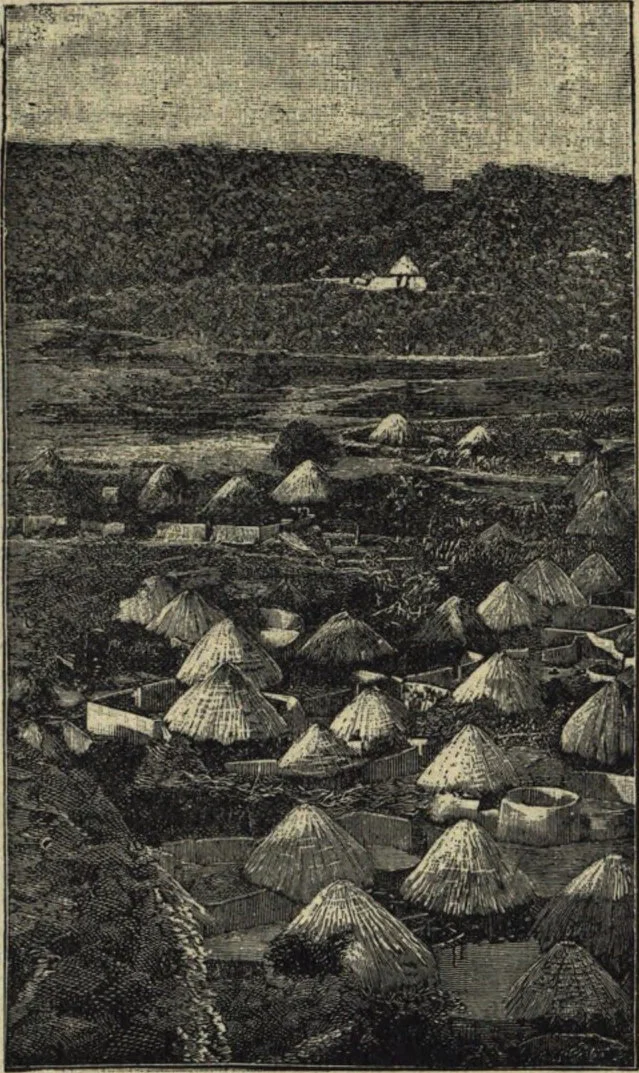
A Matabele Village.
Khama was born about 1830, the son of Sekhome, chief of the Bamangwatos. In early life he came under the influence of missionaries of the London Missionary Society, and he heartily accepted the Christian faith, and was baptized when a boy in his teens. While he was yet a youth, word was brought that the Matabele, that great fighting tribe, were about to make an attack upon Shoshong. These Matabele were always the terror of the Bamangwatos until the recent overthrow of the tribe by the British forces and the death of Lobengula, their chief. At the time of the threatened attack, when Khama was a young man, Sekhome, after sending the wives and children into the caves among the hills, turned for aid to the witch doctors, but Khama would have nothing to do with their incantations. He knelt in prayer with other Christians and asked permission to attack the Matabele. Consent was given, and in the assault he showed such skill and valor that on his return the old warrior chief, Moselekatse, said: “Khama is a man. There is no other man among the Bamangwato.” The people at Shoshong welcomed Khama with a shout, “To-day those who pray to God are our leaders.”
Khama was obliged early to take his stand against many heathen customs of his tribe. He would not join in the customary raids for cattle; neither would he celebrate the heathen rites to which all fathers took their sons. But his special trial with his father was concerning the taking of a second wife. He had married Mabisa, a plain Christian woman, and Sekhome ordered him to take another wife. Khama indignantly refused, and the contest on this matter went on for a number of years. Khama’s answer was: “I refuse on account of the word of God. Lay the hardest tasks upon me as to hunting elephants for ivory, or any service you can think of, as a token of my obedience, but I cannot take another wife.” Sekhome was furious. He devised all manner of plots against his son. At last, taking some men to Khama’s hut, where he was asleep, he ordered the men to kill him. When they refused, Sekhome tried to do the terrible deed himself, but his followers disarmed him. The people arose to the defense of Khama, and Sekhome was obliged to flee from his angry subjects. But Khama sent for him and brought him back, treating him with every mark of respect, and giving him his place as chief.
Later on Sekhome broke all his promises and succeeded in arousing the superstitious fears of the people lest “the spirits” should destroy them, since they had forsaken the customs of their fathers. The result was that Khama was obliged to flee for his life, with a few followers. His experiences were much like those of David as he fled before Saul. Sekhome cut off all food supplies, and poisoned their one spring of water, yet when one of Khama’s followers, thinking to please him, stole a horse belonging to Sekhome, Khama was greatly displeased, and sent back the horse at once, with a message of regret.
At length Sekhome died and Khama succeeded to the chieftaincy. But he was not without trials. One of his brothers plotted against him, and gave him no end of trouble, specially in view of the fact that Khama sought to introduce great reforms among his people. He utterly forbade witchcraft, wholly suppressing the witch doctors. All through Africa there is the strongest faith in the power of these witch doctors, who were believed to be able to detect evil spirits that are dwelling in men, and who profess to “smell out” these spirits. Khama also utterly forbade certain common practices, such as the killing of children born weakly or deformed, the burying of the living baby with its dead mother, destroying one of twin children, leaving the useless old people to starve, and the right of a man to kill his wife in any petty quarrel.
But the greatest reform, and the hardest to bring about, was in the matter of temperance. The Bamangwatos, like most African tribes, are great lovers of beer, and give themselves up to beer parties and drunkenness. Khama entirely forbade the making or drinking of this beer. The people were restless under this restraint. Khama afterward said, “I withstood my people at the risk of my life.” And when some good people suggested to him that his measures were too stringent, he said, “Beer is the source of all quarrels and disputes, and I will stop it.” The greatest difficulty he experienced in carrying out these temperance principles was in connection with the traders. He could control his own people, but the white men were persistent, and his conflict with them was long and fierce. The following extract from a remarkable letter sent by Khama to the English administrator in South Africa, presents his complaints against certain worthless and unscrupulous men, who had, as he says, “come outside of all government, and flood my country with their drink, after all the long struggle I have made against it, withstanding my people at the risk of my life, and just when they have themselves come to see how great a salvation my drink laws have proved to be. It were better for me that I should lose my country than that it should be flooded with drink. . . . I fear Lobengula [the Matebele chief] less than I fear brandy. I fought Lobengula and drove him back, and he never came again, and God, who helped me then, would help me again. Lobengula never gives me a sleepless night. But to fight against drink is to fight against demons and not against men. I dread the white man’s drink more than the assegais of the Matebele, which kill men’s bodies, and is quickly over; but drink puts devils into men, and destroys both souls and bodies forever. Its wounds never heal. I pray your honor never to ask me to open even a little door to the drink.”
Khama is now paramount chief over the whole Bamangwato tribe. Five years ago, after having established his authority, he undertook an enterprise which was one of the most remarkable on the records of Africa. The Bamangwato town of Shoshong was unfortunately situated. It was dirty and ill-built. The land was not good, and the springs had dried up. Khama determined to remove to a better place. They chose a site named Palapye, sixty miles to the northwest of Shoshong, where there was good soil and an ample water supply. Every arrangement was made for moving with the utmost system, and in fifteen months from the time that Khama gave the order to remove, Palapye rose from nothing to a city of 30,000 inhabitants, with broad avenues and a fine central square. A writer who has visited the place says: “If we remember that this marvelous work, the exodus from Shoshong and the rehousing at Palapye, was a work carried out by a native chief himself, without the slightest European assistance, we shall admit that Khama’s fine city of Palapye is one of the most wondrous cities under the sun.”11
There are ten great divisions in the town, each having a large airy schoolroom, and in these schools the Bible is taught by native schoolmasters, trained by the missionaries. The writer just quoted says of the peace, security, and good order of the town, that “Khama as a native ruler is as wonderful as is Palapye as a native town.” The best site was reserved for the church and the missionary, and the people raised $15,000, with which they built a large and handsome sanctuary, which was dedicated Aug. 28, 1892. Before this was completed, they worshiped on the hillside, great congregations, numbering some 2,000, gathering at sunrise every Sunday morning. The missionary, Mr. Hepburn, and his assistants held services in the afternoon, also, in various parts of the town. At the morning service Khama himself often gave sound, practical addresses, telling the people of their duties, and warning them against their sins, pointing out to them in straitest fashion what men and women Christ would have them be.—Missionary Herald.
GO, LABOR ON.
By Horatius Bonar
Go, LABOR on, while yet ’tis day;
The world’s dark night is hastening on;
Speed, speed thy work,—cast sloth away.
It is not thus that souls are won.
Men die in darkness at your side
Without a hope to cheer the tomb;
Take up the torch and wave it wide—
The torch that lights time’s thickest gloom.
Toil on, faint not, keep watch, and pray.
Be wise the erring soul to win;
Go forth into the world’s highway,
Compel the wanderer to come in.
Go, labor on; your hands are weak,
Your knees are faint, your soul cast down,
Yet falter not; the prize you seek
Is near,—a kingdom and a crown.
—Horatius Bonar.
BASEL CONTINUES TO PERSECUTE FOR CONSCIENCE’ SAKE.
By W. H. M’Kee
BY W. H. M’KEE.
DURING a portion of the months of October and November of this last fall, the authorities of the city of Basel, Switzerland, imprisoned Henry P. Holser, pastor of the Seventh-day Adventist Church, and manager of the publishing house of the denomination, in that city. The imprisonment was because of work done in the denominational publishing house on Sunday.
The law used to secure this imprisonment was the factory law, the intention of which is to secure a rest of one day in the week to the employees in manufacturing establishments. The law is declared by its interpreters to have no religious significance, but to be intended solely for the good of the laboring class; yet it was here used in an attempt to deprive a company of inoffensive working people of the results of labor for one day in the week. Those who invoked the law knew well that these people could not work on the seventh day, and they deliberately used it when they knew that by so doing they were attempting to restrict them to five days’ labor per week. Such a course and such a claim is deliberate self-stultification, yet is persistently continued.
Mr. Holser served a term of twenty-one days in the Basel prison. There is a fine of 200 francs still standing against him, which he will not pay, as to do so would be a virtual acknowledgment of the justice of the penalty. This must yet be served out in prison, which means forty days more. He is now in Battle Creek, Michigan, attending the General Conference of Seventh-day Adventists. He goes there as representative of the Central European Conference of the denomination. It is his intention, and it is expected, that he will return in the spring. When he left Basel for the United States, he placed no one in charge of the business of the publishing house, but simply arranged the work to be done, and told the employees that the house was always open to its laborers six days in the week. In consequence of the action of the authorities, the presses had already been stopped entirely, and all the press-work hired to job presses in the city. This12consists of three papers, and religious tracts and books, which the house is continually issuing. All the work done in the house is therefore of the most quiet nature,—such as typesetting,—and it would not be possible to know that labor was being done there at any time except by watching to see the workers quietly come and go morning and evening, or by actual inquiry. On January 23 the following letter was received from the Police Department:—
THE DEPARTMENT OF THE INTERIOR,
Canton Basel.
To the Imprimerie Polyglotte, Basel—
The federal factory inspector informs us that you work regularly on Sunday. As you well know, work on Sunday is forbidden by article 14 of the factory law. Now that you have already suffered the legal penalty for violation of this before-mentioned law, we are prompted to warn you against further repetition, for, according to the second paragraph of article 19 of the factory laws, besides appropriate fine, imprisonment also for three months may be affixed. Therefore we shall direct the Police Department to give special attention as to the observance of the Sunday rest in your business. Respectfully,
Chief of the Department of the Interior,
PHILIPPI.
The following Sunday the house was carefully watched by a policeman in citizen’s clothes, and the workers who left in the evening were questioned as to whether they had been at work, and their names taken. The information asked was given in every instance without hesitation.
During the week the police called at the office and held a conversation with the bookkeeper, Mr. Henri Revilly. According to the terms of the factory law, the manager alone is made responsible for the infringement of the Sunday law by factory labor. There is no one in charge of the Imprimerie Polyglotte, and no person other than the absent manager has any authority more than another, or is responsible for anything more than his or her individual work. The bookkeeper, Mr. Revilly, stands precisely on the same footing as the other employees, yet the police have told him that he will be held responsible, individually. He has been summoned to appear on Friday, February 15, before the Basel police court, to answer to a charge, upon which the authorities have threatened him with three months’ possible imprisonment. He has addressed the following letter, involving mainly the civil and personal application of this case, to the Department of the Interior, and to the representative in the National Assembly, from his Canton of Vaud:—
MONSIEUR PHILIPPI, Chief of the Department of the Interior, Basel:
The Imprimerie Polyglotte has received your letter of January 23. Unfortunately, your advice cannot be followed, for the two following reasons: (1) The director of the establishment, Mr. Holser, is at this moment in the United States, where he represents the Adventists of Central Europe at an assembly of the General Conference of the denomination. The undersigned occupies the position of bookkeeper and clerk, and consequently has no direction of the affairs of the house. He works by the hour, as well as the other employees, and has nothing to say in questions of this kind. Mr. Holser said to the workers repeatedly: “The house is open to you every Sunday. You can come to work or you can rest.” Accordingly, then, even if I wished, I could not hinder the workers from laboring on Sunday. (2) You know that the operators are Seventh-day Adventists; they rest on the Sabbath, consecrating that day to God. There are none of independent income among us. Each one must work his ten hours daily if he is to honorably make both ends meet. It is consequently impossible for us employees to rest two days. Besides this, our work is of such a character that it cannot be done outside of the establishment. These are some of the reasons because of which we work, notwithstanding the penalties endured. In this there is no sectarian pride or blind resistance. As a result of our last difficulty we have transferred our printing work, and now have it done elsewhere. We naturally have had to dismiss our pressman, a father of a family, and subject to military duty, who has to struggle for his living under great difficulties, doing jobwork with a small pedal press. No noisy work is done by us either on Sunday or during the week. In consequence we expected to have been at last left in peace, and probably would have been, except for the factory inspector.
We, workers of the Imprimerie Polyglotte, believe firmly that the Executive Council of the Canton of Basel can permit us to earn our living peacefully if it wishes. The proper-minded people do not ask that we should be oppressed in the name of an intentionally philanthropic law. Mr. Cornaz, judge of the federal court, said in a sitting of that court, “In principle the Adventists are right, and the police of Basel [he should have said the Executive Council of Basel] should have known how to shut one eye in the matter.” These are the words of a guardian of the law, and also of many others who have no special sympathy for our religious views.
In consideration of these facts, the undersigned feels impelled to make known to you what may be the results of the enforcement of these measures against us. They are simple, but serious:—
1. If the court does not accept my statements, and persists in considering me the responsible representative of Mr. Holser, I will receive the penalty of several weeks or even three months’ imprisonment, and this might bring serious results upon my young wife, who is in a critical state of health.
2. A dozen poor and respectable families will find themselves, so to speak, upon the street, for if Sunday observers find it so difficult to obtain employment, how can you expect observers of the Sabbath to find work among those who do not sympathize with them.
I am sure that my Saviour and Lord will not permit these things to go any farther than is necessary; he will preserve us from need; nevertheless the responsibility will rest with those in authority, who could have spared us these trials. I hope, however, that it will not go so far for a mere technical transgression of an unconstitutional clause in the federal factory law.
“Inasmuch as ye have done it unto one of the least of these My brethren, ye have done it unto Me.” Matt. 25: 40, 45.
Mr. Revilly will plead his own case before the court.
Basel, Feb. 12, 1895.
The Cost of a Mohammedan’s Conversion.
Dr. Baumann, of Benares, India, sends to the Church Missionary Intelligencer a striking account of the conversion of a prominent young man, named Dilawar Masih, who was early trained in Moslem theology. He had learned portions of the Koran by heart. He first joined the Sunnis, but, shocked by the conduct of his fellow-believers, he joined the sect of the Shiahs, yet found among them no purer companions. He was greatly distressed because of his own sins, and was seeking earnestly for peace of soul. At this time a copy of the New Testament in Urdu fell into his hands, and he had no sooner finished reading the precious volume than he told his father that Christ had a higher claim on man than had Mohammed. His father besought him, though he might secretly serve Christ, to remain a Mohammedan outwardly. This was against his conscience, and he sought Christian instruction. The Maulvis reasoned with him, and protracted discussions were held, but the more they reasoned the more he became convinced of the truth of the Gospel.
When he announced to his venerable and beloved father his intention of joining the Christian church, the effect was terrible. The poor man, overwhelmed with grief, lost all self-control, and, prostrating himself again and again before his son, and weeping incessantly, tried what he could to shake the young man’s constancy. One morning before dawn I was awakened and told that the inquirer was at the door, urgently desiring to see me. Dilawar, whose eyes were red and swollen, told me with a choked voice that his father was quite unmanned by his resolve to be baptized, and refused to be comforted. “O, the persecution of tears! I could bear beating and being sold into slavery, but my father’s tears are hard to bear.”
On the day on which Dilawar and his wife were to be baptized their children were snatched from them and hidden away, and violent efforts were made to hinder them from receiving the ordinance. They were obliged to leave their homes under cover of night, taking nothing except the clothes they had upon them. When the public baptism took place, the church was surrounded by crowds of Mohammedans, many being within the walls, but there was no disturbance. After the service Dilawar was accosted by one of his friends, a secret believer, who said: “Well done, brother! I wish I had your courage.”
CHINESE RELIGIONS AND TEMPLES.
By A. H. Smith
BY REV. A. H. SMITH.
ALL the gods of China may be said to have been dead men, and by the rite of ancestral worship it may be affirmed that in a sense all the dead men of China are gods. Temples are constantly erected by the consent of the emperor to men who while living had in various ways distinguished themselves. It is impossible to say that any one of these men may not in the slow evolution of ages rise to the highest place among the national divinities. There can be no doubt whatever that, as a nation, the Chinese are polytheistic. There is also the worship of nature. Temples to the gods of wind, thunder, stars, sun, and moon abound. Any kind of a divinity which seems adapted to exert a favorable influence in any given direction will be patronized.
There is a union of all beliefs. The same individual is frequently a Confucianist, a Buddhist, and a Taoist. Buddhism swallowed Taoism; Taoism swallowed Confucianism; but at last the latter swallowed both Buddhism and Taoism together.
A significant result of the union of all beliefs in China is the debasement of man's moral nature to the lowest level found in any of the creeds. This is in accordance with a law akin to that by which a baser currency invariably displaces that which is better. All the lofty maxims of Confucianism have been wholly ineffective in guarding the Confucianists from fear of the goblins and devils which figure so largely in Taoism. It has often been remarked, and with every appearance of truth, that there is no other civilized nation in existence which is under such bondage to superstition and credulity as the Chinese. Wealthy merchants and learned scholars are not ashamed to be seen, on the two days of the month set apart for that purpose, worshiping the fox, the weasel, the hedgehog, the snake, and the rat, all of which in printed placards are styled “Their Excellencies,” and are thought to have an important effect on human destiny.
The question is asked, “What do the Chinese with their gods?” There are two answers: They worship them, and they neglect them. There is much diversity. There are hundreds of square miles in which there is to be seen scarcely a single priest, either Taoist or Buddhist. In these regions you will generally find no women in the temples, and the children are allowed to grow up without the smallest instruction as to the necessity of propitiating the gods. In other parts of China the condition of things is totally different, and the external rites of idolatry are interwoven into the smallest details of the life of each separate day.
To “reverence the gods, but to keep at a distance from them,” was the advice of Confucius. It is not strange, therefore, that his followers at the present day consider respectful neglect to be the most prudent treatment for the multitudinous and incongruous divinities in the Chinese pantheon. One step beyond respectful neglect of the gods is ceremonial reverence, which consists in performing a certain routine in a certain way, with no other thought than that of securing certain external results by so doing. . . .
In China polytheism and atheism are more or less consciously held for true by multitudes of educated Chinese, and with no sense of contradiction. Its absolute indifference to the profoundest spiritual truths in the nature of man is the most melancholy characteristic of the Chinese mind—its ready acceptance of a body without a soul, of a soul without a spirit, of a spirit without a life, of a cosmos without a cause, a universe without a God.—Gospel in All Lands.
THE PRAYER DENIED.
By H. E. B.
I ASKED the Lord that I might be
A beacon light for all to see,
A shining influence from afar,
A bright and heavenward-guiding star.
Instead, he hedged my way around;
He led my feet to lowly ground;
He shut me in where none could see,
And gave this humblest work to me.
Yet dare I not repine or sigh;
I guess his wise and loving “why;”
Each day I work, each hour I live,
Thanks for my prayer denied I give;
The wisdom of his choice I trace,
And bless him for my lowly place.