The Influence of Puritan Religious Legislation Upon Subsequent Christianity.
By T. J. Van Horn
[Conclusion of a thesis by T. J. Van Horn of the University of Chicago.]
It remains to consider—
Third—The influence of puritanism on nineteenth century Christianity.
1st. Much of the rationalistic and skeptical tendencies prevalent in nineteenth century Christianity were set in motion by the inconsistencies in Puritan legislation. The fact that they made an unwarrantable use of the Bible in civil matters, their unfortunate theory that the Old Testament theocracy was the form of government for all people, at all times, and in all grades of development, this literalistic and rigid interpretation of all parts of the Bible, led to the opposite extreme in all these particulars. The influence of the Bible over the thought and lives of men has, consequently, been weakened and its authority questioned. Ellis, in his “Puritan Age in Massachusetts,” has unconsciously furnished an illustration of this fact. He has made a study of Puritan legislation and exhibits strong tendencies to rationalistic thought. I quote his observation on the Puritan’s conception of the Bible:—
Duty, the object of life, and the Bible, its rule, was their rule. To most of them it was their only book. Buried long in an unknown tongue it came to them with all the freshness of a revelation, producing effects upon them very different from those produced upon a nineteenth century adult reader. We read the Bible in the light of commentators, who have established rules of interpretation well suited to the modern mind. This inconvenient passage is a figure of speech; this monstrous law condemning witches or idolators to death was intended only for a special time; the teachings of the Saviour are not to be taken literally, for our society could not continue under such a construction: but the passages which conform to our ideas of right and propriety, which sustain our theological systems, and which enable us to live the life which is agreeable, whether they are found in the Old or New Testament, in the simple gospels or in the philosophical letters of St. Paul, have no figurative meaning and were meant for all time.
The extreme rationalistic method of treating the Bible, which we can see Mr. Ellis has in mind, in this subtle comparison between the Puritan and the modern system of Bible interpretation, is only a revolt against the stringent, literalistic method of the Puritans which everywhere crops out in their religious legislation. It is but a step from this to the entire repudiation of the Bible as a divinely inspired book, and the Ingersollism of to-day. It has been said that Christianity has suffered more from its professed friends than from its avowed enemies. Who will say that much of the skepticism and infidelity so prevalent in religious thought is a result of undue rigor in doctrine and discipline of the honest but mistaken friends of Christianity? How many of those lost in hopeless skepticism will testify that they were driven from the faith by the sombre and repelling aspects of Calvinistic doctrine and discipline enforced in their childhood home. How many have been all but attracted by the absurdities and inconsistencies read into the Bible by those who have studied it more to prove a doctrine or a theory than to find the truth.
2nd. The influence of Puritan legislation is observed again in the question of amusements which is one of the ever recurring topics in our religious gatherings and in Christian literature. To the Puritan, life was a solemn thing. They tried to impress this view upon all by their laws against popular sports and frowning upon pastimes of all kinds. Christian festivities, dancing about the May-pole on the village-green, were grievous offenses, and gaiety and lightness or any expression of exuberance of spirits, was out of harmony with the grave responsibilities of life. Mr. Gladden’s illustration of a Highlander, walking through the streets of Edinburgh, who reported that he saw, on the Sabbath, men and women walking along the streets and smiling as if they were perfectly happy, and added, “It was an awfu’ sight!” is in point here. Perhaps he is too severe in saying that “Every word otherwise than severely and sadly uttered seemed to pierce like a sword through them. If any man were pleased, their manner was fervently with sighs, to repeat those words of our Saviour Christ, ‘Woe be to you that laugh now, for ye shall lament.’” This severe habit of looking upon life among the Puritans has left an impression upon Christian life and thought still discernible. The minds of men still living are haunted with the unhealthful restraints imposed in childhood against innocent amusement. Is it unfair to assume that the excessive indulgence in amusements among American people is the result of a reaction against unwise methods of restraint used in an earlier day? But even yet the world has not recovered from the feeling that Christianity is a sombre thing.
3rd. Again, turning our attention to the Christianity of to-day, it requires a microscope of no great magnifying power to detect elements of puritanism in our Sunday legislation. Attention has already been called to the fact that the colonial Puritans, no less than the English Puritans, felt especially called upon to protect and defend the sanctity of Sunday, and also that a large part of their legislation was directed to this end. Very early in the history of the Puritan movement in England the Sabbatarian controversy took an important part. The question involved was, whether the Jewish idea of the Sabbath, which they insisted upon, could be transferred to the first day of the week. The argument of Nicholas Bound, however,349turned the tide of popular sentiment in favor of the view that a specific day of the week was not required in the Decalogue, and therefore Sunday might be observed as the Sabbath. A large minority, however, pointed out the inconsistency of this view. How much this fact may have influenced so much legislation to enforce respect for the first day of the week as a sacred day, I will not attempt to say. Certain it is that its influence in our times is evidenced by the laws enacted and printed in the statute books of nearly every State in the Union, and much of the puritanic intolerance has been exhibited in their enforcement.
Much has been said and written in our day to palliate the cruelty which was sometimes inflicted by the Puritans in the enforcement of their laws, as if such a thing were unknown among us. Yet, under the Tennessee Sunday law, four Christian men, in that State, in June of the year 1892, were imprisoned for working on Sunday. Three of these, after having been imprisoned forty-three days, were marched through the streets of Paris in a chain gang, and put to work shoveling on the common highway. Two years before this, R. M. King, whose case was appealed to the Supreme Court of the United States, but suddenly terminated by the death of the defendant, was fined seventy-five dollars and costs for performing his usual farm work on Sunday.
Persecutions from a similar cause have arisen under the Sunday laws of Pennsylvania within recent years. Some of these cases would have aroused even in old Puritan Salem something of the indignation which arose upon the whipping of Obadiah Holmes. The inconsistency of imprisoning the Tennessee Christians for peaceably working their farms on Sunday was made more glaring by a train load of laborers passing, to their work, on successive Sundays, the place where they were imprisoned. In the minds of people disposed to be tolerant, the persecution of these men would seem the more inexcusable, since they were men who conscientiously observed the seventh day of the week as the Sabbath. Especially since the constitution of the State declares that—
All men have a natural and indefeasible right to worship God according to the dictates of their own conscience; that no human authority can, in any case whatever, control or interfere with the rights of conscience, and that no preference shall ever be given by law to any religious establishment or mode of worship.
It would not be difficult to show still further the injustice done to these men, and to point out the inconsistencies involved in the whole question of Sunday legislation. In this review we can learn at least one practical lesson. Shall it not be the old, and yet imperfectly learned lesson of religious liberty? The Puritans groped towards it, but blinded by their narrow and erroneous idea of maintaining, at whatever cost, their control of State, never learned it.
As we have seen, the dogmatism of thought revealed in their legislation; the cynical attitude towards amusements which their enactments engendered; in short, the fundamental error at the root of their legislation tended to break down all religious restraint and the higher idea of true religious liberty was obscured. All can see the fundamental error of the Puritan was in his interference by civil enactment, with that freedom of conscience which he claimed for himself. In the light of their history, the lesson should be plain to us. Yet what we have seen of modern Sunday legislation leads us to ask if nineteenth century Christians have not yet higher ground to reach with reference to liberty of conscience. The lesson seems yet imperfectly learned, that civil legislation cannot enforce respect for any day as a Sabbath; that if that respect is secured at all it must arise from the consciences of men, awakened and quickened by divine truth.
Even if it were wrong to work on Sunday, the Church is only increasing the distance, already too great, between it and the masses, by raising its voice in the name of religion for civil law to enforce rest on that day. “Render therefore unto Caesar the things which are Caesar’s, and unto God the things that are God’s.” It is yet the sacred duty of the Church in the last decade of the nineteenth century to perfect the lesson begun and so imperfectly understood four hundred years ago,—Freedom of conscience and the complete separation of Church and State. To enthrone in the hearts of Christ’s followers the true import of those words of the Great Teacher:—“My kingdom is not of this world; if my kingdom were of this world, then would my servants fight.”
T. J. VAN HORN.
University of Chicago.
It Is Done! They Know It! They Claim It All!
By H. F. Phelps
At the “Episcopal Jubilee” of Cardinal Gibbons, Archbishop Ireland is reported as saying: “The times are solemn. At no time since the establishing of the Christian era did changes so profound and so far-reaching occur.” This is similar to what the National Reformers said concerning the Supreme Court decision,—“This is a Christian Nation.” Of it they said: “It is the weightiest, the noblest, the most tremendously far-reaching in its consequences, of all the utterances of all that sovereign tribunal.” And so it is, and the Catholics recognize it with all the rest. They see all they could ask, and now claim all as their own.
At the reception given to Mgr. Satolli in July last, at St Paul, Hon. C. D. O’Brien in the speech of reception said:—
“We have here a temporal democracy, resembling in its sphere the spiritual democracy of the Church, which recognizes and fosters the spiritual rights of each individual Christian. This is why the Catholic Church is so vigorous and progressive in the United States; . . . you have with you in your work the entire and irresistible force of American public opinion.”
From the standpoint of so-called National Reformers, and all that they are accomplishing, this is so.
They claim the Republic. In regard to the waves of socialism, communism, etc., he said they would be “sustained and driven back by the protecting cordon of American Catholics, who in behalf of their religion and this, their Republic, will ever stand in the forefront of the conflict to receive them.”
They see a union of Church and State. In the reply of Mgr. Satolli, he said: “Your institutions are in accord with the essential spirit of the church and her constitution. In pursuing my mission I find that I am acting out the very essence of your social and political life, and that I can be a good citizen because I am a good Catholic. Hence, I conclude that the Church and the Republic are made for one another and should walk hand in hand.”
This union is just as close as they desire it. At the banquet recently given to Cardinal Gibbons, he said: “Church and State run in parallel lines, with no conflict with each other. The Church elevates the State, and the State protects religion. We would be sorry to see religion and the State any closer than they now are.”
They see an unparalleled growth of the church in this country, under our Constitution, and they know its significance. Mgr. Satolli continued: “Time will show, very soon, I trust, that the church, from the enjoyment of the liberty guaranteed to her in this land, shall make progress such as she has not known in other times and lands. . . . And this mutual benefiting shall be clear evidence to all and in our own days that security for the commonwealth is in friendly contact with the church.” So it will be that this Nation will be an example to other nations in the exalting the papal church to her position where she will say, “I sit a queen, and am no widow, and shall see no sorrow.”
They contemplate these sudden changes in the almost daily events with evident satisfaction. Said Cardinal Gibbons, on the occasion before referred to, “There is no country on earth where the difficult problems of Church and State are so successfully solved as in the United States.”
And they are making the most of the situation, for, according to the Christian Statesman, they are sending missionaries “direct to Protestants and put before them the claims of the church and the need of membership.” According to the Protestant American, which quotes Catholic papers, “Protestants are going over to Rome by the thousand. One bishop reports receiving one hundred, another five hundred, and Cardinal Gibbons says that ten per cent. of all he confirms are Protestant converts.”
If Protestants cannot see as much in these things as Catholics do, it is only because they are stupified by the “wine” or false doctrines of the mother church.
H. F. PHELPS.
The Christian Politicians of Jersey.
By W. H. M.
At a mass meeting of professors of political Christianity held lately in Jersey City it was determined to establish a permanent organization, to be the nucleus of a religious political party. As an earnest of the spirit which is to inspire this new party, and the methods which are to be used, every church in the city was asked to appoint a committee of three; these different committees to unite as one general committee of ways and means by which to advance and enforce commercial, social, and political morals, and secure the passage of such acts by the State legislature as should be desired to this end.
A resolution was framed in the form of a demand upon the Democratic and Republican county and assembly conventions, and a committee of three appointed to present the demand to these bodies. This is the wording of the resolution:—
In a mass meeting representing the Christian sentiment of the county, it was unanimously resolved that we demand the nomination of a candidate for sheriff whose record shall command the support of all good citizens, and who shall be opposed to racetrack gambling, illegal liquor selling, and every other form of public vice, and that we do further demand from candidates for assembly in the several districts that they shall be pledged to the repeal of the vicious legislation of last winter which has disgraced our State.
However just the cause, and whatever350the reason for righteous indignation which this assemblage of professed “Christian voters” may have, and it is very certain they are not entirely unreasonable in their indignation at the legal protection of civil disorder which they have seen among them, still they are not justified, and nothing can justify them, in appearing in a civil matter and demanding to be heard, and to be obeyed, because of their religious profession, or because they represent any religious body, or bodies, as such. The only plea which they can properly make as a ground for requiring a hearing for themselves is their individual citizenship, or that they are regularly authorized to represent citizens as citizens, not as Christians or Mohammedans, or Roman Catholics, or Buddhists, or Presbyterians, or Confucianists, or Methodists, or under any other religious name. To make the demand by virtue of any one of these titles is in fact no more unreasonable in principle than to make it in the name of Christians. The heritage of human rights is equal to each, without distinction, whatever creed he profess, or if he profess no creed. The assumption of superior authority by virtue of some divine privilege is the basis upon which the tyranny of man over his fellows has always rested. Such tyranny can be exercised by a political party as readily as by an imperial despot. Let the promoters of religious politics stop and think whether they are willing to take the responsibility for the results. W. H. M.
The Sabbath Question Discussed in Saratoga.
By F. C. Gilbert
THAT the Sabbath question is the living question of the day, especially among religious denominations and organizations, no one who is in touch with the times and familiar with religious thought, will deny. A few years ago the ministers of various denominations felt quite confident that they could go and enjoy their summer vacation, and, on their return, find their flocks feeding in the same pasture as when they left. They entertained no fears that any one would enter the fold and lead the sheep into any other fields.
But of late years many of these popular shepherds do not feel such perfect security when leaving their flocks for any great length of time, for fear on their return they may discover that some have been induced to stroll in the green pastures of God’s Word, and do not care to return to feed on husks again. And even when the pastors themselves are at ease with their parishes, this great question of the Sabbath and its change comes up for discussion in various ways, both pro and con, among themselves and other non-observers of the seventh-day Sabbath.
A discussion of this nature occurred in Saratoga, N. Y., August 21st, 1893, it being introduced by a prominent first-day Baptist clergyman, who read a paper entitled “The Transference of the Sabbath.” The positions taken by this gentleman with regard to the Sabbath,—that the Sabbath of the Lord, the seventh day, was never changed nor even transferred in any way to the first day,—were clear, sound, and logical. His proof, of positions advocated, was wholly based on the New Testament, and from this book he showed clearly and conclusively that Christ kept the seventh-day Sabbath, not mentioning or intimating one word during all his ministry that it ever would be changed; that the disciples never by word from the Lord nor any other source mentioned the first thing as to the change of day. It was also portrayed vividly that the line of argument followed by the advocates of Sunday as the Sabbath was faulty, worthless, and wholly useless.
The origin of Sunday (Dies Solis) “that wild solar holiday of all pagan times,” was clearly traced to paganism; its embryo first forming among pagans, then receiving life, growth, and strength from the papal church which adopted it as its own; and afterward, being lovingly embraced in the arms of Protestantism, together with many other doctrines and beliefs from the papal hierarchy. The whole of the argument was clear, logical, and quite scholarly,—fearlessly attacking the positions held by Protestants to prove Sunday the Sabbath, showing them to be contradictory and illogical, if not sophistical.
At the close of this paper, the time generally allotted to the five minute speeches for discussion, was wholly given to the Rev. Wilbur F. Crafts, the Sunday cause champion, to talk upon the paper from his side of the question. Instead of discussing the paper as was expected, Mr. Crafts immediately began to attack Seventh-day Adventists and their work, stating that their position in regard to the Sabbath of creation, as being the same as that given at Sinai, is groundless and without Bible proof. That all that they could adduce in favor of seventh-day observance before the Decalogue, was merely inference at the best. He stated it was almost preposterous to entertain the idea, even from the fourth commandment itself, that the seventh day referred to there is the same as our Saturday. We used to tell the people, said he, that we kept the Sabbath in the spirit only, but we have learned by study that we actually keep it in the letter also. Referring to that commandment, he said, if I were to go to an attorney with this document and ask him what the seventh day in it referred to, and suggest it to be the seventh day of the week, he would laugh at the idea and think it ludicrous. He would say, the seventh day referred to is the one after six working days. Hence, said Mr. Crafts, that being correct, we keep the law not only in the spirit, but also in the letter, for after we work six days, beginning with Monday, etc., we get around to the seventh to rest, which, of course, is Sunday.
What vain, specious reasoning! Thus is the Word of God made of none effect by human tradition. Surely this is a fulfillment of the words of the prophet Isaiah concerning those who place no difference between the holy and the profane, and who call darkness light and light darkness. Did Mr. Crafts ever see a calendar or an almanac that began the enumeration of the days of the week with Monday, Tuesday, etc., making Sunday the last day of the week? But this is barely a prelude of denials of Bible truths uttered by this so-called minister of the gospel.
After contradicting himself several times in trying to show the impossibility of any definite seventh day ever being kept, he remarked that a definite seventh day never was known anyhow. And to prove this, he claimed that away back among the ancient Assyrians there were just four weeks and three days lost, and hence no definite seventh day could be kept. This certainly illustrates well the man who dug a pit for his neighbor to fall in, but fell in himself. It seems remarkably strange that just the length of time lost should be known, but no one know whither it went. Therefore it necessarily follows that there was no time lost at all. But perhaps, however, he did not stop to consider the weight which that phraseology would have, providing he could say something to oppose the Lord’s holy day.
That the Lord made the heavens and the earth in six literal days was worse than foolishness,—the height of absurdity, in his estimation. Nay, they were long periods of time, he remarked, the length of which no one knows anything about, and which it is impossible to find out. But we say with Paul of old, “Let God be true and every man a liar.”
In searching after more hay, wood and stubble with which to build up this false structure of a Sabbath, this scholarly(?) divine stated that a Rev. Dr. Wood had lately discovered in the Talmud a statement which showed that Sunday keeping was observed away back in the third century of the Christian Church. Mr. Crafts said he considered it one of the best of arguments to show a Christian recognition of Sunday, in contrast with seventh-day keeping by the Jew, at almost the beginning of the Christian era.
The statement found is, that in the year 230 A. D., the Rabbini warned the Jews against having anything whatever to do with those who observe “Youm Natsroi,” the day of the Nazarene, which indicated that there was a day observed at that time by the followers of the Nazarene different from that held by the Jews.
There is one great difficulty about this “best of arguments” against the Sunday advocates, to their injury. It proves too much, and is therefore worthless to them as an argument. If this statement be in the Talmud, which I have never discovered after years of research in the original Hebrew, it demonstrates very clearly that the Rabbini wished the Jews to understand that if this Nazarene who claimed to be the Messiah told his followers to observe another day other than that which God declared to be his holy day (the seventh day, Saturday), then it was certain that that being could not have been the Messiah of God, and hence the Jews should have no confidence in him, his day, nor in his followers. For the Jew has always believed that when the Lord has once given a command he does not change it, for God is unchangeable. Mal. 3:6. Therefore the Talmudists would have a good and sensible reason for telling the Jews to have nothing whatever to do with those who observed this day. They could not have been the true children of God, but must have been apostates.
But I would like to ask Mr. Crafts, before he makes another statement in the Hebrew tongue, to be either more familiar with the language, or, if he be at home in that tongue, to express his terms correctly. For there is no such word in the Hebrew language as Natsroi, meaning Nazarene. The word for Nazarene in the Hebrew is * (Nazer), and the term “Day of Nazarene” is Youm Hānazer, or Hā Youm Nazer.
But that which seemed to cap the climax of his argument was the spirit he manifested toward Seventh-day Adventists.351He said it was an admitted fact that there are 26,000 Seventh-day Adventists in this country, and all of them ignorant; not one educated man among them. There are 10,000 Seventh-day Baptists in this country, and among them only one really educated man, and he, Dr. Lewis. Can it be possible, said he, that on the one hand all the learned, scholarly, educated, cultured, philosophical, etc., throughout Christendom should be wrong on this question, and these few ignorant Seventh-day people have the truth and be correct? Such an idea is preposterous!
To this unchristian statement of Mr. Crafts, Dr. Hiscox, the author of the paper read, said (pointing directly at Mr. Crafts): “When you talked about those ignorant Seventh-day Adventists, a slight indignation arose within me, and it cut, yes, deep, within my heart. It is as possible for ignorant men to be right and have the truth as it is possible for learned and wise men to be in error; and even such wise men as you and I may make mistakes, as doubtless we have done today. God teaches ignorant men the truth, not always revealing it to the wise.”
He also said that the acknowledgment that the Seventh-day Adventists had the burden of Bible proof on their side of the question, was certainly very advantageous to them, for they most assuredly had the benefit of the doubt, if there be any doubt. After a few other remarks made in continuation of the truths stated in his paper, to which Mr. Crafts never even referred, the meeting adjourned for the day.
By the appearance and actions of many of the audience who were present, it was very apparent that all the truth uttered in the paper read was not accepted, and by some quite a little of the dragonic spirit was manifested.
Thus once more did the Lord use an instrument, as his mouth-piece to herald truth to many of its worst opposers, who would perhaps have been unwilling to listen to it if told by a Seventh-day observer; and also to give evidence clear and conclusive of the utter impossibility of even one jot or tittle of the law passing away till all be fulfilled.
F. C. GILBERT.
PRISON LIGHT
By Myers
Trial year. Indorsed by SENTINEL. Wants active agents everywhere. Good pay. 15c. Particulars free. MYERS, PRISON LIGHT, Newfane, Vt.
CHRISTIAN LIFE SERIES.
Four excellent books of which we can give no better idea than by quoting the table of contents of one. The first, “Christian Living,” contains nine chapters, as follows:—
I. The Appropriation of Christ. II. Christ’s Proprietorship. III. Reciprocal Indwelling. IV. “Sins” and “Sins.” V. The Will. VI. Guidance. VII. The Fullness of the Spirit. VIII. Our Work for Christ. IX. Concluding Words.
The second book of this series, “The Present Tense of the Blessed Life,” has seventeen chapters and treats of the many promises of present help and blessing. The Christian should live in the present as well as for the future. Jesus not only promises future salvation but he gives present victory.
“The Future Tense of the Blessed Life,” deals with promises of future blessings. The first chapter is “A Cluster of Grapes;” the text is Zeph. 3:17. “The Lord thy God in the midst of thee is mighty; he will save, he will rejoice over thee with joy; he will rest in his love, he will joy over thee with singing.” Truly this is a rich cluster of promises.
The title of the remaining book, “The Shepherd’s Psalm,” will sufficiently explain to every Christian the character of this volume. What follower of Christ is not familiar with the Twenty-Third Psalm and where is the trusting Christian who does not love to dwell upon it?
About one hundred and sixty pages each, bound in blue vellum cloth, 50 cents each, or four for $1.75.
Address Pacific Press, 43 Bond Street, New York City.
SOME VALUABLE BOOKS FOR YOUNG MEN.
We have secured the following books which we can recommend, not only as unobjectionable but as highly beneficial reading for young men:—
Moral Muscle and How to Use It, by FREDERICK ATKINS. A Brotherly Chat with Young Men.
“This is positively the best book for young men that we have seen. It looks the facts of young men’s lives full in the face, and proclaims the gospel of industry, perseverance, self-control, and manly Christianity. We can certify that no one will find it stupid.”—St. Andrews Cross.
First Battles and How to Fight Them, by F. A. ATKINS. Friendly Chats with Young Men.
“It is true in substance, attractive in its style, and admirable in its spirit. I heartily commend this little volume.”—Rev. John Hall, D.D.
The Spiritual Athlete and How He Trains, by W. A. BODELL. Introduction by REV. B. FAY MILLS.
A work for young men, pithy, pointed and practical.
“Its power and value lie in the consistent carrying out of the comparison between physical and spiritual training.”—The Independent.
Brave and True, by J. THAIN DAVIDSON. Talks to Young Men.
“This is one of the books the wide distribution of which cannot be too greatly desired.”—Presbyterian Journal.
Each of these books is complete in itself, and so can be sold separately at fifty cents each; but as they are all about equally good, and desiring to encourage the dissemination of such literature, we offer the four for $1.75. They are all bound alike, and put up in a neat box present a very attractive appearance. They will form a valuable addition to any young man’s or youth’s library.
IN THE HEART OF THE SIERRAS
By J. M. Hutchins
—BY J. M. HUTCHINS.
This book has been out but a short time, but it has attained a large sale. It is a book which sells to all classes of readers. As a work of art it surpasses anything of the kind which has ever before been attempted. The Yo Semite Valley is now the leading attraction for tourists, and it is visited every year by thousands. It is one of the wonders of the world, and this work written by a man who has lived so long amidst these scenes is one which all will be eager to possess.
IT IS A COMPLETE HISTORICAL AND DESCRIPTIVE SUMMARY OF THE GREAT VALLEY AND ITS MARVELOUS SURROUNDINGS.
A Book of Thrilling Interest.
All who have seen the volume pronounce it the most intensely interesting work published on the Pacific Coast.
MORE THAN ONE HUNDRED ILLUSTRATIONS.
Price, in Flexible Cloth, $1.50; Heavy Paper covers, $1.25.
AGENTS MAKE 100 PER CENT. PROFIT
and more. Get samples free. Best known goods in all America. Corsets, Belts, Brushes, Safety Razors, Curlers, Insoles, Planters, and all our other popular goods. (Either sex.)
Address, DR. GEO. A. SCOTT, 842 Broadway, N. Y. City.
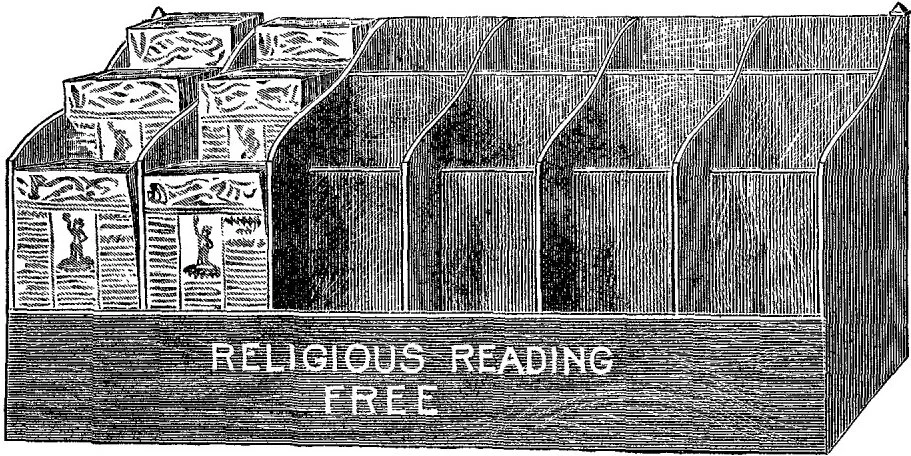
Literature Receptacle at Columbus Union Passenger Station
By C. L. Shelton
The above cut represents a receptacle for S. D. A. literature, now being used by the T. & M. Society in the Union Passenger Station, Columbus, Ohio. Societies or individuals desiring to get important matter before the public who would choose this method and style of box are informed that I am prepared to furnish the boxes and any information concerning same on application.
Address,
C. L. SHELTON,
Columbus, Ohio.
HENRY M. STANLEY, the African Explorer
By Arthur Montefiore
—By Arthur Montefiore, F. R. G. S. Brought down to 1889. 12mo. 160 pages, fully illustrated, cloth extra, 75 cents.
Address all Orders to
PACIFIC PRESS PUBLISHING COMPANY, 12TH & CASTRO STS., OAKLAND, CAL. 43 BOND ST., NEW YORK.
Book Advertisements: Missionary and Biographical Series
MEMOIRS OF EDWIN BAINBRIDGE.— The subject of this memoir is the young English tourist who met his death at the dreadful volcanic eruption of Tarawera, New Zealand, on the 10th of June, 1886. 12mo, 160 pages, fully illustrated, cloth extra, 75c.
THOMAS J. COMBER, Missionary Pioneer to the Congo—By Rev. J. B. Myers, Association Secretary Baptist Missionary Society. 12mo, 160 pages, fully illustrated, cloth extra, price, 75 cents.
JAMES CHALMERS, Missionary and Explorer of Raratonga and New Guinea—By Wm. Robson, of the London Missionary Society. 12mo, 160 pages, fully illustrated, cloth extra, 75 cents.
THE POCKET ATLAS OF THE WORLD—A comprehensive and popular series of maps, illustrating physical and political geography, with geographical statistical notes, 54 double maps, cloth, $1.00.
WILLIAM CAREY, the Shoemaker who became a Missionary—By Rev. J. B. Myers, Association Secretary Baptist Missionary Society. 12mo, 160 pages, fully illustrated, cloth extra, 75 cents.
SAMUEL CROWTHER, the Slave Boy who became Bishop of the Niger—By Jesse Page, author of “Bishop Patterson.” 12mo, 160 pages, fully illustrated, cloth extra, 75 cents.
MISSIONARY LADIES IN FOREIGN LANDS—By Mrs. E. R. Pitman, author of “Heroines of the Mission fields,” etc. 12mo, 160 pages, fully illustrated, cloth extra, 75c.
JOHN BRIGHT, the Man of the People—By Jesse Page, author of “Bishop Patterson,” “Samuel Crowther,” etc. 12mo, 160 pages, fully illustrated, cloth extra, 75 cents.
PACIFIC PRESS PUBLISHING COMPANY.
12th & Castro Streets, Oakland, Cal. 43 Bond Street, New York.