Accompanied by Elder F. H. De Vinney, C. N. Woodward, and Mrs. Porter, I have just made a tour through the northern portion of the Asiatic Division territory.
Our first stop was at Seoul, Korea, where the foreign and native laborers, together with a large delegation of the Korean brethren and sisters, had gathered for their annual meeting. It was a novel sight to see the men and women, all dressed in their queer white costumes, come into the chapel and take their seats on the floor, using small mats for seats. We soon became used to their peculiar customs, and entered with them into the spiritual work of the meeting. We found them a devout people, responsive to the teaching of the Word of God. The business passed off harmoniously, and the spiritual meetings greatly refreshed all in attendance. The people returned to their homes with renewed courage to press forward in the finishing of the work. The past year shows that the work has a solid basis and is advancing along all lines.
At Soonan, the new school and chapel building, two dormitories, and the dispensary are most “beautiful for situation.” They are located well up on the side of the hill, and above them on the crest of the hill, overlooking the valley and surrounding country, are twenty villages. In this place the small dispensary has done excellent work. Dr. Riley Russell and wife have made it decidedly a missionary dispensary, as God designed that all our sanitariums and treatment rooms should be, and it has been the means of winning many souls to the message. Such small dispensaries conducted in this way are of far more practical value to the cause of present truth in the Asiatic field than sanitariums would be. Institutions requiring a number of nurses, and facilities for boarding patients, are usually found to require a continual budget to meet the loss in operating, while the small dispensary is self-supporting, and often aids in providing funds with which to carry forward other branches of the work.
At Mukden we were much pleased to find the old headquarters of the Manchu dynasty (under which 11,000,000 people by their sagacity and courage secured and held control for so long a period, of China’s 400,000,000 people) still like the sons of Anak, a land of giants, with their walled cities and great wall separating North China from Mongolia. It was with a view to opening the Manchurian field in the near future that we visited this section on our return from Korea. Mukden, with a quarter of a million people, mostly Chinese, and Harbin, another great business center composed of a large number of Chinese and 30,000 Russians, are the two large cities of the province.
One cannot pass through Manchuria, with its large, fine-looking people, its broad fields operated on quite modern methods, and its air of general intelligence and prosperity, without feeling that the time has come that this important field should be entered. We are planning to send a Chinese worker there at once, and two foreign families expect to be in the field before the close of the year.
Think of riding twenty-four hours on an express train, from Mukden to Peking, through a fertile country of enterprising Chinese people, without passing a single lighthouse from which the light of the third angel’s message is shining to dispel the heathen darkness in which this people are sitting. Then there is Peking, the capital city of the great Chinese Republic, in which the first note of the message has not yet been sounded. It is hard to travel in such territory, peopled with millions of our unclaimed brothers and sisters who greatly need the message, and not pass the word on to the loyal supporters of the work in the homeland that there is still need of lengthening our cords and strengthening our stakes in order to meet the pressing demands of these unentered fields.
The work in Central China was never more prosperous. A good class of Chinese workers are pressing the literature and evangelistic work, and from every part of the field a spirit of courage and confidence in the speedy triumph of the message prevails. Although the work is well begun in many places, the great unworked territory must constantly stand with outstretched hands in its appeal for workers until in God’s providence its needs are supplied.
British East Africa
By A. A. CARSCALLEN
A. A. CARSCALLEN
It is now eight months since my family and I arrived in this country after a furlough of nine months. We all feel much benefited by the change, and return to our work with fresh energy.
The work here is increasing very rapidly. We were granted seven sites, but, owing to the shortage of workers, were able to supply only five of these with white workers, the remaining two being managed by our native workers. Since our return, however, we have taken over one of these stations, and Brother and Sister Matter, who have just arrived from Germany, are taking charge of the other, so all our stations are now supplied with white workers. Each station has several outschools run in connection with it, and we all are very busy looking after our main stations and visiting our outschools occasionally.12
We brought a small printing press back with us, which we find extremely useful. We are fortunate in having a qualified printer among our workers, so now we have a little paper published monthly, which we find very helpful in our schools, as it provides a constant supply of fresh reading matter for our senior pupils. The first copy of this paper was printed last January. It is called Jaote Luo, or Luo Messenger, Luo being the native name for the tribe among which we labor. One hundred and fifty copies of this paper are supplied each month to the other Protestant societies working among the Luo tribe, and recently I received a letter from a Catholic priest asking me to supply him with copies. Our paper is suitable reading for any mission school. One page is devoted to the book of Daniel. About twenty verses of this book are translated and printed each month. The other pages contain short stories from the Bible and other books, items of interest, and current news.
All our workers are putting forth special effort to increase our school attendance, and by the end of this year we hope to have one thousand pupils at our stations, besides our outschools.
We are glad to be able to report that the courage of all the workers is good, and that all enjoy a fair degree of health in this trying climate.
We ask our people in the home field to pray that God will bless our efforts, so that all the sacrifices made, and all the money spent in this field, may not have been in vain.
Kamagambo Mission Station.
Demoralizing Songs and Reading
By Editor
We are glad to see the crusade which is being carried on in some quarters against a certain class of popular songs which are now being sung even in some respectable homes. The Waterloo (Iowa) Times-Tribune sounds this timely warning:—
These songs which are now being sung in the theaters and which the young people are taking up and thinking cute and pleasurable, absolutely are so rotten that they create a stench to the very heavens. How any person with a pure mind can enjoy the lasciviousness of these songs is hard for moral people to comprehend.
Almost every one desires the newspaper to keep its columns clean; and sensational news is printed only in its mildest form. This paper has no desire to be sensational. It only wishes to carry the cleanest news, but a great many people who would not allow a yellow journal in their homes today are allowing songs to be sung that if they were published in a newspaper, would burn the center of the pages.
Immorality has always existed and always will exist, but certainly the average home demands that there be cleanliness within its environments. Thrust out the uncleanliness which is making its way into your home; throw out the lascivious songs, make a bonfire of them; turn your attention to the immorality of these things, and if other people want to practice them, let them practice them away from your home where they cannot corrupt it.
Similarly the Lutheran of June 25, 1914, decries the demoralizing reading which for the most part fills many of the newspapers of the present day:—
Recently a reader took one of Chicago’s cleanest daily papers and deducting the space given to important news, editorials, business, music, and art, the following amount of space was left for the exploitation of things people could well afford to be ignorant of:—
INCHES
Stories of crime............... 53
Homicides and brutal conflicts........ 40
Police items........ 35
Moving picture and theatrical write-ups.................... 204
Society, dress, and beauty gossip...... 186
Sporting news........ 213
Roman Catholics in politics........ 43
Tobacco and liquor ads............ 20
Total.............................. 794
As stated by the Lutheran, it is no wonder that when such stuff is read with such great avidity in the homes of the people, their tastes and ideals become depraved and vulgar. “That is why there is a plethora of sensual ideas and a famine of spiritual ideals.”
God Shows Himself Strong
God will show himself strong in behalf of the one whose heart is perfect toward him.
Scandinavia
By N. Z. TOWN
N. Z. TOWN
Five local annual conferences and the biennial session of the union conference were held in the Scandinavian countries this season.
West Norway
The series of meetings began with the annual conference of West Norway, which was held in Haugesund, one of the interesting historical places on the west coast of Norway. Just outside the town is one of the finest monuments in the country, erected in memory of Harold the Fair, who in the tenth century made a vow that he would not cut his hair or beard until he had united the thirty-one petty kingdoms of Norway. His monument is surrounded by thirty smaller ones, bearing the names of the kingdoms he conquered.
The conference was preceded by a two-day colporteurs' institute, with about twenty canvassers in attendance. This branch of the work was also given an hour's time each day during the conference. It was the writer's first experience in helping to conduct a colporteur's institute through an interpreter, but the Lord blessed in the work.
The plans of the General Conference home missionary campaign were presented, and heartily indorsed by the delegates in the conference. It was recommended that this branch of the work be thoroughly organized throughout the field.
One enjoyable feature of the meeting was the music rendered with stringed instruments. There were four guitars, two banjos, three violins, and a zither. It was indeed inspiring to listen to the beautiful music produced from these instruments by the good musicians present.
East Norway
The East Norway conference was held in Drammen, a picturesque town with lofty hills on each side, about thirty miles from Christiania. About three hundred of our people gathered for this meeting. As in West Norway, a canvassers' institute was held during the two days before the conference opened. The two Norwegian conferences have the same field agent, and as they have no tract societies, no separate record of sales is kept. The two conferences sold $19,900 worth of literature during 1913.
I here met a young man who had been working in the capital of Norway. While there he had called on the king and secured his order for twenty copies of one of our books. These books were to be placed in sailors' homes in Norway. Two other young men, working with the Norwegian health paper, visited the king. He subscribed for forty copies. Probably these have been placed in public reading rooms.
This conference gained seventy-six members during this year, bringing the membership up to seven hundred and sixty-four. The tithe increased $733. At the close of the Sabbath services Brother Christian Tobiason was ordained to the gospel ministry.
The brethren and sisters took a very deep interest in the home missionary campaign, and resolved to become more active soul winners than ever before. In the young people's program, which was planned for the last day of the meeting, some of the children did remarkably well in speaking and singing. All returned to their homes determined to do their part in finishing the work.
The Scandinavian Biennial Union Meeting
This union, which includes all the Scandinavian countries and Finland, with a population of 13,800,000, reported a membership of 3,686, a gain during the biennial period of 318 members. The gain in tithe during the two years is $2,000; offerings, $600; the total tithes and offerings for the two years being $43,160.
In this union there are three publishing centers, Stockholm, Sweden; Christiania, Norway; and Helsingfors, Finland. It was especially encouraging to hear the good report from the Christiania house, which several years ago passed through great financial difficulty. If their work continues to prosper as it has in the past few years, they will be able to sing the jubilee song in a short time. The sales of this house for 1913 amounted to 325,533 crowns ($87,568), a gain of 54,000 crowns over 1912. Just before the conference, one young man in the city of Copenhagen took 1,000 crowns' ($270) worth of orders in one week.
At the close of the meeting Brother Olaf Olsen, superintendent of the Iceland Mission, was ordained to the gospel ministry.
The Scandinavian Union is the only one in Europe which is not directly involved in the present war. With the membership which this union now has, with an intelligent class of Protestant people in every part of the field among whom to work; and with the incentive to work which the present crisis affords, the message should make good progress in Scandinavia.
Just before sailing from England, word came that there were two hundred and eighty patients at the Skodsborg Sanatorium. This institution, as well as the treatment rooms in Sweden, is doing excellent work. The school at Skodsborg, in charge of Brother Erik Arnesen, is also rendering splendid service in preparing workers for the cause. There are at present more than fifty young persons engaged in the work who have come from that school.
The brethren and sisters in this conference entered heartily into the plans of the home missionary campaign.
Sweden
Some changes were made in the Swedish Conference. Brother Ole Nelson, the president, was released to take charge of the South Swedish Mission, and Brother L. Muderspach, of Finland, was invited to take his place as president.
Brother Emil Lind gave an interesting report of the work done by the Stockholm Publishing House during the past year. Its sales amounted to $24,000. A good corps of canvassers are in the field, and it is planned to push this branch of the work vigorously.
Finland
Following the Scandinavian Union meeting, Elders J. C. Raft, J. T. Boettcher, L. Muderspach, and C. O. Carlsson, and I took the boat from Stockholm to Finland. A large company of brethren and sisters, including the Swedish choir, which furnished excellent music during the meeting, accompanied us to the wharf and sang a cheering good-by as our boat pulled out.
One who has taken this trip cannot well forget the beautiful scenery along the way. Hundreds of islands, with their luxuriant green foliage, the white houses, with their red tile roofs, among the trees along the water front, and the beautiful sunset, which we enjoyed at 9:30 P. M., made the journey very pleasant.
The Finnish meeting was held in the city of Helsingfors. About two hundred and twenty-five of our brethren and sisters were present. As the conference had been well advertised, there was a large attendance of those not of our faith at the evening services. Good progress has been made in the Finland Conference during the past year. The net gain in membership was reported as seventy-six, making a total of three hundred and forty-three. The president reported twenty-one Sabbath schools and twelve churches. An interesting chart was presented, showing the increase in tithes and offerings. The total tithe receipts for 1913 were $3,566, a gain of $317 over the previous year. The total offerings were $683, a gain of $320. As the Swedish Conference in annual session invited Brother L. Muderspach to take the presidency in Sweden, Brother C.13
O. Carlsson, of the South Swedish Mission, was elected president of the Finland Conference.
We found here a large, enthusiastic company of colporteurs. During the past year, Finland sold $12,000 worth of books. Here, as in Scandinavia, the work is carried forward on the subscription plan. Brother A. G. Sandbeck, the general agent of Denmark, attended this meeting to assist in the colporteur work. A new edition of “Great Controversy” is being prepared in the Finnish language, and the brethren are hoping that 1914 will be the banner year in this work.
In the Sabbath school 407 marks (or over $80) was given in donations. At the close of the meeting forty, mostly young people, were baptized. Notwithstanding Finland is rapidly being Russianized, our brethren still enjoy full liberty in carrying on their work. The outlook for the future is bright.
Denmark
The last meeting of the Scandinavian Union was held at Vejle, a little town in the western part of the country, only a few miles north of the German border. The best halls which our brethren can secure in Europe for holding meetings are usually in connection with hotels. For this meeting, we had a nice hall in a hotel just across the street from the railway station. We also lodged in the same house. Brother Sandbeck and I arrived two days before the conference, to assist in the short colporteurs' institute. At the first meeting we found the small hall where the Sabbath meetings are held packed to the limit with colporteurs. This was one of the most enthusiastic companies of colporteurs that I ever had the privilege of meeting. They all entered heartily into the spirit of the institute, and seemed eager to learn anything that would help them to do better work in getting our literature into the hands of the people. A few years ago the annual book sales in Denmark went down to 12,000 kroner ($3,200), but during 1913 the total sales amounted to 112,000 kroner (over $30,000).
As Elder C. C. Jensen was obliged to return to the States early in the year on account of Sister Jensen's health, Denmark had been without a president. Elder A. G. Christiansen, of California, responded to an invitation from the Denmark brethren to supply his place. With his family he arrived just as the meeting opened, and was unanimously elected president.
The day appointed for the special midsummer offering in Scandinavia fell on the Sabbath of this meeting. During the week, Elder L. R. Conradi gave two or three missionary talks to prepare the way for a special offering on the Sabbath. All were invited to come prepared to give or pledge liberally. At the time of the meeting on Sabbath, no special appeal was made, but the brethren responded cheerfully to the calls that had been previously made. The Sabbath school offerings, together with the special collection, amounted to 3,200 kroner (over $860). One brother gave 1,000 kroner. At the close of the afternoon Sabbath service, Brother N. P. Hansen was ordained to the gospel ministry.
Washington, D. C.
The Marriage Altar
By C. C. LEWIS
C. C. LEWIS
GOD has ordained that human life shall be perpetuated by means of the marriage institution. Upon the first man and woman he bestowed his blessing, and said to them, “Be fruitful, and multiply, and replenish the earth.” Marriage is one of twin institutions which come down to us from the Garden of Eden. Before sin entered, God gave to man marriage and the Sabbath institution. Marriage is honorable in all. It is the foundation of the home. Out of it grow the fond relationships of father and son, mother and daughter, brother and sister, husband and wife. What loving words are these! Blot them from our language, and with them that for which they stand, and who would care to longer bear the burden of living?
Proper Associations
Love is godlike; for “God is love.” But love and lust are far removed. Love leads to marriage, but lust severs the marriage tie. Strange that they should seem so near and yet be so far apart. Lust is the abuse (ab-use, or wrong use) of the good gift of God. It is a matter of the utmost importance to all young men and women to know how to relate themselves properly to one another. The proper association of ladies and gentlemen is a blessing to both. Men receive from such association a refining
subduing influence. Women receive strength and integrity of character. But improper associations produce evil results. In their intercourse with one another, young people should maintain a proper reserve. They should associate as friends and companions, in a frank, manly and womanly way; but at the same time there should be a bound of reserve through which no one would dare to break. Womanly reserve and modesty constitute a bulwark of purity and safety. When we forget this proper reserve, we fall into danger.
Reserve and Modesty
It would be wrong to tell young people that they should not delight in one another’s society. God has planted the social instinct in their hearts, and it is natural for them to like to be together; but it would not be wrong to say that they should be modest and reserved in their associations with one another. They should not trifle with the affections. They should not feign regard for another which they do not possess. They should not lead another on to bestow affection which is not returned, nor should they allow another to go on thus of his own accord. A quiet manner of dignified reserve is usually sufficient to set another right in this matter. Young people should learn to be happy and cheerful together without being sentimental and silly.
It is an unwise custom to be “going with” some one all the time. Many seem to think this the proper thing to do, as if all the boys and girls must be paired off before the eyes of the community, and if any little thing by chance disturbs this arrangement, there must be a great ado of fluttering about until another adjustment is made. Thus it often happens that boys and girls pass through a long course of these slender attachments, like a humming bird flitting from flower to flower, but seeming to be never satisfied to alight. Such associations dissipate their affections, until they are scarcely able to recognize or bestow true affection. Perhaps it is too much to expect that there should be in every case only one such alignment, and that the final one for the journey of life; but we should certainly approach as nearly as possible to this ideal. In Life and Health, Mrs. M. L. Dickson truthfully remarks, “Most of the divorce cases are the result of matches contracted before a girl is old enough to be governed by her intellect rather than her impulses.”
Be Sensible
But when at last the time shall come—as come it doubtless will—for our own14hearts to be pierced with Cupid’s sharp arrows, then do let us try to be sensible! If we cannot be as sensible as we should like, let us at least be as sensible as we can. It is surprising sometimes to note how foolish otherwise sensible people become in regard to these matters of affection. Good taste indicates that they should be conducted with a quiet and becoming dignity. It is not best to wear one’s heart upon the sleeve. The less publicity one attracts in these matters the better. Not that it is a matter of which to be ashamed. On the contrary, no man has fully lived until he has sincerely and purely loved a noble woman. But such relations are too delicate and too sacred to be needlessly exposed to public gaze.
(To be concluded)
The Still, Small Voice
By Nannie J. Rea
It is not in clashing armies,
Rushing o'er the field of fray,
Where the shots and shells are screaming,
Where the dead and wounded lay—
Not in these, though eager listeners,
Do we hear God's voice so sweet,
Sounding o'er life's bitter struggles,
Sending strength life's toils to meet.
It is not in life's commotion,
Where the struggling hosts of men
Strive and toil for earth's vain baubles,
Which will burst ere fully won;
It is not in fame's high temple,
That the voice of God is heard,
Though we pause and vainly listen
There to hear his sovereign word.
Down in some low path of duty,
Far from power, or wealth, or fame,
Do we hear the still, small whisper,
“I will give thee my new name
’Graved in stone of dazzling whiteness
Which shall stand when all else fail—
This the key to stately mansions
Found beyond earth’s narrow pale.”
— Nannie J. Rea, in the Christian Observer.
Conducted by Mrs. C. C. Lewis, Takoma Park, Washington, D. C
By Mrs. C. C. Lewis
Through the columns of this department, hints will be given on all matters pertaining to the home life. Short articles and letters are solicited from home makers, telling of their everyday experiences,—their joys and sorrows, their failures and successes.
The Mother’s Opportunity in Her Home
By Edyth Bollman
EDYTH BOLLMAN
THE greatest missionary in the world is the Christian mother. To her are given the most wonderful and precious of all opportunities; namely, the training of soldiers for the cross of Christ, the care of those who shall be citizens of the heavenly kingdom, the purchase of the blood of Christ.
Never was such a privilege offered mothers as today, when the army of the Lord calls loudly for young men and women, well disciplined, to go up against the mighty. The foundation for a good soldier, one who can endure hardship, be true to principle, and lay hold of God’s promises by a faith that cannot be shaken, is laid at home under the tender yet firm hand of Christian parents.
A true mother prays much and is a diligent student of God’s Word. She hungers and thirsts after righteousness. The law of kindness, truth, and gentleness is in her mouth. She follows the instructions of the Word in teaching her loved ones the law of liberty. In her life the children see loyalty to the commandments of God. She is a living epistle to them. And so our Heavenly Father intended; for the first conception a child receives of its duty to love and obey comes through its earthly parents. Its tiny mind for years does not know any other authority of God than that expressed in father and mother. Do we realize the exalted position given us? Are we conscious of the grave responsibility we have undertaken in bringing children into a world filled with corruption and sin on every hand?
To one outside of Christ the task is unequal, but to those who abide ‘under the shadow of his wing,’ is the promise found in Isa. 49: 24, 25: ‘Shall the prey be taken from the mighty, or the lawful captive delivered? But thus saith the Lord, Even the captives of the mighty shall be taken away, and the prey of the terrible shall be delivered: for I will contend with him that contendeth with thee, and I will save thy children.’ The Word is full of such promises, yet they are all conditional. Obedience and faith make them ours.
Our Heavenly Father would have us learn the lesson of obedience well before we undertake to teach, for how can we inspire the children to loyalty to all God’s demands unless we manifest loyalty to him in our daily lives? Our perfect submission to God’s law measures our love to our Creator just as truly as an obedient child tells its love by doing that which pleases mother. The only really happy child is the one who without question obeys the request of its parents. And so it is with God’s children. He designs that his laborers shall be sustained by his grace and power. He has chosen us out of the world that we may be a peculiar and holy people. Our words and actions must be guarded, pure, and uplifting.
The Bible is the source of all true education, and explicit directions for gaining wisdom may be found in its sacred pages. As knowledge is power, and we wish our children to take hold of that which will fit them to carry on through eternity a search for wisdom, we must begin here. God tells us that ‘the fear of the Lord is the beginning of wisdom: and the knowledge of the holy is understanding.’ We are instructed to teach our children diligently God’s laws, to talk of them at all times, and bind them for a sign upon our hands. If we hearken unto this admonition, our children will be able to say in time of temptation, as did David of old, ‘Thy word have I hid in mine heart, that I might not sin against thee.’
Can you not see, dear mother, your position and labor of love? Jesus says to you, ‘Take this son, this daughter, to train for me.’ O, blessed work! Shall we not with joy accept so great an honor? Think of it,— the King of kings invites you to be a colaborer with him in the fitting of your loved ones for a home in the earth made new.
Children if left alone will not naturally search the Scriptures, and so in their early years we must by patient teaching and example instill into their hearts and minds the claims of God’s law, and faith in the atoning sacrifice to cleanse and keep from sin. When we do this, we lay a foundation that all the evil hosts of Satan are unable to shake. Point your children to Christ. Lift the cross of Calvary in your homes, that your children may look and live. Regulate their characters by love to him who gave his life for them. When they behold what manner of love the Father has for them, the Holy Spirit will find an easy access to their hearts, and that sweet ‘still small voice’ will guide the youthful feet when perhaps mother’s voice is forever still. Her work, so patiently begun in early years and carried on with many tears and agonizing prayers, will see its fruition in a young life choosing to serve God and be loyal to that which is true and pure.
We may compare our children to a garden in which are tiny plants growing up to perfection, carefully trained and cared for by the faithful gardener. The soil of our children’s hearts must be enriched by the Word of God, all noxious weeds removed, and the seeds of truth made to germinate and grow by the sunlight of God’s love. It is of utmost importance that a mother gain the confidence of her children, that they may come to her with anything, without the least fear of misunderstanding, sure of loving sympathy and wise counsel.
Teach the children the laws of their being; cultivate their moral faculties. Impurity abounds on every hand, and your child is sure to come in contact sooner or later with its deadly influence. Fortify the mind against evil by a knowledge of truth. Unfold to the opening mind little by little the mysteries of life.
Mothers, in this age of infidelity believe in God; take him at his word, and claim his precious promises; they are for you. Your life and the lives of your children will then be filled with that joy and peace that the world knows not. We are on the borderland of the heavenly Canaan, and God speaks to parents now as he did to Joshua: ‘I will be with thee: I will not fail thee, nor forsake thee. Be strong and of a good courage: for unto this people shalt thou divide for an inheritance the land, which I sware unto their fathers to give them. . . . For the Lord thy God is with thee whithersoever thou goest.’
Things Learned by Experience in the Kitchen
By A NEIGHBOR
No woman definitely plans to spend her life in the kitchen; but if she uses a kitchen at all, it should contain a mirror, of good quality, if only a small one, hung in position to reflect the person frequently during the busiest hours of the day.
Such a mirror is of great benefit. It gives warning in time that the hair may be prevented from falling, as sometimes happens when it becomes too oily to be fluffy. The mirror also keeps the hair from turning gray by timely and faithful reflections when worry comes in. Its pointed suggestions help to preserve the smoothness of the face, and offer useful hints as to premature wrinkles and furrows. It aids the housekeeper’s memory, since it helps her to straightway remember what manner of person she is. Next in importance to the clock, let a mirror be hung in the kitchen.
A NEIGHBOR.
The Housewife’s Exchange
Raisin Sandwiches
WITH one cupful of seeded raisins chop an equal quantity of nut meats. Mix to a paste with fresh, sweet butter and spread between toasted crackers or thin slices of brown bread. A dash of lemon juice adds a piquant flavor.—The Mother’s Magazine.
Date Rolls
Make a crust similar to pie crust, or left-over pie crust may be used. Roll the dough into a thin sheet, and cut in strips just wide enough to cover a date. Lay the fruit along end to end about an inch apart. Pinch the edges together, cut between the dates, and press into shape. Bake in a moderate oven.
The Bible Only
“It is a good time to recall the statement of Chillingworth: ‘The Bible, I say, the Bible only, is the religion of Protestants.’ No genuine Protestant can allow creed or tradition to be of more authority to him than the Holy Scriptures.”
Turkey
By Mrs. E. A. Girou
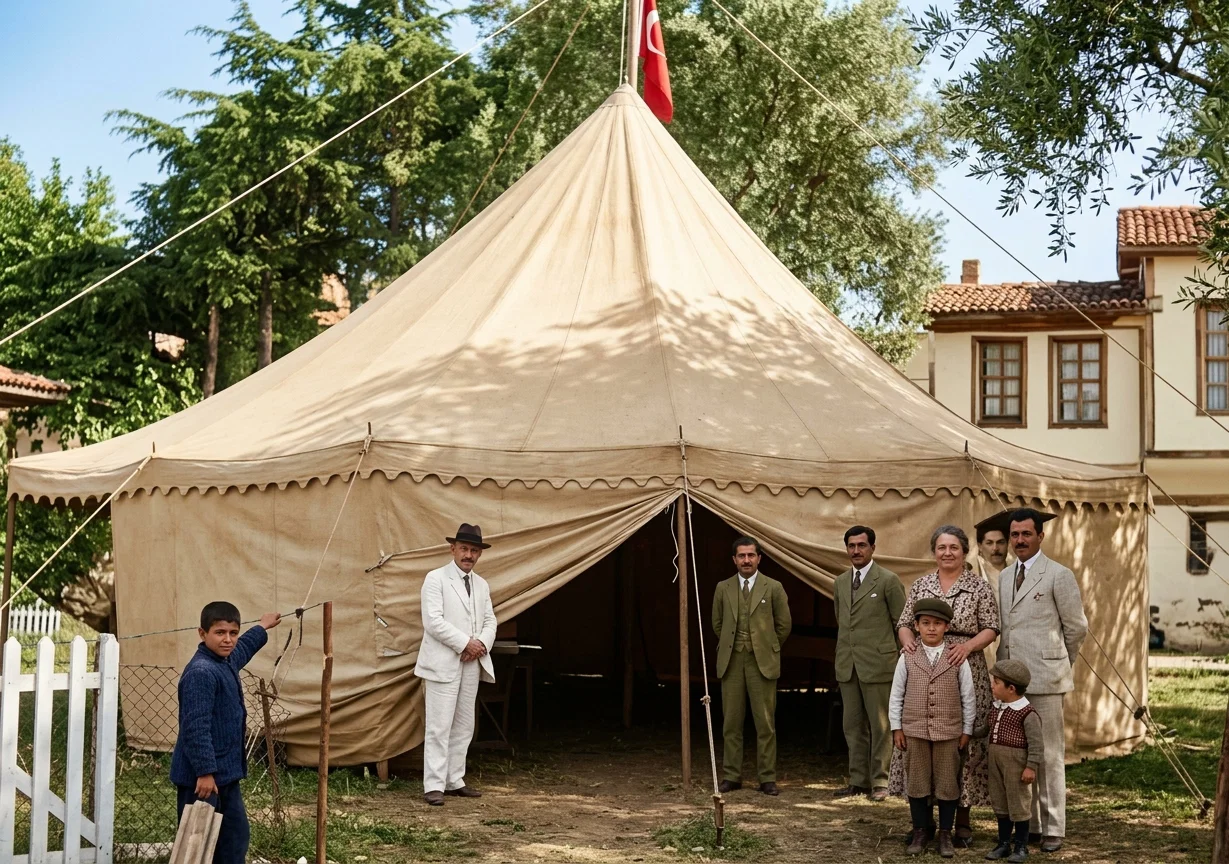
ODEMISH. — To the history of our Turkish Mission another page is added. Recently for the first time we were privileged to see a tent pitched, with special permission of the chief governor, in the center of Odemish, a city of 25,000 inhabitants, in the province of Smyrna. Two years ago a tent was pitched in Kadi-Keng, of Constantinople, but the permission for preaching under it was denied by the authorities. This was a disappointment to us then, but not a discouragement. But now, although not in a more favorable time nor in a more peaceful section, and under the same ruling power, the Lord has wonderfully opened the way before us.
After a good effort in Smyrna during the winter, my husband made a tour with Brother Dickran, a canvasser, in the surrounding country to find a suitable place for the tent work this summer. When he saw that Odemish was quite a nice place, he went first to the chief governor, or kaimakam, and talked with him about it, and inquired if he would be allowed to conduct a meeting. He was asked what kind of meetings would be held under the tent. We have learned by experience that any kind of religious meetings in Turkey have to be held in church buildings recognized by the government, in Jewish synagogues, or in mosques.
THE FIRST TENT PITCHED IN TURKEY BY GOVERNMENT PERMISSION
In asking permission for our meetings we were advised to call them moral or scientific lectures. My husband explained the nature of his lectures, that they would be to teach the people love toward God and toward one another. The second question was whether our talks would be based upon the spirit or the letters of the Bible, really a strange question to be asked by a Moslem governor. He expressed his joy when told that we believe the Bible just as it is written, without separating the spirit from the letter. He then said, “If you will do so, and if you will procure an interpreter that will be able to make our people understand those good principles you speak of, I shall consider you as an angel sent from heaven.”
Once the permission was granted, my husband hurried to find ground, and the tent was pitched. It took several days for him to return to Smyrna. We then went to Odemish. During this time it was very interesting to see the curiosity of the people. All day long crowds were coming to see the tent, each one expressing an opinion about what it was to be used for. Some were heard to say that a Frenchman had come to convert the people to a new religion and offered twenty-five or thirty dollars a month a person, with a house to live in, etc.
Another thing that seemed very strange to them was for this French preacher to have his wife interpret. The women here dare not sit in the same hall with the men. Even in their own churches they are separated in such a way that they may not be seen by men. In some parts of Turkey this is not so.
The meetings began on Sunday evening. The tent was full. Besides Christians, there were about one hundred Moslems, and about as many women were standing outside.
On the second evening the Turkish hodja (professor) brought his students to the tent. He expressed his thanks for the subject treated, “The Need of Faith.” It gave us encouragement to hear also that the people in general were pleased. But this condition did not last very long. Three days after, a very strong boycott began against Greeks by the Turks. The whole city was in danger. Turks were against Turks that would have any dealings with Greeks. Many tobacco fields belonging to Greeks were spoiled by Turks, and their owners beaten. It was like a reign of anarchy. The steps taken by the government to stop this did not materially change conditions.
On the other hand, all the Greek families thought to leave the town and go to a place of refuge at their headquarters in Smyrna, so the streets were full of cars taking the furniture of ten to twenty families each day. In the night Christians feared to come out of their houses. These things of course hindered them from coming to the tent meetings, and for several nights only a few Moslems were in attendance at the services.
Elder Frauchiger, the president of our field, visited us recently. He was on his way to the interior, coming from Saloniki, and related to us more dreadful scenes of this boycott. We had very good seasons of prayer and counseling together, especially asking the Lord to give us some souls in this town even in these times of trouble.
We were glad later to see many Christian faces during the meeting. The message is sure to gain the victory, no matter under what circumstances it is given.
We have begun special meetings for women on Sunday, also a meeting for children on Sabbath afternoons. At the latter meetings we have about two hundred children present.
In all this work we feel the hand of the Lord with us. We are sure to see some fruit in a little while. In closing, I wish to ask each reader to remember before the throne of grace this new work in Turkey.