Pacific Press Publishing Company · New York · Aug 20, 1896
CHRIST AS THIS WORLD'S KING.
By S.
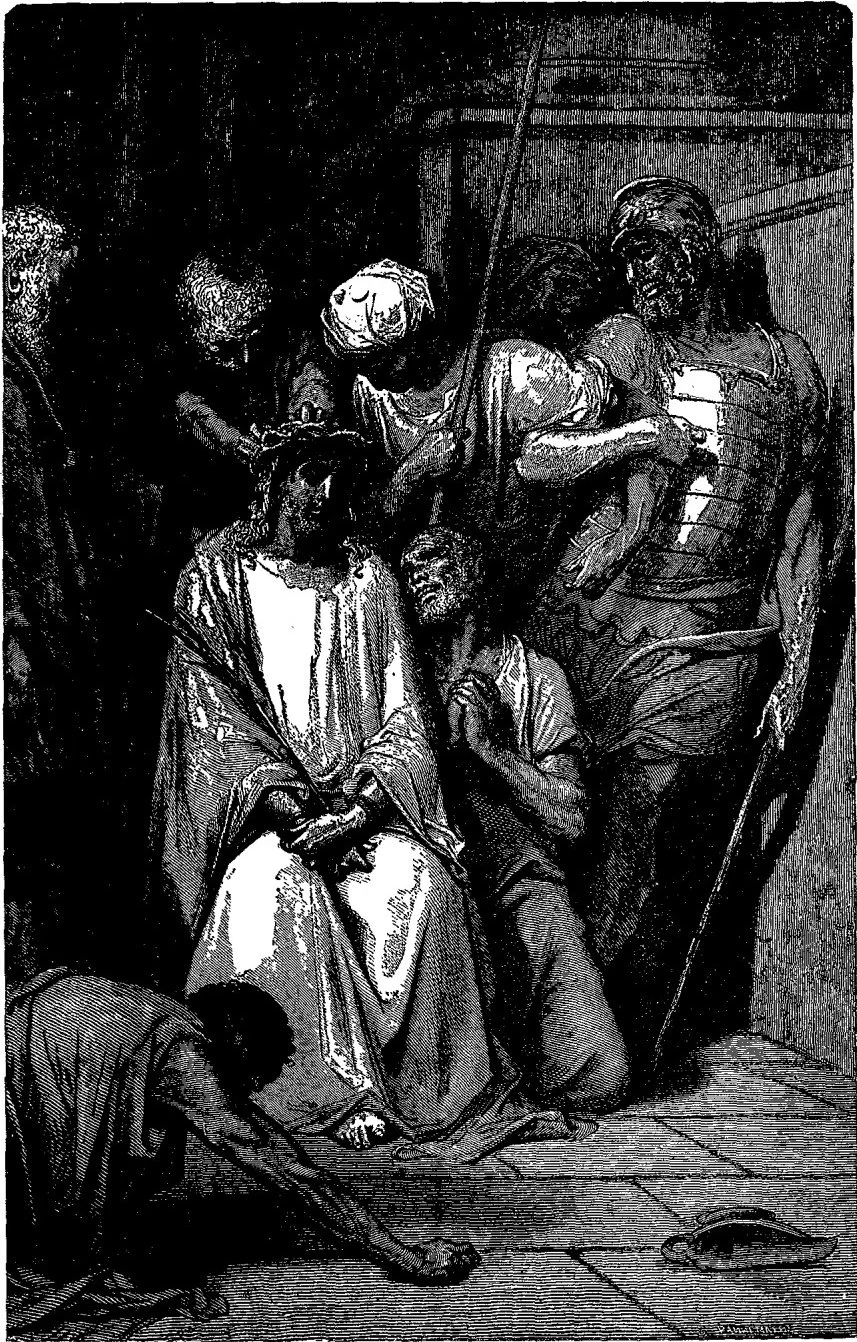
THERE was once an occasion upon which Jesus Christ, the Son of God, was literally crowned as a king by the representatives of this world. The event is narrated in the twenty-seventh chapter of Matthew. The account reads:—
“Then the soldiers of the governor took Jesus into the common hall, and gathered unto him the whole band of soldiers. And they stripped him, and put on him a scarlet robe. And when they had platted a crown of thorns, they put it upon his head, and a reed in his right hand: and they bowed the knee before him, and mocked him, saying, Hail, King of the Jews!” Verses 27–29.
What mockery, indeed! Yet there was no greater mockery in that scene than there is in the idea that Christ can be this world's king. It was the very mockery of this idea that was illustrated on that occasion.
The participants in that tragic mock ceremony were representatives of this world. They represented the people over whom Christ would reign as this world's king. He would reign over a people contrary to him; for those who are in harmony with him on this earth are vastly in the minority. His scepter of righteousness would be a reed, and his crown a crown of thorns. The homage he would receive would be hypocrisy.
There was no more mockery in that which the Roman soldiers actually did with Jesus Christ in Pilate's house, than in that which the people of this world have thought to do in their schemes to make him the world's King. In that memorable scene in Pilate's hall, the Saviour was crowned King of this world in the only way that he could and would be so crowned by this world's agencies.
There is a scheme in progress at the present time to make Christ the King of this world. It is a scheme conducted by those bearing his own name; yet its real character and meaning are not different from those of the scene when he was crowned with thorns. It is a mockery, as that was; though we are fain to think, not recognized as such by many of those engaged in it. We have listened to the pronouncements of powerful and eminent bodies of the people in its favor. The Woman's Christian Temperance Union, for example, have declared:—
The Woman's Christian Temperance Union, local, State, national, and world-wide, has one vital, organic thought, one all-absorbing purpose, one undying enthusiasm, and that is that Christ shall be this world's king;—yea, verily, this world's king in its realm of cause and effect—king of its courts, its camps, its commerce; king of its colleges and cloisters, king of its customs and constitutions. . . . The kingdom of Christ must enter the realm of law through the gateway of politics.
The National Reform Association, the American Sabbath Union, the societies of Christian Endeavor, and other organizations of more or less note, are all working with a practical unanimity for the accomplishment of this purpose.
They would have Jesus Christ made the king of this world by a vote of the people, or of their representatives. Let it be supposed that Christ would accept such a decision concerning his kingship; what would be the result? What would he do with those over whom he reigned? and what would they do with him? Is not the similarity apparent between his position as it would be in such a case, and what it actually was before the soldiers of Pilate?
The spirit of the Roman soldiers on that occasion was the spirit of the world toward Christ. The world has as much real love for Christ now as they had, and no more. They would be as ready to do his bidding as were the rabble; they would just as readily comprehend and espouse the principles of his government.
Christ as This World's King.
In short, one of two things would be inevitable. Either his subjects would treat him with mockery and derision, as Pilate's soldiers did, ignoring his will and making his kingdom one258whose fit scepter would be a flimsy reed, and whose fit emblem of kingly authority would be a crown of thorns; or he would put forth his divine power against his hypocritical subjects, and sweep them out of existence. The latter result would be the one that would follow, for Christ could not reign over unrighteous subjects. We read that the eternal Father has said to his Son, “Thy throne, O God, is forever and ever; a scepter of righteousness is the scepter of thy kingdom.” Heb. 1:8. Every subject of the King of kings will be righteous. There will be no flaws in his kingdom, no mockery connected with his reign.
This we know from the Scriptures. The time will come when Jesus Christ will receive the kingdoms of this world; and when he receives them, he will at once destroy them. That is the only thing he can do with them, tainted as they are with sin. All men have now a chance to repent and be saved from sin, and become by faith the subjects of the kingdom of grace, upon the throne of which Christ now sits. But we are told that the saved will be few, while the great majority will follow the broad road to perdition. The multitudes will prove incorrigible as concerns the purposes of God in the gospel. Sin must finally be removed from God's universe, and the incorrigible sinner must go with it. Then will come the final destruction of things earthly. As it is written in the second psalm: “I will declare the decree: the Lord hath said unto me, Thou art my Son; this day have I begotten thee. Ask of me, and I shall give thee the heathen for thine inheritance, and the uttermost parts of the earth for thy possession. Thou shalt break them with a rod of iron; thou shalt dash them in pieces like a potter's vessel.” Ps. 2:7–9.
Still more pointed is the language of Christ himself concerning the ultimate fate of those who reject his authority, as set forth in the parable of the nobleman and the talents. Christ is the nobleman, who has gone into a far country, having entrusted to all a certain amount of talents. Some trade with these talents and gain other talents, but some view him as an austere man, for whom they have no love. Finally comes the day of reckoning, when the nobleman returns from the far country, and rewards every one according to their works. And then he says concerning such as have refused to accept him: “But those mine enemies, which would not that I should reign over them, bring thither and slay them before me.” Luke 19:27. Christ will reign over his saints; not over sinners.
There is an hour which the eternal purpose of God has set over against that hour of mocking in Pilate's hall,—an hour when Christ will be crowned in glorious reality,—not King of this world, for this world will have passed away—but King of that new earth which is to be in this world's place; when, instead of the mocking worship of the rabble, there will be the adoration of saints and angels. And that will be when all the righteous ones of every age shall have been gathered out from all nations, the work of salvation completed, and the redeemed ones forever freed from the power of sin and death. Then in the presence of his redeemed, of the host of heaven, and of the wicked, the crown that far outshines all crowns will be placed upon the head of the Son of God, but not by a human hand. The men who crowned him with thorns in Pilate's hall, will see him crowned upon the Father's throne. The misguided ones who have thought to make him this world's king by their own vain methods, will see him crowned King, in God's own appointed time and way, of that new earth which is to be the eternal inheritance of the saints.
Let us not join in the vain effort to usher in the kingdom of God through the “gateway of politics.” Let us not be participants in any mock coronation of Jesus Christ.
S.
POLITICS AND CITIZENSHIP.
By S.
The sphere of politics should not be confounded with that of citizenship. A citizen may or may not be a politician. Citizenship is based upon that which all men have naturally in common; politics is based upon that which men do not have in common. It is based upon the differences in belief which men have with respect to the interests of the State. It derives its life from them. We are naturally in the sphere of the one; voluntarily, if at all, in that of the other.
We can hardly avoid the sphere of citizenship. We come into it by birth. We may say that we are not citizens here; nevertheless we are reckoned such by the State. The national Constitution declares that “All persons born or naturalized in the United States, and subject to the jurisdiction thereof, are citizens of the United States and of the State wherein they reside.” We are not the authors of our citizenship. We are not commissioned with authority to define, alter, or abolish it. We find it waiting us, defined and fixed by a power altogether beyond us, upon our advent into the world. We take it, like many other things, as we find it. There is no duty resting upon us to do otherwise.
It is not our task to defend all things which this relation has been made to cover, by the accepted principles or usages of civil government. We are not obliged to give our sanction to the “legal fiction” which is interwoven into the theories upon which civil government is conducted; least of all could we sanction all that has been done by men in the name of civil government. But we are obliged to recognize the relation which we sustain to our fellowmen as individual members of the human family, and we are bound by the obligations which grow out of it. It is because of these obligations that civil government exists. Civil government takes cognizance of natural rights. It was ordained of God for this purpose; and it is out of this that the relation of citizenship arises.
Whether one is a Christian or not, his relation is the same to the civil power. It is true that Christianity confers another and higher citizenship, which is not of this earth; but that fact does not alter the conditions to which we are subject here, any more than it changes at once “these vile bodies” to bodies of glory and immortality. The sphere of civil government and that of Christianity are altogether separate. It would be proof to the contrary were the acceptance of Christianity to affect a man's relation to the civil power. The Christian, in common with all other men, is under obligation to be subject to the “powers that be.”
It is a truth, which Christians should be no less ready than others to accept, that “all men . . . are endowed by their Creator with certain unalienable rights;” and that “to secure these rights, governments are instituted among men, deriving their just powers from the consent of the governed.” So speaks the Declaration of Independence, and in this it presents the doctrine of individualism in civil government, corresponding to that individualism which the gospel asserts in the sphere of religion. The Christian has the same natural, “unalienable rights” that are possessed by others; the espousal of Christianity takes none of these rights away. They are as necessary to his welfare as to the welfare of others. It is essential to him, no less than to others, that they should be preserved; and civil government being God's ordained means for their preservation, it is proper that he should accept the guardianship of the civil power over those rights, and conform to the requirements necessary to its existence.
Paul, the Christian, was a Jew of Tarsus, “a citizen of no mean city” (Acts 21:39). Through him the Spirit of Omniscience testifies to Christians concerning the duty of being in subjection to the higher powers, as unto the “minister of God.” This of course refers only to the exercise of that power which God ordained, for God does not appoint any power to minister against himself. The power which God has ordained is that power necessary to the preservation of natural rights.
The Christian should be no less concerned about the preservation of his neighbor's rights than of his own. The spirit of his religion teaches him to seek the good of others. He may therefore be expected to be a loyal supporter of civil government, that being the means by which the good of the human race is conserved in the important matter of their rights. Even should he say that, as a Christian, he looks to God for the preservation of his own rights, he will not be so selfish as to forget the rights of his neighbor who is not a Christian. He will uphold, to the extent of his power, the means which God has established in the earth to preserve the rights and privileges of those who acknowledge him not.
But when we enter the field of politics, we tread on uncertain ground. We wander among divergent paths, each leading apparently to the goal of temporal welfare. We259behold many signboards, directing us in varying ways. We get bewildered, and the more so when we are told about our political “duty.” We are at liberty to walk in any one of the beaten paths; or we can make a path of our own, but we are aware that that would be hopeless. We have been trained to associate duty with a correct standard of righteousness and an infallible guide; but in politics we possess neither one. We can be guided by our own best judgment from such facts as we can learn; but we do not find in this a sufficient basis for “duty.”
But we note also that the political field is a very unsavory location. As Christians we are not pleased with the associations which it offers. We find that the “science” of politics is a struggle for the mastery—a struggle not between good and evil, but between party and party. Whatever the “science” might mean in an ideal sense, this is what men have made it, and what we must accept, if we enter the political field to any purpose. But in such contentions the Christian is out of place. He finds poor company amidst would-be victors seeking for spoils, and intriguers “pulling the wires” in accordance with the accepted rules of political ethics. He knows how to be a good citizen—to live honestly and justly before all men, not infringing upon the rights of any man, and aiding with his influence, and when occasion presents, his vote, the cause that is just. As he has opportunity, he will do good unto all men. This is as God directs. God ordained citizenship; man made the politics.
“Politics” has been truthfully likened to a “dirty pool;” and not all the morality in the church, if put into it, would cleanse it. When the church goes into this pool, her skirts will be soiled; that is all. The pool will be as dirty as ever. If any wish for proof on this point, let them note the result already visible from the political sermonizing in which clergymen have indulged in the present campaign. They will see, not righteousness, but accusation, recrimination, and discord.
For moral cleansing we must look to the power of God. God will cleanse the sinner, he will cleanse the world; the one by the blood of Christ, the other by the fires of destruction. His Word tells us this, but it contains no promise that he will cleanse politics. That is left for man to essay. But in view of the effort we can but recall the words of Scripture, “Who can bring a clean thing out of an unclean? not one.” S.
FINE DISCRIMINATION.
By S.
FROM some facts which have come to light recently in Albany, N. Y., it appears that the “Law and Order League,” of that place manifest a fine sense of discrimination in dealing with desecrators of Sunday.
On the first Sunday in January last this League, aided by the police, prevented the delivery of an address on “patriotic” themes which was to have been given by a non-Catholic, on the ground that it was against the law to open a licensed house on Sunday. Only two weeks previously, however, the Leland Opera House was used for an entertainment by the “Sisters of the Dominican Convent,” with an admission fee of fifty cents. And in April last, handbills were distributed announcing a “living picture” entertainment in the same house, to be given by the “Choir of the Holy Cross Church,” Sunday evening, April 12, which was held without opposition. Sunday evening shows are also given in Union Hall, a licensed house, by Roman Catholics, with an admission fee, which are apparently not considered as violations of the Sunday “law.”
The Sunday (“Law and Order”) league of Albany and similar organizations elsewhere show a certain sort of discreetness in not attempting to enforce their ideas of “Sabbath observance” upon representatives of the Papacy, that power being itself the oldest and highest authority on the subject of observing Sunday. What Rome sanctions on that point it will be useless for “Protestant” believers in Sunday enforcement to oppose.
S.
PLAN TO EXTERMINATE TURKS IN CRETE AND MACEDONIA.
By S.
FROM the latest developments in the progress of events relating to the Eastern question, it appears that religious sympathy for the “Christians” in Crete and Macedonia is likely to lead to the extermination of the Turks in those countries. This, at least, is the purport of the plan now under consideration by the “powers of Europe,” according to the New York Sun of Aug. 13. The Sun says:—
When the parcellation of Turkey comes, France will want her share, and England hers; and even Italy has an eye on Tripoli. It was the almost insuperable difficulty of accommodating conflicting claims that last year caused Germany and Russia to concur in the harsh judgment that it was better to leave Armenia to her fate than to begin the process of interference, which would inevitably lead to the disruption of the Ottoman Empire.
There are signs, however, of a sudden and marked change of policy at St. Petersburg, caused by the fervent sympathy of the Russian people for their co-religionists in Crete.
It is reported that the Czar is inclined to countenance a blockade of Crete by a British fleet for the purpose not of hindering the despatch of munitions to the insurgents, but of obstructing the reinforcement of the Turkish troops now in the island. The struggle there would be soon over if this plan were carried out, for the Cretan Christians outnumber their Moslem neighbors in a ratio variously computed at from three to one to seven to one. It is also to be noted that the same motive which would impel Russia to take this course in regard to Crete, would operate with at least equal force in the case of Macedonia, for there not only are the Christian inhabitants members of the so-called Orthodox Church, but half of them are of the Slavonic race.
The “Christians” of Russia and England will keep out the Turkish reinforcements which the Porte might send to the scene of hostilities, while the other “Christians” at the latter place will exterminate the Turks among them,—a task which they will find comparatively easy owing to their superiority in numbers. But as one writer has pithily inquired, what material difference is there between killing “Christians” in a Turkish way, and killing Turks in a “Christian” way?
S.
“SINGLE TAXERS” AND SEVENTH-DAY ADVENTISTS.
By S.
THE “single taxers,” who have been arrested for open-air speaking in the streets of Dover, Del., are threatened with the chain-gang. This party have concentrated their political force upon Delaware, with the intent of converting that State to their views, and have been conducting the campaign for some time at Dover. Political opposition led to many arrests, on the charge of obstructing the streets. The “single taxers” had the courage of their convictions, and as fast as their speakers were arrested, volunteers were ready to take their places. The situation at first appeared humorous, but is now considered serious. We quote from an account which appeared in the Detroit News-Tribune, of August 9:—
The authorities are vindictive and threatening. The single taxers are aggressive, bitter and determined. Neither side will accept a compromise. The citizens of the town are divided in opinion, and many fear that there will be mob violence before the end is reached.
From the day of Stephenson’s arrest the list of volunteers for jail service has been steadily growing. The managers say they have a list large enough to bankrupt the Dover treasury. And it really seems that such is the case. Letters are pouring in to headquarters from all sections of the country, offering names and asking for dates when wanted. New York, Philadelphia, Baltimore and Washington have sent in quite a list.
This willingness to suffer for thirty hot days in the dingy jail in Dover does not spring from any hasty impulse or desire to pose as martyrs, but from a firm realization that a principle is at stake and a right to be maintained. It is a splendid illustration of the old spirit of American independence, and it is doubtful if its counterpart could be found in any of the ordinary political movements of the day.
Finding that arrest did not check the single-tax campaign, and having a large and increasing number of prisoners on their hands, the authorities bethought them of the chain-gang. The Tribune correspondent says:—
The latest developments are the most serious of all. The levy court, made up of “hog” sympathizers, has instructed the clerk of the court to advertise for bids for the hire of all tramps and single taxers in the custody of the county. Bids are returnable Aug. 12. Whether this can be carried out, or is only a bluff, I cannot say.
This affords opportunity for an instructive comparison with the case of the Tennessee Adventists, a number of whom, as our readers know, have been sent to the chain-gang for refusing to keep Sunday, declaring that to be against their conscientious convictions of duty. They have been accused of posing as martyrs, to advertise themselves and their religion. But what shall be said of these single-tax advocates who have manifested their willingness to suffer imprisonment and the chain-gang for a cause to which they are not bound by religious convictions. The Adventists did not leave home to court imprisonment, but the single taxers volunteer for the chain-gang from a distance, in large numbers. If the charge of posing for effect can be brought against the Adventists, it can certainly be brought with much more force against these adherents of the single tax political creed.
But it is obvious that the latter are not actuated by such a motive. They are men who are moved by their convictions of what the interests of the country demand. They believe in adhering to principle in the face of all opposition. Their imprisonment and the threat of the chain-gang constitute a gross outrage upon liberty of speech, and in their devotion to that and to what they believe to be truth, they are willing to sacrifice their own temporal interests. The Adventists are likewise moved by that courageous adherence to principle without which the noblest piece of God’s creation is but a servile, cringing slave. There is some courage of conviction, some love of God and man, in the world yet. And it is well for the world that it is so.
S.
LORD WOLSELEY ON THE ABOLITION OF WAR.
By S.
THOSE who are most familiar with war and with the conditions and causes which lead up to it, are altogether skeptical concerning the coming era of universal peace of which popular theology has long dreamed. They do not believe that lasting peace can ever be evolved out of such conditions as those upon which human society and government are and ever have been constituted. Here are the words of Lord Wolseley, Commander-in-Chief of the Army of Great Britain, to some members of the International Arbitration Society, on the subject:—
Gentlemen, I do not believe in universal peace. There never was a time when peace lasted for long; and the man who believes the time will come when there will be no more wars, I believe that man to be a dangerous dreamer of dreams, and certainly dangerous in any public position. I hope that no man who believes that, may ever be in any high position in England.
In commenting upon these words, an English journal says: “Surely the Church, for her own credit, will make some protest. Mother church blesses the sword and the battleship, but only as necessary and temporary evils. If she does not look forward to the day when wars and rumors of wars will cease to ravage and alarm poor humanity, then she is a living lie. The note of unbelief has been sounded by the Commander-in-Chief. What says the Primate?”
We are inclined to think that so long as “mother church blesses the sword and the battleship,” the words of the “Primate” in favor of the abolition of war will have very effect. Certain it is that nothing contributes more to the perpetuity of war among “civilized” nations than the idea, which “mother church” fosters by her blessing of sword and battleship, that war is proper and right, at least for the actual participants, if they engage260in it at the command of a “Christian” ruler and conduct it upon “civilized” methods.
It is only the coming of the Prince of Peace in the clouds of heaven, with the judgments of divine wrath in his hand against the wicked, that will make wars to “cease unto the ends of the earth.” Lord Wolseley and his military compeers have much better judgment on this point than the theologians. S.
“THE IMPENDING CRISIS.”
[THE following is the substance of an address by Major T. C. Ryan, well known as a lecturer on patriotic themes, before a large audience in the People’s Temple, Boston, Mass., Sunday, July 19, and reported in the Woman’s Voice (Boston), of July 25.]
My theme to-day is, The Impending Crisis. Never before in the history of our great Republic have the American people stood on the verge of a revolution that may not only enrich our soil with the blood of its own citizens, but unsheath the sword in other lands. He who cannot see the cloud on the political horizon, much larger than a man’s hand, and ever increasing in size and blackness, whose thunder shall be the boom of cannon, and whose lightning the flash of swords, needs to turn his eyes to the history of our American Republic.
I hope to be understood by what may follow. I do not look for immediate war, and pray God that no rivers of blood may again flow. Yet I see but one way to avert the storm now pending, and that is for the American people to arise in their manhood, and by the ballot without reference to political affiliations strangle the despotism of Rome while they may.
The famous decision of the Supreme Court in the Dred Scott case, voiced by Chief Justice Taney, when he declared that “the black man had no rights that a white man is bound to respect,” precipitated the great rebellion, which dug more graves and put more men into them than any other war on record. While this decision was being formulated, Congress was passing laws to make it compulsory on every man in Massachusetts if he saw a negro guiding his steps to liberty and Canada by the North Star, to send him back to his merciless taskmaster. But God spoke to the free people of the North, and they swore around the family altar and on the old family Bible, that though the stars should fall they would never prostitute their manhood by keeping back one slave from liberty.
History repeats itself. The Supreme Court has declared that we are a Christian nation, and it is proposed at the very next meeting of this body to have this construed into a decision that will mean the destruction of our liberties. You may not agree with me, but I can’t help that. God has put into my heart what I am about to say. I have spent days, weeks, months, over it, questioning the oracles of our past history. And now I say to you, consider this question prayerfully, thoughtfully; take it to the bar of reason, examine it by the light of the past, and let no man rob you of your free heritage. Remember, it is but a short time since Satolli came to this country, and every Roman Catholic paper published what I shall read to you:
“The coming of Mgr. Satolli will elevate the United States to the first rank as a Catholic nation. Heretofore she has stood before the church as a missionary nation, but now it is freed from the propaganda, and is considered by the Pope as a self-governing power subject only to himself.” This was copied into all the secular papers.
The Supreme Court in declaring that ours is a Christian nation, is doing just what Rome wants the United States to do, and what will surely plunge us into the vortex of civil war. Good Protestant people are forming themselves into line to forward this most dangerous scheme, and even yet on the public grounds of Boston may be heard the crackling of chains forged in the Vatican.
If Protestantism does not rid itself of Romanism the churches will be looking for congregations, not congregations for churches. The Supreme Court declaration was not true, for not more than one-third of our population are Christian people. . . . Our nation is formed of all shades of religious belief. To all it says that their faith shall be respected, and their right to worship God as conscience may dictate. Let the Constitution remain as it is. There is no court of law, State or national, that can legislate the love of God into the heart. . . .
If I had the power all differences between Catholics and Protestants—I do not mean between Catholicism and Protestantism—should be buried in one grave. But instead of catering to and compromising with the devotees of Rome, let us labor for their education, only remembering that there can be no union between Protestant and Catholic until there is absolute guarantee of the separation of Church and State. There must be taxation of church property; monastic institutions must be put on the same footing with those of Protestants, the Jesuits expelled, and the Roman Catholic Church in this country made to acknowledge the supremacy of the civil power. We will take a bishop’s or a priest’s advice when it is good, but reserve to ourselves the right of separating the chaff from the wheat.
God will hold us responsible for letting the Roman Upas tree be planted on our soil. Instead of protests from press and pulpit, they have given her all the encouragement she could want. The people want to hear the truth, and to-day many ministers are preaching to empty pews because they do not dare tell the truth God bids them tell. Such cowardice is the most prolific source of the infidelity of the age.
THE TRAINING OF “CHRISTIAN” PRINCES.
By Ouida
[“Ouida,” in June “Forum.”]
There are two little boys now conspicuous in Europe, one is eleven and the other eight years of age; one is a crowned prince, and the other a crowned king; the former is the most dreary and self-conscious little prig that ever was drilled in pipe-clay and buckram, and the other is still a high-spirited child, bold, saucy and lovable; but both the Prussian Kronprinz and the Spanish Rey Nino, have already but one thought in their young heads: War.
The pompous little German lieutenant only lives for dreams of strategy, manoeuvres, kriegspiel, the importance of buttons, the dignity of stripes and grades, the superiority of gunpowder and chemicals; and the bright Nino climbs on Marshal Campos’ knees, and begs to be told how Moors were killed in Morocco, Cubans in Cuba, and how many years he will have still to wait before he too can have the joy of killing them.
Divine education of Christian princes! These children are taken respectively to the Lutheran service and to the Catholic mass; and they are alike told that they are the servants of the Son of Peace, and what are they in truth being made, both by education and example? They are made the scourge of their own generation and of the generations to come. They are being taught to hope for and to aspire to direct the slaughter of their people and of neighboring peoples, to find their toys in military science, their theatre in the battlefield, their ambrosia in blood.
The little lads who run now before their carriages in the dust, shouting their names with joyous outcry, will be for them a score of years hence, crippled, maimed, riddled with shot, torn with explosive bullets, drowned by torpedoes, blown up by mines; thousands yet unborn will arise to curse them; mothers will ask their dead sons at their hands, and ask in vain; villages will burn up like wisps of straws, and cities crumble like trodden ant hills at their word; they are innocent themselves as the atoms of tubing of the tin sardine boxes which hold the detonators, and the iron nails of the bomb; but as these are filled with the deadliest fumes and fire of hell, so are these boys from their earliest infancy filled to the throat with the lust, the pride, the appetite of war.
THE last session of the Free State Volksraad has been considering a bill providing for a more strict observance of the first day of the week, or Sunday. The following, from the Cape Times, of May 16, 1896, shows how the question is viewed by some of the members:—
This morning the Raad discussed the law for the better observance of the sabbath. The commission reported that work at the mines was necessary for the welfare of the industry, recommended doubling the tariff on Sunday telegrams, and were of opinion that not much sabbath desecration in the way of amusements existed. Mr. C. Wessels opposed it on the ground that it infringed the liberty of the subject, and referred to the case of Jews, whose Sabbath was on Saturday, but would under the proposed law be compelled to observe the Christian sabbath. Messrs. J. Wessels and Steyn objected that if the Jews did not care to observe the Christian sabbath, they should stay away. Mr. Cloete argued that the law was contrary to the institutions which guaranteed full religious liberty. Mr. Van der Walt said that under this law the President could be arrested for driving to church on Sunday. This afternoon in the Raad the discussion was continued. The law was strongly supported by Mr. Fraser, who said that mine owners rest on Sunday as well as burghers, and there was not the slightest necessity for games such as tennis, football, etc. After a lengthy discussion the Raad approved of the principle of the law.
Sabbath rest is a thing of the heart, and is a matter between the individual and God; and for this reason is beyond the purview of earthly governments. All do not agree in reference to the observance of the sabbath; some keep a different day, and some observe no day whatever. Any law, therefore, which is enacted requiring the recognition of a particular day, must necessarily result in an infringement of conscience. Mr. C. Wessels, foreseeing this dire result, opposed the bill in the Volksraad on this ground, and cited the case of the Jews as an illustration. The reply made, that “If the Jews did not care to observe the Christian sabbath [Sunday] they should stay away,” is all the argument necessary to point out the tyrannical nature of Sunday laws; for certainly any law which deprives a man from becoming a citizen of a country because of his religious convictions is oppressive.
It is no more consistent to force a certain day of worship on all, than to require everybody261to be baptized in a certain way; or to require all—Jews, infidels, and unbelievers of every kind—to be partakers of the sacrament. Civil powers are ordained of God to deal with civil matters, but with religious duties they have nothing whatever to do.