S. D. A. Publishing Association · Battle Creek, Mich. · Aug 11, 1886
THE ROBE OF CHRIST’S RIGHTEOUSNESS.
By Ellen G. White
“Thou hast a few names even in Sardis which have not defiled their garments; and they shall walk with me in white: for they are worthy.” Rev. 3:4.
The robe of Christ’s righteousness is prepared for all those who will exchange their own sinful, filthy garments for the robe Jesus has prepared for them. This garment was furnished at great cost by the Son of God, and he presents it as a free gift to any one, rich or poor, high or low, wise or ignorant, who will exchange his sin-defiled garments for this robe of matchless purity. And, my youthful readers, is it not a matter of great astonishment that every human being is not willing to make this exchange?
But we see with sorrow many of our youth who wrap themselves in these sin-defiled garments, and will cling to them and refuse the pure garments Jesus has purchased for them at the price of his own life. Can we wonder at the language of Paul, when writing to some in similar circumstances: “O foolish Galatians, who hath bewitched you, that you should not obey the truth, before whose eyes Christ hath evidently been set forth, crucified among you?” It is the bewitching power of Satan that blinds the eyes of the understanding so that sin does not appear exceeding sinful.
The clinging to the defiled garments and refusing the pure, spotless robes of Christ’s righteousness is the love of sin. Not one can stand before God at his appearing in these garments of sin. Jesus points you to the mansions that he is preparing for you; and he finally shows you that if you are to have this precious home,—a home not made with hands, eternal in the heavens,—you must be earnest in building up a character that will fit you for those mansions. He finally states that there entereth into the city nothing that defileth. All must be without spot who enter that haven of bliss.
If you are to sit at Christ’s table, and feast on the provisions he has furnished at the marriage supper of the Lamb, you must have a special garment, called the wedding garment, which is the white robe of Christ’s righteousness. Every one who has on this robe is entitled to enter the city of God; and if Jesus had not been very desirous you should have a place in the mansions he has gone to prepare for those who love him, he would not, at so great an expense to himself, have made all these arrangements that you might be happy and sit at his table and enjoy the home he has gone to prepare for his redeemed family. Your own garments are unclean and your own spirit and habits are earthly and defiled. Jesus proposes that you lay these off, and put on the garments clean and white which he has prepared for you. Will you lay off your self-righteous garments and accept of Jesus Christ as your Saviour? In doing this, you accept the righteousness of the Lord Jesus, and despising your own garments of sin and uncleanness, put on the garments of Christ’s righteousness.
John saw in holy vision a company round about the throne who had white robes, every one of them; and the question was asked John, “What are these which are arrayed in white robes? and whence came they?” And I said unto him, Sir, thou knowest. And he said, These are they which came out of great tribulation, and have washed their robes, and made them white in the blood of the Lamb.” Jesus invites you to come to him just as you are. You cannot have salvation unless you do come. Will you accept the invitation without delay? Come on the side of Christ. Jesus loves you, and has expressed his love by dying upon the cross of Calvary that you might through his merits win eternal life. You cannot advance heavenward while you cling to your sins. Lay them on the Sin-bearer, and accept his righteousness; then you can run in the way of God’s commandments.
But very many say they are following Christ, and refuse to keep the commandments of God. They say this is unnecessary. Their disobedience and sin indulged make their work very heavy. Come to Jesus, but come in God’s appointed way. Your will must be set aside; God’s will must become your will, and God’s ways your ways. Jesus lived a life of obedience to all his Father’s commandments. He says, “I have kept my Father’s commandments.” If you follow Christ, you will walk in his footsteps, you will exemplify him in your life; and you will find that in the path of obedience, “Great peace have they that love thy law, and nothing shall offend them.” Those who think they can come to Jesus while they are trampling under their feet the law of God are fatally deceived. You cannot disrespect or break God’s holy law by which is the knowledge of sin, and still have the favor of God. If you love God, you will be obedient to all his commandments, for his commandments are not grievous.
MRS. E. G. WHITE.
A SCIENCE STORY.
John and his young cousin Charlie were out on a fishing excursion. John found a very pretty stone, and showed it to Charlie, who exclaimed:—
“Why, John, how light this stone is!”
“Yes, it is rather light. Keep it until we get home.”
A little while after, John found another peculiar-looking stone, which was much smaller than the first.
Charlie took it and examined it carefully.
“John, this is ever so much heavier than the other.”
“Is it? Well, then, keep them both until we get home,” replied his cousin.
That evening John asked Charlie if he had the stones they found in the brook.
“Yes, here they are. What do you want them for?”
“I will show you.”
John took up the largest one, which Charlie had said was so light.
“You said this was very light, did you not, Charlie?”
“Yes, it is the lightest stone I ever saw.”
“Put it on the scales, and see how much it weighs.”
Charlie did so, and found that it weighed nearly two pounds.
John took up the smaller one.
“You said this was very heavy, didn’t you? Put it on the scales, and see how much it weighs. Well, how much is it?”
“Only eight ounces.”
“But you said this was very heavy, and it only weighs one-fourth as much as the other. How is that?”
“I did not mean that this weighed the most, but that it was the heavier.”
“I don’t understand. When you say one thing is heavier than another, you mean that it weighs more, don’t you?”
“Not exactly that. I don’t mean that the whole stone is heavier, but that it feels heavier—”
“What you mean is—if you had a piece of each stone exactly the same size, one would be heavier than the other. Is that it?”
“Yes, that is it exactly, but I had never thought of it in that way.”
“Now, do you see, it would be very convenient if we knew exactly how much heavier or lighter every stone or metal is than something taken as a standard?”
“How?”
“Suppose we found a stone that we did not know the name of, we could look in a book on stones and find the description of one that seemed to be like it. Then we could weigh it, and compare the weight with something we knew the weight of. But, of course, it would be necessary to compare it with the same thing the author of the book did.”
“Can you think of anything that would be good?”
“We might take granite. But granite is only found in some parts of the world. I can’t think of anything that is found in every place.”
“It must be something that can be found in every place, that always weighs exactly the same, and that would be easy to compare with.”
“I cannot think of anything.”
“How would water do?”
“But water is not a stone.”
“Very true; but water can be found in every inhabited part of the world, and the same bulk of pure water always weighs exactly the same. A cubic foot of water weighs very nearly 62½ pounds.”
“How can we compare the weight of a stone with the weight of water? How can we get a cup of water just as large as this stone? See how rough and uneven the stone is.”
“Very easily. Get a basin and fill it as full of water as you can without allowing it to run over the sides. Set this basin in a larger one. Now tie a string on to the largest stone and let it down into the water by the string.”
“Yes, I have done it.”
“Can you see why I told you to do it?”
“Oh, John, how stupid of me not to think of that before! Of course, when I let the stone down into the water, it pushes just as much water over the side of the basin as the126stone takes up space in the water, and the water that has run into the large basin is just as large as the stone.”
“Yes, that is it. Only you might have said that the bulk of the water is the same as that of the stone. Now weigh the water that ran over into the larger basin.”
“It weighs just half a pound.”
“You said the stone weighed two pounds; then how many times heavier is the stone than the water?”
“Four times.”
“Yes; and that is called the specific gravity, and 4 is the specific gravity of this stone. That means that the stone is four times as heavy as an equal bulk of water. But there is an easier way of finding it than the way you did. Can you think of it?”
“No; I don’t see how we could get it in any other way.”
“We will see. The stone weighs two pounds in air. Now let it down into the water and weigh it. How much does it weigh?”
“One and one-half pounds.”
“How much less than in air?”
“Half a pound.”
“Can you think of anything now that will help us?”
“Oh, I see. It weighs just as much less in water as the water weighs that is pushed over the side of the basin.”
“Yes; every thing weighs just as much less in water as the water weighs that it displaces. And now, how will you always find the specific gravity of a stone?”
“I think the best way is to weigh the stone in air, and then in water, and what it loses in weight will be the weight of an equal bulk of water. Then divide the weight in air by the loss of weight, or the weight of the water displaced, and that will give the number of times that the stone is heavier than an equal bulk of water.”
“Yes, that is exactly right. Now you understand specific gravity, don’t you?”
“I think so, perfectly. But can we find the specific gravity of anything in the same way?”
“Certainly. Suppose you find the specific gravity of the iron poker.”
After a few minutes, Charlie comes back, and triumphantly exclaims:—
“I have it.”
“How much is it?”
“About 7. The poker weighed three and a half pounds in air, and only three pounds in water; so it lost a half-pound, and 3½ divided by ½ gives 7.”
“Yes; that is very nearly right—as near as you can get it, probably, with common scales. Here is a silver cup. The specific gravity of silver is about 10. Can you tell whether this is pure silver or not?”
“Yes, I think so.”
Charlie found the specific gravity of the cup in the same way as before.
“No, it is not pure silver.”
“How do you know, Charlie?”
“Because the specific gravity of the cup is only 8, and if it was pure silver, it would be 10. I am so glad you explained this to me, John. You are the best teacher I ever had.”—Golden Days.
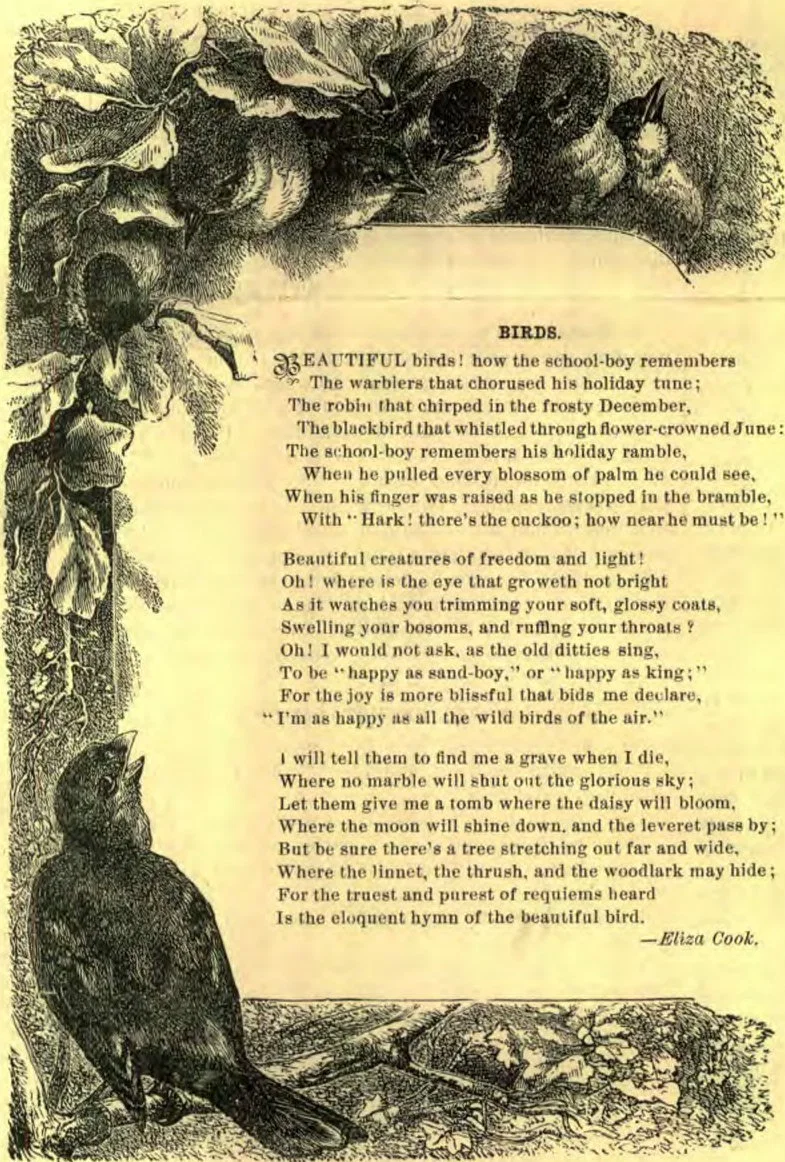
BIRDS
By Eliza Cook
BEAUTIFUL birds! how the school-boy remembers
The warblers that chorused his holiday tune;
The robin that chirped in the frosty December,
The blackbird that whistled through flower-crowned June:
The school-boy remembers his holiday ramble,
When he pulled every blossom of palm he could see,
When his finger was raised as he stopped in the bramble,
With "Hark! there's the cuckoo; how near he must be!"
Beautiful creatures of freedom and light!
Oh! where is the eye that groweth not bright
As it watches you trimming your soft, glossy coats,
Swelling your bosoms, and ruffling your throats?
Oh! I would not ask, as the old ditties sing,
To be "happy as sand-boy," or "happy as king;"
For the joy is more blissful that bids me declare,
"I'm as happy as all the wild birds of the air."
I will tell them to find me a grave when I die,
Where no marble will shut out the glorious sky;
Let them give me a tomb where the daisy will bloom,
Where the moon will shine down, and the leveret pass by;
But be sure there's a tree stretching out far and wide,
Where the linnet, the thrush, and the woodlark may hide:
For the truest and purest of requiems heard
Is the eloquent hymn of the beautiful bird.
— Eliza Cook.
BIRDS.
The Early History of Australia
By J. O. Corliss
THE EARLY HISTORY OF AUSTRALIA.—NO. 2.
In 1769 the English Government appointed Captain James Cook to command an expedition to the Southern Ocean, to observe from some point on that side of the world a transit of Venus that Kepler had predicted would take place that year. Accordingly a small vessel called the “Endeavor” was fitted out, and the great navigator started on his mission. Sailing westward round Cape Horn, the voyagers reached the island of Tahiti, where they observed the passage of Venus across the sun’s disc, and then departed for New Zealand. After making the circuit of these islands, the vessel was steered westward again, and in due time was anchored in an inlet on the eastern shore of Australia. Going ashore, strange plants and shrubs were found, and collected, which gave the place the name of Botany Bay.
In describing the country, Captain Cook said: “In the woods we found a tree which bore fruit that in color and shape resembled the cherry; the juice had an agreeable tartness, though but little flavor.” This fruit is still found in its native state, but is little used. It has been supplanted by the introduction of the finest varieties of the cherry from America and other countries, which grow quite plentifully, but are sold at high prices, as are all kinds of fruit grown here.
The voyagers were especially pleased with the brilliant plumage of the birds, that everywhere flitted through the forest. It seemed almost as though they had found a fairy world, and a veritable paradise. How deceitful are appearances! Notwithstanding the bright colored birds, and the beautiful flowers that abound in Australia, the curse rests just as heavily here as in other parts. Here wickedness abounds, and disease and death are as prevalent as in America. There is much here to make the heart sick were it not for the hope of a soon-coming Saviour to restore all things.
In 1772 a French adventurer, named Marion, sailed on a voyage of discovery to the Southern Ocean. Landing at Van Diemen’s Land, he was attacked and wounded by the natives while searching for fresh water. He then sailed for New Zealand, where a friendly intercourse sprang up between his crew and the natives. Being invited by a chief to spend a day ashore with his men, they were all surprised and killed. What led to such an act was not known for many years; but in 1851 a vessel was wrecked on the coast of New Zealand, not far from where the massacre of Capt. Marion and his men took place. Dr. Thompson, one of the shipwrecked party, says that he gathered from the natives the following version of the massacre: That Marion visited them, and that a strong friendship sprang up between him and the natives. He made them many presents; but before he departed, he violated their sacred places, cooked food with tabooed wood, and put two of their chiefs in irons.
This incident serves to show in what esteem the natives hold their religious ceremonies. It was, and may be now among some of the natives, for aught I know, customary for the chief of any tribe, as his fancy might dictate, to place upon certain kinds of wood a religious consecration. As long as the wood was thus tabooed, no one was allowed under pain of death to use it, or even touch it. When the French captain showed his disregard for their religious prohibitions, he was dealt with in a summary manner. The New Zealand native is to this day very strict in carrying out his religious convictions, and dislikes any one who performs his devotions carelessly or irreverently. In this respect, their example might be copied with much profit by many who have had far greater advantages religiously.
Melbourne, Australia. J. O. CORLISS.
THE ART OF CONVERSATION.
A GENTLEMAN who had given his only daughter great educational advantages was disappointed that she did not shine in conversation with his friends. “Why don't you talk?” he asked. “You chatter with the girls, but with people of sense you are silent.”
“I don't know what to talk about. Your friends are not interested in the things that interest me. The girls are.”
Here is the key to this problem of learning to converse. Be interested in that which interests your companion. If it is a child, make your conversation on a level with a child's comprehension, and about things that interest a child. If a philosopher be your companion, and you cannot interest or instruct him, be interested in learning from him. The importance of knowing a little of everything is emphasized by the necessity of meeting all classes of people.
“Did you ever sell dry goods?” asked a pert miss of a judge; “you seem to know all about ladies' wear.” “No,” was the reply; “but my mother, who was an invalid, taught me to do her shopping, and I have found the knowledge thus obtained invaluable in society and in my profession.”
I once overheard an elegant gentleman talking with an uncultured old woman about making soap, and showing that he knew something of the art, and was interested in learning more.
Sir Walter Scott made it a point to talk to every one he met upon some topic that pleased them. On one occasion he met, in a stage-coach, a man with whom he tried to converse upon every imaginable topic, but without arousing a response. Quite in despair, he exclaimed, “Is there anything you can talk about?” The man replied: “What do you know about bend leather?” Sir Walter confessed that he knew nothing, but he wanted to learn, and upon this topic found his companion intelligent and even eloquent. We are often told that to be a good conversationalist one must be a good listener; but to be a good listener is not to sit silent. It is to know enough of the subject under consideration to ask intelligent questions and listen understandingly to the replies.—Philadelphia Press.
A NOVEL ENTERTAINMENT.
At a social gathering, some one proposed this question: “What shall I teach my daughter?” The following replies were handed in:—
Teach her that one hundred cents make a dollar.
Teach her how to arrange the parlor and the library.
Teach her to say “No,” and mean it, or “Yes,” and stick to it.
Teach her how to wear a calico dress, and do it like a queen.
Teach her to sew on buttons, darn stockings, and mend gloves.
Teach her to dress for comfort and health, as well as for appearance.
Teach her how to cultivate flowers, and make and keep the kitchen-garden.
Teach her to make her sleeping room the neatest room in the house.
Teach her that tight lacing is uncomely as well as very injurious to health.
Teach her to regard morals and habits and not money in selecting her associates.
Teach her to observe the old rule: “A place for every thing and every thing in its place.”
Teach her the important truism: That the more she lives within her income, the more she will save, and the farther she will get away from the poor-house.
Teach her that a good, steady, church-going mechanic, farmer, clerk, or teacher, without a cent, is worth more than forty loafers or non-producers in broadcloth.—Pure Words.
The Air of a Good Mind
Good nature is the very air of a good mind; the sign of a large and generous soul, and the peculiar soil in which virtue prospers.—Goodman.
Customs of the Maoris.
By S. N. Haskell
The Maoris are very affectionate to their own tribes. They are indolent, unless stimulated by war or reward, yet they are very persevering to accomplish what they undertake. In times of war they show but little mercy toward their enemies.
When a Maori returns to his friends after a long absence, instead of meeting him with smiles and joyful faces, they receive him with tears and lamentations. These are intended to express the exceedingly painful state of their feelings while deprived of his company, sorrow for the death of such of his kindred as may have died while he was away, and sympathy with his real or imaginary sufferings, especially if he had just returned from captivity. The chiefs have a different custom from the common people. When two of them meet, a semicircle of their people is formed who perform the “tangi” for about an hour. They commence with an almost inaudible mourning,—a kind of whine, like ou, ou, ou, at the same time moving the head to and fro. Thus they work upon their feelings until they begin to shed tears like rain.
All of them, men, women, and children take a part in this. Their mourning is of the most doleful description. After this is over, the person who has returned takes his friends by the hand and presses his nose against theirs, rubbing noses with them all. Sometimes this continues about ten minutes, after which they are as jolly as other people.
The common people do not call their friends together to mourn with them, but they rub noses together, as a token of friendship, and because it is the fashion. They formerly had curiously constructed idols, which they worshiped with great devotion.
There are boiling springs in New Zealand in which the natives cook their food. They place it in flaxen baskets and put it in these boiling pools. The water is salt, so the food does not need any salting. They can bake or stew by simply scraping a hollow hole in the earth near the springs, placing the food in it, and covering it up so that the steam will not escape. They cover it with ferns and earth. Sometimes they bury the food in the hot-air passages in the ground. In places where there is no heat in the earth, they dig a hole in the ground and place stones in it. Then they build a fire on them, and heat them red hot. Upon these hot stones they lay the food which they wish to cook, and cover it with layers of leaves, ferns, and dirt. S. N. Haskell.
INSPIRED
WORDS are things. A word of common comfort may inspire a despairing man with hope. The shout, “Hold on! I’ll save you!” has given new strength to a drowning man. Miners imprisoned in a fallen mine have, when ready to perish from exhaustion, been made tenacious of life by hearing the voices of those who were digging them out. The following anecdote illustrates what sacred song may do to preserve life. On board the ill-fated steamer Seawanhaka was one of the Fisk University singers. Before leaving the burning steamer and committing himself to the merciless waves, he carefully fastened upon himself and wife life-preservers. Some one cruelly dragged away the wife’s, leaving her without hope, except as she could cling to her husband.
This she did, placing her hands firmly on his shoulders, and resting there until, her strength becoming exhausted, she said, “I can no longer hold on!”
“Try a little longer,” was the response of the wearied and agonized husband. “Let us sing, ‘Rock of Ages.’”
The sweet strains floated over the troubled waters, reaching the ears of the sinking and dying, and one after another of those exhausted ones were seen raising their heads above the waves, joining in the sweet, pleading prayer,—
“Rock of ages, cleft for me,
Let me hide myself in Thee.”
With the song came strength; another and another was encouraged to renewed effort. Soon in the distance a float was seen approaching! Singing still, they laid hold of the life-boat, upon which they were borne to the land. This is no fiction; it was related by the singer himself, who said he “believed Toplady’s sweet ‘Rock of Ages’ saved many another besides himself and wife.”—Exchange.
GLOOM AND LIGHT.
A WISE man in the East had two pupils, to each of whom he gave, one night, a sum of money, and said, “What I have given you is very little; yet with it you must buy at once something that would fill this dark room.”
One of them purchased a great quantity of hay, and cramming it into the room, said, “Sir, I have filled the room.”
“Yes,” said the wise man, “and with gloom.”
Then the other, with scarcely a third of the money, bought a candle, and lighting it, said, “Sir, I have filled the hall.”
“Yes,” said the wise man, “and with light. Such are the ways of wisdom, for it seeks good means to good ends.”
This teacher certainly had a droll way of instructing his pupils, but it was a very good way. They learned that it is one thing to fill and another thing to fill properly. One of them knew it before; the other seemed to know it—he was a simpleton. There are many such in the world.—Sel.
THE SECRET OF CONTROL.
THIS is a matter of the utmost moment, and one to which we cannot, with too much diligence, address ourselves. For, while in the case of all of us there is somebody over us, in the case of most of us there is also somebody under us, over whom we are expected, in a greater or less degree, to exert control; and yet, it may be we are sometimes almost driven to distraction by our conscious inability to do it properly.
How many a superintendent sees his school run riot before his eyes, and finds himself as impotent as that ancient Oriental monarch who undertook to control the sea, and the proud waves saucily laughed in his face, and compelled him to beat an ignominious retreat.
And how many a godly teacher, in the midst of an aggravating encompassment of irrepressible boys, finds life a burden, and so tempted to wish that he had never been born, or that the boys had never been, or that he and they were safe in heaven.
How to control them kindly, wisely, so as to make the most of them for time and eternity,—surely no graver question can be possibly considered by us.
A thousand prescriptions are suggested to us on every hand; and frequently the most forward in offering them, and the most dogmatically certain of the soundness of their suggestions, are the bachelors and spinsters, who have never had any children of their own to manage, even as the wisest war critics have commonly been those who never smelt powder, and never drew a battle-blade.
Whatever may be the wise way, it ought to be said there are several ways that undoubtedly are otherwise.
And one of these is fussiness and nervousness and jerkiness. You can ruin the best horse in the world that way; and the like is true of human kind. Coolness, firmness, gentleness, quietness,—this is the spirit that wins every time, if winning at all lies within the bounds of possibility. Take for example the superintendent of the Sunday-school: it is all well enough to select a “live” man to stand in so responsible a place, but the kind of life that finds expression in perpetual motion, in vociferation and gesticulation, and the perpetual “tintinnabulation of the bell,” is not the kind to be desired.
Another method that is anything but wise is the method of stern repression, tempered by no touch of sympathy or disposition to make allowance. God makes allowance for us, and why should not we for each other? We are assured in God’s blessed word, that “as a father pitieth his children, so the Lord pitieth them that fear him, for he knoweth our frame, he remembereth that we are dust.”
And one of the sweetest passages in the history of our Lord is that in which he apologizes, as it were, for the apparently unfeeling slumberousness of the disciples by saying of them tenderly, “The spirit indeed is willing, but the flesh is weak.”
Not long ago, we were escorted through the gloomy corridors of a famous penitentiary, where the reverence shown to the warden of the prison was something beautiful to see. Every convict’s cap was lifted, and every hardened face grew softer and brighter at his coming; and in the midst of all those desperate men he walked as safely as a father in the midst of loving children. And indeed, those felons called him “father,” because they were assured that as a father pitieth his children so the great-souled warden pitied them. Safely, we say, he moved among them; and yet we were reliably informed that his predecessor in the office never dared to make his daily rounds without being armed to the teeth and attended by a body-guard, and he needed both precautions to protect his life.
“Thrice is he armed that hath his quarrel just,” we are told on high authority. Fourfold is he armed who hath in his bosom a loving heart—at least it was so with this noble, paternal warden.
Very touching it was to hear him tell the pathetic story of many a convict’s life, and to see in every look, and to hear in every tone, the unmistakable evidence of the thoroughness of his sympathy with all these sons of sorrow and of sin.
There may be here and there some fiends incarnate, for whose betterment no kind of discipline will ever avail; but if control be possible at all, the secret of it lies somewhere in the lines along which we have been looking. These are the lines in which God works, as many a ransomed sinner knows full well who now rejoicingly exclaims: “Thy gentleness hath made me great.”—Baptist Teacher.
HOT SPRINGS AND GEYSERS.
WITH Nature’s wonderful exhibitions in earth, sea, and sky, how can it be otherwise than as Solomon stated in Ecclesiastes 1: 8,—that “the eye is not satisfied with seeing”? He must be dull indeed who can pass these all by inattentively. We want the INSTRUCTOR family to have an interest to look into Nature’s workshop for themselves, to see some of the things that are all the time being developed there; so we quite frequently direct the attention to some of her curiosities. This time we give you a few paragraphs about the way fire and water make geysers. It is an extract from an article in Harper’s Young People, and reads as follows:—
“No country in the world has more wonderful hot springs than our own. The hot water, filled with carbonic acid, which comes from the fires beneath the earth, has the power to dissolve certain minerals; these it brings up to the surface of the earth. The carbonic acid goes off in gas when it comes to the air, but the lime and other minerals, are allowed to settle; there they harden and form a cup from which the water drips down, forming limestone icicles or stalactites. Finally, cup after cup is formed in this way, most wonderfully ornamented. In one place in Italy such a spring, which is at the top of a hill, has encased the whole hill in a layer of stone formed from its settlings.
“In carbonated springs most of the lime settles at the bottom, as earth will in water; but there is a still more wonderful kind of spring which builds its own basin, and after awhile makes itself into a fountain. Such a spring is called a geyser. These are very rare, because it takes so many different things acting together to form them. They are the children of fire and water. Geysers are found in Iceland, New Zealand, and our own Western country. Those in the Yellowstone National Park, in Wyoming Territory, are perhaps the largest and most curious in the world. Indeed, that region abounds with wonderful examples of Nature’s handiwork, which must be interesting to all students of geology.
“A geyser begins by being a little hot spring; it ends by being a natural fountain. Geyser water has been put into a basin, and allowed slowly to dry up. It is then found that the settlings from this water are not on the bottom, but that, as the water dried, it left a solid rim around the basin, and as it sank, the rim broadened downward.
“In the geyser water there is a white and glassy substance that, as it settles, builds a cup for itself; when the water overflows the cup, it naturally runs out of the lowest place. Here the solid rim is built up by the glassy silica till that gets higher; the water then shifts and flows over the lowest place left, building slowly the lowest places in the rim, till, instead of a cup, it makes a high tube with a mound of silica all round it.
“Sometimes the water will lie quiet in the tube for a good while; but the fires beneath are turning water into steam, and when enough steam forms, it lifts the water in the tube, in its struggles to get out, until finally the water is thrown up into the air violently, like the jet of a mighty fountain. The steam escapes in a single burst or in several; the water sinks back and lies quiet for awhile, till steam is again formed, and the fountain jets again.
“A toy geyser can be made of an upright tube of iron filled with water, and two gas jets burning against the tube, one above another. Every different way that a geyser plays can be imitated on this simple little arrangement. It would take too long to explain why some geysers are too young to play, and why some are too old; why some play at fixed times, and others only when a clod of earth or something of the kind is thrown into the tube; but if you could see the experiment tried on the toy geyser, it would not be hard to understand.”