The Youth’s Instructor, Vol. 38, No. 6.

CONTENTMENT

The Youth’s Instructor

Feb 5, 1890

S. D. A. Publishing Association · Battle Creek, Mich. · Feb 5, 1890

CONTENTMENT

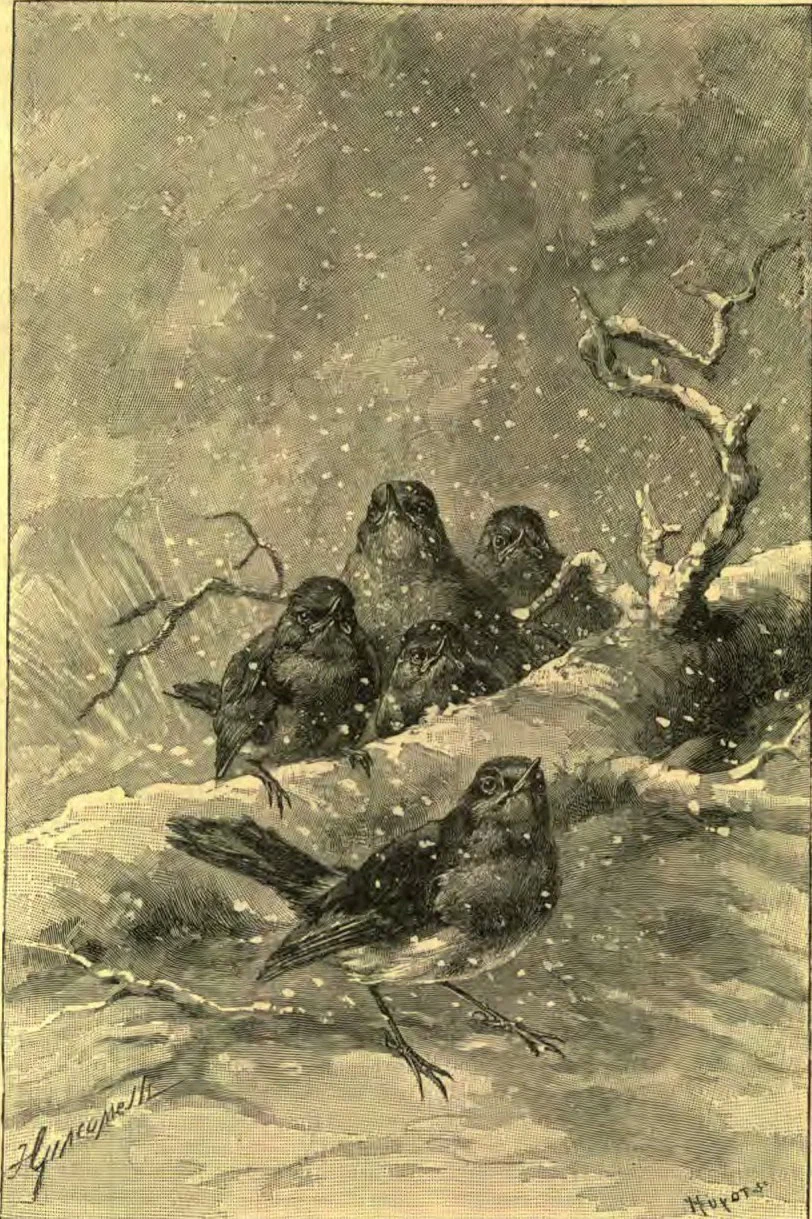
Tell me, little birds, why You stay when the snow is here? Have you not wings to fly To some happier atmosphere?
“We love the wild dance of the snow, And the berries, frosty and red; Why should we hasten to go, And here is our daily bread?”
“And if our notes are but few, When you think of the thrush and the jay, What can little birds do But sing on through the storm as they may?”
“Chirrup—chirrup—chee!” Perhaps some one is glad to hear Just this frolic whistle from us In the songless time of the year.” —Selected.

COUNTING THE JEWELS.

The king of one of the Asiatic countries—so reports a recent writer—causes all the royal jewels to be displayed before him twice a year, that he may handle them, count them, and gloat over their splendor. A certain portion of them belong, as is the case in most monarchies, not to the king personally, but to the crown. He cannot sell them nor give them away, a fact which may be supposed to lessen materially his enjoyment in handling them.
A Southern woman who died lately at a great age, and who had carried to the last days of her life a happy heart and a singularly gay temper, thus explained the mystery of her unfailing cheerfulness:—
“I was taught by my mother when a child to reckon each morning before I rose, the blessings God had given me with which to begin the day. I was not simply to say,—
“When all thy mercies, O my God, My rising soul surveys, Transported with the view, I'm lost, In wonder, love, and praise.”
but I was to count the mercies one by one, from the neat and serviceable shoes that covered my cold feet, to the sunlight shining on the hill-tops. My school friends, my play, my fun, my mother's kiss, the baby sister in her cradle,—all these I learned to consider separately, and of every one to say, ‘He gave it to me.’
“This practice taught me the habit of thankfulness. It kept my heart near to him, kept it light and happy. These every-day blessings were not to me mere matters of course, but special, loving touches from his paternal hand. No pain or sorrow could outweigh them.”
We all have a store of richer jewels than the heathen king; and, unlike the crown regalia, these jewels are our own, given to us by our Father.
How many of us, as the day begins, mutter over some perfunctory words of thanks which mean nothing? How many number their mercies, tasting the delight and joy of each, and out of glad hearts thanking the Giver?
And how many quite forget to think either of them or of him?
What better time than now in which to begin anew to cultivate a grateful temper? At the beginning of the year we are called upon, like the Oriental king, to spread out our jewels; and while we rejoice in their richness and beauty, let us not fail to be thankful to Him from whose bounty we have received them.—Selected.

ROUND THE WORLD.—6.

IN THE DIAMOND FIELDS.
The wealth of Southern Africa lies not upon the soil but beneath it. Especially is this true of the southwestern and northern parts. There are some rich farming districts, where good crops are grown, but they are not many. There are a good many places where the soil is rich, and would yield plentifully were it not for the great droughts and lack of water. Most of the farmers engage in cattle and sheep raising rather than agriculture. The land is principally owned by the Dutch, and they have immense tracts. Sometimes one man will own as many as 50,000 acres in one piece.
The Diamond Fields are six hundred miles north of Cape Town, and are situated in one of the most desolate tracts of country that I have ever seen. As far as the Ex River Mountains, about one hundred miles north of Cape Town, the land is good, there are prosperous-looking towns and many rich vineyards; but after crossing this range the “Kope” is entered.
Here the soil is of a reddish color, and covered with rocks and stones; there is not a tree or even a spear of grass to be seen; the whole country looks dried up, and we were told by some that it was over six months since there had been any rain. For miles and miles this country continues, without a single sign of life save here and there a flock of goats and a Kaffer kraal. This latter is a little round hut, perhaps six feet in diameter and the same in height, built of mud and stone. And here it is that the ancient inhabitant of the land makes his home. For a day and a half and two nights the trains run through this kind of country at the rate of fifteen miles an hour, and then Kimberley is reached.
It is here that the diamond mines are located, and a worse looking town can hardly be imagined. The streets run in every direction, as if they had been blown in there by a cyclone. The houses are for the most part built of iron, through the joints of which the dust sifts in a most unpleasant manner. We were told that there were public gardens, and went to visit them, but found only a barren plain surrounded by a few lonely looking century plants. There were a few willows, weeping willows at that, and well indeed may they shed their tears over the beauty-forsaken state of their country.
It seems that everything used in the town and surrounding country has to be imported, many of the articles of diet coming from America. This makes living expensive in the extreme. Bread is worth twelve cents per loaf, potatoes six dollars for one hundred pounds, and butter fifty cents per pound; so that though large wages are earned by the miners, most of it falls into the hands of the importers.
The wind blows hard during the greater part of the year, carrying with it a goodly quantity of red sand of the plain. This is so thick at times that it is impossible to see the houses on the opposite side of the street. The inhabitants call it the “Kimberly snow-storm.”
But there are plenty of diamonds. We went over the De Beers mine, one of the largest in the Fields. The mine itself is nothing but an immense pit, with many cables running down it, on which buckets are drawn up and down, containing the diamondiferous soil. It is then taken and spread out on large flats, and there left to be decomposed by the action of the air. After this process has been gone through, it is taken to the “wash,” where it is pulverized finely, and the diamonds taken out. There are several searchers. The first takes out only the largest of the stones, the second the next size, and so on, until they are as small as the head of a pin. Most of the mining is done by the Kaffers, and in the past the authorities have had great difficulty to prevent them from stealing diamonds. Now all who work in the mines do so under a contract, and during the time that they are under this contract, they are kept in the compound, and not permitted to have communication with the outer world. The compound is a large inclosure made of iron, where all the Kaffers live. We visited one of them, and had an inside view of the way in which the natives conduct themselves at home. They do all their cooking in the open air, and sleep out on the ground. Many of them do not wear any clothes, except a blanket thrown over their shoulders. They show but little intelligence, in fact, manifesting more the traits of an animal than those of man.
There are a great number of Jews in the Diamond Fields. They are chiefly engaged in diamond buying, and are known by the name of the I. D. B’s. These initials stand for “illicit diamond buyer.” The government demands a heavy license from all buyers of uncut diamonds. But the Kaffers steal the stones, and then take them to these Jews, who buy them for about half their worth, and thus make an immense profit. If they are detected at this, they are severely dealt with, the general term of punishment being seven years in the State’s prison. If an uncut diamond is found on the person of any one, the same punishment is inflicted. This law is frequently taken advantage of by wicked men. If they entertain a spite against any one, they manage to slip a diamond on his person, and then inform against him. There are those serving out their sentence at the present who are really innocent, and should never have been imprisoned.
We also visited the pulsator building, where the separating of the diamonds from the soil takes place. This is effected by means of large machines containing revolving cylinders. Into these the dirt is put, and washed and pulverized till all the slime passes out. Then what remains is placed upon tables, and the “searchers” commence their work of picking out the precious stones. It seems strange to think that there should be such an immense value placed on one of these small, white, glassy-looking stones, when there are other gems that are their equal in point of beauty; but the difference lies in the fact that diamonds are the rarest.
Diamonds are generally supposed to be white, but this is not always the case. They are found in every color of the rainbow, from crystal white to ebony black. We saw some “frosted” and “straw-colored” stones that were very pretty.
On the first of October we left the Diamond Fields, and returned to the Cape. The home journey was much the same as the out one had been. The trains are constructed on the English plan, small compartments with the doors opening in the side. However, the company do not require that more than four occupy a compartment, and as the upholstered back-rests pull up so as to form upper berths, the traveling is comparatively comfortable. We crossed the Ex River Mountains by moonlight; the train winds round and round among the rocks, and in the distance can be seen the snow-capped tops of the higher peaks. “Snow and South Africa” are not terms that are generally associated together; yet there is not only snow, but we are told that in winter in many places there are at times from one to three inches of ice. F. T. M.

TRYING TO TRUST JESUS, AND TRUSTING HIM.

A LITTLE girl eleven years old wrote down in her diary, one New Year's Eve, these words in large letters: “I WILL TRY TO TRUST JESUS MORE.”
She had been much discouraged because so many of her good resolutions during the year that had closed, had not been carried out, and with a troubled look on her face, she went to see a dear Christian friend. Her friend asked her what she was troubled about.
“It's about my New Year's resolve,” she said. “I cannot keep it; I made the same last year, yet I was always in trouble, always in the dark, and never happy very long.”
“What is your resolve?” was kindly asked.
“That I will try to trust Jesus more this year,” was her reply.
“Will you alter your resolution, my dear?” said her friend, with a sweet smile.
“How?” she asked, looking up quickly.
“By taking out that word ‘try,’ and just leaving the word ‘trust,’ with nothing but a hearty ‘I will’ in front of it.”
“Will that make any difference?”
“All the difference in the world, my dear. You would never dream of trying to trust me! You trust me simply, but perfectly. Now just stop trying to trust, and trust Jesus in the same simple way. Give yourself up entirely to Jesus, trusting in him for all the help you need every day of the coming year. He is not only your perfect pattern but your perfect helper. You are very weak, but he will be your strength, your ALL. Only do not merely ‘try to trust’ him; just trust.”
The little girl looked intently at her friend as she spoke these words, and a ray of sunlight seemed to beam on her troubled face.
“Trying is hard; trusting is easy,” she said, softly and slowly, as if speaking to herself. “I think—no, I am sure—I have been so busy trying that I have forgotten the trusting.”
“Do not waste time in merely trying to trust and to love, but let us go right on trusting and loving the Saviour; let us put our hands in his, willing that he should lead us, and we shall go on in the sunlight all the way. Remember, my dear, not ‘try,’ but ‘trust,’ is to be your motto.”
She at once changed her New Year's resolve according to her friend's suggestion; and in after years people were often attracted by the girl's sweet, peaceful face. If they ever asked her to what she owed the serene sunlight of her soul, she would smile and answer, “Just by taking one word out of my ‘New Year's resolve.’”—Young Reaper.

MOFFAT

One day a Scotch lad, not yet sixteen, started from home to take charge of a gentleman's garden in Cheshire, England. He bade farewell to father, brothers, and sisters, but his mother accompanied him to the boat on which he was to cross the Frith of Forth.
“Now, my Robert,” she said, as they came in sight of the ferry, “let us stand here for a few minutes. I wish to ask one favor of you before we part.”
“What is it, mother?” asked the son.
“Promise that you will do what I am going to ask you.”
“I cannot, mother,” replied the cautious boy, “till you tell me what your wish is.”
“O Robert,” she exclaimed, and the tears rolled down her cheeks, “would I ask you to do anything that is not right?”
“Ask what you will, mother, and I will do it,” said the son, overcome by his mother's agitation.
“I want you to promise me that you will read a chapter in the Bible every morning and evening.”
“Mother, you know I read my Bible.”
“I know you do, but you do not read it regularly. I shall return home now with a happy heart, seeing you have promised me to read the Scriptures daily.”
The lad went his way. He kept his promise, and every day read his Bible. He read, however, because he loved his mother, not from any pleasure he found in the sacred Book. At length, inattentive though he was, the truths he daily came in contact with aroused his conscience. He became uneasy and then unhappy. He would have ceased reading but for his promise. Living alone in a lodge in a large garden, his leisure was his own. He had but few books, and those were works on gardening and botany, which his profession obliged him to consult. He was shut up to one book, the Bible. He did not pray until his unhappiness sent him to his knees. One evening while poring over the Epistle to the Romans, light broke into his soul. The apostle's words appeared different, though familiar to him.
“Can it be possible,” he said to himself, “that I have never understood what I have read again and again?”
Peace came to his mind, and he found himself earnestly desiring to know and to do the will of God. That will was made known to him in a simple way. One night, as he entered a neighboring town, he read a placard announcing that a missionary meeting was to be held. The time appointed for the meeting had long passed, but the lad stood and read the placard over and over. Stories of missionaries, told him by his mother, came up as vividly as if they had just been related. Then and there was begotten the purpose which made Robert Moffat a missionary to the Hottentots of South Africa.—Religious Herald.

THE MOST SOUTHERN POST-OFFICE.

If one looks on a map—or, better still, if one tips up a globe—and finds Punta Arenas, in the Straits of Magellan, down near Cape Horn, one will see that it is the southernmost town in the world, the settlements on Cape of Good Hope and on all inhabited islands being farther to the north. It is not at Punta Arenas, however, that the southernmost post-office is located, but in a little sheltered nook in another part of the strait; for the harbor of Punta Arenas is so bad, and the Straits of Magellan are so stormy, that it is not often vessels can make a landing there; and as it is four thousand miles from the southernmost port on the west side of South America to the southernmost port on the east side, and as many vessels passing through the straits from one hemisphere to another have come from even more distant ports without having touched at land, it is natural that sailors should want a post-office to which they could go, no matter what the weather.
So in a sheltered nook on the mainland, about fifty years ago, a large tin box was placed and hidden so cunningly that the Indians have never found it. But there is not a shipmaster on all the southern seas who does not know where that tin box is, and who does not look forward with interest to a visit to it whenever he nears the Straits of Magellan. When a vessel comes to anchor opposite that place, all the sailors bring the letters they have written since their last stop in port, and the steward or the captain collects all the well-thumbed books and newspapers that have been so often read that nothing more of interest can be extracted from them, and all these are carried ashore to the tin box. How eagerly the captain looks over the contents of the box when he opens it! There are letters from every country on the globe, directed in all languages, to sailors on vessels of every sort which are likely to pass this way. If any are for the captain or for any of his men, he takes them out with delight; and then he looks over the papers and magazines that are there, selects those that have never been in the ship’s library, puts in the letters and old newspapers he has brought, closes the box, and hides it again most carefully. So one who has not been long at sea, far from any tidings from home or news of what is going on in the world, can imagine the delight of finding a letter in such a place, or even a newspaper two or three months old.
For fifty years this post-office has existed here, in this rocky nook on a stormy coast. It is said that its privileges have never been abused—that no sailor has ever taken a letter to which he had no right, or failed to place there for others the books and papers for which he had no further use.—W. C. Advocate.

Words Left Unsaid Between Loved Ones

WHAT silences we keep year after year With those who are most near to us and dear; We live beside each other day by day, And speak of myriad things, but seldom say The full, sweet word that lies just in our reach Beneath the commonplace of common speech; Then out of sight and out of reach they go,— Those close, familiar friends who loved us so;— And, sitting in the shadow they have left, Alone with loneliness, and sore bereft, We think with vain regret of some kind word That once we might have said, and they have heard. —Selected.

COMETS

It is somewhat singular, and even remarkable, that within the last twelve years about forty comets have been discovered by the astronomers of the United States,—making nearly four times the number found by the astronomers of the rest of the world. There are six comets now visible through the telescope. The most difficult one to find is Davidson’s, which last August was visible to the eye. The brightest at present, and the most interesting of any, is Brook’s. This comet has with it four attending comets, evidently thrown off from its own body, and following it. This phenomena has never been seen before.
Comets are exceedingly large, often thousands of times the size of our sun, yet astronomers, though enabled to apply some very delicate tests, have never yet been able to detect “mass” or weight to them.
The newest candidate whose appearance was recently announced in the press, is still too far away to determine the size, brilliancy, or direction of its course, or, in fact, anything concerning it. One can simply speculate. In fact, nothing definite can ever be announced in reference to a comet until after at least three accurate observations of its position have been taken. Astronomers, therefore, can tell us nothing about the past history or future course of the stranger for some time. They can only say that if its orbit proves to be elliptic, that is, oval, having a regular curve, then the comet belongs to our solar system, and has either appeared in the past, or will revisit the earth some time in the future; but if its orbit is a parabola or hyperbola, that is, with its curves having branches parallel with, and stretching out into, eternity, then it cannot and will not ever return. It cannot be told, as yet, what its distance is from the sun or our earth, but it is known that its distance from the former must be immense, because it is absolutely tailless, looking through the telescope as simply a faintly luminous mass of fog or haze, a sure indication of remoteness; and as it has no nucleus either, and is somewhat elongated in a direction opposite the sun, it is most positive proof of its great distance, and that it is assuredly approaching our sun. Observations show that the comet is moving slowly in a northeasterly direction.
W. S. C.

Practice Makes Perfect Only When Done Well

PRACTICE makes perfect, but perfection does not necessarily come from all practice. Everything depends upon the character of the practice. The oftener we do a thing carelessly, the more firmly we fix the habit of not doing that thing well—the harder we make it to do our best when need comes for the exercise of our highest skill.

HOW TOMMY PUT A TIMBER IN HIS CHARACTER.
TOMMY ATKINS had had a pair of skates given him at Christmas, and oh, how anxious he was to try them! But it seemed that everything was against Tommy’s desires. Instead of its snowing and freezing, as a respectable winter should, it rained and misted. Now it would be a little cold, and the wind would blow, and Tommy would begin to see something worth living for; but next day down would pour the rain in a most disheartening way.
Tommy grumbled and growled about the weather, and fretted and grew cross, just as though that would help matters. He would stand at the window with a great lump in his throat, watching the rain, and feeling that the Lord certainly didn’t care much for him, or he would change the weather.
“Why, Tommy!” said his little sister, on hearing his complaints, “don’t you suppose the Lord knows what is best for everybody? You’d be thankful if it would freeze and snow, but may be some poor little boys that don’t have even shoes would feel sorry.”
“Yes,” said mamma; “and besides, my son, you have a splendid chance to put a good timber into your building.”
“What building?” asked Tommy.
“Why, your character. Let me see, you ought to put the timber of patience in; for you think you are having a great deal of trouble, and the Bible says, ‘Tribulation [that means trouble] worketh patience.’”
“Well, a fellow has to be patient whether he wants to or not,” said Tommy.
“Oh, no! I see you have a wrong idea of patience. It isn’t patience to wait and fret and murmur. Patience is a beautiful grace that helps one’s very heart to wait and sing. Paul speaks of it as ‘joyfulness in tribulation.’ Now, Tommy, if you could say, ‘All right, just rain away; I’ll wait and be happy and thankful,’ and then look around to see what you could do to make others happy, and to serve God, you would really be putting a timber of patience into your building.”
Tommy thought this was very fine talk; but for all that, he still looked at the rain, and even helped it on by raining a few bitter tears himself. He muttered to himself that mother had never been a boy, and had never been in such a trying place in her life, so he wasn’t going to mind a word she said.
Tommy’s little sisters were playing house under a shawl, and they teased Tommy to come and be doctor, for one of their dolls was sick; but he said he didn’t care if the doll died, he wasn’t going to play baby plays any more. Tommy spoke so cross that his sisters looked very sober, and somehow they couldn’t have such a good time after that as they had had before.
When mamma wanted Tommy to bring in an armful of wood, he slammed the door, and so he kept spreading his selfish disappointment over the whole house.
But one morning Tommy’s sisters came to his bedroom door before he was up.
“Tommy,” they cried, “get up quick! it’s snowing! The ice will be sure to freeze to-day.”
It didn’t take Tommy long to dress, and he wanted to go right down to the pond before breakfast, but his mother bade him be patient, and do everything decently and in order.
The way Tommy ate his breakfast ought not to be imitated; for if it was practiced often, it would ruin the stomach. After breakfast Mrs. Atkins made Tommy wait for prayers, and then the chores had to be done, and then it was almost school-time.
“I don’t think the ice will be strong enough to skate on to-day, Tommy,” said his mother. “It is not very cold, so please do not go to the pond till to-morrow.”
Tommy was putting on his long boots, and his face grew very red, and he pulled the straps harder than he needed to.
“That’s always the way,” he said to himself, as he stopped in the woodshed; “mother is just as mean as she can be. I don’t care what she says, I am going to see how the ice is.”
Tommy didn’t kiss his mother good-by, and he was not going to wait for his little sisters, only his mamma called and asked him to.
The pond was near the school-house, a little way from the road, and so Tommy led the way to it. “Pshaw!” he exclaimed, “I believe that ice is plenty strong enough. I’m going out on it.”
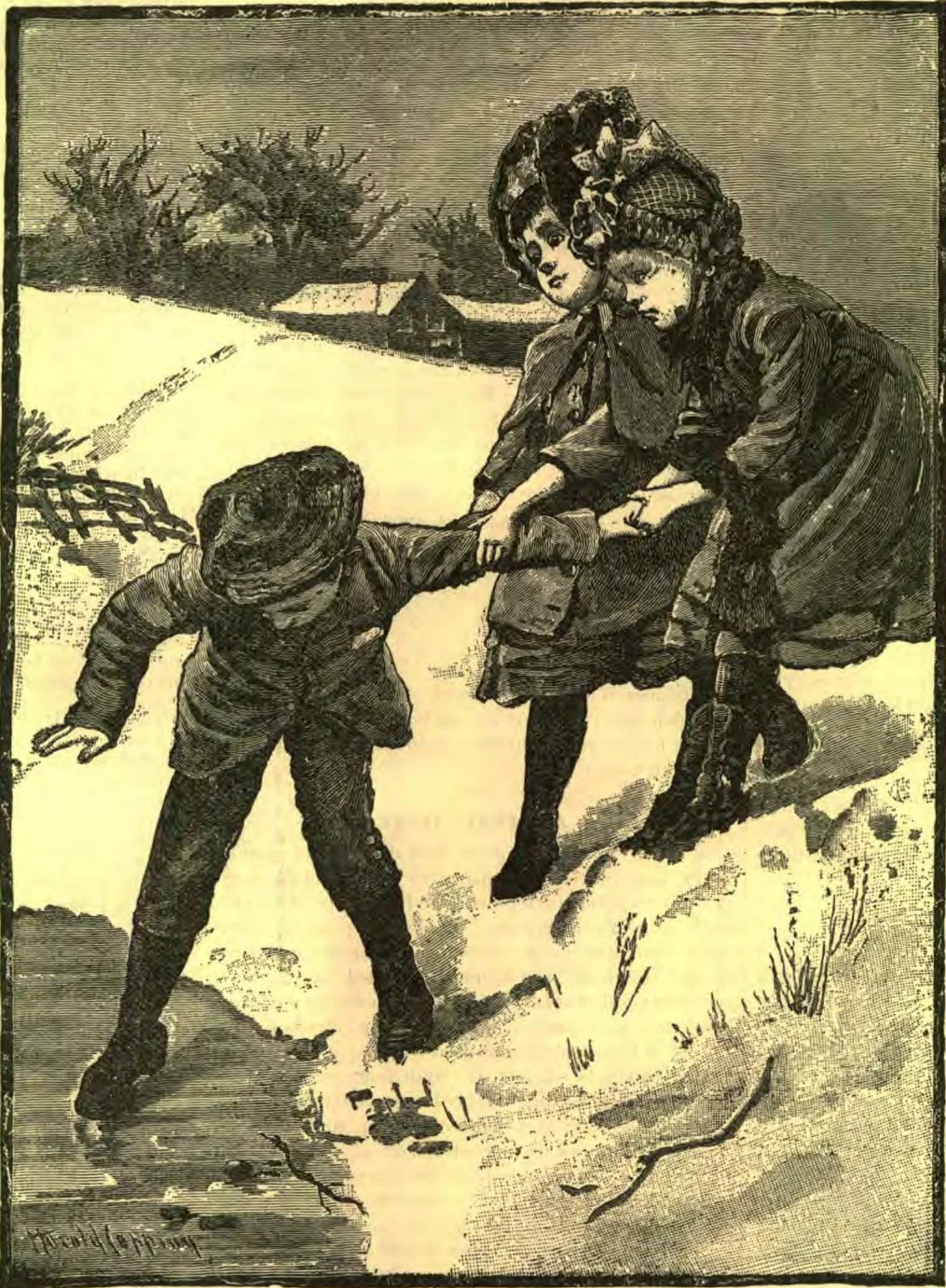
Tommy started out, but both his sisters begged him not to, and when he would go, they caught hold of his hand. Along the edge of the pond the ice seemed quite hard, but as Tommy walked out, it began to crack, and suddenly down he went. He had jerked his hand away from his sisters, and now he sunk in the water above his boot-tops. O how cold it did feel! The girls began to cry, and Tommy waded out.
“Hush!” said Tommy. “There’s nothing happened to make such a fuss about. I’ll just take my boots off and empty the water out, and everything will be all right. Say, girls, there’s no use of telling mamma about it. It will only worry her. I’m sorry enough I did it; but I’ll never do it again. You won’t tell on a fellow, will you?”
Blanche and Maggie looked at each other. They loved Tommy, and yet they didn’t want to do wrong.
“I wouldn’t be ‘tell-tales,’ if I were you,” said Tommy.
“All right,” said the girls, “if you don’t want us to, and it is all right, we won’t tell.”
Tommy sat in school all day with wet feet. The chills would creep up his back, and his face grew very hot, and oh, how his head did ache by night! Something else ached, too,—that was his heart.
He didn’t tell any one how bad he felt. He tried to do up his chores as fast as usual, and after they were done, his mamma told him she thought the ice would be safe to skate on, as it had grown so much colder. She was surprised to hear Tommy say he guessed he’d wait till morning.
Tommy went to bed early; but he could not sleep. His throat was sore, and how he did ache!
When mamma came up, and went around to see if her babies were all snugly tucked in, she found Tommy moaning with pain.
Mrs. Atkins had to go down again, and heat water, and wait on Tommy for several hours. As he felt her kind hands on his forehead, and heard her loving words, he felt as though his heart would break. He knew he had disobeyed her, and had thought she was a mean mother.
Mrs. Atkins examined Tommy’s boots and stockings, and knew what had brought on Tommy’s cold, but she did not say one word about it while he was so sick.
Tommy’s throat was very sore, but it didn’t feel as sore as his heart did. When Maggie and Blanche came up in the morning, he told them he wished they would tell mamma what he had done, but they thought Tommy would better tell her himself.
So, after awhile, when Mrs. Atkins brought him up some nice toast and cocoa, Tommy got hold of his mother’s hand, and sobbed out the story of his disobedience. Mrs. Atkins cried with Tommy, and then told him how he had grieved not only her, but his kind Father and loving Saviour in heaven.
Tommy wondered if Jesus could forgive him, and love him again. But when his mother told him how she had loved and pitied him before he told her he was sorry at all, and that Jesus was more loving than she was, he began to hope that God would forgive him.
Mrs. Atkins and Tommy had prayers together, and then Tommy went to sleep. It was a good many days before he was able to be up; and when he did get up, he could not skate; for if he went out in the cold, his limbs would ache, and the doctor said he had only just escaped having the inflammatory rheumatism.
When the boys went by with their skates that winter, and he heard their happy shouts from the pond, sometimes Tommy would sigh, but not a word of impatience or murmuring came from his lips. He knew he had cheated himself out of the good time by not learning his lesson of patience on the first trial.
Tommy concluded he must try to make others happy, so he would play doctor or nurse with his little sisters, and wind yarn for his mother, and Mrs. Atkins thanked God for the change she saw in her boy. His little sisters thought he was the nicest boy in the world, and Tommy himself said in after years that he wouldn’t take a thousand dollars for the lesson he learned that winter. FANNIE BOLTON.

A GOOD WAY TO READ.

Lord Macaulay says: “When a boy, I began to read very earnestly, but at the foot of every page I read, I stopped and obliged myself to give an account of what I had read on that page. At first I had to read it three or four times before I got my mind firmly fixed. But I compelled myself to comply with the plan, until now, after I have read a book through once, I can almost recite it from the beginning to the end.
“It is a very simple habit to form early in life, and is valuable as a means of making our reading serve the best purpose.”

ANECDOTES OF DUCKS.

The duck is considered a very uninteresting bird. Yet in intelligence, social kindness, and sagacity, he is vastly superior to others of the poultry tribe. I have kept and closely watched hundreds of ducks; I never saw them fight with one another, nor ever knew a duck the aggressor in a dispute with some other kind of fowl. But I have witnessed striking instances of charity and kindness in ducks.
Among some fifty or sixty head of ducks and fowls, I once had a solitary little old bantam hen. She became blind, or nearly so, and like other birds in that condition, “sulked,” that is, kept by herself in a dark, retired corner of the fowl-house, knowing that her cruel and cowardly brethren and sisters would persecute her to death if she appeared among them.
Here she might, perhaps, have starved, but for the constant and sympathetic attentions of a duck. Twice every day so long as the poor bantam lived, some three weeks, this Good Samaritan in the form of a duck was observed to fill her beak with from twenty to thirty grains of barley, with which she proceeded to the fowl-house, and there laid her store immediately in front of the bantam.
One more anecdote in evidence of the sagacity of the duck. I had five Alesbury ducks, with a number of fowls. The lord of the yard would never suffer the ducks to feed with his family and friends when, at the regular meal-times, the grain was scattered for their common use. Ferociously and without pity he drove them from the ground.
This had been going on for many weeks, and one day at the twelve o’clock repast, the act of expulsion was performed as usual. I was present, and saw the discomfited ducks retire to a corner of the yard. There they evidently held a conference. Having been so engaged some five minutes, they proceeded with a resolute air, in single file, as is their wont, toward their oppressor. Having reached the tyrant, they surrounded him, and with concerted action fairly hustled him clean out of the yard. The surprise of the cock as he jumped from side to side to avoid the pressure of the attacking party was ludicrous in the extreme. The victory was complete; from that hour the ducks were never again molested.
The general notion of the stupidity of the duck arises from his awkward waddling motion on the ground. He is not in his natural element on the dry earth. He navigates the water with rapidity, dignity, and grace. In his wild state, he is a perfect artist in aerial locomotion. Observe the fine, acute angle described by a flock of wild ducks in their rapid flight; with what perfect regularity they break up and reform when they change the direction of the route! And if “quack! quack!” is not a musical sound, the weird whirr of a company of ducks piercing through space certainly is.
A pretty little duck is the pochard, called also the red-headed poker, which is found on the English coast during the winter season. Its flesh is considered a great delicacy. When on the wing, it flies with great rapidity, and in flocks of from twenty to forty, commonly in a close, compact body, by which they are easily distinguished from the triangular-shaped flocks of the wild duck. The drake of this species is a handsome bird, and has a brilliant scarlet eye.—Selected.

HUMILITY

GRIEF lives in the estate of kings, And care will seek a haughty place; Joy comes to dwell with common things; And happiness the swallows chase, When grasses wave on dewy lawn, And opens the great lid of dawn.
Childhood and joy are with us still, Though fortune frown upon our state; The feet of Spring return, to fill The rounding fruit, whate'er our fate; And still the summer's cloudless blue Opens to let the white birds through.
Then climb not toward the steps of a throne; A canopy must veil the sky. From the green field we do not own, We yet may watch the wild birds fly; There shall remain the ancient heaven Once unto the child-heart given.
—Selected.

THE FREAKS OF GENIUS.

Pliny relates the following characteristic anecdote of two famous painters of antiquity: Apelles having proceeded to Rhodes to visit Protogenes, who lived there, went immediately to his house; but not finding him at home, in order to let him understand who had called, he took a brush and drew an exceedingly fine line on a piece of canvas. An old woman, the housekeeper of Protogenes, did not fail to inform him on his return that there had come a man asking for him, who, instead of telling his name, made a stroke on canvas. Protogenes, casting his eye upon this line, knew at once that it could be the production of no other but Apelles. But tracing another with still greater nicety, and of a different color, above the first, he went abroad again, ordering his housekeeper to show it to the stranger, if he should return. Apelles came back immediately after, and drew a third line above the two former, in such a style that it was impossible to make one more delicate. Protogenes, on his return, acknowledged that he was beaten, and that it was not in his power to draw a finer line than this last. He hastened to the harbor to find out his guest, and received him joyfully. The piece of canvas was carefully preserved, and became the admiration of posterity, particularly of the masters of the art. It was still to be seen at Rome in the time of Augustus, and people went to behold with astonishment a large piece of canvas where there was nothing but three lines, so delicately touched as to be scarcely perceptible; but it was burned in a fire which broke out in the palace.—Selected.

A MATTER OF INTEREST.

Not long ago Philadelphia and Baltimore vied with each other in showing honor to the brave English sea captain who had saved the seven hundred shipwrecked Danes.
Captain Murrell himself was the only man in the country who seemed to think the fuss they made over him was uncalled for. Everybody else thought his promptness of action, the trying responsibility he took on himself, the great labor he underwent, and his clever and successful seamanship were worthy of all praise. Now in the course of festivities given in his honor a most interesting fact appeared, though the hero of the hour was as modest about that as about everything else. Captain Murrell and his officers were all temperance men. Not only temperate, you understand, but total abstainers; they drank their toasts in pure water.
Had not this fact something to do with the clear-headedness of orders given and obeyed, with the high, unselfish motives that prompted the deed, and the steady nerves and unfaltering hands that executed it? Who can doubt?
Continue reading: ARTIFICIAL IVORY