The Youth’s Instructor, Vol. 32, No. 47.

THE DOME OF THE ROCK

The Youth’s Instructor

Nov 19, 1884

S. D. A. Publishing Association · Battle Creek, Mich. · Nov 19, 1884

THE DOME OF THE ROCK.
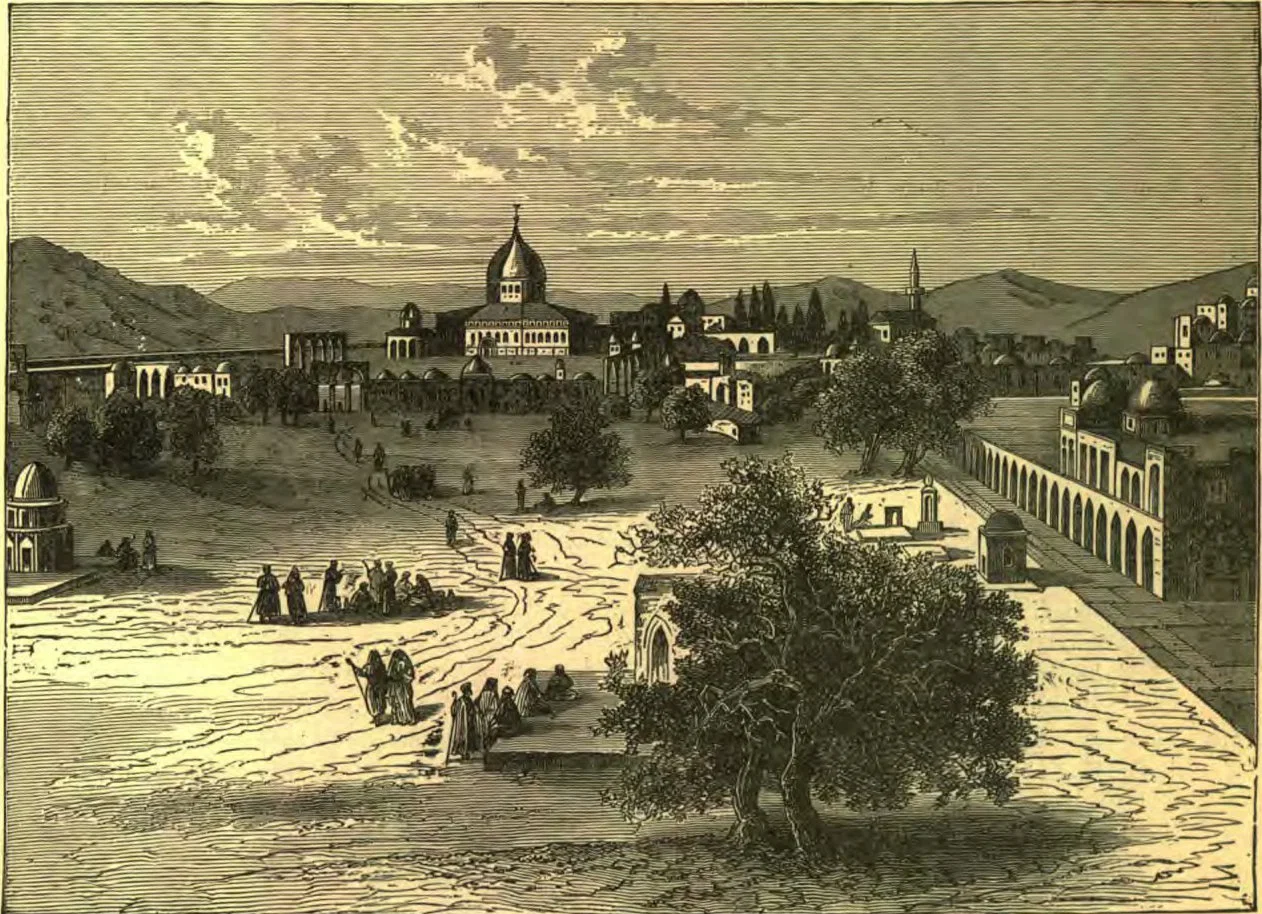
One of the most memorable spots on earth, the place on which, more than on any other, the glory of God through long ages rested, is Mount Moriah. Hither came Abraham, obedient to the voice of God, to offer, if need be, his only son upon the altar. Here, it is commonly believed, stood the threshing floor of Araunah the Jebusite, whereon King David offered burnt offerings, when the destroying angel, with uplifted sword, stood over the doomed city. And the Lord answered him “from heaven by fire upon the altar of burnt offering.” “Then David said, This is the house of the Lord God, and this is the altar of burnt offering for Israel; and he set to work hewing stone and collecting material for a house unto the Lord. David was a mighty captain, who “had shed much blood and had made great wars.” He had thus unfitted himself for this great work, and by divine command it was left for his son Solomon. On this ground, in after years, Solomon erected a house for the Lord, a temple “exceeding magnifical, of fame and of glory throughout all countries.” The plan of this temple and its surroundings has been so fully described in former numbers of this paper that a mere mention of it may be sufficient.
Moriah is one of the few places in Palestine that can with certainty be identified. Hence everything pertaining to its present condition is of interest to the Bible student. It is not a spot that the traveler may visit when he will, as he can most of the other places of interest in Palestine. The fanatical Moslems guard the place with great jealousy, and for years would not allow a Christain to enter, on pain of death. Now, however, it can be visited with suitable permits.
To obtain an area sufficiently broad for the temple and its courts, massive walls had to be built up from the sides of the mountain. In the space between the mountain and the walls, chambers were built. These chambers had very thick walls, and the roof was supported by many pillars. Then the remaining space was filled in with soil that had been scraped from off the mountain in order to bring the top of the mountain down level with the wall. In the midst of this broad space stood the magnificent temple of Solomon, that in later years was enlarged and beautified by Herod the Great.
All this has passed away. In its place now stands an octagonal building surmounted by a dome. This is the Mosque of Omar, or the Dome of the Rock. A view of this building is shown in the center of our picture. The Mosque is over five hundred feet in circumference. On the outside it is covered with tiling and colored marble. Inside, the dome is covered with gold and delicate tracery. Beautiful mosaics and passages from the Koran everywhere cover the walls. The subdued purple light that falls slanting through the gorgeous windows to the floor, the sacred associations of the place, and the solemn stillness combine to move the imagination and touch the feelings of the visitor.
This building, however, is only a covering to the object of interest. Inside the twelve pillars that support the dome is a space sixty feet in diameter. This is inclosed by an iron railing and lattice work, and overhung with a fine canopy of crimson silk. Within this enclosure rests in solemn silence a huge rock, the bare summit of Moriah. On this rock, in the ages so long gone by, stood the altar of burnt offering, or, according to some authorities, the ark of the covenant. The visitor is not allowed to enter this sacred enclosure, but he may thrust his hand through the lattice, and touch the cold stone.
Doubly sacred is the place to the Mohammedan; for from this rock, we are told, the prophet Mohammed took his upward flight, when, one night, he ascended to heaven, and like the Apostle, beheld things unspeakable. And the traveler is shown the impression of a large hand said to have been made by the angel Gabriel, as he prevented the rock from following the prophet upward. Beneath this enclosure is shown the little cave where Mohammed prayed.
The grounds around this building, as you will see in the picture, are dotted with mosques, prayer-houses, and colonnades. The profound stillness that reigns throughout is in keeping with the sacredness of a spot, where, for long years, the only living and true God was worshiped.
W. E. L.

NOVEMBER

Another year has nearly fled, November’s growing old, His snowy locks we almost see Amid the strengthening cold.
The bleak winds whistle through the trees, And tell us winter’s nigh; And from the forest’s naked heart We catch a mournful sigh.
But by and by Thanksgiving Day Will bring its well-known treat And then our merry boys and girls Will deem their joy complete.
We watch the snow-flakes coming down, A-whirl in every gust; And soon the fairy robe of white Will hide the earth’s dry dust.
Then welcome to the winter fires, Its evenings sweet and long, When, gathered round the bright hearthstone, We join in happy song. M. A. S.

DAN'S CONSCIENCE.

Pshaw, old fellow! Throw it off! What's the use? You didn't mean any harm, and all-your fretting won't make it any different. Just throw it off, I say. The whole thing will blow over in a few days, and there'll be no more said about it.
“But I can't throw it off, I tell you, and I don't want to! I've done a mean, disgraceful thing, and I haven't the courage to go to the Doctor and own up. I know he'll despise me if I do, and I'll despise myself if I don't.” Dan leaned gloomily against the fence as he spoke, and light-hearted, easy-going Harry looked at him curiously as he saw the signs of real trouble in his friend's face.
“Go to the Doctor!” he repeated, with a long whistle. “Before I'd do that! Why, Dan, he'll never dream it was you! The Doctor swears by you, and you'd better not lose your reputation with the old fellow; he's so awful on truth and honor, and all that!”
“Yes, I know all about it, and I'd never think about confessing if I hadn't got a conscience hid away somewhere! That's what bothers me. I've come out here this afternoon to think it out, and get my own consent to walk up to the Doctor and out with it. I'd rather run away and go to sea!”
“I don't see what difference it makes whether the Doctor knows it or not,” said Harry, as Dan turned and walked away.
Harry saw that he wasn't wanted longer, and started off in an opposite direction, whistling as he went.
“Dan's a tip-top fellow, but sort o' weak-minded about some things. Gets it from his mother and sisters, I s'pose,” commented Harry.
What was Dan's trouble? Just this: It was a law at Lyndhurst Hall that acts of trespass upon the rights of others should never, under any circumstances, be committed by the boys. The Doctor was strict about this, and his pupils learned to share his views upon the subject, and to look upon it as low and mean to the last degree to meddle with what was not their own. “The Doctor,” as he was always called, was a hero among his boys, and he in return loved and trusted them to a great degree. And he had reason to do so, for they were as fine and manly boys as are often found. When a lad who was sly and tricky found his way to Lyndhurst Hall, he felt himself in a new atmosphere. Sometimes it didn't suit, and when that was the case, the boy did not usually stay very long; but in most cases he fell into the ways of honor and good feeling which prevailed there, and learned to “keep to the right,” because it was the right.
Dan Hastings was one of the older boys in the school, and one who had a very high standing. He didn't believe he could do a mean, underhanded thing, and perhaps this very reason made it necessary for him to find out that the goodness which isn't taken fresh each day from God's own hand is worth very little. Dan had grown to believe that he had a sort of goodness of his own that he could depend on, and, of course, he was mistaken.
One day Dan and half a dozen other boys had set out to gather “specimens” for the botany class. Their way led past Deacon Sutton's house. The deacon was a little wiry man, with a cracked, rasping voice, with no faith whatever in boys. Nothing could persuade him that the boy-nature was not always and everywhere deceiving and destructive.
“Neow, boys, don't ye go through my apple orchard,” or, “Neow, boys, don't ye stun them chestnut trees,” or something of the sort, was the usual greeting to the Hall boys.
“There's old ‘Neow Boys,’” remarked Sam Wells.
“Wonder what he'll say now!” said Ralph Dow.
They did not need to wonder long.
“Neow, boys,” called out the old man, “mind ye don't go near my patch o' watermelons!”
As the lads were walking peaceably along the highway, the warning seemed unnecessary, and they only laughed as they passed along. But Dan's spirit was roused by the old man's suspicious taunt, and he suddenly exclaimed, “I'd like to go through his old watermelon patch just to pay him off for his meanness;” and at once every boy was excited, and cries of “Let's do it!” “This very night!” etc., followed.
It did seem as if those high-minded boys forgot all their lofty ideas of honor; for that very night, headed by Dan, they “went through” the deacon's watermelon patch, ruthlessly destroying the green fruit, and cutting open the ripe melons without so much as taking one bite! This last was in accordance with their ideas of “honor.”
A storm came on before morning, and the deacon was suddenly called from home before the day was over, and so it happened that three days passed before the watermelon patch was visited. In his heart the deacon believed that “them plaguey boys” had done the mischief, and went to the Doctor accordingly in great wrath; but when the Doctor stated the case to the school, and asked the delinquents to confess, if they were present, not a word was said.
“I cannot believe that any of my boys are guilty of this trespass,” he said, after a pause, “but I feel assured that if such is the case, I shall know it in due time.”
It was these words which rankled in Dan's conscience, and made him miserable. He justly held himself accountable for the wrong, since he had proposed it, and had headed the band. And now he felt that he could never look himself in the face again until he had gone to the Doctor, taken the whole blame upon himself, and submitted to any form of disgrace that might be prescribed. You don't believe it was an easy thing to do, boys? No; but Dan fought it out that afternoon alone, after Harry left him, and when he went back to the Hall, it was with the peace of a settled mind.
After all, it wasn't so terribly hard to confess as he had expected. The Doctor seemed to understand, and though he was very grave, Dan went away feeling that he hadn't forever and fatally lost his place in the Doctor's esteem.
The wise teacher did not ask Dan to confess anybody's sins but his own, but he did tell him that he should expect him to use his influence with the depredators to pay for the mischief as far as possible. Fortunately it was a very small “patch,” and the boys made a liberal allowance for the melons destroyed, cheerfully devoting their quarter's allowance to the purpose.
“May be it'll do the deacon good,” said Sam Wells, “and teach him to stop his growling at us.”
And it did! Dan headed the party that went to the old man's house, and confessed the deed, and also told just what put it into their heads. And it is recorded that he never again called out “Neow, boys!”
But no one got more good out of the whole miserable business than Dan himself, for he saw that he couldn't trust himself, and learned to look away from his own strength and goodness to the only real goodness, which can never be our own, lest we should learn to trust in it, but which must be received every day fresh from the hand of the only good One.—The S. S. Advocate.

Foreign Travel: From Copenhagen Through Hamburg and Berlin to Basel

FOREIGN TRAVEL.—NO. 21.

FROM COPENHAGEN THROUGH HAMBURG AND BERLIN TO BALE.

Upon our return from Sweden, on our way to Bâle, we again passed through Copenhagen, the capital of Denmark, and some portions of Germany. Denmark is but a very small country. Some years ago, as we mentioned in a previous article, the Germans took from the Danes that portion of their country lying next to Germany,—the provinces of Schleswig and Holstein, thus depriving Denmark of quite a portion of its territory. The people did not like to make the change, but force is a mighty factor in this world. Now the Germans require that all the children of these provinces shall learn the German language; but the language of their forefathers is not permitted to be taught in the schools; so they will all come up good Germans after a little, we suppose.
The country through which we passed is quite well settled. In several places we observed the people digging their firewood out of the earth in the form of peat. The process was quite interesting to us. The peat beds are composed of vegetable matter which has lain for ages in the localities where it is found. In some places it is from five to ten feet in depth, soaked full of water. They cut it out something in the form of bricks, wheel it out to the surface, and dry it in the sun; afterward they use it as fuel. It produces great heat, and there are many people in the old country who use it more than any other fuel.
The country on the southern border of Denmark is quite pleasant, and affords as beautiful patches of beech timber as we have ever seen.
After riding all night from Copenhagen, some of the way by railroad, and some of it by steamboat, crossing the channel between the different islands of which Denmark is composed, we reached the city of Hamburg, Germany, about 9 or 10 A. M. This is a city of about 275,000 inhabitants, and, including the suburbs, of about 500,000 people. Next to London, Liverpool, and Glasgow, it is the most important commercial city in Europe. Over 5,300 vessels entered its port in 1878. The trade of all Northern Europe centers here, and it is the great port of entry for the German Empire. We had no time to stop and look at its interesting objects, as we were hurrying on our way southward.
The scenery, after leaving Hamburg, was very beautiful. For twenty miles we passed through the most lovely groves of beech and evergreen we ever saw. These afford the pleasure seekers of Hamburg fine opportunities for recreation, as they contain beautiful drives over the finest and smoothest roads to be found in the world. Prince Bismark has a large estate in this vicinity, where he resides a portion of the time.
From Hamburg to Berlin is about 178 miles. The country is almost a dead level, with scarcely a hill to be seen the whole distance. The soil, however, did not look very rich, but the country was quite thickly settled.
Berlin is one of the largest capitals in Europe. It contains 1,100,000 people, and rates the third city in population in Europe, London and Paris alone exceeding it. It is situated on an extensive plain, and contains the royal residence, many palaces of the nobility, and some of the finest public monuments to be found in the world. It is the greatest manufacturing town on the continent. It excels in engine building and dyeing of woolen and silk. It is first noticed in history in the thirteenth century. Since that there was a gradual growth till Frederick William, the great elector, in 1650 added greatly to it. He invited many of the French Protestants, who were driven from their own country by the revocation of the edict of Nantes, to settle here. These were driven out of Catholic France by the cruelty of their king, and the great elector manifested his wisdom in inviting such a moral class of people to settle in his capital. Frederick the Great in 1740-86 added to it many fine buildings, employing the best architects within his reach to erect these public structures. The present emperor, William, has made it one of the great capitals of Europe. The population has more than doubled since 1861, when he ascended the throne.
We saw no city in Europe which we liked so well on the whole as Berlin. London is larger, but it is smoky, foggy, and not very beautiful. Paris contains more works of art, and in some respects is more beautiful; but Berlin seems more wholesome, and we liked the appearance of everything better.
The most important street in the city is named “Unter den Linden,” [meaning, beneath the lime-trees]. It is one of the most magnificent streets we ever saw. It is about one mile in length, and 196 feet in width. It derives its name from the avenues, lime-trees interspersed with chestnut running its whole length. The center of this great avenue is a wide walk or promenade for foot passengers, lined with fine rows of trees on each side. On both sides of this are two streets unpaved, for horsemen, and next beyond, two wide streets, well paved, for carriages, wagons, etc., then wide side-walks between the buildings and the carriage-ways. The palaces of the princes and emperors, etc., and the finest buildings in the city, are situated along this great avenue. It extends from Brondenberg gate to the statue of Frederick the Great, the finest equestrian statue in the world. This statue was begun in 1840, and completed in 1851, when it was inaugurated. It is forty-four feet in height, surmounted by a statue of the great king on horseback, in his coronation robes, the figures of the army, and other armies contemporary with him.
The principal buildings of the city are the palace of the Emperor William, the University building, the Royal Library, with 900,000 volumes, 15,000 manuscripts, among which are the first impressions of Luther’s Bible. Among other interesting objects is one very remarkable monument,—a statue of victory, erected to commemorate the great victories of the German nation in the late European wars. We should judge it was nearly 200 feet in height, surmounted by an elegant image of victory. The monument is made of the finest polished stone, immense in size, and contains the records of the most famous battles of the late wars, and several battle scenes engraved in the stone.
We saw some of the most beautiful parks and flower-gardens in Berlin that our eyes ever beheld. As we come up to the city, there is a magnificent forest of hundreds of acres of the finest trees. It is laid out in parks with beautiful drives, containing zoological gardens, and many other objects of great interest.
We were struck with the intelligent appearance of the people of Berlin. They are a large, fine-looking race, with clear complexions, and look like a people who felt their importance in the world, and expected to maintain it. I had only a few hours to spend in Berlin, but enjoyed them better than the time usually spent in sight-seeing.
In returning to Bâle from Berlin, we passed over the very best part of Germany rapidly by rail. We saw the famous Wartburg Castle in the distance, where Luther spent months of imprisonment, according to the arrangement of the elector, that he might be kept from the power of his enemies. The great reformer spent this time in translating the Scriptures into the German. This proved to be one of the greatest blessings to the world ever known in history.
We passed by many famous cities, but had no time to stop and see the interesting things connected with them. Germany is a great country,—probably the strongest empire now existing in the world. Its soldiers are trained in the strictest discipline. Fortifications appear in connection with every important city. They seem to be a fine people. Were it not for the tobacco used, and the beer drank, they would compare most favorably with any nation on the face of the earth, and undoubtedly they do already. Here all the youth have to become educated, the law being very strict in compelling every boy and girl to attend the public schools. So among the younger class of Germans there is no one who cannot read and write. The same is true of the Scandinavians, and other Northern nations. By this means the people are generally intelligent. UNCLE IDE.

IN AFTER YEARS.

The hand that lies upon your brow, And fondly clasp your own; The smiles that greet you gently now, The voice of kindly tone; The patient heart, eager to please, To soothe away your tears— Dear childhood! you will think of these In after years!
The fairy-land of youthful joy Soon vanishes from sight, And time will many a dream destroy That dazzles with delight! What can replace a mother’s kiss— The love that hushed your fears? Ah, Childhood! you will think of this In after years!
Ambition’s proud and fiery race May win the heart awhile; We never can forget one face, One pure and hallowed smile! God grant we may not, while we rove, Look back, ’mid blinding tears, Upon a mother’s slighted love— In after years!
—George Cooper.

IMPORTANT BIBLE SUBJECTS.

LESSON 21.—CHRIST'S DESCENT INTO HADES.

[NOTE TO THE STUDENT.—Do not consider the lesson learned until you can give at least the substance of every text, with the correct reference for each. The references in black letters indicate those texts that should be committed to memory. A little diligent application each day will enable you to do this.]
1. UPON whom did Christ pronounce a special blessing? Matt. 5:10.
2. For what did Peter say it is better to suffer? 1 Pet. 3:17.
3. For what did Christ once suffer? Verse 18.
4. For whose sins did he suffer? Isa. 53:5.
5. Why did he thus suffer? 1 Pet. 3:18.
6. How did he suffer for our sins? Ib.
7. By what was he made alive? Ib.
8. To whom is it said that Christ preached? Verse 19.
9. By what agency did he preach to the spirits in prison? Verses 18, 19.
10. Who are they who walk at liberty? Ps. 119:45.
11. Then who may be said to be in prison?
12. When was it that Christ by the Spirit preached to those disobedient ones? 1 Pet. 3:20.
13. Did the Spirit of God indeed strive with the antediluvians? Gen. 6:3.
14. When did the Spirit cease to strive with them?
15. To what place do the dead go? Ps. 89:48.
16. Where did Christ go before he ascended to heaven? Eph. 4:9.
17. Did the same Jesus that ascended to heaven also descend into the grave? Eph. 4:10.
18. Did the soul of Christ go into the grave (hades)? Acts 2:29–32.
19. What Scripture proof can you give that Christ did not preach while in the grave?
20. When we read that Christ suffered for sins, “being put to death,” does it mean that the soul of Christ suffered even to death? Matt. 26:38; Isa. 53:10, 12.
21. What had the Lord promised concerning death? Isa. 25:8.
22. How only could he destroy death? Heb. 2:14.
23. If Christ himself had not died, what would be the condition of the human race?

NOTES.

Since only those walk at liberty who keep the commandments of God, all sinners may be truly said to be in bondage, in prison. Peter says that “of whom a man is overcome, of the same is he brought into bondage.” 2 Pet. 2:19. The preaching of the gospel is for the purpose of setting at liberty these captives to sin. Christ said (Luke 4:18) that his mission was “to preach deliverance to the captives.” For this purpose the Spirit of the Lord was upon him. All successful preaching must be done by the Spirit, for it is only where the Spirit of the Lord is that there is liberty. 2 Cor. 3:17. The passage under consideration (1 Pet. 3:18–20) tells us what is also recorded in Gen. 6:3,—that the Spirit of the Lord was striving with the sinners in the days of Noah. The length of time during which the Spirit would continue to strive with them is plainly indicated: “And the Lord said, My Spirit shall not always strive with man, for that he also is flesh; yet his days shall be an hundred and twenty years.” The only possible meaning to be drawn from this is that when man's days should end, at the expiration of the one hundred and twenty years, then the Spirit would cease to strive. Death ends the probation of all men.
We are told that Christ suffered for us, that he was “put to death,” that he “poured out his soul unto death,” and that “his soul was not left in hell” (hades, the grave). These facts are the only ground of the Christian's hope. It was only through death that he could destroy death, and him who had the power of death. Now if it could by any possibility be proved that the very same Christ who is now at the right hand of God, did not himself die and go into the grave, then the whole human race would be left without a divine sacrifice, because Christ would be pleading, not divine, but human blood, and this never could avail to save them from death. The gospel rests on the simple fact that the divine Son of God died; any denial of that fact is an attack upon the truth and power of the gospel.

REWARD OF UNSELFISH SERVICE.

THROUGH Rochester, N. Y., runs the Genesee River, between steep and rocky banks. There are falls in the river, and dark recesses. One time a gentleman who lived in the city had just arrived on the train from a journey. He was anxious to go home and meet his wife and children. He was hurrying along the streets with a bright vision of home in his mind, when he saw on the bank of the river a lot of excited men.
“What is the matter?” he shouted.
They replied, “A boy is in the water.”
“Why don’t you save him?” he asked.
In a moment, throwing down his carpet-bag and pulling off his coat, he jumped into the stream, grasped the boy in his arms, and struggled with him to the shore, and as he wiped the water from his dripping face, and brushed back the hair, he exclaimed, “O God, it is my boy!”
He plunged in for the boy of somebody else, and saved his own. So we plunge into the waters of Christian self-denial, labor, hardship, reproach, soul-travail, prayer, anxious entreaty; willing to spend and be spent, taking all risks to save some other one from drowning in sin and death, and do not know what a reflexive wave of goodness will come to our own souls.—Selected.

Additional Notes on Sabbath School Department

☞ For additional notes, see the S. S. department in the Review for Nov. 18.

LITTLE CHRISTEL.

Fräulein, the young schoolmistress, to her pupils said one day, “Next week, at Pfingster holiday, King Ludwig rides this way; And you will be wise, my little ones, to work with a will at your tasks, That so you may answer fearlessly whatever question he asks. It would be a shame too dreadful if the king should have it to tell That Hansel missed in his figures, and Peterkin could not spell!”
“Oho! that never shall happen,” cried Hansel and Peterkin too; “We’ll show King Ludwig, when he comes, what the boys in this school can do.”
“And we,” said Gretchen and Bertha, and all the fair little maids Who stood in a row before her, with their hair in flaxen braids, “We will pay such good attention to every word you say, That you shall not be ashamed of us when King Ludwig rides this way.”
She smiled, the young schoolmistress, to see that they loved her so; And with patient care she taught them the things it was good to know. Day after day she drilled them, till the great day came at last, When the heralds going before him blew out their sounding blast; And with music, and flying banners, and the clatter of horses’ feet, The king and his troops of soldiers rode down the village street.
Oh, the hearts of the eager children beat fast with joy and fear, And Fräulein trembled and grew pale, as the cavalcade drew near; But she blushed with pride and pleasure when the lessons came to be heard, For in all the flock of her boys and girls not one of them missed a word.
And King Ludwig turned to the teacher, with a smile and a gracious look; “It is plain,” said he, “that your scholars have carefully conned their book.”
“But now let us ask some questions to see if they understand;” And he showed to one of the little maids an orange in his hand.
It was Christel, the youngest sister of the mistress fair and kind— A child with a face like a lily, and as lovely and pure a mind. “What kingdom does this belong to?” as he called her to his knee; And at once—“The vegetable,” she answered quietly.
“Good,” said the monarch kindly, and showed her a piece of gold; “Now tell me what this belongs to, the pretty coin that I hold.” She touched it with careful finger, for gold was a metal rare, And then—“The mineral kingdom!” she answered with confident air.
“Well done for the little Mädchen!” And good King Ludwig smiled At Fräulein and her sister, the teacher and the child.
“Now answer me one more question:” —with a twinkle of, fun in his eye— “What kingdom do I belong to?” For he thought she would make reply, “The animal;” and he meant to ask, with a frown, if that was the thing For a little child like her to say to her lord and master, the king. He knew not the artless wisdom that would set his wit at naught, And the little Christel guessed nothing at all of what was in his thought. But her glance shot up at the question, and the brightness in her face, Like a sunbeam on a lily, seemed to shine all over the place.
“What kingdom do you belong to?” her innocent lips repeat; “Why, surely, the kingdom of heaven!” rings out the answer sweet. And then for a breathless moment a sudden silence fell, And you might have heard the fall of a leaf as they looked at little Christel.
But it only lasted a moment, then rose as sudden a shout— “Well done, well done for little Christel!” and the bravos rang about. For the king in his arms had caught her, to her wondering, shy surprise; And over and over he kissed her, with a mist of tears in his eyes. “May the blessing of God,” he murmured, “forever rest on thy head! Henceforth, by his grace, my life shall prove the truth of what thou hast said.”
He gave her the yellow orange and the golden coin for her own, And the school had a royal feast that day whose like they had never known. To Fräulein, the gentle mistress, he spoke such words of cheer That they lightened her anxious labor for many and many a year. And because in his heart was hidden the memory of this thing, The Lord had a better servant, the Lord had a wiser king! —Wide Awake.

LITTLE FREDDIE.

FREDDIE is only six years old, and small of his age; but he does want to be large, oh, so much! One rainy day the boys played soldier. George was Napoleon, and Freddie was Alexander the Great.
Napoleon had a fierce-looking paper hat, for a gun an old broom, and for a sword a case-knife. Mounted on his war-horse—a chair turned over—he was ready to cross the Alps.
Alexander set out to conquer the world with his bow and arrow, and a rolling pin for a battering-ram.
By and by, mamma looked into the kitchen.
Freddie sat in the corner sobbing, his hands over his eyes. Had there been a real battle, and was he wounded?
“What’s the matter, Freddie? Are you hurt?” she asked.
Fred looked up. “Hurt? Why, I’m Alexander. I’m crying ’cause there’s no more worlds to conquer!”
Before long, Napoleon grew tired of his war-horse. Then the spirit of mischief entered into him, and he tried to tease Fred. He hid the rolling-pin, tore down the block cities, and did many other things. Fred bore it all patiently till George got hold of his bow and arrow. His father had brought these from the city, and they were the delight of his heart. But George began hacking the feathered arrow with his sword, and though Fred begged him to stop, he would not. Of course he broke the arrow, and he was very sorry, when it was too late. Alexander cried in earnest now, but neither sorrow nor tears could mend the arrow. How mean his brother had been! He was always doing something naughty, but of all the many playthings which George had destroyed, nothing had been quite so precious as this arrow. The more he thought of his trouble, the harder it seemed. He could never forgive his brother. Never!
Ah! Alexander had found another world to conquer!
Late that afternoon, Mr. Nelson, a neighbor, sent in word that he should drive to the next town in the evening to see a torch-light procession; and as there was just room in his carriage for another child, he would like to take one of the boys, provided mamma could trust him. Mamma was not at all afraid to trust her boys with Mr. Nelson. As for the procession, they had known of it and talked about it for over a week, but neither had expected to go, because papa was away. Perhaps the boys who have seen street parades and listened to bands of music can imagine how pleased George and Fred felt.
But the invitation was for one boy only. George was the older, and it seemed proper that he should go. But, thought mamma, he has been naughty; so she told Fred that for once he might sit up late, and see the grand procession. Fred was overjoyed; George walked away with a sober face. He felt sadly disappointed.
Just at dark there was a timid rap at mamma’s door. Then a little form entered. She had not seen Fred for an hour. Since the clouds cleared away, both boys had been out of doors.
“Please, mamma, I’d like Georgie to go to-night. I—I—think—I’d rather stay with you.”
The words came slowly, almost with a sob. Evidently this offer required a strong effort. Mamma was about to object, but Fred spoke again.
“Please say, Yes, mamma. Won’t you help me want him to go?”
Mamma did not say, No. George rode off with neighbor Nelson, and Fred stayed at home.
A small sacrifice it may seem to some; but his mother was glad of the victory her boy had won—a nobler victory than any Alexander ever made. She did not tell Fred all her thoughts. He cannot yet understand what she means by her reply, when he sighs to be large. By and by he will. She puts her arms around the little boy, and whispers, “He that ruleth his spirit is greater than he that taketh a city.”—S. S. Advocate.

Letter Budget.

ADELBERT BROWN, writing from Brown Co., Minn., says: “I am a little boy seven years old. I have three sisters,—Minnie, Elsie, and Alida. Minnie is teaching. Elsie and I learn lessons in Book No. 1, and recite them at home. We live on the prairie, away from any Sabbath-keepers, but we try to keep the Sabbath. We all love the INSTRUCTOR.”
Adelbert, have you ever introduced your INSTRUCTOR to the little boys and girls who live nearest you? Possibly they too would learn to like the paper.
CORA BABCOCK writes from Hardin Co., Ohio. She says: “I am eleven years old. I was baptized one year ago last April. “I go to Sabbath-school, and study in Book No. 2. I read the INSTRUCTOR, and like it much. I never wrote for the Budget before. I want to meet the INSTRUCTOR family in heaven, and finally inhabit the new earth with them.”
Our readers all want a home in the new earth, they say. We believe they do; but we sometimes almost fear they want something else more. Would you not think they would work hardest for what they value most? Seek first the kingdom of God; strive for eternal life, and then the Lord will add other blessings as is best for you.

You have reached the end of this edition.

The Youth’s Instructor · Nov 19, 1884