The Youth’s Instructor, Vol. 27, No. 7.

THE NORTHERN LIGHTS

The Youth’s Instructor

Feb 12, 1879

S. D. A. Publishing Association · Battle Creek, Mich. · Feb 12, 1879

THE NORTHERN LIGHTS.

Perhaps all have seen, on certain occasions, beautiful arches of light stretching across the heavens, rapidly changing in form and color, with now and again bright rays flashing out perpendicularly from them. To observe these phenomena, however, in all their beauty, we must pay a visit to higher latitudes, where they are seen much more frequently, and in far greater splendor.
These appearances are most generally known as the Northern Lights, the Merry Dancers, or the Aurora Borealis, owing to the fact that the high northern latitudes have been much more visited than the southern. The same phenomena, however, are to be seen as we go southward, and so they are sometimes spoken of under the name of the Aurora Australis. We have chosen the most popular name for our title, though perhaps the most appropriate one that has been applied to them is that of Aurora Polaris.
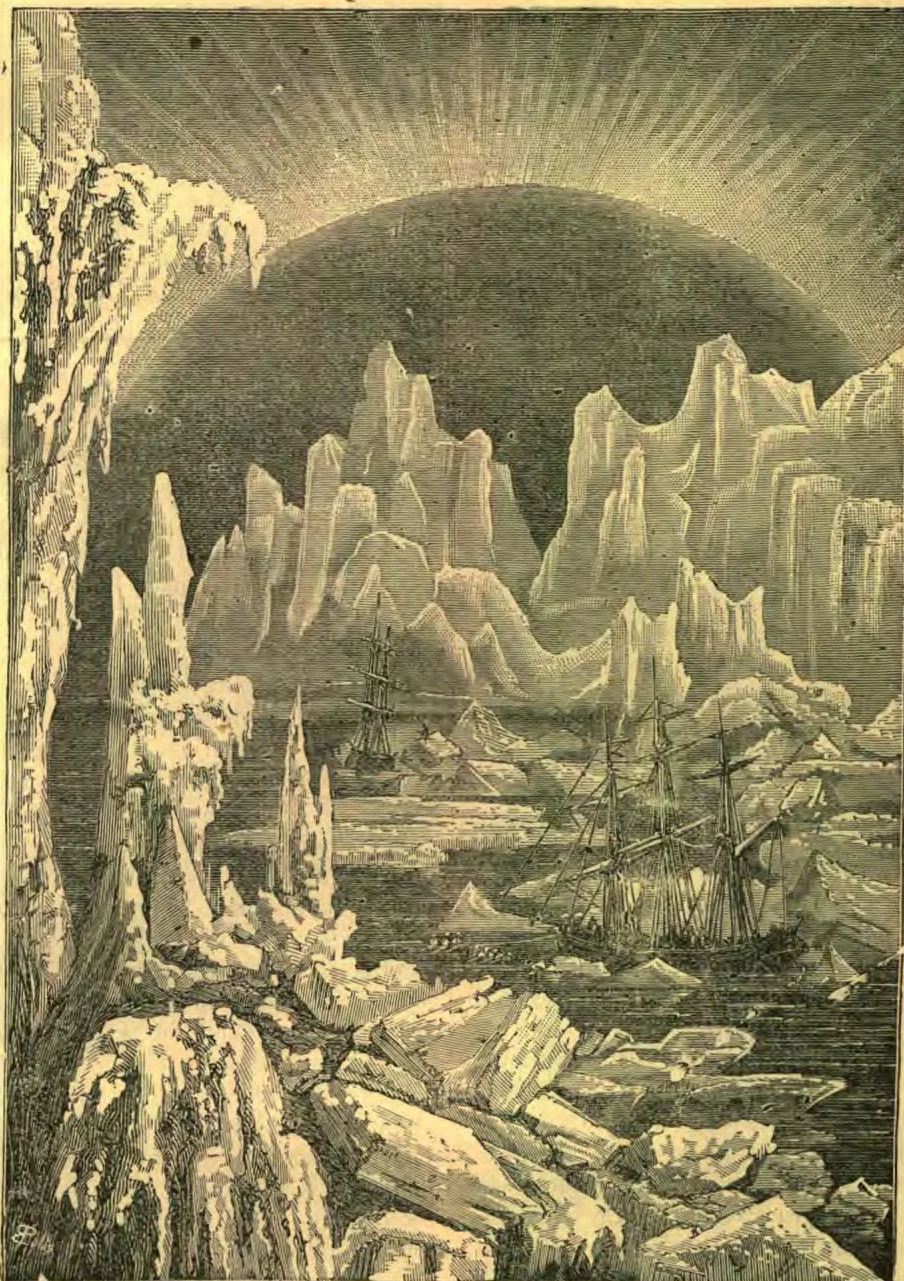
As few of those who read this will ever have the opportunity of actually visiting either the northern or the southern polar regions, let us imagine ourselves for a brief season to be upon the deck of a vessel, far away in the North—let us say in the autumn, just before the approach of the long Arctic night. As we glance around, all looks cold and bleak. There is light enough for us to see on every hand the fantastic forms of the icebergs looming up in the darkness. We hear the grinding of the bergs together, and cannot suppress an uncomfortable feeling as the contingency presents itself to our mind of the ship getting aground between two of those huge floating ice-islands.
As we look, the scene changes as completely as though a magician's wand had transferred us to one of the jeweled palaces of the “Arabian Nights.” We see arches of light stretching across the heavens from east to west, sometimes remaining stationary, and sometimes moving slowly toward the south. Rays of light shoot out perpendicularly from the arches, and if the arches are below the horizon we only see these rays, which, though really parallel, often appear, as an effect of perspective, to meet in a point in the zenith. These rays very seldom remain stationary, but shoot upward toward the zenith, at the same time moving eastward, often with a tremulous, snake-like motion from end to end, till sometimes they cover the whole sky.
If now we turn our eyes from this magnificent sight to look down again upon the surrounding mass of bergs which just now looked so weird and gloomy, we can scarcely believe that they are the same; for now they throw back to us in a thousand colors the light that flashes on them from above, and the peaks and pinnacles of the bergs appear to be set with jewels of the most varied hues and the most dazzling brightness.
The rays appear in the most varied forms and patterns, in one of the most beautiful of which, though seldom seen, the rays seem to hang from the sky in folds like a mantle.—Frank Leslie for February, 1879.
C. F. Hall, in his “Arctic Researches,” gives an interesting description of a gorgeous display of Dec. 17, 1860; and Capt. Budington, who had spent eleven years in the Arctic regions, testified that it surpassed anything of the aurora approach that he had ever witnessed; and, to tell the truth, he did not care to see the like again.
No mortal hand can truthfully describe it. My first thought was, “Among the gods there is none like unto thee, O Lord; neither are there any works like unto thy works.” It seemed as if the world was really ablaze under the agency of some gorgeously-colored fires. No sun, no moon, yet the heavens were a glorious sight, flooded with light. Even ordinary print could have been easily read on deck.

THREE WORDS.

THERE are three lessons I would write, Three words as with a burning pen, In tracings of eternal light, Upon the hearts of men.
Have hope! Though clouds environ round, And gladness hides her face in scorn, Put thou the shadow from thy brow; No night but hath its morn!
Have faith! Where'er thy bark is driven, The calm's disport, the tempest's mirth, Know this: God rules the hosts of heaven, The inhabitants of earth.
Have love! Not love alone for one, But man, as man, thy brother call, And scatter, like the circling sun, Thy charities on all.
Thus grave these lessons on thy soul,— Hope, faith, and love,—and thou shalt find Strength when life's rudest surges roll, Light when thou else wert blind! —Schiller.

INTERESTING FACTS ABOUT THE STARS.

The Milky Way is a vast assemblage of stars, so very distant that the eye can perceive only a dim glimmer.
Of the 20 million stars visible by powerful telescopes, at least 18 million lie in, or near, the Milky Way.
The stars from a very early antiquity have been classified into groups, called Constellations. There are 109 of these constellations, and 50 of them are called ancient constellations. Some of these were known 1500 years before the Christian Era.
The constellations in most cases are named after an animal, or some mythological personage; but generally little or no resemblance can be traced to the object after which the group is named.
An examination of the stars with a powerful telescope reveals most startling and beautiful appearances. Stars which appear single to the naked eye, through the telescope, are double, triple, and quadruple; and in some instances the number of stars revolving around a common center is even greater.
In one instance, what appears to the unaided eye as a faint point of light, is shown by the telescope to be a group of seven stars!
In the constellation Pleiades the six or seven stars visible to the naked eye become 60 or 70 when viewed through the telescope.
More than 6 thousand double stars are now known. Those stars which are resolved by the telescope into more than four, are called Multiple Stars.
Certain stars are known to astronomers as Variable Stars, i. e., they shine brighter at some times than at others. There are more than 100 of these stars whose periods of variation are known, and there are others whose periods have not been determined.
Another very interesting celestial phenomenon is the various colors of the stars. The light of most of the stars is white, but there are others which appear red, blue, green, orange, purple, and yellow. It is in the double and multiple stars where the richest colors are seen.
What a wondrous coloring must be met with in the planets lit up by these glorious suns; one sun setting in clearest green, another rising in purple, or yellow, or crimson; at times several star suns mingling their variously-colored beams!
Truly, as the psalmist says, “The heavens declare the glory of God.” And an apostle has written, that one star differeth from another star in glory. G. W. A.

KEEP A LIGHT IN THE WINDOW.

A FIERCE tempest was raging along the coast; there was no light of moon or star, and no friendly light-house to guide the mariner. The captain of the little fishing vessel tried in vain to find the entrance of the harbor, and his heart sunk within him as he thought that he must perish so near his home. Suddenly a light gleamed through the darkness. The sailor knew that light; it shone from the window of his own cottage, high up on a cliff overlooking the sea. Guided by the welcome ray, he succeeded in reaching the harbor, and in a few hours he was safe by his humble fireside.
The light which had saved the lives of all on board his vessel had been placed in the cottage window by his little motherless daughter. No beacon fire could live in the fearful storm that swept over the cliff, but the one thing she could do she did; and as the tiny ray pierced the darkness, she knelt down and prayed that it might reach her father in his hour of peril.
From that time a light was always kept burning in the fisherman's window through the entire night. The little family were very poor, but whatever they might lack of food or clothing that light was never permitted to go out or to burn dim. After a few years the attention of the government was called to the matter, and a light-house was erected on the cliff. Thus resulted the act of a little fisher maiden, and as long as the bright beams from the light-house guide the sailor on his trackless way, her work will live, though she herself may be sleeping in the grave.
All the followers of Christ, the young as well as the older, are to be lights in the world. By your gentleness, kindness, and courtesy, by your faithfulness in duty, by your cheerful obedience, you may show that you have learned of Jesus, and your example may lead others also to love him.
There are many things which even a child may do that will be like a ray of light in the darkness. A kind word, a little assistance, a gift to the poor or the sick, a prayer, or a tract may guide some one to the Saviour.
Be not discouraged because you cannot do great things. The little deeds of love which you may perform will perhaps be the first links in a long chain of blessings. By reading a single tract the celebrated minister and writer, Leigh Richmond, was led to Christ. His writings have been blessed to the salvation of hundreds, and his labors were instrumental in the conversion of Wilberforce, the great philanthropist, who secured the abolition of the slave trade, and whose whole life was filled up with earnest efforts for the good of humanity. The influence of that tract is still felt in the world to-day, and its fruit will be seen throughout eternity.
Although we are not able to build a light-house or even a beacon fire, although we cannot preach or publish the gospel, we can all “keep a light in the window burning,” we can tell the old, old story of the Saviour’s love, and pray that God will bless it to some perishing soul; and who can tell what the result will be?
M. A. D.

A CURIOUS MUSICAL INSTRUMENT.

THE Hindoos have a number of musical instruments, some of which claim a high antiquity; but there is one which is extremely curious, not so much from its form or structure as from the fact that it is played neither with the mouth nor an air bag, nor with strings, nor by striking. It consists of two small silver trumpets, with a very delicate apparatus within. There are no holes as in a flute.
When the Prince of Wales was in India, the Baboo Kally Prosonno Bannerjee played on these instruments before him, and excited the greatest interest, completely puzzling all to conceive how the sounds were really produced; for he did not place the mouth of the trumpet to his lips, but to his neck. Some thought him a ventriloquist, and that the trumpets were merely used to create a false impression.
It proved, however, that the delicate apparatus was so sensitive that the variations of sound were produced by the variation in the quantity of air propelled through by the pulsations of the neck, being greater or less according to the pressure on the mouthpiece.
Nothing could be more curious than to see the performer, and to hear the soft, sweet musical sounds that issued from him.

LESSONS FOR CHILDREN.

LESSON VII.—THE GIBEONITES.

AFTER the ceremonies on mounts Ebal and Gerizim were finished the children of Israel returned to Gilgal.
“And when the inhabitants of Gibeon heard what Joshua had done unto Jericho and to Ai, they did work wilily, and went and made as if they had been ambassadors, and took old sacks upon their asses, and wine bottles, old, and rent, and bound up; and old shoes and clouted upon their feet, and old garments upon them; and all the bread of their provision was dry and moldy.
“And they went to Joshua unto the camp at Gilgal, and said unto him, and to the men of Israel, We be come from a far country: now therefore make ye a league with us. And the men of Israel said unto the Hivites, Peradventure ye dwell among us; and how shall we make a league with you? And they said unto Joshua, We are thy servants. And Joshua said unto them, Who are ye? and from whence come ye? And they said unto him, From a very far country thy servants are come because of the name of the Lord thy God: for we have heard the fame of him, and all that he did in Egypt, and all that he did to the two kings of the Amorites, that were beyond Jordan, to Sihon king of Heshbon, and to Og king of Bashan, which was at Ashtaroth.
“Wherefore our elders and all the inhabitants of our country spake to us, saying, Take victuals with you for the journey, and go to meet them, and say unto them, We are your servants; therefore now make ye a league with us. This our bread we took hot for our provision out of our houses on the day we came forth to go unto you; but now, behold, it is dry, and it is moldy; and these bottles of wine, which we filled, were new: and, behold, they be rent; and these our garments and our shoes are become old by reason of the very long journey.
“And the men took of their victuals and asked not counsel at the mouth of the Lord. And Joshua made peace with them, and made a league with them, to let them live; and the princes of the congregation sware unto them.
“And it came to pass at the end of three days after they had made a league with them, that they heard that they were their neighbors, and that they dwelt among them. And the children of Israel journeyed, and came unto their cities on the third day. Now their cities were Gibeon, and Chephirah, and Beeroth, and Kirjath-jearim.”
When Joshua reproved the Gibeonites for what they had done, they said, “We are in thine hand; as it seemeth good and right unto thee to do unto us, do.” And Joshua made them hewers of wood and drawers of water for the congregation, and for the altar of the Lord.

QUESTIONS.

  1. To what place did the children of Israel go after the ceremonies on mounts Ebal and Gerizim were finished?
  2. What did the Gibeonites do when they heard what Joshua had done to Jericho and to Ai?
  3. How were they dressed?
  4. In what condition was their food?
  5. From what place did they say they had come?
  6. Why had they come so far?
  7. What did they want to do?
  8. What did they say about their bread and their bottles of wine?
  9. What about their clothing?
  10. Did Joshua consent to make a league with them?
  11. What did Joshua learn about these men a few days afterward?
  12. How far were the cities of the Gibeonites from Gilgal? Ans. It was not more than 35 or 40 miles to the farthest of them.
  13. When Joshua reproved the Gibeonites, what did they say?
  14. What did Joshua do to them?

BIBLE LESSONS FOR YOUTH.

LESSON XXXIII.—REPHIDIM.

  1. To what place did the people next come after leaving the wilderness of Sin? Ex. 17:1.
  2. What caused the people to murmur at this place?
  3. Of what did they accuse Moses?
  4. What did Moses, in his distress, say to the Lord? Verse 4.
  5. What instruction did the Lord give Moses? Verse 5.
  6. What did God promise to do?
  7. What name did Moses give to this place?
  8. Who came out to fight against Israel at this place?
  9. Describe the battle.
  10. Who visited Moses about this time? Ex. 18:1–5.
  11. On what subject did they converse? Verse 8.
  12. What did Jethro say when he had heard of all that the Lord had done for Israel? Verses 10, 11.
  13. What counsel did he give Moses?
  14. What was the character of these picked men? Verse 21.
  15. Where did the Israelites next encamp?
  16. How long did they remain in this place?
  17. By what visible manifestations did God lead them in their journeyings?

SYNOPSIS.

“And all the congregation of the children of Israel journeyed from the wilderness of Sin, . . . . . . and pitched in Rephidim; and there was no water there.” And the people thirsted there for water, and again they murmured against Moses, this time accusing him of bringing them out into the wilderness to kill them with thirst.
“And Moses cried unto the Lord, saying, What shall I do unto this people? they be almost ready to stone me. And the Lord said unto Moses, Go on before the people, and take with thee of the elders of Israel; and thy rod, wherewith thou smotest the river, take in thine hand and go. Behold, I will stand before thee there upon the rock in Horeb; and thou shalt smite the rock, and there shall come water out of it, that the people may drink. And Moses did so in the sight of the elders of Israel.”
And Moses called the name of the place Meribah, because of the chiding of the children of Israel, and because there they tempted the Lord their God.
After this, the Amalekites came out and fought with the Israelites at Rephidim. Moses stood with the rod of God in his hand, and the Lord fought for them, and Amalek and his people were utterly discomfited.
About this time, Jethro, the father-in-law of Moses, came out to meet them in the wilderness, bringing with him the wife and two sons of Moses. When Moses had told Jethro of their wonderful deliverance from Pharaoh, and of all the way by which God had led them, he rejoiced greatly, and said, “Now I know that the Lord is greater than all gods.” He seems to have been a wise and good man; for he gave Moses excellent counsel, which the Lord seems to have approved. He told Moses that his burdens were too great for him, and advised him to choose out able men, such as feared God, men of truth, hating covetousness, and place them to judge in the lesser matters, so that Moses himself need not be troubled with them.
From Rephidim the children of Israel journeyed to Sinai, and encamped there before the mount. They abode at Sinai about one year, and here they had some very important experiences, which will be noticed in following lessons.
During all their journeyings the pillar of cloud had led them by day, and the pillar of fire by night. Where the cloud rested, they encamped, whether it were for a day or many days; and when it was taken up, they journeyed, whether it was by day or by night. G. H. BELL.

FAMILY SABBATH-SCHOOLS.

THERE are many scattered families of Sabbath-keepers who cannot meet with others on the Sabbath day; they seldom or never hear any preaching, and frequently have no opportunity to attend prayer-meetings. The Bible and our periodicals are the only religious teachers they have; and the family worship, morning and evening, is the only religious service they attend for months at a time.
I think it would be a good plan for every such family to organize a family Sabbath-school. It would make the Sabbath pass more pleasantly and profitably.
The new weekly INSTRUCTOR furnishes dated lessons for every Sabbath, so that the scattered families can all be studying the same lessons that are learned from Sabbath to Sabbath in the schools. Then if they should at any time have opportunity to meet with any school, or any other family, all would have learned the same lesson, and would be prepared to unite in recitation and general exercises.
A family Sabbath-school should begin and close at a definite time, just like any other school. It would be better to have it held in the forenoon, beginning somewhere from nine to half-past ten, and continuing from an hour to an hour and a quarter. The exercises should begin with singing and prayer, and the interest would hold out better if there should be singing once or twice during the exercises, and at the close.
The parents can hear each other recite, and then hear the lessons of the children. In all cases where there are children in the family, the exercises should be adapted to their wants, and so conducted as to give them frequent change. In this way the hour will pass quickly and pleasantly, and the children will soon learn to look forward to their Sabbath-school with fond anticipations.
The general exercises may consist of reviews on former lessons, pointing out important places on the map, etc. The afternoon may be spent in reading, and in learning the lessons for the next Sabbath. Thus the Sabbath, instead of being a long, tedious day, will become a delight. Some families have been trying this plan with the most complete success, and we hope soon to hear from others.
Such schools should report to the State Secretary the same as other schools.
G. H. BELL.

SABBATH-SCHOOL OFFICERS.

ALL Sabbath-school superintendents and secretaries are requested to aid us in getting a complete list of all the S. D. A. Sabbath-schools in the country. If your State has organized a Sabbath-school Association, you may address its secretary; if not, or if you have not his address, you may report directly to the INSTRUCTOR.

WHAT TO REPORT.

Report all the facts you can, but be sure to report though you can only give the names and addresses of officers, and the number of members. Last week a table was printed showing a partial report of the Michigan schools. All of the points mentioned in that table are useful. Please notice as many of them as you can, but by all means report.
EXEC. COM. GEN. S. S. ASSOCIATION.

LETTER BUDGET.

Dear Editors: I am only a little girl, eight years old. I live near Green Bay, Wis. Eld. Tenney sent papa a copy of the INSTRUCTOR, and I want it so much to come and see me each week that I send some money for it that I had laid up. I think money was made to use.
The weekly paper is just what we little folks want these long winter evenings.
I have a little brother eleven years old. Pa and ma have kept the Sabbath almost three years. We have good meetings every Sabbath. Yours, Myrtie Reed.
Yes, indeed, money is made to be used, and not to be hoarded; but it should be used judiciously—it should not be wasted. The Saviour gave us a lesson of economy when he said, “Gather up the fragments, that nothing be lost.” We should lay up our treasure in Heaven. One way to do this is to do all the good we can with the money God lends us.
Yes, Myrtie, the weekly paper is just nice, isn’t it? We wish all could have it.
SOUTHPORT, IND.
Dear Editors: I am twelve years old. I am not keeping the Sabbath, but I attend a good Sunday-school. A friend sent me the INSTRUCTOR last year, and I like it so well I feel as though I could not get along without it. I have tried hard to earn the money, but there are so many boys in the village who do chores that I fare poorly. I have at last borrowed twenty-five cents which I send for as many numbers as it will pay for. I have no father. Mother works very hard, but we trust the Lord will provide for us. Elliott D. Townsend.
This dear boy appreciates the INSTRUCTOR, which he shall have for the year. May the God of the widow and the orphan bless this family, and so lead them that they may enjoy everlasting rest in his kingdom.
Dear Editors: I have spent the day in school, but this evening I begin my letter to the INSTRUCTOR. You will see that I am not much of a writer; but I like the INSTRUCTOR, and think I will take it another year. I read a great deal; have read four books through since Christmas. I read in the third reader at school. I learn quite fast. I am nine years old. Yours truly, Frankie B. Ackley.
Dear Frankie, we are glad you love to read, for you may acquire much useful knowledge in this way; but please remember that you should be as choice in your selection of books as in the choice of companions. Also, remember that one good book read thoroughly will benefit you more than a dozen hastily read. Be careful what you read, and how you read.

THE FIRST FRUIT.

Luella was once made the owner of the grapes upon a large vine in her father’s yard. Very anxious was she that they should ripen and be fit to eat. The time finally came. “Now for a feast,” said her brother to her one morning, as he pulled some beautiful ones for her to eat.
“Yes, but they are the first ripe fruit.”
“Well, what of that?”
“Father told me that he gives God the first out of all the money he makes, and that then he always feels happier in spending the rest, and I want to give the first of my grapes to God, too.”
“Ah, but,” said her brother, “how can you give grapes to God? And even if you were able to do such a thing, he would not care for them.”
“Oh, I have found out the way,” said she. “Jesus said, ‘Inasmuch as ye have done it unto one of the least of these my brethren, ye have done it unto me;’ and I mean to go and give them to Mrs. Martin’s sick child, who never sees grapes, because her mother is too poor to buy them.”
And away ran Luella, with a large basket of the “first fruit” of the vine, and other good things, all beautifully arranged, to the couch of the sick child.
“I’ve brought Mary some ripe fruit,” said she to Mrs. Martin.
“Dear child, may God bless you a thousand-fold for your loving gift! Here, Mary, see what a basket of good things has been brought you.”
The sick one was almost overcome with emotion as she clasped the hand of her young friend, and expressed her thanks.
Do you not think that this little girl enjoyed eating the rest of her grapes better than if she had kept them all for herself?

A REQUEST.

WE are receiving a good many subscriptions for the INSTRUCTOR through the tract societies. Probably some who are securing these subscribers are working for a prize. Will the secretaries of the several tract societies, when sending in business for agents, please give their names, with the number of subscriptions obtained by each? This will save delays in sending prizes. For the same reason we ask that canvassers outside of the tract societies will state whether their subscribers are old or new.
M. J. C.

PERPETUAL FIRE.

In the neighborhood of Baku, on the Caspian Sea, there is a phenomenon of a very extraordinary nature, called the everlasting fire, to which a sect of Indians and Persians, called Giaours, pay religious worship. It is situated about ten miles from the city of Baku, in the province of Shirven, on a dry, rocky piece of ground.
On it there are several ancient temples of stone, supposed to be dedicated to the fire, there being one among them in which fire worship is now carried on. Near the altar is a large hollow cone, from the end of which issues a blue flame. The worshipers affirm that this flame has continued ever since the deluge, and they believe if it were suppressed in that place it would break out in another.
At a short distance from this temple there is a horizontal gap two feet from the ground, about six feet long and three broad, out of which comes a constant flame, of the color of that in the temple. When there is a strong wind it rises to the height of eight feet, but is much lower in calm weather.
The earth around for more than two miles has this extraordinary property, that by taking up two or three inches of the surface and applying a lighted lamp, the part uncovered immediately takes fire, even before the flame touches it. The flame makes the soil hot, but does not consume it, nor affect what is near with any degree of heat.
It is said that eight horses were once consumed by this fire under a roof where the surface of the ground had been turned up, and by some accident had ignited. If a cane, or tube, of paper be set about two inches into the ground, and closed with earth below, and the top of it touched with a live coal, a flame will immediately issue forth without consuming the tube, provided the edges be covered with clay. Three or four lighted canes will boil water in a pot, and are sometimes used to cook victuals. The flames have a sulphurous smell, but are inoffensive.—S. S. Classmate.

The Meanings Behind Common Given Names
SOME of the names we bear have a curious meaning in the languages from which they are derived. Alfred means good scholar; Asa, healer; John, gift of God; Charles, noble; George, landholder; Isaac, laughter; Peter, a rock; Mary, bitter; Ruth, beauty; Sarah, a princess; Susan, a lady; Anna, grace; Edith, happiness; Elizabeth, consecrated to God.

BEAUTY IN LITTLE THINGS.

THE greatest bard of England roams To cull the lowliest flowers, And prettiest mosses find warm homes Upon the tops of towers.
The broad sunflower, though rimmed with gold, Ne’er wins true poets’ praises, But sweetest songs that fond hearts hold Are perfumed by the daisies. —Sel.

You have reached the end of this edition.

The Youth’s Instructor · Feb 12, 1879