The Youth's Instructor, Vol. LI, No. 39

A Trip Through Egypt—III

The Youth's Instructor

September 29, 1903

Review and Herald Publishing Assn. · Washington, D. C. · September 29, 1903

A Trip Through Egypt—III

The Pyramids
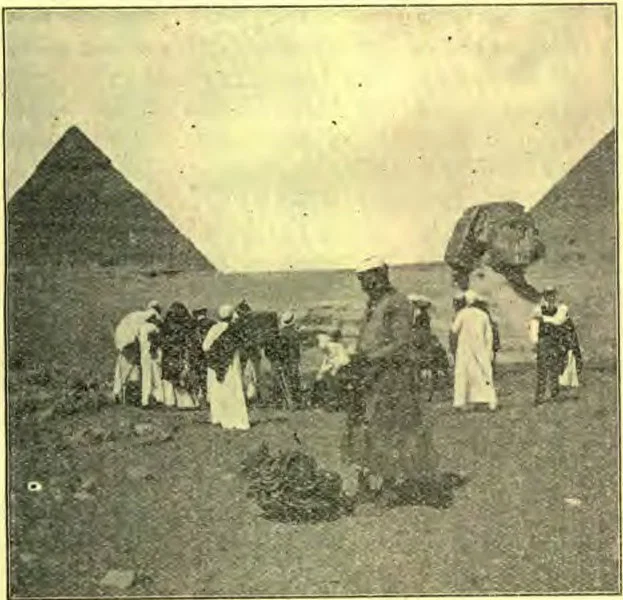
During all the sight-seeing around Cairo, the traveler has been thinking more or less about the Pyramids. The occasional glimpses he has had of them at a distance of a dozen miles, from the Citadel and the Mottokan Hills, has only served to stimulate his curiosity; and it is with a feeling of satisfaction that he boards the electric tram at Gezireh, knowing that at last he is on the way to these most celebrated of all the monuments of antiquity.
The tram, after crossing a small arm of the Nile, skirts its heavily wooded western bank for several miles, arriving at last at Gizeh, where the Museum of Antiquities was formerly situated in the beautiful botanical gardens. Here the road makes a sharp curve; and we suddenly start to find ourselves in full view of the objects of our journey, which, although yet over five miles distant, stand out in bold and massive relief against the deep blue of the Egyptian sky. From this point the line follows the beautifully shaded carriage road, traversing in a perfectly straight line for five miles a broad, fertile plain, which during the inundation is one great lake, diversified here and there with the little island formed by the raised villages.
EGYPTIAN BREAD BOY AND HIS LOAVES
Arriving at Mena House, a large hotel near the Pyramids, the traveler may hire a donkey, thus largely avoiding the pestiferous crowds of guides, antiquity venders, and other donkey boys that throng the place. We then approach the great pyramid of Cheops from which we have been unable to take our eyes ever since first beholding it. The first impression is likely to be disappointing, simply because the eyes and brain of the tourist can not comprehend so immense an object. Only when he has climbed it once, after riding around it, does he begin to realize its stupendous proportions. To form, perhaps, a faint idea of the size of this structure, imagine a pile of stone four or five times as high as the new Sanitarium at Battle Creek, which, if set down on the old Battle Creek College grounds, would cover the whole plot, encroaching also on College Avenue and the Sanitarium grounds. The stone for building a large part of Cairo, including the massive battlements of the citadel, was taken from this pyramid without appreciably affecting its size or general symmetry.
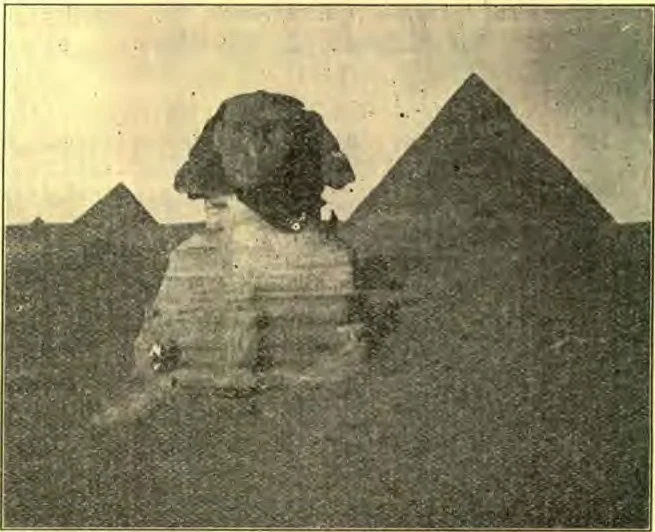
THE SPHINX—THE WRITER ON THE SHOULDER OF THE COLOSSES
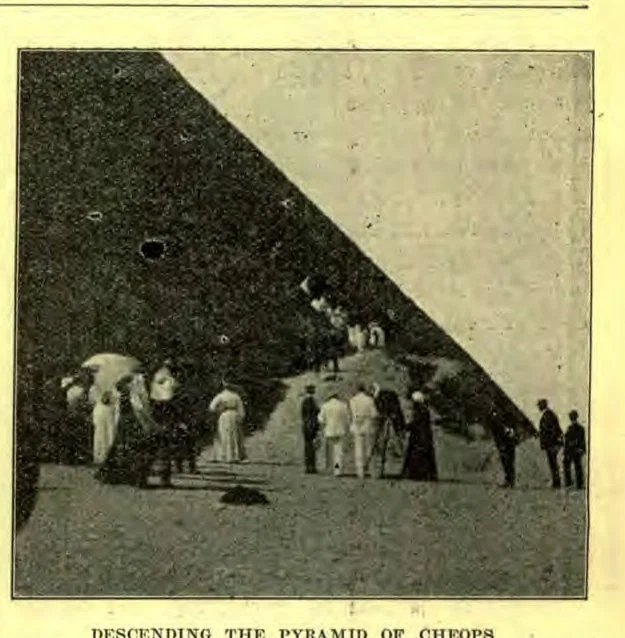
The ascent of this pyramid, though likely to be trying to one inclined to giddiness, is perfectly safe with the assistance of the two or three Bedouins who must be hired for the purpose. The view from the point about half-way up is enjoyed most by many, because the portion of the pyramid which is still above looks fully as large as the whole thing did from the ground, while what is below looks immensely larger. But the view from the top is fully as striking, and much more comprehensive. Perhaps its most prominent feature is the contrast between life and death. On one side stretch the barren, sandy, wastes of the Libyan desert, entirely devoid of life, save, perhaps, a long string of camels, slowly making their way over the caravan route. On the other side, beyond a broad, fertile plain, are the spires and minarets of a great city, teeming with its multiplied thousands of inhabitants, whose dwellings are banked up against the brown, lifeless Mottokan ridge, which marks the boundary of another desert.
DESCENDING THE PYRAMID OF CHEOPS
We will next inspect the second pyramid, which is scarcely smaller than its mighty neighbor. Some of the original smooth coating remains, making it impossible for any save a few experienced Bedouins to climb it, a feat which they perform, however, with marvelous celerity and audacity. The long, low, stifling passages and large, dark chambers within the pyramids, from which the mummies have all been taken, are interesting principally for the marvelous skill exhibited in the masonry of the walls. Not even a hair can be thrust between the different stones, the points are so perfect. This can be said of no other stone building in existence.
Leaving the Pyramids, we pass on to the Sphinx. This immense stone colossus, in the form of a recumbent lion with a human head, lies near the edge of the plateau on which the Pyramids are situated, thus facing and overlooking the Nile. One imagines, perhaps, that he can still discern an expression of benign kindliness in the massive features of the sadly mutilated face.
The Pyramids of Gizeh, dating from the fourth dynasty, are the oldest monuments of the great necropolis of Memphis, which was for twenty centuries the capital of Upper Egypt. They make the northern limit of this vast cemetery, which extends for twenty miles along the edge of the desert, containing five groups of pyramids, and numberless tombs.
Riding up the Nile Valley, we pass the small pyramids of Abusir, and, not failing to visit the house of the great Egyptologist, Mariette Bey, which is a small museum in itself, we arrive at the great “Step Pyramid” at Sakkara. It is hardly necessary to notice that these steps, which are from thirty to forty feet high, are of no special assistance in gaining the summit of the pyramid. The ground around Sakkara is honey-combed with small tombs, few of which, however, are worthy of a visit. Passing on, we arrive at the two large pyramids of Dashur, which mark the southern boundary of the necropolis. One of these which is nearly as large as the pyramid of Cheops, presents a very imposing appearance in its solitude.
Having thus “gone the rounds,” we return to Bedrashen, there to board the evening express for Cairo, very weary, but with the satisfactory feeling that this has been the most wonderful day of sight-seeing we have ever experienced.
GLEN WAKEHAM.

The Peace Christ Gives to His People

“My peace I give unto you: not as the world giveth, give I unto you.” That gift we can have, if we will receive it.

The Mystery of the False Joan of Arc

“A FALSE Joan of Arc!” I hear the reader exclaim, “How could there be one, when every detail of the short life of the Maid of Orleans is known, from her earliest childhood to the moment of her martyrdom at the stake in Rouen?”
Yet a false Joan of Arc there was, and her brothers, Jean and Pierre du Lys, believed in her for six years and more, and so did the whole city of Orleans. Many books have been written in France about this strange personage, and grave French historians have tried to “pluck out the heart of her mystery;” but, as a matter of fact, nobody to-day knows who she was, any more than in 1436, when she first appeared, and convinced the brothers of the Maid that she was their sister, the “Pucelle of France.”
Yet if any fact in history is certain, beyond all doubt, it is that Joan of Arc was burned at the stake in the public square of Rouen on the thirtieth of May, 1431. There is a splendid painting in the Pantheon of Paris of the tragical scene. Bound to the towering stake with iron chains, a white-robed, girlish figure, the heroic Maid stands clasping the cross with both hands, and with her face raised to heaven, rapt and beautiful, as if forgetting the dreadful piles of fagots at her feet, and the rough men at arms who are heaping them higher about her, and waving the torch that is to fire them. Every detail of this painting is attested by history, and thousands of eyes witnessed the martyrdom of this nineteen-year-old peasant maiden of Domremy, whose only crime was that she had saved France. The whole city of Rouen saw her led forth from prison to trial, from trial to stake; and so deep was the sympathy she excited, even in this stronghold of the English power, in France, that as she passed to her death, the multitudes, kneeling and weeping, repeated incessantly the invocation for the dying.
In one short year, Joan of Arc had saved France from the yoke that had crushed the nation for a century of wars; she had raised the siege of Orleans, and crowned the king at the Cathedral of Rheims; and then, for one more year, she had lain in the prison of Rouen, brought to trial after trial, but so clearly innocent that it took the cruelest tricks, at last, to make her even seem guilty enough for her sworn enemies to sentence her. In these trials, every year of her girlish life was gone over, so that we have the most complete biography of her (and all under oath) that exists of any human being.
We know her earliest childhood in Domremy; the forests where she wandered, the fields where she kept the sheep, her spinning wheel, her household tasks, her playmates; we see her listening to her “Voices,” and praying that she might not have to go to the wars, poor little maid! We see her sent at last to the dauphin, in 1429, and telling him a secret revealed by her visions, which was a sign, and after which he put her in command; we see her leading French armies to their first victories in a score of years, relieving Orleans, and crowning the king, in 1429, while thousands crowded to kiss her very feet, or kneel in the path where she had passed. We learn that she was beautiful, and had a wonderful magnetism about her personality, so that the English called her a “witch.” Simple and humble as the Maid of Orleans always was, the people believed her capable of working miracles—which, indeed, her marvelous victories appeared to be. So, when the tidings of her cruel death came to the king and the people of France, there was a great popular hope that in some miraculous way the Maid would come back—that she was not really dead after all. It was the same old belief that has clung about every beloved national deliverer, and it was the firm belief of half of France concerning Joan of Arc.
Besides, the Maid had died in the midst of enemies, and in the English dominions in France, up in the north. There were no telegraphs, no newspapers and special correspondents, in those days. It was only by hearsay that her friends knew of her death,—and why should the traitor English be believed? The miraculous Maid had ways of saving herself from them that none could guess. She might easily have escaped, and be lying in hiding while the English, unwilling to acknowledge her deliverance, burned some other woman in her place—and so on. We need not be surprised, therefore, that when, five years later, a “false Pucelle” appeared in the French domains, she was received with apparently no doubts at all.
But who was this second Maid of Orleans, and where did she learn to counterfeit the true heroine so marvelously? There is where the mystery comes in. In May, 1436, the “Pucelle Jehanne,” as she styled herself, arrived at La Grange aux Ormes, near St. Privay. She was at once taken to see some gentlemen of the town of Metz, near by, and, by chance, next day, the two brothers of Joan of Arc came to Metz, and were naturally anxious to meet her. “They thought that their sister had been burned, but, so soon as they saw her, they recognized her, and she them,” says the old Metz chronicle.
These brothers of the Maid had been ennobled by King Charles in honor of their sister’s deeds, had fought by her side in the wars, and were men of proved bravery and integrity. No ordinary impostor could have so deceived them as did the false Joan. The people of Metz, when the “Pucelle Jehanne” was recognized by these members of her family, were convinced that the Maid of Orleans was among them again, and went wild with joy. Arms, horses, and jewels were given to her, more than she could use, and she was invited into Luxembourg, where nobles and people alike crowded to welcome her. Orleans, when it heard the joyful news, which Joan du Lys, the younger brother, rode home to tell, “bringing letters from La Pucelle,” gave him rich presents, and sent a pursuivant to Luxembourg, to bring the false Joan at once to the city she had saved.
Meanwhile, the “Pucelle” had been sought in marriage by a knight of Metz, Robert des Armoises by name, and had accepted him. On account of this marriage, the false Pucelle did not leave Metz for Orleans, but remained there in quiet domestic life for three years, during which two children were born to her.
But in 1439 she accepted the repeated invitation of Orleans, and seemed to have been received in state, as became the Maid of France. She was “royally entertained” from July the eighteenth to August the first by the town. It must be remembered that every one in Orleans over twelve years of age had seen and known the true Joan of Arc; yet none doubted that it was she. All this while she had corresponded with the King of France, too, and had met several of the generals who had served under the real Maid of Orleans, and still no one had any suspicion of her imposture, so far as we can find out. In this same year, 1439, she was given command of troops at Maus, and took part in a raid, which shows she had some knowledge of military life, enough to deceive her soldiers. Here she was in company with an old companion in war, the Marshal de Rais, who had followed the white banner of Joan of Arc, nine years before; yet he had no doubts of her identity with the Maid.
Two persons, however, the false Pucelle had carefully avoided—the mother of Joan of Arc and King Charles himself. Joan of Arc, indeed, had never revisited her native village of Domremy from the day she first left it for the dauphin’s court; but she had endeavored to do so, and had only been prevented by the necessities of her campaigns. The false Pucelle took care not to go to Domremy, either, contenting herself with seeing her brothers in Metz and Orleans. But the time came when she had to have audience before the king.
As we have learned, the proof that had convinced Charles, the dauphin, of Joan of Arc’s divine mission to save France was a certain secret “sign” made known by her at their first interview. This “sign” Charles had never revealed afterward to any one, and the Maid of Orleans had utterly refused, at her trials, to make it known, even when threatened with torture. It was quite natural, therefore, that when Madame Jehanne came before him at his court, he should salute her courteously with the words, “Pucelle, my dear friend, you are welcome back, in the name of God, who knows the secret that is between us.” These searching words were too much for the false Pucelle. She saw he expected the “sign,” which she could not give, and, falling on her knees, she acknowledged that she was not the Maid of France, and asked pardon.
So runs the story of her unmasking, told by an aged tutor of the king’s son long afterward to a youth, Pierre Sala, who in his old age, in turn, wrote it down in a book of the Deeds of Kings. It is the only explanation we have as to why the false Pucelle suddenly dropped out of sight in public affairs henceforth; and it seems to bear truth with it. But there is no doubt, nevertheless, that years after this King Charles himself appointed Nicholas de Vouthon (in 1452) as chaplain to “Jehanne la Pucelle,” which seems strange in view of all this; and that Pierre d’Arc still recognized her as his sister to the end of his life.
The last we hear of her is in 1457, when, in Angers, the officers of King René of Anjou (father of Margaret, the wife of Henry the Sixth of England, and so, presumably, English in his sympathies), arrested “Jehanne des Ermoises” for “having long called herself Jehanne la Pucelle, and deceived many persons who had seen Jehanne at the siege of Orleans.” The record goes on to show that the false Pucelle maintained that “no other charge had ever been brought against her,” and that King René, having been “addressed by others in her favor,” granted her full liberty, on condition “that she bear herself honestly in dress.” This doubtless refers to her habit of wearing man’s dress and armor, as the true Joan of Arc had done.
From this court of Angers, the false Pucelle passes on into the same obscurity and mystery whence she came. No explanation of her imposture has ever been found; but it is certain that this unknown girl deceived every eye and every heart that had ever known the Maid of Orleans, excepting only the mother, whom she was clever enough to keep away from, and the king, whose secret “sign” she had no possible way of learning. Her success is one of the astonishing facts of French history.—Priscilla Leonard, in the Well Spring.

The Blessed Secret of Living by the Day

It is a b'lessed secret, this of living by the day. Any one can carry his burden, however heavy, till nightfall. Any one can do his work, however hard, for one day. Any one can live sweetly, patiently, lovingly, and purely till the sun goes down. And this is all that life ever really means to us—just one little day.

Knowing Ourselves and Our Task Before Us

Knowing ourselves, our world,—our task so great, Our time so brief,—'tis clear, if we refuse The means so limited, the tools so rude, To execute our purpose, life will fleet, And we shall fade, and leave our task undone.

In and About San Francisco

Golden Gate Park
SAN FRANCISCO contains many parks scattered about in different parts of the city; but most of them are small, covering from one to three blocks, and are called “squares.” These are well laid out and well cared for. Pleasant walks lead among trees and shrubs, flowers and lawns, while comfortable benches are to be found everywhere. These squares are well patronized, those in the residence districts being used as playgrounds by laughing children and resting-places by tired women; while those situated near the business sections are made to serve as lounging-places for idlers. But to speak of “The Park” in San Francisco is to speak of none of these.
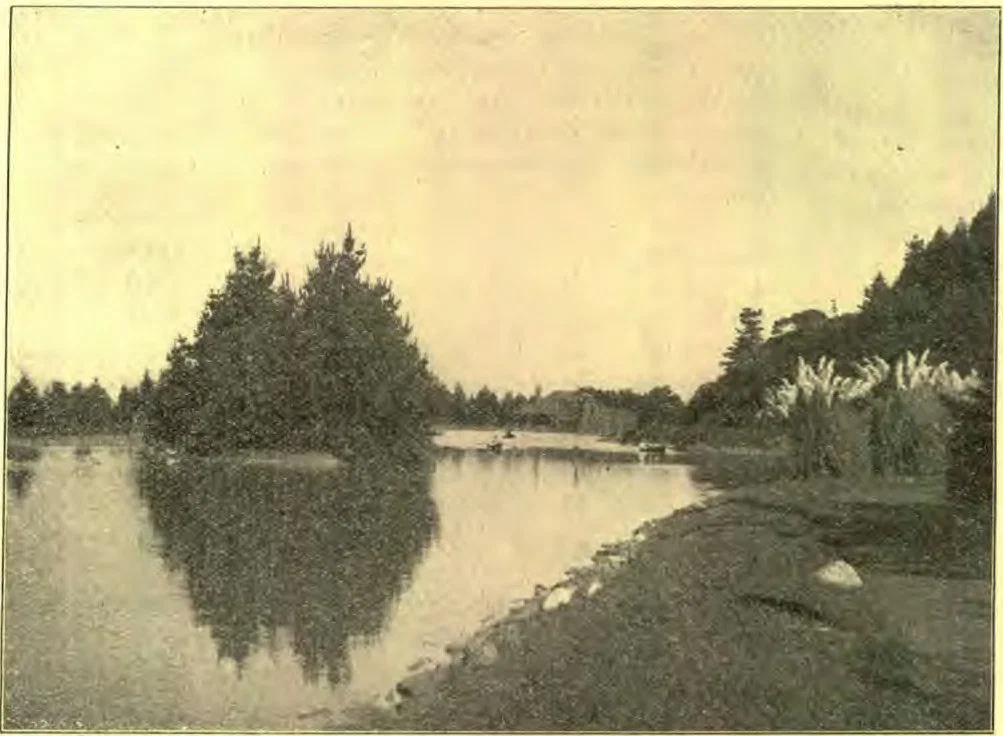
STOW LAKE, GOLDEN GATE PARK
The city’s pleasure-ground and pride is a tract of land half a mile wide, and three miles long, extending from the outskirts of the city proper to the wave-washed sands of the ocean beach. Here the city, represented by its people, repairs every afternoon and all day on Sunday to get a breath of fresh air, a whiff of the fragrance from green grass and blooming flowers, and a respite from the noise and bustle of the busy metropolis.
When the city secured title to this tract of land, and determined to make of it a park, it was an area of barren sand that for ages the unceasing wind from the ocean had been piling into great, bleak dunes, and was entirely destitute of vegetation, save for an occasional patch of chaparral that had taken root in some sheltered spot. But the ocean breezes, though they seem cold to one who must face them, bring from the Japan current some of the heat that that great ocean river has stored up in its waters, and brought from its birthplace, thousands of miles away in the tropical seas. Before this breeze the snow of the arctics melts and falls to the earth as rain; so that, summer or winter, the whole coast region of California is blessed with a semi-tropical climate. With this advantage the men who first conceived the project knew that time and patient labor would turn the great waste of sand into a landscape garden of which the city might well be proud. From that day to this the park commissioners have labored along lines of progressive improvement. The park now contains a splendid system of roads, some thirty miles in all, artistically laid out and well kept, besides innumerable paths for the use of wheelmen and pedestrians. Through these the visitor may ride or stroll for hours, or even days, surrounded by luxuriant grass and flowers and shrubs, and nowhere reminded of the shifting sands from which the park was reclaimed. Nor need the pedestrian confine himself to the paths alone; there are no “Keep off the Grass” signs in Golden Gate Park, and he may wander where he will o’er wooded hill or grass-grown slope, through shaded dell or flower-decked vale.
In so brief an article as this it will hardly be possible to enumerate the principal features of interest, much less describe them in detail, for every one of the thousand acres of the park contains something worth seeing, and failing that, worth hearing about.
The tea garden, a quaint bit of transplanted Japan, never fails to interest the visitor; especially if he is unfamiliar with the architecture of the Japanese.
Strawberry Hill is well worth the climb up the rustic stairs or around the winding road that leads to the observatory on its summit, from which one gets a splendid view of the park, part of the city, and the surrounding country. Strawberry Hill is an island in Stow Lake, upon which, if the visitor feels so disposed, he may take a row in one of the boats furnished at a nominal rental.
In the conservatory will be found many rare and curious tropical plants and flowers, each marked with its name and native country. In the animal paddocks, buffalo, elk, and several species of deer roam about at will. A number of carnivorous animals are confined in strong cages and especially constructed pits. Among these latter is a monstrous grizzly bear, said to be the largest in captivity. It is certainly the largest the writer has ever seen, and as large as he would care to see unless a fence of good strong iron bars stood between it and him.
To a bird-lover the aviary will be an interesting feature of the park. It is simply a cage of closely woven wire. But it is large enough to inclose a number of fair-sized trees, and give the thousands of birds that inhabit it plenty of room to stretch their wings without danger of interfering with their neighbors. Many of the birds have been brought from distant foreign lands; but natives and foreigners seem to get along in perfect harmony, and all appear quite contented with their lot. They certainly ought to be contented; for here they enjoy all the comforts of freedom, without its trials and dangers, and all the luxuries of confinement, without its galling restraint.
So many and so varied are the attractions of Golden Gate Park, that if all the prominent features mentioned in this article were removed, with the room they occupy, they would scarcely be missed.
J. EDGAR ROSS.

Object of Prayer

THE Bible clearly shows that God's purposes are unchangeable, and the works of nature reveal the same. The unbelieving, therefore, ask: “Why should a man pray, since God, being unchangeable in his plans and prospects, can not be changed or turned aside from them?”
All this is true, but it reveals his ignorance of the use and purpose of prayer. Prayer should never be made with the wish to change God's mind. It should be made with the object of having God change our minds. Let us not ask God to fulfill our desires, but ask him to so change us that we may fulfill his desires.
We may depend upon God's desires being wise and good while our own are ignorant and often evil. So let us let go of our desires, and get in line and accord with God's purposes. In other words, let us so surrender self that God may get hold of us and reveal himself to us and use us. We may inquire, What is God's great desire in these latter days? Is it not the speedy spread of his message for this time? How, then, shall we pray now? Shall we not pray earnestly that God may help us to become so in accord with that purpose that he may always use us to that end? E. L. PAULDING.

Away From Lazy Hills

THE path that leads to a Loaf of Bread Winds through the Swamps of Toil, And the path that leads to a Suit of Clothes Goes through the flowerless soil: And the path that leads to a Loaf of Bread And a Suit of Clothes is hard to tread.
And the path that leads to a House of Your Own Climbs over bewildered hills; And the paths that lead to a Bank Account Are swept by the blast that kills. But the man who starts in the paths to-day In the Lazy Hills may go astray.
In the Lazy Hills are trees to shade By the dreamy Brooks of Sleep, And the rollicking River of Pleasure laughs And gambols down the steep; But when the blasts of winter come, The brooks and the river are frozen dumb.
Then woe to those in the Lazy Hills, When the blasts of winter moan, Who strayed from the path to a Bank Account And the path to a House of Their Own! These paths are hard in the summer heat, But in winter they lead to a snug retreat. — Sam Walter Foss.

Poor May Give, Rich May Receive

THERE doth not live Any so poor but he may give, Any so rich but may receive.
Withhold the very meag'rest dole Hands can bestow, in part or whole, And we may stint a starving soul. —Margaret F. Preston.

October Study of the Field

Fields: White to the Harvest

OPENING EXERCISES: —
Singing.
Prayer.
Scripture Reading. Matt. 9:36-38; John 4:35-38.
Field Study: —
Progress in Brazil. Review, August 20.
Openings in Cuba. Review, August 27.
Experiences in Japan. Review, August 27.
Opportunities in Chile. Review, September 3.
Our Matabele Mission. Review, September 3.
Reading: A Visit to Carey's Chapel.
Closing Exercises: —
Consecration Service.
Benediction.

Notes

Let the leading theme in the study to-day be the fact that the fields everywhere are white to the harvest. Evidences of this may be presented on each subject suggested under the field study. Only use the bright, encouraging experiences, or promising openings, and the appeals for help. You can make this fact so prominent that every one will go from the meeting feeling that there is something for them to do in this great closing work.
After reading “A Visit to Carey’s Chapel,” a consecration service may be engaged in very profitably. We can afford to do nothing less than consecrate ourselves to the Lord in these closing hours of his work. May the Spirit that animated William Carey with the expectation that the gospel could be carried to the heathen take possession of us as young people, until we shall, every one of us, set ourselves to give this gospel to the world in this generation.
We have published Mr. Dall’s letter almost entire, as we believe every one will be interested in it. If you have not read the life of that wonderful man, the Father of Modern Missions, make an effort to secure it and read it. Every young person could well afford to give it a place in his library. It can be secured for a very small sum, and is one of the most inspiring books offered to young people to-day.
E. H.
Continue reading: A Visit to Carey's Chapel