The Youth’s Instructor, Vol. 31, No. 32.

CARMEL

The Youth’s Instructor

Aug 8, 1883

S. D. A. Publishing Association · Battle Creek, Mich. · Aug 8, 1883

CARMEL

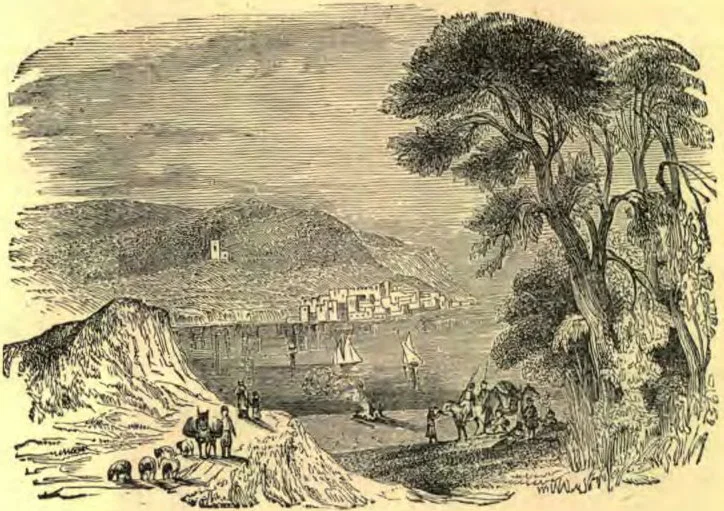
MOUNT CARMEL is not, as one might suppose, an isolated mountain, but a continuous range of hills, probably about eighteen miles long, with an average height of 1,500 feet. These mountains run inland from the Mediterranean in a south-easterly direction. At the western end, or more properly, the north-western, the range terminates in a bold promontory, which forms the southern headland of the Bay of Acre. The view given in our picture is from the north; and the travelers, with their laden mules and horses, are on the shore of the northern headland of the bay of which Carmel forms the southern.
The mountains of Carmel are of compact limestone, and on the north-eastern side, steep and precipitous, deeply furrowed with rocky ravines, which are filled with dense jungles, and inhabited by jackals, hyenas, and wolves. In the sides toward the sea are numerous caves and grottoes, formed partly by nature and partly by the work of men. These were anciently used as hiding-places by refugees; and at one time Carmel is said to have swarmed with monks and hermits, who made these caves their home. The entrances are so narrow that only one person can creep in at a time, and the caverns so crooked that he is immediately lost sight of unless closely followed. Thus we see the fitness of the reference of the prophet Amos, when, speaking the words of Jehovah, he says, “Though they hide themselves in the top of Carmel, I will search and take them out thence.” This mountain was frequently visited by the prophet Elijah, and to this day is shown a cavern called the “cave of Elijah.” It has been thought—and it is not unlikely—that it was in Carmel that the prophet called down fire upon the two fifties sent by Ahaziah to take him.
The south-western side of the ridge is not so steep and rugged as the north-eastern, but sinks down gradually into wooded hills, with well-watered valleys, presenting to the eye a district of great fertility; and declining gently into the beautiful plain of Sharon, lying along the Mediterranean. Carmel, in the Hebrew language, signifies park, or garden-like tract; a name which the mountain may well claim from its beauty and fruitfulness.
The mountain may well claim from its beauty and fruitfulness. It is sprinkled with fine oaks and other forest trees in its upper parts, and olive and fruit trees farther down. Says a writer who has visited the place: “Long, deep ravines of singular wildness wind down the mountain sides, filled with tangled copse, fragrant hawthorn, myrtle, and jessamine, and alive with the murmur of tiny brooks and the songs of birds. At intervals along the slopes are open glades, carpeted with green grass, and spangled with myriads of wild-flowers of every hue.” Another says that he is sure a botanist might spend a year in this locality, and every day add new specimens to his collection.
The north-western extremity of the range is, however, more bleak and barren; and here, overlooking the blue waters of the Mediterranean, stands the convent of the Carmelites, said to be one the finest in the world. It can be plainly seen in the picture, far up on the hillside above the town. The building is a modern one, erected on the site of a more ancient structure. At this end of the range, on the shore at the foot of the mountain, is situated the town of Haifa, a seaport on the Mediterranean. Late travelers speak of finding here a colony of about one thousand foreigners, chiefly Germans, who are quite transforming the squalid little town. They believe in the speedy coming of Christ to establish his kingdom, making Palestine his gathering place; and they are here to prepare the way by spreading Christian civilization, through means of modern agriculture, manufactories and the like. They are both zealous and industrious, and their neat gardens, streets, and houses make the place look quite inviting.
The scene of Elijah’s sacrifice in the days of Ahab, seems to have been near the south-eastern extremity of Carmel. Some have thought that they could identify the very spot; namely, a terrace of natural rock, which bears the Arabic name El Mukrakah, meaning “the sacrifice,” or “place of burning.” From this place there is a narrow pass leading down to the River Kishon, which flows at the base of the mountain; and it is supposed that down this track the idolatrous priests were hurried to meet their death by side the stream; for, part way down, is a point known as Tell Kussis, which means “hill of the priests.” From the terrace where it is supposed the altars were built, a few minutes’ climbing would have brought the servant of Elijah to the top of a projecting peak, whence he could command a full view of the sea, which is not far from ten miles distant. The fountain from which the water was probably drawn to deluge the sacrifice of Elijah, still sends forth its crystal stream; and near it are massive stones, which may have been used in the construction of the altars.
Travelers wax eloquent in their descriptions of this remarkable mountain, and in the thought that their feet have rested, and their eyes gazed, on the very spots where such wonderful things have transpired. Carmel has always been venerated, and to this day it is held sacred by Jews, Christians, and Moslems alike. E. B. G.

WHY ROBERT OF NORMANDY NEVER BECAME KING OF ENGLAND.

If you will subtract seven hundred and fifty-nine from eighteen hundred and eighty-three, you will find out what year Robert’s father was born. The father is known in history as William I., because he was the first king of that name, and also as William the Conqueror, because he came over from Normandy and defeated the Saxons in battle, after which he was crowned King of England in the year 1066. Well, this King William had three sons, and Robert, being the oldest, expected to be king when his father died, according to the English law. Robert, too, was born in Normandy, and was a brave, generous boy, but with a dreadfully hot temper, which on the least cause would make him act furious with anger; and it was this passionate, bad spirit which lost him his kingdom.
Once, when he was with his two brothers in the castle courtyard, they threw a can of water over him, drenching and spoiling his fine clothes. And what did he do but snatch up a sword, and pursue them to kill them. It was of course very unkind of them, but he was worse; for he was nearly a man and the oldest, and he would have killed one or both maybe; but the servants hurried to the king, who, in his turn, hastened to the courtyard and put an end to the quarrel. He scolded Robert very severely, who seemed blind to everything but the thought of the insult they had given him; so he ran away in the night, and tried to make the people rise up against his father. A few young men joined him, and they wandered about the country, doing every kind of mischief and robbing travelers, until something happened which made him stop short for a while, and think.
In those days, all princes and gentlemen were careful never to go out without being cased in armor from their head to their toes, like lobsters in their shells. Helmets covered their head, and when the visors were over their face, no one could tell friend from foe; consequently, when the prince and his attendants one day met the king and his followers, they did not know each other, but began to fight just because they met, apparently; and it was not long before the prince unhorsed his father, and he was just about to stab him, when he called out, “I am the king.” Just picture what those four words meant to Prince Robert! He had nearly killed his own father! From an angry spirit he changed right about, clung to his father, begged he would forgive him, vowing he would be a good man, and kissing him, placed him on his own horse. The king could not help forgiving his son, but when he died, left his kingdom to his second son instead of Robert, because he judged him unfit to govern a whole kingdom when he could not govern himself. So both William and Henry were kings in their turn, but Robert never, although he tried every way to succeed. They finally shut him in prison, and he lived there twenty-eight years, and died there.
If he could only have controlled his temper, Robert would have been as good a king as his brothers; but, as it was, he allowed his temper to rule him, and so he lost the king’s place, and was ever after known only as Robert, Duke of Normandy.
The Bible, so we think, is right when it says, “Greater is he that controlleth his spirit than he that taketh a city.”—Selected.

NIGHTFALL

THE hush of twilight, far and wide, Falls on the green and sloping meadows; All tremulous the aspens stand, By way-worn zephyrs lightly fanned, Where the clear brooklet’s mimic tide Sweeps onward to the shadows.
All day its sun-flecked ripples flow Through pastures strown with hay and clover; Through lonely glens, where alders lean To kiss the dimpled waves, unseen, And sweet wild roses blush below The brambles drooping over!
The stars peep forth, the afterglow Fades slowly out behind the larches; The birds are hushed—save one that seems To chirp a little in his dreams— When outcast breezes faintly blow Adown the woodland arches.
The ripples vanish, seaward drawn; The flowers in sleep their perfume render; So nightly round each darkening slope, The light is sown in patient hope, That the rich harvest of the dawn May rise in golden splendor.
—Arthur’s Home Magazine.

A STREET-CAR LESSON.

The law of God not only commands children to honor their parents, but also to respect the aged, and to “rise up before the hoary head.” Lev. 29: 32. Some do not seem to respect any one but themselves, and there are others who pay more respect to youth and health and beauty than they do to feebleness and old age. A lady in New York writes us the following instance:—
“I was in a crowded street-car the other day; a very pretty young lady came into the car, and a young gentleman got up at once, and with a pleasant bow gave her his seat. She thanked him and sat down. In a moment some one got up, and the young gentleman sat down opposite the young lady. “Soon an old man—very old and very shabby—entered the car. No one seemed to notice him. The young gentleman sat still. Pretty soon I saw the sweet young girl rise, and give her seat to the old man. She helped him sit down, and then stood herself. Oh, how ashamed that young gentleman looked! He could not bear it very long, and by and by he got up, said a few words to the young girl, and left the car. The young lady told me that he said, ‘You have taught me a lesson I shall not soon forget.’”
It is very well for gentlemen to make way for ladies, and rise up to give them seats; but it is not often that a gay and healthy young girl thinks to give a seat to some weary, gray-haired man, who, perhaps, has been standing and toiling all day, and who needs rest on his homeward journey. And there are some young gentlemen who would be more ready to yield a seat to a bright-faced, light-hearted young girl than to some weary woman who has perhaps been toiling to support her little ones, and who can only stand in constant weariness and pain.
If we heed the word of God, we shall seek to bear one another’s burdens, and shall be specially mindful of the infirmities and needs of the aged and feeble. “The hoary head is a crown of glory, if it be found in the way of righteousness;” and when we honor the aged, we honor those whom God has honored with length of days and long life.—Little Christian.

BOUND BY THREADS.

ONE time when Mr. Moody was to speak to a congregation of children in Glasgow, he took out of his pocket a number of spools of white thread, passing them out among the congregation, until the white threads were stretched all around the galleries, and from hand to hand through the house. The children wondered what he was doing that for, but he said not a word until the threads were stretched all around, then he asked,—
“Can any boy or girl break that thread?”
“Yes, yes!” was the answer, from all parts of the hall.
“Break it into pieces, then,” said Mr. Moody, and in an instant the thread was snapped into pieces. Then the preacher went on to say that “although that thread is a very little thing, which even a child can break, I could bind the strongest man with it. I could wind it around and around him, until he was a helpless prisoner, and he could never break it and escape.”
It is said that habit begins with silken cords, and ends with iron chains. A fly entangled in a spider’s web, thinks with a few struggles to get free; but no! Thread after thread is bound and woven about the helpless little captive, until escape is impossible. The only safety for the fly is to keep out of the web,—to avoid the slightest entanglement. It is a thousand times easier to keep out of trouble than to get out.
Satan weaves the threads of evil habit about unwary men. He begins with children, and he uses such fine thread that they are sure that they can break it. Here is a boy who tastes a little wine or cider, little thinking that these are Satan’s threads with which he binds his victims. Here is a boy learning to smoke or use tobacco, and Satan watches him as he does it, and contrives to twist thread after thread around him. That which is in the beginning a mere amusement, is continued as an absolute necessity. He who said at first, “I can use it or let it alone, as I please,” says at last, “I cannot give it up!”
Beware of Satan’s threads. No matter how light or harmless they may seem, do not allow Satan to bind you, even with a spider’s web. Shun bad habits, evil companions, sinful words, wicked thoughts; abstain from every form of evil, and serve the Lord with purpose of heart. He desires that his creatures should be free. Let us be workers with him, remembering that whom the Son maketh free, he is free indeed.—Selected.

“IT’S ALL THE LITTLE BOOK.”

SOMETHING more than a year ago, as the writer was sitting in a railway carriage, a pleasant voice sang out,—
“Paper; sir; paper, sir? Morning paper, lady?”
There was nothing new in the words, nothing new to see a small boy with a package of papers under his arm; but the voice, so low and musical—its clear, pure tones mellow as a flute, tender as only love and sorrow could make them—called up hallowed memories. One look at the large, brown eyes, the broad forehead, the mass of nut-brown curls, the pinched and hollow cheeks, and his history was known.
“What is your name, my boy?” I asked, as, half-blinded with tears, I reached out my hand for a paper.
“Johnny ——;” the last name I did not catch.
“Can you read?”
“O yes; I’ve been to school a little,” said Johnny, glancing out of the window to see if there was need of haste.
I had a little brother once, whose name was Johnny. He had the same brown hair and tender, loving eyes; and perhaps it was on this account I felt very much disposed to throw my arms around Johnny’s neck, and to kiss him on his thin cheek. There was something pure about the child, standing modestly there in his patched clothes and little, half-worn shoes, his collar coarse, but spotlessly white, his hands clean and beautifully molded. A long, shrill whistle, however, with another, short and peremptory, and Johnny must be off. There was nothing to choose; my little Testament, with its neat binding and pretty steel clasp, was in Johnny’s hand.
“You will read it, Johnny?”
“I will, lady; I will.”
There was a moment—we were off. I strained my eyes out of the window after Johnny, but I did not see him; and, shutting them, I dreamed what there was in store for him, not forgetting His love and care for the destitute, tender-voiced boy.
A month since I made the same journey, and passed over the same railroad. Halting for a moment’s respite at one of the many places on the way, what was my surprise to see the same boy—taller, healthier, with the same calm eyes and pure voice.
“I’ve thought of you, lady,” he said; “I wanted to tell you it’s all the little book.”
“What’s all the little book, Johnny?”
“The little book has done it all. I carried it home, and father read it. He was out of work then, and mother cried over it. At first I thought it was a wicked book to make them feel so bad; but the more they read it the more they cried, and it’s all been different since. It’s all the little book; we live in a better house now, and father don’t drink, and mother says ’twill be all right again.”
Dear Johnny, he had to talk so fast; but his eyes were bright and sparkling, and his brown face all aglow.
“I’m not selling many papers now, and father says maybe I can go to school this winter.”
Never did I so crave a moment of time. But now the train was in motion. Johnny lingered as long as prudence would allow.
“It’s all the little book,” sounded in my ear; the little book that told of Jesus and his love for poor, perishing men. What a change! A comfortable home; the man no more a slave to strong drink. Hope was in the hearts of the parents; health mantled the cheeks of the children. No wonder Johnny’s words came brokenly! From the gloom of despair to a world of light; from being poor and friendless, the little book told them of One mighty to save, the very Friend they needed, the precious Elder Brother, with a heart all love, all tenderness.
Would that all the Johnnys who sell papers, and fathers that drink, and mothers that weep over the ruins of once happy homes, took to their wretched dwelling the little book that tells of Jesus and his love! And not only these, but all the Johnnys that have no parents, living in cellars, and sleeping in filth and wretchedness—would that they could learn from this little book what a friend they have in Jesus.—Selected.

SUMMER SLEIGH-BELLS.

Did you, of a summer’s gloaming, While the evening winds were roaming, Catching fragrance as they flew From the beds where roses grew, Ever hear, Far or near, Sleigh-bells tinkling, soft and clear?
When the fire-flies lit the bushes, Gently ebbed through reeds and rushes Twinkling brook or placid river, Slipping smoothly on forever, Did you hear, Far or near, Sleigh-bells tinkling, soft and clear?
Did your fancy bring you back To a snowy trodden track, Birches clad in armor bright, Moon in heaven and fields of white? Like a flash On you dash, Merrily the sleigh-bells clash!
But this mellow, mystic chime That you hear in summer time Is the piping of the toads, Chorus from their tree-abodes. Ting-a-ling, Hear them sing, Universal anthem ring.
— Florence Wilkinson, in Independent.

NEW-TESTAMENT HISTORY.

LESSON 147.—REVIEW.

1. How was the gospel first introduced into Cyprus, Phœnicia, and Antioch?
2. How did the Greeks at Antioch first receive the offer of salvation through Jesus Christ?
3. To what extent was the gospel received?
4. What generous care did the church at Jerusalem bestow upon these new converts?
5. Describe the character of Barnabas, and his visit to Jerusalem.
6. Where did he obtain help to carry on the gospel work in the proud and populous city of Antioch?
7. Give an account of the labors of these apostles at that place.
8. How did the disciples at Antioch find opportunity to show their gratitude to those from whom they had received the gospel?
9. What persecutions did Herod practice, about this time?
10. Tell how Peter was released from prison.
11. Tell how he was received by the disciples who were praying for him.
12. What occurred at the prison, when it was found that Peter had made his escape?
13. Describe Herod’s interview at Cesarea with the ambassadors of Tyre and Sidon.
14. What success attended the spread of the gospel, in spite of the persecutions of Herod?
15. Tell how Paul and Barnabas were called and commissioned to go forth and preach to the Gentiles.
16. What places did they visit in the Island of Cyprus?
17. Describe their work at each of these places.
18. Whither did they sail on leaving Cyprus?
19. Tell how they continued their journey from Perga.
20. How did they introduce themselves publicly to the Jews of Antioch?
21. Tell how Paul gradually introduced Jesus Christ as the Saviour of the world.
22. What did he say of the unjust treatment which the Lord Jesus had suffered at Jerusalem?
23. To what scripture did he call their attention, as having been fulfilled by this Jesus of Nazareth?
24. In what words did Paul briefly present to them the offer of salvation through Christ? Acts 13: 26, 38, 39.
25. How did he show that those who reject Christ will perish? Verses 40, 41.
26. How was Paul’s preaching received?
27. What happened the next Sabbath to awaken the jealousy and envy of the Jews?
28. What did Paul and Barnabas say to these unreasonable men? Verse 46.
29. How did they show that such action would be in keeping with the word of God?
30. How did the Gentiles receive the good news of salvation?
31. By what means did the unbelieving Jews finally succeed in driving away Paul and Barnabas?
32. Where did the apostles next go?
33. What success attended their efforts at this place? Acts 14: 1.
34. How were the Gentiles led to oppose them?
35. How did the Lord confirm the words of the apostles? Verse 3.
36. What division arose among the people?
37. What measures did the opposing party finally take?
38. What places did the apostles next visit?
39. What astonishing miracle was performed at Lystra?
40. What did this lead the astonished people to exclaim?
41. What did they prepare to do?
42. How were they prevented from carrying out their intentions?
43. How did they finally treat Paul?
44. How were they incited to such cruelty?
45. Where did the apostles next preach the gospel?
46. What places did they visit on their homeward journey?
47. How did they encourage and establish the disciples that had been brought out under their teaching?

Father and Mother Both.

Sarah was an orphan, and the woman in whose house she now lived was not very kind to her. She was sitting one day on a rock, looking very sad and lonesome, when dear little Effie Dean, a neighbor’s child, tripped by.
“How do you do, Sarah?” said she.
“Oh, as well as I can with nobody to love me,” said Sarah. “If I only had a father and mother!”
“You have God for your Father, Sarah. The Bible says he is ‘the Father of the fatherless.’”
“Well, it doesn’t say he is the mother of the motherless.”
“But it says something like that, I’m sure,” said Effie; “for I read it myself. It says, ‘As one whom his mother comforteth, so will I comfort you;’ and mamma says God will be father and mother both to us.”
The poor orphan brightened up. “Is that so?” she asked. “I didn’t know that before. I don’t believe I shall cry so much now.”—The Sunbeam.

READY BEFOREHAND.

“WHAT are you doing now? I never saw a girl that was so constantly finding something to do!”
“I'm only going to sew a button on my glove.”
“Why, you're not going out, are you?”
“O no; only I like to get things ready beforehand, that's all.”
And this little thing, that had been persisted in by Grace Hammond until it had become a fixed habit, saved her more trouble than she herself ever had any idea of; more time, too. In fact, it was of almost inestimable value to her. Ready beforehand—try it. As surely as you do faithfully, you will never relinquish it for the slip-shod time-enough-when-it's-wanted way of doing.

HELPFUL HINTS.

A CONSISTENT Christian character is an indispensable qualification for both officers and teachers, that they may command the respect due to those who lead the young in the way to eternal life.
The superintendent should be one who has been a careful scholar and a successful teacher, until his knowledge of the Bible and experience in teaching have fitted him to rightly conduct a review of the teacher’s work, and supply such information as inexperienced teachers may lack. He should be a lover of good order, and capable of maintaining it in a prompt and easy manner. He should have a love for the work, and an earnest desire for the salvation of souls.
The secretary should be always in his place, and able to give clear weekly reports for the encouragement of the school, and a good summary at the close of the quarter. His quarterly report should be correctly made out, and promptly forwarded to the State S. S. secretary, that no delay of his shall hinder others in their work.
The chorister’s duties seem most pleasant of all, yet are not without their perplexities. His music for the school may well be given out one week in advance, that the scholars, especially the little ones, shall have time to learn the pieces. It seems strictly necessary for the chorister to be regular in attendance, that the exercise of singing, which adds so much to the harmony of the school, should not become ineffectual on account of being led by this or that unprepared one, in the absence of the chorister.
A teacher should have such a character that a Christ-like influence may attend his Sabbath instructions. Children are keen observers; and if a teacher in his daily life is found doing as the world does, speaking as its people talk, and following their styles, his influence upon his class cannot be like that of the Great Teacher. He should have a thorough knowledge of at least that portion of the Scriptures he attempts to explain. When this knowledge is obtained, like the apostle Paul, he needs to ask for wisdom of words, that he may rightly impart such instruction.
A knowledge of the country in which the events of the lesson took place, the customs of the people living there then, and the present condition of the same country and its inhabitants, presented to the class in a clear manner and in a few words, would seem to add to the reality of the characters presented in the lesson, and fix the events more firmly upon the pupil’s memory. Questioning as if seeking instruction from the pupil seems to quicken his mind and increase his interest; and should the answer be not quite satisfactory, complete it for him, as if finishing his answer. Thus you will increase his confidence, obtain a more ready answer to the next question, and his teacher will be to him a loving, helpful friend, and so a very tender relationship spring up between them. Lengthy discussions should be avoided in the Sabbath-school. Titus 3:9 says, “Avoid foolish questions, and genealogies, and contentions, and strivings about the law, for they are unprofitable and vain.”
The teacher should be an example of regular attendance, and prompt observance of the rules of the school, and should be sure to look after the absent ones with winning kindness. Teachers, as well as officers, should promptly attend each teachers’ meeting, where they should first bow in humble prayer for help in the Sabbath-school work, then together examine and discuss the lesson for the next Sabbath, if discussion is necessary to a proper understanding of it; and as conflicting ideas may find expression here, it would seem best that children should not attend these meetings, lest their minds become confused.
Now in view of these duties and responsibilities, how very necessary that we be faithful and earnest in times of secret prayer. At such seasons all connected with the school should be remembered before the Lord, and particularly the cases of those who may seem to need his special help. Through secret prayer our choicest blessings are obtained. It is the Christian’s manna, and the channel through which we must obtain that true wisdom which shall enable us to know and perform acceptably our duties in this and every other good work. Mrs. S. M. BABCOCK.

NANCY'S LESSON.

NANCY was a little girl who lived many years ago; in fact, she was a bent and wrinkled old lady when your fathers and mothers were young. She was a pretty little girl, with dark hair, and brown eyes, and rosy cheeks,—a little girl who was not afraid of the sunshine, who slept soundly nights, and who thought bread and milk very good fare for children.
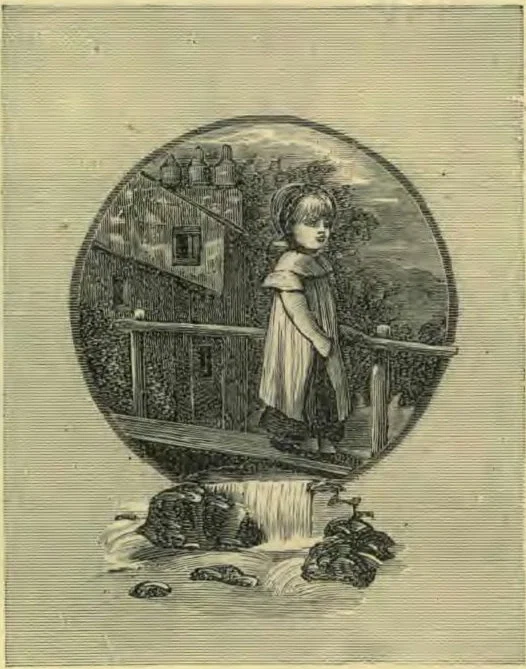
She lived with her grandmother in an old house by the brook. It was a queer old house, as you can see by the picture. There were nice cherry and apple trees in the yard, and on one side grape-vines and rows of currant bushes. In front of the yard stood a row of poplars, straight and tall.
Nancy was usually quick to mind her grandma, but sometimes she thought her own way best, and so got into a great deal of trouble.
One time the day before the Sabbath had been rainy, and the little brook by the house was very high. Grandma did not think it best for Nancy to go to church that day, and so she left her at home with Betsey Ann, the hired girl, telling her not to go away, but to stay and learn her verses.
Nancy didn't like this very well, for grandma had brought home a new bonnet for her from town that very week, and she wanted to wear it to meeting to show to the other girls.
It did not take her long to learn her verses, and then she wondered what she would do. Betsey Ann was asleep on the lounge in the sitting-room, so Nancy chased a butterfly round the yard, and then came across her kitty curled up on the piazza asleep in the sun. Kitty waked up when Nancy came near, and scampered after her down the walk.
But Nancy did not stop long to play with the kitten, for she had thought of something to do. A little way down the road stood a small cottage, where a lame boy lived. Nancy had been there with her grandma many times, and had often gone herself to carry a pretty book or some flowers to him.
“Now,” thought she, “I have often heard grandpa say that it is right to visit the sick even on the Sabbath; and I guess I'll go down and carry lame Jamie some of the cookies grandma made. He don't have any, and maybe he would like some of mine to-day.”
So she went up to her little room over the kitchen, and putting on her clean pink dress and her new bonnet, tiptoed down stairs, and filled a little bag with the cakes.
“Don't; don't! Nancy, Nancy!” the old clock ticked from the corner of the kitchen. But Nancy was too busy in filling the bag to listen to anything the clock had to say.
“To be sure,” said she, as she went through the garden, “grandma told me to stay here; but then I don't believe she would care if I went to see somebody that was sick; because the Bible tells us to visit sick folks.”
So quieting the little voice in her that kept telling her it was wrong to go, Nancy went down the garden, over the bridge that spanned the brook, to Jamie's house.
Jamie was glad to see her, and showed her some plants that he had growing in his window. When the little clock on the shelf struck twelve, Nancy started home. But in going over the narrow bridge, wet and slippery with the long rains, her feet went out from under her, and she fell into the brook below. Down the stream she floated until her dress caught on a bush, and held her fast. But the water here was so deep that she could not get out herself; so she had to cling to the bushes until some one came for her.
At last she heard grandma calling, and Nancy cried out to her. By and by, grandpa found where she was, and took her out of the water. He did not say anything to her, neither did grandma; for they thought she had been punished enough already.
In the evening, grandpa read for worship a chapter in the Old Testament, where it tells about a king who offered sacrifices when the Lord did not tell him to, and how he was punished for it. And he explained this verse from the chapter to Nancy, and gave it to her to learn: “Behold, to obey is better than to sacrifice, and to hearken, than the fat of rams.” And she never forgot it, but often told this story to her grandchildren as they gathered around her knee. W. E. L.
Continue reading: BIRD'S NESTS