The Youth’s Instructor, Vol. 37, No. 11.

CROCUS

The Youth’s Instructor

Mar 13, 1889

S. D. A. Publishing Association · Battle Creek, Mich. · Mar 13, 1889

CROCUS

O THE dear, delightful sound Of the drops that to the ground From the eaves rejoicing run In the February sun! Drip, drip, drip, they slide and slip From the icicle’s bright tip, Till they melt the sullen snow On the garden bed below. “Bless me! what is all this drumming?” Cries the crocus, “I am coming! Pray don’t knock so long and loud, For I’m neither cross nor proud, But a little sleepy still With the winter’s lingering chill. Never mind! ’Tis time to wake, Through the dream at last to break!” “’Tis as quickly done as said, Up she thrusts her golden head, Looks about with radiant eyes In a kind of shy surprise, Tries to say, in accents surly, ‘Well! you called me very early!’ But she lights with such a smile All the darksome place the while, Every heart begins to stir Joyfully at sight of her; Every creature grows more gay Looking in her face to-day. She is greeted, ‘Welcome, dear! Fresh smile of the hopeful year! First bright print of Spring’s light feet, Golden crocus, welcome, Sweet!’ And she whispers, looking up From her richly glowing cup, At the sunny eaves so high Overhead against the sky. “Now I’ve come, O sparkling drops, All your clattering pattering stops, And I’m very glad I came; And you’re not the least to blame That you hammered at the snow Till you wakened me below With your one incessant tune. I’m not here a bit too soon!” —Celia Thaxter.

A FOUR-FOOTED FISHERMAN.

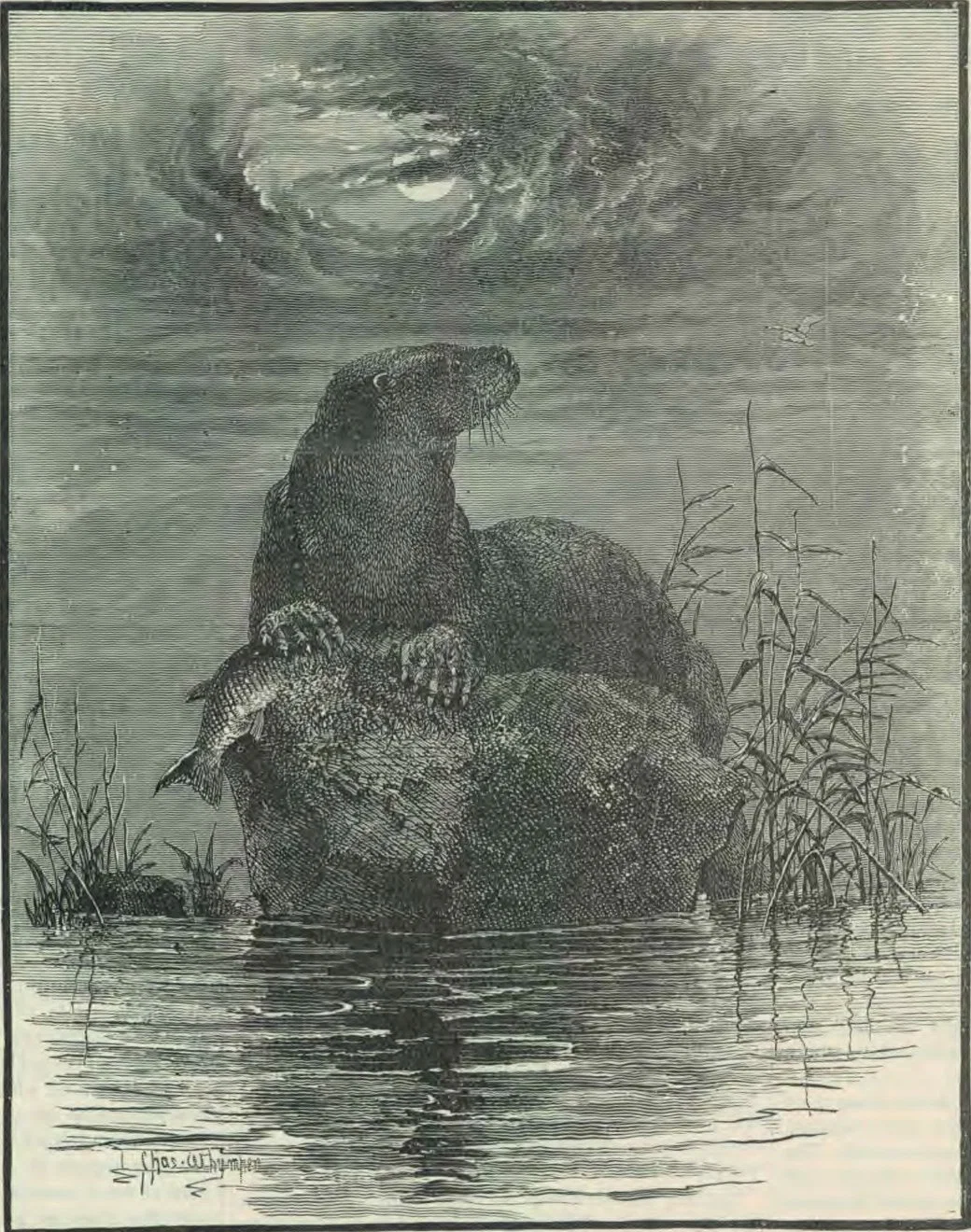
One would not think from the picture on this page that men and boys are the only fishermen. Well, we all know they are not. Some of the best fishers are found among the birds, among those four-footed animals that live partly in the water and partly on the land, and even among the fishes themselves.
The fisherman in the picture is the otter. He can dive and swim like a fish, or he can breathe the air and live on the land as we do. He cannot live under water all the time, so he builds his house high above it. To keep this house dry, and to keep out dogs and other animals that might disturb his home, he has a cunning way of building.
He chooses a place on a stream where the banks are high; then he dives down into the water and begins digging into the bank, low enough down to have the door always under water, that no land thief may enter it. After digging into the bank a little way, he digs up, and up, sometimes making rooms two and three or more stories high, so that if the water should enter one room, he could move higher up. From the top of the highest room, he digs a little hole up to the surface of the ground, for ventilation. He manages in some way to line his rooms with reeds, grass, or rushes.
The otter eats only one meal a day, generally of fish, and that always at night, so he lies quietly in his house or on the rocks all day. But when he goes into the stream after his supper, you may be sure he makes it pretty lively for the fishes. He is such a perfect fisherman that it is almost impossible for them to keep out of his way.
If this animal is caught when it is young, it may be tamed. It will then follow its owner about like a dog, coming at a whistle from him.
In some countries tame otters are taught to fish for their owners. A man in England had one that would go out with him in a boat on the river, when it would jump overboard, and bring fish back to him. This it would do until the man was satisfied. If at any time the otter remained away too long, the man had only to call him by name, when he would return to the boat at once.
One day when the man was away from home, his little boy thought he would take the otter and go fishing, as he had seen his father do. All worked well at first, and the otter jumped into the river just as he did for his father; but he did not bring him any fish, neither would he come back, although he called his name repeatedly. And worst of all, he had to go home without the animal.
The father grieved for his pet otter, not expecting ever to see him again. But several days afterward, as he was walking along by the old fishing-ground, he called his pet by name, when, to his great joy and surprise, the otter swam out of the water, and laid himself down at his master's feet.
The American otter amuses himself in sliding down hill, the same as boys do. In some of the Western countries, where the soil is slippery clay, there are what are called “otter-slides.” The otter will go to the top of one of these, which is often so steep as to make it real hard to climb, and slide down as swiftly as a boy can. Once the celebrated naturalist Audubon saw two otters slide twenty-two times each down the bank of a stream that emptied into the Ohio River, before he disturbed them.
In the winter time they will climb to the top of the highest snowy hill, lie down upon their stomachs with their forepaws bent backward, and with their hind feet, steer themselves head foremost down to the stream below. They will play in this way until all tired out.
The otter is found in every part of the earth, but most plentifully in Europe and America. The European otter differs from the American in some particulars, but principally in size. While the European species is only two feet in length, the American is some four feet long. It has two coats of fur, one short, fine, and thick, through which there grows a thinner coat, coarser and longer, and quite glossy in appearance. Its fur is brown, and skins of the common otter are of considerable value; but skins of the sea-otter, in Europe, are valued at prices ranging from thirty to sixty pounds.
The sea-otter is much larger even than the common otter of America, the great sea-otter weighing seventy or eighty pounds. It confines itself more closely to the water than do the other kinds. It sleeps in the water, lying upon its back, the mother otter in the meantime holding the baby otter in its forepaws.
The sea-otter is very playful. Hunters claim that they have watched it full half an hour as it lay upon its back in the water, tossing a bit of sea-weed from one paw to the other, seemingly taking great pleasure in catching it before it should fall. It spends hours, too, in playing with its young.
Otters are all very affectionate, and sometimes grieve themselves to death at the loss of their young.
M. J. C.

COURAGE, FALSE AND TRUE.

“It’s a cowardly thing to do, Will; I’ll have nothing to do with it.”
“You’re the coward, Tom,” replied Will, angrily.
This was what Will’s brother Howard heard, as he stood upon the roof of the piazza, sheltered by the vines that clambered up the corner of the house. He saw the two boys leave the orchard, Tom Jones turning toward his home, while Will walked alone toward the mill.
“Where are you going, Will?” he called.
Willis hurried on with rapid steps, not even looking back as he answered, “Down the road a little way.”
“I believe he has that box of torpedoes,” said Howard. “He’s planning some mischief;” and letting himself down lightly by the grape trellis, Howard followed his brother.
“What are you going to do with the torpedoes?” he asked, as he overtook him.
“I’m going to have a little fun,” answered the boy, gruffly.
“Will,” said Howard, “you’re planning mischief; tell me what you’re going to do, for I’m going with you to help you out of it.”
“Well, then, I’m going to put these torpedoes on the track; it’s nearly time for the express, and it will be fun to see them slow up the train and rush out to see what’s the matter.”
“I don’t see the fun myself,” replied Howard. “Where do you propose to stand?”
“I’m going to scatter them in the cut; they will make more noise there, and I’m going to stand on the rocks behind the bowlder.”
“Don’t do it, Will; they’ll catch you.”
“Pooh! I’m not afraid. If I were such a coward as you are, I suppose I shouldn’t do it,” replied Will, contemptuously.
Howard was not a daring boy; he never climbed a tree without looking carefully at the branches; he waited for the ice to be safe before venturing far upon it. His prudence and admonitions were a constant irritation to his reckless brother Willis, who never hesitated to place himself at the outposts of danger. The brothers had been too absorbed to give more than a passing glance to a little boy who was at play near a neighbor’s house.
Little Jerry often toddled after his brothers, but now they failed to hear the little footsteps that seemed an echo of their own.
Willis divided the torpedoes about equally between the two tracks that were shut in by the narrow cut through the rocks, and Howard followed him up a winding path, unknown except to the boys who ventured upon the steep hight.
“There’s the whistle,” said Will, as he stationed himself behind the bowlder.
Howard threw himself upon the ground near the brow, and looked down the dizzy hight. In an instant he was upon his feet. Both boys at the same instant had seen little Jerry upon the track picking up the torpedoes. Both retreated from the rock—Willis to the shelter of the woods beyond, where he threw himself upon the ground with hands pressed closely over his ears; Howard to the path that led to the track the train was rapidly approaching. His feet tripped upon the rail as he caught the child, and as he fell, he saw a freight train approaching upon the other track.
He had only time to take Jerry in his arms, and straighten himself out in the narrow space between the two tracks. He closed his eyes and waited. The noise was terrific; the crackling of the torpedoes and the shrill shrieks of the two engines echoed from the high cliff on either side, and Howard lost consciousness. When he revived, he found himself surrounded by the passengers, who had rushed from the train, while engineers, conductors, and brakemen were carefully examining the track upon either side.
“It’s no signal,” said a brakeman, “see how they’re scattered between the sleepers.”
“Some boy’s work,” said another. “Here, boy,” seizing Howard, “did you put these here?”
“No, sir!” said Howard, firmly.
“I believe that,” said the engineer, who had seen him rescue the child. “A boy who has the courage to do what he has done is above such tricks.”
Howard was too weak to attempt to go home; he sat down near the track, hoping Will would come and find him. He called, but his voice seemed to come back to him from the foot of the cliff, Then he thought Will must have fainted, and, strengthened by this thought, he determined to go home and send some one to find him.
He walked slowly, leading little Jerry, who was still crying from fright. He found Will at home, looking troubled and unhappy.
“Jerry is all right,” said Howard, answering the question he knew Will feared to ask; and in a few words he told the story of the escape.
Will was crying now.
“I am glad you are safe,” he said, as he turned away to hide his tears. “You’re the brave one, after all; I shouldn’t have dared to do what you did, and I called you a coward!”
Poor Will! he now knew the difference between false and true courage. His humility and gratitude wrought a change that surprised his friends, but no one guessed the secret Howard carefully guarded.—Christian Union.

THE MANY USEFUL THINGS PRODUCED FROM COAL.

Gas is the best known production from coal; yet a little search will show that many other things originate from the same source. Ammonia is one of these. It is first seen in liquid form, but when treated with chemicals, and slowly boiled, it will crystallize as it cools. In this form it is extensively used in dyeing cloth. Its name is said to be derived from sal ammoniae, a substance manufactured ages ago, in a district of Lydia where Jupiter Ammon was worshiped as the chief deity. Of course it was not then produced from coal, as that was long before coal was heard of. It was obtained by heating animal refuse, and also from the distillation of deer’s horns, from which one preparation of it was called hartshorn.
From the coal-tar produced when making gas, the chemist makes naphtha, creosote oil, and the ordinary pitch used in asphalt pavements and the flat roofs of houses. Naphtha is put to several uses. It is often employed for lighting purposes, as well as in mixing paints. It is also used in making India-rubber and gutta-percha.
What is known as paraffine is another production from coal-tar. From paraffine two useful oils are distilled; one fit for burning in lamps, and the other of a thicker substance, suitable for oiling machinery.
All these and other articles followed in the wake of the discovery of gas-making. But very probably these would have remained unknown, had not the value of gas for lighting purposes been demonstrated.
For a long time after it was known that gas could be made from coal, nothing was done toward manufacturing it. It was not till 1792 that William Murdoch first made use of it for lighting his house and offices at Cornwall, England. He no doubt made many experiments before succeeding in his attempt. At best the apparatus used must have been very crude, compared with the perfected arrangements of the present day.
But Mr. Murdoch was as persevering as he was ingenious. An incident of his boyhood days shows how he overcame difficulties, and mounted the ladder of fame. He was very desirous of securing a place to work in a certain foundry. But he was told that if he went to make application, he ought to wear a “top” hat, instead of the cloth “bonnet” his poverty had always compelled him to wear. Here was a difficulty. He was not able to purchase a beaver, such as was commonly worn; so he concluded he would make a substitute. But he had nothing besides wood to make it of, and even then he saw no way to make such an article unless he had a turning lathe.
Nothing daunted, however, he applied himself to the task, and in due time had a lathe of his own make. To produce the hat after that was only a question of patient labor. It was soon made,—smooth, and hard, and round as a piece of metal pipe. He colored it black, and started on his mission.
He was shown into the office of Mr. Boswell, one of the heads of the great firm. There he stood, hat in hand, an inexperienced, shabbily-dressed youth, timidly asking for a position.
“No vacancy, young man,” hastily spoke the “iron king.”
These words crushed the Scotch lad’s last hope. He was so poor, and had been so expectant, after such earnest efforts; and yet all for nothing. As, with a heavy heart, he thought of all this, he seemed transfixed to the spot. He stood there so long, twirling his hat, that finally the stern business man turned in his chair, apparently to make his answer more decided. As he did so, his eye rested on the hat, which the young man was unconsciously twirling.
Instead of speaking harshly to the poor fellow, he held out his hand for the hat. Carefully examining it, he at last inquired of the youth where he procured the article.
Then followed a pitiful story of poverty, and the desire to appear at the foundry in a dress that would insure a position. All the difficulties of first being obliged to make a lathe and then turn the hat were recited before the now thoroughly interested man of business. He saw in the production evidence of useful talent, and in a short time decided to employ the young man on low wages.
Soon the young man was advanced to higher positions, until he finally became one of the leading partners of the firm. It was to one who could thus surmount difficulties by untiring effort and persevering industry, that the world to-day owes the honor of utilizing coal-gas for lighting purposes. J. O. C.

A GENTLE WORD IS NEVER LOST.

A GENTLE word is never lost, Oh, never then refuse one; It cheers the heart when tempest-tossed, And lulls the cares that bruise one; It scatters sunshine o'er our way, And turns our thorns to roses; It changes weary night to day, And hope and love discloses.
A gentle word is never lost— Thy fallen brother needs it; How easy and how small the cost— With peace and comfort speed it; Then drive the shadow from thy cheek, A smile can well replace it; Our voice is music when we speak With gentle words to grace it.
—Selected.

A LITTLE SEED AND A GREAT HARVEST.

Mary Cander’s life lasted just sixteen years. Most of that time was passed in bed, in acute pain. She had learned to read, and to cut out figures from paper with much skill; but there her knowledge and acquirements had necessarily stopped. Her family were generous Christian people, actively engaged in work for the poor. Poor little Mary! she wished to help also; but what could she do—herself ignorant, helpless, and crippled?
Her window overlooked a hovel, in which lived John Martin, an idle Irishman, with his wife and eleven children. Drunkenness, untruthfulness, and dishonesty were notorious faults of the Martins. They were all regarded as hopeless outcasts.
“I think,” said Mary, “that if I could tell John how good the Lord has been to me, it would help him.” But her father forbade the attempt.
“John’s wife, then?” This was also forbidden.
“Let little Phil come, at least. He can do no harm.”
Phil, a bright, mischievous urchin of ten or thereabouts, was allowed to visit her. She showed him pictures, cut marvelous groups in paper, and told him stories day after day, until she won his confidence. Then she taught him how her Friend, through hard lessons, was making her like Himself.
Phil continued to be her faithful daily companion for three years, when she died. Her influence over him seemed to be even stronger when she was gone than it was before. He separated himself from his family, worked steadily, educated himself, and when he became a man, settled in Iowa, where he married. His children are now among the most influential men and women in a city of that State. They are honorable, generous Christians, serving God and their fellow-men with a peculiar heartiness and energy.
The little seed which the sick girl planted in faith, has grown to be a mighty tree, with wide-spread branches and much fruit.
Never neglect to do a good action or to speak a helpful word because “it is too small to be of use.”
If the disciples had refused to distribute the five small loaves which the Master put into their hands, how would the great multitude have been fed?—Youth’s Companion.

Do Not Be Crushed by Mistakes

Yes, that was a bad mistake, but do not feel crushed by it. Never mind if you were ridiculous for the time. No one who is worth anything succeeds in life without many mistakes. This will be quickly forgotten by your friends, and you will be judged by your capacities, not by your failures.
“I would rather make four failures and only one success, than to make no success at all,” said a good man.

The Highest Exercise of Charity

THE highest exercise of charity is charity toward the uncharitable.—Buckminster.

LITTLE FEET.

“See my new shoes,” said little Mary; “this pair had to be bigger than my old ones. Some time my feet will grow as big as sister Susie’s, and then they will be real useful feet and carry me to school. Mine aren’t big enough yet; they don’t do much but help me run and play about the house.”
“But they can be useful feet, even if they cannot carry you as far as school yet,” said her mother. “God gave you your little feet to be useful. He wants you to use them for him.”
“Why, how can I, mother?” said Mary; but her mother had gone to the baby, and did not answer.
“How can I use my feet for God?” Mary repeated to herself. “I do walk to church on them; I wonder if that is what mother means.”
“Mary!” called her father.
Mary sprang up and ran to meet him as he came in tired from his office. She always liked to wait while he took off his coat, and then she would go with him, hand in hand, into the sitting-room; but to-night he handed her a bundle.
“Here, girlie,” he said, “run down to Hannah with this, and let her put it into the ice-chest.”
Mary went very pleasantly, although she wished father had let her go into the sitting-room with him first, and see what pretty papers he had in his pocket. In the kitchen Hannah was standing, with a red and angry face.
“What am I to do now?” she was saying. “That cat of yours, Mary Allen, has drank every drop of milk I had saved for your father’s tea!”
“Please don’t be angry with pussy,” said poor little Mary, shielding her pet from a blow. “I am very sorry, Hannah, but she doesn’t know any better.”
“That doesn’t help it,” said the cook. “What am I to do for tea?”
“If you will give me a pitcher, Hannah,” said Mary, “I can run across the street and ask Aunt Jane for some.”
Hannah brought the pitcher, and Mary soon returned with the milk, walking very carefully so as not to spill it. At the supper-table grandma said the room was chilly, and in a minute Mary had slipped upstairs and brought her a soft shawl.
“Thanks, little pilgrim,” said grandmother. “Your little feet make many journeys.”
After the meal was finished, the baby wakened and began to cry again, and mother bade Mary amuse her next younger brother while the baby was having his supper. Eddy wanted Mary to be his horse, and enjoyed the game so much that after his mother had returned, he wanted Mary to keep on playing with him.
“No, Eddy,” said mother, “Mary need not play with you any more; she wants to see the picture papers father brought home. Come and I will read to you.”
Eddy began to cry. “No, no,” he said, “I want Mary to run some more.”
“I will play just a little longer with him, mother,” said Mary; “he is so little, you know.”
The mother smiled and nodded, and Mary let Eddy drive her up and down the hall for ten minutes more; by that time he was tired of it too.
“Mother,” said Mary that night, when the dear mother came to tuck her in bed, “how can I use my feet for God?”
“Dear child,” said her mother, “you have used them for him all day. When you took father’s bundle so pleasantly down stairs, when you went for the milk, when you brought grandmother her shawl, and when you ran with Eddy, you were using your feet for God. It was because you love Jesus and want to please him that you did those things so cheerfully. God has taught you already how to use your feet for him.”
Little Mary smiled. “I am going to give God my feet for always,” she said.—The Child’s Paper.

A HARD QUESTION.

If you little boys and girls, With straight hair or with curls, Who go to school to study every day, I have a question here, That may sound very queer, But a penny for its answer I will pay.
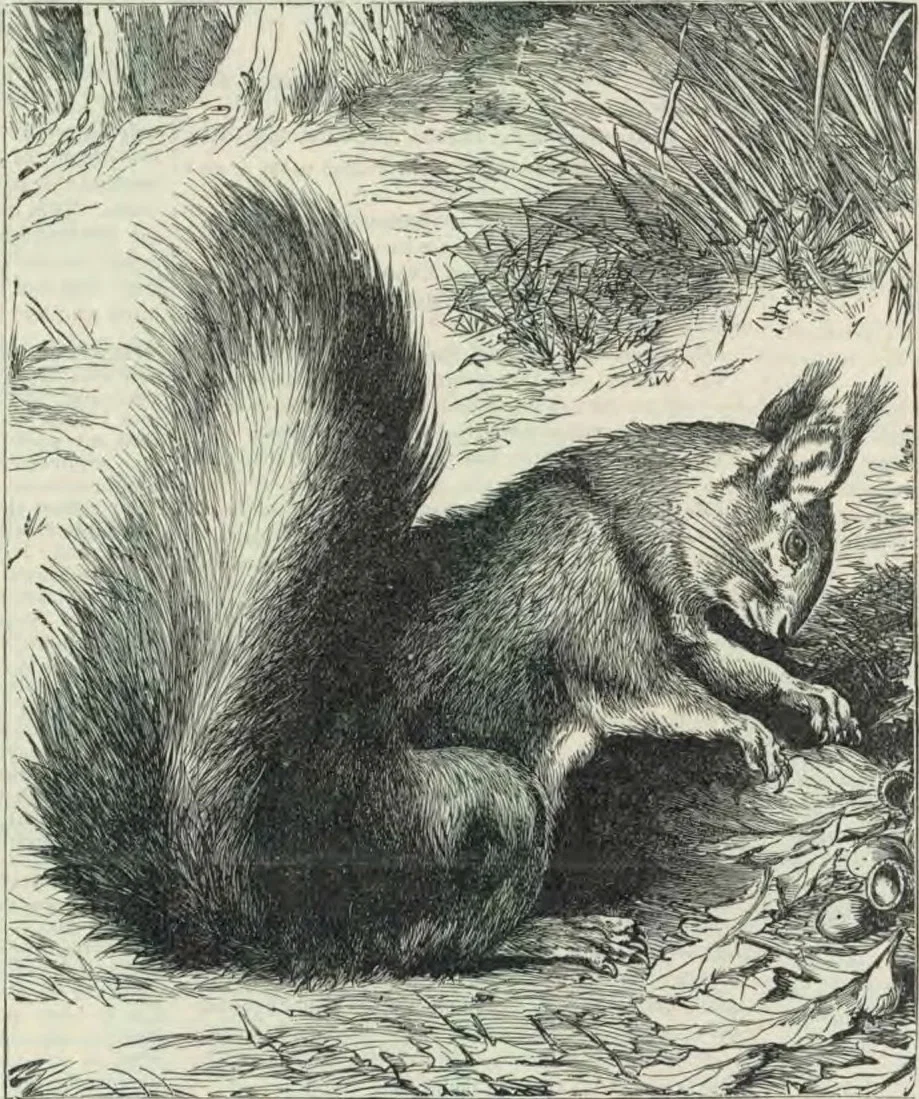
The cunning little squirrel, Whose life is all a whirl Of fun and frolic in the forest trees— Why should he, wild or tame, Have squirrel for his name? I am waiting for an answer, if you please.
Oh, I know very well That none of you can tell. Because I've waited patiently and long; So I'll have to read myself From the old book on the shelf, Where I found it when I hunted for a song.
Squirrel comes from two old words (Don't tell it to the birds) Which were put together years ago, and made One word, which means, to-day, That this little creature gay, Is one that travels with his tail for shade.
And if you go quite near, Without either noise or fear, You'll see a dark line down his back does run. Which must be what he shades (For all the other fades) With his tail all day from bleaching in the sun.
—The Kindergarten.

ONLY A SEED.

BERTIE WILLIAMS stood by the window ledge, sifting pumpkin seeds through his chubby fingers. He has a little basketful of them that he sometimes plays with. He is learning to count with them. He fences off make-believe pasture lands on the green felt of his auntie's writing stand, where he puts wonderful pumpkin-seed sheep and cows. It sometimes takes him quite a while to find out how many cattle he has in each field, and then how many there are in all the fields together. Aunt Huldah helps him.
This morning she was too busy to play with Bertie. She was writing letters. Bertie watched her swift pen fly over the paper until he was tired. Then he fell to eating the pumpkin-seeds. He is very fond of the sweet meats inside the stiff, white shells.
At length the last letter was ended. Aunt Huldah looked up while she sealed and stamped it, to see what Bertie was doing.
“Bertie Williams!” she exclaimed suddenly, “you have eaten a whole pumpkin vine!”
Bertie looked up in alarm, as if he expected soon to find a pumpkin vine trailing from his red lips.
Aunt Huldah laughed, and told him to bring two or three seeds to her. She carefully removed the outside skin.
“Now,” she said, “you can see if it is not so.” Then, with her penknife, she carefully split the seed in two parts.
“Those two fat pieces, or meats, as you call them, are the pumpkin's first pair of leaves. This little pointed end makes the stem from which the root will grow. The old pumpkin vine lays up food in these two leaves for the little plant to live on until it can make a root, and start out on a hunt for food for itself.”
Bertie's eyes opened wide in surprise. “Do plants eat?” he asked doubtingly.
“Yes, indeed,” his auntie replied. “They do not eat just as you do; but each plant sends out tiny roots that take in from water and earth just the things it needs to make it grow. Little plants do not have any roots when they first burst out from the seeds; so the parent plant gets them all ready beforehand, with something to live on until they can support themselves.”
“I should like to see a plant grow from a seed,” said Bertie; “I could plant some, and pull one up every day.”
“I know a better way than that,” replied Aunt Huldah . “Come with me, and we will do it now.”
They went to the large tin box in which Bertie's papa kept his garden seeds. They took out some peas and beans and oats and corn. Then they got four glass tumblers, and filled them nearly full of water. On top of the water Aunt Huldah placed a piece of cotton the size of the top of the tumbler. The cotton was not so thick but that water could easily soak through, yet it was thick enough to keep the seeds, when placed on top of it, from falling down to the bottom of the glass.
She placed the peas, beans, oats, and corn in separate glasses, and set them in a sunny window.
“Now, then,” she said, “you can have something new to watch.”
Bertie did watch. Every five minutes he ran to the window to see if the seeds had begun to grow. But he got tired of it by dinner time, and did not think to look at them again until the next morning. The wrinkled peas had swelled out smooth, and the beans looked ready to burst. Before many days had passed, the oats and corn sent green swords up into the air, and tiny roots through the cotton to the water below. The fat little peas sent down strong roots, and turned into green leaves.
It was very interesting, and kept Bertie amused many hours.
When spring opened, and papa got down the seeds to plant the garden, Bertie wanted to plant one too. So his papa gave him a little plot on the sunny side of the barn.
Bertie planted a little of all that his papa put into the big garden. He watered the seeds carefully, and went to look at them many times each day.
One day he came running in to his Aunt Huldah, with a very important air. He sat down on the hassock, with a deep sigh, and clasped his hands about his knees.
“It's a great deal more work to make a garden than I thought it was,” he said.
“What have you been doing now?” Aunt Huldah kindly asked.
“Why,” said Bertie, with a very wise look, “all my beans came up bottom side up. I have been turning them over.”
Aunt Huldah laughed till she cried.
“Papa's came up just the same,” said Bertie solemnly, “and I turned his over too.”
“O you dear child!” Aunt Huldah exclaimed, “don't you suppose those beans knew how to come, up? Come out into the garden, and I will show you what was the matter.”
It was a crestfallen little boy that followed slowly behind her to the bean patch. She showed him how some seeds come up with the seed skins still covering the first pair of leaves; and that after a short time this covering falls off and lets the leaves out free. In some kinds the seeds stay under the ground, sending up to the surface bright green leaves from the start.
“The seeds know just which end to send up into the air, and which to send down into the earth,” Aunt Huldah said, “and they never make a mistake about it.”
Bertie's papa had to plant the bean patch over, of course. Bertie never forgot the lesson, especially as he had to wait several weeks longer in the season than usual before he could eat any of the string beans he loved so well. W. E. L.

FINDING THE KEY.

When Mary Simms was in the country last summer, she became acquainted with a little boy who lived next door.
Lawrence was slow to learn and rather lazy, and so no one had taken pains with him, and he had never learned to read. Mary, who could read very well, wondered that a boy so old as he did not know his letters, and she made up her mind to teach him.
It took a good deal of patience for Mary to do this, but she had been taught by her mamma to try to be useful. “Do all the good you can,” mamma would often say, “in all the ways you can, to all the people you can, for Jesus’ sake.”
So Mary, without saying a word to any one about it, undertook to teach Lawrence to read. When Lawrence didn’t feel like studying his lesson, Mary would coax him with a story. This is one of the stories she told him:—
“Once there was a great king who had two nice little boys. One day their father said to them, ‘I have a large chest full of the most beautiful and precious things, and you may open it and have all the treasures in it if you will find the key. You must look two hours for it every day.’ Eric was a good boy and did as his father wished, but Otho was a lazy boy and would not try. By and by Eric found the key, and then what treasures he had! Otho was angry when he saw his brother’s good times, and sulked because he could not have them too; for, you see, he couldn’t even get a look into the chest, because he hadn’t found the key.”
“He was foolish, wasn’t he?” said Lawrence.
“Just as foolish as you will be if you don’t learn your letters,” said Mary. “This A B C is the key that will open all the beautiful books in the world, so that you can enjoy the treasures in them and call them your own.”
“Oh, I will try, I will,” said Lawrence. He began to study with all his might; and before Mary went home, he could read in words of three letters quite well.—Sunbeam.
Continue reading: LITTLE CASIBIANCA