The Youth’s Instructor, Vol. 28, No. 5.

GOD'S ACRE

The Youth’s Instructor

Jan 28, 1880

S. D. A. Publishing Association · Battle Creek, Mich. · Jan 28, 1880

GOD'S ACRE.

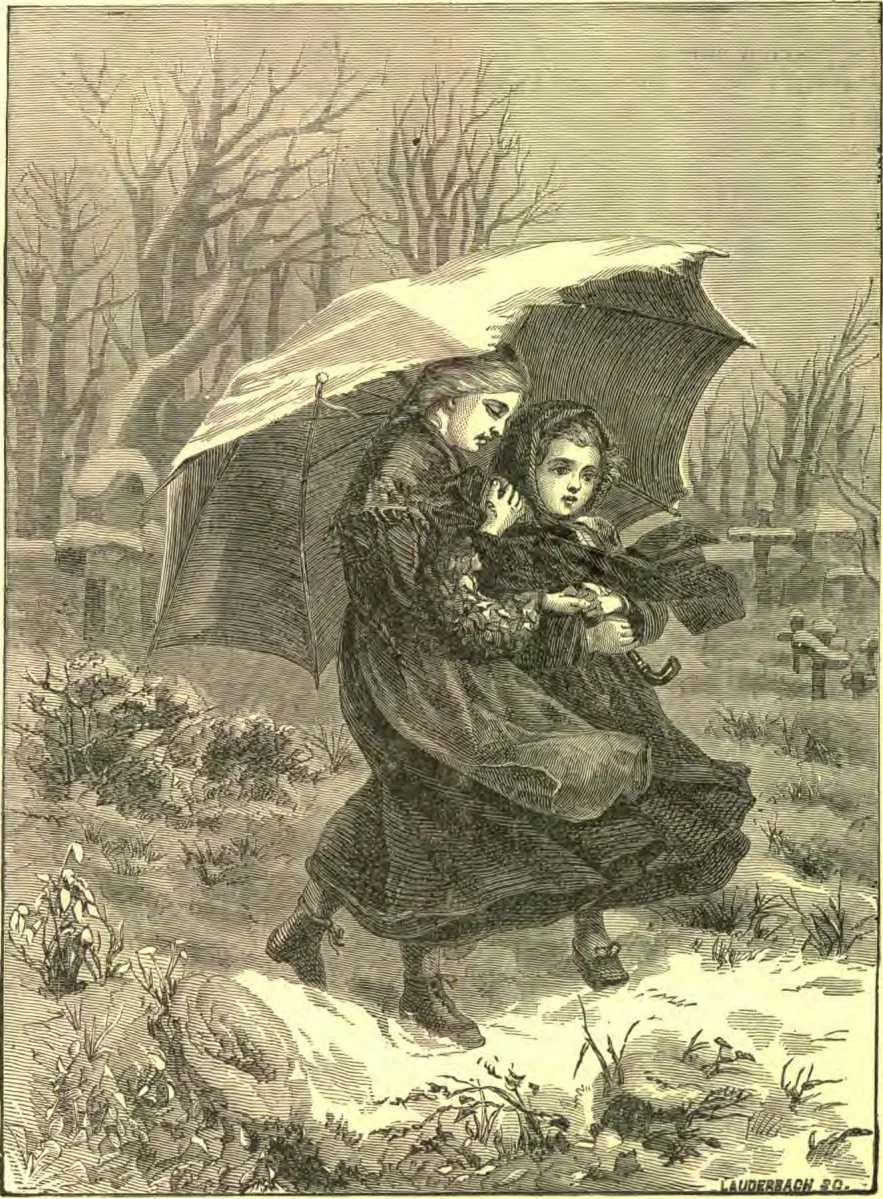
It was late in November, and the first great snow and gale of the season had set in the day before, and all through the night the storm had grown in fierceness and strength; but now, in the morning, although the wind moaned and sobbed through the bare trees, and the snow continued to fall, the storm seemed to have spent its fury, and was gradually exhausting itself.
Amy and May looked eagerly out of the window at the storm; but, shivering, returned to the small fire that burned on the hearth. These two girls were orphans, and lived with their grandfather and grandmother, who, being very old and feeble, could not work much, therefore this little family of four knew what it was to be cold and hungry. But these aged people were Christians, and had taught Amy and May to love God and trust in him.
Again and again they went to the window, gazing wistfully out across the half-mile that lay between them and the cemetery, where their parents slept that long, dreamless sleep. It was the anniversary of their mother's death, and they desired to visit her grave, and lay upon it a wreath that they had made from some evergreens which a kind lady had given them.
Finally, as the afternoon was far spent, the girls thought that they would wait no longer for the storm to cease; so, putting on their scanty wraps and taking an old umbrella, they started, Amy carrying the wreath. The memory of their parents was very dear to them, and carrying this wreath to put upon their mother's grave seemed to them a token of their love; and truly it helped to keep their memory green.
As they drew near their destination, an awesome feeling overcame them, for this was "God's acre." Thus they had always called it, because they thought that God had a special care for his children that slept here; and their grandparents had taught them that those who sleep in Jesus are guarded by angels till the morning of the resurrection.
Arriving at the cemetery, they laid the wreath upon their mother's grave, and, kneeling down in the snow, clasped their cold bare hands together, asking God to help them to be good, that they might one day meet their father and mother in Heaven.
Returning home, they were overtaken by a sleigh in which was a gentleman muffled up to his ears in fur. Halloo, little ones, won't you have a ride; and, springing out, he lifted them in before they had time to reply. Where have you been such a cold day, little girls. To "God's acre," was the reply; our mother and father lie there. Tears came into the eyes of the gentleman, but he said nothing. As he lifted them out at their own door, he slipped a silver dollar into the hand of each little girl; and before they could recover enough from their surprise to say anything, he was far down the road.
Oh, see! cried both the children at once, as they rushed into the room where their grandparents were; see what the gentleman gave us; now we can have plenty of fire and not be so cold. "Truly, those that trust in the Lord are safe," said the old people. "God is good. Let us thank him for his care;" and they all kneeled down and prayed with thankful hearts. V.

FAIRY FINGERS.

WHAT fairy fingers are these That just in a single night Have garlanded hedges and trees And made the world a delight?
That have fashioned the pump in the street Into a man of snow; That have spread a coverlet neat Where the ferns and evergreens grow?
That have filled the empty nest Which once with song ran over, And given the vane a crest, And tucked up the roots of the clover?

THE PEOPLE OF ARABIA.

ARABIA, or “the desert,” is called in the Scriptures, “the east country,” and its people “the children of the east.” In early Bible times, it was the country of the Edomites, Ishmaelites, and Midianites. In later ages the people were known under the general name of Saracens.
Though some of the Arabs live in houses in towns, yet the larger portion of them dwell in tents made of camel’s hair cloth, and their wealth is in their flocks. Each tent is divided into two parts, one for the men and the other for the women. Within the tent are camel’s skin water-bags, goat skins for milk and butter, a leathern bucket for drawing up water from deep wells, a hand-mill, wooden dishes, a few other domestic articles, and the beautiful saddles for their much prized horses.
Living as the Arabs do in the open air, their senses are very acute. They can see distant objects in their vast plains, which others cannot see; and sounds are also caught by them with great ease and certainty.
An Arab, too, can tell by the footprints on the sand whether they were made by one of his own, or another tribe; whether the man passed on that day or several days before; whether he carried a load or not, and whether he was fatigued or not. He judges of the last by the intervals between the steps. He is equally clever as to the feet of camels, and his skill is useful in recovering those that have been stolen, or have strayed.
One bad feature in the character of the people is their dishonesty. An Arab considers plunder as his right. He does not say, “I robbed,” but, “I gained.” The traveler is waylaid, seized, and stripped of almost everything; but unless he resists, or sheds the blood of an Arab, his life is safe.
The dress of the people varies in different tribes. Those who live in the district known as Yemen, or Happy Arabia, are clothed very much in the same style as the Turks. The mantles worn by the chiefs are interwoven with gold; and the headdress or cap is embroidered with gold, and inwrought with texts and passages from the Koran.
The Arabians are followers of the false prophet Mohammed, though not of the strictest sort, as indeed they are generally ignorant of his doctrines. The means of education among them are very limited, and of a humble kind, and they are intended only for boys. Girls are looked upon and treated quite as inferior beings. There is no school for them excepting those which belong to Christian missions.
—Sel.

SIN

WHEN this world came from the hand of the Creator, it was pronounced very good—it was in its Eden perfection. But sin came, and oh, how changed this Eden beauty! As every generation sins more and more, the curse rests heavier and heavier, till now we can see its effects everywhere. Every deformity in God’s work of creation is the result of sin.
As long as this world lasts, sin will mar and disfigure it; so the real conflict of life is not with poverty, or sickness, or any ill that flesh is heir to, but with sin. It hardens the conscience, so that at length it almost ceases to note that which once aroused its sharpest challenge. Sin is a tyrant that never dies. Not till Christ sets up his everlasting kingdom will sin and the originator of sin be destroyed. Then, God will have a clean universe.
We are now dwellers in this world of sin, and must contend against it if we would form good Christian characters; for it is sin that deforms. It is no sin to be tempted, for Jesus was tempted; but he triumphed over sin; this was for us, that we in his strength might also overcome. A good old minister once said, “If you do not find out your sin and bring it to Calvary to get it pardoned and washed away through the blood of Jesus, your sin will find you out, and bring you to Judgment, to be condemned and sent away by Jesus Christ to everlasting punishment.”
To guard against the inroads of sin, requires constant watchfulness at every point. The chief danger comes from the unexpected quarters. It comes stealthily, silently. The time to strike is when the very first movement is discovered. If thoroughly armed with prayer, sin is vanquished, and victory stands triumphant on the side of right.
When Christ sets up his kingdom, it will be a sinless one, and only the pure in heart will be dwellers there; then, the greatest failure that any can make in life is to let sin deform the character and unfit him for Heaven.
V. A. M.

OIL ON WATER.

You have perhaps heard of pouring oil on the troubled waters. The following is given as a real instance of the soothing effect of a little oil. Sometimes kind words and soft answers may calm the troubled sea of angry feelings.
Not many years ago, a case occurred in which a ship’s crew was enabled, during a severe storm, to escape on shore by the help of a few gallons of oil. A similar and equally successful employment of the same substance is reported to have been made off the Cape of Storms last summer. The King Centic, a vessel of fourteen hundred and ninety tons, left Liverpool for Bombay. When off the Cape of Good Hope she encountered a heavy gale from the north-west, which continued for some time. Tremendous seas broke over the ship, bursting in the main-hatch, washing away the hatch-houses and boats, smashing in the front of the cabin, and destroying the captain’s and officer’s stores and clothing.
The gale lasted for nearly five days, and though the vessel stood it very well, it was impossible to repair any of the damage, as the waves were continually sweeping her decks. At length, the chief officer suggested the trial of throwing oil upon the water. Two canvas clothes-bags were obtained, and into each two gallons of fine oil were poured, the bags being punctured slightly and flung one over each quarter in tow of the vessel. The effect was magical; the waves no longer broke over the poop and sides of the ship, but several yards away; where the oil had spread itself over the surface, and around the poop, in the wake of the vessel, was a large circuit of calm water. The crew were thus able to repair the damage with greater ease, and the ship was relieved from the tremendous shocks she had previously received from the heavy seas. The two bags lasted two days, after which, the worst fury of the gale having expended itself, no more oil was used.—Classmate.

Character Takes Its Color From What We Feed On

THE silk of certain insects takes its color from the leaves on which they feed, and a Christian man's life will always take its color from that on which his soul feeds.—Spurgeon.

ARABIA

O'er Arabia's desert sands The patient camel walks; 'Mid lonely caves and rocky lands The fell hyena stalks. On the cool and shady hills Coffee shrubs and tamarinds grow; Headlong fall the welcome rills Down the fruitful dells below.
The fragrant myrrh and healing balm Perfume the passing gale; Thick hung with dates, the spreading palm Towers o'er the peopled vale. Locusts oft, a living cloud, Hover in the darkened air, Like a torrent dashing loud, Bringing famine and despair.
And often o'er the level waste The stifling hot winds fly; Down falls the swain with trembling haste, The gasping cattle die. Shepherd people on the plain Pitch their tents and wander free; Wealthy cities they disdain, Poor,—yet blest with liberty.
—Lucy Aikin.

LESSONS FOR CHILDREN.

LESSON LVII.—THE KINGDOM DIVIDED.

As soon as it was known that Solomon was dead, the friends of Jeroboam sent for him to come out of Egypt; and when he had come, they put him at their head, and came to Rehoboam, saying, “Thy father made our yoke grievous; now therefore make thou the grievous service of thy father, and his heavy yoke which he put upon us, lighter, and we will serve thee. And he said unto them, Depart yet for three days, then come again to me. And the people departed.”
Solomon had everything so grand, and kept so many servants about him, that the people had to pay heavy taxes, and work very hard to furnish all that Solomon called for. Solomon had been doing by them just as Samuel had said that a king would do, and now they felt that they could not bear such treatment any longer. The people were right, and Rehoboam ought to have done as they said.
After the people had gone away to wait three days for an answer, “Rehoboam consulted with the old men that stood before Solomon his father while he yet lived, and said, How do ye advise that I may answer this people? And they spoke unto him, saying, If thou wilt be a servant unto this people this day, and wilt serve them, and answer them, and speak good words to them, then they will be thy servants forever. But he forsook the counsel of the old men, which they had given him, and consulted with the young men that were grown up with him, and which stood before him.” The young men said, “Thus shalt thou say unto them, My little finger shall be thicker than my father's loins. And now whereas my father did lade you with a heavy yoke, I will add to your yoke; my father hath chastised you with whips, but I will chastise you with scorpions.”
At the time appointed the people returned, and Rehoboam answered them roughly, according to the counsel of the young men. This made the people angry, and ten of the tribes rebelled against Rehoboam and made Jeroboam their king.
Then Rehoboam gathered a great army, one hundred and eighty thousand chosen men, to fight against Jeroboam; but the Lord spake by his prophet, saying, “Ye shall not go up, nor fight against your brethren the children of Israel; return every man to his house; for this thing is from me.” So the people returned, and Jeroboam was allowed to reign. Yet afterward there was much war between these two kings.
The ten tribes over which Jeroboam reigned were called the kingdom of Israel, and the two over which Rehoboam reigned—Judah and Benjamin—were called the kingdom of Judah.

QUESTIONS.

  1. What course did the friends of Jeroboam pursue as soon as it was known that Solomon was dead? 1 Kings 12:1–3.
  2. What did they say to Rehoboam?
  3. How much time did he ask before giving an answer?
  4. In what way did Solomon's grand way of living make trouble for the people?
  5. Who had foretold that a king would do just in this way? 1 Sam. 8:11–18.
  6. When had he given them this warning?
  7. What did he say a king would do?
  8. What did the people now think of such treatment?
  9. Did they have good cause for complaining?
  10. How did Rehoboam try to find out what was best to do?
  11. Whose counsel did he first seek?
  12. What advice did they give him?
  1. Did the king follow it?
  2. Whose advice did he follow?
  3. What counsel did they give?
  4. How did Rehoboam answer the people when they returned at the appointed time?
  5. What effect did this answer have upon them?
  6. What did they do? 1 Kings 12:20.
  7. How did Rehoboam think to make them serve him?
  8. How large an army did he raise?
  9. Did they go out to fight their brethren?
  10. Why not?
  11. What did the Lord tell the people to do? Verse 24.
  12. Did these two kings always live peaceably together? 1 Kings 14:30.
  13. Over how many tribes did Jeroboam reign? Chaps. 11:31; 12:20, 21.
  14. Over what tribes did Rehoboam reign?
  15. What was Jeroboam's kingdom called?
  16. What name was given to the kingdom over which Rehoboam ruled?

BIBLE LESSONS FOR YOUTH.

LESSON LXXXIII.—THE KINGS OF JUDAH, FROM JEHORAM TO JOASH.

  1. How did Jehoshaphat deal with his sons before his death? 2 Chron. 21.
  2. Whom did Jehoram marry?
  3. Whose example did he follow?
  4. How was he reproved and warned?
  5. How were these threatenings executed?
  6. Describe Ahaziah’s reign and death. Chapter 22.
  7. Who succeeded him?
  8. Describe her course, and tell her fate. Chap. 22:10–12; 23:12–15.
  9. How did Joash escape being murdered?
  10. How old was he when he began to reign? Chap. 24:1.
  11. Who was reigning in Israel when Joash began to reign in Judah? 2 Kings 12:1.
  12. Why was it desirable to have Joash made king at so tender an age?—Partly to avoid the necessity of keeping him longer concealed, but mostly to put an end to the wicked reign of Athaliah.
  13. Who really guided the affairs of the kingdom while Joash was so young?
  14. Why was it proper for him to do so?
  15. How did Joash reign while Jehoiada lived? 2 Chron. 24:2.
  16. What good work was accomplished during the reign of Joash?
  17. How did the temple come to be in need of repairs?
  18. How was the money raised to meet the expense of this work?
  19. Describe the death and burial of Jehoiada.
  20. After the death of this good man, what did the princes persuade Joash to do?
  21. How did the Lord warn them in regard to their wicked course?
  22. How did they heed these prophets?
  23. What cruelty was practiced upon Zachariah?
  24. Why was he thus treated?
  25. Why does this crime seem so monstrous on the part of Joash?
  26. What did Zachariah say when he died?
  27. How was this prayer answered?
  28. How was Hazael prevented from destroying Jerusalem? 2 Kings 12:17, 18.
  29. How did Joash meet his death?
  30. Name the kings introduced in this lesson.
  31. How long did each reign?

SYNOPSIS.

Before his death, Jehoshaphat gave to his sons “great gifts of silver, and of gold, and of precious things, with fenced cities in Judah; but the kingdom gave he to Jehoram; because he was the first-born.”
Jehoram is said to have reigned eight years, but for a large part of this time, he must have reigned in connection with his father. For a wife, he married Athaliah, the daughter of Ahab and Jezebel; and by her he was led to follow their wicked example. He was reproved for his wickedness by the prophet Elijah, who sent him a letter, threatening him with the most severe afflictions; and as he did not repent, these threatenings were fully carried out; for his wives, and all his sons but the youngest, were carried away by his enemies, and he himself was smitten with a lingering disease, not only incurable, but exceedingly painful.
Ahaziah, the son of Jehoram and Athaliah, reigned but one year, when he was slain by Jehu as before noticed. His wicked mother then slew all the seed royal except the infant Joash, who was hid six years in the house of God by his aunt, the wife of Jehoiada the priest. After a wicked reign of six years, Athaliah was slain by the sword, and was succeeded by Joash, who was then only seven years old.
Joash began to reign in the seventh year of Jehu, king of Israel. Jehoiada the priest, by whose influence he was made king, counseled this young sovereign, and really guided the affairs of the kingdom. So long as this good high priest lived, Joash followed his counsel and ruled well.
During the reign of Joash the temple was repaired. Of this there was much need; for the wicked sons of Athaliah had greatly injured it, and had destroyed the sacred vessels, bestowing the treasures thus obtained upon their false gods. In order to raise money for this purpose, a chest, with a hole bored in the lid of it, was placed at the door of the temple, so that all who wished to do so might drop in money when they came to the house of the Lord. The people were very generous, and more money was obtained than was needed for repairing the house.
Jehoiada died at the advanced age of one hundred and thirty years, and on account of his eminent services was buried among the kings. After the death of this great and good man, the princes came to Joash, and by flattery, persuaded him to allow the worship of false gods. The Lord sent prophets to testify against such a course, but the king and the princes would not listen to them; and when Zachariah, the son of Jehoiada, stood up and boldly reproved them, they stoned him to death in the court of the temple. To this atrocious act, Joash gave consent, although he owed both his life and his kingdom to the father of Zachariah.
When Zachariah died, he said, “The Lord look upon it, and require it.” This prayer was answered; for in less than a year, Hazael, king of Syria, came against Jerusalem, killed all the princes, and would have destroyed the city, if Joash had not given him all the treasures of the temple, as well as those of his own palace. Joash was shortly after assassinated by two of his own servants, having reigned forty years.

EASIER TO “RUN DOWN” THAN “RUN.”

It is not so easy to “run” as it is to “run down” a Sabbath-school. The first takes brains, heart, culture, piety, perseverance, tact, and a host of other qualities; the last takes nothing but spleen. Any one can “run down” a school, simply by persistently hinting that the superintendent is not the man for the place, the teachers not what they ought to be, the school dull and poky, the singing too slow, etc., etc. It is wonderful how many faults a splenetic nature can pick out to feast on, when once it sets itself about it. It only takes a few persons of that sort to make a superintendent feel like resigning. And they are largely in excess, in numbers, of those who hold up the hands of the superintendent, who speak an encouraging word to the chorister, and earnestly pray for the teachers. It takes a good many bees to fill a hive with honey, but one lively hornet can make a whole camp-meeting unhappy.—National S. S. Teacher.

Irregular and Tardy Teachers Demoralize the School

NOTHING so demoralizes a school as irregular or tardy teachers.

BY-AND-BY.

“BY-AND-BY,” said idle Lucy, While the precious moments flew, “By-and-by I’ll learn my lesson, By-and-by my work I’ll do.” By-and-by the setting sun Found her duties all undone.
Little children don’t stand idle, Waiting for the “by-and-by,” If you have a duty, do it While the golden moments fly; On the present carve your fate, He who loiters is too late.

DO YOU “MATCH”?

“PLEASE, aunt Mary, draw me a picture! I’m sure I can paint it.”
The childish voice by my side was full of entreaty; and I smothered a rising sigh as I laid aside my writing for the twentieth time at least, and began to draw a picture of a most wonderful dog for my little niece.
“Make his ears match, auntie, won’t you?” she asked, anxiously watching my busy pencil.
“Sure enough, Ruth!” I said. Who knows but you’ll make a wonderful artist some day; for you have ‘a good eye’ to begin with.”
“But I have two good eyes, dear auntie, and both of them blue.”
“Why do you suppose our heavenly Father did not make you with one eye blue, and the other one black?” I asked.
“Because—because he likes things to match too, I guess, as well as me.”
“Yes, ‘he likes things to match,’ I’m sure,” I said slowly. “You live in a good house, Ruth, and you have a good father and mother, good things to eat, good clothes to wear, good water to drink, and such a dear, good Heavenly Father, who gives them all to you. What sort of a girl do you think he expects you to be to match these?”
“A good girl,” she answered promptly.
“And are you always good, dear?”
“No, auntie,—not ‘always.’”
“Then, when God looks down, it must seem to him as if little Ruth did not ‘match’ with her surroundings.”
“I’m ’fraid it must,” said Ruth mournfully.
“Why aren’t we always good,—you and auntie?” I asked.
“Oh! because—because our hearts don’t match the good things.”
“What sort of hearts have we, Ruthie?”
“Bad hearts, I suppose; but you told us that Jesus would give us good ones, you know.”
“Yes, but the bad heart does not go entirely away when the good one comes; that’s the worst of it. Only we’re so very sorry when we do wrong, that Jesus forgives us.”
“I remember when I was little girl, of seeing a picture of two hearts, and inside each there were words written. Oh, how I used to study them over and over again, and think about their meaning!”
“Won’t you draw me two hearts, auntie, please? and write some words in them just like those you used to see?”
By this time the wonderful dog was fully completed; and upon the other side of the paper I drew two large hearts, in which I wrote,—
Ruth was so much pleased that she sat down upon the stool by my side a long, long time, studying over the words; then she carefully pinned them upon the paper in her little room where she would be sure to see them every morning, quite forgetting about the big dog which I had drawn upon the other side.

PEPPER

PEPPER grows chiefly on the coast of Malabar, Sumatra, Java, Borneo, Singapore, Cayenne, and the West Indies.
Pepper grows upon a beautiful vine, which, not being strong enough to grow straight up, is trained around poles prepared for it; or the pepper vines are planted near mango and other trees of straight, high stems, twining and covering them with elegant bundles of fruit in the style of the Italian vineyards.
The leaf of the pepper plant is large, resembling that of the ivy, and of a bright green color. The blossoms appear in June; they are small, of a greenish white, and are followed by the strong scented berries, which hang in large bunches, resembling in shape those of the grape, but the fruit grows distinct on little stalks, like currants.
Great care is necessary in a pepper garden, not a weed being allowed to grow near the pepper vine.
A plant in full growth is able to furnish six or seven pounds of berries. The black and white peppers are both the produce of the same plant, but the best white peppers are supposed to be the finest berries, which drop from the tree, and, by lying under it, become bleached by exposure to weather.

EMERY ORE.

It is believed that a practically inexhaustible supply of emery ore has been discovered near Peekskill on the Hudson. The discovery is regarded as one of the greatest importance from the fact that this metal, in a sufficiently pure state to make it marketable, is found in only one place in the United States, near Chester, Mass., though beds of corundum containing emery have been found in North Carolina, Georgia, and Montana. The Chester beds are said to be running out, and in that case dependence would have to be placed entirely upon shipments from Naxos, an island in the Grecian Archipelago, and from the territory near Ephesus.

Nature's Mug.

Who of our little readers ever heard of a natural mug? Well, there is just such a thing in the West Indies; it grows on trees in hot climates where there is little rain. These mugs hold about one quart; when the dew falls it is received into the mug, and a valve closes at the top and prevents evaporation. Birds are often seen to insert their beaks and procure water from them. This shows how good God is in thus providing a drinking place for the little birds that live where water is hard to find. “They sow not, neither do they reap, nor gather into barns; yet your heavenly Father feedeth them.”

Pronunciation and Usage of the Word Depot

THE word “depot” is from the French, and while the proper pronunciation is day-po, the general custom is to pronounce it de-po. The English term “station” is supplanting the word to some extent.

LETTER BUDGET.

Mr. Pleasant, Mich.
Dear Editors: We are three little girls, aged respectively, nine, eight, and six years. We go to school. Our teacher belongs to the Instructor family. She has taught us to sing “Blessed Are They That Do His Commandments,” which we sang at our last Sunday-school for this season. And now we are learning “Whiter than Snow,” which we are going to sing on Christmas eve.
We like your paper, also “Child’s Poems,” very much. We love our teacher because she is kind to us, tells us Bible stories, and reads to us from the Instructor. We would like to see all the members of the Instructor family. We may be members of it sometime.
Yours with love, Minnie Lawrence, Florence Craft, Ina Hickman.
We are very glad indeed to hear from you, little friends, but sorry that we could not give you a place in the “Budget” before. We would be very much pleased to number each of you as one of the Instructor family.

You have reached the end of this edition.

The Youth’s Instructor · Jan 28, 1880