The Youth’s Instructor, Vol. 35, No. 8.

A NOBLE MAN

The Youth’s Instructor

Feb 23, 1887

S. D. A. Publishing Association · Battle Creek, Mich. · Feb 23, 1887

A NOBLE MAN.

I LATELY read the history of a man named Robert Walker, who lived during the last century in the Lake district, and who is still remembered there by the odd sobriquet of The Wonderful. He was a man of wide scholarship and moving eloquence, and was for sixty-seven years the parish priest in the valley of Seathwaite, with a salary of less than a hundred dollars a year.
On this sum, without the alms of a penny, he brought up a family of eight children, helped his poorer neighbors, and spread his table every Sunday for the needy of his flock. In order to do this, he dressed in the coarse frock and wooden clogs of a ploughman, rose every morning by three o’clock, dug, ploughed and planted, spun and wove his own and his children’s clothes, and made their shoes.
He was a student not only of books, but of plants, stars, and rocks. He taught all the children of the valley eight hours for five days in the week, free of charge; he acted gratuitously as doctor, lawyer, and magistrate for all the district. He educated all his own children thoroughly.
In spite of his laborer’s garb, “no bishop in full vestments,” we are told, “was ever regarded with more absolute reverence and love.” His influence as a clergyman was so strong and pure that even now, after the lapse of eighty-five years, he is still obeyed and spoken of in Seathwaite Valley as a live man.
He lived to be nearly a hundred years old, and compressed into this century of life an amount of manual labor and of high service to mankind incredible to us in this age of leisurely ease and luxury. One habit he kept up to the very last day of his life, which was greatly helpful to him. No matter how pressed with work he might be, he went out into the open air every night before he slept, and remained an hour idle, alone with Nature and God.
The story in detail is of interest, because it shows a man of great intellectual force, and inspired by a passionate love for God and his fellowmen, hampered through a century of life by an hourly stress of absolute want.
In some parts of this country, fifty years ago, a system of punishment was in use, by which the criminal was compelled to perform a certain amount of work on the public highway, chained by the leg to a huge iron ball.
Many men and women, the good as well as the vicious, are bound through life to some immovable weight. With thousands of them, as with this parish priest, it is poverty that holds them back; with some it is the color of their skin, or an ugly face, or a deformed body. Or it may be the circumstances which have forbidden them education, or which keeps them always in a vulgar, ignorant circle of associates; or it may be the weight of helpless parents, or some inherited weakness or ailment, of body or mind, in themselves. They see other men and women pass on gayly to success in their purposes of life. But these, for no fault of their own, carry weight. They are chained to a burden which they cannot lift. They spend their days from childhood to old age grappling with this problem.
The old fable represents the Sphinx waiting in a narrow chasm for passers-by, to each of whom she proposed the riddle of life. To those who failed to read it aright, she became a monster who without pity tore them limb from limb. But before him who solved it, the monster vanished, and the path to the top of the height was clear.
This poor clergyman a hundred years ago guessed the riddle; his body grew stronger and his soul higher because of the difficulty given him to combat. The wise man or boy of to-day, with God’s help, can make of the weight which he has to carry a pedestal on which he can climb nearer to the stars.—Youth’s Companion.

DO NOT FORGET THE GOOD THINGS.

An old lady tells this true story about her brother:—
“He was a minister, and had among his flock two leading men who were bitter enemies; and if he pleased one of them, he would be very sure to displease the other, and so get himself into trouble. The minister, however, was not discouraged, but determined to hope for better things. So one day when he met one of these men, the man, after chatting for a few minutes, found opportunity to speak of his enemy, and that in the most uncomplimentary terms. The minister listened quietly for a few minutes, and then asked,—
“‘Hasn’t he any good qualities?’”
“‘Well, I suppose he has some,’ answered the man.
“‘What, for instance?’ inquired the minister.
“‘The man, thus urged and led on, managed to say several pleasant things of his enemy.
“Not long after, the pastor called on the other man, who was not slow in telling him how very disagreeable he would find Mr. Blank.
“‘Why,’ said the minister, ‘there must be some mistake. I met that very man a few days ago, and he made several pleasant remarks about you.’
“Some of these ‘pleasant remarks’ were then repeated, and the astonished listener, whose better nature was touched, said,—
“‘Well, he is not such a very bad fellow after all.’”
“The result of the preacher’s ‘holy tact’ was this: The men who for years had been enemies became friends, and the parish, that had been the scene of trouble and dissension, became prosperous and peaceful.
“It is hard to find people who are wholly evil; and if it is ever duty to point out the faults of others, it is not just or wise to forget the good things. And if the good things that might be said were spoken and repeated, many a quarrel would soon be healed.”—Little Christian.

WINTER

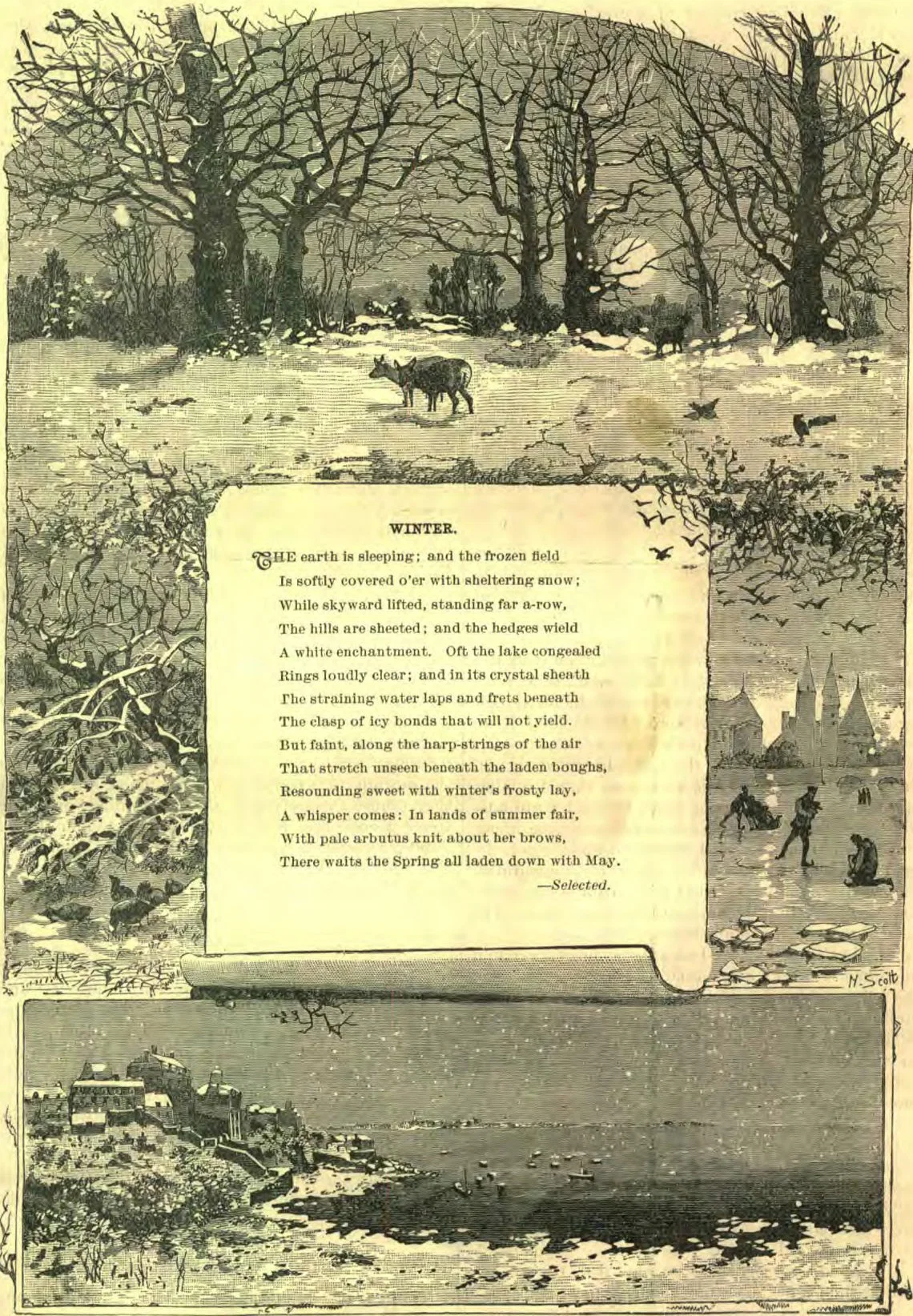
THE earth is sleeping; and the frozen field Is softly covered o'er with sheltering snow; While skyward lifted, standing far a-row, The hills are sheeted; and the hedges wield A white enchantment. Oft the lake congealed Rings loudly clear; and in its crystal sheath The straining water laps and frets beneath The clasp of icy bonds that will not yield. But faint, along the harp-strings of the air That stretch unseen beneath the laden boughs, Resounding sweet with winter's frosty lay, A whisper comes: In lands of summer fair, With pale arbutus knit about her brows, There waits the Spring all laden down with May.
—Selected.

WINTER

The earth is sleeping; and the frozen field Is softly covered o'er with sheltering snow; While skyward lifted, standing far a-row, The hills are sheeted; and the hedges wield A white enchantment. Oft the lake congealed Rings loudly clear; and in its crystal sheath The straining water laps and frets beneath The clasp of icy bonds that will not yield. But faint, along the harp-strings of the air That stretch unseen beneath the laden boughs, Resounding sweet with winter's frosty lay, A whisper comes: In lands of summer fair, With pale arbutus knit about her brows, There waits the Spring all laden down with May. —Selected.

LANGUAGE AND TRADITIONS OF THE MAORIS.

Every race of people give evidence of some knowledge of the facts recorded in sacred history. In this way they bear testimony to the truthfulness of the Bible. There are traces of this knowledge to be found among the Maoris.
Like other nations that forget the only true God, they have many traditions, some of which are contradictory. They claim that the world was created out of nothing, and that there were six stages in the creation. Before the heaven and the earth were divided, the god of night, Teanta otepo, reigned. During this time, “darkness was upon the face of the deep.” Then came the god of day, Nga atna te Ra, and said, “Let there be light.” They supposed heaven (Rangi) was a solid hemisphere, lying flat upon the earth (papa). These bodies were finally separated from each other by one of the god’s children, Tenem a huta. Then there was light. The gentle showers of spring and the dews of summer were tears of their father, Rangi, in token of his affection for them. Man was originally created by Taki, in his own image. He formed him of red clay, which he kneaded with his own blood; and after he had finished making him, he gave him breath. The common people had no direct access to their gods; this was the special work of an order of priests, called Ngato hunga, or wise men. It was supposed that these priests partook of the nature of their god, and so were upon intimate terms with him. At the extreme end of the North Island is a deep cave, called Te Reinga, or leaping-place: this was their elysium. Their chiefs were the priests, who were believed to hold direct communication with the gods, and from these superstitious ideas grew many other traditions.
The story is that the South Island (for they believed that the North Island was fished up), was discovered by one Kupe, who returned to his native land, Hawa-iki, and induced a number of his countrymen to accompany him on an expedition to the new country, of which he gave them a glowing description. They fitted out thirteen canoes, and made a voyage to Maoriland. To this day the claimants of land trace their lineage from the chieftains who commanded these canoes. An unsullied pedigree is their best title to territorial rights, and there is not an acre of land without its owner, although the claims of conquest, and sometimes of transference, qualify the title by inheritance.
When New Zealand was first discovered by the civilized nations, it was estimated that there were from 100,000 to 150,000 of the original native tribes. Whether this estimate was accurate or not, it is certain that they were very numerous; but they have so greatly diminished in numbers that the present native population is considerably less than 50,000.
The Maoris had no written language until it was given them by the missionaries. They have only fourteen letters in their alphabet—a, e, i, o, u, h, k, m, n, p, r, t, w, ng. Two consonants never come together, excepting in the nasal sound, ng, and every syllable ends with a vowel. There are ten dialects, very slightly differing from each other. To a stranger their talk seems noisy and rapid, and as meaningless as the Chinese. In their public orations, the chiefs draw largely from their native songs. It is hard for the older people to learn the English, but at present there are thousands of children learning that tongue in the schools established throughout the country by the government. The girls are also taught to sew, and are learning many other things which are calculated to make them more useful. Great effort is made to civilize and Christianize them.
S. N. HASKELL.

THE BURDEN SHARED.

It was a drizzling, cold autumn evening, when the gray sky and stormy wind made it seem dark, although there should have been another good hour of light, for it was only six o’clock. At the door of one of the hundreds of small houses which are inhabited by workmen in London, a clean, respectable looking woman stood watching. Presently two little girls entered the narrow street, slowly walking in the chill rain. One of them looked hastily up, as the woman called out:—
“What makes you so late? Come in, Kate, to your supper, and let Carrie run home to hers!”
Kate came in with a slow step, and her little companion passed on down the street. In the little kitchen a snug fire burned, and on the hob was a big mug of hot milk. A plate of bread and butter on the table stood ready for the hungry little school-girl.
Mrs. Mears bade her take off her damp cloak and sit down.
“You shouldn’t loiter so, coming from school! Father’ll be in soon, and Johnnie needs nursing,—eat up your supper, and then take him on your lap by the fire.”
Mrs. Mears was busy, and ran upstairs to finish cleaning a room, before her husband, whose work was a long way from home, should get back.
Kate sat down by the big fire, and looked at her bread and butter. Four thick slices! How nice it looked, and she was so hungry! Then she divided the slices, saying softly to herself:—
“Two for Carrie, and two for me.”
She ate her two slices very quickly, and then she turned her back on the plate and looked fixedly on the fire. The mug of milk was next attended to, and a good saucerful poured out, for it was very hot. Kate drank the saucerful, and a little more, measuring carefully with her finger until the milk descended to half way up the mug. Johnnie was quiet in his cradle; mother was still scrubbing upstairs; and Kate hastily threw on her cloak, and carrying beneath it her mug half full of milk, and her bread and butter, she went, as quickly as she could without spilling it, down the street. She stopped at the door of a house where a very wan, sad little face watched at the window. The face brightened, and soon appeared at the door.
“It’s half mine, Carrie—I wish it was more, for you’d no dinner!” said Kate, unfolding her treasure. And she followed her school-fellow into a clean room, where no fire burned, and where Carrie seemed to be alone.
“Drink the milk quickly, Carrie, for I must run home to mind Johnnie,” said Kate, as she watched with keen satisfaction the disappearance of her own two slices of bread and butter; and was so glad she had turned her back on it at home!
That night, when Kate was asleep, Carrie’s mother came. Mr. Mears asked her in, and the tired workman made room by the fire for the pale, thin woman.
“I can’t stay, thank you, but”—and the widow’s voice faltered—“’taint right as your little girl’s meals should be shared with my poor girl!”
Mrs. Mears and her husband looked at each other, and at the widow, in astonishment.
“You see, Mrs. Mears, it was like this; I was standing in the wash’us, and they didn’t know I was there, and your Kate ran in with some bread and butter, and some milk in a mug, and says she: ‘It’s half mine, Carrie—I wish it was more; for you’d no dinner!’ and my little girl was hungry, and I’d no food for her—and so she had it! But I couldn’t lie down in bed till I’d told you.”
Tears were in Mrs. Mears’ eyes; for although she knew the woman was poor, she had never thought of this! Mr. Mears spoke out:—
“I’m glad Kate could do that! Your husband worked many a year with me, and if I’d known times were so hard, you should have had a little of my little.”
Nothing was said to Kate till she was starting for school next day, when she lifted the lid of her basket and saw two separate parcels.
“What are these, mother?”
“One’s your dinner, and the other’s Carrie’s.”
Then a grateful face looked up, and Kate whispered:—
“Mother! I’m so glad! She had none yesterday; nothing to eat till—”
“You took her half your supper!” said the mother quietly. “Always tell mother, dear; for I would never grudge a morsel of what we have to any hungry child.”—Presbyterian Banner.

LOOK UP, MY BOY.

There is hope in the world for you and me; There is joy in a thousand things that be; There is fruit to gather from every tree— Look up, my boy, look up!
There is care and struggle in every life; With temper and sorrow the world is rife; But no strength cometh without the strife; Look up, my boy, look up!
There's a place in the land for you to fill; There is work to do with an iron will:— The river comes from the tiny rill— Look up, my boy, look up!
There are bridges to cross, and the way is long, But a purpose in life will make you strong; Keep e'er on your lips a cheerful song; Look up, my boy, look up!
Speak ill of no one; defend the right; And have the courage, as in God's sight, To do what your hands find, with your might; Look up, my boy, look up!
—Good Cheer.

A SOUTH AMERICAN TOWN.

Buenos Ayres, the capital of the Argentine Republic, is situated on the left bank of the Rio de La Plata. It is a large and prosperous city, and has many fine churches and other public buildings. Most of the houses are faced with white marble, and have bright green windows, giving the city a very clean and lively appearance. On entering one of these houses, the visitor finds himself in a square court-yard called a patio, filled with fragrant flowers and tropical plants. Round this patio the house is built, and is so arranged that not only all the rooms open into the court-yard, but are connected with one another. The walls are built of solid brick, sometimes a yard in thickness, thus making the houses very cool and agreeable in summer. The windows reach nearly to the ground, and are protected with an iron lattice-work painted green. Although the town contains some very fine European buildings several stories high, the houses generally have only one story; and the roofs, which are flat, are used by the people as an evening resort.
The town is set out in regular blocks, like a chessboard, and to every block there is a policeman armed with a sword, which he uses on the slightest provocation. The streets are badly paved, and are intersected with car tracks, down which the horse cars go at full gallop, the driver tooting a horn at every corner, thus making a great uproar. Many beautiful and shady plazas, or squares, planted with palm, orange, and other trees, adorn the city. Towards evening a number of cows are to be seen on the streets each with a calf tied to her tail. These belong to the milkmen who bring the cows along and milk them from door to door.
All South American towns are thronged with priests. These men do nearly all their work among the very poor and ignorant, the better classes having no respect for them, not even allowing them to enter their houses. The men pay little attention to religious services. Sometimes they are obliged to go to confession, as, for instance, before marriage, but they often send a hired substitute.
Sunday is the great gala-day in all these towns. In the morning the people hear the mass, after which they amuse themselves by dancing, riding, or going to see a cock-fight and in some places the bull-fight. Sunday evening is the great theater night, and every one who can, goes, after which all are once more ready for a week's work. FRANK HOPE.

BOYS

What is really wanted as regards boys is to light up the spirit that is within them. In some sense and in some degree there is in every boy the material of good work in the world—in every boy; not only in those who are brilliant, not only in those who are quick, but in those who are stupid, and even in those who are dull, or who seem to be dull. If they have only the good will, the dullness will clear away day by day under the influence of the good will. If they only exert themselves, they will find that every day's exertion makes the effort easier and more delightful, or at any rate, less painful, or will lead to its becoming delightful in due time.

A GOOD NAME.

There is much good in this world. There are many treasures,—gold, gems, titles, honors, estates. Eagerly are they sought, and much are they prized. But of all the possessions of men there is not one so precious as an unsullied name. It is beyond all price,—more to be desired than gold, better than riches. It is a strong tower into which the possessor can run, and be safe from the fear of evil. It will be a defense in the day of battle, a joy in times of persecution and trial. It will bring quick sympathies and loving favor in seasons of sore calamity, and when the heart is fainting unto death. Let him that hath it keep it well, and cherish it as he would life itself, for life without honor shall be but a bitterness and a curse.

THE MINISTRATION OF ANGELS.

LESSON 6.—THEY ARE GOD'S MESSENGERS TO EXECUTE HIS WILL.

1. Through whom has God often made revelations to his people? Heb. 2:2.
2. Explain how the things contained in the book of Revelation were revealed from God the Father to the church. Rev. 1:1.
3. What is said on this point in chap. 22:6, 16?
4. Who explained Daniel's visions to him? Dan. 8:16; 9:21-23.
5. Through whom did Moses receive his instructions from the Lord? Acts 7:38.
6. Mention other cases showing that it is through angels that God's will is revealed to his people.
7. Through whom does God execute his judgments upon the wicked? Rev. 15:1; 16:1.
8. Relate a circumstance illustrating this fact. Gen. 19:1-12.
9. By whom and for what were these angels sent? Verse 13.
10. When God was angry with Balaam, whom did he send to punish him? Num. 22:22, 23.
11. Tell all about this interesting event. Num. 22:22-35.
12. Who once sent a letter to Hezekiah, reproaching God and his people? 2 Kings 19:4.
13. What did Hezekiah do with the letter? Verse 14.
14. What did Hezekiah ask God to do? Verse 16.
15. How did the Lord answer him? Verses 20, 32-34.
16. How was this promise fulfilled? Verse 35.
17. When David had sinned in numbering Israel, how did God punish him? 1 Chron. 21:14.
18. Whom did the Lord send to execute this punishment? Verse 15.
19. Relate what followed. Verses 16-20, 27.
20. How was the wrath of God at one time brought upon king Herod? Acts 12:21, 22.
21. How was he punished for this? Verse 23.
22. Then, through whom does God execute judgments upon the ungodly?

NOTES.

How revelations are given.—Rev. 1:1 furnishes a good illustration of how God gives revelations to his church. 1. God gives the revelation to Christ. 2. Christ gives it to an angel. 3. The angel gives it to the prophet. 4. The prophet gives it to the church; and the church gives it to the world. Probably all of the prophecies and much of the Bible were given in this manner.
“The revelation in the Old Testament was indeed given by Jehovah, but it was the common opinion of the Hebrews that it was by the ministry of angels. As Paul was discoursing here of the superiority of the Redeemer to the angels, it was to the point to refer to the fact that the law had been given by the ministry of angels.”—Barnes, on Heb. 2:2.
The angel of the Lord smote him.—“Men of every rank are mortal. Even kings, ‘those earthly gods,’ as Watts calls them, however they may be flattered, must die; and when they have dared to persecute the church of God, they have been often cut off with marks of divine displeasure. Scripture affords many instances of this, and modern history is not without them. But Jesus lives forever; and while princes die and their works and decrees perish, the word of God must grow and prosper.”—Cottage Bible, on Acts 12:23.
If there is one thing in the world that we ought to be grateful for, it is the pressure that forces out through the surface that which is best for us. Unless it were for the grinding force of the mill, the sugar would never come out from the cane, nor the flour from the grain. It is not pleasant to be run through the mill; but there is no other way of getting into shape that which is best worth saving in every product of natural growth. We owe more of our usefulness to the crushing process that breaks down our outer self, and opens up the treasures of our innermost soul, than to any other educating agency of our lives. And we are pretty sure to get this process in one way or another.—Sunday-School Times.
TRUE teaching never fails to develop both teacher and pupil.

KIND-HEARTED INSECTS.

The Bible has made ants famous for industry and foresight, and modern naturalists find few animals more worthy of study. These insects not only are surprisingly intelligent, but manifest a lively regard for each other's welfare, as the following incident well illustrates. It is taken from Mr. Belt's “Naturalist in Nicaragua”:—
“One day, while watching a small column of these foraging ants, I placed a little stone on one of them to secure it. The next that approached, as soon as it discovered its situation, ran back in an agitated manner to communicate the intelligence to the others.
“They rushed to the rescue. Some bit at the stone, and tried to move it; others seized the prisoner by the legs, and tugged with such force that I thought the legs would be pulled off, but they persevered till they got the captive free.
“I next covered one up with a piece of clay, leaving only the ends of his antennae projecting. It was soon discovered by its fellows, which set to work immediately, and by biting off pieces of the clay, soon liberated it. Another time I found a very few of them passing along at intervals. I confined one of these under a piece of clay, at a little distance from the line, with its head projecting.
“Several ants passed it, but at last one discovered it, and tried to pull it out, but could not. It immediately set off at a great rate, and I thought it had deserted its comrade; but it had only gone for assistance, for in a short time about a dozen ants came hurrying up, evidently fully informed of the circumstances of the case, for they made directly for their imprisoned comrade, and soon set him free.
“The excitement and ardor with which they carried on their unflagging exertions could not have been greater if they had been human beings.”—Companion.

OPPORTUNITY

BLIND youth idles with time on its hands, And longs for life in a noisier clime, Will strive one day to put hands upon time, And restrain the flow of its numbered sands. —Charles K. Bolton.

“AMONG THE GAS-WELLS.”

In a late number of the INSTRUCTOR we gave you an extract from S. W. Hall’s article, “Among the Gas-Wells,” in the February St. Nicholas. Feeling assured that you would be interested in his further statements about natural gas, we quote other paragraphs as follows:—
“Boring for gas is exactly like boring for oil, in all its workings; but the after-operations of pumping and packing, as in the case of some oil-wells to raise the oil, are not necessary in gas-wells, for if the gas is there, it will come up with a rush, of its own free will and accord. Indeed, gas men would often be as glad to keep their treasure down as oil men are to get theirs up. The great pressure at which it is confined in the earth, and the corresponding force with which it escapes from the well, make it somewhat hard to manage or control. This pressure is enormous—as high as 500 lbs. to the square inch in some cases where it has been gauged. In the great McGugin well [in Washington Co., Pa.], which was not gauged, the pressure is estimated to have reached 800 lbs. to the square inch. Any attempt to confine the gas in this well for the purpose of measuring it would doubtless have resulted in sending the iron casing flying from the well, or in producing other effects more startling and costly than satisfactory or agreeable. Indeed, until recently, no plan had been devised by which the flow of gas from a well could be stopped or reduced. The quantity of gas which escapes from some wells is enormous, but probably no correct estimate of it has yet been made. Where the gas is piped away to mills and houses, all that comes from the well may be used; but if it is not all used, the remainder must be allowed to escape into the air. This is done at the regulator, where it is burned. The regulator is an arrangement of pipes and valves, placed between the gas-well and the town supplied with the gas. It allows only just as much gas as is being burned in the town to go on through the pipes, and so reduces to a proper and safe point the dangerously high pressure of the gas as it comes rushing along from the well. The temperature of the gas as it comes from the wells is about forty-five degrees, Fahrenheit.
“A burning gas-well is a grand sight. The gas is carried in pipes to a safe distance from the derrick, to be fired. When lighted, a huge column of flame shoots skyward, sometimes higher than the derrick. At times it is swept by the wind along the ground, burning it bare and dry. The hissing and roaring are almost frightful, and can be heard many miles away. The night glare, too, of a burning gusher, has been seen at a distance of thirty miles. On a clear, still night the glare is steady, and fades gradually away, above and around. But on a cloudy, stormy night the scene changes. The banks of clouds catch the light, and reflect a deep red glare, softening away in the distant parts to a yellowish tint, sometimes growing dull and faint, and anon flashing up and brightening, as the wind now beats down the flame and again lifts it skyward.
“A group of burning wells north of Washington, Pa., has presented many grand and beautiful night-scenes. Though several miles apart, they appear, at a distance, to be close together, and their light intermingles. These wells in full blast—with those flanking them on the right and the left, with the broad glare of those at Wellsburg, W. Va., showing twenty miles to the northwest, and with those at Murraysville, Pa., thirty miles to the northeast—make a scene which would terrify a stranger, if he should come upon it unaware of the existence of such things as burning gas-wells. It would only need columns of fiery lava to convince him that the whole region was full of volcanoes. And his terror would doubtless be complete when he saw a great fiery column shoot skyward, occasioned by the sudden burst of flame which escapes in ‘blowing out’ the wells and the pipes leading to the regulator, to keep them from being clogged by the salt which gathers in the pipes from the salt water thrown up by the gas. The flow of the gas is stopped for a moment, and when again released, the gas drives everything before it into the open air. This escaping air is burned at the regulator. The effect of the suddenly increased pressure is to shoot a tongue of flame, hissing and roaring, high in air. On a misty night, when the light is broken up and diffused,—the snow-covered hills sometimes adding their reflection,—the whole sky is brilliantly illuminated, and the scene is grand and beautiful.”

THE CHINESE BAMBOO.

A BAMBOO, be it said, can be put to more uses than any other thing of the vegetable kind in the world. What would our opposite neighbors in the celestial empire do without it? It is employed for all conceivable, besides some inconceivable, purposes, on land and water and even in the air, for kites are made of it, and so are the queer little whistles bound to the tame pigeons to frighten crows from the grain-fields. It can be used in the whole cane, in strips, in segments, or in threads, and no part comes amiss. The tubes are suitable for water-pipes, and so it answers for aqueducts; it is so strong that foot-bridges are constructed of it, and light enough for rafts; so available that a house can be built of it—the frame, the thatch, the lattices, the partitions—and it furnishes material for the tables and chairs, and some of the utensils and decorative articles; it is so hard that knives are made of thin slices, and so delicate that it may be carved into the daintiest of boxes and thimbles and necklaces; so elastic that baskets are woven of it, so fibrous that it may be twisted into ropes and cordage. It supplies lining for the chests of tea, strands for fishing nets, strips for fans, and canes stiff enough for oars and spears and palanquin poles. It is one of four things without which China would be China no longer: rice for food, tea for drink, silk for wear, and bamboo for everything.
There are said to be more than sixty varieties of this wonderful thing, which is neither grass nor tree, yet is in structure like grass; while it grows in dense groves like trees, and shoots away up even to the height of a hundred and fifty feet, and is nothing after all but a hollow, jointed reed.—Wide-Awake.

AN EXTRAVAGANT MIRROR.

Perhaps no more luxurious mirror was ever made than one described by A. Sauzay as belonging to Maria de Medici, Queen of France, in the 16th century. In 1791, its value was estimated at $30,000. The description is as follows:—
“The mirror is of rock crystal; and agates, cut, polished, and set in a network of gold, form a frame around the rectangular glass. Precious stones of the finest water glitter on the frame, particularly three large emeralds. One of these is set in a gold mounting, enriched with diamonds and rubies; the two others, placed on the side pedestals of the base, support helmeted heads, representing a warrior and an amazon. The face and neck are cut in a gem called hyacinth; the helmets and drapery are of gold, enriched with diamonds. Small emeralds serve as a setting for two carved stones; one of them, at the top of the whole construction, is an onyx of three layers, carved into the head of a Victory; the other is an onyx agate, carved in the 16th century, and representing a female head in profile, draped, having a veil which falls from the head on the shoulder, and wearing on the forehead the crescent of Diana.”

SLEEPING ON AIR.

Among the novelties is what looks very much like an ordinary hair mattress, but it is stuffed with—what do you think? Air! Yes; actually blown up like a foot-ball. It is made of what is called armor-cloth, and is air-tight. As it can be filled to any required degree of hardness, you may imagine what a delightful bed it makes. It is said, there is never the slightest odor of rubber about it. The same idea is carried out in all kinds of upholstery. The cushions made on this principle are inflated by a special appliance provided for that purpose; at any time the air can be expelled and the whole affair folded and packed up. It is particularly useful on vessels at sea, a mattress being a perfect life-preserver for as many people as can get hold of it.—Sel.

Ancient Bible Written on Palm Leaves

“THERE is a Bible in the library of the University of Gottingen which is written on five thousand four hundred and seventy-six palm leaves.”

Curing a Stingy Boy.

Jimmie was the stingiest little boy you ever knew. He couldn't bear to give away a cent, nor a bite of an apple, nor a crumb of candy. He couldn't even bear to lend his sled, or his knife, or his hoop, or skates.
All his friends were very sorry he was so stingy, and talked to him a great deal about it. But he couldn't see any reason why he should give away what he wanted himself.
“If I didn't want it,” he would say, “p'r'aps I would give it away; but why should I give it away when I want it myself?”
“Because it is nice to be generous,” said his mother, “and to think about the happiness of other people. It makes you feel better and happier yourself. If you give your sled to little ragged Johnny, who never had one in his life, you will feel a thousand times better watching his enjoyment of it than if you had kept it yourself.”
“Well,” said Jimmie, “I'll try it.” The sled was sent off. Jimmie looked on as if he were taking a dose of rhubarb. “How soon shall I feel better?” he asked by and by. “I don't feel as well as I did when I had the sled. Are you sure I shall feel better?”
“Certainly,” answered his mother; “but if you should keep on giving something away, you would feel better all the sooner.”
Then he gave away a kite, and thought he didn't feel quite as well as before. He gave away a silver piece that he had meant to spend for taffy. Then he said: “I don't like this giving away things. I don't feel any better. I like being stingy best.”
Just then ragged Johnny came up the street, dragging the sled, looking so proud, and asking all the boys to take a slide with him. Jimmie began to smile as he watched him, and said, “You might give Johnny my old overcoat; he's littler than I am, and he doesn't seem to have one. I think—I guess—I know I'm beginning to feel ever so much better. I'm glad I gave Johnny my sled. I'll give away something else.”
And Jimmie has been feeling better and better ever since that hour.—Our Little Ones.

WILD WINDS.

Oh! oh! how the wild winds blow Blow high, Blow low, And whirlwinds go To chase the little leaves that fly Fly low and high, To hollow and to steep hillside; They shiver in the dreary weather, And creep in little heaps together, And nestle close and try to hide.
Oh! oh! how the wild winds blow! Blow low, Blow high, And whirlwinds try To find a crevice, to find a crack,— They whirl to the front, they whirl to the back; But Tommy and Will and baby, together, Are snug and safe from the winter weather.
All the winds that blow Cannot touch a toe, Cannot twist a curl, One silky curl; Though they rattle the door in a noisy pack, The blazing fire will drive them back.
—Mrs. M. F. Butts, in Youth’s Companion.
Continue reading: A USEFUL TREE