Your ShelfYour Projects

The Youth’s Instructor, Vol. 64, No. 43.

Hamburg Missionary Paper Reaches 200,000 Circulation

The Youth’s Instructor

Oct 24, 1916

Review and Herald Publishing Assn. · Takoma Park Station, Washington, D. C. · Oct 24, 1916

Hamburg Missionary Paper Reaches 200,000 Circulation

Word comes from Hamburg that their missionary paper has a circulation of more than 200,000 copies.
“If I had twenty tongues, I would preach politeness with them all, for a long experience has taught me that the results are tangible and inevitable. Politeness is the Aladdin’s lamp of success.”
A colporteur in Arizona recently sold more than $1,241 worth of books in two weeks. One day he sold $105 worth. Some of the largest records that have ever been made in the book work have been made this year.
On September 14 the people of British Columbia, by an overwhelming majority, adopted both State-wide prohibition and woman suffrage. The vote was on a prohibition bill, submitted to referendum by the provincial government. The measure absolutely prohibits the sale of liquor as a beverage after July 1, 1917.
A “Home to Norway” movement is sweeping over Norway. The great emigration to the United States, which during the last fifty years has drained the country of young laborers and girls from the farms, has never made itself felt so much as in the last two years while Norway has been endeavoring to become more and more self-supporting and independent of foreign imports.
A thrilling story is given in The Outlook of how a man named Beck, of Pasadena, California, patrols the desert in search of the lost. For ten years, his companion in this work has been his dog Rufus. He has an outfit by which he carries six quarts of water, besides a pouch containing a hypodermic syringe and antidote for snake bites. Rufus has a record of having saved the lives of thirty-two men, “down and out,” and in the last stages of delirium. Besides, there are three hundred and thirty-four men who were lost, and short of provisions and out of water, who were revived by provisions and water, which Rufus himself carried. The dog is an expert in testing the quality of water. Once when Mr. Beck, perishing from thirst, did not wait for the dog first to make the test, he almost died of poisoning from drinking it. Mr. Beck and Rufus are certainly a noble pair, both deserving medals.

The Tongue the Index of Character

THE tongue is the index of man's whole being. While through ear and eye he receives all that ever gets in, through the tongue his whole being is revealed.
When God would break up man's first great ambitious scheme of a self-centered monopoly on the Shinar plains, he simply touched his tongue. The first evidence of God's touch in the remaking of man on that memorable Pentecost day was upon his tongue.
The effect upon his tongue of the break with God has been radical and strange.
The moment a man gets a vision of God he is instantly conscious of something the matter with his tongue. The sight that comes to his eyes, the sound to his ears, makes him painfully self-conscious regarding the defect in his tongue. Moses found himself slow-tongued. Isaiah felt the need of the cleansing coal for his tongue.—S. D. Gordon.

The Right Way to Criticize

“I THINK you spoke your piece splendidly, Rob. I was at the very back of the room, you know, and I could hear every single word.”
Rob’s face grew pink with pleasure. His sister Judith, though not grown up by any means, is considerably older than Rob, and he has a very high respect for her opinion. It made him feel happy to know Judith thought he had done so well. And he was glad so many of the boys had heard the ring in Judith’s voice as she praised him.
It was not till the two were alone, that Judith added something she had meant to say all along. “The next time you speak a piece, Rob, I’d be careful not to swing my arm quite so much. It won’t be hard if you just remember.”
“I’ll remember,” Rob promised, and he did not mind the criticism a bit. Judith showed her good sense in praising him where others could hear, and saving her bit of criticism for his ear alone. If all sisters were as tactful and sensible, their suggestions would help their brothers far more than they do.—James G. Cowles.

Missionary Notes

J. A. P. GREEN, who recently spent some time in the colporteur work with J. L. Holder, field agent of the West Caribbean Conference, reports that they took orders for books to the amount of $402 United States currency. Among those who subscribed for the book were the president of the republic, the minister of foreign affairs, minister of public instruction, ex-president of Costa Rica, superintendent of education, and other noted officials.
After leaving Costa Rica, Brother Green went to Colombia. From there he wrote: “In two days I sold 5,900 pesos’ worth of books. You will be able to understand this when I tell you that ‘Coming King’ sells here for 200 pesos a copy.”

The Study of Modern Languages Through Correspondence

THE Fireside Correspondence School, Takoma Park, D. C., desires to announce the completion of arrangements for the study of German, French, Spanish, and Italian through correspondence, either with or without the phonograph. For particulars and the Nutshell Catalogue, address as above.
C. C. LEWIS, Principal.

A Trip in Java

(Continued)
K. M. ADAMS
BORO-BUDUR, THE BUDDHIST TEMPLE
SHORTLY after our return to Weltevreden we arose early to take the train to Jokjogarta, or Jokjo, as it is commonly called. The road-beds in Java are well ballasted and the trains ride smoothly. The telegraph poles are made of railroad steel rails stood on one end. No wood can be used, as the rain and white ants work such great ravages. There are baggage cars in connection with the trains, but only sixty-six pounds will be carried free of charge.
After the train leaves Weltevreden for Jokjo, it travels through endless rice fields. The whole country toward the sea is as level as a floor. The monotony of the rice fields is broken by clumps of trees, beneath which lie clustered the houses of native villagers. Thousands of coolies can be seen scattered everywhere; in one place they are planting the rice stalks in the flooded fields one stalk at a time, while over yonder they are reaping in the same fashion. On the other side of the track, the view is much the same, except that in the smoky distance are the pale-blue mountains and rugged peaks, reminders of the hidden powers beneath that may without warning burst forth at any moment and engulf the pleasant scene.
As the day progressed, the traveling became very wearisome. We were glad when Jokjo was reached at seven o’clock that night, and were soon asleep, resting from the fatigue of the day. Next morning we arose at four o’clock, in order to catch the early train at Muntilam. The moon was shining brightly as we left the hotel to go to the station, and it seemed more like evening than early morning. A coolie was carrying our suitcases, three on his head and one in his right hand. He earned the small amount customarily given.
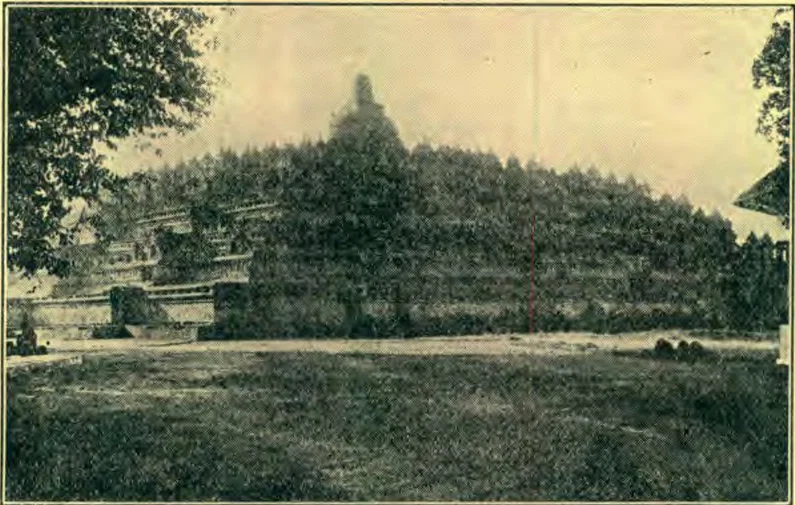
The morning air was cool, almost chilly, as the train carried us along. In a little more than an hour we reached Muntilam, where we awaited the sado that was to take us to Boro-Budur. We jolted along between rice fields for seven miles or more before we came in sight of this stupendous monument of Buddhism. After breakfast in the hotel we went to inspect the structure. More than three hundred feet square and about one hundred and fifty feet high, it appears a solid work of masonry. It is entirely composed of blocks of stone which are less than two feet in any dimension. There are four flights of steps that ascend to the uppermost terrace, one on each side. The pile appears to be square. After walking around the uppermost terrace, and peering into the latticed cupolas, in each of which there is a statue of Buddha, we inspected the center structure. It is solid so far as is known, for no one has made an opening into it.
The next two terraces have the same cupolas with images inside. Many of these images are without heads; presumably they have been broken off by the later race of Mohammedans, who detest idolatry and images of any form. The lower terraces are decorated with the most intricate design of bas-relief. There are eleven hundred statues of Buddha on the structure, but the number of figures in this bas-relief are innumerable. Each figure is about two feet high; there are about three to the foot, for they are placed side by side as close as is possible, and the total length of the bas-relief is three and one-half miles. These figures are all carved out of stone. The sculpturing is remarkably good, the figures and faces are well formed, and there is hardly a grotesque figure to be seen. Men, women, horses, elephants, monkeys, carriages, snakes, boats, umbrellas, and bows and arrows are some of the subjects, and all are well executed. Scholars tell us that these pictures are the story of Hindu mythology. If so, they are a wealth of information.
Boro-Budur was unknown one hundred years ago. It was discovered by Sir Stamford Raffles, who was at that time the governor of Java, which then belonged to England. He removed the débris that covered the temple. It looked like a large hill covered with trees and grass. It has been kept clean and in repair since that time, although some of the walls have sunk a little, and are overhanging and cracking. It is supposed to be about eleven hundred years old.
There is a curious fable concerning the building of Boro-Budur. A certain Hindu prince who was ruling in Java was madly in love with a beautiful princess, but she did not return his affection. However, in order to quiet his urgent pleadings for her hand, she said if he would erect a wonderful temple that would exalt the religion of Buddha, and complete the work in ten days, she would become his bride. Immediately he called together all the people of his kingdom, and spurred on by the exhortations of their ruler, the entire work was finished in the allotted time. When the princess surveyed the work, she said, “This monument is indeed beautiful and the images fine, but their expression is cold, and, like my feelings for you, there is no life in them.” So in spite of her promise, the princess refused to marry her lover.
Boro-Budur is truly a wonderful work of art. Viewed from a distance it is imposing, with its many minarets and spires silhouetted against the sky; scrutinized closely it reveals a wealth of detail and perfection that cannot but command awe and wonder. If the pyramids are the greatest physical feat of the ancient race, truly Boro-Budur is the culmination of magnificence in art.
The Javanese are at their best in making cutlery, and their krises, or swords, are famous throughout Malaya. The best krises are made of layers of iron and steel. These layers are thin as paper, and they are welded together to make the feathery blade. First comes a layer of tempered steel, then a layer of soft iron, and so on till the blade is built up. After the welding process, the blade is rubbed with lime juice, and arsenic is applied. By a chemical process, the arsenic unites with the iron, and remains there. The blade is then tempered, and fitted with a handle and scabbard, and is ready for sale. Just one cut from such a blade, if not fatal itself, will produce poisoning from the arsenic that is in the blade.
Many krises are made with snaky blades, in order that they may make a more ragged wound. Some have jeweled hilts and the scabbards are decorated with gold. The handles of most of them are shaped like the handle of a revolver. Many krises are worn by the coolies of today, but they are not of any special workmanship, only plain large blades.
On the road back to Muntilam there is a much smaller temple. Inside of this is a stone statue of Buddha about twenty feet high. On the face is the same expression of calm, majestic peace that characterizes his images. This temple is about sixty feet high. On the exterior are representations of Vishnu and other Hindu gods. We returned to Muntilam in our sado, feeling well satisfied with our trip. In a few moments the train was hurrying us in the direction of Samarang.
(To be concluded)

A Book of Stories

A FEW years ago, Mr. Hans Döring, one of the subagents of the British and Foreign Bible Society, crossed the desert of Gobi to Hami, in the heart of Central Asia, and then pressed on toward Urumtsi, the capital of Chinese Turkestan. On his way he was snowbound for a couple of days at a little town named Mu-hi-lo—a place so far inland from the port cities of China that often two months or more are required for the journey by the swiftest available means of transit.
While marooned by the snowstorm at this outpost of civilization, Mr. Döring was invited to visit a cloth dyer named Wang, whose modest abode consisted of a single room opening onto the main street. Mr. Wang seated his foreign guest on his k'ang (bed), and then took down from the wall a book which hung fixed by a string on a nail. It was a copy of the Acts of the Apostles in the Mandarin Chinese Version. Its original cover had been replaced, and the smoke of the small mud hearth near the k'ang had toned the outside of the book to a gray-black tint, like the color of the wall on which it hung; but the pages gave evidence of having been much read, and leaves torn here and there were carefully patched.
Mr. Wang told Mr. Döring that he had obtained this book seven years before from a traveling Chinese merchant, who had received it from some missionary, but not caring to read it, had given it away. Originally Mr. Wang had lived where he heard much of the “doctrine” from traveling English missionaries, but then he had not given it serious thought. Apparently he had to be sent away from his old surroundings into the remote region in which he was now living, in order to be made to think more of the gospel story. The insignificant little book, rejected by the merchant, thus came into the hands of one whose heart had been prepared by the Holy Spirit’s ministry. For seven years this small-type copy of the book of Acts had been to Mr. Wang his choicest treasure—a book of stories which to the dweller on the far-western rim of the Gobi Desert, had proved to be streams of living water.
So far as Mr. Döring could judge from Mr. Wang’s knowledge of the gospel and from his manner of life, he had become thoroughly converted. He kept his copy of the Acts in as prominent a position as his Chinese neighbors kept their idols. By the side of this book he had hung up two sheets of paper. On one of them he had himself written as much as he could remember of the commandments. Seven of them were practically correct; for the other three he had substituted other precepts based on such Christian teaching as he recollected. Thus, instead of the fifth commandment, he had written, “Thou shalt not speak ill of thy neighbor;” and instead of the fourth, “Judge not, that ye be not judged.” On the other sheet he had written as much of the Lord’s Prayer as he could remember. Mr. Döring took especial pleasure in helping him complete these two sheets.
There are surprises in store for those who read the book of Acts over and over again, with the same diligent attention to its stories of absorbing interest (for example, the story of Philip’s ministry in Samaria) as that given to it by Mr. Wang of Mu-hi-lo. And let it ever be remembered that the reading of this skilfully written storybook, will give one much clearer conceptions of the early apostolic era than will any disconnected study of the volume, valuable though a verse-by-verse study is.
The whole of the book of Acts can easily be read during a Sabbath afternoon. The book is not half so long as one might think. Boys and girls find no difficulty in reading page after page of the YOUTH’S INSTRUCTOR and of other popular weeklies. The book of Acts would scarcely fill eight or ten pages of any one of several well-known journals that might be named, and could easily be included in the columns of a single issue of the INSTRUCTOR.
And let those who read, remember that Luke’s narrative is a book of stories,—stories that arrest the attention and grip the interest and stir the blood and kindle the admiration, to say nothing of their power to uplift, to convict, and to convert. There is nothing dry or unessential in stories as told by Luke.
Charles Reade, the novelist, somewhere states that at the suggestion of Sir Edwin Arnold he read certain books of the Bible as if they were entirely new to him. Such reading brought to him many genuine surprises and unexpected pleasures, and made the Bible to him a new book indeed.
The surprises and pleasures multiply as the same book is read a second time, and a third, and a fourth. Mr. Work, formerly of the University of Wooster, has observed “how a child will return again and again to the reading of the same book, each time with some new element of interest.” “Even an adult mind,” he declares, “knows something of this experience. There are certain books that have traveled with us through all the ‘track of years.’”
Lord Macaulay, an omnivorous reader, was wont to reread certain books many times. “I have no pleasure in books,” he once wrote, “which equals that of reading over for the hundredth time great productions which I almost know by heart.”
Mr. John Morley, the biographer of Gladstone, in an address to business men and workingmen, once said: “It is a mistake to think that, because you have read a masterpiece once, twice, or ten times, therefore you have done with it. Because it is a masterpiece, you ought to live with it, and make it part of your daily life.”
“You must take the Epistles,” said John Locke, the English philosopher, “as you would take any other letter. You must take each as a whole, and sit down and read each from beginning to end, and see what it is about.” The book of Acts is one of the New Testament Epistles, written by Luke to Theophilus.
During the remaining months spent on the book of Acts in Sabbath school study, let us plan to devote at least two Sabbath afternoons to a special examination of this precious writing handed down from ancient times. And as we read story after story, and turn page after page, to the very end of the narrative, let us pray God for the simple faith to receive and to believe that was manifested by the pious reader found by the Bible Society agent in the heart of heathen Asia.
C. C. CRISLER.
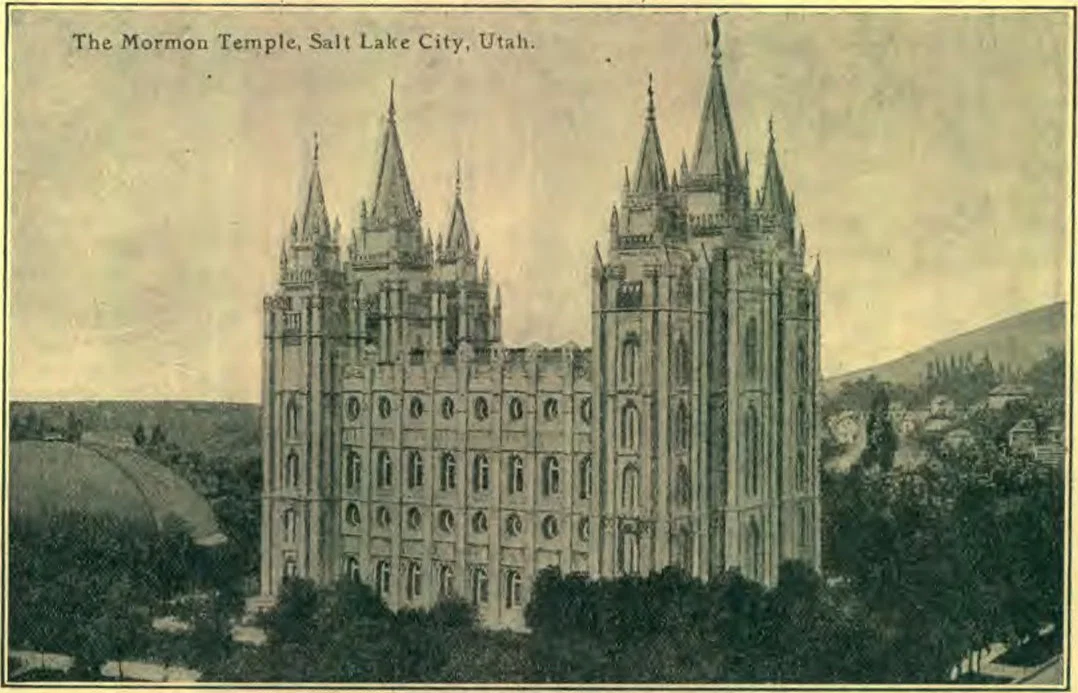
The Mormon Temple, Salt Lake City, Utah.

The Zion City of the Mormons

The city by the great Salt Lake interests one from the very minute of arrival. Lying beautiful and serene at the foot of the high, cool Wasatch Mountains, Salt Lake City is as refreshing, after a long ride over sagebrush country, as an oasis in the desert, which, in fact, it really is, thriving there in that vast sparsely developed country. It is a city of streets that are marvels of width and length. The average block is 660 feet long, and the width of the streets is 132 feet from property line to property line. Of particular admiration is the parking of the streets, especially where they are parked down the center with beautiful flower beds at each end. The residence streets are particularly beautiful, with their large brick houses and big velvety lawns.
This city by the “inland sea” holds much that is of peculiar interest to the visitor. Historically the Mormon buildings come first, and the first place to which all visitors are taken is the temple grounds. Inside the surrounding wall is the magnificent Temple, an awe-inspiring structure which is to the Mormon what Solomon’s temple was to the Jew, a holy place, devoted to sacred ordinances. The cost of its construction was $4,000,000. It is not open to the public, nor is it used as a place for general worship. Within its walls the different rites of the Mormon priesthood and the ceremonies of baptism and marriage are celebrated.
The Mormon Tabernacle, which is just west of the Temple, is one of the architectural curios of the world. Its elliptical shape looks like a vast terrapin back, or half of a prodigious eggshell cut in two lengthwise. The interior presents the appearance of an oval arch without any center support, being one of the greatest self-supporting arches in America, and probably the largest in the world that is constructed wholly of wood. The bents of the roof are composed of a lattice truss and rest upon twenty-four pillars. The gallery, which extends around the building except at the west end, is 480 feet long and 30 feet wide. The entire building has a seating capacity of 10,000. It has twenty large doors, so that in case of emergency a great audience can make its exit within two or three minutes.
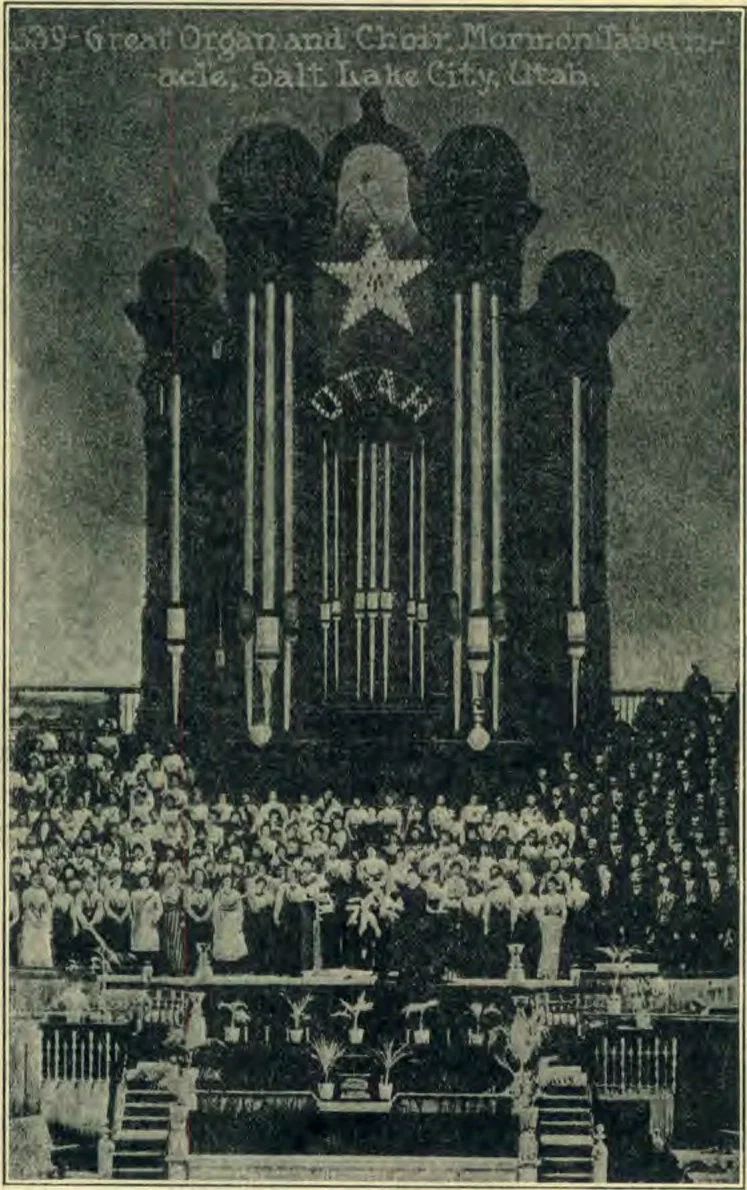
In the Tabernacle there is a wonderful, old melodious pipe organ, pronounced by some musical critics to be unequaled in variety of construction and the massing of tonal qualities. Always a wonderful instrument, it has kept pace with, adopted from time to time, the latest improvements in its line, and today is regarded by many as “the ne plus ultra in organ building.” “The organ was constructed over thirty years ago, entirely by Utah artisans and mostly from native materials. The front towers have an altitude of 58 feet, and the dimensions of the organ are 30 by 33 feet. It has 108 stops and accessories and contains a total of over 5,000 pipes, ranging in length from two inches to thirty-two feet. It is capable of 400 tonal qualities. It is orchestra, military band, choir, and organ combined; and, I am told, there is no color, shade, or tint of tone that cannot be reproduced by it. The action is half electric and half tubular pneumatic. The electric motor is ten horsepower. The two bellows weigh 5,000 pounds and the two reservoirs 38,000 pounds. Five thousand cubic feet of air can be pumped into the bellows every minute. The organist sits 20 feet from the organ, facing the congregation, and the distance between him and the air valves is 65 feet; yet the pipes will respond 726 times a minute.”
The sea-gull monument always creates interest, and the story connected with it is very interesting. In 1848, when the city was less than a year old, and the pioneers were struggling with their first crops, there came a plague of crickets. The pests began to rapidly destroy all the vegetation in sight, and although the people fought them, the insects were too many for them and their hopes of a harvest were fading fast when a great flock of sea gulls came in from the Great Salt Lake and destroyed the crickets. The bird has ever since been held sacred by the Mormons, and the monument was erected in memory of the timely aid given by the birds.
When the outsider hears of Salt Lake City he usually thinks first of salt, and particularly the Great Salt Lake. The lake itself is a wonder, 80 miles long and 40 miles wide, with water 23-per-cent salt and so dense that a person can float in it with very little danger of sinking. Not far from the lake are the great salt beds presenting a remarkable sight. Round about in circling whiteness lies a shimmering expanse of salt ponds. The country for miles around the refineries is as level as a table top. Into these great ponds salt water is pumped to a depth of several inches. Sunshine is plentiful in Utah, and the process of evaporation is unhindered. The ponds are “skimmed”—much as one would skim a pan of milk. This process removes all foreign substances, and then the heavily laden salt water is sluiced into other ponds where the evaporation process is continued. When the water is entirely evaporated, a layer of salt is left. Then the process is repeated until a thick depth of salt in its natural state has been deposited over many acres of ponds. Some four to five months are required to secure the proper amount of salt deposits. Then the “harvesting” begins, and the processes of grinding, sorting, cleaning, weighing, and sacking the salt follow.
Just recently a potash factory has been established near the city. It is now shipping out great quantities of potash, so the country has no need to fear a shortage because Germany’s exportation of the article has stopped. In speaking of this new industry recently, a Salt Lake editor said: “Every little while the United States discovers Utah. When the country is in need of some mineral, it runs around in circles for a time, so to speak, and then is told to possess its soul in patience, as Utah has the article required. If the country wants anything very badly it has but to ask for it. We will wager it is somewhere in Utah.”
ERNEST LLOYD.

“Saul, Saul”—Repetitions

“AND he fell to the earth, and heard a voice saying unto him, Saul, Saul, why persecutest thou me?” Acts 9:4.
The following reasons are offered for the repetition of the term “Saul:” —
“The repetition of the name adds solemnity and earnestness.” — J. A. Alexander.
“The repetition of the name would fix his attention.” — Albert Barnes.
“[For] the impressiveness gained, as so often in Hebrew, by the repetition of the word.” — R. F. Weymouth.
“It is ingeminated, or doubled, not only to arouse and awaken Saul, but to testify his love to him, and commiseration of him.” — Matthew Pool.
The following are a few Biblical examples of repetitions:—
  1. “Abraham, Abraham.” Gen. 22:11.
  2. “Moses, Moses.” Ex. 3:4.
  3. “Samuel, Samuel.” 1 Sam. 3:10.
  4. “O earth, earth, earth.” Jer. 22:29.
  5. “O Jerusalem, Jerusalem.” Matt. 23:37; Luke 13:34.
  6. “Lord, Lord.” Matt. 25:11; Luke 13:25.
  7. “My God, my God.” Matt. 27:46.
  8. “Master, Master.” Luke 8:24.
  9. “Martha, Martha.” Luke 10:41.
  10. “Simon, Simon.” Luke 22:31.
  11. “Crucify him, crucify him.” Luke 23:21.
  12. “Saul, Saul.” Acts 9:4; 26:14.
  13. “Is fallen, is fallen.” Rev. 14:8; 18:2.
Joseph said unto Pharaoh:—
“And for that the dream was doubled [“repeated.” — Newberry] unto Pharaoh twice; it is because the thing is established by God, and God will shortly bring it to pass.” Gen. 41:32.
ARTHUR L. MANOUS.

Quitting a Certainty for an Uncertainty

HE is no wise man that will quit a certainty for an uncertainty.—Samuel Johnson.

How God Answers Prayer

MEN scoff at the idea that the Creator of the universe could or would stoop to listen to, much less answer, the millions of petitions that ascend to him daily, the great majority of them referring to what to him would be very trivial matters.
They reason, that having countless habitable worlds under his control, many of them far superior to this insignificant planet of ours, and all of them peopled with myriads upon myriads of sentient beings, looking to him for guidance and help in their daily lives, such a thing would be impossible. They forget that even an earthly ruler answers the prayers of his people, though thousands of petitions may come to him daily. If he be a beneficent ruler, no case of sickness, poverty, or suffering is brought to his notice that does not receive his attention, and the causes of distress are, if possible, removed. How does he hear and answer prayer? He is only a finite being, with small intellectual capacities compared with those of God; and yet, somehow, he accomplishes the work—in a limited way, perhaps, but in a manner that secures the love and gratitude of his subjects.
He has helpers; men who work under his direction and carry out his plans. To one of these he sends a dispatch that the petitions that have come to him from the citizens of a burned-up village are to be granted, and the town to be rebuilt; to another, that the survivors of a flood, or of a volcanic eruption, are to be relieved. Has God any less power at his command? Has not he also his helpers and messengers and the means of sending dispatches to the children of earth? Are not the angels ministering spirits sent forth to succor those in need? The Pope of Rome has only “the eyes of man,” yet he can see all over the earth by means of his church organization, and though he is but a usurper of God’s throne here below, he counts himself almost omnipotent because of the far-reaching vision that he thus acquires, and because of the power that it gives him to answer the prayers of his people.
May not the machinery that the Pope uses to make him an all-seeing man, so far as this world is concerned, serve us to understand in some faint measure how the great Creator is all-seeing and all-powerful? He is not only all-seeing by virtue of his own natural eyes, and all-powerful by virtue of his own inherent wisdom and strength, but he is also so through the vast body of absolutely incorruptible officers that he employs in the government of the universe. So if a president or king can hear and answer even an individual request, cannot God, who has all the resources of the universe at his command, do as much? But you say, “How can he? How does he, when he is so far away?” Think a moment. Have you never heard of wireless telegraphy? God knew of this long before it was discovered by man. And by his own wireless system he caused his Spirit to move upon the minds of his prophets and apostles so that they spoke “the words of his mouth,” just as the man at the other end of the wireless telegraph speaks ours. God and his agents are mind readers. He knows our most secret thoughts. We may hide these from the majority of our fellows, but we cannot hide them from him. If our meditations are wicked meditations, he knows it; and if pure and right, he knows it. The psalmist says, “Thou understandest my thought afar off.” Ps. 139:2.
A missionary in India sent to Mrs. H. B. Hastings, of Boston, for a specified amount of tracts to be used in combating the growing infidel sentiment of that country, at the same time praying God to supply the exact sum needed. He did not know of the writer of this article nor did I know of him, but God did, and just before his letter reached Mrs. Hastings, she was impressed to write to me for money to help in the circulation of anti-infidel books and tracts. On reading her note, I felt at once that no less a sum than five dollars must be the answer. When it reached her the India letter had arrived, and the sum sent was just the needed amount.
Was this an accident? Is there any room for questioning as to God’s hearing and answering the devoted missionary’s prayer? Is there doubt as to the “how”? God knew of India’s needs. That faithful soldier of his had looked to him to pay for the tracts while he was inditing his letter to Boston. And instantly a wireless dispatch was sent to Mrs. Hastings to write to me for help, and another was sent to me to tell me to give the needed sum. It is all simple and beautiful.
What a high privilege to be allowed to come into the very presence of the greatest and most august Being in all the wide circle of the heavens, and not only to be allowed to come, but also to have the assurance that our petitions shall be granted if presented in the name of our great High Priest and Saviour, Jesus.
S. Roxana Wince.
Continue reading: Roman Army Officers