The Youth’s Instructor, Vol. 35, No. 50.

ONE THING I KNOW

The Youth’s Instructor

Dec 14, 1887

S. D. A. Publishing Association · Battle Creek, Mich. · Dec 14, 1887

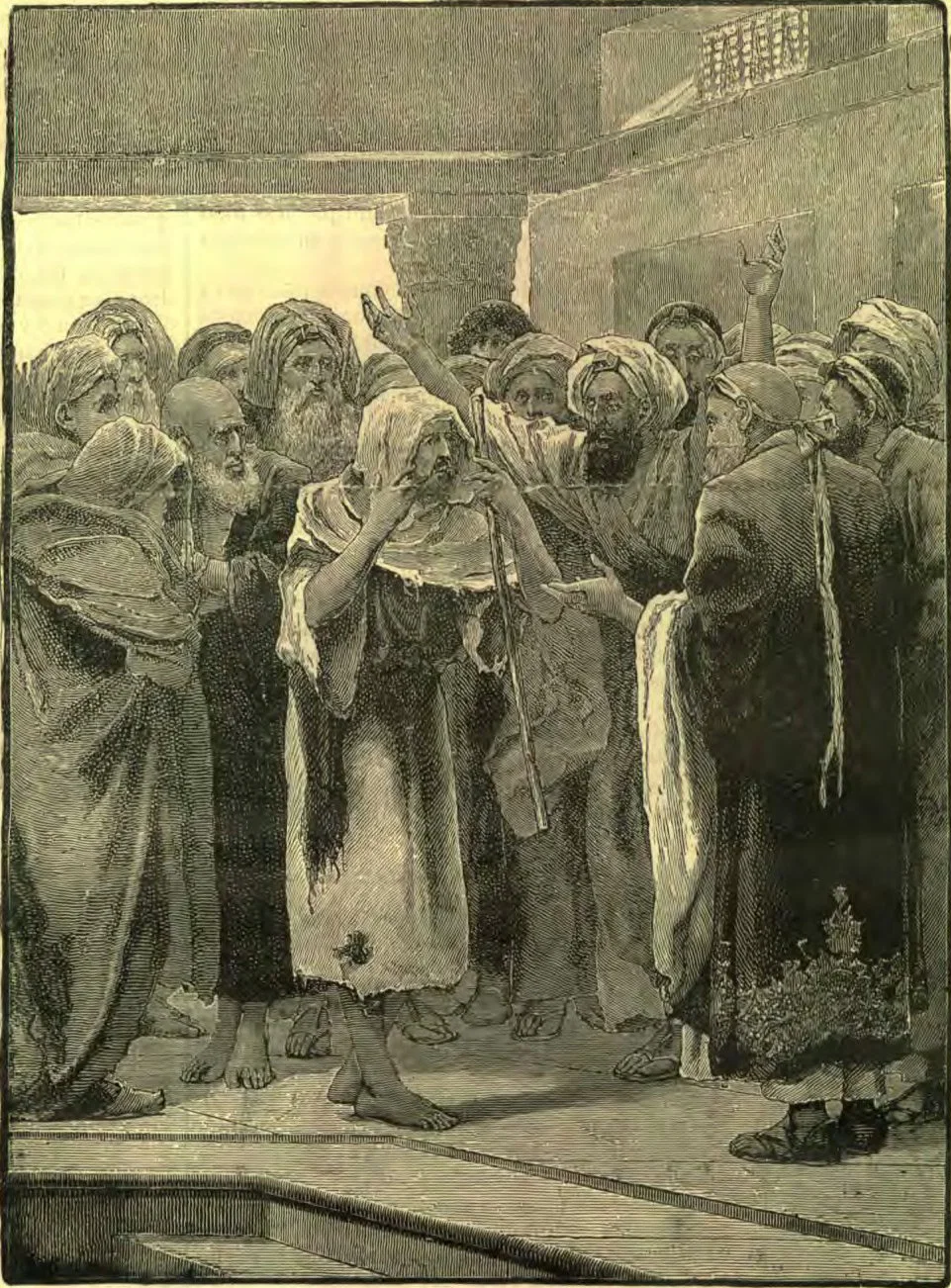
ONE THING I KNOW.

He stood before the Sanhedrim; The scowling rabbis gazed at him. He recked not of their praise or blame; There was no fear, there was no shame, For one upon whose dazzled eyes The whole world poured its vast surprise. The open heaven was far too near, His first day's light too sweet and clear, To let him waste his new-gained ken On the hate-clouded face of men.
But still they question, "Who art thou? What hast thou been? What art thou now? Thou art not he who yesterday Sat here and begged beside the way; For he was blind."
—"And I am he; For I was blind, but now I see."
He told the story o'er and o'er; It was his full heart's only lore; A prophet on the Sabbath day Had touched his sightless eyes with clay, And made him see who had been blind. Their words passed by him like the wind Which raves and howls, but cannot shock The hundred-fathom-rooted rock.
In vain were threats and fury spent, The Hebrew's neck could not be bent; Their sneers at Jesus and his band, Nameless and homeless in the land, Their boasts of Moses and his Lord, All could not change him by one word.
"I know not what this man may be, Sinner or saint; but as for me, One thing I know, that I am he Who once was blind, but now I see."
They were all doctors of renown, The great men of a famous town, With deep brows, wrinkled, broad and wise, Beneath their broad phylacteries; The wisdom of the East was theirs, And honor crowned their silver hairs. The man they jeered and laughed to scorn Was unlearned, poor, and humbly born; But he knew better far than they What came to him that Sabbath day; And what the Christ had done for him, He knew, and not the Sanhedrim.
They cast him out, he went his way, They stayed to plot, he went to pray; The downward path they blindly trod, He found the Christ, the Son of God.
—Selected.

A NOBLE LIFE.

Is it not sad to think that a truly good man should be forgotten when he is dead; that when he has spent his life in trying to bless and help others, the world should neglect to praise him, and the young should grow up without even knowing that there was such a man? Is it not strange that while we remember the heroes who fought bloody battles, and besieged cities, and conquered kingdoms, we should forget those who, in a more quiet way, and without causing such scenes of want and horror, have been of just as much service to mankind? We would be better, and the world would be better, if we should learn less about the bad characters, even if they were famous, and should study and try to imitate the good ones. It is about one of these good but forgotten heroes that I wish to tell you. He lived in England more than eleven centuries ago. But that you may understand just how much he did for his time, you will need to know a little about the early English people.
It was in the sixth century that forty Roman monks, under good St. Augustine, landed upon the shores of England, and gave to the hardy, warlike Saxons who peopled the country, three of the greatest gifts that could be bestowed upon mankind. These were the Christian religion, the Hebrew Bible, and the Roman letters. None of these the heathen Saxons had ever before heard of. All the history they had was what had been preserved by the minstrels, who sang around the hearth fires, to the accompaniment of a rude harp, the exploits of their “deed-bold warriors.” You may imagine what a blessing it was to these Saxons to have written characters by means of which they could put into permanent form the stories that had heretofore been kept only in the memory.
The monks built churches and monasteries, and did much to enlighten the people. You must remember, however, that there were no printed books in those days. It is to the slow, patient pens of these plodding monks that we owe all our knowledge of early English history.
To the monastery of St. Peter, at Wearmouth, in the North of England, a little boy went over eleven hundred years ago. His name was Bede; in his epitaph he is called “the venerable Bede.” He wanted to be a holy man, and spend his time in study and good works. After a few years he was transferred from this monastery to that of St. Paul at Jarrow on the River Tyne, where he dwelt the remainder of his life. He studied diligently, and took great delight in learning, teaching, and writing. But he did better than merely to copy books; he made new ones of his own. He wrote text-books on grammar, astronomy, natural philosophy, and many other subjects, to be used in the monastery schools. I am sure we would find these old books very amusing when compared with the ones used at the present day. Besides these, he wrote books on religious subjects. But the book by which he is best known is his Ecclesiastical History, which is really as much a history of England as of the Church.
The fame of this simple, earnest, godly man reached the ears of the pope at Rome, and he very much desired to have Bede grace the pontifical court with his learning. But Bede refused to leave the quiet of his monastery. Even when his brother monks wanted to make him abbot, he would not accept the office, because, as he said, it “demands household care; and household care brings with it distraction of mind, which hinders the pursuit of learning.” Do you not admire the noble spirit which led him to refuse these high honors simply that he might better help the poor and lowly among mankind? He seems to have worked, like his blessed Master, for the pure love of doing good.
— Bede wrote in Latin, the language of the scholars; but in his last days he completed a work for which I am sure he should be held in grateful remembrance. It was the translation of the four Gospels into English, the speech of the common people,—the first translation made in our tongue. He died just as he had finished the Gospel of St. John. This was in the year 735, three years after he had completed his Church History.
“There is,” says one writer, “a beautiful account of his death by his favorite scholar, Cuthbert, who wrote down from his master’s dictation this English version of the Testament. As they drew near the last chapters of St. John, Bede ordered Cuthbert to write with all speed, but his breath came so painfully that the old priest had to pause frequently in his dictation. As the day drew near its close, the writer said, ‘Most dear master, there is yet one chapter wanting; do you think it troublesome to be asked any more questions?” He answered, ‘It is no trouble; take the pen, make ready, and write fast.’ In the evening Cuthbert said, ‘Dear master, there is yet one sentence unwritten.’ Bede said, ‘Write it quickly.’ Soon after, the boy said, ‘It is written.’ ‘It is well,’ answered Bede; and sitting upright on the floor of his cell, he breathed his last in a song of rejoicing.” W. E. L.

CONQUERED BY KINDNESS.

Boys often go astray from the very energy and restlessness of their natures, without any vicious purpose. But they have often a nature which may be reached by genuine sympathy and kindness, and molded to a generous manhood. The following anecdote was told at a meeting of the London Sunday-school Union, of James Kershaw, Esq., who died when a member of Parliament for Stockport:—
When a lad ten years of age, he was in a Sunday-school class in Manchester. James was a very troublesome boy. The teacher came up with his name to the superintendent, and again and again said:—
“Mr. Steel, I cannot do anything with him.”
“But,” said Mr. Steel, “I am sure there is something in James, if one knew how to develop it.”
Again and again came the complaint, and again and again did this kind-hearted superintendent set it aside. At last this little boy broke through a rule which involved exclusion; and when the next Sunday came, the inquiry was, I believe, somewhat in this form:—
“Who of you have been to the races during the past week?”
None in this class, none in the other, none anywhere but James.
“Well,” said the teacher, “you see the boy must go, Mr. Steel; a diseased sheep will infect the flock.”
“But,” said the superintendent, “I cannot part with that boy; let us have him up in the presence of the whole school.”
Up he came, a fine, daring, defiant, handsome little fellow. All the school looked on, and the superintendent said:—
“Now, James, I am sure, when you come to think of it, you are sorry that you went to the races.”
The little fellow shrugged his shoulders, he was not at all sorry. Then, just as one of you ladies would touch the keys of a piano, did the superintendent in his address try to touch the keys of that boy’s heart, till at length he had produced some effect. Turning to the hundreds of boys in his presence, he said:—
“My lads, if we turn James out of the school, he will go to the bad and become worse. Shall he go?”
“No, no, no,” shouted three hundred voices, and James burst into tears, fairly conquered by affection—fairly won by love.
What he became afterwards, there are Manchester gentlemen on this platform who can tell you better than I.
He became a member of Parliament, he became a member of a Christian church. His £100 a year was always carefully paid into the London Missionary Society, and sixty guineas, as I know, to the Manchester City Mission; and I may also say, as I happened to have some pleasant acquaintance with him, that there were many things which his right hand did, which his left hand was not allowed to know. Now he has gone—one of the brightest trophies of Sunday-school instruction.—British Messenger.

THE VOICE IN THE TWILIGHT.

I WAS sitting alone in the twilight, With spirit troubled and vexed, With thoughts that were morbid and gloomy, And faith that was sadly perplexed;
Some homely work I was doing For the child of my love and care. Some stitches half wearily setting, In the endless need of repair;
But my thoughts were about the "building." The work some day to be tried, And that only the gold and the silver And the precious stones should abide.
And remembering my own poor efforts, The wretched work I had done, And, even when trying most truly, The meager success I had won:
"It is nothing but 'wood, hay, and stubble,'" I said; "it will all be burned"— This useless fruit of the talents One day to be returned.
"And I have so longed to serve him, And sometimes I know I have tried: But I'm sure when He sees such building, He will never let it abide."
Just then, as I turned the garment, That no rent should be left behind. My eye caught an odd little bundle Of mending and patch-work combined.
My heart grew suddenly tender, And something blinded my eyes, With one of those sweet intuitions That sometimes make us so wise.
Dear child! She wanted to help me, I knew 'twas the best she could do; But oh, what a botch she had made it— The gray mismatching the blue!
And yet—can you understand it?— With a tender smile and a tear, And a half-compassionate yearning, I felt she had grown more dear.
Then a sweet voice broke the silence, And the dear Lord said to me, "Art thou tenderer for the little child Than I am tender for thee?"
Then straightway I knew his meaning, So full of compassion and love, And my faith came back to its Refuge Like the glad returning dove.
For I thought, when the Master-Builder Comes down his temple to view, To see what rents must be mended, And what must be builded anew,
Perhaps, as he looks o'er the building, He will bring my work to the light, And seeing the marring and bungling, And how far it all is from right,
He will feel as I felt for my darling, And will say, as I said for her, "Dear child! She wanted to help me, And love for me was the spur.
"And, for the true that is in it, The work shall seem perfect as mine; And because it was willing service, I will crown it with plaudit divine."
And there in the deepening twilight I seemed to be clasping a hand, And to feel a great love constraining me, Stronger than any command.
Then I knew by the thrill of sweetness, 'Twas the hand of the Blessed One, That would tenderly guide and hold me Till all the labor is done.
So my thoughts are nevermore gloomy, My faith no longer is dim, But my heart is strong and restful, And mine eyes are unto him.
—Selected.

The Pleasure of Doing for Others

The selfish people are those who never knew what real friendship is, and so cannot see how pleasant it is to do things for others.

Filling the Home with Joy and Light

WHEN you go home, fill the house with joy, so that the light of it will stream out of the windows and doors, and illuminate even the darkness.

TWO GREAT KINDS OF FOODS.

What do you suppose they are? I fancy I hear you say, “Animal and vegetable,” or “Spiritual and physical.” These are indeed great foods, but they are not, however, the kinds of which I am going to speak.
For the present, we will name them No. 1, and No. 2. These foods are the two which build up the perfect man and woman. No little boy or girl ever became good and useful without the use of both Nos. 1 and 2. All partake of No. 1, and we are sorry to say, in harmful quantities, at times, too. And often it is so prepared that even a small quantity is injurious.
No. 1 is used from infancy by all the animal kingdom. But now let us consider No. 2. No. 2 differs in respect to the extent of its use. Hundreds, yes, thousands, of persons never even taste it. The animals do not have any use for it. Even children, under five years of age, scarcely ever use it. It would not be wise for them to use it sooner.
Some little boys and girls are fond of food No. 2, they eat it with great relish; but many more enjoy No. 1 the best. About 300 years ago, yes, less than that, only the rich could afford No. 2, and many of them in very small quantities, some having only one of its many varieties. No. 2, like No. 1, is divided properly into two divisions, of which we will speak presently. In every city of any size, great buildings are erected, just for the purpose of serving food No. 2. It requires considerable skill to “dish out” this food. Men and women are educated expressly for this purpose. O, how some little girls and boys dislike to go to these places! But how ready these same children are to partake of food No. 1!
There are also buildings where all are welcome to come and eat their fill, but they will have to help themselves. It is not safe for children to attend these places, until they have acquired an appetite for the proper variety.
It requires great skill to select and prepare food No. 1, but far greater skill is necessary in selecting and preparing food No. 2.
Now I presume you have formed your opinion as to what kinds of food I have referred to, and are anxious to know if you are right. I will tell you what they are. No. 1 is the food which we eat to sustain our bodies. No. 2 is the food which we eat to develop our minds, namely, books. What, eat books?—Yes, we eat books. Who knows of a good man in the Bible who ate a little book? Jeremiah said he ate the word of God, and it was a joy to him. Jer. 15:16. Ezekiel also ate a book. He said he found it sweet. Ezek. 2:8-10; 3:1, 2. Books and study make our minds grow, just as food makes our bodies grow.
I said we would speak of the two divisions of food No. 2. They are religious and non-religious. They correspond quite well to the two kinds of which No. 1 is composed, animal and vegetable. We could make a success of life without the use of animal food and non-religious food, but take away vegetable and religious foods, and life is a failure.
The best food for the mind is the Bible. Of which food do you eat the most? R. S. ANTHONY.

A GOOD WORD.

It was a holiday afternoon at Mrs. Russel's school, and a dozen girls were busying themselves in different ways. Among all the homesick girls, none had the complaint worse than poor Hattie Reed. She had only a humble home, yet it was very dear to her; for there a loving mother lived and toiled and prayed for her children. Hattie had no fine dresses nor extraordinary talents to give her a position among her school-fellows. She was shy and self-distrustful, and these traits gave her more unhappiness than any one ever dreamed of. She thought that no one cared for her here; no one appreciated her; and she felt like dropping a tear or two over her sewing.
Just then a young pupil-teacher came along, with a piece of work in her hand, and took a seat near by.
“Do you know, Hattie, that your industry is quite a stimulus to me? I always feel reproved by it when I sit down to idle away a half-hour. How much you must accomplish in your odd minutes! What do you do with all you make?”
“I am preparing them for presents for mother and the children,” said Hattie, with a brightened face. “Mother always taught me to improve my odd minutes, and I feel uneasy if I have not some little piece of work in hand, which I can catch up in my spare time.”
“It is a very good rule, indeed, and I mean to practice it also. You set us a good example in more respects than one. I wish all the girls in my class were as studious and orderly.”
Miss Oliver stooped and kissed the cheek of her young pupil, as she arose to go upstairs for a forgotten thimble. Hattie's eyes were very bright, and her manner warm and impulsive, as she threw an arm about her neck and gave her a kiss in return. No more sadness and low spirits for her that day. “Heaviness in the heart of man causeth it to stoop, but a good word maketh it glad.” You do not need to say much to one who is heavy-hearted, but a good word even will make it so much lighter. Try the plan with any sad heart around you, and see if you do not find your own spirits greatly blessed while you are bestowing an unspeakable blessing upon another.—Youth's World.

MR. "TEN MINUTES."

A TOUCHING STORY is told of the late Prince Napoleon. He had joined the English army, and was one day at the head of a squad riding horseback outside of the camp. It was a dangerous situation. One of the company said: “We had better return. If we don’t hasten, we may fall into the hands of the enemy.” “Oh,” said the prince, “let us stay here ten minutes and drink our coffee.” Before the ten minutes had passed, a company of Zulus came upon them, and in the skirmish, the Prince lost his life. His mother, when informed of the facts, in her anguish said, “That was his great mistake from his babyhood. He never wanted to go to bed at night in time, nor to arise in the morning. He was ever pleading for ten minutes more. When too sleepy to speak, he would lift up his two little hands and spread out his ten fingers, indicating that he wanted ten minutes more. On this account, I sometimes called him ‘Mr. Ten Minutes.’”
How many have lost not only their lives, but their precious souls, by this sin of procrastination! When God calls, we should promptly obey.

I MUST PRAISE MORE.

All good Christians agree that we ought to pray more; but it strikes me that we ought to praise more as well as pray more. I do not know how it is with others, but I know that I have a great deal for which to be thankful and to praise God. I feel that it will not do for me to spend all my breath in prayer. I should thus, it is true, acknowledge my dependence on God; but where would be the acknowledgment of his benefits conferred upon me? I must spend a part of my breath in praise. Oh, to be animated from above with that life, whose alternate breath is prayer and praise! God has been very good to me. Yes, he has exercised goodness toward me in all its various forms of pity, forbearance, care, bounty, grace, and mercy; or to express all in one word, “God is love,” and he has been love to me. I do not know why he should have treated me so kindly. I have sought, but can find no reason out of himself. I conclude it is because he “delighteth in mercy.” His nature being love, it is natural for him to love his creatures, and especially those whom he has called to be his children. O, the goodness of God! The thought of it sometimes comes over me with great power, and I am overwhelmed in admiration. Nothing so easily breaks up the fountain of tears within me. Those drops, if I may judge from my own experience, were intended as much to express gratitude as grief. I think I shall be able, without weariness, to spend eternity on the topic of divine love and goodness.
Reader, can you not adopt my language as your own? Has not God been the same to you? And shall we not praise him? Shall all our devotion consist in prayer? Shall we be always thinking of our wants, and never of his benefits—always dwelling on what remains to be done, and never thinking of what has already been done for us—always uttering desire, and never expressing gratitude—expending all our voice in supplication, and none of it in song? Is this the way to treat a benefactor? “No, indeed. It is not just, so to treat him; neither is it wise. It is very bad policy to praise no more than Christians in general do. They would have much more success in prayer, if one half the time they now spend in it were spent in praise. I do not mean that they pray too much, but that they praise too little. I suspect the reason why the Lord did such great things for the Psalmist was, that, while he was not by any means deficient in prayer, he abounded in praise. The Lord heard his psalms, and while he sung of mercy shown, showed him more. And it would be just so with us, if we abounded more in praise and thanksgiving. It displeases God that we should be always dwelling on our wants, as if he had never supplied one of them. How do we know that God is not waiting for us to praise him for a benefit he has already conferred, before he will confer on us that other which we may be now so earnestly desiring of him? It is wonderful how much more prone we are to forget the benefit received, than the benefit wanted—in other words, how much more inclined we are to offer prayer than praise. For one who offers genuine praise, there may be found ten that pray. Ten lepers lifted up their voices together in the prayer, “Jesus, Master, have mercy on us,” but only one of the ten “returned to give glory to God.” The rest were satisfied with the benefit—this one only thought gratefully of the benefactor. His gratitude obtained for him, I doubt not, a greater blessing than ever his prayer had procured; and praise has often, I believe, in the experience of the people of God, been found more effectual for obtaining blessings than prayer. A person, being once cast upon a desolate island, spent a day in fasting and prayer for his deliverance, but no help came. It occurred to him then to keep a day of thanksgiving and praise, and he had no sooner done it than relief was brought to him. You see, as soon as he began to sing of mercy exercised, the exercise of mercy was renewed to him. The Lord heard the voice of his praise.
Christian reader, you complain perhaps that your prayer is not heard; suppose you try the efficacy of praise. Peradventure you will find that the way to obtain new favors is to praise the Lord for favors received. Perhaps if you consider his goodness, he will consider your wants. It may be you are a parent, and one child is converted, but there is another concerning whom you say, “O that he might live before Thee!” Go now and bless the Lord for the conversion of the first, and it is very likely he will give thee occasion shortly to keep another day of thanksgiving for the salvation of the other. Some of us are sick. Perhaps it is because we did not praise the Lord for health. We forget that benefit. We do not forget our sickness. Oh, no. Nor is there any lack of desire in us to get well. We pray for recovery. And so we should; but it strikes me that we might get well sooner were we to dwell with less grief and despondency on our loss of health, and to contemplate with cheerful and grateful admiration what God has done for our souls—the great love wherewith he loved us, even when we were dead in sins; and how he spared not his own Son, that he might spare us; and gives us now his Spirit, to be in us the earnest of heaven, our eternal home. If we were to think such thoughts, to the forgetfulness of our bodily ailments, I judge it would be better for the whole man, body and soul both, than any other course we can pursue. If the affliction should still continue, we should count it light, aye, should rejoice in it, because it is his will, and because he says he means to make it work our good.
There is nothing glorifies God like praise. “Whoso offereth praise, glorifieth me.” Ps. 1: 23. Prayer expresses dependence and desire; but praise, admiration and gratitude. By it men testify and tell all abroad that God is good, and thus others are persuaded to “taste and see that the Lord is good.” Praise is altogether the superior exercise of the two. Prayer may be purely selfish in its origin, but praise is ingenuous. Praise is the employment of heaven. Angels praise. The spirits of the just made perfect will praise. We shall not always pray, but we shall ever praise. Let us anticipate the employment of heaven. Let us exercise ourselves unto praise.
Let us learn the song now, “O that men would praise the Lord for his goodness.” But above all, “let the saints be joyful in glory: let them sing aloud upon their beds.” I charge thee, my soul, to praise him, and he will never let thee want matter for praise. “While I live, will I praise the Lord: I will sing praises unto my God while I have any being.”—Nevins.

LESSON 19.—REVIEW ON LESSONS 11-15.

1. How were the disciples warned against the hypocritical customs of the Pharisees, and taught to pray simply and in secret? Matt. 6:5-8.
2. How did Jesus encourage secret prayer by his own example? Matt. 14:23; Mark 6:46; Luke 6:12.
3. What other examples point in the same direction? 1 Kings 17:19-21; 2 Kings 4:33; Gen. 24:63; Dan. 6:10; Ps. 55:17; Acts 10:9.
4. Give some noted examples of personal prayer. Gen. 18:23-32; 19:19, 20; 24:12-14; 32:9, etc.; Judges 6:13; 1 Sam. 1:13; Dan. 9:1-21.
5. Mention some prayers that consist mainly of the most humble confessions. Ezra 9:5-12; Dan. 9:3-20.
6. Give some of the leading points made in the public prayer offered by Solomon at the dedication of the temple. 1 Kings 8:22-53.
7. Give examples of different attitudes in prayer. Gen. 24:52; Ex. 34:8; 2 Chron. 6:12, 13; Ps. 95:6; Luke 18:13; 22:41; Matt. 26:38, 39; Mark 14:35.
8. What is said of praise-giving in Ps. 50:23?
9. What should be among the Christian's most ardent desires? Ps. 51:15; 71:8.
10. Give some passages showing that thanksgiving should be closely connected with prayer. 1 Chron. 16:8; Ps. 92:1, 2; 1 Thess. 5:18; Eph. 5:20.
11. In answer to their request, what prayer did Jesus teach his disciples? Matt. 6:9-13; Luke 11:2-4.
12. What feelings and reflections should be awakened by the first sentence of this prayer?
13. What thoughts is the second sentence well calculated to awaken?
14. How should the fourth reprove us for inordinate desires?
15. To what end should the third and fifth lead us to close self-examination?
16. What was the most urgent petition of the Saviour's prayer offered for his disciples just before his betrayal? John 17:11, 17, 21.
17. What are some of the most important lessons to be learned from his prayer in the garden of Gethsemane? Matt. 26:41; Mark 13:35-37.

Long-Disputed Bible Texts and Their Meaning

There are Bible texts over which denominationalists have wrangled for centuries without coming to an agreement. Volumes have been written on them—to the entire satisfaction of the writers, and of everybody who agrees with those writers. But every now and then some one rises up, and coolly asks for a decisive answer as to the precise meaning of one of those texts, as if there had never been a question raised concerning it.

NOTICE

AFTER a series of unexpected delays, the S. S. map of Africa is ready. It has been made larger than originally designed, in order to show the location of all our missions in the Old World. These mission stations are marked on the map by a scarlet ring. The map has been mailed free to every school by the International S. S. Association. If by any chance a school should be missed—and of some we have not the address,—the superintendent will confer a favor by notifying us at once. Address,
INTERNATIONAL S. S. ASSOCIATION, Care of Review & Herald, Battle Creek, Mich.

GENERAL WASHINGTON'S FARM.

THE readers of the INSTRUCTOR all know General Washington as the Father of his Country, but the following paragraph, clipped from an Almanac of 1790, gives some interesting particulars concerning his farm-life, which may be new to them. It reads:—
“General Washington possesses 10,000 acres of land in one body, where he lives; constantly employs 240 hands; keeps 25 plows going all the year, when the weather will permit; sowed in 1787, 600 bushels of oats, 700 acres of wheat, and prepared as much corn, barley, potatoes, beans, peas, etc.; has nearly 500 acres in grass, and sowed 150 with turnips. His stock consists of 140 horses, 112 cows, 235 working oxen, heifers, and steers, and 500 sheep. The lands about his seat are all laid down in grass; the farms are scattered around at a distance of two, three, four or five miles, which the General visits every day, unless the weather is absolutely stormy. He is constantly making varied and extensive experiments for the improvement of agriculture. He is stimulated with that desire which always actuates him—to do good to mankind.”

SIGN-LANGUAGE

TALKING with the fingers is not confined to deaf mutes. In some parts of the East the traders have a sign-language which they use to very good purpose. In the customary open-air markets of Eastern countries—especially in those devoted to transactions in hides, leather, wool, grain, and fruit—it is no uncommon thing to see a couple of sedate-looking traders seated on the ground, each with his right hand concealed in his neighbor’s capacious sleeve, and engaged to all appearance in squeezing each other’s fingers. For a few minutes they will remain in this position, one nudging the other occasionally, but without exchanging a word; and then rising, they will separate and go their way. Sometimes the performance is varied a little. A couple of merchants will stand in the middle of a brawling and gesticulating crowd by which they are surrounded and observed; one will raise the end of his long robe or unroll the muslin veiling of his turban, and under cover of this the pair will begin to clasp hands and fingers as before. The spectacle is extremely funny to the Western traveler who does not understand what is going on; but, in point of fact, the traders are simply engaged in what they call “fixing the price,” or bargaining, by means of a code of manual signs almost universally used by Eastern merchants, who are compelled to do much of their business in the open air, surrounded by people who are quite as curious about every affair in progress as the principals themselves. The feet are also used for a similar purpose. This custom is referred to in Prov. 6: 13, where it is said of the “naughty person,” “He speaketh with his feet, he teacheth with his fingers.” By this mode of doing business, merchants can bargain in the dark as well as in the light.—S. S. Classmate.

AN ASTRONOMER'S PAVEMENT.

A NEWLY patented pavement is said to have been suggested by the surface of an elephant's tooth, which consists of intermingled layers of hard and soft material, so that the process of wearing always produces a series of ridges upon the surface. The new system of paving is the idea of Mr. Ranyard, the English astronomer, and comprises the use of blocks having alternate hard and soft layers—such as Portland cement and a mixture of sand and cement—which are set upon edge, so that the edges of these laminæ form a wearing surface. The blocks are made four inches high, and may be worn to less than an inch, without becoming smooth, like granite blocks.

AN EASY RULE.

PROF. W. H. GREEN, of Princeton, N. J., recently gave a very simple rule for remembering the number of books of the Bible: In the word “Old” there are three letters; in the word “Testament” there are nine. These placed side by side give the number of books in the Old Testament,—39. The same numerals multiplied, one by the other, give the number of books in the New Testament—27.

MAMIE'S LESSON.

“Oh, dear!”
Mamie uttered an exclamation of dismay, as she stood on the lower step of the broad stairway, and looked up at the tall, old-fashioned clock, which was ticking solemnly away on the landing, just as it had ticked every day of Mamie's short life. Ten minutes of nine, and in just ten minutes more the clock would strike, and mamma would call: “It is time for your half-hour's practice, Mamie.”
And she did so want to finish the new dress she was making for Arabella. Of course, it could be finished afterward, but she wanted to do it now, and put it on, so that her waxen ladyship would be all ready for her to take out for a walk. If only that persistent old clock would stop for a few minutes! but no, it ticked steadily on, and while Mamie stood on the stairs, it gained a minute, so now she had only nine minutes left. Grandpa had just been winding the clock, and with carelessness that was very unusual, he had forgotten to lock the door of the tall case. Mamie's quick eyes spied that it was ajar, and perhaps it was this that made a sudden temptation flash into her mind.
Why not push the hand backward, and gain time to finish Arabella's dress? It would not really be much harm; for she would have to practice her half-hour just the same, argued the tempter; and though Mamie knew better than to believe that it was no harm to deceive, she was only too willing to yield.
She ran to the hat-rack, and got grandpa's umbrella, and, going upstairs, listened, fearful, for a moment, lest some one should come along the hall and see what she was doing; then, opening the door of the clock, she reached up, and with the handle of the umbrella pushed the large hand of the clock back twenty minutes.
With a beating heart, she hastily closed the door, and returned the umbrella to its place. Then she went back to her doll's dress.
Somehow all the pleasure had vanished from her task; and when she found that she had sewed the sleeves in wrong side up, she put away her little work-box without trying to repair the mistake.
The stolen twenty minutes seemed the longest that Mamie had ever known, and it was a relief to her when at last the nine strokes sounded. She went to the piano without being reminded, and practiced scales and exercises with unusual care, trying to make up for her wrong-doing.
Before the half-hour had passed, mamma came in with a smile of approval.
“You have practiced very faithfully this morning, Mamie, and now I have a pleasant surprise for you. Uncle Herbert sent me word that he will be on the train that stops at the station here at quarter past nine, and he wants to take you home to spend the day with Aunt Bessy; then he will put you on the evening train, and papa will meet you. Won't that be nice? Now you have plenty of time to get dressed and walk quietly over to the station before train-time, and I will excuse you from practicing the other ten minutes.”
All Mamie's troublesome thoughts vanished at the prospect of this unexpected pleasure, and her face was as bright as a June morning while she prepared for the little trip. Suddenly the shrill whistle of the approaching train made her look up in dismay.
“Oh, I shall be late!” she cried. “Mamma, isn't that the train whistling now?”
“It sounds like it, but it must be a ‘special,’ for it is twenty minutes yet before the train is due. I just looked at the clock,” answered mamma.
Twenty minutes! Mamie suddenly remembered how she had stolen that twenty minutes by pushing back the hand of the clock; and as she realized that she had indeed missed the train and her anticipated pleasure, she threw herself on to the floor in a passion of tears.
Her wrong-doing had brought its own punishment, and it had been a hard one; for Mamie counted a visit to Aunt Bessy among her greatest pleasures.
With her tear-stained face hidden on mamma's shoulder, she confessed the truth; and no word of reproof was needed to add to her sorrow.
The little girl had learned the lesson that every one has to learn sooner or later,—that sin brings its own punishment, though it may not always come as swiftly as it did to Mamie that bright summer morning.—Minnie E. Kenney.
Continue reading: Letter Budget