The Youth’s Instructor, Vol. 31, No. 43.

THE CHINESE CAPITAL

The Youth’s Instructor

Oct 24, 1883

S. D. A. Publishing Association · Battle Creek, Mich. · Oct 24, 1883

THE CHINESE CAPITAL.
In a small tributary of the River Pei-ho, in the province of Chi-li, stands one of the oldest cities of the Chinese empire, Peking. It is about forty miles south of the great wall, built long, long years ago as a barrier between the Chinese and the fierce Tartar tribes to the north. This city, the capital of the province of Chi-li and also of the empire, has a population of nearly two millions.
There are two parts to the city; the southern, the Chinese city, is the larger, and contains fifteen square miles; the northern, the Tartar city, contains twelve square miles. These cities are each surrounded by a wall thirty feet high, twenty-five feet thick at the base, and twelve feet at the top. The walls are built of earth or rubbish, and faced with brick laid nearly smooth and perpendicular on the outside, but on the inside receding in the form of steps, while at intervals are sloping banks of earth that enable a horseman to gain the top of the wall. The Chinese city has the greater number of inhabitants. It is not nearly so well built nor so clean as the Tartar city. In fact, cleanliness does not seem to be numbered among the virtues of a well-bred Chinaman; and the stench arising from the filth and garbage of the streets would be very offensive to any but a native. The principal streets are one hundred feet broad, and extend from one side of the city to the other, with a gate at each end. Branching off from these main thoroughfares are irregular streets, mere alleys or lanes.
The houses on these back streets are poor, squalid affairs; on the principal streets, however, they are of brick, well built, and often highly ornamented with gilding.
Along the main streets are ranged the shops, with tall sign-posts at each side of the building, setting forth the superiority of the goods, and the fair-dealing of the merchant. The shops are open, and the goods are heaped confusedly together in front. In the day-time, all is hurry and bustle; but as night comes on, quietness settles down over the city, broken only by the watchmen, who pace the dimly lighted streets, and mark the time by striking two pieces of bamboo together.
Three gates lead from one city to the other. The Tartar city consists of three inclosures, one within another, each surrounded by a wall nearly as solid as the outside city wall. This is called the prohibited city. Here the queen rules the harem in the “palace of earth’s repose,” the office-seekers are presented to the emperor in the “tranquil palace,” and at another place stands the “gate of extensive peace,” a balcony, where the emperor receives his courtiers. There are beautiful gardens, with artificial lakes, fountains, groves, and temples. On the west side stand some public buildings and a printing office. Peking publishes a daily journal of sixty or seventy pages, called the Peking Gazette. It contains an account of all the principal events of the kingdom, together with all the petitions presented to the emperor and his answers to them. It publishes an account of all the judicial affairs, which the editors cannot change in the least, without rendering themselves liable to be put to death; and knowing that such things have been done in times past, the editors are very careful to make no changes. Over each of the four gates and in each corner of the yard stand towers, where the troops and guard are stationed.
The second inclosure, called the imperial city, is oblong in shape, and is surrounded by a wall six miles in circumference. No one is allowed to go within these walls except by special permission, and then only on foot. Here stand the dwellings of the officers, numerous temples, and several official buildings. On the north side is an artificial mountain, one hundred and fifty feet high; and on the west, a large park, with an artificial lake more than a mile long.
The third inclosure is the Tartar city proper. It contains the principal government offices, the medical college, the national academy, and other prominent buildings, besides several churches.
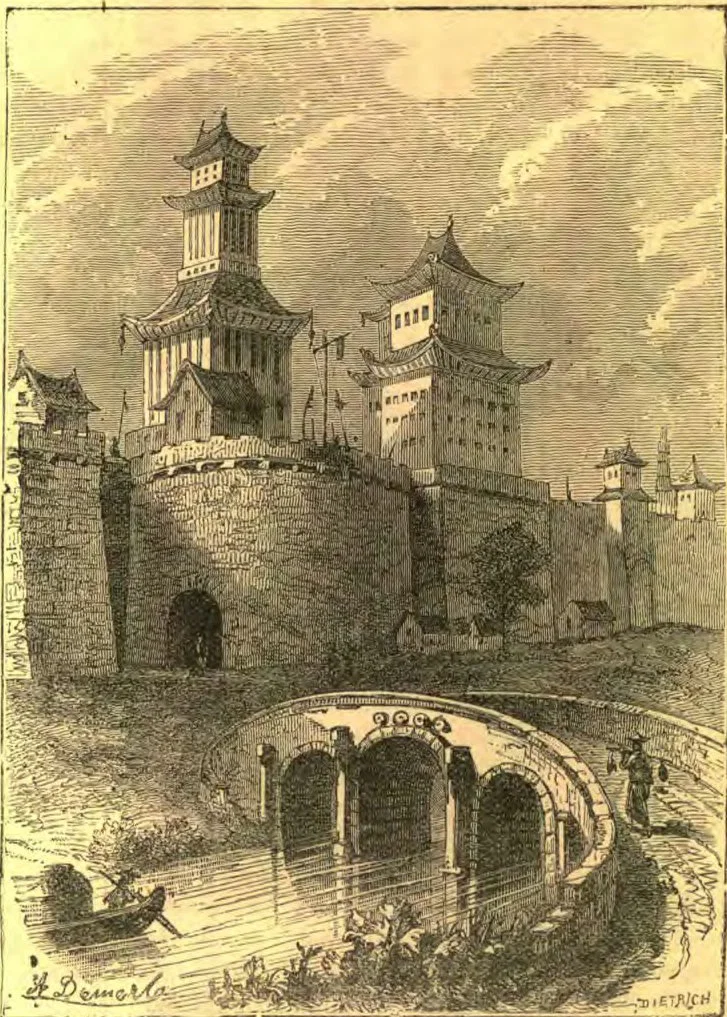
Once outside one of the thirteen city gates, one of which is shown in the picture, nothing can be seen but a long stretch of wall, with watch-towers projecting out some fifty feet, and the tops of pagodas, and the flag-staffs in front of the officers’ houses.
In the well-cultivated suburbs stand many fine dwellings, together with little hamlets surrounded by trees, so that from a distance Peking looks as if it stood in the midst of a vast forest.
The country becomes hilly about eight miles north-west of the city, and has been converted into a park containing nearly twelve square miles. The Chinese are said to be among the best landscape gardeners in the world, and here they have had a fine chance to display their skill. The hills and vales are interspersed with lakes, rivulets, and canals, with here and there a tangled thicket, through which a path leads to some secluded summer-house, or a highly cultivated piece of ground, with a palace for the emperor or his ministers standing in the midst of it. These beautiful houses were plundered by the French and English soldiers in 1860 on their way to capture the capital.
The winters in Peking are cold, the thermometer ranging from ten to twenty-five degrees above zero; in the summer it stands from seventy-five to ninety. The climate is said to be healthful. Violent storms are of frequent occurrence, and in 1671 an earthquake destroyed the city, and four hundred thousand of the inhabitants were buried in its ruins.
The Chinese were formerly very careful to exclude all foreigners from their country, and no ships were allowed to land at any of their ports. From time to time embassies were sent from different nations to Peking to treat with the government relative to opening up communications with other countries, but each time they failed to accomplish their object.
After many years the Chinese have finally consented to let foreigners trade at their ports; they allow travelers to visit China, and their own inhabitants to live in other lands. Christian missionaries have opened up missions in many parts of the country, and are doing a good work in bringing the light of the gospel into this heathen land.
W. E. L.

AUTUMN

With what a glory comes and goes the year! The buds of spring, those beautiful harbingers Of sunny skies and cloudless times, enjoy Life’s newness, and earth’s garniture spread out; And when the silver habit of the clouds Comes down upon the autumn sun, and with A sober gladness the old year takes up His bright inheritance of golden fruits, A pomp and pageant fill the splendid scene.
There is a beautiful spirit breathing now Its mellow richness on the clustered trees, And, from a beaker full of richest dyes, Pouring new glory on the autumn woods, And dipping in warm light the pillared clouds. Morn on the mountain, like a summer bird, Lifts up her purple wing, and in the vales The gentle wind, a sweet and passionate wooer, Kisses the blushing leaf, and stirs up life Within the solemn woods of ash deep-crimsoned, And silver beech, and maple yellow-leaved, Where Autumn, like a faint old man, sits down By the wayside a-weary. Through the trees The golden robin moves. The purple finch, That on wild cherry and red cedar feeds, A winter bird, comes with its plaintive whistle, And pecks by the witch-hazel, whilst aloud From cottage roofs—the warbling blue-bird sings, And merrily, with oft-repeated stroke, Sounds from the threshing-floor the busy flail.
O what a glory doth this world put on For him, who, with a fervent heart, goes forth Under the bright and glorious sky, and looks On duties well performed, and days well spent! For him the wind, aye, and the yellow leaves, Shall have a voice, and give him eloquent teachings. He shall so hear the solemn hymn that Death Has lifted up for all, that he shall go To his long resting place without a tear.
—Longfellow.

THE TIME TO BE PLEASANT.

“Mother’s cross!” said Maggie, coming out into the kitchen with a pout on her lips.
Her aunt was busy ironing, but she looked up and answered Maggie: “Then it is the very time for you to be pleasant and helpful. Mother was awake a great deal in the night with the baby.”
Maggie made no reply. She put on her hat, and walked off into the garden. But a new idea went with her.
“The very time to be helpful and pleasant is when other people are cross. Sure enough,” thought she, “that would be the time when it would do the most good. I remember when I was sick last year, I was so nervous that if any one spoke to me, I could hardly help being cross; and mother never got angry nor out of patience, but was just as gentle with me! I ought to pay it back now, and I will.”
And she sprang up from the grass, where she had thrown herself, and turned a face full of cheerful resolution toward the room where her mother sat soothing and tending a fretful, teething baby.
Maggie brought out the pretty ivory balls, and began to jingle them for the little one.
He stopped fretting, and a smile dimpled the corners of his lips.
“Couldn’t I take him out to ride in his carriage, mother, it’s such a nice morning?” she asked.
“I should be glad if you would,” said her mother.
The little hat and sack were brought, and the baby was soon ready for his ride.
“I’ll keep him as long as he is good,” said Maggie; “and you must lie on the sofa and get a nap while I am gone. You are looking very tired.”
The kind words and the kiss which accompanied them were almost too much for the mother.
The tears rose to her eyes, and her voice trembled as she answered: “Thank you, dearie; it will do me a world of good if you can keep him out an hour; and the air will do him good too. My head aches badly this morning.”
What a happy heart beat in Maggie’s bosom as she trundled the little carriage up and down on the walk. She had done real good. She had given back a little of the help and forbearance that had so often been bestowed upon her. She had made her mother happier, and given her time to rest.
Maggie resolved to remember and act on her aunt’s good words, “The very time to be helpful and pleasant is when everybody is tired and cross.”
—Selected.

THE OLDEST LANGUAGE UPON EARTH.

The story goes that three old men—a Mohammedan, a Jew, and a Brahmin—were seated on the ground beside a well, disputing together as to which was the first language spoken upon earth. The discussion waxed so hot, and the voices were raised so loud, that the sound drew to the spot a young Englishman. The youth had been out shooting; with his gun in his hand and his game at his feet, he now stood leaning against a tree, listening to the discussion between the three men.
The Mohammedan, with violent gestures and many an oath, declared that no language could equal the Arabic.
“Is it not the language,” he cried, “in which Mohammed (blessed be his name) received the holy Koran? Is it not that in which the Most High gave laws to the faithful? Will ye, O ye unbelievers, cast dust on the grave of the prophet by doubting that Arabic is the oldest language on earth?”
The Jew shook his gray head, and his brow knit into many wrinkles as he made answer: “The language which Abraham, our father, which Isaac and Jacob (peace be on them) spake, must be honored above all other tongues. Surely it was heard in paradise before Eve plucked the forbidden fruit! The oldest and most sacred language assuredly is the Hebrew.”
Then spake the Brahmin in tones of scorn: “All languages compared to Sanscrit are as the bulrush compared with the spreading banyan. Nay; even as the banyan sends forth shoots, which, when they touch the earth, spring forth young trees, so other tongues spring from the life-giving Sanscrit. He must be void of reason who doubts that the most ancient language is Sanscrit.”
The old men grew so angry that it seemed as if blows might follow words, when the young Englishman stepped forward.
“O venerable men!” he said, with courtesy, “you have numbered many years and I but few; yet let me decide between you. I know what is the most ancient and honored language spoken on earth.”
“You know?” exclaimed the Mohammedan, in surprise. “You have but down upon your lips, and will you teach graybeards like us?”
The Hindu muttered to himself, “The Sahib dogs think that they know everything. They can make roads and bridges, and send messages through wire; but what can they tell of ancient languages to a Brahmin?”
“The language of which I would inform you is not only the one first spoken upon earth, but it is the one now spoken in heaven,” said the Englishman. The three men stroked their beards, and uttered exclamations of astonishment at the presumption shown by the youth.
“And yet more,” continued the youth, his eyes, blue as the sky, sparkling with animation as he went on; “without learning to speak this language, no man, of whatsoever nation he be, will ever be suffered to enter the kingdom of heaven.”
“Do you know this language?” asked the Mohammedan quickly.
“Yes; God be praised!” the Englishman replied.
“And where did you first learn it?” asked the Jew, doubtingly.
In a softened tone the young man replied: “I learned it first from the lips of my mother.”
The three men glanced at each other in surprise; and then the Brahmin inquired, “And what is this language, O Sahib?”
“The language of Truth,” said the Englishman. When the word was spoken, the clouds cleared away from the faces of the three; they stroked their beards and cried, “Well said; truth is the language of God, truth is the language spoken in heaven.”
“But it must be learned upon earth,” said the Englishman earnestly. “Before I came to this land, I gave up pleasures by day and rest by night in order to learn the language of Hindustan. Were I not to know it, I could not remain in the honorable service to which I belong. And thus it is with truth, the language of heaven. God is truth itself, and a lie is to him an accursed thing. It is written in his word: ‘Lying lips are an abomination to the Lord.’”
Again the three men glanced at each other. There was not one of them that would not have lied for the sake of making a few pice larger profit in a bargain. Lies were to them common as the mosquitoes which buzzed around their heads; not one of them had ever thought of falsehood as a sin hateful to God.
The Mohammedan was the one to speak first: “Upon what authority does the Sahib affirm that the gate of heaven is closed against those who speak not the language of truth?”
“On the authority of God’s holy word, which cannot be broken,” replied the Englishman. “Hear, O my friends, what is declared of the abode of the blessed by Him who cannot utter untruth: ‘There shall in nowise enter into it anything that defileth, neither whatsoever worketh abomination or maketh a lie.’”
“Heaven will be very empty, then,” said the Jew, with a sneer. “Your favored Saint Peter, according to your Scriptures, lied thrice, with oaths and curses. Shall he be shut out from heaven, or shall his sin alone go unpunished?”
“Peter’s sin was punished,” replied the Englishman gravely; “but it was Peter’s Lord, the Master whom Peter had denied, who bore the penalty for him. The blood that flowed from the Saviour’s wounded side can wash away all sin, whether of thought or word or deed, the sin of falsehood among the rest. But those who would be forgiven like Peter, must, like Peter, believe and love. When God’s Spirit comes into the heart, he comes to drive away evil from it, the unjust become just, and the proud become meek, and the lips that often were stained with falsehood learn the language of heaven, ‘the language of truth.’”—The Young Pilgrim.

More Things Are Wrought by Prayer

More things are wrought by prayer Than this world dreams of. Wherefore let thy voice Rise like a fountain for me night and day, For what are men better than sheep or goats That nourish a blind life within the brain, If, knowing God, they lift not hands of prayer Both for themselves and those who call them friend? For so the whole round earth is every way Bound by gold chains about the feet of God. —Tennyson.

Let Each Day's Actions Be Worthy

LIFE is a book of which we have but one edition. Let each day's actions, as they add their pages to the indestructible volume, be such as we shall be willing to have the assembled world read.

OUT OF THE MOUTHS OF BABES.

“Little Annie Wilder has joined the church,” said Mrs. Fielding to her friend, Mrs. Brewster.
“Joined the church! Well, I must say I don’t believe in filling the church with children, and such material, too. I don’t believe Annie Wilder knows how to read.”
“And her mother is such a low-lived vagrant,” added the first speaker.
“Yes, and that isn’t the worst of it; she takes a drop too much, I am told.”
“Say a great many drops, and you will get nearer the truth,” was the reply.
This bit of dialogue took place in Mrs. Fielding’s pretty parlor in a certain suburb.
It happened that not long thereafter Annie Wilder came to Mrs. Fielding’s and asked for work. She was set to washing dishes and cleaning vegetables, and a most efficient little hand-maiden she proved. She was as gay as a bird, warbling snatches of hymn and song as she hurried from one task to another.
One day Mrs. Fielding said: “Annie, I wonder you are not more serious since you joined the church. It is a great responsibility to be a church member, and religion is a serious thing.”
Annie paused in her work, looked at the lady with her sweet, truthful eyes, and said,—
“I don’t know what you mean, ma’am.”
“I feared as much,” said Mrs. Fielding. “Child, do you know what it is to join the church?”
“It means being on Jesus’ side,” said Annie, her face radiant; “and oh! I love him so that I can’t help singing.”
“But,” said Mrs. Fielding, “don’t you have any fears, any struggles?”
“Why should I, ma’am?” asked the child, her clear eyes opening wide.
The lady said no more, but she shook her head ominously as she walked away.
The hot weather came on; family trials were onerous, nobody had an appetite, the children were cross, papa was critical. One morning Mrs. Fielding felt particularly out of sorts. The sun, but a little way on his journey, shone with noonday intensity. Not a leaf stirred. The breakfast was tasteless. The flies were aggravating. I don’t know how it happened, but it only takes a little spark to make an explosion when the train is laid. Some unguarded word was spoken, a temper blazed, a child was slapped and sent away from the table, the husband remonstrated, sharp words followed, then tears, a downright quarrel. “Oh, the trouble of living!” groaned Mrs. Fielding, when husband and children were out of the house and she was left alone. “I cannot bear it!” and she gave herself up to hysterical sobbing.
By and by, when the storm was a little cleared away, came Annie, her face serene, her eyes soft and untroubled.
“Please excuse me, ma’am, for being so late,” she said, “but mother was bad this morning, and wouldn’t let me come.”
“What is the matter with her?”
The child blushed.
“She has been drinking, I suppose,” said Mrs. Fielding.
Annie raised her arm at that minute, and there on the soft, fair flesh, was the livid mark of a blow.
“What’s that?”
“Please don’t ask me, ma’am; it’s nothing.”
“Your mother has been beating you—and what a face! You look as if you hadn’t a trouble in the world. How can you bear such things?”
“I keep saying ’em over, ma’am.”
“Saying what over?”
“The charity verses. I said ’em so fast I didn’t hear mother very plain.”
“What do you mean?”
“‘Love suffereth long and is kind,’ isn’t it beautiful, ma’am?” and the child’s face glowed. “And then, when I started to come here,” she continued, “I could n’t help feeling bad and lonesome, and I thought of another verse: ‘Lo, I am with you alway, even unto the end of the world.’ Always, ma’am—think of that! It means Jesus, ma’am; and oh, I love him so!”
Mrs. Fielding went to her own room, dumb before the wisdom of an ignorant child. Presently Annie’s voice came floating out on the stifling air. She was singing, “His loving-kindness, O how great!”—New York Observer.

NEW-TESTAMENT HISTORY.

LESSON 158.—PAUL WRITES TO THE CHURCH AT CORINTH.

The entire period of Paul’s labors in Ephesus covered about three years. During the latter part of this time he wrote the two epistles to the Corinthians. Indeed, he seems to have written them one letter earlier than this, but it has not been preserved.
Even while Apollos was preaching at Corinth, a party spirit had arisen; for some admired the eloquence and learning he displayed, and wanted to regard him as their leader instead of Paul, who had purposely made his preaching as plain and direct as possible. Others preferred Peter; while some, despising all human leadership, declared themselves to be of Christ.
Not only had dissensions and divisions sprung up among the Corinthian brethren, but some of them had been led away by the idolatry and licentiousness that prevailed in that wicked city. False teachers were trying to turn the disciples away from the doctrines and practices that Paul had taught them.
The sad state of the Corinthian church was made known to Paul by some of the household of Chloe, who had come from Corinth to Ephesus.
Deeming it imprudent, under the circumstances, to go to Corinth himself, Paul sent them Titus, and then set about the difficult task of writing the letter known as “Paul’s First Epistle to the Corinthians.”
“After a tender greeting to the church, he refers to their experience under his ministry, by which they have been led to turn from idolatry to the service and worship of the true God. He reminds them of the gifts of the Holy Spirit which they have received, and presents before them their duty to make continual advancement in the Christian life, that they may attain to the purity and holiness of Christ.”
Having thus prepared their minds, he begins to admonish them in regard to their errors, saying: “Now I beseech you, brethren, by the name of our Lord Jesus Christ, that ye all speak the same things, and that there be no divisions among you; but that ye be perfectly joined together in the same mind and in the same judgment. For it hath been declared unto me of you, my brethren, by them which are of the house of Chloe, that there are contentions among you. Now this I say, that every one of you saith, I am of Paul; and I of Apollos; and I of Cephas; and I of Christ. Is Christ divided? was Paul crucified for you? or were ye baptized in the name of Paul?”
Paul thanks God that he baptized but few of them, probably fearing that he might be accused of baptizing in his own name. He says that Christ did not send him chiefly to baptize, but to preach the gospel, and that not with enticing or high-sounding words, lest men should be attracted by his eloquence, and not be willing to accept the cross of Christ. To them who reject it, such preaching appears like foolishness; but those who believe will find in it the power of God unto salvation. “The Jews,” he says, “require a sign,”—probably the sign of circumcision; for the Judaising teachers still contended for that rite;—“and the Greeks seek after wisdom,”—the vain philosophy by which they sought to explain the creation and government of the world. Paul, in his speech at Athens, had shown that all this wisdom was mere foolishness; for after the Athenians had set up altars to gods innumerable, they were themselves unsatisfied, and set up one inscribed to the unknown god. By the very preaching which they called foolishness, Paul set forth the true character of that God whom their highest wisdom did not enable them to comprehend. Thus he proved that the foolishness of God is wiser than men.
In this way, Paul shows the Corinthians the priceless value of the gospel they had received; that it is a gift from God himself; that it is the same, whether preached by Peter, by Apollos, or by himself. It is light from heaven, and does not depend for its excellence upon the wisdom or eloquence of men. He calls attention to the fact that not many of the believers are from among the wise, the mighty, or the noble of this world.
In speaking of his own preaching, he says: “And I, brethren, when I came to you, came not with excellency of speech or of wisdom, declaring unto you the testimony of God. For I determined not to know anything among you, save Jesus Christ, and him crucified. And I was with you in weakness, and in fear, and in much trembling. And my speech and my preaching was not with enticing words of man’s wisdom, but in demonstration of the Spirit and of power; that your faith should not stand in the wisdom of men, but in the power of God.”

QUESTIONS.

  1. What was the entire period of Paul’s labors in Ephesus? Acts 20:31.
  2. What important letters did he write during the latter part of this time?
  3. What may be said of an earlier letter to the same church?
  4. What had arisen in the church at Corinth, even while Apollos was preaching there?
  5. Why did some of the Corinthian brethren want to take Apollos for their leader instead of Paul?
  6. What had Paul purposely done while with them?
  7. What other leaders did some claim to follow?
  8. What other evils prevailed in the church at Corinth?
  9. How did Paul learn of these things?
  10. What step did he first take toward helping them?
  11. What difficult task did he then take up?
  12. How does he begin this letter?
  13. To what does he then refer?
  14. Of what does he remind them?
  15. What duty does he present?
  16. What result is to follow the discharge of this duty?
  17. After thus preparing their minds, what does he begin to do?
  18. What earnest admonition does he first give them? 1 Cor. 1:10.
  19. Of what does he accuse them? Verse 12.
  20. What questions does he ask them?
  21. For what does he thank God? Why?
  22. For what purpose does he say Christ had sent him? Verse 17.
  23. Why was he not to preach the gospel with enticing words?
  24. To whom does such plain preaching appear like foolishness?
  25. What will it prove to be to those who believe and obey it?
  26. What did the Jews require?
  27. What did the Greeks seek after?
  28. What sign is probably meant in this passage?
  29. What wisdom is referred to?
  30. In his speech at Athens, what had Paul shown in reference to this wisdom?
  31. How did he make this appear?
  32. How did he set forth the God whom their highest wisdom could not enable them to comprehend?
  33. What does he thus show the Corinthians?
  34. What does Paul, in this way, teach them in regard to the gospel they had received?
  35. What does he call upon them to observe with reference to those who had been called out by the gospel? Verse 26.
  36. What does he say about his own preaching among them? Chapter 2:1, 2.
  37. What was his condition of mind at that time? Verse 3.
  38. How did he endeavor to have their faith stand in the power of God rather than in the wisdom of men?

THE COW-TREE.
“Mamma,” said little Robbie Wood one day at the dinner-table, “how does butter grow?”
“Oh, ho!” cried his brother Harry before mamma could answer; “what a goose you are, Rob! butter doesn’t grow.”
Mamma looked across the table, and saw a little lip quivering, for Robbie hated to be laughed at. Harry saw it too, and was sorry.
“No matter, Rob,” said he; “I had no business to laugh at you; but it was so funny;” and Harry had hard work to keep back another shout.
“I suppose you would think it was very funny,” said mamma, putting some milk into her cup of tea, “if I told you that there is a country where the people get milk from trees.”
The great tears in Robbie’s eyes forgot to roll out, and Harry stared at his mother to see if she was joking.
“It is true,” said she.
“Now, mamma,” said Harry, “you are going to tell us about it, aren’t you? It will make such a nice story.”
“I haven’t time now,” mamma said; “but come to me after supper, and you shall hear it.”
The boys went out to play that afternoon, and perhaps you think they forgot all about the story; but they didn’t do any such thing, and just as soon as supper was over, and mamma had taken her sewing and sat down by the table, the boys brought their chairs and sat down in front of her.
“Now, mamma, for the story.”
“Well,” said mamma, “far away from here—so far away that people go in ships, tossing up and down on the waves—”
“That must be great fun. I’d like to go,” said Harry.
“Don’t talk, Harry,” said Robbie, with his eyes on mamma’s face.
“So far away,” continued mamma, “that very few travelers go there, there is a country very different from ours. There is never any cold weather, never any snow or ice. There are wonderful things there. The fishes are of beautiful colors, blue and yellow and orange and red; you can see them shining far down in the clear water. There are sharks, and alligators, and crocodiles, too, and they are not lovely at all.”
“Don’t they eat people sometimes?” asked Harry.
“Sometimes,” said mamma.
Rob looked frightened, so mamma hurried on.
“But the birds are even more beautiful than the fishes; some of them are as white as snow, and some are as pink as baby’s cheeks, and some have bright red wings; some of them are green and gold, with drooping tail-feathers a yard long. One of them has a cry that sounds just like a child in trouble—it would make you sad to hear it; and there is one that has a spur as sharp as steel under his wing, so he can fight his enemies. There are a great many gay little humming-birds that fly in and out among the trees, and everywhere green and purple dragon-flies dart about in the bushes.”
“But the plants and trees are the most wonderful of all. There is a flower called the fever flower, because at certain times in the day it gives out heat; and there is a plant called the pitcher-plant, because its leaves are folded up into little green pitchers that hold water. One of the plants has a very large flower that just before it blossoms looks like a swan held by its bill; but when it is all open, it turns into a liberty-cap with a violet lining. The vines climb away up to the tops of the tall trees, and blossom there; and ferns, that grow close to the ground here, grow there till they are as high as trees. You would like to go to walk there, and see the strange trees: coffee-trees, with shining evergreen leaves, and little white flowers, very sweet to smell; cocoa-trees, very tall and straight, with a cluster of leaves at the top—great leaves twenty feet long; and orange-trees, with leaves and blossoms and green and ripe oranges all on the trees at once. But I think you would like best of all to see the cow-tree—only you would have to climb up very high, for it likes to live on high places.”
“I wouldn’t mind that,” said Robbie; “I can climb.”
“Guess you would get tired,” said Harry.
“No, I wouldn’t, either,” said Robbie. “Would I, mamma?”
“If you lived down in the valley, it would be a long walk,” said mamma; “for these trees grow far up on the sides of the mountains. Sometimes it doesn’t rain in that part of the country for weeks, and weeks, and months, and the leaves droop, and the poor cow-trees look as if they were dead; but if you were to cut a little place in the trunk of one of them, what do you think would come out?—Nice, sweet milk!”
“Is it just like cow’s milk?” asked Harry.
“Not just exactly like it,” said mamma, “but almost like it, and just as good to drink. You would think so if you could see the little boys and girls there drink it. The milk runs fastest at sunrise; and so when the sun rises over the mountains, the people come,—men, and women, and children,—with their bowls in their hands, to get the milk. They only have to hold the bowl close to the tree, and the little white stream soon fills it. If they like, they can set it away when they get home, and in a little while it will turn thick like cream.”
“What a wonderful tree!” said Harry. “Does it look like any common tree?”
“Yes,” said mamma; “only it is very tall—a great deal taller than any of the trees here. It has beautiful dark-green leaves, pointed at the end, and longer than my hand; and tiny little flowers, and small, round fruit with a little leaf on the top like a cap.”
“But, mamma,” said Harry, “you haven’t told us where the country is where all these strange things are.”
“It’s among the Cordilleras, on the coast of Caracas,” answered mamma.
“But I don’t know any better now,” said Harry. “I never heard of that place before.”
“I know it,” said mamma, smiling; “but you can take papa’s big atlas to-morrow and find it.”
“Oh, please tell us now,” begged Robbie. But mamma only shook her head and smiled again.
“That’s just like you, mamma,” said Harry. “You always leave something for us to find out for ourselves, and I like it. Rob and I will have a good time to-morrow hunting up that place.”
“Very well,” said mamma. “Now scamper to bed, little men.”—Mrs. Carbee.
Continue reading: SABBATH-SCHOOL MAPS