The Youth’s Instructor, Vol. 65, No. 2.

Zeoditu Rules Abyssinia After Menelik's Death

The Youth’s Instructor

Jan 9, 1917

Review and Herald Publishing Assn. · Takoma Park Station, Washington, D. C. · Jan 9, 1917

Zeoditu Rules Abyssinia After Menelik's Death

Zeoditu, daughter of the late emperor Menelik of Abyssinia, is now ruler in her father's stead, having deposed her nephew Negus Jeassu.
Admiral Sir John Jellicoe has been appointed first sea lord, and Vice Admiral Sir David Beatty succeeds Jellicoe as commander of the British fleet.
Dr. Henry van Dyke has resigned as American Minister to the Netherlands. His reasons are purely personal. He desires to resume his literary work.
Formal announcement was made November 27, that ex-Justice Charles E. Hughes would resume the practice of law January 1, as a member of his old firm in New York City.
According to Mr. Dudley Harmon, who represents the government in the Ladies’ Home Journal, measles, though less dreaded than smallpox or infantile paralysis, causes more fatalities than either.
The work of making Verdun, France, uninhabitable has been thoroughly accomplished. Only one building remains untouched, and in the city made famous by its bombardment the intact house is treated as a “sight” to be shown to all visitors.
To make Chicago “dry” in 1918 a year’s educational work is planned, including work by prominent speakers, a billboard campaign, street-car advertising, and street meetings. Ten thousand workers are needed, of whom the churches and young people’s societies have already furnished 3,600.
In New York State 501 out of 932 towns are “dry,” and 111 of the remainder are partly “dry.” There are only 320 towns in which liquor may be sold. In New York, towns vote on the license question every two years, but cities are not allowed to vote on this question; hence all New York cities are “wet.”
A certain blight has been noticed on the olive trees of various parts of the world. The blight has been traced to the proximity of the oak to the olive tree. By special scientific investigation of the subject in Italy it has been discovered that no disease is transmitted by the oak, but that the roots of the oak appropriate the richness of the soil and literally starve the olive into its diseased condition.
A new answer to the perplexing question, “What shall we do with our former Presidents?” was proposed in a resolution introduced in the House recently by Representative Moore of Pennsylvania. The resolution would give former Presidents the right to a seat and voice in either House or Senate, as they might elect, at compensation of $25,000 a year. They would not be given a vote.
Dr. George E. Vincent of Chautauqua fame has been given the presidency of the Rockefeller foundation. For twenty-five years Dr. Vincent had charge of the Chautauqua courses of instruction, a country-wide school. In 1892 he was given a professor’s chair in the University of Chicago. He finally became dean of that institution. In 1907 he was made the president of the University of Minnesota, the present enrolment of which is more than 9,000 students.
Professor Lowell, who died on November 13 in his observatory at Flagstaff, Arizona, was an astronomer who invested his theme with interest, with the result that he was perhaps better known to people than most of his contemporaries. His fame rests chiefly on the extraordinary researches he conducted in relation to the planet Mars, and his assertion that it was the abode of living, intelligent beings. He discovered what he declared to be the handiwork of a race endowed with reasoning and constructive qualities so like those found in our own world that they could hardly be other than human beings. All the primary requisites for the support of animal life he found on the planet—water, heat, and atmosphere. His discovery of a vast network of not less than five hundred canals,—some of them nearly a thousand miles in length,—constructed, as he declared, with greater intelligence and engineering skill and on a far grander scale than anything we possess or can show, stimulated the desire of the scientific as well as the unlearned to know more about the wonderful world which seemed to be opening a new portal that might lead to the revelation of the secrets of the universe. Professor Schiaparelli had found only one hundred and four canals with the telescope, yet his observations were accepted as strengthening the theories advanced by Lowell. So, little by little, the world has come to believe that the red planet is really inhabited.
Under a scientific experiment two girls lived for three months on nothing but peanuts. They were students of the University of California, acting under instructions from Prof. M. E. Jaffa, head of the department of nutrition, who wanted to prove that peanuts were among man’s most nutritious food products. The scientific experiment was a success. “We never felt better,” said one of them, who insisted that their names be kept secret, “but I can’t bear the sight of them now.” The peanuts cost each girl fifteen cents a day, or $1.05 a week. This cut their expenses down to $4.20 a month, breaking the record for frugality on the campus.
Readers of Chinese need fear no dearth of reading matter, as there is a Chinese library in Washington containing 40,000 printed volumes. The collection is part of the Congressional Library. Dr. Walter T. Swingle, of the library, says this collection contains some of the rarest Chinese works in print. Some of them were printed before 1450 A. D. The three largest books in the world are listed in the collection.

Finding a Friend Who Shares Life's Burdens

“To find a friend along life's road Who'll help to bear another's load; To find a friend who'll claim in part The burden resting on one's heart, Is finding treasure yet untold — A wealth that far outvalues gold.”

The Land of the Lapps

(Concluded)
W. S. CHAPMAN
The dress of the Lapp in winter is very attractive, especially if newly made. The cap, or lapinlakki, is heavy and square-topped with a bright scarlet crown, with a band of otter fur around the head. A sieppura, or collaret of bear’s fur, encircles the neck, with the bear’s mask hanging over the heart. The coat, or outer garment, the matsoreo, is made of soft, gray-brown reindeer skin. Short, hairless leather breeches are joined at the middle of the thigh by the sapakket, or reindeer-skin leggings, reaching to the ankles, and are there made fast to the leather boots by narrow, red, clothlike bandages. The summer dress is not so attractive, as the fur parts are omitted.
The boots are made quite large, so that the foot can be surrounded by Lapp grass, which takes the place of stockings. This grass is a crisp, green, dry grass, without knots and without seeding tips. It is twisted up and kneaded in the palms of the hands to break the fiber, and then becomes like a pad of soft horse-hair in texture. A supply of this grass is always carried by each Lapp, and the foot covering is renewed as needed. It requires some skill and practice before the grass can be properly wrapped about the feet.
The customs of the people vary slightly, depending upon the location of the home and the occupation of the owner. On the borders of civilization, and where Western customs have been adopted, the Lapp’s home and surroundings differ materially from that of the wandering or lake Lapp, or from that of the inland farmer. But everywhere a stranger is ever welcome. He has but to open the door and walk in, then help himself. Hospitality is as natural to a Lapp as it is to breathe.
To the wandering Lapp, the fisherman or herder, the idea of a home, as we realize it, is unknown. Almost anywhere else in the world a host will ask his guest to “come inside.” While all that the Lapp has is at the disposal of the visitor, yet he has no house pride. Any shelter, a rock or the sunny side of a bank, for a dining-place, is all-sufficient, and a place on the ground inside his brown, cloth-covered la-wo, or tent, similar to our Indian tepee, at night, is the sum total of all entertainment he ever thinks can be expected of him. In cold weather, however, a more substantial dwelling, in the shape of a hut of peet or sod, is erected, and is about twelve feet in diameter at the base.
The small farmer—one who is tired of wandering, and possibly growing old—settles down by some lake, cultivates a small patch of ground, and from his crops and the fishing manages to eke out a precarious living. Generally these farmer huts consist of two rooms, a general living-room and a tiny, cupboard-like sleeping-room, which is often the dairy also. These, with two box beds, make up the total accommodations for possibly a large family and servants, to say nothing of occasional traveler guests. But while the hospitality in these settlements is indeed open-handed, the chances of obtaining food, except it may be dried rotten fish, and possibly coffee, is small indeed.
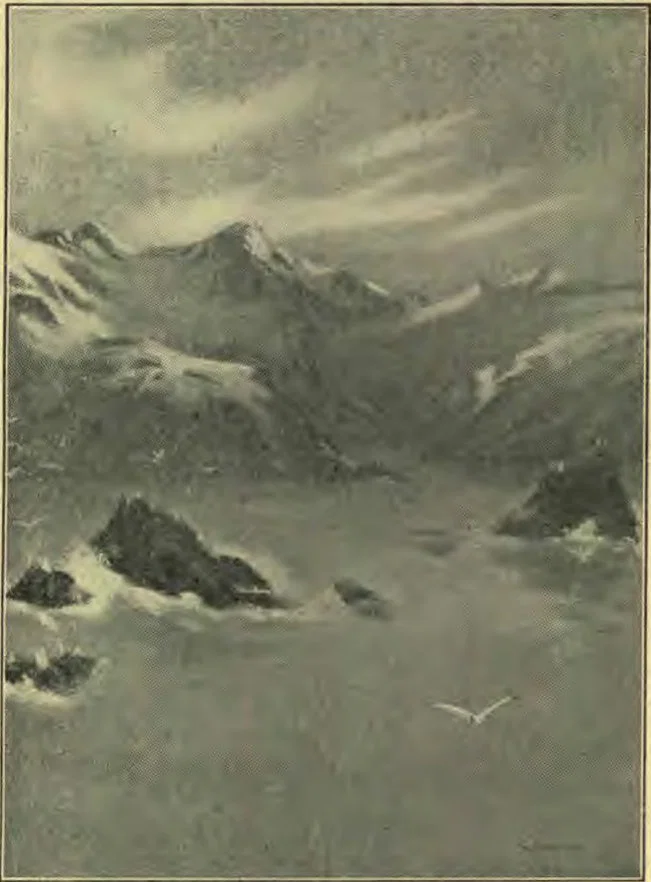
THE GATES OF RUSSIAN LAPLAND
The more prosperous farmer, with perhaps a thousand reindeer, owns a comfortable encampment near grazing ground for his herd. Such dwell in a kata, or tent, about twelve feet in diameter at the base, the ground inside comfortably covered with fur skins for mattresses and for bed covering, and is usually stocked with a bountiful supply of frozen meat, smoked meat, tongues, buckets of frozen milk, and bladders of frozen blood, of which they are passionately fond. In Lapp homes there is no separation in sleeping because of sex or social position. Usually, all sleep in one room. The Lutheran Lapps, as they prepare for retiring, unite in singing hymns of praise to God.
In Arctic Lapland there are no arbitrary hours for work or rest or sleep. Among the herders especially, who have no timepieces, the thought of hours finds no place. It would occasion no comment to see children preparing for bed at 4 A. M., or a laborer starting for the fields to work at 2 A. M., for the sun shines, practically, during all the twenty-four-hour day. Paul Du Chaillu, the noted traveler, commenting on this, wrote:—
“I was under the impression, before visiting this part of the country (Arctic Lapland), that the long-continuous daylight or dark short days must degenerate men; I found to the contrary; the farther north I traveled in Norway or Sweden, the more healthy seemed the people, the larger the families, and the greater the number of births according to the population. . . . It is not uncommon to see a family of fifteen or eighteen children by one wife, and sometimes, though rarely, twenty to twenty-four. Fish and milk are evidently good food for the increase of the human race. I met many people living to a great age, showing them to be strong men and women.”
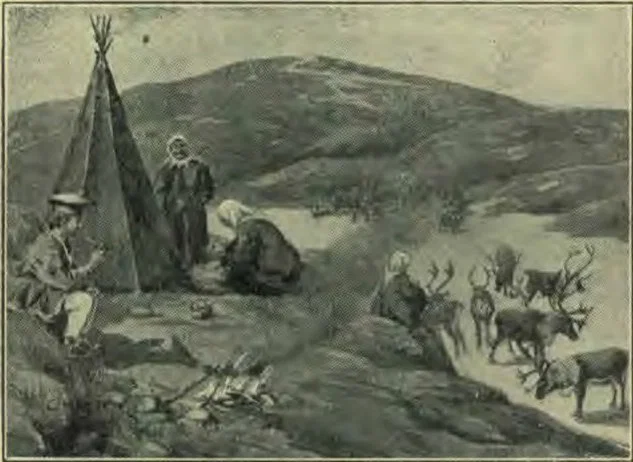
HERDER LAPPS' ENCAMPMENT
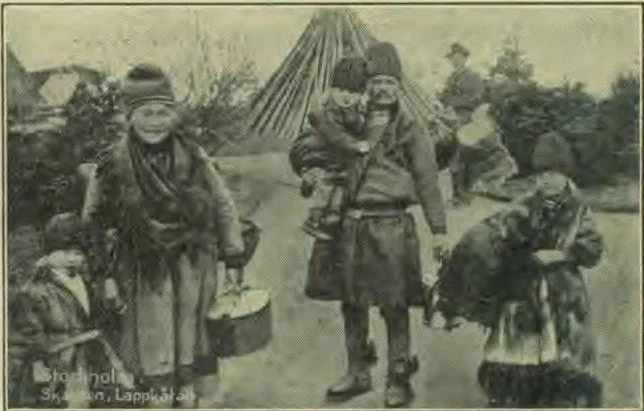
A LAPLANDER AND HIS FAMILY
Among the Arctic Lapps, however, who are not so comfortably situated or so well fed as are the Swedes and Norwegians, the mortality among infants up to two years of age is very great, comparatively few surviving the rigors of their first winter’s experience.
The winter storms in Arctic Lapland are sometimes indescribably fierce—something frightful. Of these Du Chaillu has this to say:—
“My journey over the mountains beyond the arctic circle, between 69° and 70° lat., was over. I had met many a storm on the Atlantic; the tornado of the equator had often passed over my head or struck the ship which bore me; but of all the windstorms I ever encountered, that of the mountains which we had just crossed was the grandest. As I look back to those days, I fancy I can hear the shrieks and howling of the wind, and remember how I crouched upon the rocks for safety while the tempest beat upon me as if the elements had obtained the mastery over the world, and chaos was coming again.”

So Mightily Grew the Word of God and Prevailed

“So Mightily . . . the Word of God . . . Prevailed”

I WONDER how many of the young people will recognize this Scripture quotation; and how many know what is meant by the statement that the word of God “prevailed.” The Word of God has certainly had many mighty enemies and has won many glorious victories, but perhaps none of its triumphs are of greater interest and practical importance to us than the one here mentioned.
Here is the story in the simple words of the Scripture narrative:—
“Many that believed came, and confessed, and showed their deeds. Many of them also which used curious arts brought their books together, and burned them before all men: and they counted the price of them, and found it fifty thousand pieces of silver. So mightily grew the word of God and prevailed.”
What a dramatic scene it must have been! Here is a man staggering down the street under a great burden of books, his left arm full, his right hand just reaching the top of the load to steady it. Here comes a young girl with her books of fiction and magic. Here is a family each carrying a load, and all hurrying eagerly toward the great bonfire and heaping the books on. What can it mean? Are these books valueless, that all seem to take pleasure in destroying them? Are they out of date? Have they cost nothing? Ah, no, dear friends, but the word of God has prevailed. For years their minds have been darkened and enslaved by means of these evil books, but at last the glorious word has shined in and has mightily prevailed.
The expression reminds one of that in Genesis 7: “The waters prevailed, and were increased greatly upon the earth; and the ark went upon the face of the waters. And the waters prevailed exceedingly upon the earth; and all the high hills, that were under the whole heaven, were covered. Fifteen cubits upward did the waters prevail; and the mountains were covered. . . . And every living substance was destroyed which was upon the face of the ground.”
O that this divine word might prevail in our lives, so that everything contrary to it might be destroyed!
Never were heathen cursed by books of satanic inspiration more than are our own people by present-day fiction. Here is one of the many earnest warnings that have come to us through the Spirit of prophecy: “You are indulging an evil which threatens to destroy your spirituality. It will eclipse all the beauty and interest of the sacred pages. It is love for storybooks, tales, and other reading which does not have an influence for good upon the mind that is in any way dedicated to the service of God. . . . You were represented to me with your eyes turned from the Sacred Book, and intently fixed upon exciting books, which are death to religion.”
“I appeal to parents to control the reading of their children. . . . Especially do not permit upon your tables the magazines and newspapers wherein are found love stories.”
How unaccountable it is that notwithstanding this positive, explicit instruction we find these popular magazines in the homes of so many of our people. O, that our people would arouse and feed upon the Word of God! Then it would mightily grow and prevail against these things which are a curse to the youth.
The wife of an influential worker recently argued with me in favor of one of these most popular “home” magazines. But she studied the matter honestly and prayerfully, and the Word of God prevailed. She said, “I can see now that it was the subtle infatuation of those stories which made it such a cross for me to give up the journal.”
Many a home would do well to have a bonfire like that of the Ephesians, even as we are told in the “Testimonies for the Church,” Vol. I, p. 135:—
(Concluded on page ten)

“So Mightily . . . the Word of God . . . Prevailed”

(Concluded from page four)
“Parents would better burn the idle tales of the day, and the novels, as they come into their houses. It would be a mercy to the children. Encourage the reading of these storybooks, and it is like enchantment. It bewilders and poisons the mind.”
Dear young people, take the Word of God and study it until it prevails. Meditate upon it until it prevails exceedingly, until the rising tide of divine light and life and power overwhelms and destroys every earthly element. If you have not already done so, enrol at once in the Bible Year, and determine by God’s help to read the Bible through during 1917.
“The life of God which gives life to the world is in his Word.” MEADE MACGUIRE.

On the Steamship “Empress of Asia”

[The following article is an extract from a letter written by Mrs. A. G. Daniells to her son Grosvenor. We know our readers are always glad for every word that comes from those visiting or working in mission fields.—Ed.]
HERE we are eight days out, and this is the first line I have written to you, although I fully intended writing a little every day. We have been such good sailors in all previous voyages that I counted on being able to write even if the sea was rough, but so far on this trip we have felt more like lying down than working. We had never been this way before, but had heard it was almost always rough and frequently stormy. I had heard such exciting things about this northern route that for the first time in thirty years I was timid about sailing, and felt the same dread of the ocean I did the first time I ever sailed. I had heard that the boat would so nearly tip over that the people could walk on the side as well as on the floor of the cabin; that the trunks and suit cases would follow each other in a mad chase around the cabin; and that the captain would tell the people who knew how to pray to go to praying. Altogether, I felt it would be a new experience for us, and it has proved so.
We sailed from Vancouver about noon the second day of November. The first afternoon, going down the coast, the sea was as calm as a mill pond, but the next morning when we awoke we found we had struck different waters. The boat was pitching and rolling, and we felt that it would be wise to stay in bed, so we remained there for about two days. We have been up most of the time since. The sea is very rough, but this is such a fine large boat (it is six hundred feet long), and it rides the waves so steadily, that we do not get the force of the sea as we would on a smaller boat. A few of our company (there are fourteen of us) have been as well as possible all the way, but the most of us have been rather indisposed, and several have been quite seasick.
Brother and Sister Gillis and their thirteen-year-old son are among our party. These people went to China when the boy was seven years old, and came home because of the mother’s ill health. Their furlough should have been a year, but now after ten months they are on their way back, starting just as soon as Sister Gillis’s health would permit, and all are glad to go to China again. I was surprised that the boy should be willing to leave America after being here a few months, but he says he likes China better and is glad to return. He speaks Chinese well.
Brother J. P. Anderson is also with us, returning to South China. He went to China ten years ago, when he was only nineteen years old. Although so young, he has done a splendid work. A few months ago he came home with his sick wife, and now that she is recovering he has left her to hasten back to his work. It seems good to see people with such missionary zeal. Six years ago he married a young woman missionary who had been sent out from America to China. They have two children, and it was hard to leave the mother with the children, but he felt he must return as soon as possible.
There are many Chinese on board going back to their native land. Six or seven are traveling first class, about thirty second class, and seven hundred are in the steerage. In a cabin near ours is a Chinese family with three children. They are superior-looking persons, and the children are bright and well behaved. One day the little four-year-old was missing, and the father was much alarmed. He went around asking if any one had seen his little “China boy.” The baby is about two years old, and is named Minnie. She is a sweet child that any one could love. In fact, the Chinese children are much better behaved than most of the American children on board.
We are now getting into calmer waters, and nearly all the passengers are able to be at the table in the dining-room. It is cold, but we are quite comfortable in our cabins; not many venture on deck for any length of time. We shall soon be near Manila, where it is always summer. We have had no storms thus far, but I think this bleak northern sea is almost always rough. My fear has gone, and we are enjoying the association with our people.
There are a number of missionaries of other denominations on board, some returning to their field of labor and some going out for the first time. I held a Bible reading with some of these ladies in the dining-room. One of them was anxious to have all the texts we used. She is going to Canton to work with the Chinese who live on the house boats in the harbor. Thousands of people live on these boats, rear their families, and never know any other home. There is a small place about four feet wide by eight or ten feet long which has a covering of canvas over it, and there the family live. They tie the small children to the side of the boat so they will not fall into the water while the mother is rowing passengers from place to place.
We hope to be in Yokohama tomorrow evening or the next morning, and look forward to meeting all the people again. Later on we shall come back to Japan and hold a general meeting in the church at the mission in Tokio. I wish you could see our church in Tokio. There is a large entrance way, or hall, and at time of service the place is filled with wooden shoes that the worshipers remove from their feet on entering, and put on when they come out. They never wear their shoes into any house, but leave them in the hall or at the door, and walk in in their stocking feet. All these shoes looked alike to me, and I wondered how they knew them apart. I was told that each pair has a strap peculiar to itself, by which the shoes are identified.
From Yokohama we go to Kobe where we shall remain one day while the ship unloads cargo, and then we go to Nagasaki for a day. All this is in the beautiful Japan Sea. From there we should go to Manila, but there are so many passengers on board who are booked for Shanghai that they have sent in a petition to have the ship go from Nagasaki direct to Shanghai. We heard today that they have decided to do this, and we too are much pleased, for that will give us a few hours with our brethren and friends there. It is not probable that we shall have time to go out to the mission; for these large steamers anchor some distance from shore, and the passengers are taken up the river by means of small boats. It takes between two and three hours to get to the city, and about an hour to go from there to the mission, and we do not expect the boat to remain that long. But we shall send a wireless to our people, and no doubt they will meet us at the boat; or we may go up the river and have a little time with them at the wharf or in the city.
I went with a party down into the hold of the ship to see the steerage passengers. There were hundreds of them, mostly Chinese, and they were like bees in a hive. The place was not at all clean, but it was well ventilated. Many of them were gambling, and we saw quite large sums of money pass from one to another. I am told that they gamble there all night, and I am sure it is so, for we can hear them shouting at different times all night. Our cabins are on the deck above all this, and when I had gone upstairs, I truly felt that I had been down to the underworld. Notwithstanding the people are packed into such meager quarters, and have almost nothing to make them comfortable, they all seemed happy and laughing.
MRS. A. G. DANIELLS.

In Preparation

MR. OTTO KUHN, one of the party of forty-two missionaries who recently went to the Far East, is to engage in medical missionary work in China. We expect Mr. Kuhn to render excellent service in that needy field, and we await reports of his work with interest; but just now, while he is learning the language, we shall have to content ourselves, perhaps, with what he may write to friends. The following paragraphs are excerpts from a letter to his sister:—
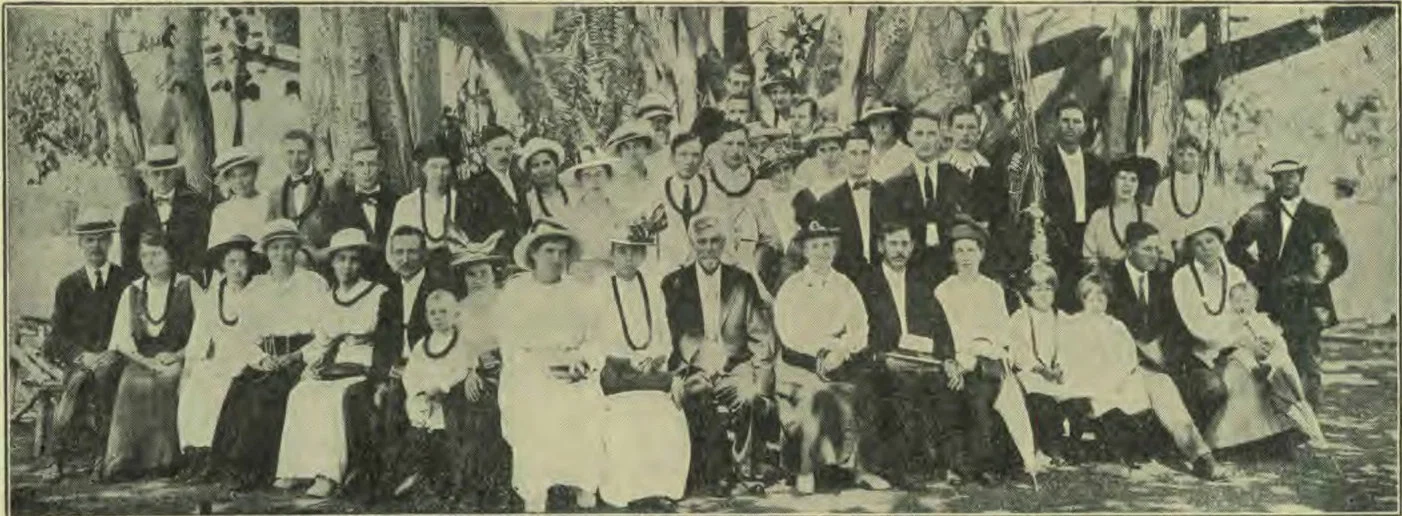
THE LARGE COMPANY OF MISSIONARIES THAT WAS SO ROYALLY ENTERTAINED BY OUR HAWAIIAN FRIENDS
“We are comfortably settled. Our goods came in good condition. One box was overlooked by Montgomery Ward. It will reach here in a week or two. The typewriter is in it, and also our winter clothing and bedding. We live in a beautiful compound. The garden and grounds are large and lovely.
“We like the Chinese very much. They are clever, intelligent, patient, and hard-working. We have a man to do the cooking, washing, and general housework. He is a good baker and cook, and does the housework well.
“Mrs. Kuhn and I are studying the language here at the Nanking Language School. The school will continue until about April. The language is difficult to learn, but it is interesting. We can read about one hundred and fifty characters, write about one hundred, and speak about two hundred words. The language course in six months will give us about five hundred characters. Henry talks quite a little in Chinese; it is amusing to hear him. The Chinese have named him Yoh Han, meaning John.
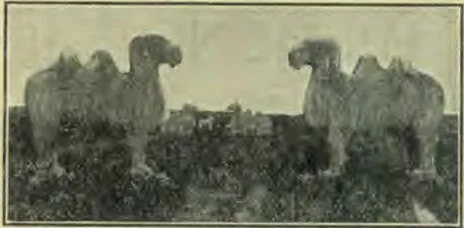
ROADWAY TO MING TOMBS,
NANKING, CHINA
ROADWAY TO MING TOMBS, NANKING, CHINA
“Last week we went out to the Ming tombs. The first emperor of the Ming dynasty is buried there. He died about five hundred years ago. His coffin was covered with earth until a small mountain was made. The mound is much larger than the sanitarium hill. “Elephants, camels, horses, several times larger than normal, were carved out of solid rock and placed in pairs along the road leading to the place of burial. They are in good condition at the present time.”

Our Trip to the East

WHEN the steamship “China” weighed anchor and sailed out of the Golden Gate, various feelings were experienced by the forty-two missionaries who were leaving home for the Far East.
We strained our eyes for a last glimpse of dear faces on the dock, and when they were no longer discernible we watched the white flag on the end of a long pole that was being waved to and fro. After a while that too faded away, and we turned toward the new and untried.
A few of the company were a little seasick the first day or two, but fine weather and smooth sailing soon dispelled all unpleasant feelings.
Deep on our memories are engraved the wonderful sunsets. The strange, intense green and crimson of the sky and the sea, the purple and gold of the clouds, would eventually change into a deep violet. The swift-changing panorama sometimes lasted for two hours.
We had one or two rough days. One of these was especially enjoyable. The waves dashed over the bow of the boat all day. A few stray water-mountains dashed over our heads. Some of the company were drenched, but they did not mind it.
The sixth day out from San Francisco we had a wireless from Honolulu. A royal welcome awaited us there. We were impressed with the noble mold of the Hawaiians, their delightful music, their great good-heartedness. As we left them, our eyes filled with tears, while not one was shed at leaving the homeland. To find our own kith and kin, as it were, in the middle of the boundless ocean, brought a new and happy experience into our lives.
After about fourteen days more, we sighted Japan. To see Japan is like riding through a storybook. The little people smiled and bowed as we walked along their streets or bought their wares.
We had the privilege of visiting a Japanese home. We removed our shoes before entering. At Tokio we visited the chief store of the place—the Wanamaker’s store of the East. Here we were provided with red-velvet sandals, which were removed as we left the store. I wish I could enumerate all the wonderful things we saw there—beautiful embroideries, silks, ivory work, and lacquered articles. We were not supplied with a large amount of change, and bought only a few little souvenirs.
The latter part of August we reached Shanghai where the various members of the company separated for their fields. We left Mr. and Mrs. Jacques in Japan, and feel that Japan is rich in having them. Professor Steinel and his wife and Mr. and Mrs. Sevrens went on to the Philippines, Mr. and Mrs. Barto to Borneo, and Mr. and Mrs. Morris to South China. The others are scattered through Korea and North and Central China.
In our experiences thus far, we testify to the truth of Isa. 54:10: “My kindness shall not depart from thee, neither shall the covenant of my peace be removed, saith the Lord that hath mercy on thee.”
MAY C. KUHN.
Continue reading: The Paradise of the Pacific