The Youth’s Instructor, Vol. 29, No. 15.

WAYSIDE SCENES IN INDIA

The Youth’s Instructor

Apr 13, 1881

S. D. A. Publishing Association · Battle Creek, Mich. · Apr 13, 1881

WAYSIDE SCENES IN INDIA.
(Concluded from last number.)
SOME of the roads leading to the city are lined with mango trees. These trees are the property of the government; and each year, when the fruit is still green, the trees are sold to parties who agree to pay a certain amount when the ripened fruit has been sold.
The fruit of the mango tree is prized not only by the natives of India, but by Europeans also, and therefore brings a good price in the market; so the persons purchasing the trees hope, from the sale of the fruit, to realize not only enough to pay the amount promised, but to secure a nice little sum for themselves.
Each year, from April until June or July, when the fruit ripens, under these trees by the roadside we see booths built, sometimes of branches of trees, and sometimes like the lodges now in the fields. Under many of the trees, as the branches are low and widespreading and the foliage heavy, there is only the bed on which the guardian of the tree sits by day, and on which he rests at night. Sometimes under one of these great trees an entire family take up their abode while the fruit is ripening. The father watches sharply the boys and birds, whose covetous eyes are upon the fruit which he hopes in due time to turn into silver. The mother prepares the food—not a difficult matter, even though the mouths be many. A fire-place of mud is made, and a small pile of twigs, which the children help to gather, cooks the rice and the “dál;” the mother kneads with her hands thin cakes of bread, which are quickly baked on the coals; and the meal is ready to serve. Portions are poured into large brass plates. The father first comes, taking his seat on the ground and using only his fingers to convey the food to the mouth. When his hunger is satisfied, the other members of the family cluster eagerly around. In these frugal households there is no surplus, and the portion prepared is soon all disposed of. The mother then scours the vessels that have been used with a little water and the sand at her feet, after which she carefully stows them away, for a poor man’s greatest wealth often consists of his few vessels of bright brass.
This work done, the mother sits idly upon the ground with folded hands, plays with her children, or lazily turns her spinning-wheel. The children play under the trees, or stray away to visit children living under neighboring trees. In this idle way these poor people are quite content to spend their time.
The fruit so carefully guarded is sold as it ripens. Passing travelers make small purchases, giving with their pennies such items of news as they have picked up by the way.
Men come with empty baskets, which, after much bargaining, they carry away on their heads, filled with luscious fruit, which they sell from house to house, or carry immediately to the public market. Servants come to buy fresh fruits for the tables of their masters.
This is the reaping-time, and the owners of the trees find pleasant occupation in counting over their gains. It is a busy, patience-trying time, too; for the crow—which abounds in India and gains a livelihood chiefly by pilfering, which it pursues as a lawful calling—seems as fond of the rich, golden fruit of the mango tree as man himself, and quite as determined to have its full share; so that through all the day, and even into the night, the shrill voices of the guardians of the richly laden trees are mingled with the shriller screams of the impudent crows. Frequently the birds become so bold that they pay little heed to the shrillest shouting; then smooth stones sent from a sling with great velocity and unerring aim are freely used.
Under a tree close by the roadside, for nearly two months, lived a man watching the fruit on the boughs above him. This man did not even own a bed, but when he slept, spread on the ground a mat or a strip of coarse cloth. His wife brought his food, and spent a part of each day under the tree, busy with her little spinning-wheel.
An Oriental knows nothing of the value of time, and idly waits weeks, and even months, for the grain in the fields to mature, or the fruit on the trees to ripen, taking little more note of time than the birds singing in the branches above him. If a servant is sent on an errand, he will not mind waiting a whole day for an answer, provided there is a bazaar near at hand where he may purchase a few handfuls of grain to satisfy his hunger.
Through the grounds of a gentleman whose home is in a pretty village at the foot of a low range of mountains in India flows a stream, which during the rains is wide and full and swift, but whose bed during the hot season is often quite dry. One day, after a very heavy shower, the gentleman, walking through his grounds, found the stream full to its banks and the water tumbling and dashing over the rocks at a furious rate. By the side of the stream sat several boys. “What are you doing here?” asked the gentleman. “Waiting for the brook to run dry, so that we can pass over,” answered one of the boys; and sure enough, in a few hours the bed of the stream was again dry, and the boys passed over dry-shod.
It would be well if American boys and girls would learn lessons of patience from the children of India, who from babyhood seem to understand that they must bear the trials of life bravely; but I should be sorry to have any boy or girl imitate the children or the grown people of India in their indifference to the value of time.
God gives us the precious years of life, and he expects us to improve them wisely, that we may be fitted to serve him acceptably, and be useful in the world in which he has placed us.
—Helen H. Holcomb.

MY PICTURE.

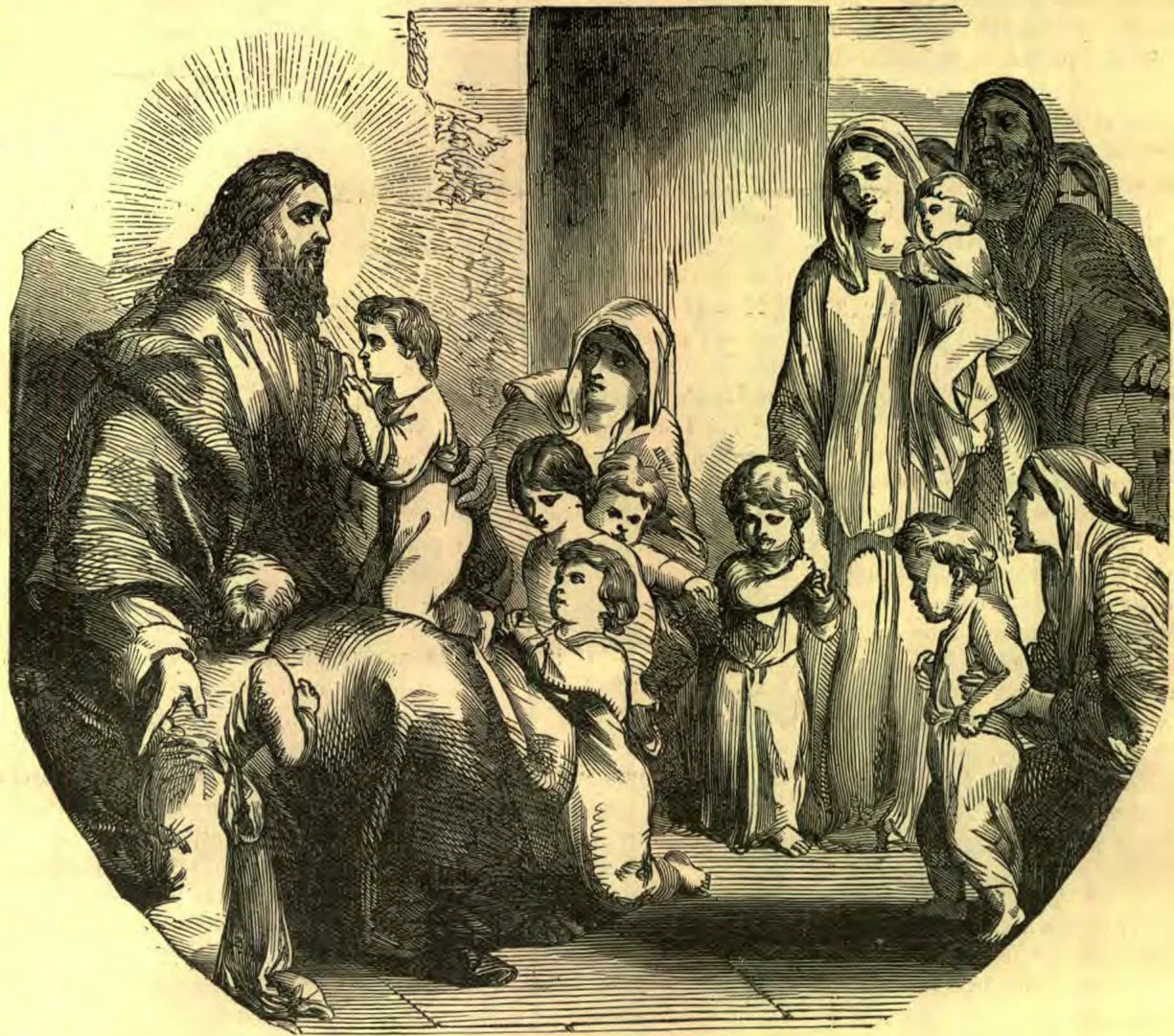
I have seen a lovely picture, 'Twas as sweet as sweet could be; 'Twas a group of little children Gathered close around the knee Of a kingly, yet a gentle And a loving-looking man; They were pressing all about him, Just as little children can.
They were leaning on his shoulder, They were clasped within his arms, As if they knew his tender love Would shelter them from harm. They were sitting on his knees, and Some were kneeling at his feet, And some were holding fast his robe With their baby-fingers sweet.
And they all were gazing toward him, And listening to his word, As if they loved him for his love, And owned him for their Lord; While his kind lips seemed to whisper That for every single one Of those precious, happy children His own life he would lay down.
For the man was Christ our Saviour; Little children loved him well, When he came to earth from Heaven In their home for years to dwell. He had breathed a blessing on them, Bright as any gift could be, When he said, “Let not the children Ever be held back from me.”
From his home above in Heaven Still the sweet old words ring down, Telling all the little children They may claim him for their own. With his blessing will he welcome Every dear uplifted face, Saying, “Suffer little children To come unto me for grace.”
—JULIA A. MATHEWS, in Child’s Paper.

"I LIKE TO HELP PEOPLE."

A lady was walking along a street one windy day, when the rain began to come down. She had an umbrella, but her hands were full of parcels, and it was difficult for her to raise it in that wind.
“Let me, ma’am; let me, please,” said a bright-faced boy, taking the umbrella in his hands. The astonished woman looked on with satisfaction, while he managed to raise the rather obstinate umbrella. Then taking one of those ever-handy strings which boys carry, he tied all the parcels snugly into one bundle, and politely handed it back to her.
“Thank you so much,” she said. “You are very polite to do so much for a stranger.”
“Oh, it is no trouble, ma’am,” he said, with a smile. “I like to help people.”
Both went their ways with a happy feeling in the heart; for such little deeds of kindness are like fragrant roses blossoming along the path of life.
We all have our chances day by day, and shall one day be asked how we have improved them. Almost any one likes to be helped in any difficulty. Are we all as fond of helping others over the hard places? If we take the Golden Rule for our guide, we shall not only make a great many people glad they have ever known us, but we shall ourselves be glad in heart.—Child’s World.

“FOR THINE IS THE POWER.”

“CAN’T do it,—it’s impossible. I’ve tried five times, and I can’t get it right,” and Ben pushed his book and slate away in despair.
Mrs. Hartley gave a little sigh at her boy’s perplexity, but only said quietly, “Then you don’t believe in the Lord’s prayer?”
“The Lord’s prayer, mother! Why, there’s nothing there to help me with this example.”
“Oh, yes; there is help for every trouble in life in the Lord’s prayer, if we only know how to get at it. I am afraid you don’t yet know that prayer.”
Ben flushed. If it had been anybody else that had said that, he would have been really vexed, but mother was different. Ben always tried to be sure he quite understood her, for he never for one instant forgot why her hands were never idle.
“Now mother, you don’t mean that. I have said that prayer ever since I was a baby! I couldn’t go to bed or leave my room in the morning without saying it. I know I sometimes don’t think enough of what I am saying; but you know, mother, I do try to mean it—I—I—.” But Ben stopped, his voice half choked.
The mother saw that her boy had misunderstood her, and answered quickly, “I never doubt, Ben, my boy, that you are trying and praying; but I was trying a long time before I knew what the last part of the Lord’s prayer really meant. I’m no minister or scholar, but I’ll try to tell it to you. You know we ask God for bread, to be kept from evil, and to be forgiven; and then we say, ‘For thine is the kingdom, the power, and the glory.’ It is God’s power we rely on,—not our own; and it often helps me, Ben, when I have a difficult new pattern to fit. I say, ‘For thine is the power,—this is my duty; Heavenly Father, give me thy power,’ and he does, Ben, he does.
Ben sat silent. It seemed almost too familiar a prayer. And yet, that time when he had to stay from school because he had no clothes, he had asked God; and the minister’s wife had brought him a suit the very next day. “But a boy’s sums, mother!” he said.
“I think that the sum is just as much to you as many a grand sounding thing to some one else. You say if only you get that right, you will be perfect for the month. Now, I care a great deal about that, but I’m sure your Heavenly Father loves you more than I do. I would help you so gladly, Ben, if I could; but he can help you—his is the power; ask him.”
There was another silence, and then Mrs. Hartley said, “Now, Ben, I want you to run to the store for some sewing-silk for me; the air will do you good. I believe, my son, that, if you ask, you can do that sum when you come home.”
Ben started at once; his mother’s slightest wish was law to him. He ran along, enjoying the cool fresh air and the rest from study. The sewing-silk was bought, and Ben started home, when he caught sight of Phil Earlie across the street. Ben gave the whistle that boys so delight in, and Phil looked back, and joined him.
“Done your lessons?”
“All but my sums.”
“Did you try the fifteenth example?”
“Yes.”
“Get it right?”
“No, not yet; but I will.”
Phil gave a provoking little laugh. “You will? I guess not; I’ve done it, but I never could have found it out alone; I had help.”
Ben’s heart fairly ached with envy for a moment. It was always so; Phil had his Uncle George, and other boys had big brothers or fathers to help them; only he was left quite alone. But just then he remembered his mother’s words, “It’s God’s power we rely on,—not our own.” “I’ll get help, too,” he said to himself. The boys chatted on, played leap-frog, and raced each other; but even as he raced and romped, Ben felt changed. He had begun to believe in his Heavenly Father as never before, and was wonderfully happy.
After giving the silk to his mother, he picked up his slate and book, and went up to his own little room. Kneeling by the bed, he repeated the Lord’s prayer, stopping at “Thine is the kingdom,” and saying with all his heart, “And thine is the power, Heavenly Father. I want power to understand this. There’s no one to help me; please give me power.”
Ben waited a moment and then he took his slate and tried again. Do you ask me, “Did he succeed?” “If any of you lack wisdom, let him ask of God, that giveth to all men liberally and upbraideth not; and it shall be given him.” Ben had asked, and God had answered. After a little earnest thought, he saw what rule he had neglected, and worked the example correctly. The next day he was “head,” for he was the only boy who had “done his sums without being helped.”
“Yet I was helped, mother,” he said; “and I shall never forget the last part of the Lord’s prayer after this.”—Hope Ledgard, in S. S. Times.

A VOICE FROM THE SUDS.

In and out of the foaming suds, Rubbing and scrubbing and wringing, Forth from the chaos of steam and soap Order and cleanliness bringing; So may life's trial and discipline be Pureness and cleansing to thee and to me.
Out on the line in the brisk, sweet air, Flapping their fresh white pinions, Dried by the breath of the whispering wind As he roves through his vast dominions; So may the damps of our fret and care Be lost in the pure, soft wind of prayer.
Spread on the board, while the irons pass Over each fold in their noiseless gliding, Smoothed are the crumples with fervent heat, Never a roughness in corner hiding; So may the love of the Christian's heart Bid every blemish and crease depart. —M. E. R., in Child's Companion.

LET GIRLS BE GIRLS.

ONE of the crying evils of the times is the tendency and disposition of girls to get through girlhood hurriedly and get into womanhood, or rather young-lady-hood, without waiting to enjoy the beautiful season of girlhood. Speaking on this point, Bishop Morris says: “Wait patiently, my dear children, through the whole period of your girlhood. Go not after womanhood; let it come to you. Keep out of public view. Cultivate retirement and modesty. The cares and responsibilities of life will come soon enough. When they come, you will meet them, I trust, as true women should. But oh! be not so unwise as to throw away your girlhood. Rob not yourself of this beautiful season, which, wisely spent, will brighten all your future life.”—Selected.

THE WARNING.

WINTER, that old enchanter, quakes, Hearing the robin’s magic word; With fear the wrinkled wizard shakes, For Heaven has sent the warning bird.
The shrouds of snow melt into flowers, Through the dead leaves the primrose comes; Between the April showers The swallows dart, the wild bee hums.
Then from the old king’s loosened grasp Expands a little ruffling wind; And there flits out that gentle bird,— The rainbow-colored bird,—the Spring. —Ladies’ Repository.

A GLEAM ACROSS THE WAVE.

REV. SPENCER COMPTON, the earnest evangelical minister at Boulogne, France, relates the following incident: “During a voyage to India, I sat one dark evening in my cabin, feeling thoroughly sick, as the sea was rising fast, and I was but a poor sailor. Suddenly the cry of ‘Man overboard!’ made me spring to my feet. I heard a trampling overhead, but resolved not to go on deck, lest I should interfere with the crew in their efforts to save the poor man. ‘What can I do?’ I asked myself, and instantly unhooking my lamp, I held it near the top of my cabin and close to my bull’s-eye window, that its light might shine on the sea, and as near the ship as possible. In half a minute’s time I heard the joyful cry, ‘It’s all right, he’s safe,’ upon which I put my lamp in its place.
“The next day, however, I was told that my little lamp was the sole means of saving the man’s life; it was only by the timely light which shone upon him that the knotted rope could be thrown so as to reach him.”
Christian worker, never despond, or think there is nothing for you to do even in the dark and weary days. Looking unto Jesus, lift up your light; let it shine that men may see; and in the resurrection morning, what joy to hear the “Well done!” and to know that you have unawares saved some soul from death!—Christian Herald.

NEW-TESTAMENT HISTORY.

LESSON 25.—THE TWELVE APOSTLES CALLED.

In our last lesson we have seen that the scribes and Pharisees were so angry with Jesus for healing a man on the Sabbath day that they laid plans for taking his life.
“But Jesus withdrew himself with his disciples to the sea; and a great multitude from Galilee followed him, and from Judea, and from Jerusalem, and from Idumea, and from beyond Jordan; and they about Tyre and Sidon, a great multitude, when they had heard what great things he did, came unto him. And he spake to his disciples, that a small ship should wait on him because of the multitude, lest they should throng him. For he had healed many; insomuch that they pressed upon him for to touch him, as many as had plagues. And unclean spirits, when they saw him, fell down before him, and cried, saying, Thou art the Son of God! And he straitly charged them that they should not make him known:” that it might be fulfilled which was spoken by Esaias the prophet, saying, Behold my servant, whom I have chosen; my beloved, in whom my soul is well pleased: I will put my spirit upon him, and he shall show judgment to the Gentiles. He shall not strive, nor cry; neither shall any man hear his voice in the streets. A bruised reed shall he not break, and smoking flax shall he not quench, till he send forth judgment unto victory. And in his name shall the Gentiles trust.”
“And it came to pass in those days that he went out into a mountain to pray, and continued all night in prayer to God. And when it was day, he called unto him his disciples; and of them he chose twelve, whom also he named apostles.” St. Mark says that he chose them to be with him, and to go forth throughout the land, preaching in his name, and casting out devils.
“Now the names of the twelve apostles are these; the first, Simon, who is called Peter, and Andrew his brother; James the son of Zebedee, and John his brother, Philip, and Bartholomew; Thomas, and Matthew the publican; James the son of Alphaeus, and Lebbaeus, whose surname was Thaddaeus; Simon the Canaanite, and Judas Iscariot, who also betrayed him.”
“And seeing the multitudes, he went up into a mountain; and when he was set, his disciples came unto him; and he opened his mouth and taught them, saying, Blessed are the poor in spirit; for theirs is the kingdom of Heaven. Blessed are they that mourn; for they shall be comforted. Blessed are the meek; for they shall inherit the earth. Blessed are they which do hunger and thirst after righteousness; for they shall be filled. Blessed are the merciful; for they shall obtain mercy. Blessed are the pure in heart; for they shall see God. Blessed are the peacemakers; for they shall be called the children of God. Blessed are they which are persecuted for righteousness’ sake; for theirs is the kingdom of Heaven. Blessed are ye, when men shall revile you, and persecute you, and shall say all manner of evil against you falsely, for my sake. Rejoice, and be exceeding glad, for great is your reward in Heaven; for so persecuted they the prophets which were before you.” “But woe unto you that are rich! for ye have received your consolation. Woe unto you that are full! for ye shall hunger. Woe unto you that laugh now! for ye shall mourn and weep. Woe unto you when all men shall speak well of you! for so did their fathers to the false prophets.”

QUESTIONS.

1. What caused the scribes and Pharisees to counsel with the Herodians about taking Christ’s life? Mark 3: 6.
2. To what place did Jesus then go? Verse 7.
3. Who came to him when they heard what great things he did?
4. What miracles did he perform in the sight of this great multitude?
5. What caused them to press upon him?
6. How did he escape from the crowd, and yet continue to teach them?
7. What did the unclean spirits do?
8. What charge did Jesus give them?
9. What prophecy was thus fulfilled? Matt. 12: 17-21.
10. In what chapter of Isaiah is this prophecy found?
11. According to this prophecy, who were to trust in the name of Jesus?
12. What came to pass about the time of which we are speaking? Luke 6: 12.
13. What did he do after having continued all night in prayer to God?
14. What term did he apply to these disciples?
15. What does St. Mark say of the purpose for which these disciples were called?
16. What were the names of the twelve apostles? Matt. 10: 2-4.
17. To what place did he finally withdraw himself? Matt. 5: 1.
18. When his disciples came to him, what did he do?
19. Repeat verses 3-9.
20. Repeat verses 10 and 11.
21. Why did he tell them to rejoice when they were persecuted for his sake? Verse 12.
22. What woes did Jesus pronounce? Luke 6: 24-26.

TYRE AND SIDON.

TYRE and Sidon were celebrated cities of Phoenicia, situated on the eastern coast of the Mediterranean Sea, between Beirut and Carmel. Tyre was about one hundred miles directly north of Jerusalem.
Sidon, or Zidon, some twenty miles north of Tyre and thirty-five or forty south of Beirut, seems to have been the most ancient of the two cities; indeed, it is believed to have been one of the most ancient cities of the world. In the time of Homer the Zidonians were eminent for their trade and commerce, their wealth and prosperity, their skill in navigation and architecture, and for their manufactures, especially of glass. They had also a commodious harbor.
Tyre, though termed the “daughter of Sidon,” and probably at one time a colony of it, soon gained the ascendency over the mother-town and all the towns of Phoenicia. It became a proud and magnificent city, and was known as “the mistress of the seas.” The city consisted of two parts, one town situated on the mainland and the other upon a rocky island lying about half a mile from the shore. Some three centuries before Christ, the city was besieged by Alexander the Great. The people withdrew to the island city, where for seven months they defied him. Not being able to reach its walls with his engines, he at last collected the whole remains of the old city on the shore—stones, timbers, rubbish—and threw them, with great quantities of earth, into the narrow channel, thus forming a causeway across from the mainland to the island; and in this way he succeeded in taking the city. Ever since then, Tyre has stood upon a peninsula, with no appearance, to ordinary observation, of ever having been surrounded by waters; and the sands of ages drifting in, have transformed the original narrow causeway into a belt of land about half a mile broad.
During the reigns of David and Solomon, we find Tyre under king Hiram. He seems to have been on the most friendly terms with both these monarchs. From Tyre were obtained both timber and skilled workmen for the temple and other magnificent buildings erected at Jerusalem. The timber was sent by floats down to Joppa, and from thence conveyed by land to Jerusalem. Later, we learn of the marriage of Ahab, king of Israel, with Jezebel, daughter of the “king of the Zidonians.” The consequences of this marriage were very fatal, as Jezebel brought with her the idolatrous worship of her father, and thus led Israel astray. Whatever friendship still existed between the Tyrians and the Israelites was most likely ended by the revolution of the kingdom and the destruction of Jezebel in Samaria, by Jehu.
The inhabitants of these cities, especially Tyre, are represented in the Old Testament as filled with pride and luxury, and all the sins attendant on prosperity and great wealth; judgments are denounced against them in consequence of their idolatry and wickedness; and the destruction of their cities is foretold: “The Lord hath given a commandment against the merchant city to destroy the strongholds thereof” (Isa. 23:11); “They shall destroy the walls of Tyrus, and break down her towers; I will also scrape her dust from her, and make her like the top of a rock;” “Thou shalt be a place to spread nets upon, and shalt be built no more.” (Eze. 26.) The decline and ruin of these cities have been so complete as to satisfy in a literal way these terrible predictions of the Hebrew prophets.
The ruins of both cities are still inhabited, and are visited by travelers with great interest. The modern Tyre is situated upon the junction of the isthmus with the island. Its walls, with one gate, inclose some three or four thousand inhabitants. The modern name is Sûr. Most of the houses are mere hovels; the streets are narrow, crooked, and filthy; and even the walls and buildings of a superior class are so shattered by earthquakes that they look as if about to fall to pieces. “A walk around the ruins of Tyre is indescribably mournful. One is reminded at every step and by every glance, of the prophecies uttered against this city.” “A mournful and solitary silence now prevails along the shore which once resounded with the world’s debate.” “Ruins on the top of ruins cover the peninsula, and are strewn among the waves around it.” “We are struck with the aspect of desolation,—broken columns half buried in the sand, huge fragments of sea-beaten ruins, and confused heaps of rubbish, with a solitary fisherman spreading his net over them, or a few workmen digging up building-stones.” Many fine stones have been removed to other cities.
The modern city lies only upon the eastern part of the island. The western shore is a ledge of ragged rocks, strewn “from one end to the other along the edge of the water and in the water, with large columns of red and gray granite of various sizes, the only remaining monuments of the splendor of ancient Tyre.” Truly they have laid her “stones and timbers and dust in the midst of the waters.” Three or four small one-sail vessels drifting in the harbor is all the shipping of which the once proud mistress of the seas can now boast. And this is Tyre, whose glories were once the talk of the world, whose merchants were princes, and whose ships covered every sea. “How art thou destroyed, that wast inhabited of sea-faring men, the renowned city, which was strong in the sea.”
Sidon, now known as Saida, is not so desolate as Tyre. It is surrounded by a wall, and has some eight or nine thousand inhabitants, partly Moslems and partly Jews. The streets, like those of Tyre, are narrow, crooked, and dirty; but the houses are some of them large and even elegant. The town is without trade or manufactures worthy of the name, and compared with what it once was, is a poor, miserable place; yet surrounded as it is by fragrant gardens and orchards, it presents a beautiful appearance. “Oranges, lemons, citrons, bananas, and palms, grow luxuriantly, and give the environs of the old city a look of eternal spring.”
This city once divided the empire of the seas with her daughter Tyre, but her harbor is now choked with sand and inaccessible to any but the smallest vessels. The architectural ruins about Saida are not extensive, but this is the only place in Phoenicia where Phoenician monuments with Phoenician inscriptions have as yet been found. For centuries the ruins of ancient Sidon have furnished building materials for other cities. Saida has few antiquities. As Dr. Thomson so forcibly remarks, “She is too old. Her decline commenced before antiquity began.”
“Though silent and forgotten, yet nature still laments The pomp and power departed, the lost magnificence: The hills were proud to see thee, and they are sadder now; The sea was proud to bear thee, and wears a troubled brow, And evermore the surges chant forth their vain desire: “Where are the ships of Tarshish, the mighty ships of Tyre?” E. B.

SCENES IN THE LIFE OF CHRIST.

LESSON 12.—REVIEW OF LESSONS 9-11.

  1. WHERE was Jesus born?
  2. Where did he live most of the time until he was thirty years old?
  3. Give a brief description of his early home.
  4. Where did Joseph and Mary go with him when he was very young? Why?
  5. When did they return, and go to Nazareth to dwell?
  6. Who were the parents of John the Baptist?
  7. Where was their home?
  8. Describe that country.
  9. Tell how Gabriel talked with Zachariah in the temple.
  10. How did Gabriel describe John's character?
  11. What great work did the angel say John would do?
  12. When John had grown to be a man, where did he preach?
  13. Describe that desolate region.
  14. What were John's habits of life?
  15. How well was his preaching attended?
  16. Where did he baptize those that believed in his preaching?
  17. Describe this river.
  18. Where does it empty?
  19. Describe the Dead Sea.
  20. What good instruction did John give the people?
  21. What was his chief theme?
  22. What did John say when Christ came to him to be baptized?
  23. How did Jesus reply to him?
  24. As Jesus came up out of the water, what sign was given to show that he was the Christ?
  25. What words were spoken by a voice from heaven?
  26. Where was Jesus led by the Spirit soon after his baptism?
  27. For what purpose was he led into that wild region?
  28. Why was it necessary for him to be tempted?
  29. How long did he go without food?
  30. How did Satan tempt him with regard to appetite?
  31. How did he tempt him with regard to worldly possessions?
  32. How did he tempt him to be rash?
  33. In what way did Jesus answer Satan?
  34. What lesson may we learn from this?
  35. Why would not Jesus perform a miracle to relieve his own suffering?

MOUNT OF THE BEATITUDES.
Matthew, in speaking of the Sermon on the Mount, says: “And seeing the multitudes, he went up into a mountain, and when he was set, his disciples came unto him,” etc. Luke in describing the same scene says: “And he came down with them and stood in the plain, and he lifted up his eyes on his disciples,” etc. Now, to some, here may appear to be a contradiction; but we think that by a little study of the country, it may all be satisfactorily explained.
On the west of the sea of Galilee, running down toward the sea between Tiberias and Magdala, is a wild and rugged glen, with perpendicular walls, abounding in calcareous caverns. The valley bears the name of Wady-el-Hamâm, that is, Pigeon-glen, from the immense flocks of pigeons that nestle among its cliffs. This glen is a wild and desolate place, and has from time immemorial formed a hiding-place for robbers and refugees. Following along this valley, which forms the dry bed of a winter torrent, the road leads across an irregular plateau to the base of a mountain, which is called by the Arabs Kurân Hattin, ‘the Horns of Hattin,’ because of its fancied resemblance to the horns of a camel’s saddle. The following, from Dr. Fish, in “Bible Lands Illustrated,” explains the view taken by him and several other travelers:—
“Emerging upon a fertile table-land, we have before us the spot where Christ is supposed to have delivered his memorable Sermon on the Mount. The two-horned elevation is called the Mount of Beatitudes, or Kurân Hattin. Kurân means ‘horns,’ and by a close look at the view of Hattin here given [reference is made to an accompanying engraving], the two horns, or mounds, will be seen, resembling, as the Arabs fancy, the shape of a camel’s saddle, with its two knobs, or horns. The hill (it is scarcely a mountain) is some two and a half miles in a straight line from the lake, and rises 1178 feet above the level of the sea, and about 60 feet above the surrounding plain. It is a third of a mile in length.
“We rode up and down its sides, and surveyed its configuration. There are two considerable elevations on the mount (the horns), and it seems likely that the Saviour, from his prayer-place on one of these, stepped down into the open space (the ‘plain’ of Luke 6:17)—a natural amphitheater between the mounds, capable of seating the hundreds that may have been present—and there delivered the wonderful sermon, and made his final and special call and choice of his apostles. As to this being the true site of the scene referred to, the tradition is not clear beyond the time of the Crusaders [which virtually closed with the famous battle of Hattin, or Tiberias, A. D. 1187]. But none of the other mountains in the neighborhood could answer equally well to the descriptions, inasmuch as they are merged into the uniform barrier of hills around the lake; whereas this stands separate. It is ‘the mountain’ which alone (uninhabited) could lay claim to a distinct name; with the exception of the one height of Tabor, which is too distant to answer the requirements.”
Although the view given above may not be correct in every particular, it seems fully to harmonize the passages referred to,

MINNIE AND THE BANANA.

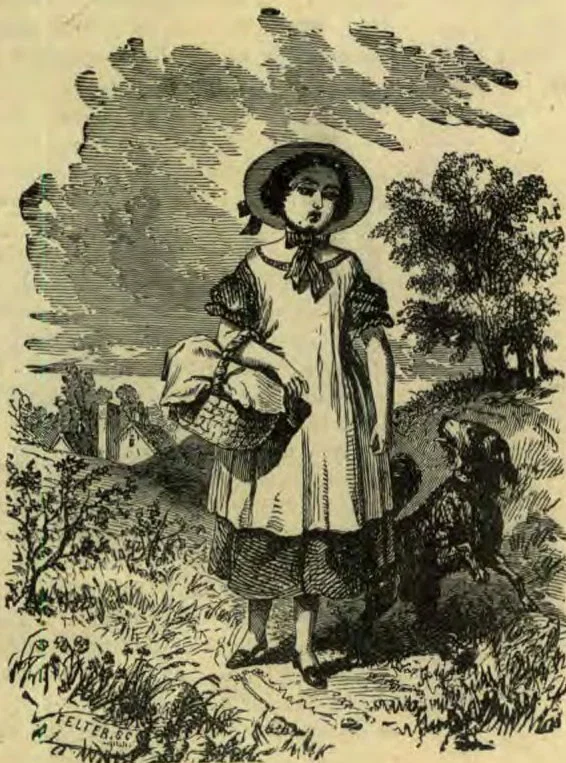
When Minnie was about eight years old, she went “down town” with a basket on an errand for her mother. She did the errand, and was just going past Mr. Harmon’s store, on her way home, and she saw him getting in a new lot of bananas. And you may be sure this attracted Minnie’s notice at once; for if there is anything that looks tempting to Minnie, it is a banana.
As Mr. Harmon was carrying in a great basketful, what should one of the bananas do but drop off on the sidewalk right before Minnie’s longing eyes! Oh what a temptation for Minnie! She picked it up. She wanted it so much! and there it was, right in her hand; and I do not believe she stopped to think whether it really belonged to her or not. She half made herself think that it was hers; for instead of giving it to Mr. Harmon, as maybe you would have done, she put it in her basket and walked on toward home.
But did Minnie feel right about it? Not at all. She felt dreadfully uneasy, and just as if she ought at least to have offered the banana to Mr. Harmon.
Was not her basket ever so much heavier than it was before she put the banana in? Yes; I think that banana weighed more to Minnie than all the other contents of her basket; and I should not wonder if she wished a dozen times before she reached home, that she never had put it in there, for her heart was growing very heavy as well as her basket. It is safe to say that Minnie was not happy at all, but very miserable, and all because of the banana. She did not take it out of the basket, for I think she wanted her mother to see it, and in some way help her out of this uncomfortable affair.
When Minnie’s mother opened the basket, she said, “Where did this banana come from?”
“Why, mamma,” said Minnie, speaking in the way she always does when excited, and catching her breath at every few words, “Mr. Harmon was carrying in lots of new bananas just as I was coming by his store, and this one fell off on the sidewalk, and I picked it up. Now, mamma, you know, if there’s anything in the world that I like, it’s bananas. But do you think it’s stealing for me to keep it, mamma? because, if it is, I wouldn’t keep it any way, for I’d rather die than steal. Do you think I ought to carry it back, mamma?”
“You must do just as you think best about it, Minnie,” said her mother.
“Eat it, Min; I would,” said Minnie’s auntie, who was in the room.
Eat it! Minnie would about as soon have thought of eating the most disagreeable thing she ever tasted as that banana, just then. I hardly think she could have swallowed it without choking. But she could not just make up her mind what to do. She tried to get her mother to say what she ought to do, but her mother would not give her any advice, only to do just what she thought was right about it.
At last, after a good deal of thinking and talking, Minnie concluded she would go and carry the banana to Mr. Harmon. So she started off down street, her heart growing lighter every minute. She went into the store and gave the banana to Mr. Harmon, and told him it was one that had dropped from his basket, and that she had found it on the sidewalk.
Mr. Harmon told her she might have it; and then, no doubt, Minnie was happy. The banana was all her own, and she could eat it now without choking. She went skipping home with a light heart; and how much better she felt about it, and has ever since, than if she had tried to eat it when she felt that it did not belong to her!
Do not you think, little folks, that she did just the right thing—that is, the best thing she could do—after she had taken the banana and brought it home? If Minnie had kept the banana, it would have been easier to do the same thing another time, for the first wrong act is always harder to do than the second.—Well-Spring.

Ruskin on Happy Childhood and Heavenly Bread

Ruskin has just written: “Make your children happy in their youth; let distinction come to them, if it will, after well-spent and well-remembered years; but let them now break and eat the bread of heaven with gladness and singleness of heart, and send portions to them for whom nothing is prepared; and so Heaven send you its grace, before meat, and after it.”
Continue reading: Take Your Bibles to Christ for Light