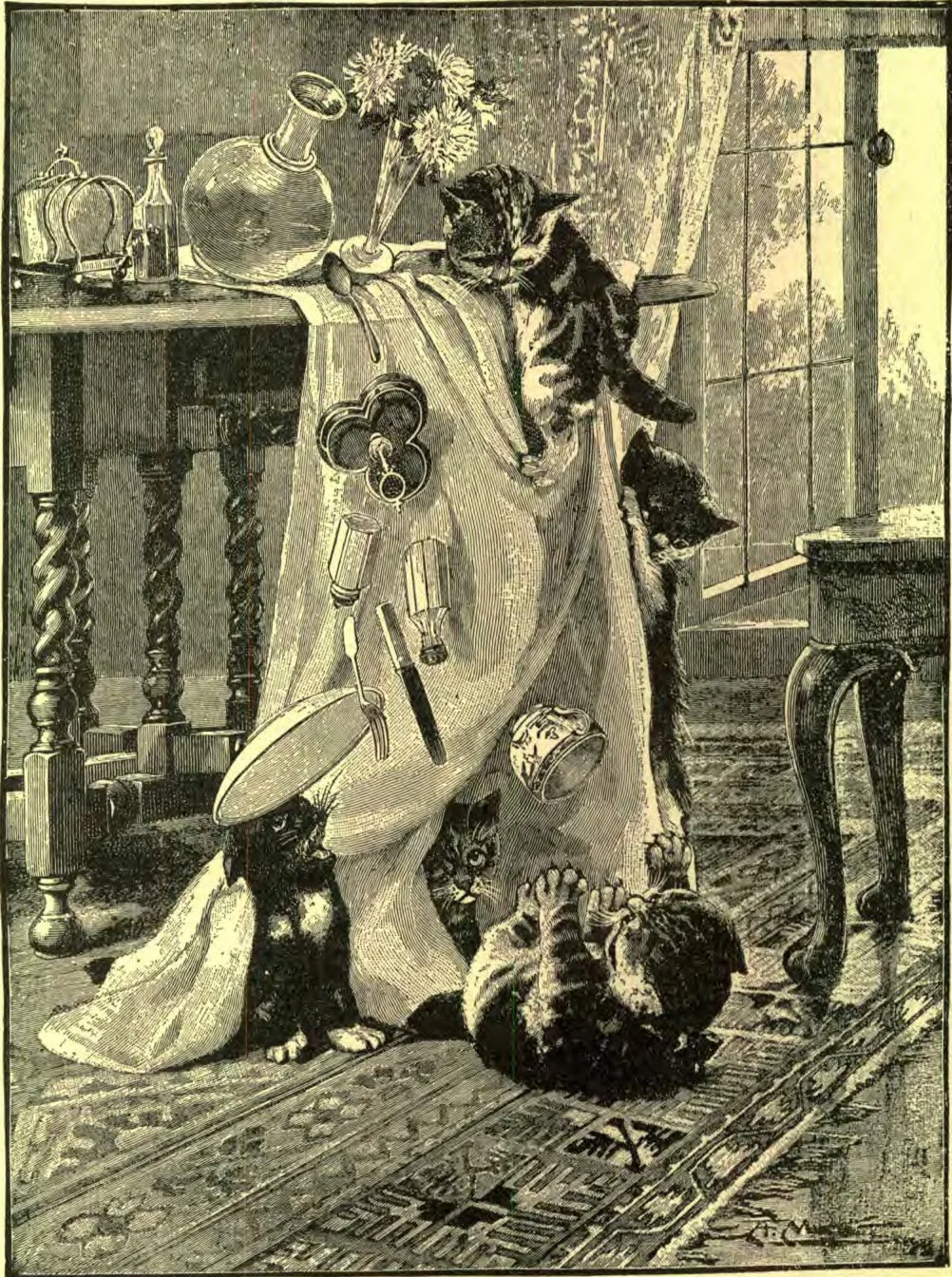
If I a little girl could be,
Well, just like you,
With lips as rosy, cheeks as fair,
Such eyes of blue, and shining hair,
What do you think I’d do?
I’d wear so bright and sweet a smile,
I’d be so loving all the while,
I’d be so helpful with my hand,
So quick and gentle to command,
You soon would see
That every one would turn
to say:
“’T is good to meet that child
to-day.”
Yes, yes, my bird, that’s
what I’d do,
If I were you.
Or if I chanced to be a boy,
Like some I know;
With crisp curls sparkling
in the sun,
And eyes all beaming bright
with fun,—
Ah, if I could be so!—
I’d strive and strive, with
all my might,
To be so true, so brave,
polite,
That in me each one might
behold
A hero, as in days of old.
’T would be a joy
To hear one, looking at me,
say:
“My cheer and comfort all
the day.”
Yes, if I were a boy, I know
I would be so.
— Independent.
A LESSON IN FAITH.
By Mrs. O. Peterson
WHEN we passed through Kangra, in northern Punjab, a little Marathi girl came down from the Cashmere hills with her father, and presented Mrs. Kempton, the missionary’s wife, with a shawl of exquisite workmanship. It was a gift of gratitude, so courteously bestowed that it was impossible to refuse it. Upon questioning her father, Ramon May, we learned that it had been four years in the making.
The year before, when the Kemptons were traveling near Sealkot, they stopped overnight in the hut of Ramon May, whom they found in great distress on account of a debt that he had incurred to the chief of the province, and for which he was about to be imprisoned. In vain he had pleaded inability to meet his obligations; the chief’s officers were inexorable until Mrs. Kempton paid the two hundred rupees, when they gave Ramon a seal of security, and left him in peace. Ramon was deeply touched by the missionary’s generosity, and promised to repay the money, which he did in the course of the year by the sale of Cashmere wool.
A CATASTROPHE.
We admired the gift so much that Ramon invited us to visit his hut to see the shawl-making in progress; so one morning we rode over the Cashmere border to the quaint little house in the shadow of the deodars, where the workers sat stitching away at their precious webs.
There were four women at work,—Ramon’s wife and two grown daughters and a neighbor woman,—all dressed in short, bright-colored garments, with little red-and-gilt jackets exactly like our zouaves in shape, but more gayly embroidered. They had gentle, dark faces; large black eyes shadowed by long lashes; and black, silky hair, with little crude gold and silver coins interwoven in the thick, glossy braids.
Ramon’s wife was a very skilful worker. She held a bit of tracery before her, and directed the design, which was worked wrong side up in tiny, rainbow-colored squares. A different needle was used for each thread, and sometimes the pattern was so intricate as to require only a few finger-lengths of one colored thread. The result of the hour’s work was barely perceptible to our inexperienced eyes, but Ramon’s wife pointed out a few delicate threads of sulphur color picked into the warm browns, that gave the look of flecks of sunshine glinting through the web of shadow. It would take five years of diligent labor for one person to finish the piece then in hand, so delicate was the needlework, yet it was not among the most difficult patterns.
What a lesson in patience and faith! The workers never clamored to see the design, but worked on cheerfully, steadily, and hopefully, knowing that all would be right if they followed the master’s directions; and that, little by little, the pattern would grow into a thing of perfect beauty.
Shall we not perform our allotted tasks cheerfully, and trust our Heavenly Father with the great issues of life? If the web of life looks intricate and hopeless to us, we need not despair; he is able to bring all patient effort to perfect fulness. MRS. O. PETERSON.
OUR LETTER FROM MEXICO.
By Tia Anita
GUADALAJARA, JALISCO, MEXICO, May 16, 1899.
Dear Children: In my last letter I spoke of next describing my visit to a beautiful cañon, but I believe I will save that description for another letter, and tell you to-day about the funeral of the archbishop of this state, who died last November. He was greatly beloved by his people, and at his death business in this city was almost entirely suspended. His body lay in state for three days. The funeral took place from the cathedral at four o’clock in the afternoon. I was fortunate enough to have friends along the line of march, who invited me to look at the scene from their balcony; so I had an excellent view. First came a company of women dressed in black, marching by twos. The first two carried a large wreath of white flowers. These were followed by all the girls’ parochial schools of the city. Then came all the different societies, followed by the governor and his staff, and the government envoys from all the nations represented here. The United States consul was among the number. After these followed all the boys’ schools of the city (Catholic). Then came the society for poor men and women, all wearing the sign of the society, next the divinity students, and then the priests. There were three hundred priests; and in their midst, on the shoulders of eight men from the better classes, was borne the coffin.
From the coffin extended six gold cords, held by the priests. The bishops from this state and others walked near the coffin. The carriage of the deceased followed. It was drawn by four black horses, covered with black velvet and gold. The carriage was entirely covered with black, trimmed with gold fringe. On the four corners of the coach were wreaths of white flowers. There was no driver, but the four horses were guided by four grooms, all in black. This was followed by the hearse, draped in black and violet satin,—the colors of the prelate. The hearse was driven by a black coachman from Mexico City. Over one hundred carriages followed in line, most of them empty. It was the most imposing funeral procession I ever saw.
The archbishop was laid away in a private vault in Belen, and at the end of five years is to be interred in the crypt beneath the main altar in the cathedral. His fortune is to be distributed among the poor.
As I witnessed this scene, I could not help thinking of the time, so soon to come, when all who sleep in Jesus will awake, and, with those who serve him on the earth, will enter into eternal life with him.
Tia Anita.
A PROBLEM IN PUNCTUATION.
A FUNNY old man told this to me
('T is a puzzle in punctuation, you see):
I fell in a snow-drift in June said he
I went to a ball-game out in the sea
I saw a jelly-fish float on a tree
I found some gum in a cup of tea
I stirred the milk with a big brass key
I opened my door on my bended knee
I ask your pardon for this, said he;
But 't is true when told as it ought to be.
— Selected.
The True Nobility of Self-Improvement
“THERE is nothing noble in being superior to some other man. The true nobility is in being superior to your previous self.”
FEEDING THE FOUR THOUSAND: HEALING THE BLIND, DEAF, AND DUMB
THE SABBATH-SCHOOL LESSON.—NO. 3.
(July 15, 1899.)
FEEDING THE FOUR THOUSAND: HEALING THE BLIND, DEAF, AND DUMB.
Places: Decapolis, Dalmanutha, Sea of Galilee, Bethsaida. Persons: Jesus, man with an impediment in his speech, Pharisees and Sadducees, blind man, apostles.
QUESTIONS.
1. What was the field of Christ’s labors after leaving Syrophenicia? Mark 7:31. Who resorted to him there? Matt. 15:30. What was the effect of the work done? V. 31. For what case was special assistance asked? Mark 7:32. What course did Jesus pursue in healing him? Vs. 33, 34. What request did Jesus make at this time? V. 36. Why? Note 1.
2. After healing the sick, what next received the Saviour’s attention? Mark 8:1–3. What parallels exist between the facts and the circumstances of this miracle and those of the feeding of the five thousand? Compare verses 1–9 with chapter 6:34–42. With so great similarity between the two cases, why is the second one mentioned? Note 2. How many were fed? V. 9.
3. Crossing the sea, to what place did Jesus and his disciples go? V. 10; Matt. 15:39; note 3. Who came to him there, and for what purpose? Matt. 16:1. What reply did Jesus make to their request? Vs. 2–4. What were the “signs of the times”? Note 4.
4. Against what did Jesus now caution his disciples? V. 6. What idea did they get from his words? V. 7. Why did they so misunderstand? V. 8. To what did he direct their minds, in order to correct them? Vs. 9–11. What truth did they now understand? V. 12; note 5. To what place did they go after leaving the Pharisees at Dalmanutha? Mark 8:22. Who was brought to Jesus for healing? Id. Tell what was done in this case. Vs. 23–25; note 6. What request did Jesus again make at this time? V. 26.
NOTES.
1. Jesus’ object in requesting that they “tell no man,” was to avoid, as far as possible, stirring up premature opposition. He did not wish to have his work unduly cut short. See “The Desire of Ages,” pages 264, 265.
2. The five thousand were Jews, while the four thousand were Gentiles. The details, though alike, are repeated to show that the blessings of the gospel are for all alike, both Jew and Gentile. Jesus was also laboring to remove still further the prejudices of his disciples against the heathen.
3. But little is known concerning these places. From the record it is evident that they were on the western shore of Galilee. It is supposed that Magdala lay a few miles to the southwest of Capernaum, Dalmanutha being about a mile farther to the south.
4. The “signs” to which Jesus had reference were the miracles and teachings of his own life. See Matt. 12:40, 41. In their blindness, they failed to discern these “signs,” as found in the life of the One who stood in their midst. “Signs direct from heaven had been given to attest the mission of Christ. The song of the angels to the shepherds, the star that guided the wise men, the dove and the voice from heaven at his baptism, were witnesses for him. Every miracle that Christ performed was a sign of his divinity. He was doing the very work that had been foretold of the Messiah; but to the Pharisees these words of mercy were a positive offense. The Jewish leaders looked with heartless indifference on human suffering. In many cases their selfishness and oppression had caused the affliction that Christ relieved. Thus his miracles were to them a reproach.”
5. The disciples had drunk in so much of the false teaching concerning the Messiah, that their minds were gross, and slow to discern spiritual things. They were like children, who take literally everything that is said. The chief cause of their blindness was that they cherished continually the thought that Jesus would set up a temporal kingdom; and with mind dwelling upon this, Christ’s words, full of spiritual thought, often fell meaningless upon their ears. Sin cherished by us, often makes foolishness of the most blessed truths.
6. Jesus practised many methods in healing the sick, from simply sending the word, to the use of means, as in the case of the blind man. Great faith, as in the case of the centurion (Matt. 8:5–13), required but little ceremony. Jesus worked according to the degree of faith.
What impressions, or circumstances, probably led Nebuchadnezzar to set up the golden image? What idea was embodied, or represented, by it? What three Hebrews refused to worship the image? What brave answer did they give the king? What order did he issue? Who were appointed to do the work of execution? Why were the victims bound? What was the fate of the executioners? What astonishing spectacle did the king behold? To whom did he compare the Fourth? Who had saved the captives from death? With whom, then, is deliverance?
NOTES.
1. About the year 580 B.C., twenty-six years after the beginning of “The Captivity.” Nebuchadnezzar set up the golden image in the plain of Dura, southwest of the city of Babylon, and some distance from it. “Colossal statues of gold were familiar to the Babylonians. Three crowned the temple of Bel, containing gold to the worth of eighty-five million dollars.” “The objection felt to the narrative on account of the gigantic size of this image has been made much of by rationalists and skeptics;” but a writer in the London Expositor “notes the fact that recent excavations in Egypt have disinterred a stupendous colossal image of Rameses II, which weighed twelve hundred tons.”
2. Some time previously to the setting up of the golden image, Nebuchadnezzar was wondering “what should come to pass hereafter,” and God gave him the dream recorded in Daniel 2, which opened to him the history of the world from his day to the overthrow of all earthly powers, and the setting up of the everlasting kingdom of God. Each succeeding kingdom from his own was represented by baser and baser material, until the image that spanned time was, by the stone cut out without hands, smitten into dust, and became like the chaff of the summer threshing-floor.
3. The king could not accept this view of the subject; and after thinking upon it for a long time, he formulated his own idea in a great image about a hundred feet tall and ten feet broad, all of gold from head to foot; and “set it up in the plain of Dura, in the province of Babylon,” to be worshiped. This was a positive setting up of his own idea against that of God. This was to declare to all people that his golden kingdom was to endure forever, that there was to be no such thing as another kingdom arising separate from his, and inferior to his,—a kingdom of silver, and another of brass, and then one of iron, and after that even descend as low as iron mixed with miry clay. No! there should be only his golden kingdom of Babylon, and that should never be broken nor interrupted.—“The Great Empires of Prophecy,” pages 15, 16.
4. The command to worship this image was an open challenge to his Lord. It was the assertion that Nebuchadnezzar’s idea of the kingdom of men should be accepted as the true and divine idea, instead of that of God. It was the assertion that the embodiment of this idea should be worshiped as God. And all this was indeed the putting of Nebuchadnezzar himself in the place of God as the ruler in the kingdom of men, the head of all religion, and the director of all worship.—Id., page 16.
5. “Not careful to answer.” The servants of God do not need to deliberate as to what they shall answer in a question of duty. He who serves God knows what to answer. Jesus says: “Ye shall be brought before governors and kings for my sake. . . . But when they deliver you up, take no thought how or what ye shall speak: for it shall be given you in that same hour what ye shall speak.”
6. With idolaters, religion always has been, and still is, a part of the government; in heathen systems, religion and the government are always united: while in the true system—the divine, the Christian, system—they are always separate. . . . The Lord had brought all nations under this king’s yoke as to their bodily service; but now, by an unmistakable evidence, this same Lord showed Nebuchadnezzar that he had given him no power nor jurisdiction whatever in their souls’ service.—Id., page 18.
7. “Whenever a miracle occurs, there is always an adequate reason for it. . . . There were tens of thousands of captive Jews in Babylon. . . . When the exiles returned to Jerusalem, they were thoroughly cured of idolatry.” This miracle was also a testimony to all nations that there is a God who is able to deliver.” The divine Presence was with the sufferers, and their sorrow was turned into joy.
8. These things were written for our admonition and comfort, upon whom the ends of the world are come. The old image of man-made power in opposition to God’s command is in process of preparation, and will soon be set up for the worship of men. (See Revelation 13 and 14.) The old test will come to the servants of God, and in the day of test will be manifested those who will not worship the image in the face of suffering and death. “Be thou faithful, . . . and I will give thee a crown of life.”
9. Nebuchadnezzar was equally at fault in making a decree for the worship of the true God. Worship is acceptable only when it springs from the heart. “The Father seeketh such to worship him.” Then how vain, how blasphemous, how atrocious, are religious laws! True Christian citizenship will say to the government that would enforce religious observances, “Hands off!” “Render therefore unto Cæsar the things which are Cæsar’s; and unto God the things that are God’s.”
The Trivial Round, the Common Task
“The trivial round, the common task,
Will furnish all we ought to ask,—
Room to deny ourselves, a road
To bring us daily nearer God.”
MAKING A QUILT.
By NELLIE V. DICE
Cut nine pieces of calico or gingham into blocks three inches square (four should be light in color, and five dark), being careful to have them perfectly true. Thread your needle with No. 40 thread; take one dark square and one light one, and backstitch them together. (Backstitching, you will remember, is done by taking a stitch backward on the upper side of the cloth, and a longer stitch forward on the under side, making the stitches meet.) To the light square sew another dark square with the same stitch, making three in a row,—a dark square on each side of a light one. Sew together the three remaining squares, this time placing a dark square between two light ones. With the same stitch sew three more squares together, this time having a light one in the center and a dark one on each side. Now join the three rows. Take the row that has a dark center, and backstitch to each side of it the rows that have the light centers. Sew all three rows together in this way, and you have a quilt “block” of nine squares.
Next time we will make another, using different stitches. We will practise these different stitches on several simple things, until we can take them perfectly; then we will make something to wear. It would be pleasant for several who belong to the same Sabbath-school class, or who live in the same neighborhood, to make enough of these blocks for a quilt. When they are finished, send them to me, and I will see that they are all put together, and given to the Old People's Home or to the Haskell Home. A still better plan would be to meet together when you have enough blocks finished for a quilt, and put them together yourselves. In this way our little sewing-circle may become a real missionary circle.
NELLIE V. DICE.
TEST OF TRUE FRIENDSHIP.
TRUSTING a friend as long as there is no room for doubt or distrust, is very well so far as it goes. A decent man can hardly do any less than this. It is always easy to trust a friend as far as one sees. But the real test of fidelity in friendship is when others doubt or question, and when there is room, or occasion, for two opinions as to a friend’s conduct and appearance. True friendship evidences itself when one has to walk by faith, and not by sight. If one rests his trust on the friend because of what others think of that friend, that is one thing: there is no special friendship in that. But real friendship does not depend on outside testimony or opinions.—Sunday-School Times.
INTO THE LIGHT.
By Lena E. Howe
It was a bright Sunday morning in May, and all of Deacon Conwell’s family, except his daughter Grace, had gone to the little church in the village. She had been confined to the house with a sprained ankle for several weeks. Just before leaving, her father had brought a large easy-chair to the front porch, and here she sat, reading a little, but often stopping to listen to nature’s music around her. Her heart went out in thankfulness to her Heavenly Father for all his goodness, and for the beautiful things with which he surrounds his children. She was just wondering if Eden could have been more beautiful, when she heard the front gate click, and up the walk came the quick, light step of her dearest girl friend.
“O Grace!” she exclaimed, as soon as she reached the steps, “I was afraid you would be lonely; so I coaxed mama to let me come and stay with you while the others were at church. Isn’t this lovely! Did you ever see a more perfect morning?”
“No, May, I never did. I was just wondering, when you came, if Adam and Eve, in their Eden home, ever saw one more delightful.”
“That is one thing that made me so anxious to come this morning. We have been hearing lately that the earth will sometime be restored to more than its Eden beauty.”
“Where did you hear that? Tell me about it.”
“You remember I told you of some people who were putting up a tent in the meadow near the blacksmith shop?”
“Oh, yes! Uncle George was speaking of them last night. He says they keep Saturday for Sunday, and that they have set several different times for the Lord to come.”
“I think he is mistaken about their setting the time for the Lord to come. Last Thursday evening they held their first meeting. That morning a young lady called, gave me a printed program of the meetings, and invited us all to attend. She was very pleasant, and we thought we would go just that evening; but we were so interested that we have been every evening since. The subject the first night was Christ’s second coming.”
“Well, did they tell you when it was to be?”
“No; Elder Barnes, the minister, said that no one knows the day or the hour of his coming, but that Christ himself has given us signs, so all may know when it is near. He said they had been accused of setting the time for his coming, but that they never have done so: they have simply read to the people what the Lord says in his word. Then he read a good many texts, and told us where to find them.”
“I wish I could have heard him.”
“I knew you would be anxious to know all that he said, because you were so disappointed not to attend our Christian Endeavor meeting when we studied that subject; so I wrote all the texts down in this little book.”
“Why, thank you, May! Why not read them over together? Then you can tell me what Elder Barnes said about them.”
“All right. The first one is John 14:1-3. You read it, and I will try to remember what he said.”
Grace turned to the chapter, and read: “‘Let not your heart be troubled: ye believe in God, believe also in me. In my Father’s house are many mansions. . . . I go to prepare a place for you. And if I go and prepare a place for you, I will come again, and receive you unto myself; that where I am, there ye may be also.’”
“Jesus had just been telling his disciples that he was going away, but for their comfort he added what you have just read. The words were not only for the disciples who were present, but for all who should believe in him, even to the end of the world. He says: ‘In my Father’s house are many mansions. . . . I go to prepare a place for you. And if I go and prepare a place for you, I will come again, and receive you unto myself.’ Here we have Christ’s promise to come again. Acts 1:9-11 is the next text.”
Grace read as follows: “‘And when he had spoken these things, while they beheld, he was taken up; and a cloud received him out of their sight. And while they looked steadfastly toward heaven, as he went up, behold, two men stood by them in white apparel; which also said, Ye men of Galilee, why stand ye gazing up into heaven? this same Jesus, which is taken up from you into heaven, shall so come in like manner as ye have seen him go into heaven.’”
“Christ had been telling his disciples that they should receive the Holy Ghost, which would fit them to be witnesses for him. Just as he finished, he was taken up, and a cloud received him out of their sight.”
“Don’t you think they were surprised and sad to have their dearest Friend leave them in that way?” asked Grace.
“Yes, he thought of that, and bade two of the angels go and comfort them. After the angels had spoken the words you have just read, they went away, and the disciples returned to Jerusalem, rejoicing that Jesus was coming again.”
“How real it all seems! The same Jesus who walked by the Sea of Galilee, who healed the sick, cast out devils, and raised the dead,—our Saviour, who was wounded for our transgressions and bruised for our iniquities,—who died and rose again! I never knew that he was coming in that way. And will those who are living see him come, just as the disciples saw him go away?”
“Yes, and we may be living then. Indeed, it is quite likely that we shall be. Now read Rev. 1:7.”
“‘Behold,’ read Grace, ‘“he cometh with clouds; and every eye shall see him, and they also which pierced him: and all kindreds of the earth shall wail because of him: even so, Amen.’ Does that mean that every one who is living will see him when he comes?”
“Yes, and not only the living, but those who took a prominent part in condemning and putting him to death. I think that is in Mark 14:62. You notice that the high priest had just been asking him if he was indeed the Christ. He replied in the words of the sixty-second verse.”
Grace read: “‘And Jesus said, I am: and ye shall see the Son of man sitting on the right hand of power, and coming in the clouds of heaven.’ ‘How is it possible,’ she asked, in surprise, ‘for them to see him come, when they have all been in their graves nearly two thousand years?’”
“They would have to be raised from their graves;—but the clock is striking twelve, and we have hardly begun. I was so anxious to study the signs of his coming with you; but I promised mama to come home at noon, and help her prepare lunch.”
“Oh, I am so sorry we did not get farther along! Won’t you come over again this evening?”
“The subject at the tent to-night is to be the resurrection, and I wish very much to hear it; but perhaps I can come over a little while this afternoon.”
“That will be better. I, too, wish to know what the Bible says about the resurrection, and I am anxious to learn more about the subject we have been studying, so be sure to come this afternoon.”
“I’ll try,” said May, as she went down the walk. LENA E. HOWE.
Christians Grow Slowly Like the Oak
“Christians are not morning-glories. They do not come to perfection in an hour. Their growth is slow and constant, and they grow to beauty and strength as the oak grows, through years of wind and sunshine, refreshing rain, and buffeting storm. The Scripture plan is for believers to ‘grow in grace.’”
To Reach BATTLE CREEK
FROM
CHICAGO, BUFFALO, DETROIT, OR TOLEDO,
Purchase Tickets Reading over the MICHIGAN CENTRAL
“The Niagara Falls Route.”
A First-class Line for First-class Travel between Chicago and New York and Boston. Elegantly equipped through trains pass Battle Creek in each direction daily.
R. N. R. WHEELER, Ticket Agent, Battle Creek.
O. W. RUGGLES, Gen'l P. and T. Agt., Chicago, Ill.
Grand Trunk Railway System
Time Card in Effect February 5, 1899.
C. & G. T. DIVISION.
WEST-BOUND FROM BATTLE CREEK.
No. 11, Mail and Express, to Chicago — 12.00 M.
No. 1, Chicago Express, to Chicago — 9.00 A. M.
No. 3, Lehigh Valley Express, to Chicago — 3.40 P. M.
No. 5, Pacific Express, to Chicago, with sleeper — 12.55 A. M.
No. 75, Mixed, to South Bend — 7.30 A. M.
Nos. 11 and 75, daily, except Sunday. Nos. 1, 3, and 5, daily.
EAST-BOUND FROM BATTLE CREEK.
No. 10, Mail and Express, to Pt. Huron, East, and Detroit — 3.45 P. M.
No. 4, Lehigh Express, to Pt. Huron and East — 8.27 P. M.
No. 6, Atlantic Express, to Pt. Huron, East, and Detroit — 2.25 A. M.
No. 8, Lehigh Exp. to Saginaw, Bay City, Pt. Huron, and East — 6.50 A. M.
No. 74, Mixed, to Durand (Starts at Nichols) — 7.35 A. M.
Nos. 10 and 74, daily, except Sunday. Nos. 4, 6, and 8, daily.
E. H. HUGHES.
A. G. P. & T. Agt. Chicago, Ill.
A. S. PARKER.
Ticket Agent, Battle Creek.
TAKE THE Canadian Pacific Railway
for . . . CHATHAM, LONDON, WOODSTOCK, PORTLAND, OTTAWA, GALT, TORONTO, and MONTREAL, QUEBEC, BOSTON,
All points in New England, the Maritime Provinces, Great Britain, and the Continent.
Illustrated literature, time-tables, and full particulars, upon application to—
J. FRANCIS LEE, GEN. AGENT,
Passenger Dept. 228 SOUTH CLARK ST., CHICAGO.
Branch Offices:
76 Ottawa St., Grand Rapids, Mich.
Room D, Chamber of Commerce, Cincinnati, Ohio.
315 Chestnut St., St. Louis, Mo.
HOUR BY HOUR.
By George Klingle
One single day
Is not so much to look upon. There is some way
Of passing hours of such a limit. We can face
A single day; but place
Too many days before sad eyes,—
Too many days for smothered sighs,—
And we lose heart
Just at the start.
Years really are not long, nor lives,—
The longest which survives,—
And yet, to look across
A future we must tread, bowed by a sense of loss,
Bearing some burden weighing down so low
That we can scarcely go
One step ahead,—this is so hard,
So stern a view to face, unstarred,
Untouched by light, so masked with dread!
If we would take a step ahead,
Be brave, and keep
The feet quite steady; feel the life-breath sweep
Our face again,
We must not look across,—looking is vain,—
But downward to the next close step,
And up. Eyes which have wept
Must look a little way, not far.
God broke our years to hours and days, that, hour by hour
And day by day,
Just going on a little way,
We might be able, all along,
To keep quite strong.
Should all the weight of life
Be laid across our shoulders; and the future, rife
With woe and struggle, meet us face to face
At just one place,
We could not go;
Our feet would stop, and so
God lays a little on us every day;
And never, I believe, on all the way
Will burdens bear so deep,
Or pathways lie so steep,
But we can go, if, by God's power,
We only bear the burdens of the hour.
— George Klingle.
ENCOURAGING WORDS.
“I AM delighted with the restoration of the INSTRUCTOR to its previous form,” writes an INSTRUCTOR friend in New Orleans.
A brother in Montreal writes: “I am delighted with the INSTRUCTOR. After reading it, I give it to an interested family, who are greatly pleased with it.”
Another, in renewing her subscription, says: “I can not tell you how much I appreciate the INSTRUCTOR. It contains a means of acquiring a liberal education, if carefully studied. It grows better with each issue. May the Lord continue to bless its publication.”
One of our State Sabbath-school secretaries writes for sample copies, and says: “I am anxious to get all our young people to reading the INSTRUCTOR. I am glad to see it in its old, familiar dress: it seems like an old friend just returned, inside as well as out. God bless its work!”
A contributor in North Carolina says: “The INSTRUCTOR has always been my favorite paper. I will confess I felt a little disappointed at first to see it appear in its present form; but after looking it over carefully, I concluded that the change is best, for several reasons. I think it will please our young people.”
Harvard Professor Assigns the Bible for Reading
A PROFESSOR in Harvard has lately assigned the Bible to his classes for continuous reading, on the ground that there has been “no master of English literature during the last three centuries who has not also been a master of the English Bible.” Whether this is true or not, there is a far better reason for the daily reading of the Scriptures of truth than that given by the Harvard professor. To be a master of English literature may be a desirable thing; but to hold daily communion with the Master of the universe is one of the highest honors bestowed upon man.
Great Empires of Prophecy and Sunday-school Lessons
THE most of the International Sunday-school lessons, for the quarter beginning July 1, are from portions of Scripture covered by the new book, “The Great Empires of Prophecy;” such as “Daniel in Babylon;” “The Hebrews in the Fiery Furnace;” “The Handwriting on the Wall;” “Daniel in the Den of Lions;” “Returning from Captivity;” “Rebuilding the Temple;” “Encouraging the Builders,” etc. It is perfectly safe to say that there is no book that gives the setting of these lessons, the causes and the principles involved, and the history of that time, as completely as does “The Great Empires of Prophecy.” Our people everywhere should call the attention of Sunday-school teachers and superintendents to this. It presents one of the grandest of opportunities to spread the light and truth of the word of God. Shall this opportunity be improved? or will it be neglected and lost altogether?
AN INTERESTING LETTER.
By W. J.
A YOUNG Druse princess in an orphanage and training-home in Beirut, Syria, sends an entertaining letter in response to a request that appeared some time ago in the INSTRUCTOR. You may wonder how she came to see this paper in that far-away land, so I will tell you that for a number of years friends of that school have sent to it a club of INSTRUCTORS. At present, however, only two copies are going there. Is there not some Sabbath-school that will gladly raise this club to ten copies? Nowhere will the papers be more gladly received, or do more good. All contributions for this purpose should be sent to Miss Hattie House, Review and Herald, Battle Creek, Mich. After expressing her appreciation of the paper, she thus describes an Oriental orange-grove:—
Let me tell you what I know about an orange-grove. There is one at Jaffa, and the scent of its blossoms fills the air long before the grove is reached. Hundreds of trees belong to different owners, who mark them with white and red paint, that they may know their own; many tie on rags and a small bone from a sheep, to keep off the “evil eye.” When the oranges are yet green, and only tinted with yellow, they are carefully picked, wrapped in tissue-paper, packed in boxes, and sent to different countries. Many women and girls are employed to do this work.
We have many orange-trees in our garden, but they bear bitter oranges. A month ago they were all in blossom; the orchard was a lovely sight. From the blossoms of this tree the natives make orange-flower water, which they use freely in sherbet and in rice and milk and other dishes made with milk. They also make a sweet preserve of the blossom. The juice of this orange is used for flavoring such dishes as beans, lentils, etc. It is interesting to see flowers, green fruit, and ripe oranges on the same tree. Another time I will tell you about an olive-grove. W. J.