The Youth’s Instructor, Vol. 47, No. 27.

A Malay Village

The Youth’s Instructor

Jul 6, 1899

Review and Herald Publishing Company · Battle Creek, Mich. · Jul 6, 1899

A Malay Village.
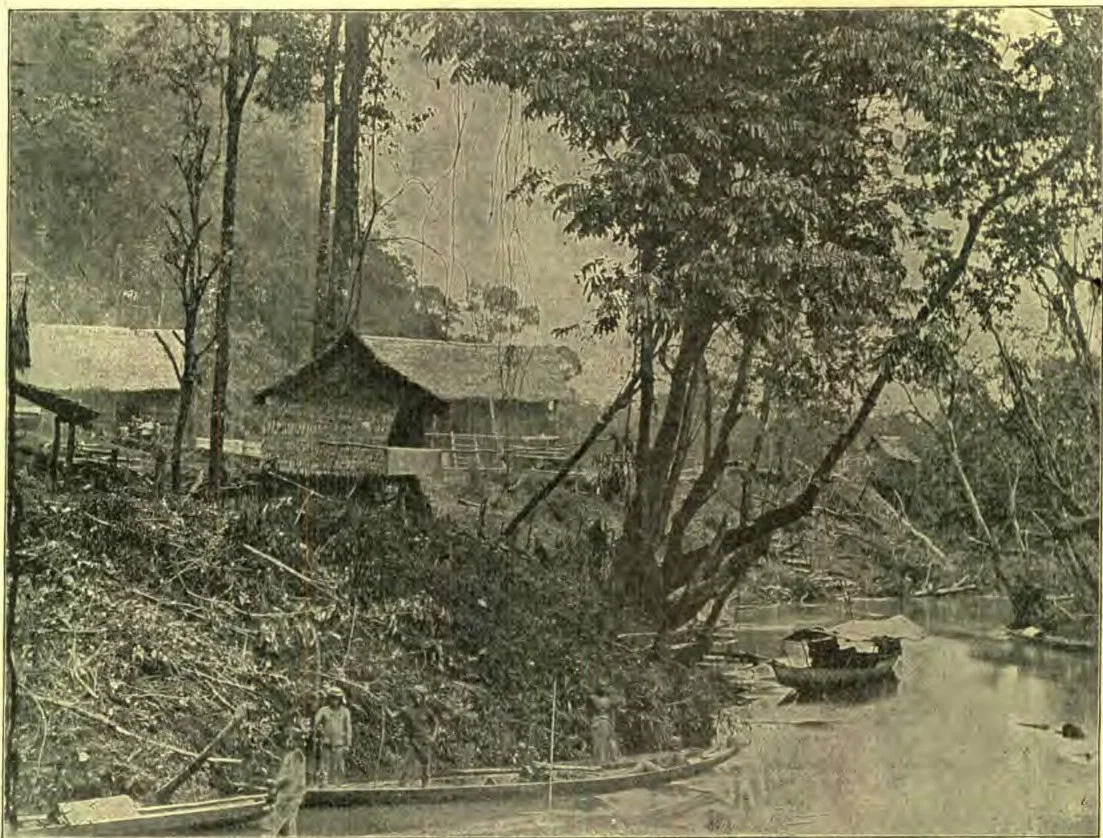
In the Malay Archipelago there are several branches of the race inhabiting different sections, possessing local characteristics and distinct languages, but all belonging to the great family of Malay peoples. In the picture of a Malay village, in No. 8, Feb. 23, we have the typical Malay house.
MALAY “KAMPONG,” OR VILLAGE, IN THE JUNGLE.
This village is inhabited by Bugis (Boo'-gees), natives of Celebes. If you will turn to your geographies, and look at the map of the East Indies, you will see that Celebes lies to the east of the great island-continent of Borneo, and extends on each side of the equator. It is situated in the middle of the tropics, and its shores are bathed by the tepid waters of a shallow sea. It is rough and mountainous, and is inhabited by a warlike and daring race, who are renowned for their skill as seamen. This applies only to the navigation of the boats which they themselves construct; but with these they face heavy seas and strong winds, and weather gales that would easily swamp boats of equal size in Western waters. The Bugis are great traders, and ply between Celebes and the large European trading-ports of this region for purposes of traffic. They have also penetrated all regions of the archipelago. Some of their boats are constructed something after the fashion of a brigantine. The seafaring qualities of these are by no means insignificant, and they are capable of a high rate of speed. Other boats are designed for less extensive voyages, and still other smaller ones are used only for local navigation. Passenger-boats are supplied with awnings made of sword-grass, supported by slender poles. The speed with which these boats travel is indeed marvelous. They sit lightly upon the water, and are so constructed that a minimum amount of energy is expended in their propulsion.
The Malays are not only great sailors, but also great swimmers. Their fondness for the water accounts for their building their habitations so near it, as in this case. Malay children learn to swim at an early age, and any but a Malay mother would never permit her little ones out of her sight in such habitations as these; for they would be morally certain to be drowned in less than twenty-four hours. But with the Malays there is no occasion for anxiety; for when a child is old enough to walk, it very soon thereafter is old enough to swim. A disobedient boy, fleeing from paternal wrath, would not hesitate to plunge into the sea to escape a “tanning;” and Malay mothers have been known to kick their children into the water for no other purpose than to teach them good manners.
You will be interested to know something about the construction of these houses. The roofs are invariably made of palm-leaf thatch, while the walls are usually constructed of thin boards. In remote parts of the archipelago the natives use the same material for the sides that they use for the roof; or if their circumstances will permit, they make a wall of split bamboo, woven into a sort of basket-work, which is both strong and attractive in appearance. To American children the interior of these dwellings would appear very bare and ill-furnished; but the Malay boy, never having known anything different, is just as happy and contented as any of my readers, in their more pretentious homes. When he sleeps, his bed is the floor, with only a grass mat under him and the thinnest of blankets over him, and his pillow is made of cotton, tightly packed into a cover; or else, as is often the case with the poorer classes, it is made of slits of bamboo stretched across two boards, held apart by a round stick in the middle. When he rises in the morning, and is called to breakfast, he sits cross-legged on the floor, and eats his rice from a banana leaf with his fingers. Knives and forks and spoons—in fact, dishes of any character—are rarely used, except to hold the food, or for drinking purposes. The furniture of one of these houses could be made into a bundle and carried on a man's back. It is common for some of these Malay tribes, particularly in Borneo, to move the entire village, houses and all, to a more favorable location, where the soil is fertile, and game more abundant.
Perhaps you have read that the Malay native sits in his doorway, and fishes by throwing his line first into the water and then into the kitchen, with a member of the finny tribe attached; but this is largely fiction. The fellows who inhabit this village would fast long and well if they depended for their daily food upon the fish they might catch in the waters that surround their huts. They rise long before dawn, and in one of their smaller boats make their way six or eight miles out into the deep waters of the straits, where some of the finest fish that swim are daily caught for the market.
R. W. MUNSON.
(Conclusion in next number.)

REJOICE at the good of others.

THE CONVERSION OF FRANCOIS COPPEE.

In the preface to his last volume, “La Bonne Souffrance,” François Coppée, one of the most brilliant French writers, relates his conversion, or what he calls “the transformation which took place in my soul.” He found, in the gospel, God as a Saviour and a Father, and his whole being was filled with light and peace. I am sure you will enjoy his beautiful testimony, which I will endeavor to relate in his own words:—
“Toward the decline of my life, and when suffering reappeared, I had the happiness, although I had badly used the time of prosperity and the favors showered upon me by God, of receiving a ray of his divine grace, which restored to me the consolation of prayer and faith. My conversion was rapid, but not sudden nor accompanied with extraordinary circumstances. It must be attributed only to divine grace; for when I compare my present state with what I was only a few months ago, I am stupefied in face of such a change, which appears to me as nothing less than miraculous. The benefit that we may all receive from this change is within the reach of all. In order to obtain it, it is sufficient to ask for it with a humble and submissive heart.
“Although my intellectual life has been filled almost wholly with literary work and care for my art, I have been at times troubled, as every thinking man is, by the great mystery which constantly surrounds us, and have asked myself: ‘Why is life? why death? and above all, Why suffering? why tears?’ In view of these formidable problems, the human mind has arrived at only uncertain and contradictory solutions. None satisfied me; those who deny a God who sees and judges us, those who reject our responsibility toward a future life, were always and especially distasteful to me. In view of so much injustice, the supposition that the good and evil done by men bear their only consequences in this world, appeared to me entirely absurd. In other words, I have always felt the need of God. To believe in God and in a responsible soul, is assuredly but a minimum of spiritual life; and yet, however cold or meager this religious sentiment may be, it suffices to keep many in their respective duties and conditions of life.
“My conscience, especially for a few years, was more exacting. Every time when I thought of my last days, and tried to judge myself as God would judge me, I was not satisfied. When I summoned up my past, I had often to blush, and felt the weight and heavy burden of my sins. Through weakness as well as through cowardice I did not reform. The God of all kindness had in store for me a far better than a hasty and timid repentance,—‘the repentance of the hour of eternity.’
“The improvement in my physical condition was of but short duration; and only through the introduction of a new method of treatment was I once more stopped at the doorway of death. This relapse obliged me to keep in painful quietness for many long days, some of them extremely hard to endure. It was then that my mind turned more than ever toward serious thoughts. Having examined my life with the most scrupulous severity, I was disgusted, and abhorred myself; and at this time my spiritual adviser gave me the following prescription: ‘Pray only,’ said he, ‘and read the gospel.’
“During the following weeks and months of my convalescence, which I spent mostly in bed or in my room, I lived with the gospel; and little by little every line of this Book of Life became alive indeed to me. In every word of the gospel I have seen the truth shine like a star. I have felt its throb like the beat of my heart. Why shall I not henceforth believe in miracles and mysteries, when just now one has been performed within me?
“My soul was blind to the light of faith; but now it sees it in all its beauty and splendor: it was deaf to the word of God; now it hears it in all its sweet persuasion everywhere: it was paralyzed with indifference; now it soars toward heaven with all its might, and the impure demons that troubled and possessed me are chased away forever. All this only by prayer and faith. ‘According to your faith be it unto you.’
“Two years ago, when in comparatively good health, I felt with terror the approach of the infirmities of old age; to-day, as it prematurely oppresses me, I greet it with courage, almost with joy, because I do not fear it any more, having learned in the gospel the art of suffering and dying. I have tried to become like those little children of whom our Lord said, ‘Suffer the little children to come unto me, and forbid them not: for of such is the kingdom.’ I have listened to the divine Word with as much simplicity as did the fishermen of Tiberias, to whom Jesus spoke, seated at the prow of the ship. An imperious desire drew me to God. I have not resisted, but have allowed myself to be guided; in one word, I have obeyed, and to-day I taste the joy of obedience.”
Dear young friends, has your soul undergone such a transformation? Have you followed the still, small voice of Jesus, which says, “I am the way, the truth, and the life,” and pleads: “Come unto me, all ye that labor, and are heavy laden, and I will give you rest”? If not, remember that “now is the accepted time; behold, now is the day of salvation.”
C. V. S. BOETTGER.

The Ready Never Wait Long

“THE ready never wait long for opportunities.”

THE BEST THINGS ARE GIFTS.

If sunshine were to be bought by the square inch, how eager we should be to possess it! How readily we would economize, and deny ourselves in other things, if only we might fill our homes with sunbeams! But while God gives them to us in such abundance, we are quite likely to draw down the shades, for fear this heavenly gold will take away some of the brightness from our house-furnishings.
If the small courtesies and kindnesses which have so much to do with our home happiness, were the result only of long effort and training, how earnestly we would strive to cultivate them! Like the student or the artist who devotes years of life to developing some especial ability, we would work hard to cultivate the grace of sweet and courteous manners. But since they need only a little thought and care, we fail to realize their worth.
Flowers which grow outdoors without receiving any special care, are usually looked upon as weeds by those who tread them underfoot. In another climate, where the same plant needs the most careful cultivation, it is prized and cherished. And this fact illustrates a decided weakness of human nature. We should be very much wiser, as well as vastly happier, if we could learn to appreciate the things that come to us without any special effort on our part. It is for trifles that we toil and struggle and waste our lives. The best things are to be had for the taking.—Young People's Weekly.

CONDITIONS OF WATER.

I.

THE clouds, heavy with moisture, hover around the mountain’s brow; and soon the chill winds condense the vapory mass, and let fall the crystal drops in showers to the earth. How the parched ground drinks in the bountiful drafts, and all vegetation, refreshed, lifts leaf and blossom in grateful recognition of the Heaven-sent bounty.
Observe how the copious floods sink down in the soil, reaching the rootlets of every herb and tree, each plant instinctively selecting its own peculiar food-element.
The waters flow on, on, through sand and rocky fissure, gathering volume and force, and burst out on the slopes in beautiful fountains, rippling streams dancing along hillside and valley, forming springs and cascades; then hastening on, the rills and brooks, according to the Creator’s law, never resting, increase to rushing rivers, hurrying on to the mighty sea. Here they blend with the restless, rolling waves, joining in the deafening, solemn song proclaiming the creative power that first gathered the sea in bounds, that the dry land might appear.
This vast storehouse of waters seems first in time in the great work of creation. Connected with this, we trace the phenomena by which the land is supplied for all the needs of plants and animals. The heat of the sun, falling on the vast expanse of waters, is ever raising vapor, visible or invisible, which accumulates in masses of visible clouds, again ready to pour down their fulness on the earth.
Wherever we turn our eyes in the varied fields of nature, we find the beautiful and wonderful to admire; but when we stand by the boundless, deep, surging sea, we are solemnly impressed with a sense of the presence, power, and majesty of the great Creator, who upholds and guides the universe. O wonderful deep! where brooded the Spirit of God in the mystery of darkness,—that primeval night before creation’s morning shone forth upon the world.
Says the psalmist, “Thy way is in the sea, and thy path in the great waters, and thy footsteps are not known.”
MRS. S. M. SPICER.

THE VOICE OF LOVE.

A LONG, sunshine country road, lying like a streak of gold in the shady wood to the left, and to the right a succession of hills, which gradually become more elevated until the far-away peaks of the Blue Ridge are outlined against the sky,—this is the delightful view upon which I gazed from beneath the cool shade of a large tree. It was a beautiful spot, and well-beloved of birds. The saucy robin chatted volubly as he gaily flitted to and fro among the branches overhead, scolding me for thinking I was early, when he had been frolicking among the trees for hours. The robin is a bird of decided opinions. Like sparks of golden sunlight, the little yellow-birds, or American goldfinches, bound through the air, singing their sweet songs, the very embodiment of gladness. Now the swallows sweep by in pairs, darting, wheeling, diving, and chattering; an oriole flashes past, or sings from a neighboring tree-top; and a cardinal-bird, looking like a bright flower on the dead limb he has chosen, pours out his heart in song.
As I listened to the delightful music of the birds, in whose chorus even the harsh notes of the blue jay, discordant indeed when heard alone, blended harmoniously, I was led to reflect that all this harmony is only a part of the triumphant strain sung by all nature. The sun that floods the earth with golden light; the stars that glow in the heavens, upheld by a never-failing power; the miracle of the spring, making the bare earth blossom as the rose; the little brown sparrow and the wayside daisy,—all sing the praises of Him who, with infinite wisdom, has fashioned them so beautifully.
As I gazed at the tranquil scene before me, my heart was filled with gladness; and like a strain of music came the words of the promise: “I know the thoughts that I think toward you, saith the Lord, thoughts of peace.”
EVA M. CARTER.

INSUBORDINATION IN THE THRUSH FAMILY.
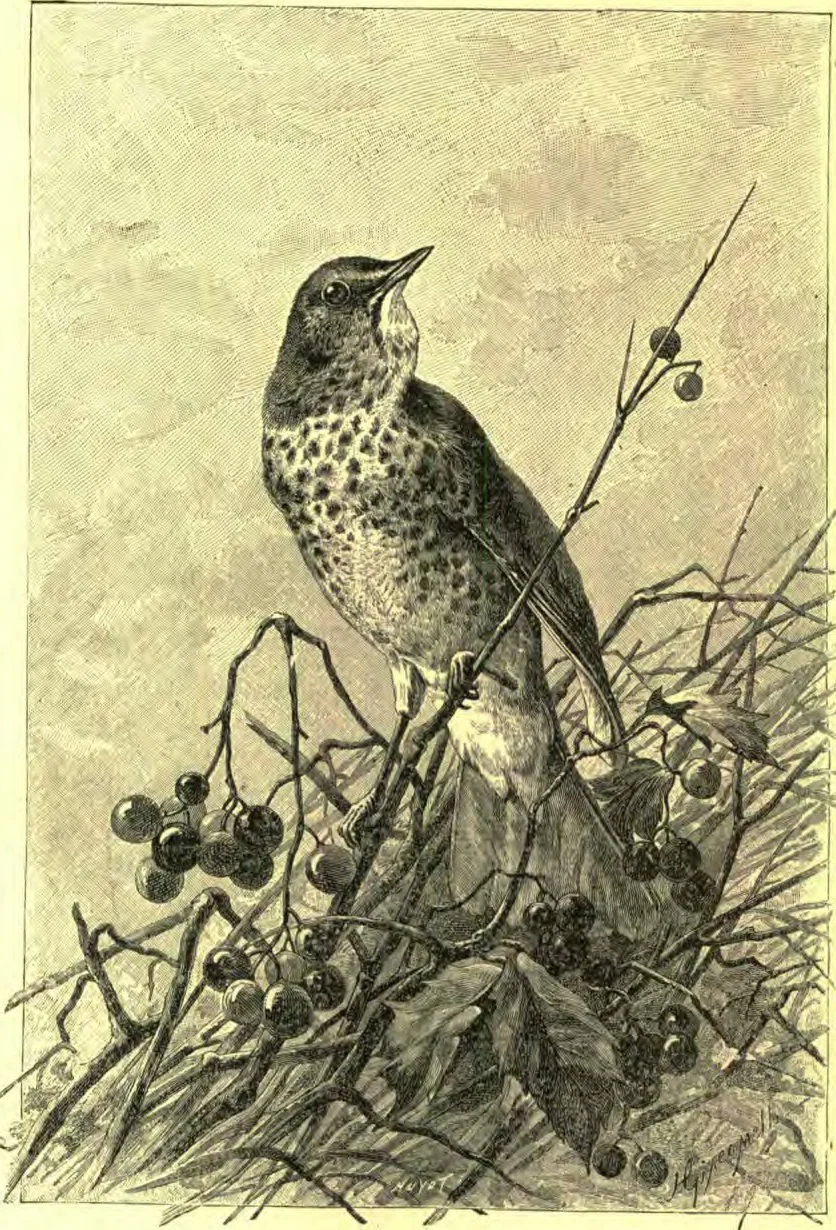
EARLY one morning in the middle of June I was an unwelcome but interested witness at the début of a family of young wood-thrushes. The nest was situated on the horizontal fork of an oak limb branching from the trunk some twenty feet from the ground, the fork being fully ten feet distant from the center of the tree. The nest was large, and well-shaded with oak leaves, only two points commanding a clear view of it. Two large heads and two pairs of yellow-rimmed eyes peered over its edge when first noticed. The male bird soon came and fed the owners of the eyes. He was followed shortly by the female, who, seeing me, thought it prudent to remain, and first perched on the edge of the nest, then covered her large babies completely with her body. Against this latter precaution they obviously rebelled, and presently two red-brown heads struggled up into a squeezed position between the rim of the nest and the creamy, spotted breast. She was clearly thwarting rising ambition; for soon she was obliged to rise to her feet and stand over the turbulent oppressed, while the nursery rearranged itself more comfortably, when she settled down to stay.
THE THRUSH.
THE THRUSH.
The male next came and fed the youngsters; and as he touched the outer threshold, like an arrow from a bow the female was off and away. She doubtless thought he would care for, and keep intact, the contents of the home; but having ministered to its wants, he seemingly had business down-town, and soon disappeared. Instantaneously, on his departure, the eldest member of the brood arose, shook himself, and unhesitatingly plunged a short, wavering distance into the future, fluttering a few feet from the nest, where he stood motionless on a small limb, breathing hard, and staring about with wondering eyes.
The exit of No. 1 was plainly a relief to No. 2, who rose higher in the family circle; puffed out his feathers freely; stretched, with the stiff, weary expression of having spent several nights in a sleeping-car berth; and prodded his bill diligently into his feathered flesh, making a careful toilet, with the exception of his ruddy head. This he did not touch, and it continued to bear its feathers fiercely erect, in ludicrous contrast to the meek expression of his unaccustomed young eyes. It seemed as if this young thrushling could not get enough of stretching, and his evident comfort aroused heartfelt sympathy for what must have been his previous cramped condition. Now, in turn, a third head came to view beside his, and the nest, to all appearance, was as full as before.
Mother thrush was now returning, and I was curious to see how she would accept the changed state of affairs in the nursery. As she neared the oak, No. 1 fluttered a short distance farther away from the nest, and I lost sight of him; for, amazing to relate, No. 2’s young idea was ripe for flight; and, swifter than thought, he was away, straight, unswervingly, through the upper foliage full thirty yards before he settled slowly to the ground!
Instead of awaiting the scene of maternal consternation that surely ensued, I made the mistake of following the astonishing first flight of No. 2, and returning from a fruitless search, found that the mother had firmly and uncompromisingly set herself down upon the nest and the remaining two urchins, having made up her mind that they were not to be permitted the chance of following the mad example of their brothers. Interested to see what her success would be, and whether they were to be starved into submission, I went again, about five o’clock in the afternoon, only to find, in accordance with my expectations, an empty nest, an outgrown cradle. The point of rebellion had come to the whole brood, and they were scattered abroad in the forest, whose enchantments had long wooed their peeping eyes.
Small blame to the parent bird, however, considering the matter from a practical point of view, if she worked hard to keep her babies in the nest. With the empty mouths gathered within the shelter of the oak, her task was simplified; but with them dispersed throughout the wood, she has not only to hunt the dainties which tempt thrush appetites, but also to hunt the open mouths awaiting nourishment, and the latter are not at all sure to be found twice on the same twig when untried wings tempt flight. Whether it is particularly so with young thrushes, I do not know; but with most bird-babies it is long after they first try their wings before they feel it incumbent on themselves to provide their own food.—Selected.

A FRIEND IN NEED.

One winter I did more for a bird friend than I have ever done for any human being. On the fifteenth of December I was walking with a friend over well-known ground near Arlington, Mass., when, as often happened, our conversation was interrupted by the glimpse of a wing or tail. Instantly the idea of identification sprang to our minds, and we glided and peered about in vain efforts to get a good look at this shy bird.
Finally all trace of him was lost; and we went on over the hillside, arguing, from what we had seen, that he was either a fox-sparrow or a brown thrush. The sparrow was more probable from the time of year; in fact, a brown thrush had never been seen in Massachusetts in winter. Fox-sparrows, on the other hand, are not so shy, would hardly look so large, and so on.
Suffice it to say that the chance of its being a thrush was sufficient to bring us to the spot two days later. It was a beautiful sloping hillside, known to us for many winter-birds. It was bounded by fir-woods and orchards, and covered with large deciduous trees and clumps of short cedars. Stone walls cut it in various directions, and two little streams flowed by. Along one of these stone walls a brown thrasher jumped up with a loud “chuck,” and flew clumsily off a short distance.
Poor bird! we began to conjecture what had caused him to stay behind,—a young bird lost on the journey; or perhaps he had been shot in the wing and disabled. He soon showed signs of embarrassment under our fixed stare, and flew a little farther off. As he lighted, we noticed that his left wing drooped. This was probably the explanation of his staying behind, and remaining so persistently in the same spot. Some mischievous small boy or marauding Italian had broken his wing.
If this was the explanation, the wing was by this time healed sufficiently to permit short flights; and these the bird indulged in, not wishing to make friends too easily. So far, the ground was bare, and no doubt bugs were plenty; but one day a heavy snow-storm came, leaving a crust on top hard enough to walk on. We thought of the thrush at once, and set out to encourage him. He was sitting on one of the lower limbs of a cedar, looking the picture of discontent. Probably benumbed with cold and hunger, he allowed us to approach, looking at us with keen, bright, suspicious eyes. Without disturbing him, we laid a few crumbs on the snow, and withdrew behind two cedars.
He puffed out his feathers, craned his neck forward, flopped down on the snow, and hopped cautiously toward the crumbs, looking suspiciously at us. He tasted one, liked it, ate another, then another and another, till they were all gone. Bayberries were the only other possible food we could think of not covered by the deep snow.
From this first snowfall till early March the ground was not once bare; and regularly three or four times a week we brought provisions, consisting of Indian meal, meal-worms, meat chopped fine, and bread-crumbs. The meal, soaked in water or milk, was his staple. Creatures seem always to be tamed by hunger; and in time our brown thrush became very rash, but never confident. He soon learned to recognize us, and even distinguish us from those he did not know. When he saw us coming in sight, he would fly straight to the spot where we fed him, and wait for us impatiently. As soon as we had put his food on the snow, and withdrawn a few feet, he would begin to eat, simply gorging himself before the meal became frozen. All the rest of the day he was obliged to pick off one bit at a time, and melt it by swallowing it. With each fresh snow-storm the meal was covered; but, however deep it was, he always dug through till he found enough to satisfy his hunger.
A few warm days in the first of March melted the snow on the open grounds, and the thrush disappeared, never to be seen again. Hard as it had been to feed him, we were sorry to miss him, and looked in vain for him to return the next winter.—Arthur Scott Gilman.

Chapter IV

FROM SINAI TO OLIVET

Chapter IV.

AUNT NELL was Mrs. Goss’s youngest sister, and only ten years older than Shirley. She was not a great admirer of her brother-in-law. She thought his “way” tiresome; yet she did not approve of Shirley’s quarrel with him, nor of her determination to leave home.
“Depend upon it, Shirley,” she said, as they sat on the back steps, talking late into that spring-time night, “it is very foolish to run away from home; and a father is a father, you know. You will regret it if you persist in this. You have gumption enough to carry you through most anything; but you don’t know much about getting on. You are as ignorant of the world as a chick with the shell on its back.”
“Well, who’s to blame for that, I’d like to know?” interrupted Shirley, with spirit, “and how am I ever to know anything? Father doesn’t think it necessary; he doesn’t think me capable of knowing anything. He intends me to go on just as I have been going, with him buying my dresses,—taking all I earn in my work on the farm in goods that I don’t want, instead of the money that is mine; for I do earn it, Aunt Nell, and you know that I never had a whole dollar in my life at once. I never bought anything, never had any ‘say’ about what I should wear.”
“Neither did a robin.”
“Well, I’m not a robin.”
“No; and I know, Shirley: I think it ought to be different at your house in a good many things; but you have been placed in that lot in life, with its peculiar difficulties, for some good purpose. Every place has its difficulties, everybody has hard things to endure, and believe me, there are worse things than having a father who insists on buying one plenty of clothes and things, even if they are such as one would not exactly choose for one’s self. I’ve not lived so very much longer than you have, but I’ve seen a good deal; and I tell you, you had better go back home. Have a good, square talk with your father, but come to some sort of kindly understanding, instead of going off in this way. I believe in the authority of the commandment, ‘Honor thy father.’”
“Aunt Nell, it’s of no use; I can’t talk to father. Don’t try to take me home by way of Sinai: I’m not going home. If you won’t lend me things to go decently, I’ll go as I am.”
“Don’t be silly, child. You know you would never go as you are. Of course, if you are determined to go, I shall help you to go decently and safely, just as I said at first; but you will not be in a hurry?”
“I shall take the 5:10 train to-morrow morning. Do you suppose I’m going to hang around here, and have father coming or sending after me again? If Seth Adams should come, I know I should hate him as long as I live, and I don’t—really—want to do that.”
“O, you don’t,” laughed Aunt Nell; “Seth would have liked to hear that.”
“Aunt Nell, if you tell him——”
“Shirley, do you think me capable of meanness?”
“No, I don’t; you are as good as gold; forgive me: but I am so perplexed, and I think I am a little afraid of everybody, until I get off for good. Don’t try to hinder me, Aunt Nell; I will not be hindered by anybody.”
“Very well,” replied Aunt Nell, gravely, “I’ll get you started off comfortably,—only you must promise that you will keep me notified of your whereabouts; and if anything happens, and you don’t get on all right, that you will let me know at once.”
“Aunt Nell, I shall not make any such promise. I will promise that when I get to work and settled, I will let you know. But I expect to have trouble; anybody would, brought up as I have been. I’m not going to tell my troubles, though, and have everybody worrying about me.”
“You are fixing things so no one will worry, I should say,” and Aunt Nell’s voice was teary and indignant. “You are just like your father, Shirley. It is very unfortunate that you are a girl. I don’t know what to do with you. I wish Will was at home.”
“And what would he do?” asked Shirley, with a little smile.
Will was Aunt Nell’s husband, of four years’ standing, and the jolliest fellow alive, as everybody knew. He always believed that everything and everybody were coming out all right.
“You know, Aunt Nell, that Uncle Will wouldn’t do one thing to hinder me. He’d just laugh, and say, ‘Well, go it, old girl! Take care of yourself. Stay as long as you can, and come back when you get ready.’”
Shirley had so exactly copied him in tone and manner that they both had to laugh, and Aunt Nell had to say: “That’s just about his style, for a fact; but he would take a serious view of this, I know he would. He would insist on going to Chicago with you, if he had to dress up as a girl to do it.”
“No, he would not; I would not have him, nor anybody. I tell you, Aunt Nell, I am going by my own self; so no more this time. It’s getting late, and I must get my things together. Will you let me take that gray dress and sailor hat,—that is such a neat outfit,—and lend me five dollars? You can go to my closet, and pay yourself out of my clothes, such as they are.”
“You’ll need more than five.”
“Not a cent more. It will cost me one to go, and girls who know how to do housework are always wanted. I shall get a place before a week is out, and it would cost me only four dollars for that week, I know.”
“I think I’m crazy to let you go,” said Aunt Nell, desperately, “but——”
“But,” interposed Shirley, laughing, “since you can’t help yourself, you will.”
“I suppose that is about it. You are a regular highwaywoman, compelling me to do things that I would not do for the world if I could help myself. I shall insist on buying your return ticket outside of the five dollars.”
“You will not. I tell you, I am not going to owe one cent more than I must, so let us go and get the things ready, and stop talking.”
They arose, and went in, Aunt Nell busily planning how she could prevent this escapade on the part of her wilful niece; but she could see no way. She was alone with two little children, her husband, who was a canvasser, being off in the field. Besides, she was afraid of driving Shirley to some more reckless act if she attempted to thwart her purpose.
If she could but detain her for a day! If she could cause her to oversleep in the morning, and to miss that early morning train. If the girl could but have time to cool down a little, so that she could think calmly before she did this rash thing. But at all events she must not drive her away from herself.
She got the things that Shirley would need, and placed them on a chair by the little bed, which was just off her own room; hunted up an old, well-worn purse, into which she put the contents of her own new one, except a five-dollar bill, which she left in it for Shirley, who must not go shabby in any part of her outfit: the old purse would do for herself again, until she could afford a new one.
Another five-dollar bill she folded in a handkerchief, and secured it with a safety-pin to the pocket of the dress that Shirley was to wear. A small satchel was packed with a change of clothing, including the work-dress and apron in which Shirley had fled, not forgetting brush, comb, and a tooth-brush that had just been purchased to replace an old one, nor yet any of the odds and ends that go into a girl’s supplies.
A tiny Bible was slyly tucked down at the end, where it would not be quickly discovered, for Shirley was not in the least “religiously inclined;” and if she found the book too soon, it might not be as well for the book.
MRS. S. M. I. HENRY.
(To be continued.)

THE LANTERN-FLY.

I wonder if any of you have ever seen a lantern-fly. I hardly think you have, because you would be obliged to go to China, or Guiana, or Brazil, or the West Indies, to get sight of this large firefly.
Would you not like to know where the lantern-fly keeps its light?—It has rows of light on each side of its body, and sometimes leaves a line of light behind it, but not very often. When the insect is flying, of course its wings do not cover its body, and its light can be seen; but when it folds its wings over its body, it hides its light.
Sometimes in the summer months, when the young people in Brazil have their festivities, persons galloping through the streets on horseback have their own clothes and their horses covered with these fireflies, so that, as they dash through the town, they look like moving bodies of light. In China, Brazil, and the West Indies, are the largest fireflies in the world.—Selected.

THE DRAGON-FLY.

Have you not all noticed, during the early summer days, troops of these graceful creatures hovering over some pond or sluggish stream, or darting here and there among the flowers of the garden or the weeds of the roadside?
The dragon-fly, often called “devil’s-darning-needle,” is really a beautiful insect. Its marvelous gauzy wings, of which it has two pairs, are extremely delicate, and often completely transparent. They are painted in colors of red, brown, yellow, and a shimmering sapphire blue; and as the insect flies here and there in the bright sunshine that it loves, the colors of the rainbow seem tangled in its wings.
These same wings, which look too frail for even the light body of their owner, do a vast amount of work. Watch one of these insects, and notice how seldom it stops to rest. Darting, wheeling, turning, forward and back, up and down, it seeks its prey, in the effort to satisfy the voracious appetite that is one of its chief characteristics. It is while on the wing that it secures the flies, gnats, midges, etc., that make up its bill of fare. It is said that two or three dragon-flies placed in a sleeping-room will destroy mosquitoes, and not injure the human occupants.
The dragon-fly can move backward, forward, and sidewise without turning its head. “There are very few insects that the swallow, with its marvelous speed and dexterity, can not catch; but the dragon-fly is one of them. The insect, without any apparent trouble, will keep a few feet ahead of a swallow for half an hour at a time; the swallow may fly never so swiftly, but the dragon-fly is never just there when it makes its swoop. This is because the swallow has to turn its body, while the dragon-fly only reverses its wings.”

THE SPEED OF INSECTS.

It is the popular belief that the flight of birds is much swifter than that of insects; but a number of naturalists who have been making a study of the matter think that such is not the case. The common house-fly, for example, is not very rapid in its flight; but its wings make eight hundred beats a second, and under ordinary circumstances send it twenty-five feet through the air in that length of time. When the insect is alarmed, however, it increases its speed to over one hundred and fifty feet a second. If it could continue this rapid flight for a mile in a straight line, it would cover that distance in exactly thirty-three seconds. It is not an uncommon thing, when traveling by rail in the summer, to see a bee or a wasp keeping up with the train, and trying to get in at one of the windows.—Christian Neighbor.
Continue reading: IF I WERE YOU