The Youth’s Instructor, Vol. 30, No. 35.

ROADS OVER THE ALPS

The Youth’s Instructor

Sep 13, 1882

S. D. A. Publishing Association · Battle Creek, Mich. · Sep 13, 1882

ROADS OVER THE ALPS.
Of all the interesting places on the earth, travelers like best to linger in the sunny valleys of the Alps, and to climb their majestic, snow-covered summits. This mountain chain, winding along the boundary lines of France, Italy, Switzerland, and Hungary, for a distance of many hundred miles, sends up more than four hundred peaks into the region of eternal snows. The highest of these rises 15,766 feet above the level of the sea. There lie all along the chain many beautiful valleys, where, walled in by these everlasting bulwarks, whose glistening tops are ever in view, dwells many a happy peasant, tilling his soil by day, and at night calling to the fold his flocks from their pasturage on the mountains. In these valleys grow the world renowned Alpine flowers, and through them rushing streams carry to the broad rivers beyond, the melted snow and ice from the heights above.
But all about the Alps is not thus fair and lovely. There are other scenes which, though grand to behold, are fraught with perils which make the hearts of brave men stand still. Far above the valleys are precipices so high that no sounds from below can possibly be heard at their summits, which often hang over the valley below like vast shelves. Sometimes these precipices will rise one above another, leaving only a narrow ledge between, covered with ice and snow. Along these ledges where one false step would be instant death, the people who live in the mountains have to travel in going from valley to valley, or when in search of game for food. As these ledges are often composed entirely of ice to the depth of several feet, the rays of the sun will sometimes cause great cracks, or fissures, to open, over which travelers have to leap by the aid of long poles. These fissures will sometimes become filled with light snow, so that they are not seen, until the foremost of the party sets his foot on it, when he will instantly sink down, down, out of sight, and beyond the help of his comrades. To provide against these dangers, a party of Alpine travelers always attach themselves to one another by means of a long rope, so that if one falls, the others can pull him back. They each carry a long, sharp pole to help them up the steep rocks, and with this they also try the treacherous snow ahead.
But there are still greater dangers among these mountains, from which men have no power to save themselves. The masses of ice and snow which accumulate on the heights, become so great that they are forced slowly down the mountain sides before they become melted, forming what are often called “rivers of ice.” These huge masses will descend gradually till they reach the edge of some precipice, where they are often stopped by a tree or projecting rock. Here they remain until, urged onward by their own weight or other masses behind them, they only need some jar, or sudden wind to send them over the edge, burying all beneath, be it men, animals, houses, or whole villages. So delicately are they sometimes poised that even a voice, or the tinkle of a small bell will be enough to hurl them downward.
These are the dreaded avalanches of the Alps, and once every traveler who crossed the mountains was in deadly fear of them. Buildings, called “hospices” were built at intervals all along the passes, where lived monks, who would after each storm or avalanche go out with their dogs and look for travelers who might have lost their way in the blinding snow, and be freezing to death. The dogs would scent out the persons, and the monks would follow with ropes, blankets, food, and restoratives.
But during the present century there have been built as many as sixteen good roads across the mountains, all but two of which, can be traveled with carriages.
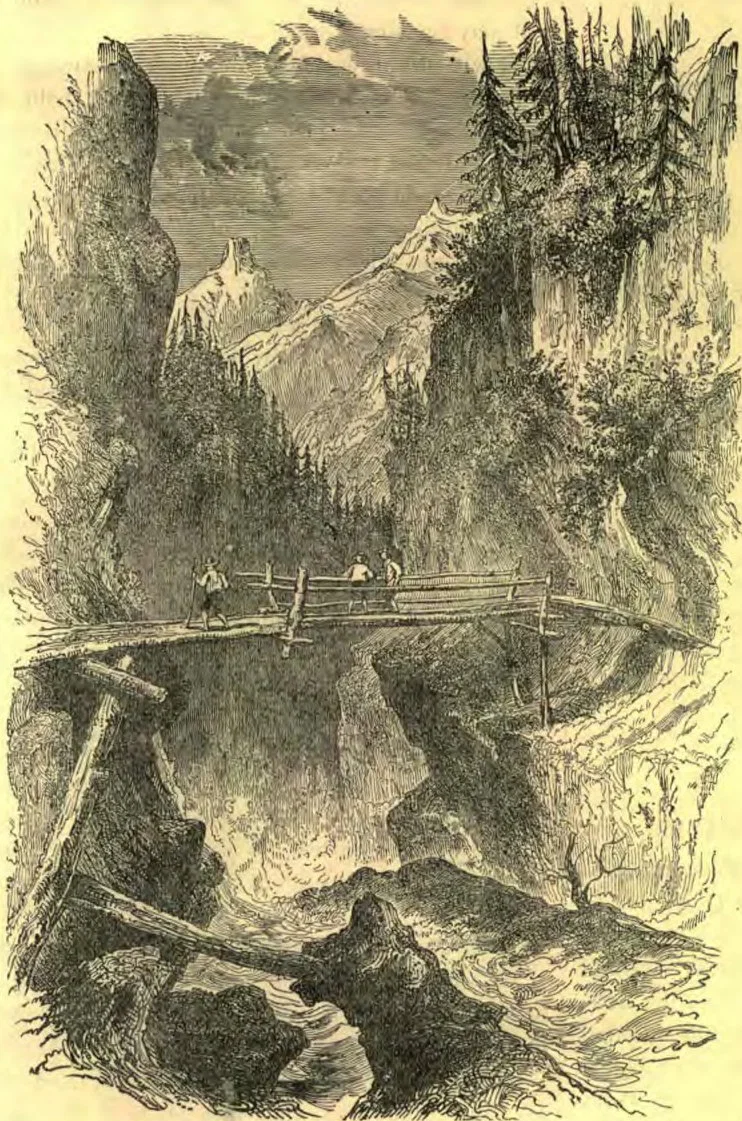
One of the best of these roads was first built by Napoleon Bonaparte. It is thirty miles in length, eighteen feet wide, and 6,773 feet above the level of the sea. These roads cross frightful chasms by long bridges, and avoid dangerous places by means of tunnels cut in the solid granite. One of these tunnels is over six hundred feet long. The bridge shown in the cut is probably a rustic one built by the inhabitants for their own use. The long public roads across the mountains are built by some government.
No description can do justice to the beauty and grandeur of the Alpine scenery, and though volumes have been written on the subject, every traveler must feel that “the half has never been told.” C. H. G.

The Strength of the Hills Is His

The strength of the hills is His also.

THE RIVER

FAR up on the mountain the river begins,— I saw it, a thread in the sun. Then it grew to a brook, and through dell and through nook It dimpled and danced in its fun. A ribbon of silver, it sparkled along Over meadows be-sprinkled with gold; With a twist and a twirl, and a loop and a curl Through the pastures the rivulet rolled.
Then on to the valleys it leaped and it laughed, Till it stronger and stiller became; On its banks the tall trees rocked their boughs in the breeze, And the lilies were tapers aflame. The children threw pebbles and shouted with glee, At the circles they made in the stream, And the white fisher boat, sent so lightly afloat, Drifted off like a sail in a dream.
Deep-hearted, the mirth of its baby life past, It toiled for the grinding of corn; Its shores heard the beat of the lumberman's feet, His raft on its current was borne. At inlet and cove where its harbors were fair, Vast cities arose in their pride, And the wealth of their streets came from beautiful fleets, Forth launched on its wandering tide.
The glorious river swept on to the sea, The sea that engirdles the land; But I saw it begin in a thread I could spin, Like a cobweb of silk, in my hand. And I thought of the river that flows from the throne; Of the love that is deathless and free; Of the grace of his peace that shall ever increase, Christ-given to you and to me.
—Margaret E. Sangster.

LITTLE MOZART AND HIS PRAYER.

MANY years ago, in the town of Salzburg, Austria, two little children lived in a cot covered with vines, near a pleasant river. They both loved music; and, when only six years old, Frederika could play well on the harpsichord. But, from her little brother, such strains of melody would resound through the humble cottage as were never before heard from so young a child. Their father was a teacher of music, and his own children were his best pupils.
There came times so hard that these children had scarcely enough to eat; but they loved each other, and were happy in the simple enjoyments that fell to their lot.
One day, they said, “Let us take a walk to the woods, it is so pleasant. How sweetly the birds sing! And the sound of the river, as it flows, is like music.” So they went.
As they were sitting in the shadow of trees, the boy said thoughtfully, “Sister, what a beautiful place this would be to pray!”
Frederika asked wonderingly, “What should we pray for?”
“Why, for papa and mamma,” replied her brother. “You see how sad they look. Mamma hardly ever smiles now, and I know it must be because she has not always bread enough for us. Let us pray to God to help us.”
“Yes,” said Frederika, “we will.”
So these two sweet children knelt down and prayed, asking the heavenly Father to bless their parents and make them a help to them.
“But how can we help?” asked Frederika.
“Why, don’t you know?” replied Wolfgang. “My soul is full of music; and, by and by, I shall play before great people, and they will give me plenty of money. And I’ll give it to papa and mamma, and we’ll live in the fine house, and be happy.”
At this, a loud laugh astonished the boy, who did not know any one was near them. Turning, he saw a fine gentleman, who had just come from the woods.
The stranger made inquiries, which Frederika answered, telling him, “Wolfgang means to be a great musician. He thinks he can earn money, so that we will not be poor any more.”
“He may do that, when he has learned to play well enough,” replied the stranger.
Frederika answered, “He is only six years old, and not only plays beautifully, but can compose pieces.”
“That cannot be,” replied the gentleman.
“Come to see us,” said the little boy, “and I will play for you.”
“I will go this evening,” answered the stranger.”
Then, as he turned to go, the boy took hold of his coat, and said, “Do you think God will send us some dinner? We have asked him to.”
“I think he will,” was the reply.
The children went home, and told their story to their parents, who seemed much pleased and astonished.
Soon, a loud knock was heard; and, on opening the door, the little family were surprised to see men bringing in baskets of richly cooked food, in variety and abundance.
They had an ample feast that evening. Thus God answered the children’s prayer.
Soon after, while Wolfgang was playing a sonata which he had composed, the stranger entered, and stood astonished at the wondrous melody. The father recognised in his guest Francis I., Emperor of Austria, who had been residing in the vicinity.
Not long after, the family were invited by the emperor to Vienna, where Wolfgang astonished the royal family by his wonderful powers. From that time, the father and his children gave concerts in many cities of Germany and France.
At the age of fifteen, Wolfgang Mozart was acknowledged by all eminent composers as a master.
These are some incidents in the life of the most eminent musical genius the world has ever known.
He was good as well as great. The simple trust in God which he had learned in childhood, never forsook him. In a letter to his father, he says:—
“I never lose sight of my God. I acknowledge his power, and dread his wrath; but, at the same time, I love to admire his goodness and mercy to his creatures. He will never abandon his servant. By the fulfillment of his will, mine is satisfied. I shall always make it my duty to follow punctually the counsels and commands you may have the goodness to give me.”—M. P. H., in Well-Spring.

BEAUTIFUL, STRONG, GLORIOUS.

Come, and I will show you what is beautiful. It is a rose fully blown. See how she sits upon her mossy stem like the queen of flowers! Her leaves glow like fire, the air is filled with her sweet odor. She is the delight of every eye. The rose is beautiful, but there is a fairer than the rose. He that made what is so beautiful is more beautiful than anything he has made. He is all lovely. He is the delight of every true heart.
I will show you what is strong. The lion is strong. When he raiseth himself from his lair, when he shaketh his mane, when the voice of his roaring is heard, the cattle of the field fly, and the wild beasts of the desert hide themselves, for he is very terrible. The lion is strong, but He that made the lion is stronger than he. His anger is terrible. He could make us die in a moment, and no one could deliver us from his hand.
I will show you what is glorious. The sun is glorious. When he shineth in the clear sky, and is seen all over the earth, he is the most glorious object the eye can behold. The sun is glorious, but He that made the sun is more glorious than it. The eye beholdeth Him not, for his brightness is too dazzling for us to bear. He seeth in all dark places, by night as well as by day; and the light of his countenance is upon all his works.
Who is this beautiful, this strong, this glorious One? What is his name, that our lips may praise him?
His great name is God. He made all things; but he is himself more excellent than they. They are beautiful, but he is all beauty; they are strong, but he is strength itself; they are glorious, but he is more glorious than they all.—Mrs. Barbauld.

ALMOST

We had been spending several days at that delightful summer resort, Martha’s Vineyard. From the little cottage on the hill-side, where we were made to feel “at home,” we had “listened to the sea-gulls scream,” and gazed in speechless admiration upon
“The ocean old, Centuries old, Strong as youth and as uncontrolled; Pacing restless to and fro; Up and down the sands of gold”
We had eagerly sought for “specimens” upon the beach at Oak Bluffs, which forms in part the boundary of Cottage City; tried the virtues of sea-bathing; and spent hours arranging the curious sea-mosses with which these waters abound. How much we should have enjoyed having the young friends of the INSTRUCTOR family with us!
We had said good bye to our motherly hostess and her sweet faced children, and were on our homeward way over the ever restless, dancing waters. As our boat stopped for some moments at a landing, we saw a bunch of sea-weed floating toward us with every tossing wave. As it neared the boat, we could see that it was finer and more delicately tinted than any we had yet been able to secure. Anxious to obtain it, we lowered a hook and line to take it, when lo! just as it was ours—almost—the boat started, and it was swept from our sight.
And so it is in life. Golden opportunities are presented—the boy or the girl appreciate the advantages of an education, and resolve to secure what seems so desirable, at some future time. But while their minds are occupied with other things, circumstances change, and Time sweeps on, till when ready to seek the treasure, they find it has eluded their grasp.
Many a youth turns away from the sweet offers of Mercy, only to wait for “a more convenient season.” The rubbish accumulates in the heart’s chambers, and the gentle knock of the Master is not heard.
Dear young friends, there is no better time than now. Perform its duties with whole souled heartiness, so shall you avoid regret when it is unavailing. “Behold now is the accepted time; behold now is the day of salvation.”
MARY MARTIN.

BE HONEST AND TRUE.

Be honest and true, O eyes that are blue! In all that you say, In all that you do. If evil you'd shun, And good you'd pursue; If friends you'd have many And foes you'd have few— Be honest and true In all that you say And all that you do, O eyes that are blue!
Be honest and true, O eyes that are gray! In all that you do And all that you say. At home or abroad, At work or at play, As you laugh with your friends, Or run by the way, Be honest and true, By night and by day, In all that you do And all that you say, O eyes that are gray!
Be honest and true, O eyes that are brown! On sincerity smile; On falsity frown: All goodness exalt, All meanness put down, As you muse by the fire, Or roam through the town, Remember that honor Is manhood's chief crown, And wear it as yours, O eyes that are brown!
Be honest and true, O eyes of each hue!— Brown, black, gray, and blue, In all that you say And all that you do. O eyes in which mothers Look down with delight, That sparkle with joy At things good and bright, Do never a thing You would hide from their sight! Stand up for the right Like a chivalrous knight; For the conqueror still, When the battle is through, Is he who has ever Been loyal and true. Make the victory sure, O eyes of each hue!—Selected.

SCENES IN THE LIFE OF CHRIST.

LESSON 86.—THE TEMPLE CLEANSED.

Jesus went into the temple, and looked about upon all the things, but when evening came on, he went out with his disciples to Bethany. On the next day, as they were coming from Bethany to Jerusalem, early in the morning, Jesus was hungry; and seeing a fig-tree afar off, he went to it, hoping to find some ripe fruit. On coming up to it, however, he found nothing but leaves, and said to the tree, “No man eat fruit of thee hereafter, forever.”
When they had come to Jerusalem, Jesus went into the temple. Here he found a scene of confusion, for men were buying and selling in the temple, changing money, and carrying on business very much as they would in a place that was not held sacred. But Jesus began to cast out them that had bought and sold in the temple, overthrowing the tables of the money-changers, and the seats of them that sold doves, and saying, “Is it not written, My house shall be called of all nations the house of prayer? but ye have made it a den of thieves.” The scribes and chief priests were only made angry by these words, and were the more determined to kill him. The common people, however, had confidence in him, and brought the blind and the lame to him in the temple, and he healed them.
“And when the chief priests and scribes saw the wonderful things that he did, and the children crying in the temple, and saying, Hosanna to the son of David, they were sore displeased, and said unto him, Hearest thou what these say? And Jesus saith unto them, Yea; have ye never read, Out of the mouth of babes and sucklings thou hast perfected praise.” At evening Jesus went out over the Mount of Olives to Bethany, and lodged there as he did the night before.
On the morning of the next day, Tuesday, as they were returning to Jerusalem, the disciples noticed that the fig-tree which Jesus had cursed the day before was dried up from the roots. And Peter said, “Master, behold the fig-tree which thou cursedst is withered away.” After this Jesus encouraged his disciples to have faith in prayer, but told them plainly that if they would have their sins forgiven, they must from the heart forgive others.
“And they come again to Jerusalem; and as he was walking in the temple, there come to him the chief priests, and the scribes, and the elders, and say unto him, By what authority doest thou these things? and who gave thee this authority to do these things? And Jesus answered and said unto them, I will also ask of you one question, and answer me, and I will tell you by what authority I do these things? The baptism of John, was it from heaven, or of men? answer me. And they reasoned with themselves, saying, If we shall say, From heaven, he will say, Why then did ye not believe him? But if we shall say, Of men; they feared the people, for all men counted John, that he was a prophet indeed. And they answered and said unto Jesus, We cannot tell. And Jesus answering saith unto them, Neither do I tell you by what authority I do these things.”

QUESTIONS.

1. After Jesus had made his triumphal entry into Jerusalem, what did he do there? Mark 11 : 11.
2. Where did he go when evening came on?
3. When did Jesus come back to Jerusalem?
4. As he was on the way, what did he see afar off?
5. Why did he go to it?
6. How was he disappointed?
7. What did he say to the tree?
8. When they had come to Jerusalem, where did Jesus go?
9. What condition of things did he find there?
10. How did Jesus bring about a state of order and quietness?
11. What did he say to the men?
12. What effect did his words have upon the scribes and chief priests?
13. How did the common people regard him?
14. What did he do for them? Matt. 21 : 14.
15. What greatly displeased the chief priests and the scribes? Verse 15.
16. What did they say?
17. How did Jesus answer them?
18. Where did Jesus lodge that night?
19. What did the disciples notice as they were returning to Jerusalem the next morning?
20. What did Peter say about it?
21. What encouragement did Jesus then give his disciples?
22. What did he plainly tell them? Mark 11 : 25, 26.
23. When he had reached Jerusalem, who came to him as he was walking in the temple?
24. What questions did they ask him?
25. What did Jesus reply to them?
26. How did they reason among themselves?
27. What answer did they finally give?
28. What did Jesus then say?

NEW-TESTAMENT HISTORY.

LESSON 99.—THE PRAYER OF JESUS FOR HIS DISCIPLES.

“These words spake Jesus, and lifted up his eyes to heaven, and said, Father, the hour is come; glorify thy Son, that thy Son also may glorify thee; as thou hast given him power over all flesh, that he should give eternal life to as many as thou hast given him. And this is life eternal, that they might know thee the only true God, and Jesus Christ whom thou hast sent. I have glorified thee on the earth; I have finished the work which thou gavest me to do. And now, O Father, glorify thou me with thine own self, with the glory which I had with thee before the world was. I have manifested thy name unto the men which thou gavest me out of the world; thine they were, and thou gavest them me; and they have kept thy word. Now they have known that all things whatsoever thou hast given me are of thee; for I have given unto them the words which thou gavest me; and they have received them, and have known surely that I came out from thee, and they have believed that thou didst send me. I pray for them; I pray not for the world, but for them which thou hast given me; for they are thine. And all mine are thine, and thine are mine; and I am glorified in them.
“And now I am no more in the world, but these are in the world, and I come to thee. Holy Father, keep through thine own name those whom thou hast given me, that they may be one, as we are. While I was with them in the world, I kept them in thy name; those that thou gavest me I have kept, and none of them is lost, but the son of perdition; that the scripture might be fulfilled. And now come I to thee, and these things I speak in the world, that they might have my joy fulfilled in themselves. I have given them thy word; and the world hath hated them, because they are not of the world, even as I am not of the world. I pray not that thou shouldest take them out of the world, but that thou shouldest keep them from the evil. They are not of the world, even as I am not of the world. Sanctify them through thy truth; thy word is truth. As thou hast sent me into the world, even so have I also sent them into the world. And for their sakes I sanctify myself, that they also might be sanctified through the truth.
“Neither pray I for these alone; but for them also which shall believe on me through their word; that they all may be one; as thou, Father, art in me, and I in thee, that they also may be one in us; that the world may believe that thou hast sent me. And the glory which thou gavest me, I have given them; that they may be one, even as we are one; I in them, and thou in me, that they may be made perfect in one; and that the world may know that thou hast sent me, and hast loved them as thou hast loved me. Father, I will that they also whom thou hast given me be with me where I am; that they may behold my glory which thou hast given me; for thou lovedst me before the foundation of the world. O righteous Father, the world hath not known thee; but I have known thee; and these have known that thou hast sent me. And I have declared unto them thy name and will declare it; that the love wherewith thou hast loved me, may be in them, and I in them.”

QUESTIONS.

1. When our Lord had finished the discourse given in the preceding lessons, what did he do? John 17:1.
2. What power has the Father given to the Son?
3. What did Jesus say about eternal life? Verse 3.
4. How may this passage be understood?—The same way that leads to eternal life does at the same time lead to a knowledge of the true God, and of his Son Jesus Christ.
5. What did Jesus say with reference to his work? Verse 4.
6. What request did Jesus make of his Father?
7. To whom had Jesus manifested the name of his Father?
8. What did Jesus say concerning the obedience of these men?
9. What had they learned? Verse 7.
10. How had they been taught this?
11. What had they known and believed?
12. What did he say about the objects of his prayers? Verse 9.
13. What did he say to show that all Christians are equally connected with God and Christ?
14. How is our Saviour glorified?
15. How did he show that his disciples were soon to be in special need of help from above? Verse 11.
16. What did he pray his Father to do for them?
17. What was to be the result of their being thus kept?
18. What is it for Christians to be one?
19. What had Jesus done for his disciples up to this time? Verse 12.
20. Why did he make this prayer aloud before his disciples? Verse 13.
21. What had he given them?
22. Why did the world hate them?
23. What did Jesus desire for them? Verses 15–17.
24. How were they to be sanctified?
25. What similarity is there between Christ’s mission, and that of his disciples? Verse 18.
26. Why did Jesus sanctify himself?
27. For whom did Jesus pray besides those who were then present with him?
28. What was his most earnest petition for them all? Verses 21–23.
29. How was this unity of Christians to affect the world?
30. What other special request did he make? Verse 24.
31. Why did he desire that they might be with him?
32. What did he say concerning a knowledge of the character of God? Verse 25.
33. What grand result did Jesus have in view? Verse 26.

THE SCHOLAR AND THE SAVIOUR.

A YOUNG minister in New York, at some association, gave the following experience: “When I was a little boy, a minister used to come to my father's house. One day he put his hand on my head, and told me about Jesus. Since then I have been trying to serve my Saviour. And now it is the height of my ambition to find some waiting, eager child, on whose head I can place my hand, and tell him about the children's Saviour. Lofty ambition! Holy, heavenly work! Such, dear teachers, is our duty. To such divine ministry Christ calls us.
A Sabbath-school teacher once asked his class, “How soon can a child know God?” One said “at thirteen years of age;” another said “at ten;” a third, “at six.” One dear little fellow said, “As soon as he knows who Christ is.” Christ is pleased with the approach of children to himself. He reaches out his arms of love to the least and welcomes them. He blesses at once all who come to him, and he blesses abundantly those who bring them. Be as pastor, as father, as mother, as brother, as sister, as friend to the converted child. Foster his religious life tenderly and carefully. Aid him in temptation, strengthen him in discouragement, comfort him in sorrow. Keep his eye fixed on Christ. In childhood and youth, in early manhood, and even unto death, point your scholars to Christ.—Teacher's Cabinet.

IN THE STOCKS.

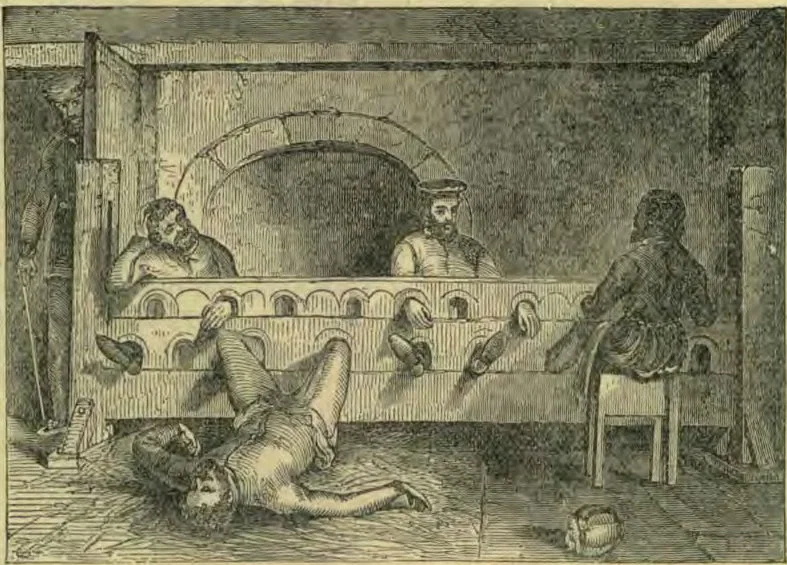
WHAT do you suppose these men are doing? and why are they sitting and lying in such a strange way? They do not look as if they could be at all comfortable.
In olden times people sent to prison, often had their hands and feet fastened in this manner both to make their punishment greater and to keep them from getting away; and to this day it is still done in some parts of the world. It is called putting them “in the stocks.” Once upon a time there were two good men who went to a city of Greece to tell the people how Jesus Christ had come to earth and lived for thirty years among men, and then died a cruel death on the cross to save them from their sins. Through the week they went from house to house, telling to all who would hear them this glad news. On the Sabbath they had a meeting on the banks of a river outside of the city a little way, and there they preached to those who gathered to hear them. Some of the people were very much interested in what the men had to say, and a few believed this new truth and were baptized in the name of Jesus. One woman, who kept a store, was very kind to the preachers and invited them to make it their home at her house. This they did, but every day they went into the streets of the city and taught those who would listen.
At one time a girl who had the spirit of a devil in her, kept following the men and crying out, “These men are the servants of the most high God, which show unto us the way of salvation.” She did this for several days, until finally one of the preachers turned and in the name of Jesus bade the unclean spirit come out of her; and it did. Now some of the men were angry with these good men because of their plain talk to them, and they were glad to find some excuse for making them trouble. So they went to the officers of the city and said these men who had come among them were teaching bad things and making a great deal of disturbance in the town. Then the preachers were taken and beaten, and cast into the “inner prison” and their feet made fast in the stocks.
Now most of us would feel very sad and unhappy to be used in this way when we knew we had been doing right. But these men were very cheerful amid all their trials, for they remembered for whose sake they suffered, and knew that He was able to deliver them from prison. So all the night time they were praying and singing praises to God so loud that the other prisoners heard them. Do you not think they must have wondered what made these strange men so happy?
Well, about midnight, all at once there was a great earthquake, the prison was shaken, all the doors flew open, and every prisoner was freed from the stocks. At this, the keeper of the prison waked from his sleep, and supposing that the men had all got away, he was about to kill himself. But one of the preachers called aloud to him and told him to do himself no harm, for they were all there. Then the jailor got a light and came in where they were. He was very much afraid, and begged the good men to tell him what to do to to be saved. So they told him about the Lord Jesus Christ, and how he must believe on him if he would be saved. He then asked them to go with him to his own house, and after the men had talked to him and to his family, they all believed and were baptized in the name of the Lord Jesus. And the next day these good men went on their way to preach to the people of another city.
If any of you would like to hear more of this story, and know the names of these preachers who were treated so cruelly, you may get some one to read you the 16th chapter of the Acts of the Apostles. E. B.

DOING EVERYTHING CHEERFULLY.

Who does not love to see everybody doing things cheerfully? How pleasant to see children, in their play, in their work, in their studies, engage in each of them cheerfully!
Most of the pictures of school-children represent them just out of school. They are all life and joy, throwing their hats into the air and shouting in their gladness, as if they were just bursting out of the gloomy cells of a prison.
It is, indeed, a great relief, after two or three hours of hard study in the heated school-room, to come forth into the fresh air. No wonder the children make such exhibitions of joy at such times.
But is it not also pleasant to see children happy on their way to school! With books and slates, and in their tidy school dresses, why should not the children march cheerfully along, singing and shouting as they go? They are not on the way to cruel prison tasks. They are walking the same path which all the wise and learned and honored have trod before them. If any have a right to be joyful and happy on the way to and from school, it is those who are cheerful and diligent in their studies while in school.
Yes, young friends, learn to do everything, at home and in school and everywhere, cheerfully. That is the way to make life, with its many duties, pleasant and happy.—Selected.

THE WRONG PLACE.

WHEREVER a Christian cannot carry a clean conscience and his Master's smile, is the wrong place. I do not care how strong the inducement to go there, or how attractive the bribe which the tempter may offer. If conscience rebels—if conscience even whispers a doubt as to the rightfulness of going—then stay away. If we err at all, let it be on the safe side. But a Christian never does “err” when he obeys his conscience, and honestly aims to please his Master. The real error and the backsliding commonly begin when we begin to hush the murmurs of conscience by saying, “Oh, I will go just this once;” or, “Everybody else goes. Why may not I?” or, “If I do go, it won’t be noticed.” These are the smooth excuses which the devil always has ready for a Christian professor, when he is strongly tempted toward the ball-room, or the sensual entertainment, or the convivial frolic of some kind. The place where he would not be expected to be, is the very place where he ought not to be. Let the “lovers of pleasure more than the lovers of God” gather to the carouse, or to the passion-kindling play, or to the wine-feast, if they will; but Christ’s smile never beams upon one of his followers in such places. The eye that “looked upon Peter,” until Peter shrunk away to shed bitter tears in the garden, often falls upon the inconsistent Christian who is spending an evening in bad company.—Dr. Cuyler.
Continue reading: RELIGION AND YOUTH