The Youth’s Instructor, Vol. 47, No. 44.

CHRISTIAN EDUCATION IN AUSTRALIA

The Youth’s Instructor

Nov 9, 1899

Review and Herald Publishing Company · Battle Creek, Mich. · Nov 9, 1899

CHRISTIAN EDUCATION IN AUSTRALIA

WHEN we consider English history, and the fact that civil and ecclesiastical affairs of that nation have for ages been closely identified, and also the close relation that the people of Australia sustain to English history, it is not at all strange that there should be in the colonies a strong tendency toward a union of church and state. It would follow, as a matter of course, that there would be a demand for the introduction of religious matters into the Department of Public Instruction. It is true that the prevailing sentiment is in favor of the separation of religious considerations from public affairs; still, the effect of tradition lingers in the blood of many of the people of the land.
DORA CREEK BRIDGE
DORA CREEK BRIDGE
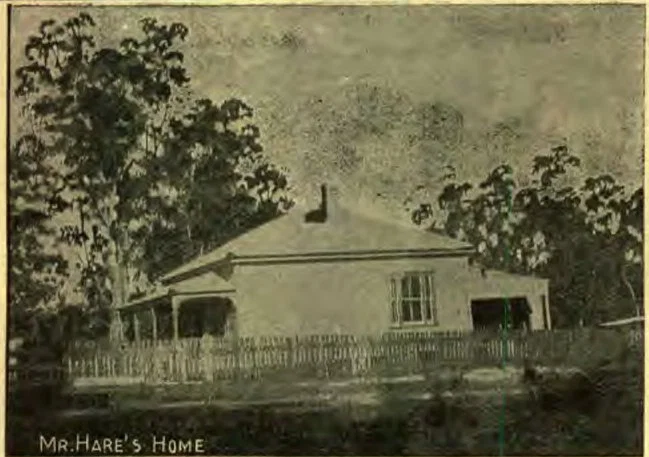
MR. HARE'S HOME
MR. HARE'S HOME
But it is vain to look for Christian education in secular institutions. There is a distinction to be observed between the terms “religious” and “Christian;” for while Christianity is always religious, religion is not always Christian. Christian instruction can emanate only from Christian sources. And it is necessary for those who have definite ideas as to what constitutes Christian education, and wish their children to enjoy the advantages of such education, to provide a school in which these religious ideas are the essential element.
Seventh-day Adventists are coming to recognize this fact, and this has led them to undertake the establishment of a denominational school in Australasia; and great efforts are being made by its promoters to have it in all respects just what such a school should be.
Having spent a few days at this school, I will, at the courteous invitation of the Editor, put some of the facts and my impressions on paper.
The initiative step toward this school was the temporary establishment, in 1892, of the Australian Bible School in Melbourne. As facts are the object of our account, we shall omit names quite largely, except where it seems necessary to mention them. But this should not be regarded as showing a lack of appreciation of the personal efforts of those who have labored unselfishly in the work.
It was felt that the city was not the place for the establishment of such a school. The counsel of Mrs. E. G. White, who during this time has been a resident of Australia, led to a diligent search for a suitable location, where lessons from nature could be drawn without stint or limit; where opportunities could be found for practical instruction in useful industries, both agricultural and mechanical; and where there would be a minimum of those influences that distract the minds of students from their work, and thus undermine the work of the teacher.
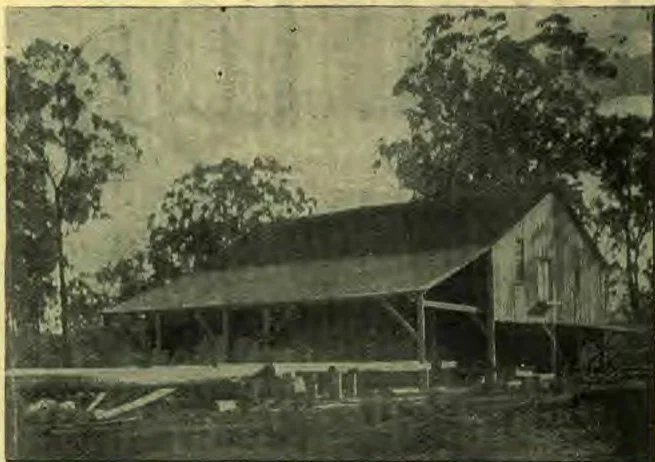
SAWMILL.
SAWMILL.
About seventy-five miles north of the beautiful city of Sydney, and twenty-five miles south of the coal-mining city of Newcastle, the railway line crosses an arm of the sea. This is called Dora Creek. It is not much of a creek, in the usual sense of the term, having but a small flow of fresh water during the greater part of the year. But practically it is a deep and beautiful waterway, capable of bearing small vessels, and is always placid and available for use. About three miles up this stream, or arm of the sea, toward the west, was found a large tract of land for sale. It consisted of over fifteen hundred acres in a wild state, covered with a dense growth of timber, and having a soil of varying quality. There was a portion of swamp; there were knolls, and dry ridges, and low valleys; and there was clayey soil and sandy soil, as well as rich mold.
After much deliberation, into which misgivings mingled with confidence, and doubts contested the ground with faith, this tract was purchased at a low price, and the work began in 1894. The school was opened in a vacant public house near the estate; and from this little fortress the students and workers sallied forth on the adjacent forest, armed with axes, grubbing-hoes, and saws. Their capital was faith in God, from whom they drew their strength and courage.
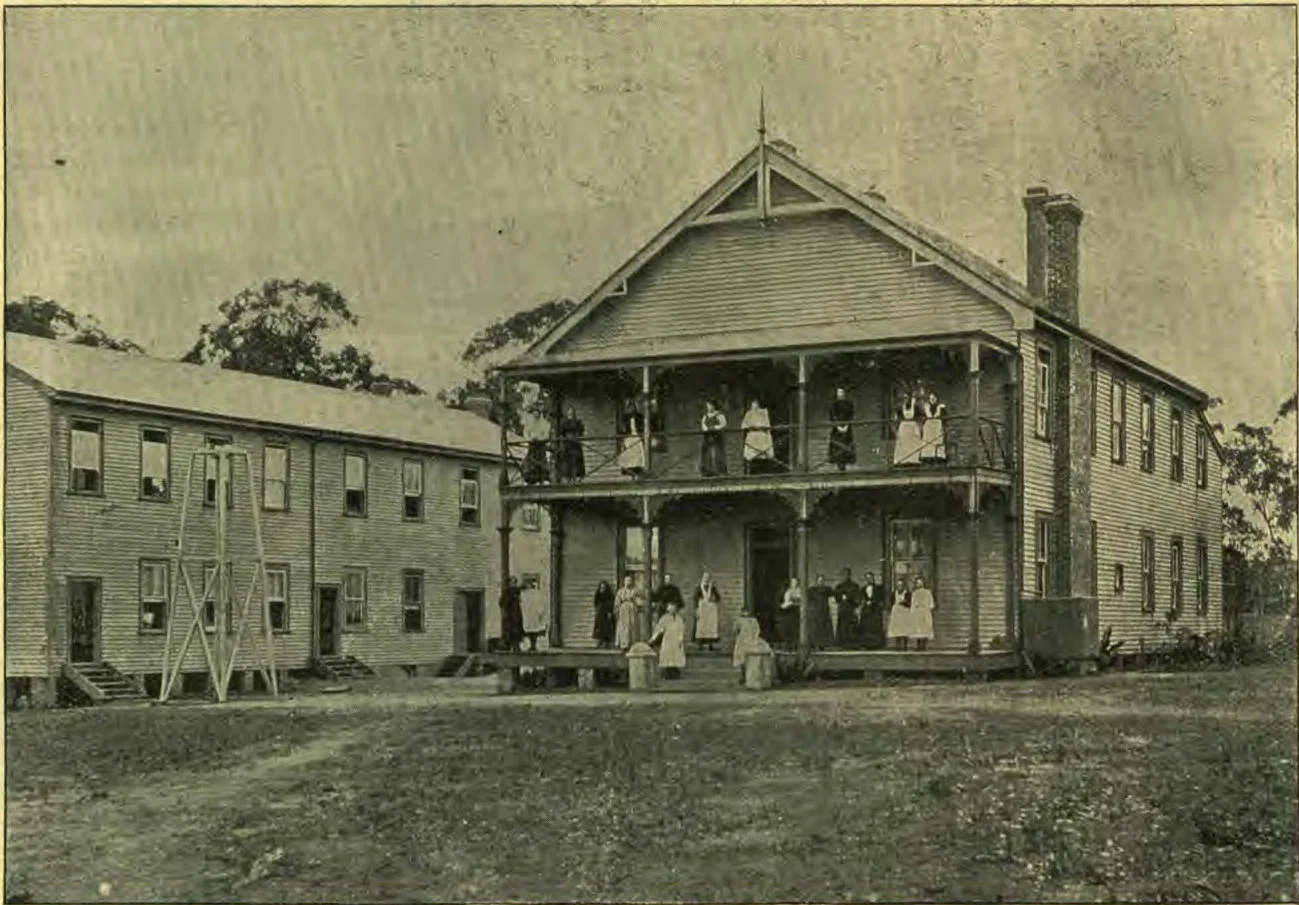
THE DINING-HALL AND GIRLS’ HALL.
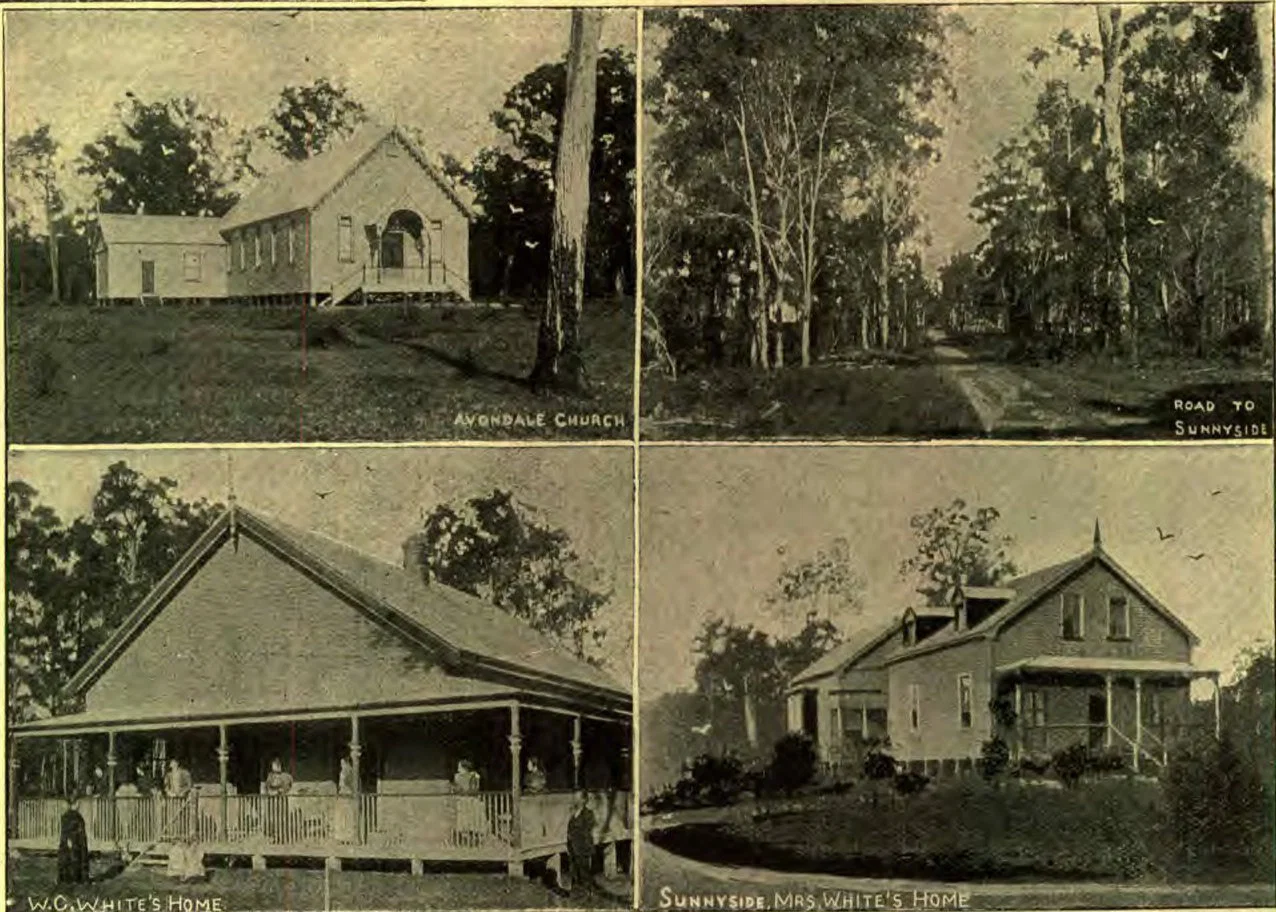
Mr. Metcalf Hare was the first to settle on the estate, and the first house was a cotton tent. This was in April, 1895. Three months later, Mrs. White opened a clearing half a mile north of the school site, and began the building of a dwelling. She immediately had an orchard planted, and advised those in charge of the school work to follow her example. While the matter of purchasing the estate was in doubt, an angel appeared to her in a dream, and confirmed the proposition to purchase, assuring her of the fruitfulness of the soil. It was her faith in this testimony, and her intense desire to see it verified, that prompted her vigorous work.
During that year one thousand of the best fruit-trees were set out; and in less than three years a good supply of peaches, plums, lemons, oranges, and nectarines was obtained, all the fruit being of the best quality. Vegetables and grains also do well. Thus in five successive seasons has the faithfulness of the heavenly witness been demonstrated, to the silencing of every voice of misgiving and distrust, even though supported by the wisdom of the world.
One of the first enterprises was the erection of a sawmill, in which the timber could be converted into building-material. The mill first cut its own cover, and then provided the lumber used in the construction of other buildings.
On Oct. 5, 1896, the first brick in the foundation of the first school building was laid by Mrs. E. G. White. This was the Ladies’ Hall, which is sixty-five by thirty-six feet, two stories high, and affords accommodation for thirty students. At the same time a dining-hall was erected, which is eighty by twenty-six feet, two stories high, and has a basement forty by twenty-six feet.
These two buildings were ready for use at the beginning of the first term, April 28, 1897, on which day the buildings were dedicated to their sacred mission.
During the vacation of ’97 and ’98 another building, the Boys’ Hall, was erected. This is considerably larger than either of the others. It is, like them, plastered and ceiled inside, and will accommodate fifty-six students. A bakery and laundry have also been built, and a cistern, which in all ordinary weather provides an ample supply of the best water.
The school now has seven horses, eleven cows, and six young cattle. The cows provide ample milk and cream for the school.
One year ago twelve swarms of bees were secured, and during the year they have made over six thousand pounds of strained honey, and have increased to about thirty-five swarms.
A good number of fowls provide eggs for the school. This is their only use, as the school family is strictly vegetarian, both in principle and in practise.
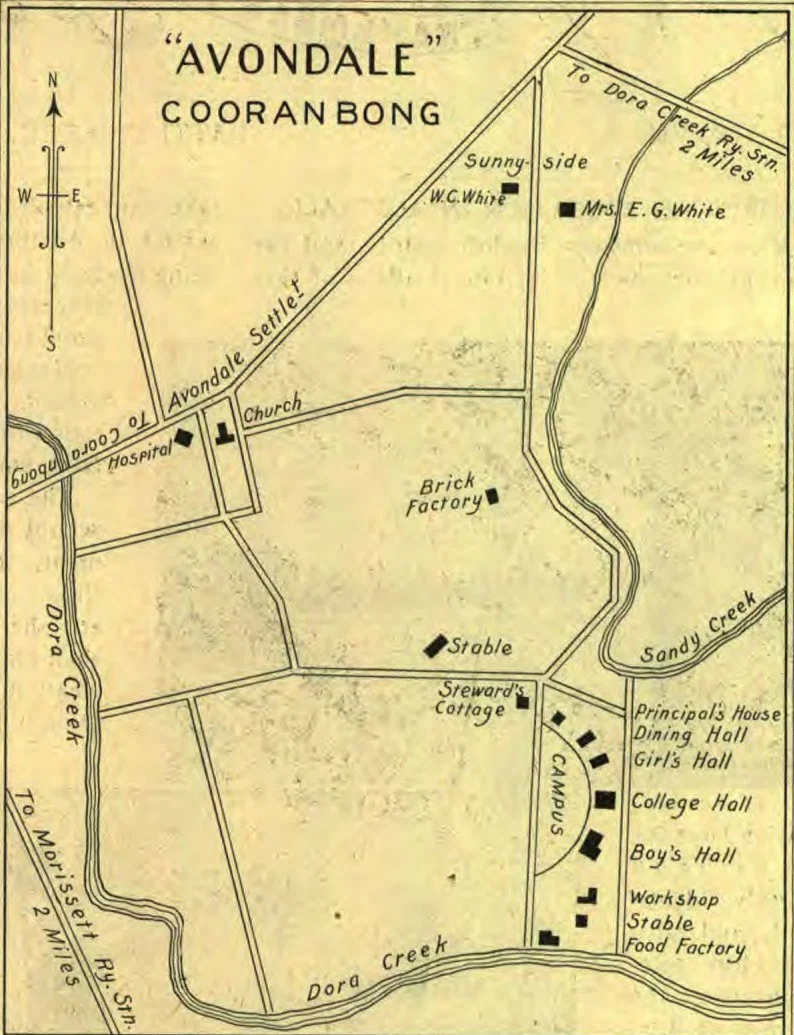
The school buildings are erected in a large crescent, in front of which is a broad campus. A short distance beyond the campus is the fertile swamp land, with a range of hills for a background. When facing the swamp, Sandy Creek is between one and two hundred yards distant squarely to the right. The road to Mrs. White’s home leads in that direction, close to the creek. In front, but a little to the right, is the home of Mr. M. Hare, and the road leading to the church is in the same direction. To the left is the mill and the Avondale boat-landing on Dora Creek, and to the rear of the buildings is the orchard. Mrs. White’s home and the church are both situated on Maitland Road, about three fourths of a mile distant. One thousand acres of the school land are beyond this road, and open for sale and settlement; and a number of our brethren have already established homes on the estate: but the greater part of the land on the school site “is, by the appointment of God, dedicated to the school farm.” G. C. TENNEY.

A PARABLE FOR THE TEMPTED

A STORY is told of a man who once asked an Eastern king if he could tell him how to avoid temptation.
The king told the man to take a vessel brimful of oil, and carry it through the streets of the city without spilling one drop. “If one drop is spilt,” said the king, “your head shall be cut off.” He then ordered two executioners, with drawn swords, to walk behind the man, and to carry out his orders.
There happened to be a fair going on in the town, and the streets were crowded with people. However, the man was very careful, and he returned to the king without having spilled one drop of the oil. Then the king asked: “Did you see any one while you were walking through the streets?”
“No,” said the man; “I was thinking only of the oil; I noticed nothing else.”
“Then,” said the king, “you have learned how to avoid temptation. Fix your mind as firmly on God as you fixed it on the vessel of oil, and you will not then be tempted to sin.”—Well-Spring.

The Praise of the Multitude

“THE praise of the multitude can not give peace to the heart that has been false to itself.”

THE JOY THAT IS SET BEFORE US

II

The message of mercy that Christ brought from the Father to man was meant for the ears of the world: “I, if I be lifted up from the earth will draw all men unto me.” Everlasting life has been purchased for man at an infinite cost. “God so loved the world, that he gave his only begotten Son, that whosoever believeth in him should not perish, but have everlasting life.” Through this matchless gift, Christ encircles the world with an atmosphere of grace. All who choose to inhale this life-giving air will have eternal life.
That Christ should take human nature, and by a life of humiliation elevate man in the scale of moral worth with God; that he should carry his adopted nature to the throne of God, and there present his children to the Father, to have conferred upon them an honor exceeding that bestowed upon the angels,—this is love that melts the sinner’s heart. It is too much for the human mind to grasp, that God, having gathered together all the riches of the universe, and laid open all the resources of his power, should place them in the hand of his Son, saying, All these I give to you for man. These are my gifts to him. Confer them upon him, that he may know that there is no love like mine, and that his eternal happiness consists in giving me his love in return. As the sinner contemplates this love, it broadens and deepens into infinitude, passing beyond his comprehension.
Co-laborers with God are to fill the space they occupy in the world with the love of Jesus. The world needs spiritual workers, who will plant the seeds of truth in every heart. Christ calls upon us to be “instant in prayer.” By this he means that the heart is constantly to go out after God, while we watch for opportunities to do good to the souls that are ready to die.
“Seeing ye have purified your souls in obeying the truth through the Spirit unto unfeigned love of the brethren, see that ye love one another with a pure heart fervently.” God has chosen you to salvation through sanctification of the spirit and belief of the truth. Therefore stand fast. Your hardest conflict will be in keeping the straight and narrow path that leads to eternal life. In order to do this, you must die daily. If you serve God faithfully, you will meet with prejudice and opposition; but do not become provoked when you suffer wrongfully. Do not retaliate. Hold fast your integrity in Jesus Christ. Set your face as a flint heavenward. Let others speak their own words, and pursue their own course of action; it is for you to press on in the meekness and lowliness of Christ. Do your work with steadfast purpose, with purity of heart, with all your might and strength, leaning on the arm of God. The true and exalted nature of your work you may never know. The value of your being you can measure only by the life given to save you.
The apostle gives us his experience and the experience of his fellow laborers in their work. “We are troubled on every side,” he says; “yet not distressed; we are perplexed, but not in despair; persecuted, but not forsaken; cast down, but not destroyed; always bearing about in the body the dying of the Lord Jesus, that the life also of Jesus might be made manifest in our body.” If we work the works of Christ, the mind will gather strength and firmness to resist the adversary of souls. The apostle says, “Think it not strange concerning the fiery trial which is to try you, as though some strange thing happened unto you.” “Ye are in heaviness through manifold temptations: that the trial of your faith, being much more precious than of gold that perisheth, though it be tried with fire, might be found unto praise and honor and glory at the appearing of Jesus Christ.” “Wherefore let them that suffer according to the will of God commit the keeping of their souls to him in well-doing, as unto a faithful Creator.” “Humble yourselves therefore under the mighty hand of God, that he may exalt you in due time: casting all your care upon him; for he careth for you. Be sober, be vigilant; because your adversary the devil, as a roaring lion, walketh about, seeking whom he may devour: whom resist steadfast in the faith, knowing that the same afflictions are accomplished in your brethren that are in the world.”
For every soul who is growing up into Christ there will be times of earnest and long-continued struggle; for the powers of darkness are determined to oppose the way of advance. But when we look to the cross of Christ for grace, we can not fail. The promise of the Redeemer is, “I will never leave thee nor forsake thee.” “I am with you alway, even unto the end of the world.” MRS. E. G. WHITE.
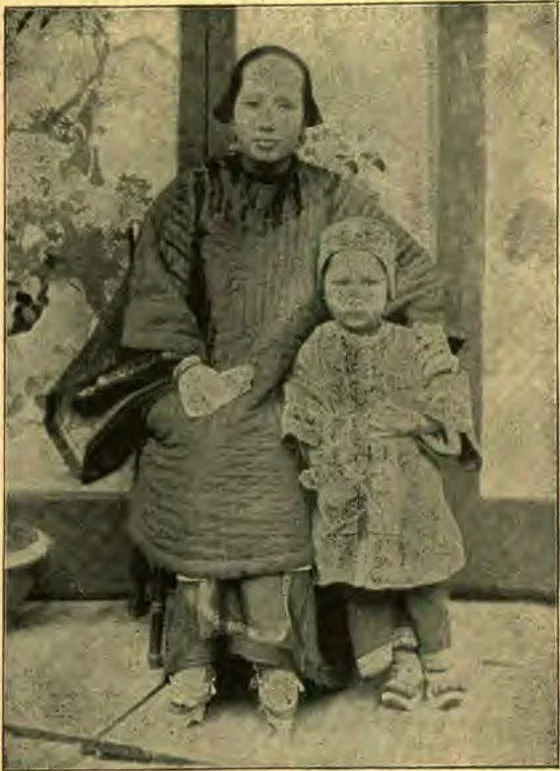
WELL-TO-DO CHINESE MOTHER AND CHILD.

CHINESE CHILDREN

A few days ago a friend asked me how children are cared for and trained in China. Yesterday another young friend, a reader of the INSTRUCTOR, asked me if Chinese mothers are kind to their children. I said, “No, they are not, because they do not understand what kindness is.”
“Then I would not like to be a Chinese girl,” said my friend.
Well, it is quite so. I suppose you would rather stay where you can get a sweet kiss from a lovely mother than to be in a land where motherly love, as we understand it, is unknown. But some must be Chinese girls and boys; for there are many children in the “Flowery Land,” as the Chinese call their country. And now, to speak the truth right out, your uncle loves those small, dirty boys and those forsaken girls; and why should he not?
First I will try to answer the question brought before us concerning the care of Chinese mothers for their children. While I am doing this, please do not say, “What a dirty people the Chinese are!” but instead, draw near to Jesus, and say, “Jesus, they do not know thee.” And you must not be afraid if he asks you to go, and teach them the love of God; but gladly say, “Lord, here am I; send me.”
Let us in imagination go far, far away into the interior of the “Land of Sinim.” There we shall not sit at the doors of the rich, neither stay among those who love Jesus, but go out among the common people, to the very poor, and hear what they say, and see what they are doing. In that way we can more fully understand what we are speaking about.
I think it will do you good to know the real condition of the children of China; and I am sure all of you have a little love in store for them. To love those whom no one else loves is the surest way to be filled with peace and happiness ourselves. As a small girl in my native country [Sweden] said: “Mama, when I give poor Kalle my dinner, I am so happy that I don’t feel hungry all day.”
The Chinese are all their lifetime in bondage to a fear of evil spirits. They do not have the Bible, from which to learn that death is a sleep, and that the “dead know not anything;” so they imagine that the souls of their dead neighbors are hovering around, ready to do all sorts of mischief. They think that if they show they are glad when a little child is born, some evil spirit will immediately do something to hurt it; so they resort to many tricks to deceive these spirits.
The poor little babies are often sadly neglected, partly on account of the poverty of their parents, and partly because they do not know the better way. Children are not under any circumstances washed clean, as are the little ones in this country; but they are left to grow up in dirt as well as they can. I asked a father who brought his eight-year-old boy to my school why he did not wash his son’s face before bringing him to school. The poor father looked surprised, and said: “Dear lang-shi-fu [foreign teacher], the climate is such in this land that if we wash the children, they will surely die. Furthermore,” he said, “the real truth is that the kwei-tsi [evil spirits] would not have such a small, dirty keo-wa-tsi [puppy].”
You can easily understand that where filthiness is so prevalent, all forms of disease are found. I have seen small children whose whole bodies were covered with scrofulous sores. Smallpox is very common in China, as a result of uncleanliness. In one place I found outside a cottage door a poor little boy who was about to lose the sight of both eyes. His whole head and face were covered with painful sores. He had never been thoroughly washed. The father, seeing me beside the boy, came and bowed several times toward the ground, and said: “Tai-fu [doctor], will you kindly cure my boy? He is suffering terribly, as you see.” I promised to do what I could. After I had, like a Chinese doctor, examined the pulse in two places on the right arm, and also spent some time in examining the palm of the left hand, the father said: “Tai-fu, I see you understand your business.”
“Yes,” I said, “I think I do.”
I then told the father to bring some water. The poor man did not understand me; he thought I was thirsty, and wanted something to drink, so he brought me a tea-pot. In telling him plainly that I wished water to wash the boy clean, he rose up to his full height, and said: “Now I know what you are trying to do.” Then he drove me out of the house, as one would drive a dog who had stolen food. As I went slowly away, he shouted after me, with all his might, saying: “You are thinking about killing my boy! You want his eyes, heart, and liver for medicine! I know your intention. Get away, foreign devil, and never return!”
I have much more to tell you, by and by, about Chinese children,—how they are dressed while very small, how they are carried and fed, and many other things.
Will you not ask God to raise up, educate, and qualify many persons to go out to China to help the poor, ignorant fathers and mothers and the neglected children?
UNCLE PILQUIST.

OVER ALL

WHETHER the skies be dark or blue, The same kind Father is over you; The clouds that obscure the sun to-day, To-morrow his hand will sweep away. In storm or in shine, In deluge or dew, The same kind Father Will watch over you.
Whether the heart, then, sings or sighs, Whether the sun hangs in the skies, Or whether shadows hang thick above, Over it all is a God of love. In storm or in shine, In deluge or dew, The same kind Father Will watch over you.
— Selected.

PERSPECTIVE

NATURE is God’s great library. In no other way can we study nature so well as by trying to reproduce her. To be able to picture nature correctly, we must first see her correctly, and then we must have a practical knowledge of perspective.
The text-book on perspective is usually a complex thing, though it is an admirable help to the student after he has gained, by practical work, a knowledge of its terms.
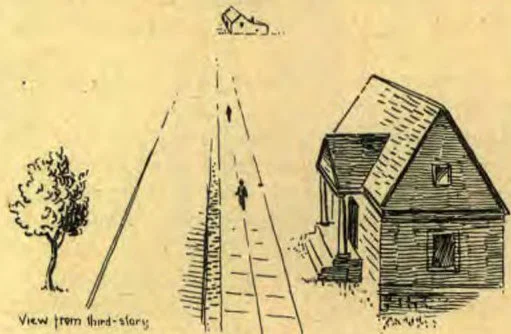
By drawing objects in perspective, we mean putting them on a flat plane. For example, this page is a flat plane; a wall or pane of glass is a flat plane. If we were to go to a third-story window, and with brush and ink outline upon the pane a few of the objects we see through it, we should be drawing them upon a vertical plane.
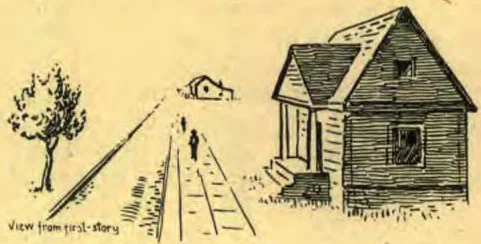
View from first-story
We should notice that a person half a mile away would seem to be floating in the air above the head of one nearer by. A barn in the distance would appear as small as one of our neighbor’s windows, and would appear to be floating over his roof. If you looked out of a first-story window, the distant man would appear smaller than the one near you, but would not seem to float over the latter. The distant barn would also be smaller than the neighbor’s house, though instead of being above the house, perhaps it would be on the same level. In either case your drawing, on a vertical plane, the distant objects that you saw through the window, would illustrate the meaning of the word “perspective,” which means “to see through;” per, “through;” and specio, “look,” or “see.”
Do not think that one should be able to draw before studying perspective; for the rules of perspective enter into everything one draws. With some thought and practise, a child can understand simple perspective well enough to draw correctly what he sees before him. This point we will endeavor to reach together.
The chief thing to remember is that we must draw the object as we see it, rather than attempt to reproduce what we know it to be. Often one sees persons draw a cube or box with all sides parallel, as illustrated in Fig. 1. They know the sides of the box are all parallel, and they draw it as they know it to be, instead of as they see it.
If they observed closely, they would see that all the receding lines, if extended, would meet at one point, as in Fig. 2. This would be impossible to draw if all the receding lines were made parallel, as in Fig. 1. For example, we know that the steel rails of a track, as they go away from us, are parallel; that they are no closer to each other two miles away than they are right here at our feet. But if, when we draw them, we draw them parallel, we shall be drawing them as we know them to be; and our picture will not look in the least as those rails do when we stand and look down the track.
As they recede from us, the sides of the track appear to be nearer together until they seem to meet in the distance. PEDRO LEMOS.

Harvest That Waits in a Diviner Air

But it may be, in a diviner air, Transfigured and made pure, The harvest that we deemed as wholly lost, Waits, perfect and mature; And the faint heart that now, defeated, grieves, May yet stand smiling ’mid abundant sheaves. —Mary L. Ritter.

STRANGE LANGUAGES

Mrs. A. D. WELLMAN, who with her husband spent some years in the Pacific Islands, under the direction of the Foreign Mission Board, gives, in one of our exchanges, the following interesting comments on the languages of those islands:—
On the many islands in the central and southern part of the Pacific Ocean, the people speak languages not used in any other part of the world. The speech of the different islands is somewhat alike, and probably not very long ago they all had the same language. On some of the islands, for example, the word that means “man” is taata; on others it is tangata; on still others, kanaka. The word “love” is aroa in some of these places; in others it is arofa, aroha, alofa, and aloha.
These islanders never bid one another “Good morning,” or “Good evening.” Instead, some of them say, when they meet and when they separate, something that means, “Live.” Others have other forms of greeting. Most of them have no words meaning “thanks,” or “please,” or “pardon.”
They have strange names for some of the things that have been taken there by white people. A cat is called a “cry-house;” a horse, an “animal-run-land;” a sail-boat is known as a “wind-boat.” They were very much frightened at the first horses taken there.
These people have no oaths; and if they learn from rough white men to swear, it is in English, or French, or German. They think the worst thing they can say to any one is to call him a rat.
A hundred years ago no one could write the language of these people, and they had nothing to read, and would not have known how to read it if they had; but missionaries came, and learned the languages, and then wrote the words, spelling them just as they sound. Afterward the missionaries translated the Bible into many of these languages, printed it, and taught the islanders to read it.
But there are no words in these languages for some things mentioned in the Bible, such as snow, different kinds of food, animals, and other things; and foreign words had to be used, and their meaning explained to the natives.
When I have tried to explain to some of these people what ice is, by telling them that it is water become hard like rock, because of the cold, they have thought I was telling a falsehood; for they never saw ice, nor would they believe that water ever becomes solid.

Life's Best Things Take Time

“LIFE’S best things take time. A character is not a creature of a day. An education can be bought only by the expenditure of years. Friendships that last are long in the growing. So it is with all things worth while. There is no sure treasure gained in a hurry. He who would be rich with life’s best riches must plan to spend long years in the securing of them.”
Continue reading: MYSTERY OF THE CLOUDS