The Youth’s Instructor, Vol. 28, No. 17.

TWO WAYS OF READING THE BIBLE

The Youth’s Instructor

Apr 21, 1880

S. D. A. Publishing Association · Battle Creek, Mich. · Apr 21, 1880

TWO WAYS OF READING THE BIBLE.
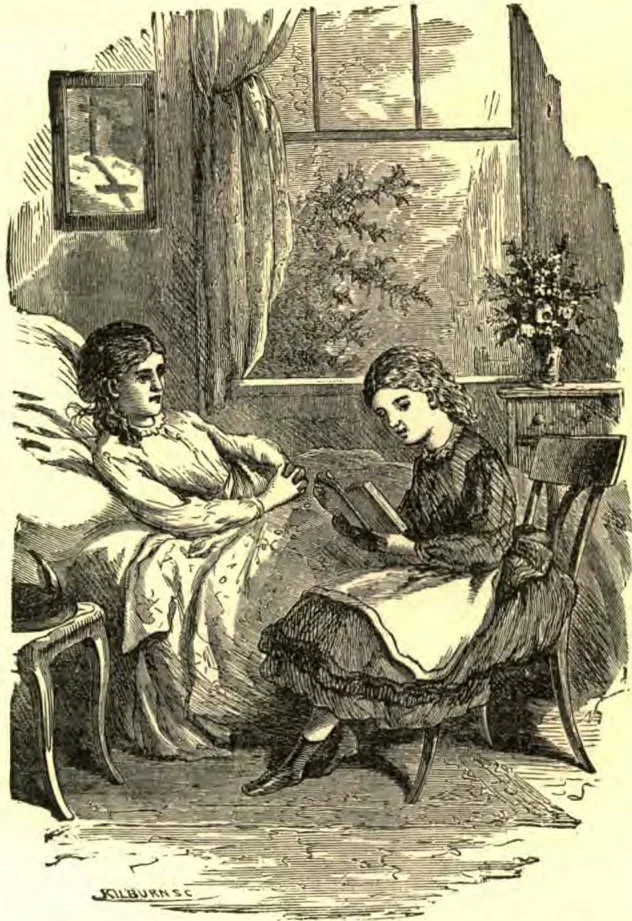
“Would you like another chapter, Lilian dear?” asked Kate Everard of the invalid cousin, to nurse whom she had lately come from Hampshire.
“Not now, thanks; my head is tired,” was the reply.
Kate closed her Bible with a feeling of slight disappointment. She knew that Lilian was slowly sinking under incurable disease, and what could be more suitable to the dying than to be constantly hearing the Bible read? Lilian might surely listen, if she were too weak to read for herself. Kate was never easy in mind unless she perused at least two or three chapters daily, besides a portion of the Psalms; and she had several times gone through the whole Bible from beginning to end. And here was Lilian, whose days on earth might be few, tired with one short chapter!
“There must be something wrong here,” thought Kate, who had never during her life kept her bed for one day through sickness. “It is a sad thing when the dying do not prize the word of God.” Such was the hard thought that passed through the mind of Kate, and she felt it her duty to speak on the subject to Lilian, though she scarcely knew how to begin. “Lilian,” said Kate, trying to soften her naturally quick, sharp tones to gentleness, “I should think that now, when you are so ill, you would find special comfort in the Scriptures.”
Lilian’s languid eyes had closed, but she opened them, and with a soft, earnest gaze on her cousin, replied, “I do—they are my support; I have been feeding on one verse all the morning.”
“And what is that verse?” asked Kate. “ ‘Whom I shall see for myself,’” began Lilian slowly; but Kate cut her short—“I know that verse perfectly—it is in Job; it comes just after ‘I know that my Redeemer liveth;’ the verse is, ‘Whom I shall see for myself, and mine eyes shall behold, and not another.’”
“What do you understand by the expression ‘not another’?” asked Lilian.
“Why of course it means—well, it just means, I suppose, that we shall see the Lord ourselves,” said Kate, a little puzzled by the question; for though she had read the text a hundred times, she had never once dwelt on its meaning.
“Do you think,” said Lilian, rousing herself a little, “that the last three words are merely a repetition of ‘whom I shall see for myself’?”
“Really, I have never so particularly considered those words,” answered Kate. “Have you found out any remarkable meaning in that ‘not another’?”
“They were a difficulty to me,” replied the invalid, “till I happened to read that in the German Bible they are rendered a little differently; and then I searched in my own Bible, and found that the word in the margin of it is like that in the German translation.”
“I never look at the marginal references,” said Kate, “though mine is a large Bible and has them.”
“I find them such a help in comparing scripture with scripture,” observed Lilian.
Kate was silent for several seconds. She had been careful to read daily a large portion from the Bible; but to “mark, learn, and inwardly digest it,” she had never even thought of trying to do. In a more humble tone she now asked her cousin, “What is the word which is put in the margin of the Bible instead of ‘another’ in that difficult text?”
“A stranger,” replied Lilian; and then, clasping her hands, she repeated the whole passage on which her soul had been feeding with silent delight: “‘Whom I shall see for myself, and mine eyes shall behold, and not a stranger.’ O Kate,” continued the dying girl, while unbidden tears rose to her eyes, “if you only knew what sweetness I have found in that verse all this morning while I have been in great bodily pain! I am in the Valley of Shadow—I shall soon cross the dark river; I know it: but He will be with me, and ‘not a stranger.’ He is the Good Shepherd, and I know his voice; a stranger would I not follow. And in the glad resurrection morn, it is the Lord Jesus whom I shall behold—my own Saviour, my own tried friend, and ‘not a stranger;’ I shall at last see Him whom, not having seen, I have loved.”
Lilian closed her eyes again, and the large drops, overflowing, fell down her pallid cheeks; she had spoken too long for her strength, but her words had not been spoken in vain.
“Lilian has drawn more comfort and profit from one verse—nay, from three words in the Bible, than I have drawn from the whole book,” reflected Kate. “I have but read the Scriptures—she has searched them. I have been like one floating carelessly over the surface of waters under which lie pearls; Lilian has dived deep and made the treasure her own.”—Advocate and Guardian.

APRIL

A FAINT, soft breath from low-hung skies— As if it swept o'er flowers; A languid sweetness running through The long day's dreamy hours; The violet haze upon the hills Drops on the leafless trees, And in the west the setting sun Is drowned in purple seas.
A sweet, green prescience clothes the fields; And in the rocky dells The violet and forget-me-not Unclose their azure bells; The streams, released from icy chains, Down the grim highlands flow— And the great river's troubled breast Is white with foamy snow.
The fruit-trees droop with crimson buds,— A prophecy of bloom; The crocus and the daffodil The garden beds illume; The pale arbutus springs to life, And lifts its starry eyes In quiet forest paths, and haunts Where mellow sunshine lies.
Anon, upon the crystal air Rings out the robin's note; And from the tall elm, by the gate, The bluebird's warblings float; The lambs bleat on the pasture hills, And frolic at their play— And all the earth is holding breath To hear the step of May.

SIX MONTHS ON A CAKE OF ICE.

(CONCLUDED.)
The month of March opened upon our voyagers with terrible severity, yet one of the men ventured out on the ice and shot sixty-six dovekies, a little Arctic water-bird which weighs only three or four ounces. About this time the party were in very great apprehension by the grinding of the ice mountains, which sounded like heavy artillery. The floe also was being constantly reduced in size. The roaring of the gales, the collision of the bergs, the swashing of the water, and the breaking up of the floe, made their situation most terrible to contemplate. But the Guiding Hand had mercies still in store for them, and soon the weather moderated. Not far from this, when their food was all gone, and one of their boats burned up for fuel, the captain shot a polar bear, which saved them from starving. “Praise the Lord,” writes one of the men, “this is his Heavenly work! Food comes some way, when we must have it.”
The last of March, observations were made, and they judged that they were opposite Cape Farewell, the most southern land of Greenland. Heavy Atlantic gales were now greatly reducing the floe in size, and they were also in a drowning condition. They now took to the boat in hopes of finding a larger piece of ice. They had also reached the place where vessels in quest of seals might be expected. After buffeting with ice and water for several hours, they hauled up on a small floe, and erected the canvas tent. At this time one of the Esquimaux shot a bear, which was ranging over the ice in search of seals. This furnished them with a supply of food for a while. But the month of April was by far the most perilous time to the drifting party, in consequence of their being obliged to pass from floe to floe, as the ice would break. Sometimes the floe would suddenly separate, leaving the party on different pieces, and throwing them into the water. At times they were obliged to keep the women and children in the boat, to be ready when the ice broke. Once they were compelled to hold on to the boat for above thirty hours in succession, to keep her from being washed off in a gale.
But there remained only a few more days of drifting, and waiting, and watching for the mariners. On the 28th, just at night, they descried a steamer in the distance, but could not attract her attention, and she bore away. Fires were now made on the ice, with seal blubber, to attract the attention of passing vessels. Again their spirits rose and fell by seeing a steamer several miles away, but she, too, soon passed out of sight, though they discharged all their guns to attract her attention.
But early on the following morning, when the fog lifted, a glorious sight met their anxious gaze! A steamer was discovered within a short distance of the floe. Guns were immediately fired, the colors were set, and loud and prolonged shouts were uttered. The vessel’s head was soon turned toward them, and in a few moments she was along-side the floe. The continued cheers given by the shipwrecked party were returned by the shouts of a hundred strong men on deck and aloft. In a few moments they were all on board; yes, on board, and, thank Heaven,—SAVED.
This providential deliverance occurred May 1, 1873. The vessel was the sealer Tigress, of Newfoundland. The floe-party was picked up off the coast of Labrador, in latitude 53° 35′ north, and had consequently drifted through twenty-four degrees of latitude, and over a waste of ice and water some two thousand miles in length!
How wonderful are the ways of Providence with the needy children of men.
In another article we will tell the readers what became of the Polaris, and the men left on board.
G. W. AMADON.

HARRY'S LESSON.

Harry Connors was fifteen years old, and he thought himself a very fine, manly fellow; and so he was in his way; he despised everything mean, never ordered about the little boys, and was always respectful to his parents; but he had some unfortunate notions of manliness. One of these was, that doing errands was not dignified and proper employment for a person of his age and experience, and should be left entirely to small boys.
One day his mother asked him to go to Mrs. Lucas’ with a basket of work, and some food for the widow’s dinner. Harry did not like to refuse, though he thought his mother might have sent some one else as well; so he took up the basket and walked along rather sullenly. Mrs. Connors looked after him, feeling a little proud of her boy, and at the same time a little sorry that he was no wiser.
The day was rather unpleasant, and the cold rain chilled Harry so that he felt uncomfortable, and it must be owned, quite cross, as he turned up the lane that led to Mrs. Lucas’ door. He was glad to find a good fire inside and to have an opportunity of warming and drying himself, while the good woman put away the work and the food he had brought, and thanked him over and over for his kindness. As he took up the empty basket and put on his cap, Mrs. Lucas said to him,
“I believe the Lord sent you here this dismal day. Did you ever think what a privilege it is to do the Lord’s errands?”
“I certainly didn’t think of it in that way,” answered Harry. “I came to oblige my mother.”
“You have obliged me, too,” said the widow; “but the best of it is that you have done an errand for our Master.”
Harry said “good morning,” and went out thoughtfully. He didn’t think much about the rain on his way home, but he thought a good deal about what Mrs. Lucas had said to him, and his silly feeling that he was too much of a man to do errands. He was really manly enough to see where he had made a mistake and try to correct it, and the few words that reminded him that he was serving our Lord in the little service he had done for his mother put the matter in quite a new light. What can be nobler than to work for our Master, our Father in Heaven?

LITTLE THINGS.

A LITTLE bit of patience often makes the sunshine come, And a little bit of love makes a very happy home; A little bit of hope makes a rainy day look gay, And a little bit of charity makes glad a weary way.

BEAUTIFUL THOUGHTS.

What we think is more or less revealed by our faces. Those versed in human nature can discern the workings of the mind by the expression of the countenance. Envious thoughts give a dissatisfied expression to the face, and all evil thoughts cut the features into ugly shapes. Pure, noble, and beautiful thoughts leave their impress upon the countenance, and fashion the features into almost angelic loveliness.
Dear children, beauty of soul may be cultivated by cherishing beautiful thoughts. Poetry is the most beautiful part of literature. It excites the sympathies and appeals to the heart. I advise you to store your minds in youth with gems of poetry. In after-years, memory will delight to dwell upon those pearls of thought, and perhaps in some dark hour, a verse will come to the mind and prove a ray of light.
Character is affected by thought. The most beautiful thoughts are those of God and Heaven. Think upon these subjects, and your dispositions will grow gentle and lovely. This inner life will shine on your countenances, and attract others to Him who is the great Source of all beauty and love.
ELIZA H. MORTON.

LESSONS FOR CHILDREN.

LESSON LXIX.—ELIJAH TAKEN UP TO HEAVEN.

“And it came to pass, when the Lord would take up Elijah into Heaven by a whirlwind, that Elijah went with Elisha from Gilgal. And Elijah said unto Elisha, Tarry here, I pray thee; for the Lord hath sent me to Bethel. And Elisha said unto him, As the Lord liveth, and as thy soul liveth, I will not leave thee. So they went down to Bethel. And the sons of the prophets that were at Bethel came forth to Elisha, and said unto him, Knowest thou that the Lord will take away thy master from thy head to-day? And he said, Yea, I know it; hold ye your peace. And Elijah said unto him, Elisha, tarry here, I pray thee; for the Lord hath sent me to Jericho. And he said, As the Lord liveth, and as thy soul liveth, I will not leave thee. So they came to Jericho. And the sons of the prophets that were at Jericho came to Elisha, and said unto him, Knowest thou that the Lord will take away thy master from thy head to-day? And he answered, Yea, I know it; hold ye your peace. And Elijah said unto him, Tarry, I pray thee, here; for the Lord hath sent me to Jordan. And he said, As the Lord liveth, and as thy soul liveth, I will not leave thee. And they two went on. And fifty men of the sons of the prophets went, and stood to view afar off; and they two stood by Jordan. And Elijah took his mantle, and wrapped it together, and smote the waters, and they were divided hither and thither, so that they two went over on dry ground.
“And it came to pass, when they were gone over, that Elijah said unto Elisha, Ask what I shall do for thee, before I be taken away from thee. And Elisha said, I pray thee, let a double portion of thy spirit be upon me. And he said, Thou hast asked a hard thing; nevertheless, if thou see me when I am taken from thee, it shall be so unto thee; but if not, it shall not be so. And it came to pass, as they still went on, and talked, that, behold, there appeared a chariot of fire, and horses of fire, and parted them both asunder; and Elijah went up by a whirlwind into Heaven.
“And Elisha saw it, and he cried, My father, my father, the chariot of Israel, and the horsemen thereof! And he saw him no more; and he took hold of his own clothes, and rent them in two pieces.”

QUESTIONS.

  1. From what place did Elijah and Elisha depart when the time had come for Elijah to be taken up to Heaven? 2 Kings 2.
  2. What did Elijah say to Elisha?
  3. What reply did Elisha make?
  4. When they had come to Bethel, what did the sons of the prophets say to Elisha?
  5. What did he say to them?
  6. Where did Elijah propose to go next?
  7. What did he tell Elisha to do?
  8. What did Elisha say to him?
  9. What did the sons of the prophets at Jericho say to Elisha?
  10. To what place did Elijah then say the Lord had sent him?
  11. What reply did Elisha make this time when Elijah tried to have him tarry behind?
  12. Who watched these two men as they went on to the Jordan?
  13. What did Elijah do when they came to the river?
  14. When they had crossed the Jordan, what did Elijah say to Elisha?
  15. What did Elisha ask to have done for him?
  16. What did Elijah say of this request?
  17. How was Elisha to know whether his request would be granted or not?
  18. How were they parted, as they still went on talking together?
  19. What became of Elijah?
  20. What did Elisha say when he saw this?
  21. What did he do?

FLOWERS IN THE WINDOWS.

It is the fashion to have flowers in the windows. I am glad of that. It is a pretty fashion, a sweet fashion, and one that never can grow old or become ludicrous because of being so, as modes in robes and bonnets must. Even a “confection” of the most fashionable of modistes may be pronounced “horrid” and “funny” some day; but the geranium on some window sill, the roses on your flower stand, the hanging basket over which the delicate vine leaves droop, and where the dainty dew-plant blooms, set a fashion that no other generation can do more than copy. I like to see the great stands and pots of painted china—the best work of the florist—in the windows of the rich; but I will tell you what I like more: the flowers that bloom behind the panes of the poorest dwellings.
When, far up in a tenement window, or in some laborer’s little hut in the suburbs, I see green things growing, I know that there, poor as it is, is a home, and comparatively a happy one. The wretched have no time for flowers. The suffering woman whose husband comes home to beat her has no heart for them. You never saw flowers in any window where the house-mother was not honest and sober, and with a sense of tidiness and beauty. Where flowers bloom, the children have clean faces, and the growing girls something else to do besides leaning out of the window or gossiping in the street. You may find the coarsest garments, the homeliest fare and unremitting toil under that roof, but never squalor, never disgrace, never any of those things that lead to the prison and the poor-house.

PRIVATE PRAYER.

THE root that produces the beautiful and flourishing tree with all its spreading branches, verdant leaves, and refreshing fruit—that which gains for it sap, life, vigor, and fruitfulness—is all unseen; and the farther and the deeper the root spreads beneath, the more the tree expands above.
Christians, if you wish to prosper, if you wish to bring forth all the fruits of the Spirit, strike your roots deep and wide in private prayer. That faith and support, that strength and grace, which you seek of God in secret, that it may be exercised in the hour of need, God will in that hour give it you before men.—Bickersteth.

BIBLE LESSONS FOR YOUTH.

LESSON XCV.—REVIEW OF LESSONS XCII-XCIV.

  1. Give an account of the early experiences of Daniel and his fellow-captives in Babylon.
  2. What rank and position did Nebuchadnezzar hold when Daniel was taken captive?
  3. When did Nebuchadnezzar have his dream of the great image?
  4. What difficulty did he encounter in obtaining an interpretation of the dream?
  5. What was revealed through this dream?
  6. How did this entire occurrence work to the advantage of God’s people?
  7. Relate the circumstances which caused Shadrach, Meshach, and Abed-nego to be cast into the fiery furnace.
  8. Tell how they were protected.
  9. Who were present to witness their deliverance?
  10. What decree did the king then issue?
  11. How would all this tend to the salvation of mankind, as well as to the honor of God?
  12. Relate Nebuchadnezzar’s second dream as recorded in Dan. 4:10–17.
  13. Describe his efforts to secure an interpretation.
  14. What was the meaning of the dream as interpreted by Daniel?
  15. Why was this dream given him?
  16. What counsel did Daniel give?
  17. How was this counsel heeded?
  18. What arrogant words were uttered by Nebuchadnezzar about a year after this?
  19. What terrible retribution followed?
  20. What effect did this humiliation produce upon the character of Nebuchadnezzar?
  21. What course did he pursue upon his recovery?
  22. How much longer did his reign continue?
  23. Give a brief account of his successors on the throne of Babylon.
  24. What remarkable visions did Daniel have during the first years of Belshazzar’s reign?
  25. On what occasion was Daniel again called to the court of the king?
  26. How did he interpret the handwriting on the wall?
  27. Why was Belshazzar to be cut off?
  28. What prediction had Jeremiah made in regard to this? Jer. 27:6, 7.
  29. Tell how Babylon was taken by Cyrus.
  30. Who ruled over the empire while Cyrus was extending his conquests farther west?
  31. What plot was laid for Daniel’s life?
  32. Why did these men wish to destroy him?
  33. How did their plot succeed?
  34. How was Daniel delivered?
G. H. Bell.

TO EVERY ONE HIS WORK.

ONE secret of gaining and holding the attention of a class is to give each one something to do. An idle mind makes a listless, inattentive scholar; a busily-thinking mind keeps its possessor intent upon the object of thought. It is the duty of the teacher to turn the thought upon the topics of study then in hand.
Some teachers ask questions of the class as a whole; they usually gain answers from the forward or the studious, while the other members of the class are listlessly gazing about the room, or intent on some fresh line of mischief. Other teachers begin uniformly at the “head” of the class, and as uniformly ask each in turn some questions; these teachers usually find, as they near the “foot” of the class, that those at the “head” have been more than usually busy in breeding some hitherto undiscovered form of disorder.
The observing teacher soon discovers that young minds will be busy with something; it tests his skill to turn the activity into the right channel. If one in the class grows listless or inattentive, let a question come upon that one unexpectedly; plan to have the questions short, sharp, and rapidly following each other. Keep them all busy thinking on the lesson.—Sel.

TOMMY'S RABBITS.

A good old German writer once said, “A sorrowful man I can endure to see, but not a sorrowful child;” and Dr. Wilson used to think of the saying every time he looked at little Tommy Welles, whom he had adopted for his own son. He had taken Tommy, after the death of his father and mother, to his own beautiful home, and he wanted to see him as lively and happy as other boys of his age. Tommy was very grateful and obedient, and admired all the new and fine things, which he had never heard of in his own simple home, but he was very lonesome. He did not tell this to any one, and did not know that he looked like a “sorrowful child.”
One day Dr. Wilson said, “Tommy, go out to the barn, and the coachman will show you some little friends I brought there for you; be very good to them.”
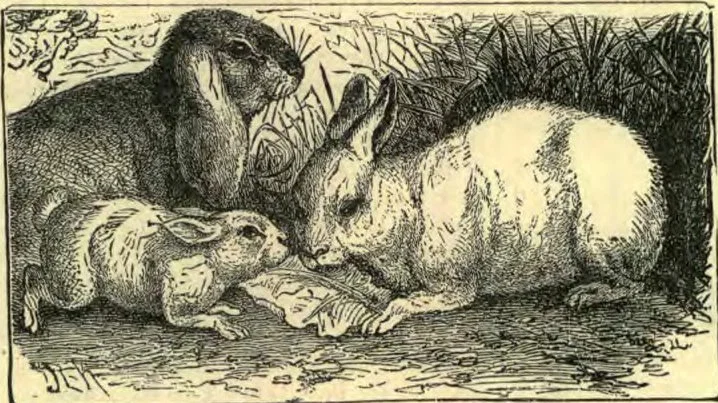
Tommy, wondering what he meant, went out and found three beautiful white rabbits. A little while after, Dr. Wilson went out and found him feeding them, with his face beaming with delight. The cunning little animals had made him happier than the splendid house and elegant new toys. He did not afterward get tired of them, but rushed off every morning with the same lively interest to see them.
“Tommy,” asked Dr. Wilson one day, “why have the rabbits made you so much happier? Do you love them more than you do me?”
“Oh, no,” said Tommy, blushing; but thinking a minute, he answered, “They are something to love and take care of, because they need me. I can help them, but I could not do anything like that for you, you are so much richer and stronger than I. I can be a father to the rabbits, as you are to me.”
Dr. Wilson laughed heartily, saying, “You are quite right, Tommy. It always makes one happier to be needed; but remember I need a little boy’s love, if I am rich and strong.”
“I do love you, I do love you,” said Tommy, earnestly.
The rabbits had taught both the man and the boy a lesson.—S. S. Visitor.

LETTER BUDGET.

WESTPORT, MINN.
DEAR EDITORS: This is my first letter to the INSTRUCTOR. I have taken it nearly a year, and like it very much. Papa takes the Religious Telescope, and thinks it is one of the best papers in the world. I am going to try to get some subscribers for the INSTRUCTOR.
NELLIE SHAW.
MANKATO, MINN.
DEAR EDITORS: I have been a reader of the INSTRUCTOR for many years, and could not do without it. We have a good Sabbath-school and a good teacher. I have to go five miles to Sabbath-school. Brn. Hill and Ells were here with the tent. I am trying to be an overcomer. I want to live so that when our Saviour comes he may take me to his home, there to live with the good of all ages forever. Pray for me that I may overcome all my sins, and at last meet you in the kingdom of Heaven.
Yours in hope of eternal life,
C. E. YOUNGS.
WATERVILLE, MAINE.
DEAR EDITORS: I have taken the INSTRUCTOR two years, and like it very much. I am ten years old. Since my mother returned from the Sanitarium at Battle Creek, most three years ago, we have kept the Sabbath—mother, two brothers older than myself, and little sister Edith, eight years old. We pray that dear father may keep the Sabbath too. I read this morning in the Testament: “Blessed are they that do his commandments, that they may have right to the tree of life.” I mean to watch and pray that I may overcome all my faults, and that I may be saved when Jesus comes. Please pray for us.
Yours truly,
WILLIE M. DOW.
FRANKTON, IND.
DEAR EDITORS: We are two sisters, eleven and thirteen years old. We like the letters in the INSTRUCTOR so much that we thought we would try and write one too. Elds. Covert and Rees came to our place with their tent over one year ago. We have been keeping the Sabbath with our father, mother, and brother ever since. We have an interesting Sabbath-school, where we get the INSTRUCTOR. Pray for us that we may be among the redeemed when Christ comes.
OCEA CAMPBELL,
ROSE CAMPBELL.

NATURE'S SPRING FASHIONS.

Spring has come, and with it the necessity of learning about the spring fashions; for, throughout the world, Fashion reigns supreme. She is a fickle queen, and wonderfully eccentric; but her fashion-plates and notes are studied with equal zest in the parlor and the kitchen; and in city and country, in high life and low life, she rules with mighty and undisputed power.
Just now all nature is absorbed in the pursuit of this fascinating branch of knowledge, and has become all alive upon the question of reconstruction.
Notwithstanding the chilliness and dreariness of the early spring months, the old dame has laid aside her beautiful robes of ermine, and now that warm, sunny days have come, she calls to her many maids, far and near, to hurry up the spring sowing; in consequence of which, spring openings are quite the rage.
The sedate old trees in forest and garden, and the modest shrubs, seem to have grown tired of their brown winter suits, and are eagerly studying the leaves of their latest fashion-magazines. The delicate flowers are quietly preparing brilliant apparel for spring and summer; and even the coarse weeds and herbs of the field have caught the inspiration, and are busily giving re-touches of color and style to their last-year garments.
The Maples have already come out in bright-scarlet hats; the stately old Elms are arraying themselves in new beauty; and it is rumored that the Horse-Chestnuts will soon make their appearance in pink and white.
The much-admired Madam Arbutus has appeared in the loveliest and most becoming of trailing dresses.
The Bachelors, always fussy and notional, are bothering their tailors about the cut of their coats, the most desirable color, and even the style of their buttons.
The color and style of the Monkshood will be the same as in previous years; for that monastic order refuse to appear in anything but deep, somber purple.
Dashing young Dandelion, in his gay-colored coat, is found almost everywhere; but he never receives much attention, except from little children, who are sometimes attracted by his graceful curls.
The city trees will soon leave for the summer. Miss Columbine, the Heaths, and their cousins the Laurels, contemplate spending the summer at the mountains; while the Iris family and the Lilies will pass the season at the watering-places.
The musical troupe, Mosquito Brothers & Company, intend to visit the country some time during the summer; and for evening serenades, and also for teaching patience, offer their services to the public.
As the summer advances, we will try to find time to report other developments in the fashionable world.—Pansy.

Every Generation Laughs at Old Fashions

EVERY generation laughs at the old fashions, but religiously follows the new.—Thoreau.

You have reached the end of this edition.

The Youth’s Instructor · Apr 21, 1880