Mrs. Benton was baking. When she had put the last pie into the oven, she stepped to the door and called, “Johnny!”
A bright-eyed, rosy-cheeked little boy came bounding up the steps, and stood before her.
“What do you want, mama?” he asked.
“I want you to run to the grocery right quick, and get some eggs. Wait a moment, and I’ll give you some money.”
She stepped into the sitting-room, went over to the mantle, and put out her hand to take the change she thought was there. To her surprise it was gone, and she stood for a moment with a puzzled look on her face.
“I surely put a quarter there this morning,” she thought. Then the puzzled look gave place to one of mingled annoyance and pain. She was positive she had laid that money on the corner of the mantel after her husband had left the house that morning. The front door had been closed and locked all the time, and nobody but herself and the little boy had been in the room. Had Johnny taken it? The thought startled her. “But he must have taken it,” she told herself; “for I know I put it right here after Mr. Benton went away, and there was no one else to take it. O, to think my boy would be dishonest—after all my teaching!”
Without taking time to consider the possibility of being mistaken, she turned upon the child, who had followed her into the room, and demanded:—
“Johnny, did you see that money I laid here this morning? tell me the truth!”
“Why, no, mama; I didn’t see it,” answered the boy at once.
“Are you going to tell me a falsehood, besides taking what does not belong to you?” asked the mother angrily. “I shall punish you for that. You needn’t deny it, Johnny; mama knows you took it, and it grieves her very much that you would take anything that doesn’t belong to you, and then tell a falsehood about it. It’s too much; mama is ashamed of you!”
Poor little Johnny burst into tears.
“Mama,” he sobbed, “I didn’t take your money,—true as anything, I didn’t. I—”
“Don’t say another word!” interrupted the mother, too angry to be reasonable, “I tell you, I know you did take it, because nobody has been in here but you; and I know I laid it there after your papa went away this morning. I shall punish you well. Sit down there till I come back, and I’ll see if I can’t make you tell the truth, anyway.” And pushing him into the nearest chair, she left the room.
She came back presently with a switch in her hand and a determined look on her face. To her surprise, the little boy rose from his chair as she entered the room, and came toward her.
“Mama,” he said, raising his tear-stained face to meet the angry look she cast upon him, “—mama, I’ve been praying to God, and I know he’ll help me out of this.”
“How do you know he will?” the mother asked, somewhat startled. “Who told you he would?”549
“My Sabbath-school teacher said so. She said if we ever got into trouble to just ask God to help us, and he would. And so I asked him to help me out of this trouble, and I believe he will.” And the brown eyes filled with tears again.
If this were anything but a true story, I should make it read that the mother gladly stayed the punishment of her child until his guilt was proved beyond the shadow of a doubt. But, strangely enough, this real mother was more angry than before, and made the punishment more severe because of his “hypocrisy” as she called it.
When Mr. Benton came home to dinner that day, he was told the whole story, his wife expressing much sorrow that her boy had not only taken the money, and then tried to conceal it with a falsehood, but had acted the hypocrite besides.
When she had finished, Mr. Benton said sadly:—
“Well, I am very sorry this has happened, I am sure. You are mistaken about having put the money there before I left. Jennie, I took that money myself.”
I will leave you to imagine the mother’s feelings. But I am glad to tell you that she took the lesson to heart. In relating the incident to a friend afterward, she said, with quivering lips and tear-filled eyes,—
“Poor little fellow! It did not help him out of his trouble to pray that time, but I assure you it will in the future.”—Sunday-School Times.
CHOOSE A SAFE PATH
By Marcus L. Carpenter
BY MARCUS L. CARPENTER.
(Fremont, Mich.)
O’er the rugged rocks of an Alpine hight,
In the bracing air of the morning cold,
He is going forth in his giant might,
With a bounding pulse and a spirit bold.
In the wildest gorge, on the highest rock,
He’s as much at home as the chamois fleet;
And he fears no ill from the wild wind’s shock
As he dashes on with unerring feet.
From a dizzy point on a beetling wall,
He is thrilled with joy at the awful view;
But he stops aghast, as he hears a call,
“Father, choose a safe path! I am following you.”
At a glance he sees in the steep, rough path,
An adventurous child in ecstatic joy;
Then he rushes back at the threatened scath
And grasps the hand of his only boy.
And his heart is stirred with the solemn thought
Of the copy he sets for his child, who could dare
To follow his steps with such dangers fraught;
And he leads him along with the utmost care.
There’s a lesson here we should study well;
Oftentimes the strong may with safety run
In a doubtful course, where temptations fell
Would make dangerous ground for some weaker one.
Then with anxious care, and with humble heart,
Always choose a course that is safe and true,
Seeking help from God to act well your part,
For some weaker one may be following you.
SOUPS—FRUIT SOUPS.
By Mrs. D. A. Fitch
BY MRS. D. A. FITCH.
(Sanitarium Cooking School.)
USUALLY soups do not take so large a place in the bill of fare as they should. Taken hot at the beginning of a meal, they stimulate the flow of the digestive juices, and to some extent satisfy hunger before the stomach is overloaded.
When we speak of soup, we do not refer to some water in which a bone, or possibly a bit of flesh has been cooked; but to a food prepared from grains, legumes, vegetables, or fruits. Such soups are economical from more than one standpoint. This material costs less pound for pound and contains much more nutrition.
It would be impossible in this brief article to give recipes for any number of soups; but perhaps a few general suggestions will be helpful. The grains, vegetables, or legumes should first be thoroughly cooked in the usual manner, but in as little water as possible. Pass them through a colander fine enough to remove hulls or any coarse portions which would render the soup otherwise than fine and smooth. Milk forms an excellent base for these soups, being itself a food containing important elements of nutrition.
Stock possessing quite a “meaty” taste and certainly much nutrition is made by simmering a cup of closely sifted wheat bran in a quart of water. When strained, there may be added to it the previously cooked material, flavoring to suit the eater. We would suggest celery, onion, or other savory herbs.
In order to secure sufficient mastication of soups, some hard bread, such as crisps, zwieback, or crackers should be eaten with them. No fats should be added, unless it be sweet cream, and all condiments left out except it may be a trifle of salt.
To some, the idea of fruit soups may seem as strange as it is new; but once tried, there will be no more significant smiling about them. Here is a recipe: In a quart of warm water put four level tablespoonfuls of sago or maniocca, and cook slowly (in a double boiler is best) until transparent; then add one dozen well-cooked prunes, one cup of stewed raisins, one-half cup cooked cranberries, currants, cherries, or plums, or, if preferred, a half cup of the juice from any one of these fruits. The addition of the juice of one lemon and sugar to suit the taste, will complete a soup, which, if served hot at the beginning of the meal, will not be forgotten.
In many European countries these latter soups are much used, and should be more frequently found on American tables. The thoughtful cook will find many ways of varying the kind and quality of all soups, and will be surprised at the good use that may be made of the bits of leftover foods so difficult to be economically disposed of in any other way. Economical, healthful, palatable, nutritious, inexpensive, and easily prepared, are terms properly applied to good soups. May we have more soup?
[From a very pleasant recollection of our experience with fruit soups in Europe, we gladly unite our testimony as to their delicious qualities. All the above adjectives and several others belong to them.—Ed.]
AFRICA
By Geo. B. Thompson
The third angel’s message is world-wide. The Lord says it will go to every nation, kindred, tongue, and people. The magnitude of this truth we have only of late begun fully to realize. And while our work in every way has made marked progress, we find ourselves in the beginning, as it were, of the work which is to be done before the end of all things, and a large portion of the earth, with its millions of inhabitants, yet unwarned.
At this time we wish to inquire, What is our duty to Africa? Here is the second largest continental division of the globe, with an estimated population of some 200,000,000, the greater portion of whom know nothing of the gospel. Its benighted regions are “full of the habitations of cruelty;” but the people of Africa are our brethren. God “hath made of one blood all nations” (Acts 17:26), and has fashioned all hearts alike. Ps. 33:14, 15. The place where a man is born counts nothing with the Lord. A man born in Central Africa is just as precious in his sight as though born in America. God looks at the heart, and has no prejudice against him because of the color of his skin. Our God is no respecter of persons; neither are we, if we have the Spirit of the Master.
Jesus “lighteth every man that cometh into the world” (John 1:9); he is the “desire of all nations” (Hag. 2:7), whether black or white; and the Lord will in some way send them the gospel to satisfy that “desire,” which he has created. The Spirit of God through his servant has said: “The missionary work in Australia and New Zealand is yet in its infancy; but the same work must be accomplished in Australia, New Zealand, and in Africa, India, China, and the islands of the sea, as has been accomplished in the home field.”—General Conference Bulletin, p. 294.
Ponder well this remarkable testimony from the Lord. The “home field” no doubt refers to the United States. There the truth is going everywhere; not only are the large cities being entered, but the small villages and hamlets, and witnesses are being raised up everywhere to stand for the truth. Will it be the same in Africa? God says it will, and from all its numerous tribes some will be gathered to stand around the throne. Then, brethren and sisters, is it not time to wake up? There is a work that if many who are sitting in their comfortable homes around our large churches will take hold of, the deadly stupor which enshrouds them will be broken. If we do not, mark it, God will find those who will, and they will wear the crowns we might have worn.
A beginning has been made, it is true, on the West Coast and in Mashonaland, and we thank the Lord for the beginning. But this is only a drop as it were in the boundless ocean. There is room for hundreds more. We admit that the prospect of living among barbarians is not so inviting as living in the centers of civilization. There will be trials and difficulties unnumbered; but are we to consult our own ease? Christ pleased not himself.
There are some declarations of Scripture, which, if we mistake not, refer to the work which will be accomplished in the Dark Continent. The entire prophecy of Zephaniah refers unmistakably to the last days. In chapter 3:13 the “remnant” is mentioned. Just at this time, when the indignation of the Lord is to sweep the earth like the besom of destruction (verse 8), the Lord says, “From beyond the rivers of Ethiopia my suppliants, even the daughter of my dispersed, shall bring mine offering.” Verse 10. Standing where this language was penned, “beyond the rivers of Ethiopia,” would be over in the darksome regions of Africa, and550include, would it not, Interior Africa? Yet from this dark spot the Lord declares that a people will bring him offerings. Let us all be glad, and say, Amen.
Again we read: “Princes shall come out of Egypt; Ethiopia shall soon stretch out her hands unto God.” Ps. 68:31. May not “Ethiopia” here refer to all the African races? Webster so defines it, and Cornell’s Physical Geography says, “This race [Ethiopian] occupies nearly the whole of Africa.” (See also Jer. 13:23.) Thank the Lord that these Ethiopian races will soon stretch out their hands to God. Are they not now doing it? Are they not asking us, their brothers and keepers, for the gospel?—Yes; and their cry will be heard, and the gospel will be carried to them.
Looking at the work from a human standpoint, it appears impossible; but all things are possible with God, and those who go forth clothed with the gospel, which is the power of God unto salvation, can do the work, and will be rewarded finally by seeing souls in the kingdom who will rise up and call them blessed.
“Lift up your eyes, and look on the fields; for they are white already to harvest.” John 4:35. Who will go forth to reap? Only those who reap receive wages. If it is not our duty to go, perhaps, it is our duty to contribute some of the mammon of unrighteousness to send somebody else.
When we look at the vastness of the work, and remember that time is short, almost finished, we know that the work must move faster in the future than in the past. This will be done by God’s people seeking for more of that power which awaits their demand. O that God’s people would seek him for more of that heavenly anointing which alone can fit them for the work which remains to be accomplished. When they do, the work will be cut short in righteousness.
GEO. B. THOMPSON.
A MOTHER'S RESPONSIBILITY.
By Lauretta Kress
BY MRS. LAURETTA KRESS, M. D.
(Sanitarium.)
I once attended a large meeting in a pavilion, and I noticed a lady sitting not far from me with a little child by her side, probably four years of age. The little one became a trifle restless,—for the seats were hard, with only one board across the back,—and accidentally fell backward to the ground.
The mother became angry in a moment, picked up the poor, frightened child, shook her severely, and set her down with force enough to have made the matter very impressive upon the child's mind. The question came to my mind, How would that mother have liked to be placed in similar circumstances, with similar treatment?
Now, dear mothers, think you that such a lesson will ever be forgotten by that child? No! no! and in after years, the child is apt to reflect a similar image.
We do not half realize our responsibility as mothers to our children. The child learns by seeing and hearing others. And the mother stands in a position to lead her children heavenward, or to lead them to destruction.
We often hear it said, when a child has done wrong and gone astray, that it had the best of training; but how can this be? Is n't it natural for people to imitate others? Is not the mother the first teacher? and does she not have the very best opportunity of putting good into that child's mind, before it could possibly learn evil? Where is the wrong, then, in the training of the child that goes astray? It must be, nearly always, in the earliest teaching.
In what ways do children reflect the mother's image?—In every act she performs; in each word she speaks; in careless habits not corrected; in cross words spoken to them; in rude manners and selfishness. They also imitate kind words, cheerful words, tenderness, unselfishness, true courtesy, pleasant manners.
Sometimes these tender plants so yearn for better lives that they draw nourishment from a kind heavenly Father, when the child's faith is directed to him by a dear teacher or a kind little friend. This, then, brings the greater responsibility, for the mother should be first to teach the child. Teaching children begins in the mother's arms and needs much consecration. “The mother's work is such that it requires continual advancement in her own life, in order that she may lead her children to higher and still higher attainments.”
These things being true, dear mothers, let us work while it is day; let us seek God for wisdom, for the promise has been given that he will give to those that ask.
CLIPPINGS FROM THE “MISSIONARY REVIEW.”
The work of Mr. Warszawiak among the Jews of New York City continues to deepen and spread. He believes with all his might that his countrymen are every whit as susceptible to gospel influence as any other class, and the results of his labors appear abundantly to justify his conclusion. He preaches to crowds, and he visits from house to house. Every day he devotes three hours for private conference. This time is largely taken advantage of, many hundreds coming to see him. A home called the “Home for Persecuted Christian Jews and Inquirers,” located at 65 Avenue D, has been of the greatest help to the work. In one year 3000 meals were provided, while 625 beds were occupied. Mr. Warszawiak is assisted by ex-Rabbi Leopold Kohn, Mr. Simon Goodhart, Mr. and Mrs. Cruickshank, and Miss Mabel Alwater.
A missionary thus speaks of a congregation at a church service in Japan: “Japanese audiences are models of politeness. No one yawns, snaps his watch, shuffles his feet, or goes out, even though the speaker is talking in an unknown tongue. Every eye is upon the speaker. When he begins to speak, he is greeted by a polite obeisance from every one in the audience; and when he concludes, another low bow from every one in the room says silently, ‘I thank you.’ After the address another song, a prayer, and benediction, and then what? A grabbing of hats and canes and overcoats, and a ‘break’ for the door!—Ah! no; the Japanese have not learned thus to close their worship. All drop into their seats again; for a full minute they sit with covered eyes and bowed heads, and then slowly and reverently pass out of the church or break up into little groups.”
Under the influence of the American missionaries the Roman Catholics in Peking have issued an elegant edition of the four gospels in Wenli, the book language of China, and have added to it a commentary.
The very general notion that the Chinese are a stolid, unemotional race, and hence we should not expect to find a joyous, fervid type of piety among them, is a mistake, writes Rev. N. W. Brewster, in Gospel in All Lands. When the Chinaman becomes filled with the Spirit, he has as much joy, and manifests it in much the same way as other people.
The Bishop of Lahore calls his the Mohammedan diocese of India, and in his opinion, though the Mohammedan problem is formidable, it is far from hopeless. Of the eighteen native clergymen in the diocese, no fewer than eight are converts from Mohammedanism. As many converts are gathered from among Mohammedans as from the Hindus and Sikhs. In addition, as he judges, it is in India that the conflict with Mohammedanism must take place. The church seeks there “no favor,” but it has—what cannot be had in Persia and other lands—“a fair field.”
Nearly three years ago a missionary in connection with the Swedish Mission Union made the perilous journey across the Thian Shan Mountains into Chinese Turkestan, accompanied by an assistant Armenian preacher, and was so pleased with the country and its people that he advised his society to allow the Armenian to remain. The Swedish Union has now resolved to extend the sphere of its operations, and two European missionaries have left Sweden, one of whom will live in Kashgar and the other in Yarkand. This is the beginning of missionary enterprise in this portion of the Chinese empire.
A journal published in Yokohama states that the Japanese religious press calls for more women evangelists, or Bible-women, and it is plain that the responsibility of the enlightenment of the women of Japan rests, to a great extent, upon the native Christian women of this empire. To meet such a want two women connected with the American Board established in Kobe first a training class and later a school. Already forty have graduated after six months of study for three successive years, and as long a period of practical work. Other similar schools have been opened by other missions.
Let the heralds of the cross, before they have thoroughly mastered the language of the people to whom they are sent, beware, lest in their ignorance they preach deadly heresy. Rev. W. E. Bromilow has this to confess concerning himself in the early days of his work in New Guinea: “I remember that through the peculiar affirmatives and negatives I misunderstood a native who was helping me in the preparation of an address, and I said with all earnestness, ‘Geabo ua ona ‘ai ‘aila. Ona ‘ai ‘aila i to umalina sinabwana.’ ‘Do not speak the truth. To speak the truth is very bad.’ For months we used the expression, ‘Goseda i to ‘umalina,’ in the Lord’s prayer for ‘Him the evil one,’ when it really means ‘our friend the evil one.’ I had often heard this word ‘goseda’ and from interpreters and others learned that it was used like our pronouns ‘he’ and ‘him.’ I tried it often, and it was always ‘goseda.’ But one day I caught the word ‘gosiagu’ and found out that it meant ‘my friend,’ whereupon I asked for ‘our friend’ and other forms, and I then ascertained that I had been calling the evil one ‘our friend,’ because this term is in constant use in the place of the name of any one.”
EUROPEAN DISARMAMENT.
By M. E. K.
It sometimes happens to individuals, that, having adopted an unwise course, they are compelled to follow it until they can hardly tell which course is the most destructive, to keep on as they are going or to stop altogether. This is as true of nations as it is of individuals, and the nations of Europe, in regard to the question of disarmament, stand in this position. They have gone on arming until they can go no farther; they are almost crushed by taxation to support their immense armies, and now they do not know what to do.
The Roman empire, in the days of its greatest prosperity, maintained on land and sea an army of 450,000. (See “Gibbons’s Decline and Fall,” Vol. I., p. 21.) The author above quoted declares on the same page as quoted and in a note at the bottom of the page, that this army had been equalled by the army of Louis XIV., but that France was still suffering from the strain of that extraordinary effort. Since that time, beginning with the French Revolution and ending with the battle of Waterloo, the armies of all the European nations were greatly augmented, and during this period, the army of France under Napoleon was increased until at the time of the invasion of Russia the French army had reached the then enormous figure of more than a million of men. This great army was almost entirely wasted in the disastrous Moscow campaign. After the battle of Waterloo the nations of Europe, exhausted from their protracted struggles, did not attempt to raise such enormous numbers of troops as they had maintained before. Even Louis Napoleon with his desire to imitate his uncle, Napoleon I., did not think of such armies as have lately sprung into existence in Europe.
The war declared against Germany by Napoleon III. was the indirect cause of the present enormous armies of Europe.
The defeat of France by Germany would not necessarily make these two nations such bitter enemies that they would immediately begin preparations for another terrible struggle. Had Germany been a generous victor, she might have won the friendship of France, who at that time was inclined to throw the blame for the quickly incited war upon Louis Napoleon, where it no doubt properly belonged. But Germany was not content with defeating France, or even with taking from her a full money indemnity for the expenses of the war. She went farther, and seized a large portion of French territory. This was a greater affront than the high-spirited people of France would endure. Time has fully demonstrated that this seizure of Alsace-Lorraine was the greatest blunder in statesmanship that Bismarck ever made. A generous foe may easily become a friend; but when a nation is not only defeated but despoiled, and its national pride subjected to an extreme and unnecessary humiliation, a desire for revenge is engendered, which makes a stable peace very doubtful.
As soon as peace was established, the increased armament of France suggested her determination for another and more satisfactory settlement of the question. Alarmed at the wonderful recuperative energy manifested by France, and her growing military power, Germany also increased her army, and finally she secured for allies both Austria and Italy. This latter action was no doubt551intended as a defense against an assault from France, which country was regarded as the menace of the peace of Europe; but an alliance of such great proportions was considered a greater menace, both by France and Russia. The Franco-Russian alliance is therefore entirely due to the Triple Alliance of Germany, Austria, and Italy. And now we have five nations of Europe arrayed in hostile attitudes, each one having a larger army than Napoleon I. ever commanded, and equipped with such weapons of destruction as he never dreamed of; and France, defeated and despoiled in 1871, carries her burden the easiest of them all. France and Russia together can now place in the field a million more men and seventeen hundred more cannon than the Triple Alliance.
All these immense armies are prepared and sustained for war. To talk as many European statesmen do about these great armies being kept in the interests of peace, is the veriest nonsense. Siberian blood-hounds are not kept for household pets, nor are armies maintained for peaceful purposes. The talk of disarmament and the actual preparation for war go on together, and some day Europe will witness such scenes of carnage as have not been seen since the days of the first Napoleon. Disarmament will not come until some bloody results of all these years of preparation have been attained, and the map of Europe be arranged as the fortunes of war shall determine.
M. E. K.
SHALL HE PAY HIS FINE?
By G. C. T.
A GENTLEMAN in Indiana writes us that he does not accept the statement made a few numbers since in the REVIEW, that the imprisonment of our bodies is of but minor consequence; and backs up his opinion of the importance of personal freedom by authorizing the Religious Liberty Association to pay up brother Capps’s fine and costs, and draw on him for the amount. We trust that all will realize that we were speaking comparatively of the importance of maintaining principles, rather than contemptuously of personal liberty. To voluntarily pay a fine would be to surrender, in a great measure, the principle; there are hundreds of his own brethren, who would feel it a privilege to do that, if it were right; but it is for this reason that brother Capps remains in jail. We cannot consistently become a party to an outrageous usurpation of power over men’s consciences, by voluntarily submitting, and thus recognizing the right of the authorities to inflict punishment upon a man for peaceably following his own convictions; and his unjust imprisonment is a mighty protest against religious bigotry. This and other kind offers from disinterested friends will be placed before brother Capps, and it will be for him to accept if he chooses. Should he do so, it will be with the understanding that since others outside our ranks desire to share the burden of injustice and join the protest against it, it is their privilege to do so. We do not court persecution. We simply demand our rights; and we are thankful for the many assurances of sympathy that come to us from our fellow-citizens. The deep injustice inflicted upon this citizen of free America appeals to all lovers of liberty and equality.
The inherent weakness of the Sunday cause drives its reckless advocates to desperate measures. We have no reason to suppose that the men who stand back of this crusade against freedom will sicken of their gruesome work. As the sight and smell of blood infuriated the old inquisitors, so will the cry of oppression seem to these misguided men to be the token of their triumph. But other men, with more perfect perception and perhaps more honest hearts, will see where truth and justice lie, and some will choose the thorny path of obedience to God.
G. C. T.
THE EASTERN EMBROGLIO.
By G. C. T.
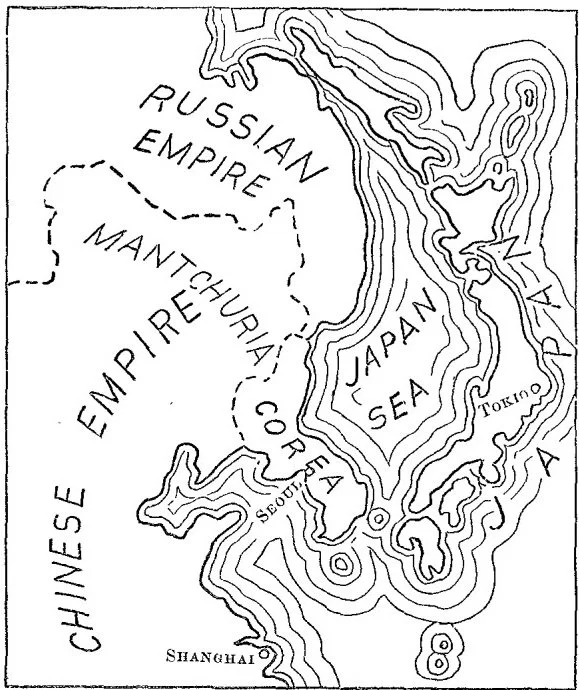
China and Japan are close neighbors, as will be seen by the outline map published herewith. Japan is an island empire, having an area of 147,655 square miles. It is smaller by 10,000 than California, and somewhat less than Illinois, Indiana, and Michigan combined. The population is 40,000,000. The Chinese empire covers almost 1,337,000 square miles, and contains nearly 400,000,000 people. Thus it will be seen that the odds in size are about ten to one in favor of China. And when we consider the corporeal size of individuals in each territory, the same discrepancy appears, though probably in not so great proportion. The Japanese are not a stalwart race; but what they lack in size and numbers they seem so far to more than make up in vigor and alacrity.
It will be noticed that Corea is a peninsula occupying a position between the two countries. It is a dependent country, and the present struggle is over the question as to who shall exercise the controlling influence. This has nominally been in the hands of China; but Japan insists that it shall be equally shared; or in plainer terms, shall be surrendered into her hands. It will also be seen that the Russian Asiatic dominions join Corea on the north. Consequently Russia is by no means a disinterested spectator of the trouble. British interests in that vicinity are very important, and so also are those of other western nations though to a lesser degree.
Thus far the fortunes of war seem to favor the Japanese, though news is meager and uncertain. These nations having been regarded as the Ishmaelites of the human race, the more “select” nations are inclined to look upon their war with indifference as to the bloodshed and misery they may inflict upon each other. The sole anxiety of so-called Christian governments seems to be centered in their own individual interests.
The Japanese and Chinese may kill and destroy among themselves for the entertainment of the rest of the world; but when the end comes, and the strength or wrath of one or both are exhausted, then the great powers will be ready to come forward and dictate just how the trouble shall be settled. It is not to be supposed that England or Russia would allow any settlement that affected their interests adversely. How much more humane it would be for these and other great countries to separate the fighters and dictate terms of peace now, rather than at the end of a barbarous and destructive war.
G. C. T.
SUNDAY IN THE UNITED STATES ARMY.
By M. E. K.
The case of Private Soldier Cedarquist, who refused to go on target-practice on Sunday, the punishment inflicted upon him by his superior officer, and the subsequent action of the War Department in releasing him and ordering a trial by court-martial of the officer who ordered his punishment, have before been noted in these columns. There is one point, however, that is worthy of mention in connection with this affair that probably is not generally known.
The War Department at the first determined to sustain the action of the officer! We learn this interesting fact from the Christian Nation of Aug. 15. It appears that when the case first came before the public, the editor of the above-mentioned paper addressed a letter to the War Department, protesting against the punishment of the soldier for his disobedience of orders. To this letter a reply was received from the Assistant Secretary of War, justifying the officer, and making the following statement:—
“It is not the opinion of this department that Private Chas. O. Cedarquist ought to receive a pardon. His punishment is very proper, and, as mitigated, is exceedingly mild. It is thought that upon reflection you will see that it is simply impossible that any soldier should be made the judge of the necessity of an order given him. And inasmuch as there is no question about the disobedience of Private Cedarquist, his punishment followed as a matter of course.
“Your general sentiments are very proper and are concurred in; but it is thought that to pardon Private Cedarquist would be subversive of discipline, without which an army is worse than useless.
“You will observe that the question of the advisability of target-practice on Sunday is not the one which presents itself. Permit me to say, further, that the department is taking the proper action in this matter aside from the status of Private Cedarquist.”
The above was the position of the War Department until the great hue and cry of the religious press led the President to interfere, reverse the opinion of the War Department, release the soldier, and order the trial of the officer. The whole affair is suggestive of the grip which the religious element has upon the government.
We have no words of condemnation for Private Cedarquist. His rights of conscience are as dear to him as ours are to us. At the same time, we shall hold that he is out of his place in the army. Moral questions, particularly if conducted on Christian lines, cannot come into the army, if any real service is expected of it. A man whose Christian conscience will not allow him to shoot at a mark on Sunday, but who has no compunction in regard to shooting at men on Monday, has a conscience too complicated for a soldier. It is very suggestive of the Russian robber who murdered and robbed a man, but refrained from taking some meat the victim was carrying home, because it was during the time when the church forbade meat-eating! The court-martial which was ordered by the President to try Major Worth has acquitted that officer of all blame, holding that the circumstances fully justified his action. Now let Cedarquist be discharged from the army, and take some peaceful employment, where he will not be compelled to shoot at a target or a man on Sunday. M. E. K.