The Youth’s Instructor, Vol. 30, No. 16.

MEG'S ANNIVERSARY

The Youth’s Instructor

Apr 19, 1882

S. D. A. Publishing Association · Battle Creek, Mich. · Apr 19, 1882

MEG'S ANNIVERSARY.
It was the last Sabbath in April, a few weeks before Anniversary-day, and the May walk was uppermost in the minds of the children. Miss Way feared that the lesson on “Confession and Cross-bearing” made but slight impression on the group of girls around her, for attention wavered. She had prepared it earnestly and prayerfully, hoping that more than one might be led to deny themselves, take up their cross, and follow Jesus, but only shabby little Meg seemed to take an interest in the subject. Meg’s great blue eyes were always serious. She was an orphan, lived in an attic, and sold flowers. Miss Way had seen her on the street some months previous, and had invited her to Sabbath-school. As it was the one bright spot in Meg’s life, every Sabbath found her in her corner by the wall, quiet and attentive. Her coming to the class had been received with great disapprobation by the other girls. Meg was used to slights; but perhaps if the girls could have seen the tears that fell in the lonely attic, they would have been more tender. After the lesson, the new anniversary hymns were sung with a zest, and there was a brief opportunity for the long-suppressed chatter.
Meg, in her corner, heard accounts of wonderful dresses which were to appear on the great occasion.
Pearl Parker seemed the most gay and thoughtless of all her class. An only child of an indulgent home, she knew and cared nothing about self-denial, and somehow the lesson made her uncomfortable. There was, however, no trace of this in her manner as she said, “Just think, girls! my birthday is on Anniversary-day.”
“What do you suppose you’ll have?” inquired Lizzie Lane.
“Oh,” replied Pearl, “I have my gift already,” and she drew a ten-dollar gold piece from her purse, and allowed each of her mates to hold it a moment.
“Are you going to spend it?” said Kate Wilson.
“Of course I am,” said Pearl. “I am going to buy a lovely white satin fan with violets all over it, to carry on the anniversary.”
A succession of exclamations here received a timely check by the superintendent’s bell, and school was dismissed.
As Pearl walked toward home, she passed Meg. Acting on the impulse of the moment, she said pleasantly, “You are coming to the May walk?”
Now, that prospective anniversary had been in Meg’s thoughts for several weeks. Until this particular Sabbath she had looked forward with joy to a part in the bright festival, which she had often witnessed. Somehow the feeling had come to her that her coarse attire would be sadly out of place, and she would better quietly absent herself, and be patient. So, in answer to Pearl’s question, she said, “I should like to come very much, but I can’t.”
The involuntary glance at her dress expressed more than words. Pearl thought of her gleaming gold piece and the coveted satin fan, and said, passing on, “You would better come; the music is always good.”
“Whosoever will come after me, let him deny himself, and take up his cross, and follow me.”
Oh, that Sabbath-school lesson! It came to Pearl as she stood at the door of her elegant home. It was written all over the pages of her new book. It put the piano out of tune.
Everything went wrong that week. Pearl said she would stay at home the next Sabbath, but it found her in her place; and in the evening meeting Miss Way wept for joy to hear Pearl say, “I want to be His disciple.”
Pearl went home with a happy heart. Out from her purse came the gold piece. “You have a new name,” she said to it, smiling. “It is ‘Meg’s Anniversary.’”
Anniversary-day dawned, the merriest of May days. The Sabbath-school buzzed with excitement.
“Where’s Pearl?” queried more than one anxious voice in Miss Way’s class.
“I’m glad that dreadful Meg Alton has the good sense to keep away,” said Clara Steele.
“There’s Pearl, now!” said Lizzie Lane, with such a pretty girl in blue.
“Oh, if it isn’t Meg!” exclaimed Kate Wilson.
Yes, it was Meg, transformed by happiness and a ten-dollar gold piece into a beautiful, radiant Meg. The situation was awkward for the girls, but following Pearl’s leadership, everything went on pleasantly, and Pearl waved a twenty-cent fan very contentedly. But the best was yet to come. With Mrs. Reid, the pastor’s wife, was a visitor, Mrs. Delmont, a wealthy and childless widow, who seemed deeply interested in Meg Alton’s face, and made several inquiries about the child. After the exercises, she beckoned to Meg, who went to her wonderingly. “My dear,” she said, “do you want a mother?”
Oh, the longing that filled the child’s eyes!
“Then kiss me.” Thus the contract was made and sealed.
One bright day, as an ocean steamer swung out into the harbor, Pearl Parker turned from the pier with Meg’s “good-by” kiss on her lips, and the blessing of the “God of the fatherless” upon her head, and went home to find it her chief joy to deny herself, take up her cross, and follow Him.—Selected.
THE PINE-APPLE.
THE PINE-APPLE.

THE PINE-APPLE.

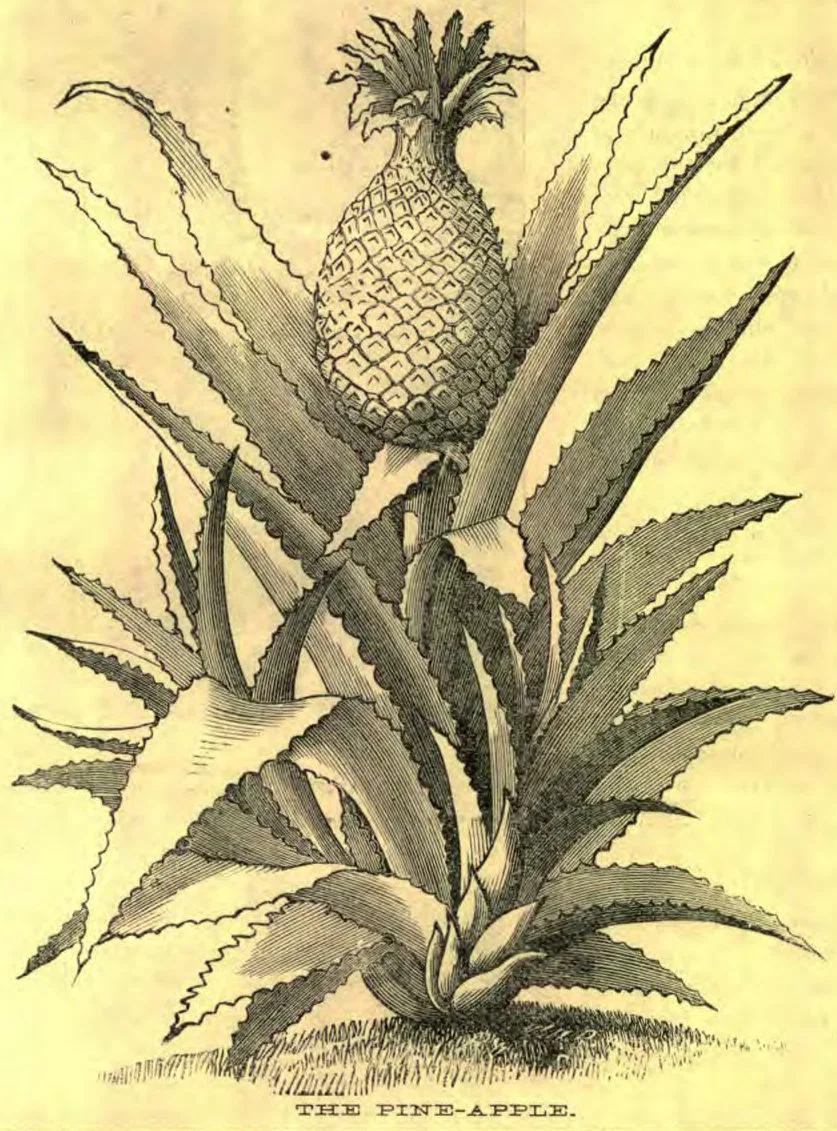
The pine-apple plant, of which we here have a picture, is highly esteemed, and much cultivated for its fruit. It has a number of long, sharp-pointed, rigid leaves, looking much like those of the century plant. These all spring from the root, and from the midst a short flower-stem is thrown up, bearing a single spike of flowers and therefore a single fruit. From the top of the fruit springs a crown, or tuft, of small leaves, capable of becoming a new plant, and very generally used by gardeners for planting.
The pine-apple is a native of South America, where it grows wild in the woods; and from there it has been carried to Africa and the East Indies, where it has become almost like a native plant, and scarcely requires cultivation. It is also raised to some extent in Great Britain and other temperate countries, but always in hot-houses, as it requires a high degree of temperature and very careful treatment. The fruit so grown, however, is said to be even superior in delicacy of flavor to that raised in the open air in its native countries.

AN APRIL WELCOME.

Come up, April, through the valley, In your robes of beauty drest, Come and wake your flowery children From their wintry beds of rest; Come and overblow them softly With the sweet breath of the south; Drop upon them, warm and loving, Tenderest kisses of your mouth.
Touch them with your rosy fingers, Wake them with your pleasant tread, Push away the leaf-brown covers, Over all their faces spread; Tell them how the sun is waiting Longer daily in the skies, Looking for the bright uplifting Of their softly fringèd eyes.
Call the crow-foot and the crocus, Call the pale anemone, Call the violet and the daisy, Clothed with careful modesty; Seek the low and humble blossoms, Of their beauties unaware, Let the dandelion and fennel Show their shining yellow hair.
Bid the little homely swallows Chirping, in the cold and rain, Their impatient sweet complaining, Sing out from their hearts again; Bid them set themselves to mating, Cooing love in softest words, Crowd their nests, all cold and empty, Full of little callow birds.
Come up, April, through the valley, Where the fountain sleeps to-day, Let him, freed from icy fetters, Go rejoicing on his way; Through the flower-enameled meadows Let him run his laughing race, Making love to all the blossoms That o'erlean and kiss his face.
But not birds and blossoms only, Not alone the streams complain, Men and maidens too are calling, Come up, April, come again! Waiting with the sweet impatience Of a lover for the hours They shall set the tender beauty Of thy feet among the flowers!
—Phebe Cary.

Mountain Scenery.

THE grandest sights presented in nature are those witnessed by the mountain tourist. The winding canyons, the dashing waterfalls, the towering rocks, though presenting different phases of the beautiful, all lead the mind to view the great Creator through his wonderful handiwork.
To stand on the summit of some lofty peak, and gaze on the golden glory of the sunset, and look upon the hills as they stretch away until lost in the lake-dotted plains beyond, is a privilege which may well be sought by the painter. But while the “beauty of the hills” may be appreciated by standing upon their highest points, and the mind be thus excited to devotional thoughts, there are other views of God’s handiwork which seem more grand and wonderful. Standing upon the edge of some vast precipice, and gazing downward thousands of feet into the abyss below, one feels awed by the sublimity of nature’s work. At the bottom of the gorge the foaming waters of some mighty river roar with intense fury, the stream perhaps so far beneath that it is nearly lost from sight among the rocks, and appears little more than a tiny thread of white. It seems hard to realize that this apparently little brook is in reality a great and mighty river.
One glance over such a precipice will give to the word depth a meaning never before appreciated. But the pleasure-seeker is never fully satisfied until he views the canyon from below. Down in the awful depths of the “rocky rift,” he turns his eyes upward to behold the overhanging crags, black and blasted, which threaten to topple and fall upon him. Here the walls, composed of many-colored rocks, rise perpendicularly to an enormous height, and the spectator stands spell-bound as he gazes upon their fantastic shapes. Further on, is a section of the massive defile where no sunshine ever enters, and but a very narrow strip of the heavens is visible. Truly the scene presented from this stand-point is picturesque in the extreme.
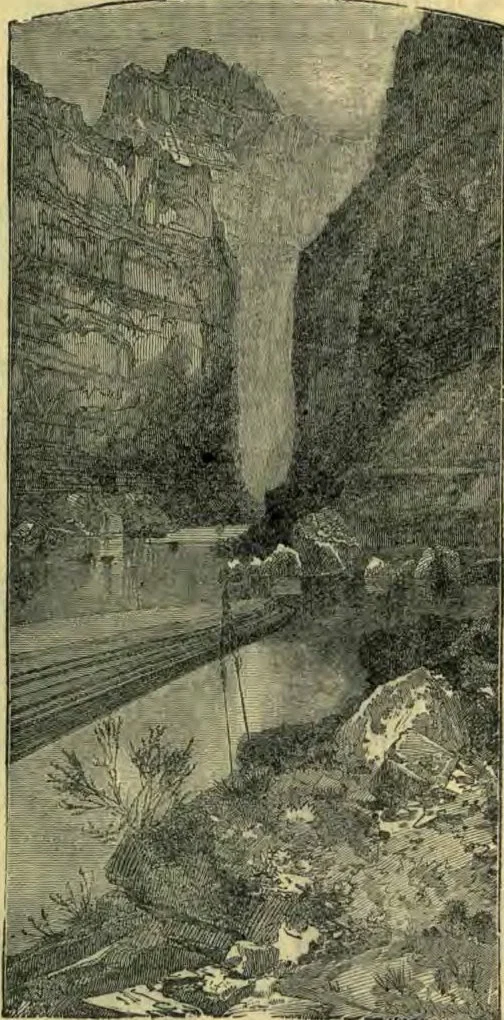
The accompanying cut presents a scene similar to that just described. It shows a part of Marble Canyon, through which runs the Colorado River. The stream passes through the canyon for sixty-five miles, and winding its way through a portion of Utah and Arizona, empties into the Gulf of California. The limestone walls, which rise from two thousand to four thousand five hundred feet, are often highly polished, and are of many colors,—white, gray, pink, and purple, with saffron tints. At one point there is a flood-plain like a marble pavement, polished and fretted in strange devices, and embossed in a thousand fantastic patterns.
True, indeed, are the words of the Psalmist, “The works of the Lord are great.”
J. O. CORLISS.

ENGLAND'S RELICS OF THE OLDEN TIME.

WHEN looking at England's relics of past time, we find many more remains of the Norman than of either the Danish, Saxon, Roman, or Druid periods. This is partly owing to the fact that those earlier works were constructed mostly of perishable material; and those of more enduring substance have been defaced by time or destroyed by ruthless invaders.
As you have been told before, the Druids regarded the oak as sacred, and performed most of their worship under its wide-spreading boughs. They had, however, their sacred circles, formed of huge stones so placed as to resemble a coiled serpent. Their sacred altar was placed within the inner circle. One of these, still standing on Salisbury plain, consists of one hundred and forty stones, some of them from thirteen to twenty feet in height. One of them is so large that it would require one hundred and forty oxen to draw it.
The Druids had also idols constructed of huge rocks. Of these there are two remaining in Cornwall. One of these, called the Talmen, is one vast oval pebble placed on the point of two natural rocks. It is thirty-three feet in length, eighteen feet six inches wide, and fourteen feet six inches deep. It is ninety-seven feet in circumference. The other is called the Logan, or Rocking-stone. Its bulk has been computed at ninety-five tons. These stone deities of the Druids do not touch the ground. They imagined that every sacred thing would be polluted by touching the soil.
If we do not see the idol temples of the Romans, we may look at the places where some of them stood. Westminster Abbey was built by Ethelbert, of Kent, on the spot where stood the temple of Apollo. St. Paul's Cathedral, London, was built on the site of an old Roman Temple of Diana. In different parts of the kingdom there are relics of old Roman walls. Southampton has a long strip of Roman wall still standing, and also three of the ancient gates of the borough. The wall has some outer work and buttresses undoubtedly of Norman construction. These do not, however, cover the ancient wall, but have strengthened it and protected it from the ravages of time.
A few weeks since, I visited the ancient Borough of Grimsby, situated on the Humber River. It was one of the points where the Danes made their invasion of Britain. One of its streets is still called Dane's Gate. I found but little in the line of relics of Danish occupation, but I learned much of the habits and customs of the people of those bygone days, when they were just emerging into civilization. One interesting item was with reference to their mode of electing their Mayor. The people would elect three men by vote. They would then blindfold the three men, and place on the back of each a small bundle of hay; then they would place them at different points in the public pound. A young calf was then turned into the pound with the blindfolded men. The first man the calf approached to get a mouthful of hay was declared their Mayor. Of course such usages have long since passed away, as learning and civilization have advanced.
J. N. LOUGHBOROUGH.

HABITS

HABITS of evil are very dangerous, though they may be very small in the beginning. A single drop dripping from a hillside is small, but drop following drop, day and night, begins to make a little stream; and the stream will flow, gathering more and more as it goes, until it becomes a river, and the river a flood which sweeps away everything before it. So little habits of evil drown men in destruction. Sin is a fire which at first could be easily quenched, but let alone, it spreads into a conflagration, taking cities on its fiery wings and melting rocks into dust. “Touch not, taste not, handle not.”

Teaching Children About Jesus' Saving Love

“WOULD you like to be a judge?” said a gentleman one day to a little boy. The child replied: “I think I should like better to teach children about Jesus dying to save them. That would make them love and obey him; and if they loved and obeyed him, they would not need a judge.”

SCENES IN THE LIFE OF CHRIST.

LESSON 64.—THE GOOD SAMARITAN.

And a certain lawyer, wishing to tempt Jesus to say something by which his enemies could make him trouble, asked him, saying, “Master, what shall I do to inherit eternal life?” Jesus replied by asking him the question, “What is written in the law? how readest thou?” And the man answered, “Thou shalt love the Lord thy God with all thy heart, and with all thy soul, and with all thy strength, and with all thy mind; and thy neighbor as thyself.” And Jesus said to him, “Thou hast answered right; this do, and thou shalt live.” Then the man, willing to justify himself, and perhaps wishing to tempt Jesus still further, said unto him, “And who is my neighbor.” The Saviour answered this question by relating the following parable:—
“A certain man went down from Jerusalem to Jericho, and fell among thieves, who stripped him of his raiment, and wounded him, and departed, leaving him half dead. And by chance there came down a certain priest that way; and when he saw him, he passed by on the other side. And likewise a Levite, when he was at the place, came and looked on him, and passed by on the other side. But a certain Samaritan, as he journeyed, came where he was: and when he saw him, he had compassion on him, and went to him, and bound up his wounds, pouring in oil and wine, and set him on his own beast, and brought him to an inn, and took care of him. And on the morrow when he departed, he took out two pence, and gave them to the host, and said unto him, Take care of him; and whatsoever thou spendest more, when I come again, I will repay thee.”
And when Jesus had finished this parable, he said to the man who had questioned him, “Which now of these three, thinkest thou, was neighbor unto him that fell among thieves?” Of course the man could not do otherwise than answer, “He that had mercy on him.” Then said Jesus unto him, “Go and do thou likewise.”
And as Jesus and his disciples journeyed, they came into a certain village called Bethany, a little town about two miles east of Jerusalem. And a woman by the name of Martha received them into her house. And she had a sister named Mary, who sat at the Lord’s feet and listened to his teachings. Now Martha was so busy and anxious about the affairs of the house that she did not take time to listen to the words of Jesus, and she thought Mary ought to be helping her too; so she came to Jesus and said, “Lord, dost thou not care that my sister hath left me to serve alone? bid her therefore that she help me.” But he said to her, “Martha, Martha, thou art careful and troubled about many things; but one thing is needful, and Mary hath chosen that good part which shall not be taken away from her.” Now Jesus did not, by these words, mean to encourage idleness; but quite likely Martha was doing more than she need to have done, and perhaps things that might have been left until another time, when the Lord was not there. Perhaps, too, he thought she was in danger of regarding the common work of the house as of more importance than the precious words which he was speaking, and so took this way to give her a gentle reproof.

QUESTIONS.

  1. What question did a certain lawyer ask Jesus? Luke 10: 25.
  2. What did this man hope to make Jesus do?
  3. What way did Jesus take to answer him?
  4. Repeat the question that Jesus asked him.
  5. What did the man say was written in the law about our duty to God and man?
  6. How did Jesus receive this answer?
  7. What advice did he give the man?
  8. What further question did this lawyer ask the Saviour?
  9. How did Jesus answer him this time?
  10. Where did a certain man start to go?
  11. Which way was Jericho from Jerusalem? and about how far was it?
  12. What kind of road would the man have to travel in taking this journey?
  13. What happened to him while he was on the way?
  1. How did the thieves treat this traveler?
  2. What did a certain priest and a Levite do, who came that way and saw the poor man in such want?
  3. What very different course did a Samaritan take, who happened that way?
  4. What did he do for the wounded man?
  5. How did this good Samaritan provide for the further wants of the man who had fallen among thieves?
  6. How much money did he give the host for his care?
  7. How much would this be in our money?
  8. Why was it to be wondered at that a Samaritan should treat a Jew so kindly?
  9. What question did the Lord ask the lawyer when he had finished this parable?
  10. Give his reply.
  11. What did Jesus then say to him?
  12. To what little town did Jesus and his disciples come as they journeyed?
  13. How far was Bethany from Jerusalem?
  14. What woman welcomed them to her house?
  15. What was her sister’s name?
  16. How did Martha feel about having her sister spend her time in sitting at the feet of Jesus?
  17. What did she say to the Saviour about it?
  18. How did he answer her?
  19. What did he say about the good part which Mary had chosen?
  20. What do you think the Lord meant to teach in answering Martha as he did?

NOTES.

A certain lawyer.—One who professed to be well skilled in the laws of Moses, and whose business it was to explain them.—Barnes.
From Jerusalem to Jericho.—The distance from Jerusalem to Jericho was about fifteen miles, in a northeast direction. The road lay for the greater part of the way through the most rocky and desolate portion of the wilderness of Judea, and though there was much travel over it, it was a very dangerous road to pass. There were at this time, as now, many robbers in Judea, and the dark caves and wild gorges gave them excellent places for hiding, until some unprotected traveler passed that way, when they would rush out upon him, rob him, and if he resisted them, leave him wounded and half dead, like the man in the parable. To this day the way “from Jerusalem down to Jericho” is as dangerous as ever, and travelers in the Holy Land dare not pass it without a body of armed men to protect them.
A certain Samaritan.—The Samaritans were the most bitter foes of the Jews. They had no dealings with each other. It was this fact which made the conduct of the good Samaritan toward the wounded man seem so remarkable.
Two pence.—About twenty-seven cents in our money. This may seem a small sum, but we are to remember that in that day and in that country this sum was probably ten times as valuable as it would be with us—that is, it would purchase ten times as much food and the necessaries of life as the same sum would now. A late traveler in the Holy Land says that he could live well on one English penny (two cents) a day.
Sat at Jesus’ feet.—This was the ancient posture of disciples or learners. They sat at the feet of their teachers—that is, beneath them, in a humble place.

NEW-TESTAMENT HISTORY.

LESSON 78.—REVIEW.

1. WHAT family in Bethany was especially dear to Jesus? John 11:1, 5.
2. What great affliction came upon them?
3. What did the sisters do in their distress?
4. What apparent indifference did Jesus manifest when he heard that Lazarus was sick?
5. Why did it seem inconsistent for him to go to Jerusalem at this time?
6. On what occasion had the Jews attempted to stone him?
7. Was it the fear of the Jews that caused him to delay his visit?
8. What did Jesus say to show that he was directed in his actions by the counsel of his Father?
9. What conversation took place between him and his disciples with reference to the condition of Lazarus?
10. What danger did the disciples anticipate in going to Jerusalem with Jesus?
11. Who were at the home of Mary and Martha when Jesus and his disciples arrived at Bethany?
12. Describe the meeting between Martha and Jesus.
13. Relate the conversation that took place between them.
14. Describe the conversation between Mary and her Lord.
15. What did the Jews exclaim when they saw Jesus weeping?
16. What question did they ask?
17. Describe the raising of Lazarus.
18. What effect did this miracle produce?
19. What did the chief priests and Pharisees say when they had met in council?
20. Who was Caiaphas, and what did he say?
21. Why did Jesus dwell in the city of Ephraim, by the wilderness?
22. What did Jesus say to his disciples about faith? Luke 17:5, 6.
23. How did he teach them a lesson in humility? Verses 7–10.
24. What did he say to the Pharisees about the coming of the kingdom of God? Verses 20, 21.
25. What did he say to his disciples on the same subject? Verses 22–25.
26. What comparison did he draw between the days of Noah, and the days just before his second advent? Verses 26, 27.
27. By what other comparison did he illustrate the suddenness of his second coming? Verses 28–30.
28. What advice and warning did he then give his disciples?
29. What lesson did he teach them about prayer? Luke 18:1.
30. By what parable did he encourage them to be persistent in praying?
31. How did he apply this parable? Verses 7, 8.
32. By what parable did he warn them against self-righteousness? Verses 9–14.
33. What lesson did he teach them with respect to the sacredness of the marriage relation? Mark 10:2–12.
34. What lesson did he teach in regard to the innocence of childhood? Verses 15, 16.
35. How did Jesus turn this circumstance to good account? Verse 17.

NOTES.

The kingdom of God cometh not with observation,—with scrupulous observation. That this is the proper meaning of the original has been amply proved by the best Greek writers. It is as if he had said: “The kingdom of God, the glorious religion of the Messiah, does not come in such a way as to be discerned only by sagacious critics, or is only to be seen by those who are scrupulously watching for it; it is not of such a nature as to be confined to one place, so that men might say of it, Behold, it is only here, or only there: for this kingdom of God is publicly revealed; and behold it is among you; I proclaim it publicly, and work those miracles which prove the kingdom of God is come; and none of these things are done in a corner.”—Clarke.

MORAL AND SPIRITUAL PREPARATION.

So sensitive is the emotional nature of children, that a teacher’s feelings and temper are more powerful in their influence than his intellectual condition. Indeed, they will of necessity affect the latter directly; a teacher who is out of humor will neither teach well, nor be able to conceal the cause from the quick observation of his pupils. He needs to be not merely in intellectual, but also in moral and spiritual, harmony with the message he is about to deliver. He needs not only a well-stored memory, and a clear view of the truths to be taught, and the methods to be used, but also an emotional state which shall accord with the sacredness of the occasion, the lofty aim of the work, and the sublime dignity of the nature and destinies of those whom he seeks to train alike for earth and heaven.
But this moral preparation is not directly under the control of the will. Harassed and disturbed with the thousand anxieties of every-day life, it is not always easy to obtain.
“A heart at leisure from itself.”
Nevertheless, in the exercise of prayer the Christian possesses a divine sedative, which, more than any material or merely intellectual agency, will tranquilize the spirit, and fit for Sabbath duty.—Teacher’s Cabinet.

POLLYWOGS AND BABY-FROGS.

SOME, my boys and girls, do not waste this early spring weather. You can sit in the house in winter and on rainy days; and no doubt you are very busy in school, and learn much from books. But take my advice: learn something from nature too. Shall I tell you how to do it? We cannot well do more than one thing at a time, so we will now busy ourselves with one animal.
You know there are animals which feel warm when you put your hand on them—like the cat and dog, chickens and all birds. There are also creatures which feel cold to the touch—such as fish, turtles, lizards, toads and frogs. This time we will study a cold-blooded animal.
If we take a pail and a dipper and go to a pond where frogs live, we may search closely for tadpoles. A tadpole is also called a “pollywog,” though in some places it is called a “bullhead.” Which name do you like best? When a tadpole is quite young, it looks like a comma in your book; but it would not do for a comma, because it wriggles all the time and pushes its body along through the water. This little tadpole was once an egg—a frog’s egg. It was a very small black ball or point in a mass of white jelly as large as a green pea. Then the jelly faded away, a tail grew out of the little ball and began to wriggle, and lo! the egg had become a pollywog. Remember,
“The pollywog Is a baby-frog.”
But its mother takes no care of it. It must swim about alone, and feed itself on what it finds in the water. This baby-frog grows larger very rapidly. Every day, if you should watch him closely, you would see that he was larger than he was the day before. He grows longer and longer. His head does not seem to be much separated from his body. Just where his neck might be, he will put out little gills, with which he breathes by letting the water pass through them, just as a fish breathes. When he is a little older, the gills go away, and his eyes grow large enough for you to see them. Now that the gills are gone, the tadpole breathes air with his lungs.
Next, his body grows thicker and his tail more slender, and when he is an inch and a half or two inches long, he puts out two little legs, with little feet that have five toes; and so he swims about with his long tail and little legs, and grows larger and larger. In a few days more he puts out two small arms, with five fingers on each hand, and he looks very much like a lizard.
And what does he next? He waits until he has grown larger, and then, of a sudden, his tail drops off. Now he is a true and real frog.
If, in the pond or puddle, you see a tadpole, be he an egg in jelly, or a comma with a wriggling tail, or a fish-like animal swimming about waiting for his legs to grow, or a tadpole with two legs, or a lizard-like creature,—in whatever state you see him, cautiously put your dipper into the water and catch him; then put him in your pail with some water and carry him home. Do not be satisfied with one: take half a dozen or more. At home place them in a glass dish or in an earthen one, and set it in the sun, but do not put it where the dog may lap up the water. Do it all gently. Then day by day watch your little captives, and you will see them grow and go through all their changes.
If you walk out in the early spring, you may find the eggs or spawn; if later, then you find the tadpoles; but the sooner you go, the more pleasure you will have in watching the growth of the little animals. Do not hurt them nor be cruel to them. Then you can find in the library some book which describes the frog and the tadpole, and you will like to read it after you have seen the creature itself.
When your tadpoles have become frogs, put them in the pail again; put on your broad-brimmed hats—for the sun’s rays will have become powerful in the full summer—and go again out to the pond and set your captives free. Then, if they can, let them tell the wild frogs, who all these weeks have been out in the native ponds, what a strange place they have been in, what large eyes have looked at them, what rosy lips have smiled at them, what a clatter of youthful voices they have heard—how their portraits have been taken, and how they have been petted and made much of. And at this strange story all the wild frogs ought to lift up their hands in astonishment, and exclaim, “Oogaragook! oogaragook!”—Child’s Companion.

THE BOY'S PRAYER.

In April of 1860, the brig Helen Jane, bound from St. Domingo, when well advanced on her course in the southern latitudes, was one day confronted by a huge waterspout—sometimes so dangerous a foe to ships at sea—which was bearing down upon the vessel with great rapidity. The sails—for there was little or no wind—afforded no means of escape, and the firing off of a pistol, in the absence of any larger gun, could not produce a concussion of the air sufficient to bring down the mighty column of uplifted water. All now was consternation and confusion on board, among both crew and passengers, of whom there were several, including three or four young children and their parents, persons of culture and education from a Massachusetts city. One of their little group—a boy of about ten years—noticing the captain's pale and terrified look, and his pious mother, with the rest, in tears, with despair depicted on their faces, came up to her who had taught him from infancy to pray to the great God as “our Father in heaven” and our only helper in time of trouble, exclaiming in earnest yet composed voice, “Mamma, why don't you pray? why don't you pray?” and then, without waiting for a reply, he knelt down in the midst of the trembling cabin company, and in a few simple words besought that God whom winds and waves and the whirlwind obey, to turn away the awful waterspout, and mercifully preserve them from the impending danger.
After his prayer the child seemed to feel sure that the Lord would hear it and grant deliverance. Nor was he mistaken in his expectation of relief from the power of an overruling Providence. In a few moments the dark, seething, hissing, cloud-crested mass of waters passed harmlessly by, not touching, yet so almost grazing the vessel's side as to cause all to regard their escape as marvelous, and to realize that to God the Lord belonged all the praise.
From that mother's still fresh memories of the scene we have received the narrative given above. Her dear son's life-voyage ended in his early manhood, but not without honor and the crowning grace of true religion. What has been here recorded is a just tribute to his memory and a true story of a boy's great faith in God.—American Messenger.

HOW SPOOLS ARE MADE.

At Drummondville, on the St. Francis River, Canada, on the line of the northern division of the South-eastern Railway, there are large factories for making spools from white birch, which grows in profusion there. The farmers get from two dollars and fifty cents to three dollars per cord for the wood, which, after being delivered to the factories, is first sawn into pieces about four feet long and from an inch to an inch and a half square, according to the size of the spool it is desired to make.
These pieces are put into a stove and thoroughly dried, whence they are taken into the factory and given to the “roughers,” who in a short space of time bore a hole in the center a couple of inches deep, turn about the same space round, and then cut off the length required for the spool. The machines used for this purpose are revolving planers, in the center of which is a revolving gimlet or bit, and immediately to the right a small circular saw with a gauge set to the proper size for the spools.
One proprietor ships over two million spools per month to England, and another firm ships over one million to Scotland.

The Power of Small Faithful Things

The power to do great things generally arises from the willingness to do small things.

WHERE IS GOD.

In the sun, the moon, the sky; On the mountain, wild and high; In the thunder, in the rain; In the grove, the wood, the plain; In the little birds that sing; God is seen in everything.

The Voice of Spring.

I am coming, I am coming! Hark! the little bee is humming; See, the lark is soaring high In the blue and sunny sky; And the gnats are on the wing, Wheeling round in airy ring.
See, the yellow catkins cover All the slender willows over; And on banks of mossy green Star-like primroses are seen; And their clustering leaves below, White and purple violets blow.
Hark! the new-born lambs are bleating; And the cawing rooks are meeting In the elms—a noisy crowd! All the birds are singing loud; And the first white butterfly In the sunshine dances by.
Turn thine eyes to earth and heaven! God for thee the spring has given, Taught the birds their melodies, Clothed the earth and cleared the skies, For thy pleasure or thy food— Pour thy soul in gratitude.
—Mary Howitt.

You have reached the end of this edition.

The Youth’s Instructor · Apr 19, 1882