The Youth’s Instructor, Vol. 38, No. 26.

SPIDER WEBS

The Youth’s Instructor

Jun 25, 1890

S. D. A. Publishing Association · Battle Creek, Mich. · Jun 25, 1890

SPIDER WEBS
NATURE never grows monotonous. In all her productions there is a pleasing variety of structure that renders this department of study a fascinating one. Even in the trap of so repulsive a creature as the spider is shown the nicest care in adaptability and execution of design. The web of the geometric spider is a familiar example. You have undoubtedly often watched the little builder throw out his lines, make them taut, and spin thereon his wheels within wheels, laying a clever snare for unwary flies or other winged insects.
Often on a dewy morning the grass plots seem to be half covered with irregular cobwebs. A close examination of one of these discloses a tube at one corner of the web, near the opening of which a wary little housekeeper sits. When the spider feels something alight on the web, she runs out and snatches it, and carries it into the tube to eat.
The water spider spins a little balloon of silk, which she fastens onto some aquatic plant, and, filling it in a curious way with air, lives in it, feeding upon the insects that prey upon water plants.
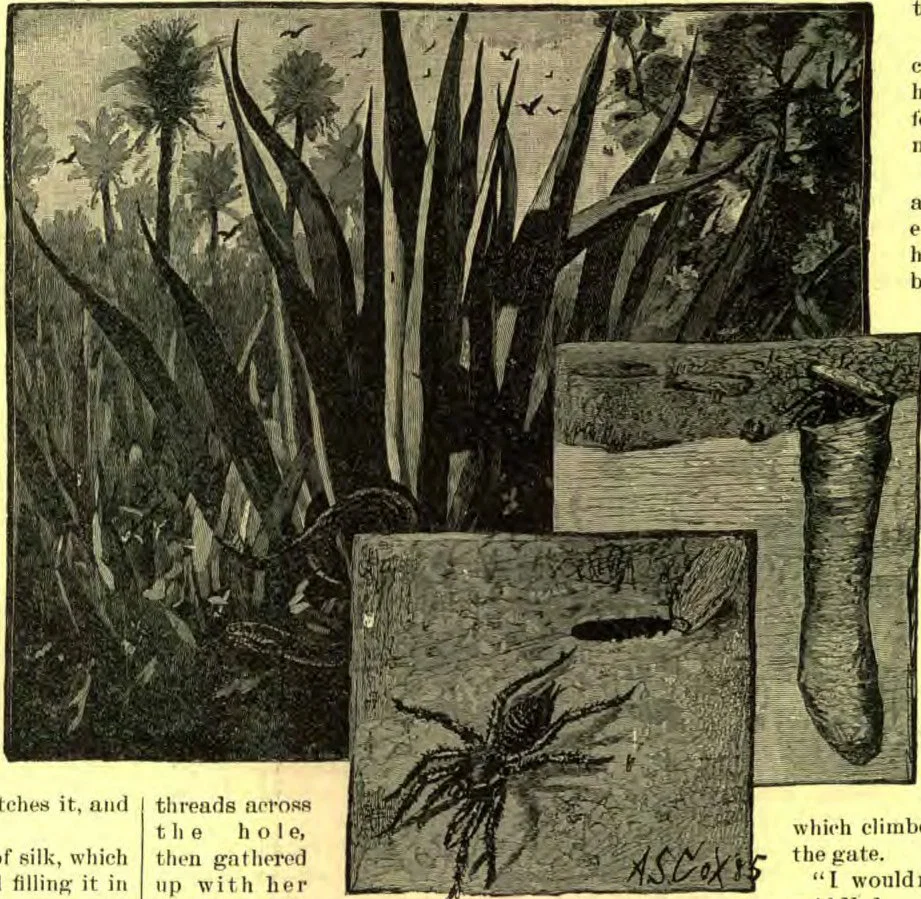
One of the most curious webs is that spun by the trap-door spider. The American species of this insect is found in New Mexico, Arizona, and California. Several species are also found in Southern Europe. The accompanying picture shows this spider, together with a sectional view of his home.
The holes made by this spider are nearly an inch wide, and from two inches to a foot in length. The spider digs this hole in fine soil, which afterwards assumes a brick-like hardness. At the top of the hole is fastened a cover that fits as tight as the cork to a bottle. The inside of the hole is smoothly lined with silk, even to the little cover that shuts so nicely over the opening. This cover is very cleverly fastened to the opening by a few threads that make an admirable hinge. When alarmed, the spider retreats to her hole, and seizing the door with her front pair of feet, so cleverly braces herself against the walls of the tube with the others that it is impossible to lift the cover without tearing it from the tube.
One species of trap-door spider digs a branch tube, connecting it with the main one a little below the surface, and closing the opening at the junction by another trap-door, so hung that it can close either passage.
Still another species builds a straight tube, with two doors, one a little below the surface, so that when an enemy tries to dig the spider out from above, she can close the lower door, making it appear like an empty nest. The spiders live in these nests most of the time, generally coming out at night to catch insects, which they carry to their nest to eat.
The naturalist Moggridge once caught one of the American species, and put her in a pot of earth, to watch her habits. She at once set about loosening the earth, and carrying it away piece by piece. In an hour she had dug a hole half as large as a walnut.
At another time he was fortunate enough to catch a spider at work making a door. “She spun a few threads across the hole, then gathered up with her front legs and palpi an armful of dirt, and laid it on top of the threads. She then got under the pile, into the tube; but the motions of the dirt showed that she was still at work on it, and next morning the underside had been thickly covered with web, and the whole separated from the mouth of the tube except at one side, where the usual hinge was left. The new door was at first soft, but in two or three days hardened, and appeared exactly like an old door.”
These spiders are in the habit of covering the door with moss, the more cleverly to conceal the nest from their enemies. Curious to know what the spider would do, Mr. Moggridge at one time scraped the moss from the door of this spider, and dug the ground up all around it. On visiting the nest the next morning, he found that the spider had carefully replaced the moss, thus making the nest show conspicuously on the bare ground. W. L. K.

A JUNE SONG.

A SONG for June, whose breath is sweet With blossoms opening at our feet; Whose voice is heard in brooks that run Through meadows, glad with song and sun. O happy, happy June!
The robin in the apple-trees His nest among the branches sees, And bubbling from his silver throat, What wordless songs of rapture float!
Above the world the firmament Spreads out the azure of its tent; How blest are we, whose dwelling is Beneath so kind a roof as this!
Our hearts are glad with bird and bee For what we feel, and hear, and see; Life seems a song to sweetest tune, O, would it were forever June! —Selected.

CLEAN HANDS.

“It’s a bargain you won’t get again in a hurry, and if you’re sharp, you won’t miss it.” Ned Howell spoke impatiently, as Ezra, the chore-boy at his grandfather’s house, stood by the gate, thoughtfully looking at a pair of cuff buttons that lay on his open palm.
“They’re real,” went on Ned, eager to close the bargain. “Why, one of them is worth more than half a dozen of your fancy pigeons, and here you have a chance to get the pair of them for less than half price.”
Ezra had come out the loser too often in his dealings with Ned to be willing to believe everything that he said; but the buttons did look like real gold, and if they were, he would have been quite willing to give six of his white fantail pigeons for them.
“Don’t paw them over with your dirty hands if you’re not going to take them,” said Ned rudely, as Ezra turned the buttons over, and examined them more closely. “If you aren’t sharp enough to make a good bargain for yourself, why, give them back to me.”
“I’ll take them,” said Ezra slowly, closing his hand over them. “I’ll have the pigeons in a basket ready for you to take home with you to-morrow morning.”
He put the buttons in his pocket, and went down to the barn to do his evening chores, wondering whether he had really been cheated again in his bargain, as he had so often been before. Ned stood at the gate, looking after the retreating figure of Ezra, with a triumphant smile on his face.
It did not occur to him that he had done a mean or dishonorable action in taking advantage of Ezra’s ignorance, and he was proud of what he considered his cleverness.
He knew that there was very little danger that Ezra would discover the comparative worthlessness of the cuff buttons, and so his untruthfulness in the matter would not be discovered.
Presently Uncle Frank left his seat on the porch, where he had been sitting, hidden by the vines which climbed over it, and joined his nephew at the gate.
“I wouldn’t be a chore-boy for anything,” said Ned.
“Why?” asked Uncle Frank.
“Oh, they have to do such rough, dirty work!” answered Ned. “Ezra’s hands are always dirty. I wouldn’t touch them for anything,” and he glanced with a very satisfied air at his own hands, which were almost as smooth and white as if he had been a girl.
“Ezra’s hands are cleaner than yours, to my mind,” said Uncle Frank, gravely.
“Why, what do you mean?” asked Ned, opening his eyes in surprise.
“I think dishonest bargains stain one’s hands more than honest work,” answered his uncle. “I could not feel that my hands were clean, no matter how white they might be, if I had just been cheating a poor boy out of his pigeons.”
Ned’s face grew very red.
“It wasn’t my fault if he didn’t know how to make a good bargain,” he muttered. “Every one must look out for himself in bargains.”
“He simply took your word for the value of the buttons. You told him they were real.”
“Well, so they were—real buttons,” said Ned, smiling as he remembered what he had thought his cleverness. “I didn’t say they were real gold; I only said real buttons.”
“You meant to make him think that they were real gold,” said Uncle Frank, sternly. “It was just as much a lie as if you had said real gold. You cannot call your hands clean, my boy, when you stain them by cheating, and the stains are upon your heart as well as your hands.”
He went into the house, leaving Ned to think about his words.
Somehow, Ned did not feel now as if he had done a smart thing in getting the best of the bargain. As he looked at his hands, he fancied that he could almost see the stains upon them, and he grew uncomfortable at the remembrance of the stains which were upon his heart. At last he made up his mind that he would rid his hands from this last stain, and he went down to the barn to look for Ezra.
“I say,” Ned began bravely, “I cheated you about those buttons. They aren’t real gold; they are only plated, and worth about twenty-five cents. You keep the pigeons till I send you the money for them.”
Then he went back to see Uncle Frank.
“I’ve made it all right with Ezra,” he said, “and I mean to keep my hands clean after this, sir.”
“Don’t forget the stains on your heart, Ned,” said Uncle Frank, kindly. “Remember to whom you must take those stains for cleansing.”
Ned had been proud of his sharp bargains, and it was no easy matter for him to remember his new resolution to keep his hands clean; but he did not give up trying, and when he failed, as he did sometimes, he took care to free his hands from dishonest stains by confessing his fault, and then he took his heart-stains to be washed away in the blood of the Lamb of God.—Sunday-School Times.

A PICTURE.

WHEN a child, a kind friend took me to a panorama of dissolving views, to see some beautiful scenes of sunny Italy. For a moment a view would glow on the canvas, only to fade away, and be mysteriously replaced by another and another.
The remembrance of this pleasing entertainment suggested the thought that the events of our earth, when compared with God’s great universe, are but the changing scenes in a dissolving view. Paul said, “We are made a spectacle unto the world, and to angels and to men.” But what strange scenes are presented to the heavenly beholders! As an old poet says:—
“Man, proud man, Plays such fantastic tricks before high heaven, As makes the angels weep.”
Could we see ourselves as we appear to those holy beings, would we not strive with far greater earnestness to act well our part in life? And yet we may know how we are regarded in the estimation of the great God; for he has given us in his Book a series of word-pictures, portraying the character of men, women, and children, just as they appear in his sight. If you read the Bible attentively, you will find these pictures. Both good and bad characters appear, and by comparing your own thoughts and actions with them, you may learn how to please God; you are to imitate the good, and shun the bad.
Will you read with me the few verses in Matt. 8:1-4, and also the parallel passages in Mark and Luke? As we read of this incident in the life of our Lord, we seem to see the cloudless sky of Palestine and the deep blue sea of Galilee. And here is Capernaum, the “highway to the Sea.” The splendid Jewish synagogue, with its chiseled blocks and carved columns, gleams in the sunlight, and the white houses stand forth from the brown hill-sides, or glimmer through the green trees.
A great crowd of people have just descended from the low mountain, and are about entering the city. These men are clothed in the loose, flowing robes of the East; they have come from Judea and Jerusalem, from Tyre and Sidon, and from all parts of Palestine, to see the new prophet, Jesus of Nazareth. Many of them were sick and crippled, but the Great Physician has healed all their diseases, and now, having listened to his “Sermon on the Mount,” they are following him, hoping for still other displays of his goodness. A little in advance of this motley crowd walks the great Teacher, Jesus Christ.
Suddenly a figure advances, scarcely human in appearance. His garment is rent, and the parts of his body exposed are covered with swellings and sores, while hands and face are coated with scaly white blotches. From his uncovered head the white hair hangs in a tangled mass; he is a most loathsome sight. This poor man is a leper, and by the Jewish law an outcast. He is forbidden to approach or to salute any one, but must stand afar off, and with covered mouth cry, “Unclean, unclean,” lest some one should come near, and be infected by the horrible disease.
He has heard of the great Healer, and comes directly to him. The crowd shrink back in terror, but the poor leper sees them not. He kneels at the feet of Jesus, saying, “Lord, if thou wilt, thou canst make me clean.” And the compassionate Saviour does what no one else dares,—lays his hand upon the leper, saying, “I will; be thou clean.” And then, O wonderful sight! the poor man’s sores disappear, and his skin becomes smooth as a little child’s. The tide of returning health courses through his veins. His leprosy has departed, and the leper is cleansed.
Dear children, we all have inherited a far more terrible disease than the Asiatic leprosy; it is the leprosy of sin, and with it we can never enter heaven. No earthly hand can heal us, and our only hope is to go to the Saviour, and kneel at his feet, saying with the leper, “Lord, if thou wilt, thou canst make me clean.” The defects of our sinful natures will then gradually disappear, and the image of the meek and lowly Jesus will be reflected in our lives. We shall be cleansed and fitted to enter into the presence of our Lord and Saviour, and dwell with him forever.
A. W. HEALD.

GRANDFATHER'S THREE THINGS.

What a delightful old gentleman Grandfather Morris was! So all the boys and girls in the family made up their minds.
They had none of them seen him since they could remember, for he lived thousands of miles away, and had not been to visit them for a number of years.
But it did not take long for him to make friends with every one. He talked with the boys of their sports, with the girls of their fancy work, and with the little ones of their games, until all felt that if it could be as many years since he was a boy as he said it was, he must have a wonderfully good memory of it.
And he talked to mother and father until they almost felt young again.
There were many sad faces when it was understood that grandfather had fixed on a day to go away.
On the day before, he called the boys for a little talk.
“We've had a great deal of fun together, boys,” he said, with the genial smile which was so dear to all the young people. “We have all enjoyed it, and it will be good to remember it. But I hope we have also found the sober things good as they came along, and that they, too, will be good to remember.”
“When I was a boy, I had a grandfather—”
“Was he as nice as you are?” interrupted little Archie.
Grandfather gave him a small shake, and went on.
“The last time I saw him, he said a few things to me which I have never forgotten. I should like to say something like them to you, as I may never talk to you again. He took my hand, looked at me with very earnest, gentle eyes, and said: ‘My dear boy, I haven't a long string of advice to give you. I will tell you of only three things, which I wish you to remember.’”
“I thought,” went on grandfather, “that three things could not be very much to bear in mind. This was the first thing: Always behave so as to be a credit to yourself.”
“Any boy would want to do that,” said Phil.
“Yes,” said grandfather, “but when I began to think it over, I thought it meant a good deal. It meant that I should strive to win the best opinion of people with whom I might be thrown by always being my very best self, by keeping all that was best and most pleasing in me uppermost. And I could not do that without keeping all the bad under.”
“The second thing was: Always behave so as to be an honor to those who love you.”
“I hope we all of us want to do that,” said George, soberly.
“I hope so,” said grandfather. “I found, on considering it, that just so far as we love our beloved ones better than ourselves did this mean more than the other. It brought before me all who had all my life been doing their very best for me, all who had given to me and taught me, all who had hoped in me. I could honor or dishonor them by my conduct.”
“Yes,” said Archie, with a grave shake of the head, “there was a bad boy on the street the other day, and I heard some one ask, ‘What kind of father did he have?’”
“Exactly,” said grandfather, with an encouraging smile, “you have hit the very essence and spirit of the thing, my little man. People may not ask it of you in so many words, but a boy can always carry with him pretty accurate information as to what kind of training he has had. Strangers will read it on his face, in his actions, in everything about him.”
“Now for the third. My grandfather, you see, began by the lowest step, and went up: Always behave so as to give glory to God.”
“You see, boys, the other steps are good; better; but we never get to our best short of planting our feet firmly and squarely on the third. We might for a long time contrive to keep up a very fair line of life and conduct before men, gaining their best opinions by what might be merely outward show. But it is only when the root of it all is planted firmly in the heart that we can give true glory to God; only when we are true and honest from the core, when all our outward well-doing springs from the earnest seeking of good to man and the glory of the Christ who has redeemed us to God; only when our lives are consecrated to his highest service.”
“So now, boys, let us try to remember grandfather's three things to seek: Credit for yourselves, honor for those who are dear to us, glory for the Lord.”
The boys' eyes were misty as they caught the last glimpse of the dear gray hairs as grandfather was driven from the door.
“I guess we'd better try and remember his three things,” said Fred.
“Yes, if it would ever make us as he is.”—Sydney Dayre.

A SMALL, SWEET WAY.

There’s never a rose in all the world, But makes some green spray sweeter; There’s never a wind in all the sky But makes some bird wing fleeter: There’s never a star but brings to heaven Some silver radiance tender; There’s never a rosy cloud but helps To crown the sunset’s splendor; No robin but may thrill some heart, His dawnlight gladness voicing; God gives us all some small, sweet way To set the world rejoicing.
—Selected.

FINGER SPEECH.

Oriental traders on the east coast of Africa have been compelled, in order to avoid the interference of lookers-on, to adopt a sign-language. Walking through a market-place, the traveler will often witness a strange sight. Two grave, long-bearded Arabs will step aside; each will put his hand up the other's capacious sleeve, and the pair will then begin apparently to pinch each other's fingers for a few minutes. Often the performance will be varied. One will unroll his long turban cloth, or perhaps lift up his long mantle, and then cover his hand, and concealed beneath this, the pinching of the fingers will proceed as before. The initiated know that this is a method of bargaining by means of a code of finger-speech understood by Eastern traders from Southern Arabia and Northern Africa to the borders of Persia. It has been adopted for a simple reason. In the East, especially along the coast of the Red Sea, all business is transacted in the open air. In all such transactions the by-standers, idlers, riff-raff, and meddlesome busy-bodies generally, contrive to have a good deal to say, tendering their advice to both buyer and seller. The unwritten etiquette of the East requires that such friendly counsel be not resented. But as the merchants and dealers find it an unmitigated nuisance and a great hindrance to business, they have adopted a certain code of finger-signs, which they exchange, when bargaining, with their hands concealed under their sleeves or turban-cloth. Each finger and each joint of a finger represents a certain figure. So the pair can bargain by the hour, as they often do, to their heart's content, and none of the noisy, and gaping busybodies around them be any the wiser for it.—St. James Gazette.

A KINGLY EXAMPLE.

An exchange tells a pleasing story about two American boys traveling in Europe. They were playing in the streets of Copenhagen, and one boy tossed the other's hat into a tree. While the victim was trying to dislodge it, there came along an old gentleman, with an umbrella under his arm, and his head buried in his book.
“Please sir,” said the hatless boy, “will you get my hat?”
The old gentleman tried with his umbrella for about five minutes, and failing to dislodge the hat, told the boy to mount his shoulders; and, with the umbrella, he finally captured the hat. As the boy dismounted, and thanked the old gentleman, another gentleman came along, who saluted, and called the one with the umbrella, “Your Majesty.”
The boys were astonished to find that they had in this unceremonious fashion made the acquaintance of the king of Denmark, and they think the king deserves his kingdom.—Selected.

TAKE CARE.

Little children, you must seek Rather to be good than wise; For the thoughts you do not speak Shine out in your cheeks and eyes.
If you think that you can be Cross and cruel, and look so fair, Let me tell you how to see You are quite mistaken there.
Go and stand before the glass, And some ugly thought contrive, And my word will come to pass, Just as sure as you're alive.
What you have and what you lack, All the same as what you wear, You will see reflected back; So, my little folks, take care.
And not only in the glass Will your secrets come to view: All beholders, as they pass, Will perceive and know them too.
Out of sight, my boys and girls, Every root of beauty starts, So think less about your curls, More about your minds and hearts.
Cherish what is good, and drive Evil thoughts and feelings far: For as sure as you're alive, You will show for what you are.
—Alice Cary.

A FANTASTIC FLY-CATCHER.

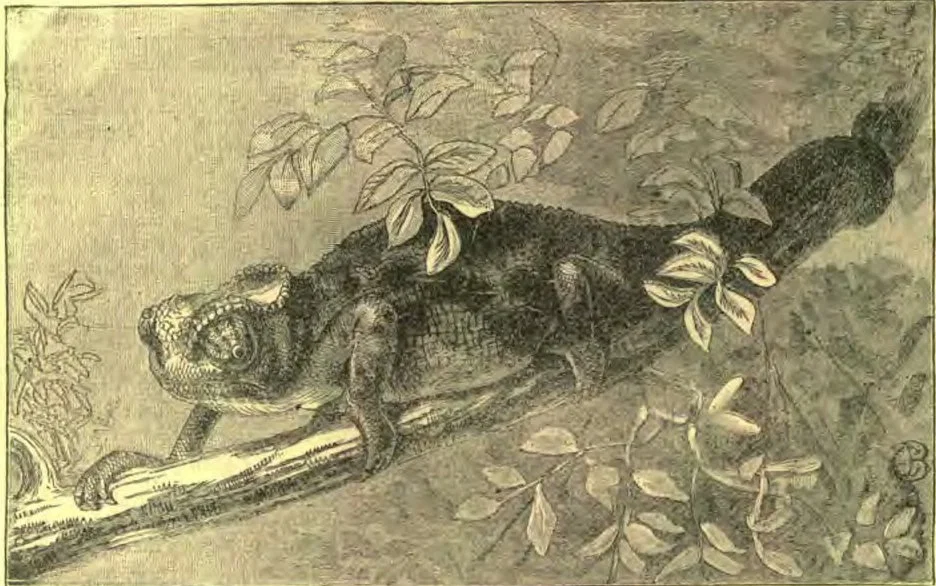
COME with me into my garden, and I will show you something. Where is my garden? Why, it is in Africa, of course; where else should it be? Don't ask foolish questions, but come down to the farther end of the garden, and sit down on this bench, under the thick green leaves of the cork-tree. Now look at that branch, and tell me what you see on it. “Leaves?” Yes; but what else? “Nothing else.” Why, where are your eyes? Put your finger on that leaf, and see—“Oh, oh! it is alive!” Indeed, it is very much alive.
That is a chameleon, and a very singular fellow he is. He is a kind of lizard, and—see! Look how his color changes! He was green when we first saw him, and now he is nearly black, with round, yellow spots all over him. He can change the color of his dress whenever he pleases, without having to change the dress itself; that is a great convenience. He is so perfectly still you might think him asleep, if it were not for his green, big, round eyes, which are constantly moving. He can move them in different directions at the same time, which is more than you can do, or your schoolma'am either. One up and the other down; one forward and the other back; truly, that is the way to use one's eyes. It seems very paltry to be obliged to move both at once, and in the same direction. Ah! he moves a little, just a very little; now he is still again. I think he sees that large fly that has just lighted on the branch. He says to himself, “It is dinner-time.” (It is always dinner-time whenever he sees a fly, or any other insect.)
Now, how do you think he is going to catch that fly? It is so far off, he certainly cannot reach it from where he sits, and his motions are so slow that the fly might be a half mile away before he had uncoiled his tail from the branch round which it is closely twisted.
Flash! What was that? Out from his mouth darted a long, slender, round thing, as long as his whole body almost; it darts back again, with the fly on its tip; and Mr. Chameleon swallows quietly the first course of his dinner. That long, slender thing, as straight as a billiard-cue, and as sure of its aim, was the gentleman's tongue. “What a very remarkable tongue!” you say, and you say well. It is gun and fishing-rod, knife, fork, and spoon, to the chameleon. He will sit there for hours, perhaps, perfectly motionless, except for his tongue; and whenever a fly or other insect alights within reach of that wonderful member—flash! it is out and in again, and the unhappy insect is devoured before he can say Jack Robinson, supposing that he knows how to say it, which I doubt. Ah, look! You did not look quickly enough, my dear. In the time that it took you to turn your head, a dragon-fly came, and was seen, and was conquered, and the last wing of him has just disappeared down the chameleon's gaping jaws. And now I do believe the creature is changing color again! Yes! the yellow spots fade out, and the black lightens, until now he is a light brown all over, just the color of a dead leaf. Pop! another fly has met his fate.
Have you seen enough of this very greedy fellow? Jump up, then, and shake the branch. Whisk! Scrabble! He is gone. You see he can make haste, after all, when he tries.—Laura E. Richards.

HOW RUTH AINSLIE LOST AND WON.

You see the one that stayed at the head of the spelling-class the most days in the term was to have a prize, really the most elegant Bible you ever saw—or at any rate I never saw one so handsome; but you have lived in the city, and I haven’t. Well, Luena Shaw and I were just even, and that very day was to decide it, because the next day was examination.
The baby—our baby, I mean—was sick, and I told mother that morning that Luena Shaw’s baby was always well, and that was how she got ahead of me in arithmetic; but she said it was because Luena’s mother was stronger than she, and so didn’t need her little girl’s help. That made me sorry I had been cross, and I stayed till the very last minute, carrying him round and round the room, singing to him. I’m glad enough I did, for he didn’t live long after that, and I knew he was pleased to be carried, because he kept just as quiet as could be; but when the school-bell rang, of course I had to go. The spelling class came just after the prayer, and I saw Luena’s book open under her desk when she bent her head. I didn’t like that; seems to me I’d never pretend that way; but if I didn’t study, I felt like crying, I was so anxious. And I guess I didn’t pray any more than Luena, till it came to “Deliver us from evil.” I thought missing a word would be a dreadful evil, and I know I did pray then. When the class was called, I stood at the head, and Luena next. All the chance I’d had to look at my lesson was just a little time till mother came and kissed me good-night, and took the light away, the night before. I was so sleepy then I could hardly see the words. But I was sure on the first part; and I made up my mind, by the number of words we generally had, we were almost through the lesson, when the teacher gave out “tyranny.” I couldn’t remember I’d ever seen the word, and I couldn’t imagine how it was spelled; but as it went on down the class, every one missing it, I listened to the best spellers, and felt sure it was tyr for the first syllable, an for the next. If there had been one boy below Tom Peters, I should have known whether the last syllable was ny or y. As it was, it came to me without my being sure. I was so frightened; I spelled well enough till it came to that last syllable; then I hesitated, long enough, I suppose, for the teacher to think I’d put in the two n’s, but I truly didn’t put in but one. Just then somebody knocked at the door, and as he started to answer it, he gave out another word. But Luena called out, “Aren’t there two n’s in tyranny?” “Yes, and Ruth put in two; didn’t you, Ruth?” he asked. And then he opened the door, for the rap was repeated, and I had to wait while he showed in a visitor. The school desks seemed to swim before my eyes. I knew he would believe me, because he said once I was truthful; and there was the Bible, with its splendid clasps shining like gold. Besides, it hadn’t been my fault that my lesson wasn’t learned, and Luena had studied hers in prayer-time. I don’t know how I thought so much in so short a time, but I seemed to see in a flash all the reasons why it wasn’t fair that I should lose the prize.
But just as soon as I thought of prayer-time, I remembered the place where I had joined in it, and the evil seemed now to be a lie, and not losing the prize. I couldn’t make it that any more; it was as if I had said, “Deliver us from lying.” And I thought of mother, and what she would say, and how the teacher would look if he found me out. As soon as he turned toward us again, if you’ll believe me, he gave out another word, as if nothing had happened. I spoke up loud now: “No, sir; I didn’t put in but one n.” He looked puzzled first, and then said, “Didn’t you?” and looked sorry. If he hadn’t looked that way, I shouldn’t have done it; but when Luena went above me, biting her lips to keep from laughing in my face, I couldn’t speak to spell the next word he gave me. He seemed to want the visitor to hear me spell a hard word, because I had just failed. If I had spoken, I should have burst out crying, and I hate to see a big girl like me do that, so I went down again. I told my mother about it at noon, and said I’d lost the prize, and another place besides, all for asking to be delivered from evil; for by that time all my wishing had come back. But she kissed me, and said it was better so; I would never have enjoyed the most beautiful prize if it couldn’t honestly be mine, and that she would give me a pretty Bible because I had told the truth. But I thought she could never afford to get me one like that I had lost; and I should have been cross, but that she seemed so worried about the baby.
When examination day came, the teacher told us to take our places in the spelling class in alphabetical order, that is, if a girl’s name began with A, she should stand first. Mine did, you see, so I was at the head again, but there was no comfort in that now. When the class were all in their places, he made a little speech to the visitors, for the room was full by this time, explaining about the prize. Then he said Luena Shaw had been perfect one more day than I had, and called her up to take the prize. She was dressed beautifully; but I had to wear my old plaid that had faded in the wash, because baby was too sick for mother to finish my new gown. I felt as if everything was against me that day.
Luena made the prettiest bow, and said, “Thank you, sir,” and came up the aisle looking so pleased. But she was good when she came to me, for she looked another way, and was sober. When she was seated, the teacher cleared his throat, and said—well, I can’t tell just what it was, for I was so surprised, but he spoke of my having been perfect in spelling so many times, and that he would have thought that I had spelled the word right, only I said I hadn’t. He ended by saying he wanted me to have a present; and calling me up, handed me a Bible exactly like the other.
I didn’t make a pretty bow like Luena; I just bent my head, for fear he would see tears; I saw them in his eyes when I tried to whisper, “Thank you.” I didn’t look nice, nor carry it off nicely, and told mother so. But she didn’t care; she just hugged me, and we were so happy over it.
On the fly-leaf of the Bible was written:—
RUTH AINSLIE.
From her Teacher.
“They that deal truly are His delight.”
—M. A. Parsons.

A QUESTION ANSWERED.

A boy once asked this question, “How can I find my way in the woods, if I have no compass, and am entirely unacquainted with the region?”
The reply was: “There are three quite sure ways of knowing the points of the compass, which every one should learn. First, three-fourths of the moss on trees grows on the north side; second, the heaviest boughs of spruce trees are always on the south side; third, the topmost twig of every uninjured hemlock tips to the east.”
By signs like these, the Indians know their way in forests through which they have never passed. If any one will remember these signs, he need never get lost in the woods.

Blessed Are the Pure in Heart

BLESSED are the pure in heart; for they shall see God.

FINGERS AND FORKS.

Did you know that Queen Elizabeth ate with her fingers? You may have known that she loved show and style, that she was so fond of fine clothes, that when she died she left three thousand dresses and any quantity of jewels; but did you ever imagine that such a great lady could be so inelegant as to eat with her fingers? But she did, and so did Shakespeare, and Chaucer, and William the Conqueror, and King Alfred, and everybody else who lived before her time. These last were more excusable than she—they had no forks; but even she was not without excuse, for though she had several, they had been given her as curiosities, which, I suppose, nobody expected her to use. There was one of crystal garnished with gold and sparks of garnet, another of gold with two little rubies and two pendant pearls, and still another of coral.
Why didn’t she use them? you ask. Well, because she had never seen or known anybody that used one, and they were something new; and, besides, there was a prejudice against this invention just from Italy. But you must not think because there were no forks that the old-fashioned dinner made no pretensions to elegance or refinement.
The guests had knives, and they had fingers, and with these two implements, they managed nicely. From their old books of etiquette we learn how they did it. In the first place, the fingers must be publicly washed before beginning the meal; even if this had just been done privately, it must be repeated at the table, that no one might feel uneasy in eating after his neighbor’s fingers had been in the dish. To aid further, the meat was prepared as far as possible before it was brought on the table. If in a stew, as was usually the case, it was in bits; if roasted, it was cut by a carver, and passed in large plates with a knife.
As to the way of helping himself, each guest must choose and keep a particular part of the dish as his own. He must help himself daintily from this place, using only three fingers; afterward, in carrying the food to the mouth, which, of course, was done with the hand, these same three must be used, taking care, however, not to touch the nose with them, to do which was extremely inelegant, and showed a lack of good-breeding.
Of course all this soiled the hands, and in refined households at various intervals bowls of perfumed water and different napkins were passed, and no one must refuse to wash. The old fashion of handing round a silver bowl or dish of rose-water is still sometimes seen in Europe.
After awhile man found out that he needed forks, or, rather, woman did, for it was she who first used them. Great dames kept them in their rooms to eat comfits with and to toast bread; and, in course of time, they brought them to the table.
As I have said, there was a prejudice against them; and the first few persons who were brave enough to use them were laughed at and called effeminate; a preacher even went so far as to say that for any one to refuse to touch his meat with his fingers was an insult to Providence.
Nevertheless they spread; in England slowly, even after Italy, the home of their birth, was full of them. Those who knew their value, however, found them so convenient that up to 150 years ago—since which it has been no longer necessary—gentlemen traveling from place to place, and knowing how poorly supplied were the inns, carried one with them in a case with a knife. Since that time the old two-pronged forks, or fourchette (little pitchforks), as the French called it—and really they were only tiny pitchforks—has given way to the more convenient three and four pronged forks in use in our own homes.—Harper’s Young People.

AN ANGEL HERE.

A ragged urchin played along the street, And slipped, and fell upon the icy way; A fair-browed girl tripped by with nimble feet, But sudden stopped beside the boy, who lay
Half crying with his pain. In sweetest tone, And eyes brimful of tender, human love, She said, “And did you hurt you much?” A groan Died on his lips. An angel from above
Could not have grander seemed than she to him. He opened wide his great, brown, homeless eyes, Thus to be sure one of the seraphim Had not come down to earth in sweet disguise.
She went her way, forgetting that she smiled, Glad to have said a word of hope and cheer; Not so the vision to the humble child; That voice and face would live through many a year.
And then to boys who gathered round the lad, He said, with face aglow with sympathy, And heart that ’neath his ragged garb was glad, “I’d fall again to have her speak to me.”
O precious human voice, with power untold! O precious human love to mortals given! A word or smile is richer gift than gold; Better be angels here than wait for heaven.
—Sarah K. Bolton.
Continue reading: SHUT IN