Your ShelfYour Projects

Signs of the Times, Vol. 36, No. 6.

The Love of God
Earlier text: A Sunday-Rest Law

Attorney Brady's Fee and the Power of Corporate Wealth

As indicating the greatness of corporate wealth, the opportunities for greed and graft, take the fee of Attorney John W. Brady, who prosecuted the Waters Pierce Oil Company in Tarrant County, Texas. The company was fined $1,625,000, and his fee amounted to $975,000. The next largest to this on record in the South is one which Senator Bailey received in Texas, of $200,000 from the Kirby Lumber Company. It is stated that Brady's fee would purchase 50,000 acres of Texas land and stock it with 20,000 head of the finest longhorns.

Russian Veteran Claimed to Be World's Oldest Man

The oldest man in the world is said to be a Russian warrior, born 136 years ago. He has papers which show that his birth was on Sept. 5, 1772, and he enlisted in 1796, was discharged from the army with the rank of Sergeant-Major, and a good pension, in 1857. He was in the Napoleonic wars and the Crimean campaign, and wears twelve medals. His name is Andrei N. Schmidt. For sixty-two years he has been a widower. He has never smoked tobacco, or drunk spirits.

Earthquake in Italy: A Visitation from God?

The Sacramento “Bee,” referring to the recent terrible earthquake in Italy, states that “A man to-day who would deliberately declare the terrible slaughter of two hundred thousand souls to be a visitation from God would be viewed as a heathen rather than a Christian, and rightly so, too.” And yet the Western Watchman, one of the ablest Catholic papers in the country, does not fear to declare that it is a visitation from God.

International Prison Congress Seeks Crime Prevention Focus

The International Prison Congress will meet in Washington in 1910; $50,000 appropriation has been asked of Congress in its behalf. Its deliberations next year will look toward prevention of crime, rather than to its punishment, to strike at the root of the growing tree among the juveniles. They have our sympathy. We wish their work might reach the fathers, mothers, and preachers.

Colorado Sunday Law and Mercantile Association Enforcement Push

Colorado has a Sunday law, but the Colorado Springs Telegraph notes that at a recent Mercantile Association meeting, the convention voted for a more rigid enforcement of the Sunday-closing ordinances and asks the Legislature to pass a Sunday-closing law. That will ever be the case till the ideal Puritan law is reached. All the limited Sunday measures which are presented to our Legislatures are entering wedges simply.

Unemployment Hardship Across Great Britain

It is said that there are seven million human beings in Great Britain who are suffering hardship now through unemployment. This is on the basis that every worker represents a family of five. The skilled workers unemployed number five hundred thousand, and unskilled, one million. This is surely a fearful condition, and how long will it be endured?

Tennessee Has Voted Prohibition.

The governor has vetoed the bill, but the Legislature has passed it over his veto. The same issue came up in Washington in a bill to prohibit liquor-selling in the District of Columbia, but the House Committee killed it by a vote of 11 to 2.

Praise for Secretary of Agriculture James Wilson

Mr. James Wilson, Secretary of Agriculture, has been for twelve years in the Cabinet. He is a Scotchman by birth. He has done most excellent work in his department, and we wish for the farmers’ sake he might be retained.

China’s Bereavement.

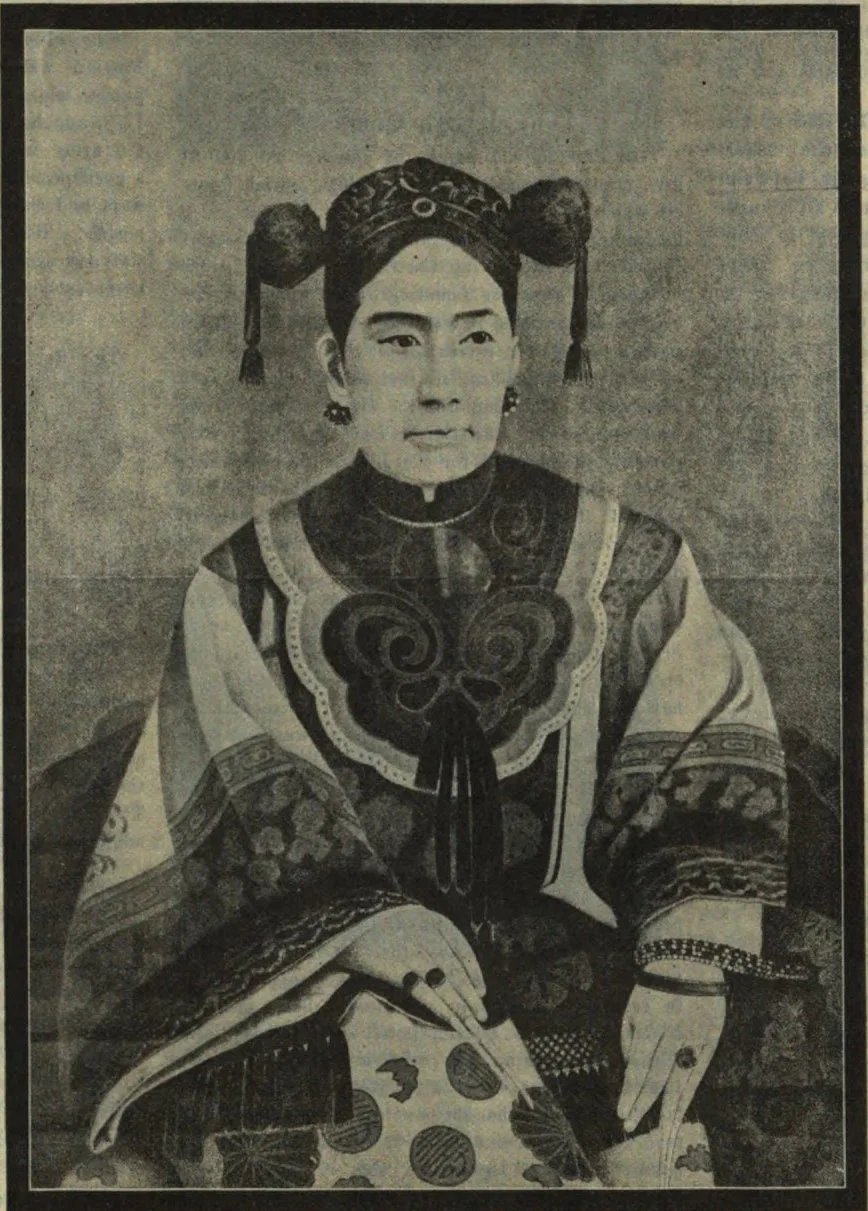
It had been expected for some time that the Empress Dowager who was nearing her seventy-fourth birthday would not have many more years to manage the affairs of China. It was also known that the Emperor’s health was in a feeble state. But the news of the death of both within twenty-four hours of each other came as a surprise to all in the Empire of China. The death of the Emperor Kwang Hsü, who was in the thirty-fourth year of his reign, occurred on the 14th of November, and that of the Empress Dowager, the following day, November 15. The Dowager Empress was elected to a high place in the royal family in the reign of the Emperor Hsien Feng, who was the Emperor of China from 1851 to 1862.
The Late Empress Dowager of China.
Upon his death she was appointed regent over his son, T’ong Chi, who reigned for thirteen years, ending his reign in the year 1875. T’ong Chi had no sons, neither had he any brothers, so the Empress Dowager appointed her nephew Kwang Hsü to succeed T’ong Chi to the throne, she still holding the reins of government in her own hands, since Kwang Hsü at this time was but eleven years old. Too, it is a rule according to the Chinese “Book of Rites” that the heir to the throne can not manage the affairs of the government until eighteen years of age; nor can a prince memorialize the throne until he has attained this age.
As Kwang Hsü became older the empress gradually gave him power and responsibility until the year 1887, when he had the affairs of government in his own hands. During his younger years every opportunity was given him for acquaintance with affairs of state, both at home and abroad. And since his reign was synchronous with this period of modern enlightenment the spirit of reform took hold upon him, and he, seeing that China’s future depended upon an awakening from the old paths, put forth every effort to model his kingdom after those of other, Western nations. But just at the time when he was about to effect some of these reforms, his plans were revealed to the Empress Dowager and some of the conservative princes, with the result that Kwang Hsü was compelled to abdicate his power of the throne, and since the year 1898 was emperor only in name, the affairs of the government being in the hands of the Empress Dowager.

Reverses During His Reign.

At the time when Kwang Hsü became emperor, China had barely recovered from the ravages of the T’ai P’ing Rebellion. Before ten years of his reign had elapsed, China was again engaged in war with France. In 1894 the war with Japan resulted in the independence of Korea and the cession of the Island of Formosa to Japan. This again was followed by the Germans seizing Kiao Chow, a point of land off the eastern border of the Province of Shantung. The Russians soon occupied the Liaotung peninsula, and a portion of the southern province of Kwangtung was leased to Great Britain. These misfortunes were followed by that of the Boxer uprising, with the payment of indemnities incurred by this, and the war of 1904 on Chinese territory between Russia and Japan. So he was not able to transmit to his successor the same territory that he received. And this series of reverses was a matter of deep grief to the emperor, who was represented as a man of gentle and quiet disposition, of high purposes, ever willing to learn, and anxious for the good and progress of his country.
The most influential character, however, in China during the last half century has been the Empress Dowager. Having during the greater portion of this period the affairs of the government in her own hands she became the most powerful personage and perhaps the most skilled in manipulating official matters of any one in the empire. She was a woman of unusual talent and well versed. Many important statesmen had their career and passed away during her reign,—such as Li Hung Chang and Liu Kun Ye. Her last official act was to appoint the new emperor who was the nephew of Kwang Hsü, being the son of his younger brother, Prince Chun. Since Pu Yi is but a child two years old, his father was appointed regent over him and will be during the few years to come the supreme ruler in China. It will be recalled that Prince Chun, the present regent, was the special envoy sent by the Chinese government to Berlin to offer apology for the assassination of the German Ambassador in 1900. He is a man of progressive ideas, and has chosen as his two chief counselors Chang Chi Tung and Yuan Shi K’ai, two of China’s greatest and most respected statesmen, as well as being strong advocates of reform. The last wish of the late emperor was that China should make haste in adopting the Western form of government, and it was his wish that his younger brother’s son should succeed him to the throne. The latter has already been effected, and there is very little doubt but what the other request will be rapidly carried out, for now there seems to be nothing left to obstruct the policies of the reformatory party of which the present regent is the chief promulgator.
Everything is reported as being quiet in Peking, and arrangements are being perfected for the burial of the late Empress Dowager and the Emperor. Meanwhile all the officials in China have been commanded to go into mourning for one hundred days. This mourning ceremony will be universally observed by all subjects of the Chinese Empire, they being required to remove the red button from their hats, red being a sign of joy, and it be replaced by white or blue— Chinese colors for mourning. Wherever red is ordinarily used, whether on a bridal chair or as a covering of an umbrella that precedes an official procession, or as decorations on a newly opened store, the use of this color is forbidden for one hundred days. Further, it is required of all officials that they shall not shave their heads during this time, and it is expected of every loyal Chinese subject that he shall also acquiesce in this matter. In front of all large stores will be found banners and crapes of white having written on them in blue characters expressions of mourning. The various legations of foreign countries will for twenty-seven days lower their flags to half-mast. Throughout the country the leading officials of each district must for three days gather their subordinates morning and evening for seasons of weeping. Marriages and feasts and all occasions of hilarity are forbidden during this one hundred days. Previously when emperors died, it was not so easy to carry out the rites of mourning, owing to the lack of rapid communications to the different parts of the empire, and it was sometimes weeks before some of the lower officials would receive the news. But to-day the decrees reach all parts of the empire during the same day.
The official name given to the new emperor by which his reign will be designated is “Hsuen Tong,” which translated means “continuation of glory.” So next year the Chinese calendar will be the first year of the reign of Emperor Hsuen Tong. With the few experienced statesmen as his counselors and a large number of foreign trained officials already at his command, we believe the outlook is very encouraging for the adoption of a constitutional government for China, and the development of her governmental policies along those followed by other governments in the formation of a strong army and navy. Judging from the present indications the affairs of state are well under the control of the Imperial House at Peking. As to how these reforms will be a betterment to the people in general, we can not say, but we know that the spirit of the time is that every nation is trying to outdo the other in its preparation for war. And we feel that that which bestirs China most of all towards adopting Western methods is that she may learn how to fight successfully so as to protect her territory from future ravages such as have taken place during the reign of the late emperor, by the powers that were fully equipped. China has felt the injustice of these intruders and has felt that it was force rather than principle that has robbed her of her territory. Some day this pent-up vengeance will give expression when a few millions of China’s young men are armed with the implements of modern warfare.
H. W. MILLER, M.D.
Shanghai, China, Nov. 24, 1908.

Our Work and Workers.

Brethren J. W. Christian and R. E. Harter conducted the dedicatory services for a new church building at Aberdeen, S. Dak., January 9, 10.
Seven hundred copies of “Patriarchs and Prophets,” Spanish, were recently shipped by the Pacific Press to Manila, where orders had already been taken for the full number.
Meetings have been held by Brother Daniel N. Wall at Spring Valley, S. Dak. He has organized a Sabbath-school of seventeen members, ten of whom have taken their stand for the truth.
A well-attended bookmen’s convention was held at Mountain View, Cal., January 23 to February 1. Delegates from all parts of Pacific Press territory were present. Much practical instruction was given.
Sabbath, January 16, twenty-two young persons and children were baptized at the Takoma Park Church, Washington, D. C., by Prof. Frederick Griggs. Nearly all are from the Takoma Park church school.
At Scranton, Pa., in the Jackson Street Baptist Church, on Sabbath, January 2, Elder W. H. Heckman baptized five new members. This makes a company of fourteen persons who have recently been added to that flourishing church.
Brother N. Z. Town, who has spent twelve years in missionary work in South America, is now at the office of the Pacific Press preparing manuscript and translating into the Spanish language literature for Spanish-speaking people.
Brother O. O. Fortner reports through the South African Missionary the baptism of six candidates at Durban, Natal, late in the autumn of last year. In all, fourteen accepted of present truth under the labors of Brother and Sister H. J. Edmed and Sisters M. E. Robertson and Annie Strachan.
Dr. Oberholtzer, of Burma, writes that a Buddhist priest has recently begun to study the truth of God, and in a few days he said he would never bow to an image again, and a little later he took off his yellow robe in which he begged as other priests did. A little later he was taken very sick so that the doctor despaired of his life, but was raised up in answer to prayer.
Brother J. C. Rogers, referring to a marriage ceremony in Nyassaland, says if a girl wants a man, she cooks a pot of porridge and sends it to him; if he eats it, that constitutes the engagement; he generally gives her a yard of cheap calico to bind the bargain. At the time of the marriage ceremony there is a big feast, and if any one has a grudge against the bride, they take revenge at that time by whipping and beating her to their hearts content. Brother Rogers has applied to the government for official papers authorizing him to perform the marriage ceremony in a Christian manner, especially among our people.
Splendid reports come to us from the great Russian field. Brother J. T. Boettcher has just ended a trip among the churches of the Baltic Conference. He had baptism in nearly every church, and organized two new churches. In one instance, when the baptism was held at midnight so as not to attract attention, not thinking any one would know, at least 150 people accompanied them, among whom were three policemen, a city officer, and a soldier, and some were intoxicated. One of the policemen asked if he should make the people take off their hats, and he was told that that was left to every individual; but every head was uncovered, and stillness and order reigned throughout the entire service. We quote: “Where heretofore we have dreaded to see policemen, we now quite often find them friends to the cause of God.” In a university city thirteen were baptized in the river at midnight. This was in the far north where it is not too dark at midnight, and where many people are still going about.

Action and Endurance in Human Life

THE life of man is made up of action and endurance; and life is fruitful in the ratio in which it is laid out in noble action or in patient perseverance.— H. P. Liddon.

Wanted for Missionary Work.

SIGNS, Watchman, Life and Health, Life Boat, Bible Training School. Address Paul Curtis, Saskatoon, Sask., Can. Send post-paid; do not seal or cover ends, because of excessive postage.
SIGNS, Instructor, Little Friend, Watchman, Life and Health, and all kinds of tracts. Mrs. S. A. Williams, 15912 Park Ave., Harvey, Ill.
CLEAN copies of SIGNS OF THE TIMES or other Seventh-day Adventist publications suitable for missionary work. Address James Harvey, 1068 3d St., Oakland, Cal.

Steps to Christ

—This little work, by Mrs. E. G. White, presents in a simple and attractive manner the steps by which the sinner may be made complete in Christ. While the book is an excellent guide for inquirers and young converts, it also contains a wealth of counsel and encouragement for those who are laboring with the difficulties that beset a growing experience. Paper covers, 30 cents; cloth, plain edges, 60 cents; cloth, gilt edges, $1.00. Address this office.

Thoughts from the Mount of Blessing

Thoughts from the Mount of Blessing.— An exposition of Christ’s Sermon on the Mount. It has 218 pages and six chapters: On the Mountainside, The Beatitudes, The Spirituality of the Law, The True Motive in Service, The Lord’s Prayer, Not Judging but Doing. A new edition just printed on fine enameled paper, new type, and reillustrated with 27 beautiful half-tone engravings specially prepared for the book by eminent New York artists. It will be found full of comfort and blessing by all fortunate enough to obtain and read it. A beautiful gift book. In paper covers, 35 cents. Address this office.

Education: A Book on True Education

Education.

The object of true education and how it may be realized by the youth, the parent, the teacher, the writer, the tiller of the soil, and the business man, is the great theme of this book.
Its first chapter is devoted to First Principles; following that are illustrations taken from the history of Israel. Master Teacher, Nature Teaching, the Bible as an Educator, Physical Culture, Character Building, the Under Teacher, and the Higher Course, are titles of other chapters. 321 pages. Cloth, $1.25. Address this office.

Friend in the Kitchen: Vegetarian Cook-Book

Friend in the Kitchen.—This is an educational cook-book. Its object is to educate people away from flesh-eating by presenting to them a far better way. This “better way” consists of 400 thoroly tested recipes for the preparation of good, wholesome dishes, none of which include meat of any kind. The book gives the nutritive value of foods, time required to digest various foods, rules for dyspeptics, best food for infants, substitutes for meats, and, in fact, about everything a person wishing to reform his dietary needs to study. Durably bound in flexible cloth, 25c; oilcloth, 50c.

The Inevitable.

I LIKE the man who faces what he must, With step triumphant and a heart of cheer; Who fights the daily battle without fear; Sees his hopes fail, yet keeps unfaltering trust That God is God; that somehow, true and just, His plans work out for mortals; not a tear Is shed when fortune, which the world holds dear, Falls from his grasp: better, with love, a crust Than living in dishonor: envies not, Nor loses faith in man; but does his best, Nor ever murmurs at his humbler lot, But, with a smile and words of hope, gives zest To every toiler: he alone is great Who by a life heroic conquers fate. — Sarah Knowles Bolton.

Building a Home

By Mrs. L. D. Avery-Stuttle

Windows.

It matters little how much money is expended in building a house, or how much pains is taken in its erection, it can never be a home in the truest sense of the word, unless there are plenty of windows, because it is sunlight which makes a room pleasant and cheerful, and which gives to it a certain air of comfort and coziness which it is impossible to gain without it.
And yet—strange, isn't it?—there are ever so many people who seem to think that the blessed light of the sun is the one important thing to be excluded. But who ever heard of a “cozy corner” without a window in it? or what would be thought of an architect who planned a building with no windows, or even one windowless room? Such a structure might be called a house, but assuredly it would not be a home. And homes are what we need. There are very many more houses in the world than there are homes.

Gloomy Homes.

But what good, pray, are the windows if they are kept closed and heavily curtained with thick, dark draperies and shades through which it is quite impossible for a suggestion of light or a stray sunbeam to flicker through?
Wait; I had forgotten. Did I say that the architect builds no windowless houses? Perhaps not entirely windowless, but I believe there are houses,—at least I have been told that there are,—very massive buildings of stone or brick, with only now and then tiny windows which are placed very high in the walls. These little windows are so arranged as to exclude as much light as possible from the miserable occupants. But there are no curtains to these windows. There are bars instead, and the rooms are called cells. I trust that the readers of these lines need no such punishment.
Then, unless we want to make jails or penitentiaries or prisons out of our houses, in the name of reason, I say, open your blinds and raise your curtains.

“Let There Be Light.”

These remarkable words were spoken by the Almighty on the morning of the first day of Creation. He did not wait until the second day or the third day to utter this all-important command.
What is the first work we do when we enter an unlighted room after dark?—We strike a light. Yes, but when a provident heavenly Father Himself has kindly lighted our dark little planet by His glorious light-bearer, the sun, what are we that we should attempt to exclude it?
“Yes,” you say, “but it fades our carpets and our draperies and our costly couches. Of course, it is cozier and more cheerful with the shades raised, but the sunshine fades everything terribly!”
Not so, my sister; not everything. The sunlight does not fade the pale, hollow cheek of the consumptive; it is the shadows that do that. Neither is the plump, round cheek of childhood faded by its kindly kiss. The sunlight does not fade the rich and luscious cluster of grapes on yonder vine. It is the finger of light which tints the ruddy cheek of the peach and the pear and gives the wondrously rich hue to the cherry and the apple. No, my sister, there are some things, you see, which the sunlight doesn't fade.
As I write, the beams of the afternoon sun are falling across my desk. Outside the “chill December winds” are scurrying a few stray white flakes hither and thither, but the cheerful light of God's great luminary brightens the whole room, and I say, “Thank God for the sunlight!”
The other day I called upon a neighbor, a frail little woman who looks as if her hold on life was very slight. She came to the door with her baby in her arms and welcomed me. But once inside, it was so very dark that I was almost unable to see at all. The only window in the room was a north one, and that was entirely darkened by a dense window-shade. Two or three straggling rays of dim light struggled for entrance under the very bottom of the curtain and flickered feebly across the window-sill. My first thought was to make my stay very short and endure the dungeonlike gloom in silence; but the gloom was so oppressive that I could not, and begged my friend to raise the shade. She seemed rather surprised than otherwise at my request, but I only wondered how she managed to live and work in the dark all day, or how either she or her sweet babe could ever develop the roses of health.
O better, a thousand times better, a faded carpet than faded cheeks; better faded draperies than lusterless eyes.
Then, if you are building a house, don't be chary of your windows. Dispense, if you must, with a few ornaments or a little grille work, yes, or even an extra room for a parlor, but if you value the health and happiness of your loved ones, arrange for plenty of sunlight.
Sunshine is the best disinfectant on earth, or one of the best; it is a foe to germs and filth and bacilli. It is to the housekeeper what the trained soldier is to the army.

Convenience.

In building a home, everything should be arranged as far as possible so that the housewife will not be obliged to climb stairs. If the work of the day can all be done on one floor, so much the better. I have read somewhere that it is quite exhilarating to ascend a flight of stairs, but in my own experience I have lamentably failed to prove the truth of this. Given even a short flight of stairs to climb several times a day, with the hands and arms filled with dishes and pails and what not, and you have one of the most complete woman-killers and disease-producers of which I know anything about, to say nothing of inconvenience and loss of time.
Let us learn to live simpler; to cultivate simpler tastes, not only in dressing and in eating and drinking, but in the furnishing and arrangement of our homes. Simplicity of living means longer and happier lives.

’Toxicated Turkeys: A Dialect Poem on Temperance

’Toxicated.

Now, honey, jes look at dem turkeys, Dey’s ’toxicated, no doubt about dat. I gib dem some tormented grape juice, And it’s laid de whole kit ob dem flat. I kin tell dey is drunk by dere actions, Dey wheels like dat ole man ob mine When he’s loafed at de conah some ebning, And tarried too long at the wine.
O dey’ll come around afo’ sunset, And be ready to roost on de fence; But it’s queer how dat tormented grape juice Kin take away eb’ry one’s sense. And ’pears if it ’fects turkeys dat way, It can’t do no good no how, honey; For it takes away brains, dat am certain, And I know dat it steals away money.
I’ve come to de pint ob de motion,— I’ve had all I want ob de stuff, It makes my ole head like de ocean, When de wind blows and waves are all rough. So me and de turkeys henceforward Are W. C. T. U’s, And dat means dat we keep our heads level, And won’t take a mite ob de juice. FRANCES E. BOLTON.

Mothers, Spare Yourselves.

MANY a mother grows old, faded, and feeble, long before her time, because her boys and girls are not thoughtfully considerate and helpful. When they become old enough to be of service in a household, mother has become so used to doing all herself, to taking upon her shoulders all the care, that she forgets to lay off the burden, little by little, on those who are so well able to bear it. It is partly her own fault, to be sure, but a fault committed out of love and mistaken kindness for her children.

The Reform of the Heart

“THE heart of all reforms is the reform of the heart.”

Character in Private: What You Are Unseen

“WHAT you are when no one is looking, is what you are.”

Willingness to Stand Alone in Leadership
“If you would lead, you must be willing to be lonesome at times.”

FOOT-HILLS OF CALIFORNIA

The Most Beautiful Home Sites in the World
Why not live where the gold of the hills, the gold of the trees, and the gold of the sunshine combine to make life worth living?

COME WEST

For particulars write
C. S. Fee, Passenger Traffic Manager, San Francisco, Cal.
SOUTHERN PACIFIC RAILROAD COMPANY

Helps to Bible Study.

BIBLE READINGS FOR THE HOME CIRCLE

This book comprises 182 readings for public and private study, and answers nearly 3,000 questions on religious topics,—practical, historical, and prophetical. It contains 600 octavo pages, printed on a superior quality of tinted paper, embellished with 57 full-page engravings and 170 ornamental headings, together with ten full-page Scriptural and prophetic diagrams, 3 colored plates, and other attractive features. The bindings are elegant and substantial, the styles and prices being as follows: cloth, gilt side title, marbled edges, $2.75; library, marbled edges, $3.75; full leather, marbled edges, $4.75; cheap edition, 400 pages, solid type, no illustrations or colored plates, no poetry, thin paper, brown cloth, plain edges, $1.25.

CHRIST'S OBJECT LESSONS

By Mrs. E. G. White. This volume of 436 pages from the pen of Mrs. White is an attractive grouping of the parable-teaching of Christ. The linking of divine truth with common things and incidents is a prominent characteristic of Him who "taught as never man taught;" and in this book the author has developed and illustrated in a beautiful way these teachings, making a volume full of gems of truth, and which will give to many readers a new meaning to the surroundings of every-day life. The publishers have taken great pains to make the setting worthy of the gem, as to both mechanical work and illustrations. The latter are by talented New York artists, and have been expressly designed for this book. Handsomely ornamented cloth cover, $1.25. By mail, 15 cents additional. Also in German, Danish, and Swedish, at same price.

DANIEL AND THE REVELATION

Revised edition, by Uriah Smith. A history of the rise and fall of nations, being an exposition, verse by verse, of the important prophecies of Daniel and John, comparing Scripture predictions with historical facts. It follows in the track of no other commentary; but, guided by the obvious rule that the Bible should be its own interpreter, it aims to arrive at the exact meaning of the sacred writers in harmony with the great plan of redemption as presented throughout the Scriptures. The author has devoted over thirty years to the study of the Bible, and believes that the prophecies of Daniel and John were written for our admonition, and that the subjects they unfold are the coming themes for the religious world, destined to engage the attention of all thoughtful minds. Over 900 pages, with new illustrations, beautifully bound. Plain cloth, $1.50; cloth, marbled edges, $2.75; library, marbled edges, $3.75; leather, marbled edges, $4.75; paper-covered edition, in two volumes, 50 cents.

PATRIARCHS AND PROPHETS

Or the great controversy between good and evil, as illustrated in the lives of the holy men of old. This book treats upon the themes of Bible history—themes not in themselves new, but so presented here as to give them a new significance. Beginning with the rebellion in heaven, the author shows why sin was permitted, why Satan was not destroyed, and why man was tested; gives a thrilling description of man's temptation and fall, and rehearses the plan of salvation. The life of each of the patriarchs, from Adam to King David, is carefully scanned, and from each a lesson is drawn. The deliverance of Israel from Egypt, the incidents of their forty years' wanderings, the building of the sanctuary, the entrance into Canaan, the subjection of the land, and the continued history of the Israelite nation down to the close of David's reign are all related in an interesting, narrative style that charms the reader and opens up to him new beauties in the scriptural record. The book contains 825 octavo pages, and is illustrated with 148 fine engravings, 38 of them being full-page. Styles and prices: Cloth, marbled edges, $2.75; library leather, marbled edges, $3.75; full Turkey morocco, gilt edge, $4.75. Also published in Danish, Swedish, German, Dutch, and Spanish.

THE DESIRE OF AGES

By Mrs. E. G. White. The life of Christ presented in a new and beautiful form. Its whole object is to show that in Christ the love of the Father is revealed, and that we may live the life He lived if we rightly connect with the same Source of power.
The illustrations number about 300, and are largely original. It contains nearly 900 royal octavo pages, printed on enamel finish paper, with wide margins. The bindings are handsome, as well as substantial. Cloth, marbled edges, $3.00; half morocco, marbled edges, $4.50; full morocco, $6.00; trade edition, no illustrations, thin paper, smaller type, cloth bound, $1.50; leather bound, $2.00.

THE GREAT CONTROVERSY BETWEEN CHRIST AND SATAN

By Mrs. E. G. White. This volume presents the most wonderful and intensely interesting history that has ever been written of the great conflict between Christianity and the powers of darkness, as illustrated in the lives of Christian martyrs and reformers on the one hand, and wicked men and persecuting powers on the other. Beginning with our Lord's great prophecy, given while viewing Jerusalem from the Mount of Olives, this book outlines the history of the whole dispensation down to the time when "sin and sinners are no more, God's entire universe is clean, and the great controversy is forever ended." It contains 39 full-page illustrations, nearly all of them new and specially engraved. It is printed on fine tinted paper, beautifully and substantially bound, and contains 700 octavo pages. Over 200,000 copies already sold. English cloth, embossed in jet and gold, marbled edges, $2.75; library, marbled edges, $3.75; full leather, marbled edges, $4.75.

HERALDS OF THE MORNING

By A. O. Tait. A new edition of this popular work, enlarged and thoroughly up to date. It treats on the second coming of Christ, and the signs that the Scriptures tell us should precede that great event. It tells the meaning of the appalling loss of life by murder and suicide, and by fearful calamities on every hand, of the capital and labor troubles, strikes, fires, perplexity, among the nations socially and politically, and the significance of the great phenomena in nature as portrayed all around us. With all this Christ is presented as the Friend of sinners, and His coming as the cheering hope of His children. It points out the place of refuge for those who would be shielded amid the perils of these last days, and how we may be saved from the great deceptions that Satan is multiplying in the earth. The light from the "sure word of prophecy" is turned on life's pathway, clearing up the obscurity and brightening it up amid the troubles and perplexities, even unto the dawning of the morning of the eternal day when strife shall cease. More than 150 illustrations vividly portray that upon which the subject-matter treats. A live book upon a live subject. 384 pages, cloth, marbled edges,

OPPORTUNITY

presents itself of doing self-supporting missionary work with the Signs Monthly. Many agents devote all their time to its sale; others spare time only. The following is from one of them: “We had so many precious experiences which made us strong in faith. God certainly richly blesses His workers, and it is my desire to stand firm in the truth and work for the Master.”

AGENTS WANTED

Everywhere in the United States and Canada. Persons without previous experience have developed into very capable agents. We furnish helps—instruction in salesmanship, and canvasses for each number. This magazine sells readily. One agent sells 400 copies a week regularly. The work is pleasant, educational and remunerative. Get free sample copy from your tract society, or the publishers at Mountain View, California.
SIGNS OF THE TIMES

Revised Bibles.

The American Standard Edition.

Northwestern Christian Advocate says: “There can be no doubt that in this version we are nearer the thought and therefore the Spirit of the Master than in any other version now existing in English.”
The following have good, large type—Bourgeois—references and maps. The size of the book is 8x5¼ inches.
No. 160—Cloth boards, red edges ........$1.00
No. 167—Thin leather cover, limp, round corners, gold edges ........$1.75
No. 173—Bound in thin leather with overlapping edges, leather-lined, round corners, gold edges ........$2.75
Address Pacific Press, Mountain View, Cal.

Address this office

Colds.—By G. H. Heald, M.D. A treatise on the causes, prevention, and cure of colds. White leatherette binding. 58 pages, 25c.

Address this office

Continue reading: Pacific Coast Missionary and Bookmen's Convention Closes