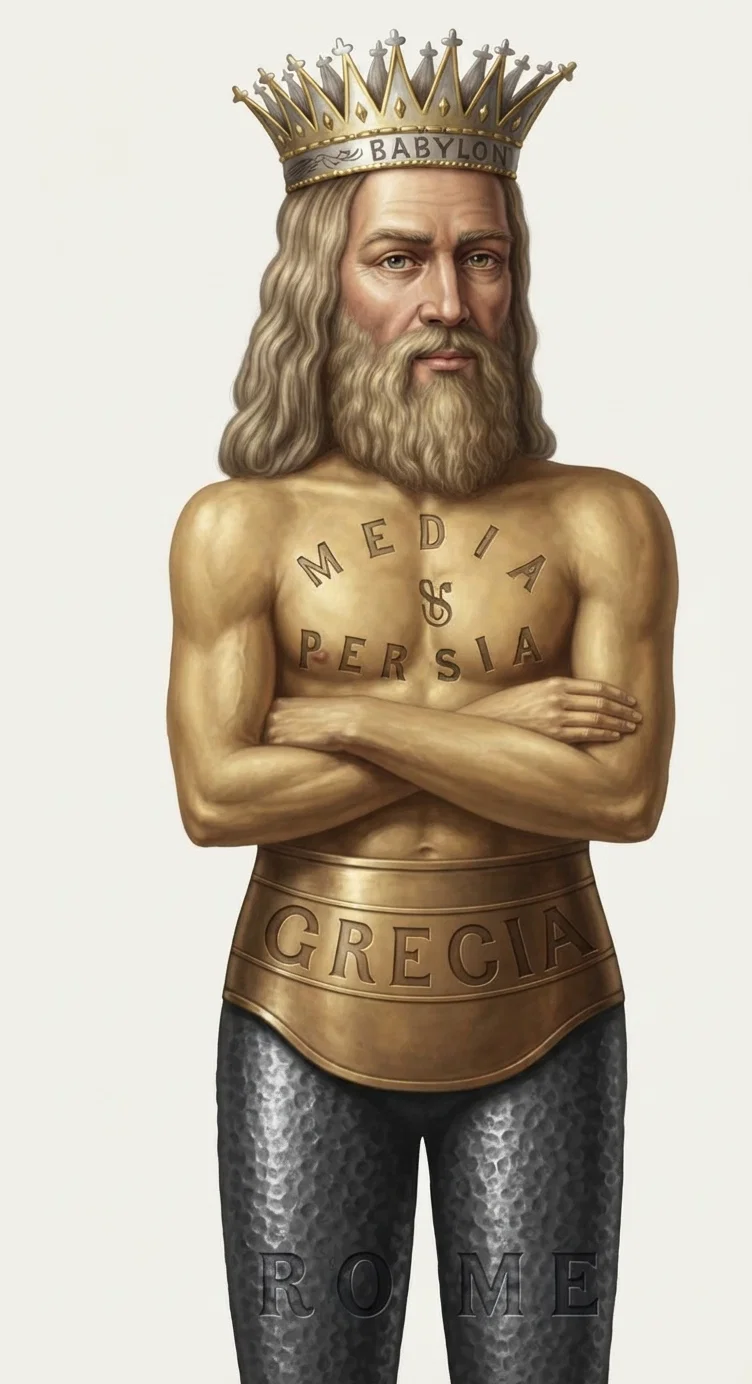
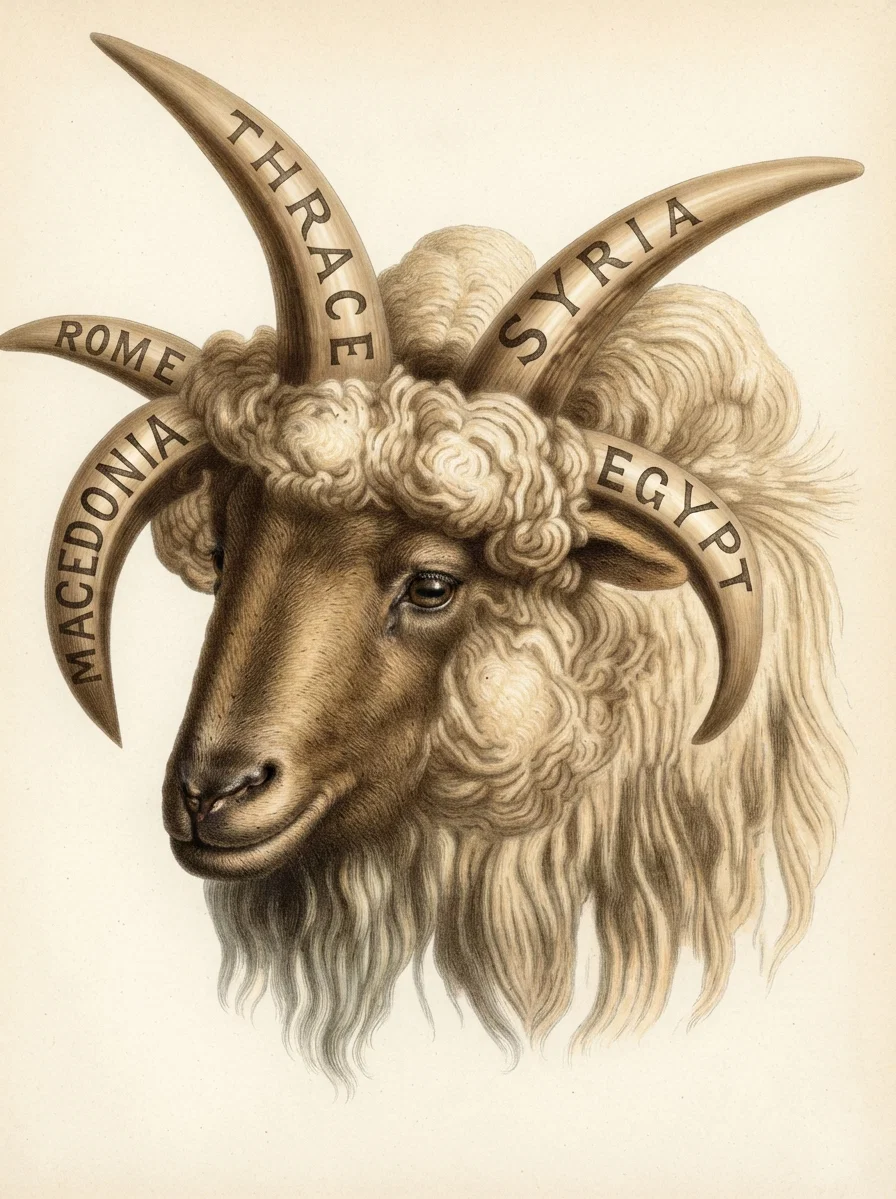
The brass of the great image was followed by the legs of iron; and out of one of the four horns which sprung up when the great horn of the goat was broken, the Prophet saw come forth a little horn which waxed exceeding great. Dan. ii, 40; viii, 9. What power is designated by these symbols? Answer: The next great power that succeeded the empire of Grecia as existing in its divided form under Alexander's successors; and that power was Rome.
Passing over, as already proposed, these division of the Grecian empire, the narrative of events is interrupted till we reach the year B. C. 161. Previous to this point it does not become necessary in the light of prophecy to notice particularly the power under consideration; for be it remembered that a power is not introduced into prophecy till it becomes in some way connected with the people of God; and here the Romans first assumed this relation. The Jews being grievously oppressed on account of their religion by the heathen, Syrian kings, Judas Maccabæus sent an embassy to the Romans, to solicit their aid, whereby a league was entered into between them of mutual friendship and defense. This was the commencement of the Roman ascendancy over the Jews; and here we may place the termination of the third kingdom of brass after it had borne rule from the battle of Arbela 331, one hundred and seventy years.
THE FOUR HORNS.
Before proceeding to trace the progress of this power, we must notice an objection which is urged against the position here taken. Papists, to avoid the application of the prophecy concerning the little horn to the Roman power, Pagan and Papal, have applied it to Antiochus Epiphanes a king of Syria. And as it is no unusual thing for the Pilates and Herods of the land to make friends against the cause of truth, they have been followed in this application by the mass of those who oppose the Advent faith.
But who was this Antiochus Epiphanes? Let us look at facts. The succession of kings that constituted the Syrian horn of the empire after the death of Alexander, was as follows: 1. Seleucus Nicator. 2. Antiochus Soter. 3. Antiochus Theus. 4. Seleucus Callinicus. 5. Seleucus Ceraunus. 6. Antiochus the Great. 7. Seleucus Philopator. 8. Antiochus Epiphanes. 9. Antiochus Eupator. 10. Demetrius Soter. 11. Alexander Bala. 12. Demetrius Nicator. 13. Antiochus Theos. 14. Antiochus Sidetes. 15. Zebina. 16. Seleucus, son of Nicator. 17. Antiochus Grypus. 18. Antiochus, the Cyzicenian. 19. Seleucus, son of Grypus. 20. Antiochus Eusebes. 21. Antiochus, second son of Grypus. 22. Philip, third son of Grypus. 23. Demetrius Eucheres. 24. Antiochus Dionysius. 25. Tigranes. 26. Antiochus Asiaticus, who was the last of the Seleucidæ, or Syrian kings, and who after an insignificant reign of four years was driven from his dominions by Pompey.
1. By this it appears that Antiochus Epiphanes was only one, the eighth in order, of a series of twenty-six kings that constituted the Syrian horn of the Grecian empire. How then could he, at the same time, be another remarkable horn?
2. If it were proper to apply the little horn to any one of these kings, it would be reasonable to suppose it would be to the most illustrious; but Antiochus Epiphanes did not by any means sustain this character. Although he took the name of Epiphanes, that is, The Illustrious, nothing, says Prideaux, on the authority of Polybius, Livy, and Diodorus Siculus, could be more alien to his true character. For on account of his vile and extravagant folly, some thinking him a fool and others a madman, they changed the name of Epiphanes, The Illustrious, into Epimanes, The Madman.
3. Antiochus the Great, the father of Epiphanes, being terribly defeated in a war with the Romans was enabled to procure a peace only by the payment of a prodigious sum of money, and the surrender of a portion of his territory; and as a pledge that he would faithfully adhere to the terms of the treaty, he was obliged to give hostages, among whom was this very Epiphanes, his son, who was carried to Rome. This ascendancy the Romans ever after maintained. Which therefore was the most notable power, the Romans who exacted tribute, or the Syrian kings who were compelled to pay it?
4. The little horn waxed exceeding great; but this Antiochus did not enlarge his dominion except by some temporary conquests in Egypt; which he immediately relinquished when the Romans took the part of Ptolemy, and commanded him to desist from his designs in that quarter. The rage of his disappointed ambition, he vented upon the unoffending Jews.
5. The little horn, in comparison with the powers that preceded it, was exceeding great. Persia is simply called great, though it reigned over “an hundred seven and twenty provinces.” Esth. i, 1. Grecia, being more extensive still, is called very great; but how ludicrous and absurd, in view of the above facts, to apply the next power which waxed exceeding great to Antiochus, who abandoned Egypt at the dictation of the Romans!
6. This power was to stand up against the Prince of princes. The Prince of princes is, without controversy, Jesus Christ. Dan. ix, 25; Acts iii, 15; Rev. i, 5. But Antiochus died 164 years before our Lord was born.
The following reasons may also be urged to show that Rome is the power in question:
1. It was to come forth from one of the four kingdoms of Alexander's empire. We have said that nations are not brought into prophecy, till connected with the people of God. The Roman power had been in existence many years before the league with the Jews above mentioned; and seven years previous to that event, in the year B. C. 168, it made Macedonia, one of the horns of the Grecian goat, a part of itself. Speaking of the peremptory manner in which Popillius, the Roman ambassador commanded Antiochus to quit Egypt, the historian says: “That which made him so bold as to act with him after this peremptory manner, and the other so tame as to yield thus patiently to it, was the news which they had a little before received of the great victory of the Romans, which they had gotten over Perseus, king of Macedonia. For Paulus Æmilius having now vanquished that king, and thereby added Macedonia to the Roman empire, the name of the Romans after this carried that weight with it, as created a terror in all the neighboring nations; so that none of them after this cared to dispute their commands, but were glad on any terms to maintain peace, and cultivate a friendship with them.” Being introduced into prophecy after this event, it is represented as coming forth from one of the horns of the goat.
2. The following specifications of the little horn, are also fulfilled in the Roman power to the very letter: 1st. It waxed exceeding great towards the south, and towards the east, and towards the pleasant land, [Palestine, Ps. cvi, 24; Zech. vii, 14.] Rome being almost directly north-west from Jerusalem, its conquests in Africa, Asia and Palestine, were of course in those directions, and furnish an exact fulfillment of the prophecy. 2d. It was to cast down of the host and of the stars, the same as predicted of the dragon, [Rev. xii, 3, 4.] which all admit to be Rome. Who can fail to see their identity? 3d. It was a king of fierce countenance. See Moses' description of the same power. Deut. xxviii, 49, 50. 4th. It did “destroy wonderfully” from fifty to one hundred millions of the “mighty and the holy people” being put to death by it. 5th. It did stand up against the Prince of princes. Pagan Rome nailed Jesus to the cross. 6th. It is to be “broken without hand.” How clear the reference to the stone “cut out without hand,” that smote the image. Dan. ii, 34. Further proof is unnecessary; and probably ere this, the reader has agreed with us that Rome is the subject of the prophecy.37
From small beginnings, with a steady ascent, Rome rose to unparalleled greatness. How Macedonia became a Roman province B. C. 168 has been already stated. The empire of Syria shared a like fate B. C. 65, when Pompey reduced all those parts to the Romans as far as the river Tigris. The only remaining portion of the goat's dominions, not yet engrossed by the little horn, was Egypt; but this also fell before the Romans, when Augustus Cæsar, on the death of Cleopatra, made it a Roman Province B. C. 30. Twenty-five years after this, when the whole world was settled in thorough subjection to this same Augustus, and the temple of Janus, at Rome, which was kept open only in times of war, was for the fifth time shut since the building of the city, and peace reigned over the nations, there was born “in the city of David, a Saviour which is Christ the Lord.” Luke ii. 1-11.
In this glorious, peaceful reign of Augustus Cæsar, says Butler, the fifth kingdom commenced, [Dan. ii, 44, 45.] in the Advent of the Messiah. This is the opinion of not a few; and hence it demands a moment's attention. Or rather the opinion that prevails is, that the fifth universal kingdom, in fulfillment of the promise, that in the days of these kings the God of heaven should set up a kingdom, is the kingdom of grace in the hearts of believers, and was established at the cross of Christ. 'At this very time,' says Prideaux, 'Christ's kingdom commenced in the erection of his church.' 'The kingdom of Christ,' says Scott, 'was evidently intended; from small beginnings it hath already made vast progress,' &c. 'A stone cut out; the fifth monarchy; the spiritual kingdom of the Lord Jesus,' says Clarke, 'which is to last forever, . . . the extensive and extending empire of Christ,' &c.
In reference to this position, we have brought the image down to the cross of Christ, where it is said this kingdom was set up, in order to avail ourselves of the advantages to be derived from illustration, in impressing the truth upon our minds on this subject. To meet the question fairly we must here anticipate a little. The image had two feet and ten toes; and the fourth and terrible beast of Dan. vii, had ten horns; which both represent the ten kingdoms which arose out of the Roman empire, as will be more particularly noticed hereafter. Until this division of the empire took place, the image was not complete: the feet were not fully developed. But where did the Stone smite the image? Upon the feet, and the feet only. Now look at the illustration. There is the cross, but where are the feet? We have not reached them. Can it then be said that the Stone that was to smite the image upon the feet, did its work away back there upon the thighs at the cross of Christ? Impossible. But do you say that we have erected the cross too soon? that the image should have been completed, and the cross erected at the feet? We answer, That cannot be; for the feet were not developed till 483 years after the crucifixion. No; the image cannot be smitten upon the feet, till we reach the feet; therefore it could not have been smitten at the cross. The prophecy promised that in the days of these kings (those that rose from the Roman empire) the God of heaven should set up a kingdom, and not 483 years before the division took place, or the kings existed.
Again, it does not read that the Stone gradually wore away the image, or that by some chemical process, it dissolved its metallic substances, and appropriated them to itself, till they were all used up. Far from it: the Stone smote the image; and the iron, brass, silver and gold, were ground to powder, and blown away. The nations have not yet been dashed in pieces with a rod of iron, [Ps. ii, 9.] they have not yet been shivered like a potter's vessel; therefore that fifth universal kingdom which is to be set up by the God of heaven and stand forever, which is to be ushered in with events like these, is yet before us.
The conclusion is therefore obvious, that the position handed us by Butler, Prideaux, Scott and Clarke,—a position which has been seized upon by hosts of more modern origin as an objection to the faith we cherish of the soon coming of the Son of man to establish upon the demolition of all earthly governments, an enduring empire—it is obvious, we say, that their position is erroneous and untenable. We declare unhesitatingly and without fear of contradiction, that they have misapplied that portion of prophecy. Nor can any one say otherwise, unless he will wrest the phraseology of the Scripture, and have the image smitten, not upon his feet, but upon his thighs!
That the work of grace upon the heart, the freedom of the gospel, the growth of Christianity, and events in the church's history, are sometimes set forth by the phrase, kingdom of heaven, is not to be doubted; but it does not come within the province, of this article, to show the application of all these expressions wherever they occur. The prophecy of Daniel is our subject, and to show the application of the kingdom there brought to view, is all that the scope of the theme demands at our hands. We have endeavored to show that that kingdom was not set up at the crucifixion, but is still future. It was future at our Lord's last passover. Matt. xxvi, 29. He did not set it up before his ascension. Acts i, 6. Flesh and blood cannot inherit it. 1 Cor. xv, 50. It was a
matter of promise to the apostles, and is so to those that love God. Jas. ii, 5. It is promised in the future to the little flock. Luke xii, 32. It is to be set up when Christ shall judge the living and the dead. 2 Tim. iv, 1. It is to be set up when the Son of man shall come in his glory and all the holy angels with him. Matt. xxv, 31-34.
This is the kingdom prepared for the faithful from the foundation of the world, upon which they will enter, when those who will not have Jesus to reign over them, are brought forth and slain in his presence. Luke xix, 12-27. This is the kingdom which the saints shall take under the whole heaven, and possess forever and ever. Dan. vii, 27. The prayer which our Saviour taught his first disciples, still fervently ascends from the lips of his patient waiting flock in these last days. 'Our Father who art in heaven, thy kingdom come!'
(To be Continued)
UNITY AND GIFTS OF THE CHURCH. No. 2.
By James White
"And he gave some, apostles, and some, prophets; and some, evangelists, and some, pastors and teachers; for the perfecting of the saints, for the work of the ministry, for the edifying of the body of Christ, till we all come in the unity of the faith." Eph. iv, 11-13.
The unity of the Church of Christ, as taught in the New Testament, we regard as very important to the church in these days of apostasy, disunion and peril. But few seem to be acquainted with the plain testimony on this point; or, at least, but few feel the force of such testimony, and act upon it.
Some labor under the mistaken idea that order in the church is an abridgment of their religious rights. They have broken away from the bondage of creeds, and human organizations, and rejoice in freedom; but overlook the order, and organization of the church set forth in the Word. They continually talk of, and rejoice in the freedom they have found, and can see nothing else; while the New Testament holds out, and enjoins on them the most rigid discipline. It requires of them submission and most perfect order. A mistaken view of this subject has led many astray, hence we see a thousand and one disorderly ranters, and vain disputers, who are an annoyance to religious meetings. They cry out against the sins and confusion of Babylon, and say many truthful things; but at the same time occupy a ten-fold worse position than those they oppose and accuse. Babylon signifies confusion. But in some of these who cry out so against Babylon there is confusion enough to distract the 144,000. This is, and has been our plea, Exchange human creeds for the Divine Word. Leave human organizations for that order ordained by Heaven. In this land of boasted civil and religious liberty, the idea of gospel freedom has run with many well nigh to madness. Everything outside of their little sphere is "Sectarian," when in fact they are the veriest sectarian bigots the world bears up. What a relief to the Remnant, when some such drew off not long since. But we fear this peaceful state of things may not long last, when another sheet of communication for the disorderly ones will be needed to develop the real feelings and views of some among us. But God's word is a perfect guide, and if received, will work a perfect cure of the evil of which we have freely spoken.
1 Cor. i, 4-10. "I thank my God always on your behalf, for the grace of God which is given you by Jesus Christ; that in everything ye are enriched by him in all utterance, and in all knowledge, even as the testimony of Christ was confirmed in you; so that ye come behind in no gift, waiting for the coming of our Lord Jesus Christ: who shall also confirm you unto the end, that ye may be blameless in the day of our Lord Jesus Christ. God is faithful, by whom ye were called unto the fellowship of his Son Jesus Christ our Lord. Now I beseech you, brethren, by the name of our Lord Jesus Christ, that ye ALL SPEAK THE SAME THING, and that there be no divisions among you; but that ye be PERFECTLY JOINED TOGETHER in the SAME MIND and in the SAME JUDGMENT."
1. Paul beseeches the brethren by the name of our Lord Jesus Christ—High authority!
2. That ye all speak the same thing, and that there be no divisions among you, but,
3. That ye be perfectly joined together in the same mind, and in the same judgment.
What a front such a church would present to the world! Such a church would be most powerful, and would be, in very deed, the light of the world. Many have entirely neglected to take heed to the many entreaties and exhortations of the New Testament, like the above from the great Apostle, and have taken another course like the following—
1. To beseech all in the name of Christian liberty, falsely so called, without regard for the views of their brethren.
2. To all speak their own opinions, though there be as many opinions, and divisions among them as there were persons, and,
3. To avoid being joined together in the same mind and the same judgment, lest they become sectarian.
We wish to hold up both sides of the picture, that rational people may judge for themselves, and be rooted and grounded in the truth of this subject.
Rom. xv, 5, 6. "Now the God of patience and consolation grant you to be LIKE-MINDED one toward another, according to Christ Jesus: that ye may with ONE MIND and ONE MOUTH glorify God, even the Father of our Lord Jesus Christ."
1. Reference is made to Christ Jesus, as the standard of union. Read his agonizing prayer recorded in John xvii. Here is a part of it. "I pray not that thou shouldest take them out of the world, but that thou shouldest keep them from the evil. They are not of the world, even as I am not of the world. Sanctify them through thy truth; thy word is truth. As thou hast sent me into the world, even so have I also sent them into the world. And for their sakes I sanctify myself, that they also might be sanctified through the truth. Neither pray I for them alone; but for them also which shall believe on me through their word: that THEY ALL MAY BE ONE; AS THOU, FATHER, ART IN ME, AND I IN THEE, that they also may be one in us, that the world may believe that thou hast sent me."
2. It does not seem to be enough that the church all speak the same things, as a Methodist Presiding Elder once told a young preacher that he might believe Mormonism or Millerism, but must preach Methodism; but the church must be of one mind according to Christ Jesus. What a rebuke on the loose, unchristian sentiment, "Only be honest, and you may believe what you please." We will bless God that truth is a unit, and that the means ordained of God are ample to bring men and women into the one channel of divine truth, so that if they are not sanctified through the truth, it is their own fault.
Phil. ii, 1, 2. "If there be therefore any consolation in Christ, if any comfort of love, if any fellowship of the Spirit, if any bowels and mercies, fulfill ye my joy, that ye be LIKE-MINDED, having the SAME LOVE, being of ONE ACCORD, of ONE MIND." Chap. iii, 16. "Nevertheless, whereto we have already attained, let us walk by the same rule, let us mind the same thing." 1 Pet. iii, 8. "Be ye all of one mind, having compassion one of another; love as brethren, be pitiful, be courteous." 2 Cor. xiii, 11-14. "Finally, brethren, farewell. Be perfect, be of good comfort, be of one mind, live in peace; and the God of love and peace shall be with you. Greet ye one another with an holy kiss. All the saints salute you. The grace of the Lord Jesus Christ, and the love of God, and the communion of the Holy Ghost, be with you all. Amen."
We might repeat such testimony to great length; but if any will set this aside, they would treat more in the same way. Brethren, let us search for the truth diligently, on all points, especially on those of such great practical importance as the unity and gifts of the church.
Our Home.
By S. M. Swan
HERE we have no continuing city, but we seek one to come. This has been the position of the people of God in all ages. They have ever been pilgrims and strangers on the earth, looking forward to a world to come, neither seeking nor expecting rest until they reach their journey's end. Even our blessed Lord when upon earth could say, "The foxes have holes, and the birds of the air have nests, but the Son of man hath not where to lay his head." And Paul, while speaking of the prophets and saints of former ages, says, "They wandered in deserts and in mountains and dens and caves of the earth; of whom the world was not worthy." They saw the promises afar off, and embraced them, and became pilgrims on the earth that they might receive a better, a heavenly home. From that time until the present, we find that the people of God have been a despised and persecuted people, having no portion here, but cheerfully foregoing all the pleasures of earth, and counting not even their lives dear unto themselves, for the sake of the promised inheritance, their final home. Home! O how sweet the sound to the way-worn pilgrim! How often has it cheered the tried, desponding Christian on his lonely journey! How has it strengthened the martyr to face the tyrant's frown, and how has it alleviated his sufferings under the most shameful torture and death! How has it buoyed up the child of God amid poverty and affliction, and how has it cheered his passage through the valley and the shadow of death! The home which we seek, is a glorious home. 'Tis not some little spot of earth upon which wealth and pride have lavished all their art to beautify and adorn; 'tis not some kingly palace with gilded domes and princely halls, where the rich and great of earth alone can enter; no! it is a city whose streets are of purest gold, and whose gates are of the most magnificent pearl, and where are "many mansions." Eye hath not seen nor ear heard, nor can the heart of man conceive of its glory. 'Tis the capital of a land whose beauties have never been spoken, and whose glories, poets have in vain endeavored to portray.
No change shall mar the beauty of that land, no autumnal winds shall sweep over it, to blast its blooming flowers, no wintry snows to cover its perpetual verdure. No disease or death are there, "no weary wasting of the frame away;" there the parting hand is never taken, the bitter word, Adieu, is never spoken. No tears shall ever dim the eye, no sad and sorrowing hearts are there, no tired and weary limbs. No temptation or sin are there; but what is best of all, Jesus is there, "the joy and the light of the place." No need of the sun, for his glorious presence forever banishes the night. There he who died to redeem his people from death, shall reign their triumphant King. There we may bask forever in his smiles, and with immortal tongues forever sing his praise.
These are a few of the glories which adorn the Christian's home. Is it not worth striving for? If its glories so attracted those who saw it afar off, how should they attract us who view it nigh at hand? Already have we passed the last waymark, and we almost begin to see its splendid domes, its pearly gates, its glorious foundations. Already its brilliant lights begin to shine with greater lustre upon our pathway, already its celestial music breaks upon our ears, already do our hearts leap with joy at the glorious prospect, and we become so captivated with the beauties of our home, that the place of our pilgrimage seems dark and dreary. Dear brethren and sisters, not much longer shall we be homeless wanderers. Says Jesus, "I go to prepare a place for you, and will come again and receive you unto myself, that where I am there ye may be also." A little while, and he that shall come will come, and will not tarry. A little while, and we'll roam the fair fields of paradise restored, and forever enjoy the pleasures of home, our own sweet home! O how my heart longs for home!
S. M. SWAN.
Orwell, Ohio, Nov. 1857.
TO THE MESSENGERS.
By D. J. Frisbie
Go sound ye the cry,
"The Saviour is nigh!"—
Invite all the guests to the feast;
Go plead with them, Come,
While yet there is room,
E'er mercy's last message has ceased.
This last warning call,
Proclaim unto all,
To nations both distant and near;
If truth they reject,
Or treat with neglect,
How will they in judgment appear?
In vain will they call
For mountains to fall,
And hide them from Him on the throne;
That great vengeance day
Is speeding its way,
As God through his prophets hath shown.
Then bid sinners come
While yet there is room,
And all God's commandments obey;
That they may now be
From bondage set free,
And shielded in that coming day.
Come gird thee anew,
Thy journey pursue,
Bright angels are going before;
They will strengthen thee,
Where e'er thou may'st be
Until all thy labor is o'er.
Then haste ye away,
Nor longer delay,
Thy mission proceeds from on high;
A crown soon will be
Extended to thee
For lo! the Rewarder is nigh!
And when he shall come
To take his saints home,
Your warfare will then all be o'er;
Your work will be done,
The victory won,
Then trust ye in Him evermore.
D. J. FRISBIE.
Battle Creek, Mich.
Sincerity no Guaranty for Truth.
By J. A. Wilcox
BRO. SMITH: As it is quite common in these days to hear people make the assertion, or say much the same in substance, that it makes no difference what men believe, if they are only honest; (for, say they, all denominations of Christians are aiming to arrive at one place, heaven;) I thought best to send you the following extract, which I took from Tract No. 534, published by the American Tract Society. It not only clearly illustrates the dangerous position which many take in reference to the most solemn and important subject to which the minds of mortal men can be directed, but also shows the folly of it.
J. A. WILCOX.
"But a short time since the entire community was startled with the news of a sudden and fearful shipwreck. The bark Elizabeth was returning, richly laden from a foreign port. Her voyage was almost finished, when as she neared our coast, a violent storm arose. In the darkness of midnight, as she is driven before the tempest, her officers mistake the light on Fire Island for the one on the highlands and steering as they suppose for the latter, but in reality for the former, the bark is soon dashed, an utter wreck upon the breakers, and part of the crew and all her passengers are swallowed up in the waves, swept as in a moment to eternity. It is of little moment how the mistake was made, whether from erroneous calculations, or presuming confidence, or careless neglect of chart and compass. The fact that it was made, is certain, and the awful result like all the realities of the past, is beyond the reach of prevention or remedy. All that remains for us, as we mourn the dreadful calamity is, that we endeavor to open our hearts to some of the many lessons it so solemnly teaches. It shows that the sincerity of our belief on any subject is no proof of its correctness. Here is not an uncommon error, especially in reference to religion.
"How often from thoughtless or skeptical persons do we hear the assertion, it is no matter what a man believes, if he is only sincere. But alas! this fatal shipwreck tells a different story. Doubtless the officers of that ill fated bark were sincere in their terrible mistake. They honestly believed the light toward which they were steering was the one which would guide them to their expected port in safety. But did the sincerity of their belief prove its correctness? Did it calm the raging of the winds and the waves, or break the violence of the terrific crash, or save from the jaws of death one of its appointed victims? And if sincerity of belief, of itself is no assurance of truth and safety in ordinary life, is it in matters of religion? If it is not a safeguard to the mariner on the deep, is it on the voyage to eternity?"
The Kingdom of God.
By R. Rockwood
"AFTER this manner therefore pray ye, Thy kingdom come, thy will be done in earth, as it is in heaven." Matt. vi, 9, 10. Christ, the great central truth, points our minds beyond all types and shadows to the end of our hopes, which cannot be realized this side of the kingdom of God. This is the end of the hopes of the Christian. Catholicism, Mormonism, Mahomedanism, Universalism, Protestantism and Spiritualism all have some great fingerboard pointing to this kingdom; but when and how we obtain it is the bone of contention. There would be no difficulty if we would leave this question to the Bible, but when we step aside and lose sight of the truth that points out how and when we obtain it, we find ourselves lost in the mist of conjecture. Thus men in the light of the nineteenth century have claimed and still claim, that it is already set up. Can this be true? Let us see when it is to be set up. Daniel ii, 44. "In the days of these kings shall the God of heaven set up a kingdom." So Christ says, Matt. vi, 10. "Pray Thy kingdom come." It had not in Daniel's day, nor yet in Christ's day; for it was the deep inquiry of the apostles in their last meeting before his ascension, when the kingdom was to be restored. Acts i, 6. Now if the kingdom is set up, the saints are in possession of the kingdom, and the end of their hopes is realized. If the long desired kingdom has come, let us ask for its locality. Kingdom implies law, subjects and territory; and where do we find the law of God's kingdom obeyed? If we go to Africa, we find their barbarism as black as their skin. Turn to India and ask those deluded followers of the Juggernaut who reigns there. Turn to the Christian government of Great Britain, and see those lords and nobles rolling in luxury, while suffering Ireland cries for bread. Go into their lanes and highways, and see their suffering, while that which would save them from famine and starvation, is bestowed on pampered hounds and horses of young noblemen and lazy priests, to gratify their lusts for sport. Who reigns in these kingdoms? Does Christ? or are they under the control of the god of this world? But let us come nearer home, and search the records of our own model government, this land of liberty, and hear the groans of four millions of human beings driven to their toil by the lash of tyrants. Look into the halls of our government, see them legislating on the system of slavery, acting upon the principle of "let us do evil that good may come." I ask, Is this from heaven? Truth answers, no; and we should turn from these dark pictures with disgust, and pray in the language of Christ, Thy kingdom come. Again, who can think that any kingdom could exist when seven tenths of its inhabitants lived in open hatred to its laws? How long could any kingdom stand under these circumstances? Yet this is a true picture of this world. Seven tenths of the inhabitants trample God's law under their feet. No wonder Job said, The earth is given into the hand of the wicked. Job ix, 24. Paul says also that men are governed by the prince of the power of the air. Eph. ii, 2.
Again I ask, in whose hands rests the government of this world? Who rules? Let truth answer, let statistics tell. This earth is in the hands of Satan, and the great mass of its inhabitants are led captive by him at his will. But the day hasteth greatly when these kingdoms shall fall, when Jesus Christ shall put down all rule and all authority, and when39all shall bow to the mandate of the King of kings. Let watchmen who are proclaiming peace and safety from the pulpits of the land, tremble for fear, and for the things that are coming on the earth.
R. Rockwood.
Burr Oak, Mich.
LETTERS.
By L. R. Chapel
"Then they that feared the Lord spake often one to another."
From Bro. Chapel.
BRO. SMITH: I take this opportunity to let you know how we are prospering in the cause of the Lord. I feel truly grateful to the Lord for his loving kindness in giving us the truth and light in regard to our present position, and I think that the majority of the church here are trying to arise from their lukewarmness, by being zealous and repenting of all past wrongs, and endeavoring to buy the gold and white raiment, and to get their eyes anointed that they may see.
When I look back upon my past life, and see how far from the Lord I have been, I wonder that the Lord could bear with me and give me another warning and chance to get right, and into the work of the Lord, by the message of the faithful and true Witness. O the long suffering of God to his erring creatures! I believe the last notes of warning are now being given, to prepare a church to stand in the time of trouble, and all that heed the message of the true Witness will be prepared to stand, and will with all the true Israel of God enter the gates into the city. Can it be possible that any will be so unwise as to let the warning pass and not be zealous and repent, and finally be left to perish, and be destroyed by the seven last plagues? I feel a great desire to have my whole soul in the work of the Lord, and to be wholly consecrated to him. I want the truth to have a sanctifying influence on my life, and in whatsoever I do, have an eye single to the glory of God. The apostle James gives us some good instruction, which I think is applicable to the present time. He says, "submit yourselves therefore to God, resist the devil and he will flee from you. Draw nigh to God and he will draw nigh to you. Cleanse your hands ye sinners; and purify your hearts, ye double-minded. Be afflicted and mourn and weep: let your laughter be turned to mourning, and your joy to heaviness. Humble yourselves in the sight of the Lord, and he shall lift you up." James iv, 7-11. This testimony agrees with Joel ii, 12, 13. "Therefore also now, saith the Lord, turn ye even to me with all your heart, and with fasting, and with weeping, and with mourning: and rend your hearts, and not your garments, and turn unto the Lord your God; for he is gracious and merciful, slow to anger, and of great kindness, and repenteth him of the evil."
Yours in hope of eternal life. L. R. CHAPEL.
Palermo, N. Y., Nov. 22nd, 1857.
Extracts from Letters.
Bro. D. Chase writes from Fairhaven, Mass. Nov. 17th, 1857. "We are made to rejoice greatly by the good news we have through the Review, of the prosperity of the cause of truth. The little company here are striving to overcome. The interest in our meetings has been rising gradually for a number of months, and I hope we all shall soon pay the price and obtain the gold, white raiment and eye-salve. O how small all earthly things appear, when we get our eyes anointed with eye-salve. It is then we can turn the telescope towards the inheritance in the earth made new, with its entire perfection in everything. Well may the poet say:
"I long to be there, and the thought that 'tis near,
Makes me almost impatient for Christ to appear,
And fit up that dwelling of glories so rare,
The earth robed in beauty, I long to be there."
"Let us meditate much on the words of Jesus, who said, 'Take my yoke upon you and learn of me, for I am meek and lowly in heart; and ye shall find rest to your souls.' I want to be meek and lowly, yea very lowly, under a deep sense of past follies, pride and error. O may I humbly walk in the narrow way to life, that I may be hid in the day of his anger."