The Youth’s Instructor, Vol. 43, No. 18.

ONE THING I KNOW

The Youth’s Instructor

May 2, 1895

S. D. A. Publishing Association · Battle Creek, Mich. · May 2, 1895

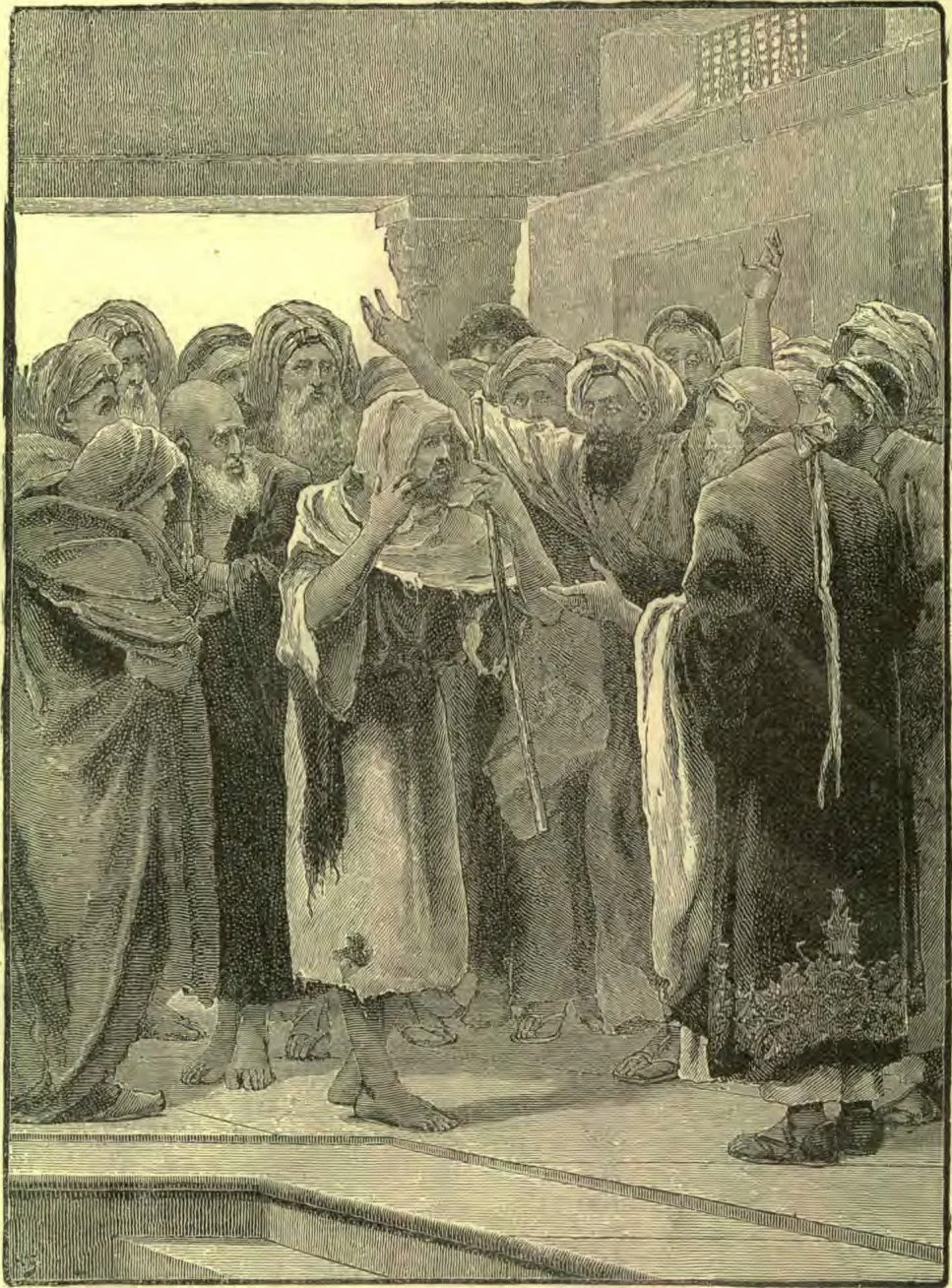
“ONE THING I KNOW.”

He stood before the Sanhedrim; The scowling rabble gazed at him; He recked not of their praise or blame; There was no fear, there was no shame. For one upon whose dazzled eyes The whole world poured its vast surprise— His first day's light too sweet and clear To let him waste his new-mown ken On the hate-clouded face of men.
But still they questioned, “Who art thou? What hast thou been? Who art thou now? Thou art not he who yesterday Sat here and begged beside the way; For he was blind.” “And I am he; For I was blind, but now I see.”
He told the story o’er and o’er; It was his full heart’s only lore:— A prophet on the Sabbath-day Had touched his sightless eyes with clay, And made him see, who had been blind. Their words passed by him like the wind Which raves and howls, but cannot shock The hundred-fathomed, rooted rock. Their threats and fury all went wide; They could not touch his Hebrew pride; Their sneers at Jesus and his band, Nameless and homeless in the land, Their boasts of Moses and his Lord,— All could not change him by one word.
“I know not what this man may be, Sinner or saint; but as for me, One thing I know—that I am he Who once was blind, and now I see.”
They were all doctors of renown— The great men of a famous town, With deep brows wrinkled, broad, and wise Beneath their broad phylacteries. The wisdom of the East was theirs, And honor crowned their silver hairs. The man they jeered and laughed to scorn Was unlearned, poor, and humbly born; But he knew better far than they What came to him that Sabbath day; And what the Christ had done for him He knew, and not the Sanhedrim.
— John Hay.

THE KINGDOM OF GLORY.

We have seen how the kingdom will be set up and how an end will be made of all the kingdoms of this world. Now we will further consider the future existence of this kingdom. Four things belong necessarily to a perfect kingdom,—a king, citizens or subjects, laws, and a territory, or land. The kingdom of God will be a perfect kingdom, and the four things mentioned are all clearly spoken of in the Bible.
THE BLIND MAN HEALED.

THE KING.

Christ, the anointed of God, will be king in the kingdom of glory. He alone is worthy to receive this honor. Through temptation and agony he has struggled to obtain it; with his own blood he has paid for the crown. The heathen rage; the kings of the earth take counsel together against the Lord and against his Anointed. They want to usurp the power which belongs to him alone. But the Lord laughs. His eternal decree stands unshaken: “Yet have I set my King upon my holy hill of Zion.” “Thou art my Son; this day have I begotten thee. Ask of me, and I shall give thee the heathen for thine inheritance, and the uttermost parts of the earth for thy possession.” Ps. 2:6–8.
What will Christ do with the heathen?—Those who will not receive him he will root out of the earth, he will “dash them in pieces like a potter’s vessel.” Ps. 2:9.
“For unto us a child is born, unto us a son is given: and the government shall be upon his shoulder: and his name shall be called Wonderful, Counselor, The mighty God [the Father has given him all power in heaven and earth. Matt. 28:18], The everlasting Father [Jesus was in the beginning. John 1:1. He is alive forever. Rev. 1:18. He is the father of God’s children. Heb. 2:13.], The Prince of Peace.—Of the increase of his government and peace there shall be no end, upon the throne of David, and upon his kingdom, to order it, and to establish it with judgment and with justice from henceforth even forever. The zeal of the Lord of hosts will perform this.” Isa. 9:6, 7.
In the Danish Bible the seventh verse begins thus: “In order that the government may be great, and that there may be peace without end upon the throne of David and upon his kingdom.” Jesus is the Prince of peace; his kingdom is the kingdom of peace, his subjects are peacemakers, and the greatness of his peace shall be without end. All quarrel, strife, and war will cease under his mild scepter.
O prince of war! Thou must flee before the Prince of peace. The confused noise of thy battles shall be heard no more; the thunder of thy terrible cannon shall be brought to silence. The bloody garments, the groans of the dying, the tears of the widows and orphans shall flee from the Sun of righteousness, the Prince of peace, like the darkness of the night before the morning sun. When the great King of peace comes, darkness must flee before his eternal light.
The angel said to Mary, Thou “shalt call his name Jesus. He shall be great, and shall be called the Son of the Highest; and the Lord God shall give unto him the throne of his father David: and he shall reign over the house of Jacob forever; and of his kingdom there shall be no end.” Luke 1:31–33.
Jesus shall be king forever in the glorious kingdom of God. What comfort and encouragement this is to our poor hearts! He who wore the crown of thorns shall wear the eternal crown of glory. How loving and kind Jesus is! How willingly he receives poor sinners that come to him! Will he turn away from us when we come?—No, never! He is more willing to receive us than we are to come to him, and he is mighty to keep us. But we must suffer with him a little while. Afterward we shall reign with him in glory.

THE CITIZENS OF THE KINGDOM.

“Now therefore ye are no more strangers and foreigners, but fellow-citizens with the saints, and of the household of God.” Eph. 2:19. “For our conversation [Greek, commonwealth, or citizenship] is in heaven; from whence also we look for the Saviour, the Lord Jesus Christ.” Phil. 3:20. Of the heavenly city, which is to be the metropolis of the new earth, we read that it has no need of the sun or the moon to shine in it; for it is lighted with the glory of God, and the Lamb is the light therein. “And the nations of them which are saved shall walk in the light of it: and the kings of the earth do bring their glory and honor into it.” Rev. 21:24. The citizens of the kingdom of God are all kings and priests unto God, and they shall reign with Christ on the earth. Rev. 1:6; 5:10.
What an exalted privilege! May none of us be slow to make out his intention to become a citizen, and to get full citizen papers, if we do not have them already. And if we have them, let us be very careful that we do not lose them; for none of us have a right by natural birth to the citizenship. We are adopted children, redeemed from sin and death by Him who loved us and washed us from our sins in his own blood. Rev. 1:5.

THE LAWS OF THE KINGDOM.

The kingdoms of this world have some good and some bad laws, but the laws of Jesus are all perfect and good. On the earth the laws are often perverted. The rich are favored and the poor oppressed. Money is the ruling power. Justice has departed, the hire of the laborers is kept back by fraud, and their cries have entered into the ears of the Lord. James 5:4. But the kingdom of Jesus is drawing near. There is no unrighteousness. He shall establish it with justice forever and ever. Isa. 9:7. “And righteousness shall be the girdle of his loins, and faithfulness the girdle of his reins.” Isa. 11:5. “Righteousness is the scepter of thy kingdom. Thou hast loved righteousness, and hated iniquity.” Heb. 1:8, 9. “For the kingdom of God is not meat and drink; but righteousness, and peace, and joy in the Holy Ghost.” Rom. 14:17.
Here the people of God have a foretaste of the joy and peace in the kingdom of God, and that is worth more than the fleeting joys of the earth. How glorious then must be the peace and joy in the world to come!

THE TERRITORY.

The kingdom of God will be on the new earth. Jesus will reign on the throne of his father David, and the throne of David was on the earth. The kingdom of God will fill “the whole earth.” Dan. 2:35. And Jesus says that the meek “shall inherit the earth.” Matt. 5:5. This shows plainly that the kingdom of God will be on the new earth.
Jesus has taught us to pray, “Thy kingdom come. Thy will be done in earth, as it is in heaven.” Matt. 6:10. In heaven all obey the will of God, and they obey it perfectly. Not so on earth. Here are only a few, comparatively, who obey God, and even those few do not obey him as perfectly as do the angels in heaven. But when the kingdom of God comes, and Jesus dwells personally in the midst of his people; when the glory of the Lord covers the earth, and righteousness and peace kiss each other, then the will of God will be done in the earth as it is now done in heaven. This is the glorious hope of the people of God as they pray, “Thy kingdom come.”
When Jesus stood before Pilate, he said, “My kingdom is not of this world.” John 18:36. Jesus referred to this present world in its corrupt condition. Of this the apostle says, “The world passeth away, and the lust thereof.” 1 John 2:17. This world is reserved unto fire. 2 Peter 3:7. “Nevertheless we, according to his promise, look for new heavens and a new earth, wherein dwelleth righteousness.” Verse 13.
May the Spirit of God and his blessed truth find room in our hearts. Then we shall not love the present corrupted world, or think most of the things that belong to it. Then we will turn unto God with all our hearts, and live and long for the eternal kingdom. Let us give heed to the words of our dear Master, “But seek ye first the kingdom of God, and his righteousness; and all these things shall be added unto you.” Matt. 6:33.
J. G. MATTESON.

PROJECTED CABLES.

THE present time is an era of great projects. Not many years ago the question of a submarine cable was only a question; for it had not been demonstrated. Then Cyrus W. Field made it possible for Europe and America to clasp hands under the stormy Atlantic, and since then these speaking wires are binding the different countries of the world so close together that our morning paper contains the news of all the important events of the previous day in all the civilized nations.
And the world has not yet enough of these swift messengers, and more are projected. England has a plan to lay one from Vancouver by the way of the Hawaiian Islands to Australia. She has not yet secured a resting-place for her cable among the Hawaiian Islands, and she may be obliged to change her plan of route.
The last United States Congress was importuned to give authority for an American cable from San Francisco to Japan via the Hawaiian Islands, but that body refused to sanction the plan that was proposed. However, it has not been lost sight of. High officials of the Japanese government have been lately conferring with those of the United States government to consider further the matter. France would like to be included in this project, so that her islands in the Pacific, which now have no telegraphic communication, may be put in touch with the world. She is not at all pleased with the Vancouver route, which is an English plan throughout.
Russia is particularly interested in this plan of an American cable to Japan. She now has the wires laid from Moscow and St. Petersburg to Japan via Vladivostok, her new naval station on the China Sea. The news which Russia now receives by cable all comes through Europe, which is not pleasing to her; but with a new route through America, she would be independent of the countries of Europe, especially of the countries of the Triple Alliance, with which, sometime, she may find herself at war. Which one or how many of these projects will be carried into effect, cannot now be determined; but no doubt some of them will be put through, and perhaps all. If there is money in an enterprise, or if national interests as a means of offense or a successful defense in case of a war demand it, there is hardly anything too great or too expensive to be done.

REST IN THE LORD.

“The wicked are like the troubled sea, when it cannot rest.” Tossed and beaten by storms of passion, restless as the heaving tides, God’s peace is unknown to them. They have no inward rest, and they have no resting-place where their souls can find refuge. Like Noah’s dove, they “flit between rough seas and stormy skies.” To mortals thus laboring and heavy-laden, Christ sends the gracious invitation: “Come unto me, . . . and I will give you rest. Take my yoke upon you, and learn of me; . . . and ye shall find rest unto your souls.”
The restless cannot rest wherever they are; and the faint and weary fail to rest because they have no resting-place. Christ gives an inward rest, a rest to the soul, and he also affords a resting-place where heart and flesh may find repose.
Rest in the Lord. Rest in his love, which satisfies the deepest yearnings of the human heart; rest in his care, which watches over the lowliest, and notes the sparrow’s fall; rest in his providence, which never fails, and which is over all his works; rest in his promises, which are exceeding great and precious, and which cover the needs of his trusting children in every state and condition in life. O weary, wayworn, burdened, tempted, despondent, troubled soul, there is rest for you. Go to Him who giveth rest. “Rest in the Lord, and wait patiently for him.” “Return unto thy rest, O my soul; for the Lord hath dealt bountifully with thee.” And beyond the blessedness of this present rest of faith and hope and love, “there remaineth a rest for the people of God.” Blessed are they who shall gain that Sabbath, and share in its sweet repose.—Northwestern Christian Advocate.

I Cried Unto God With My Voice

“I CRIED unto God with my voice, even unto God with my voice; and he gave ear unto me.”

END OF THE EASTERN WAR.

DEFINITE reports have reached this country, through the Japanese and Chinese legations at Washington, D. C., and also from a dispatch from John W. Foster, who has been acting as counsel for China in the peace negotiations, that the armistice between the belligerent powers has terminated in a treaty which has been signed at Shimonoseki by the commissioners of the two powers, and that the war is over.
The principal points embraced in the treaty are said to be these: (1) The independence of Corea. (2) Temporary retention by Japan of all the country she has conquered. (3) Japan also will hold, temporarily, the territory east of the Lao River. (4) The island of Formosa is to be permanently ceded to Japan. (5) The payment by China to Japan of an indemnity of one hundred and fifty million dollars, payable in six annual payments. (6) An offensive and defensive alliance between Japan and China, and the opening of several more cities of China to foreign trade. There are also many minor details relating to trade, which will form part of the terms of the treaty. The Russian government is not pleased with this settlement of the difficulties, and threatens to make trouble if her wishes are not consulted. All the powers seem greatly to fear that the Japanese people will become the manufacturers for China, and that they will therefore gain the trade which Europe now has. That Japan shall gain new territory and the Chinese trade too has made quite a sensation in Europe. There is some doubt as to the truthfulness of the report of an alliance between Japan and China.

AFRICAN CONTENTIONS.

THE partition of Africa among the nations of Europe promises to furnish many opportunities for contentions between them as to the bounds of their new territories, or as is often expressed, their “spheres of influence.” The Congo Free State, an immense country in the center of Africa, has lately become a part of the Belgian kingdom, but since Belgium proper is neither a large nor powerful kingdom, she had little difficulty in managing her African affairs, until by treaty with England, the latter country was promised the complete control of the Nile valley. This stirred up France. She held that as the Congo Free State was a creature of all the powers of Europe, she had no right to contract a treaty with one of the powers (England) without the consent of the others. Germany supported France in this position, and the treaty was not confirmed.
Since then France has been more aggressive than ever in Africa, and her exploring parties are pushing farther and farther toward that portion of Africa over which England claims the exclusive control. Lately a French colonel and a body of men have penetrated into the region of the Nile valley. England is much stirred over this action, and by a formal statement of Sir Edward Grey, parliamentary secretary of foreign affairs, it is stated that unless this movement shall be disavowed by France, it will be considered as an unfriendly act toward Great Britain. This is thought to be almost equal to a threat of war. France has made an enormous growth in the size and importance of her colonial possessions during the last twenty-five years, and there is no doubt that England, as the great colonizer, feels a little alarmed at the prestige which France has gained.
The reply of M. Hanataux, the French minister of foreign affairs, to the strictures of Sir Edward Grey, shows much diplomatic skill, and it will touch England in a very tender place. The English occupation of Egypt has always been bitterly opposed by France, and she continually insists that England has no right to hold by force the country of the khedive, which is a dependency of Turkey. So, whenever England protests against some real or fancied intrusion upon her rights by France, the latter suggests the reopening of the Egyptian question. She does this now in her reply through M. Hanataux to Sir Edward Grey. The French minister of foreign affairs maintains that the khedive of Egypt is the real ruler of the Nile valley, and with Gallic sharpness says that France wants to know where Egyptian influence ends and English influence begins, and then France will know what to do! This must be exceedingly galling to England, for on account of her very anomalous position in Egypt, she will not care to answer this question. Thus the matter stands at the present.
Under these sharp contentions, the friendship between England and France, which was the result of their concerted action in the Crimean war, is fast wearing out, and there is a growing feeling of bitterness between the people of the two countries toward each other, which unless checked, may at some time lead to war.

COMING VEHICLES.

Two innovations are likely to revolutionize road tours. The first is the horseless carriage, and the second the motor cycle. Already in France prizes are offered for the first, and more than one great competition has taken place for speed on long-distant runs, such as from Paris to Rouen. The Count de Dion is the aristocratic patron of the “Voiture Automobile,” as it is called, and he has now scores of adherents. No law in France denies the right of driving a locomotive over any highway, and no danger flag precedes even the traction engine of the steam roller. The firm of Les Fils de Peugeot Freres, one of the largest firms of carriage and cycle constructors in France, has its hands full of orders, and without any doubt a tremendous popularity is in store for this easy and cheap mode of locomotion. In a few words, I will endeavor to describe this carriage.
It is built of tubes, which are incased in a light framework, and therefore not seen. These tubes are the tank to supply the water—not for the boiler, for a boiler there is not, but for the cylinders direct. That is to say, the water is conducted into two little tubes with closed ends over wicks no larger than those of a duplex lamp, which are lighted with petroleum oil. These supply steam for the cylinders sufficient to drive a carriage for four people, weighing about one thousand three hundred pounds, at the rate of fifteen miles an hour over level ground, and from three to four miles an hour up gradients of an ordinary road character. The engine and all apparatus are practically out of sight, but easy of access for lubrication. The wicks are inclosed in a little box, with doors behind, and only need very occasional trimming, perhaps once a day. A few minutes suffice to get up full steam.
The conducting, or driving, is regulated by a lever at the right hand of the “coachman.” The brakes are to the right of the driver and left of driver’s companion, and another, like that on an omnibus, is applied by the driver’s foot. Steering is much the same as a cycle, both hands holding upright handles.
The wheels are fitted with cycle spokes, and have solid, vulcanic tires. The fittings of the interior of those I have seen differ in nowise from an ordinary horse carriage, but at present the seats are generally facing each other, which is a mistake, I think, as it only induces the occupants of the first seat to turn round constantly to see where they are going, besides qualifying them for stiff necks. But others with differently arranged seats also exist.
The price of these carriages so far is very high. It will come down after the novelty is worn off. For a carriage to seat two, £172 is asked. For the carriage just described, £224 to £236; for a victoria for four, £244; for a phaeton for four, £240, and for a break, £252. Then one has to pay more for the hood and for all kinds of other extras. But after all is said that can be said, even at these prices, the cost is less than a horse and carriage, with the same accommodation. For, after the first outlay, there is little else to pay for. One half-penny a mile is all the cost of the best refined petroleum, and the wear and tear of the whole affair, comprising even the tires, is estimated at not more than the same amount a mile.
Of the motor cycle I shall not speak now, but I witnessed this week an exhibition of the newest make, which convinces me, without the shadow of a doubt, we shall have thousands upon the roads of England, to say nothing of the Continent, before twelve months are over. These two inventions—though they are in principle one and the same—will eventually do more for the amelioration of the cab and light draught horses than all other fruitless endeavors by moral suasion have done or will do.—London Queen.

SCHOOL TROUBLES IN MANITOBA.

The contention between the Catholics and Protestants in Manitoba, growing out of the order of the British Privy Council to restore the parochial schools, is still raging. There are quite a good many Catholics who favor the public-school system, and who are outspoken in its defense. Sunday, April 14, Cardinal Langevin, of Winnepeg, by a formal action excommunicated all Catholics of Manitoba who do not support the parochial-school system and oppose the public-school system. The Catholics thus excommunicated hold that the decrees of the Baltimore Council allow Catholics perfect freedom in educational matters. But the decrees of Baltimore were calculated for the latitude of the United States, and not for those parts of Canada where the Catholic Church has almost supreme control. The Catholic Church creeps where it cannot ride, but it is determined to ride wherever it can. Whether it will ride over the free-school system of Manitoba is now the great and absorbing question agitating that province. If it conquers there, it will be emboldened for another assault, upon the school system of the United States. The same spirit that would now destroy the public-school system of Manitoba, would do the same in the United States, were there an opportunity and a prospect of success.

SIZE OF JAPAN.

Although frequently spoken of as “little Japan,” among the nations of the earth Japan is not specially little, either in area or population. The area of Japan, one hundred and forty-seven thousand six hundred and fifty-five square miles, is larger by twenty-seven thousand square miles than that of the United Kingdom. Furthermore, there are forty-one million people who are subjects to the mikado, against thirty-eight million in the United Kingdom, taking latest census returns in both cases. Japan’s population is larger than Italy’s by fully ten million, while her area is thirty-seven thousand miles greater. No one speaks of Italy as “little Italy,” although she is not as populous as Japan. Japan has nearly ten times the area and almost twenty times the population of Denmark. Japan is not a “little country,” save as compared with such unwieldy masses as the Chinese empire, or such a giant as the United States. That she is big enough to hold her own and more, she has evinced in battle to the amazement of her great antagonist.—American Youth.

STUDIES ON THE FIRST EPISTLE OF JOHN.

OUR FELLOWSHIP.

“But if we walk in the light, as he is in the light, we have fellowship one with another, and the blood of Jesus Christ his Son cleanseth us from all sin.” 1 John 1:7.

QUESTIONS ON THE TEXT.

In what should we walk?
How should we walk in the light?
What do we have under these circumstances?
With whom do we have fellowship?
Then what does the blood of Christ do?
Walk in the light.—To do this requires a constant walk with Christ. John 8:12. But to be with Christ is to be with the Father; for they are one in their work. Chapter 10:30. “We will come unto him, and make our abode with him.” Chapter 14:23. This is the promise to those that keep his words. In all God’s intercourse with us, the promise and its conditions are inseparable. What he is to be to us depends upon what we are willing to be to him. It is our work to keep in the light. We are not to let one ray be obscured by any selfish act of ours. “Thy word is a lamp unto my feet, and a light unto my path.” To keep in the light is to keep within the teachings of his word. It is searching the Scriptures every day. “Walk while ye have the light, lest darkness come upon you.” Chapter 12:35. He who turns his face from the word of God, turns to darkness. You will never find a young man who has backslidden while the Bible is his constant study.
We have fellowship.—“And truly our fellowship is with the Father, and with his son Jesus Christ.” 1 John 1:3. Fellowship is partnership, a close union, where the interest of one is the interest of the other. “I am the Vine, ye are the branches.” John 15:5. Here is the figure that shows the nature of our fellowship with Christ and the Father. The connection between the vine and the branch is a living one. No external, temporary union will suffice; no work of man can effect it. The branch, whether the original or the engrafted one, is such only by the Creator’s own work, in virtue of which the life, the sap, the fatness, and the fruitfulness of the vine communicate themselves to the branch. Just so it is with our fellowship with Christ. Our union with him is no work of human wisdom or human will, but an act of God, by which the closest and most complete life-union is effected between us and him.
As our fellowship with Christ binds us to him, so we will be bound to all others who have this fellowship. Recognizing that, like the branch, our very existence depends upon our connection with the true Vine, we can never esteem ourselves better than our brother. We have no more power than he has to live a righteous life, so we cannot boast of any superiority. Knowing that Christ, the vine, can supply all our wants, and those of our brother, too, we have no need to fear that we shall be robbed in order that our brother be supplied.
This leads us to consider ourselves one in Christ. “Neither pray I for these alone, but for them also which shall believe on me through their word; that they all may be one; as thou, Father, art in me, and I in thee; that they also may be one in us; that the world may believe that thou hast sent me.” John 17:20, 21.
His blood cleanseth us.—It is not enough to look back to a certain day or hour when we felt that we were pardoned. We need daily, hourly cleansing from daily, hourly sin. In other words, we need to be kept in the right way as much as we did to be put there at first. We may learn a lesson from the coal miner. When he comes from the dark mine to the light, his face may be black enough, but his eyes are clear and lustrous, because the fountain of tears in the lachrymal gland is ever pouring its gentle tides over the eye, cleansing away each speck of dust as soon as it alights. So we need a continual cleansing, and that the blood of Jesus will do for us.
Whenever we would shudder at the evil of our old nature asserting itself, in some dark thought or desire, we should remember that we are walking with Him, and claim the cleansing of the precious blood. If assailed by the tempter, who knocks at our door for admittance, remember that you are walking in the light, that evil cannot gain an entrance. If the evil one, as it were, places his foot upon the doorstep, look to Jesus, and his blood cleanseth from all sin. J. H. D.

A PARABLE AND ITS MEANING.

SOMETIMES a striking occurrence which has lately taken place can be used as an illustration in a way to impress people with the importance of some great truth. Christ took advantage of such things to teach most important lessons. At one time some Galileans, who had come to Jerusalem to offer sacrifices, were seized by Pilate, and their own blood was mingled with the blood of their sacrifices. The attention of Jesus was called to this action, perhaps with the hope that he would utter words condemnatory of Pilate, seeing that Jesus himself was a Galilean; but Jesus did not feel it to be his duty to denounce the governor, even though he was clearly in the wrong. He came to bear witness to the truth, but it was the truth in regard to salvation,—the words which God had given him to speak,—that he came to the world to present, not the truth in regard to the personal character of a man and the actions of men. Jesus, therefore, instead of using this occurrence as an occasion for denouncing Pilate, drew from it a lesson in regard to the special truth which he came to present. Said he: “Suppose ye that these Galileans were sinners above all the Galileans, because they suffered such things? I tell you, Nay: but except ye repent, ye shall all likewise perish.” Luke 13:2, 3. Thus an opportunity to speak ill of Pilate, and truly, too, was passed by as something unworthy of remark, and a precious lesson on the importance of immediate repentance was given instead.
He then introduced another illustration of the same character by referring to certain men upon whom a tower had fallen, and asked if they “were sinners above all men that dwelt in Jerusalem”? And again he impressed the lesson of repentance by saying, “Except ye repent, ye shall all likewise perish.” Then to make his meaning very clear, he told the parable of a certain man who had a fig-tree planted, which bore no fruit. Three years he waited, after it should have borne fruit, and at last he was compelled reluctantly to give the order, “Cut it down; why cumbereth it the ground?” Then follows an illustration of the striving of mercy against justice. One who is the dresser of the vineyard pleads for more delay. He says, “Lord, let it alone this year also, till I shall dig about it, and dung it: and if it bear fruit, well: and if not, then after that thou shalt cut it down.”
In this simple story the necessity of repentance, which was the lesson Christ drew from the recital to him of the tale of Pilate’s cruelty, is brought out in still clearer features. He shows that if any one finally perishes, it is because he resists the pleading and the providential dealings of God with him. God looks for fruit,—the fruits of the Spirit,—love, peace, joy, long-suffering, goodness, and patience. He has these precious qualities of himself, and our faith may be the medium by which these heavenly flowers may be transplanted to bloom anew in human lives. If we are in a condition unfavorable for bearing this fruit, bound about with worldly influences which prevent the Spirit of God from accomplishing the desired result, he digs about us, and by the ministry of his word, by his Spirit accompanying it, by his providences, he labors to bring us into a fruit-bearing condition. Very long, sometimes, does God thus labor to save us; not three years only, but many years, does he wait to see the fruits of holiness appear. O the marvelous long-suffering of the Dresser of the vineyard!
Have you slighted his mercy so long that the time may be reckoned by years? Are you cumbering the ground with selfish purposes and pursuits? Are you still unrepentant, bringing forth no fruits to repay the Dresser’s care? If so, this parable and these words are for you. Receive them; heed the gentle calls of the Spirit of God; so shall your lives be filled with precious fruits of faith, and the dread sentence, “Cut it down,” may be deferred forever. Otherwise—but the picture is too sad to contemplate, and we leave it to be considered by the reader before God alone!

GOD'S TOKENS.

WITH the coming of spring, nature puts on her new suit of green, and the world seems to awaken from a sleep to a new life and a radiant beauty. The promise of God that “while the earth remaineth, seedtime and harvest, and cold and heat, and summer and winter, and day and night shall not cease,” is attested to be true by the returning seedtime, the promise of the harvest. Gentle showers distil upon the earth, making nature glad, and rejoicing the hearts of men. It must have been at some such a time that David wrote that beautiful sixty-fifth psalm. Read verses 8–13.
There is a spiritual significance in a thousand things around us, if our eyes could be opened to see and our hearts to believe. God’s renewing of the earth in spring seems like a yearly reminder of the coming time when he will make “all things new,” so to remain in beautiful freshness and everlasting bloom for the home of his redeemed people. The bursting buds and flowers from what look like lifeless stalks, tell of the resurrection, of a new life by the power of God, of opened graves, and of the multitude of captives to be ransomed, erelong, to bloom forever as plants in the garden of God. These and thousands more of the voices of nature speak to us of a loving heavenly Father, and proclaim in another way the same great and precious truths that we find in his holy word.
M. E. K.
Continue reading: ADDITIONAL NOTES