The Youth’s Instructor, Vol. LIII, No. 9

Visit to Finland

The Youth’s Instructor

February 28, 1905

Review and Herald Publishing Assn. · Washington, D. C. · February 28, 1905

Visit to Finland
(Concluded)
You may be interested to know how the country people of Finland live. There is generally one large room in the home of wealthy families. There may be one or two smaller rooms, for strangers and the accommodation of the friend, when he comes. In the large room is a table, and there may be one or two benches, upon which the people sit. In some of these large rooms they have beds. In east Finland there are generally no beds; the people sleep on box-like benches, made around the walls, or on the floor. In these benches are the mattresses and bedclothes. The rooms are heated by a large brick oven. They also use the regular log house fireplace for cooking. In summer the peasants work about eighteen hours a day, and in winter they sleep about twelve hours. In the north even longer sleeping hours are observed.
The poor people working for the farmers get about ten cents a day and some food. There are no plates on the table. The potatoes are put in one dish, herring in another, and then there is a dish of mush or soup. The hired people sit around the table, using nature’s fingers, save when it comes to soup, which is eaten with wooden spoons. Generally these poor peasants are not paid in silver or gold or paper; they receive their wages in potatoes and rye. The grain is harvested as in Ruth’s time—by women, who seize on a handful of grain and cut it down with the sickle. The grain can not be dried in the open air by the sun. It is placed on the ground, in a large, tightly built log house, around a big heated brick oven. Such a house is called a reea. The grain is either flailed out, or threshed by a very slow, simply constructed native threshing-machine.
But of course in more wealthy communities there are modern threshing-machines.
The people do not live in scattered, widely separated houses, but in village communities, as in southern Germany. Within the last ten or fifteen years public village schools have been established, in which are taught the common branches and the Lutheran religion. The children attend these schools until they are thirteen years of age. Completing, at this time, the work offered in these schools they are examined, and then study for a few months with the priest on certain days of the week. This is the confirmation school. After finishing the work here, they are confirmed and take part in the Lord’s supper. No one can get married or obtain a state office of any kind unless he has gone through this confirmation school. A person can not sever his connection with the church unless he unites with a body recognized by the state. He must pay his church dues even though belonging to a non-recognized sect. The Methodists and Baptists are recognized by law, and of course the Russian church has all the rights it wants.
Certain interesting facts should be noted with reference to these churches recently recognized by the state. For example: The law granting them their rights says they shall not baptize a candidate under twenty-one years of age. Of course a father whose children are minors may leave the Lutheran Church with them; but the children who are of age must decide for themselves. A man who unites with the Baptist or Methodist Church ever remains a member of that, though he may become a backslider and reprobate, until he comes before the proper church officials and renounces his former faith. This makes it necessary for these churches to have two church records—one for members in “good standing,” and the other for “backsliders.” Not all the individual Baptist and Methodist churches have accepted this law. After a church does accept it, that church must have the senate of Finland sanction its choice of pastor, before he is recognized as the regular pastor of that church.
Sometimes the senate has failed to sanction the first choice, and another man has had to be chosen. All of our people, and all sectarians, and all individual Baptists and Methodists, and all local Baptist and Methodist churches who have not accepted the provisions of the law, are still members of, and must pay their dues to, the state church.
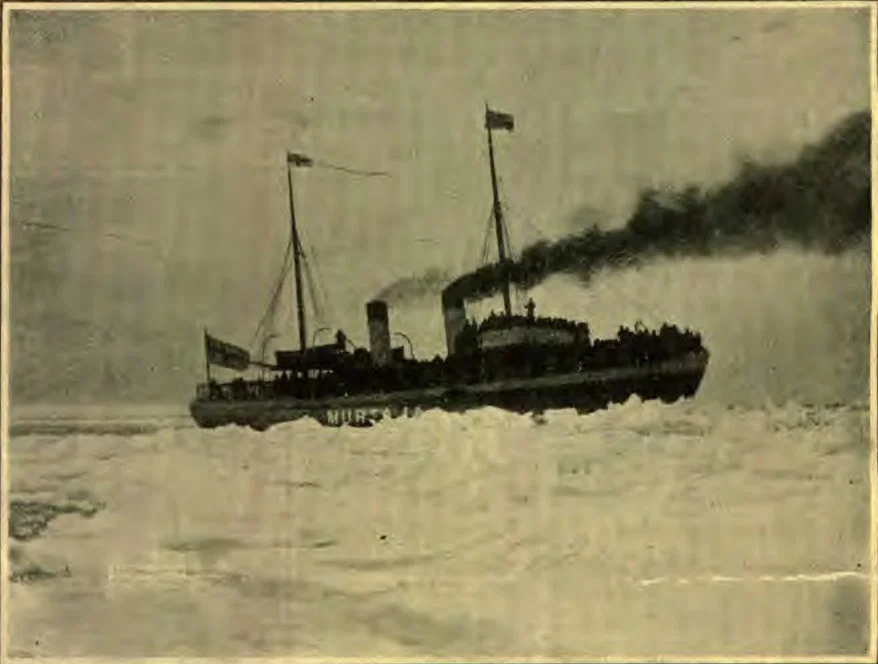
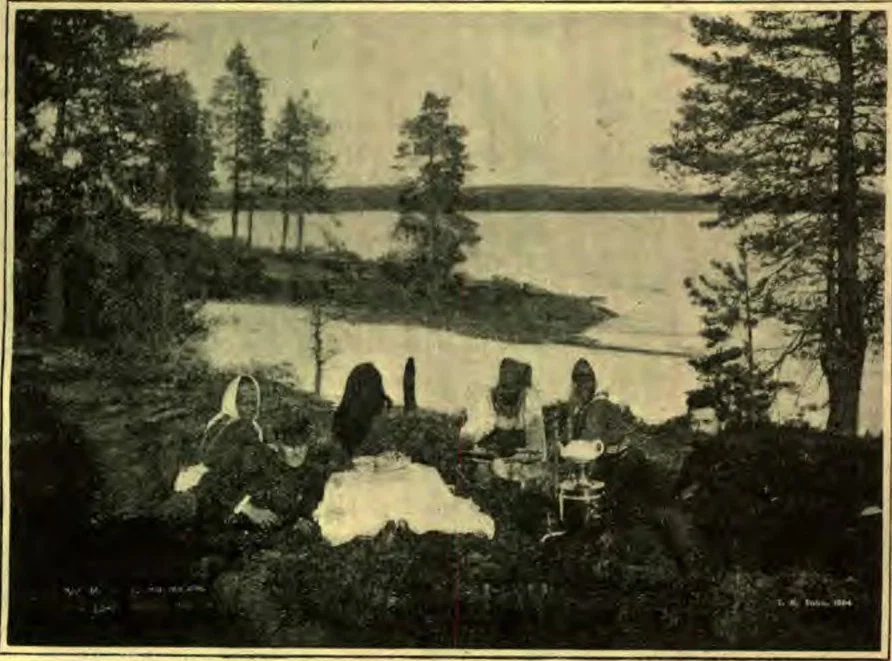
I send two photos. One is of a genuine outing scene in east Finland. In the foreground is the tea-pot. The round loaves of bread are in the basket, and there are also cakes. On the white cloth is the sugar, and you can see the small fish. In many places for a meal the people have only sour rye bread (sometimes mixed with bark), potatoes, salt, and coffee. Fish is also largely used. The land, pine trees, and water and rocks form a typical Finnish scene. The other is of the ice-breaker boat, which opens the harbor in spring. There are two of these boats. The other is much larger and stronger, and cost more than a million Finnish marks. The coming of these boats is a great event, as it betokens the opening of the spring season. The whole city is full of rejoicing when the boat comes.

Our Work in Finland

While there are some things that might be changed for the better, as in every other field, there are many encouraging features. There are always minor difficulties that have their influence in drawing away those who are weak in the faith, and no one can fail to see that only those who love the truth above anything else in the world will be able to stand. If it is not one thing, it is another, that tries the faith.
Financially the cause here is in a comparatively good condition. For the twelve months ending Oct. 1, 1903, the tithe amounted to 3,486.42 Finnish marks; Sabbath-school donations, 194.68 marks; raised for the Finnish mission, 959.07 marks; for general gifts, 256.22 marks (5.10 Finnish marks equal one dollar). Swedish papers to the number of 15,200 copies have been sold; 33,500 copies of the Finnish paper, Aikain Wartija, which has a monthly issue of 3,500; 12,029 copies of books were sold in Finnish and Swedish, valued at about 25,000 Finnish marks; 645,075 pages of tracts have been sold; 298 copies of “Christ’s Object Lessons” in Swedish. During the same twelve months we published here “Christ Our Saviour,” Swedish, 6,450 copies; “Steps to Christ,” Swedish, 8,000, Finnish, 13,000; Swedish tracts, 30,000 copies. This Helsingfors house also sold 5,000 copies of “Christ Our Saviour” to Sweden. These books are not included in the reckoning given above. It is expected that the book, “Thoughts on Revelation,” by Elder L. R. Conradi, in both Finnish and Swedish, will be published here the coming year, as well as “Ministration of Angels” (Finnish) and “Christ Our Righteousness” (Swedish). (It will be remembered that there are in Finland about 300,000 Swedes, and about 2,300,000 Finns, and there are a number of Russians. Number baptized, ten; present membership, sixty-five, divided among the church in Helsingfors and the companies in Borga, Bjorneborg, Vasa, Åbo. Nine of the sixty-five are isolated Sabbath-keepers.
For the coming year the same officers have been chosen as served last year.
There has been a ten-days’ canvassers’ institute in connection with the meeting, and our nine canvassers have good success in this field.
The coming season Elder Anderson continues his meetings in Helsingfors until Christmas, and Brother Hoffman carries on the work in Åbo until next summer. Åbo, with its suburbs, has fifty thousand people. This city is where the Swedes landed when they first came to Finland. Here they built their first castle and church. Here the Swedish Catholic soldiers went out and gathered the heathen Finns into the city, and Bishop Henry sprinkled water on them, as soon as they could repeat the Lord’s prayer in Swedish after the priest. Whoever refused to accept of the baptism was killed. The well from which the water was taken for the baptism still exists, and is known as Kupp’s well. A large painting of this scene hangs in the cathedral at Åbo. The Finns, however, finally killed this bishop.
One Bible worker will be engaged in the Swedish work, also a sister, who will later, it is hoped, develop into a Bible worker for the Finnish people. The workers in Finland have had some interesting experiences. One man was recently baptized who first came into the meeting intoxicated. The subject under consideration was intemperance, and its effect upon one’s children was mentioned. (The second commandment was the real subject of the lecture). This man sat in the front seat, often interrupting the speaker with a demand for Bible proof for the statement made. He went away, stopped drinking, came to no more meetings for a long time. Then for a while he came again, and a few Bible readings were held with him, but there was no decided result. In a few months the minister moved to a city about three hundred miles distant. He exchanged one or two letters with the man. His mind had no rest. He went to the doctor, who examined him, and said his health was good, only there must be something his mind was troubled about. Eighteen months after the first sermon was heard, the man made an unannounced visit to the city of the minister, and, strange to say, found him at home, as he had been providentially detained from taking a journey he had planned for. The brother was baptized, and now desires to give himself to the work of warning others. God’s Spirit always strives with men, if there is any hope that they will yield to him,
The work in Finland should go forward. This seems a good field. The Finns are hospitable, liberal, kind-hearted. God has a people here. Pray for the workers, that more power may be given them, so that a rich harvest of souls may be gathered in. Here in Helsingfors we have a commodious hall, used by students and for public lectures, and the rent is not expensive. O that God’s power may unite all the hearts of the workers, and that the work may prosper!
GUY DAIL.

The Inauguration

THE American people at first had no very definite idea of how their presidents should be inaugurated. The coronation of European kings was suggestive, but the fathers of the republic were wholly averse to following monarchial customs. The circumstances necessarily made Washington’s first inauguration a great popular demonstration. Before his second he requested each of his cabinet officers to suggest in writing an opinion in regard to the way the inauguration should be conducted. Mr. Jefferson thought the oath of office should be taken privately, but his views were not supported.
The event, occurring as it does every four years on the same day of the month in the same city, affords a basis for noting the growth of the country and of the tendencies of American life. The electrical display on the evening of the last inauguration, it is said, was the greatest ever known. Mr. Jefferson was not troubled by the electric glare. The first public news sent by telegraph was at the time of Polk’s inauguration in 1845. Mr. Morse occupied a seat on the platform, and with an instrument in hand telegraphed the proceedings to Baltimore.
The parade seems to be the chief feature of inauguration day. This has grown in size as well as in dignity during the century. The long line includes military and civic organizations and political clubs. The sight of thousands of uniformed men marching in solid ranks, extending from curbstone to curbstone of one of the widest avenues in the world and continuing for hours is interesting, as the immense crowd of onlookers testifies. The line forms behind the newly inaugurated president as he leaves the Capitol for the White House, which is a mile and a half away, and passes him at that point in formal review. In the early inaugurations veterans of the Revolution had an honored place in the parade. At William Henry Harrison’s inauguration the soldiers of the war of 1812 bore a noticeable part, the general himself riding on his white charger. The procession at the time of General Taylor’s inauguration was largely made up of soldiers of the Mexican War. At the approaching inauguration, the Spanish War veterans are to directly follow the heroes of the Civil War. Without doubt the parade on the coming fourth of March will surpass every other. Besides the various military, civic, and political companies granted a place in the procession, the governor of each State has been requested to select ten high school boys from his State to help extend the line. A representation of college and university men was also solicited. One college president opposed the idea strongly. He did not regard it a high compliment to the leading educational institutions to be represented merely by the hands and feet of its men. He thought unless some product of the brain was demanded, it was hardly a fitting thing to suspend their regular school work for a place in the inaugural ceremonies.
The exercises take place out of doors at the east front of the Capitol. This allows many more to witness the ceremony than could possibly do so otherwise; but if the weather proves disloyal, the occasion assumes a more serious aspect than is desirable. Benjamin Harrison delivered his long inaugural address from under an umbrella during a drenching rainstorm.
The president’s address precedes the taking of the oath of office, which is administered by the chief justice of the Supreme Court. When the president kisses the Bible after swearing to “preserve, protect, and defend the Constitution of the United States,” a deafening shout arises, and the clicking of the telegraph announces in every city of the land that the inauguration has taken place.
The vice-president makes his speech in the Senate chamber earlier in the day. The retiring vice-president delivers a valedictory address. These exercises are attended by the retiring and incoming presidents, the justices of the Supreme Court, the diplomatic corps, and the members of Congress.
The ceremonies of inauguration are ended by the inaugural ball. This is at present but little more than a great social reception, the vast crowds of people preventing hardly more than standing room. The plan of substituting for the ball a musical concert by the best talent to be obtained was suggested this year, and approved by many of the best citizens. It was argued that such an entertainment was more fitting and dignified than a ball for commemorating one of the chief national events. But custom prevailed.

The Pretty Alpine Flower

THE edelweiss, the famed flower of the Alps and the Pyrenees, so rare in Switzerland that it is protected by law, is to be grown in Lincoln Park, Chicago. The gardener is a native of Switzerland, and having secured some seed of edelweiss, he planted them last spring, keeping the shoots under glass all summer. When winter came, the plants were transferred to the greenhouse. They are thriving now, and if all goes well with them, the gardener's efforts will be rewarded by a blooming bed of edelweiss in June. Never has this flower been grown before on this side of the Atlantic.

The Patience Lesson

“The class in Patience.” (To the school Of Life the pupils came, Of every age and of every grade, And “Time” was the teacher’s name.) “Stand and recite! Let each one give The rule by which to solve The patience problem of this world As the days and the years revolve.”
First was a youth with a sullen brow And eyes of gathering hate; “The rule I’ve learned,” he growled, “is this: ‘No use to fight with Fate!’” “Wrong!”—and the teacher looked rebuke; “The pupil who should dare To work with such a rule would reach Not patience, but despair.”
Next stood a girl with a merry eye And a tossing, curly head. “The lesson is plain enough to me, With an easy rule,” she said. “I’ve found no use for fret or care, I see no need for tears; This is my motto: ’Twill be all The same in a hundred years!”
The teacher gravely smiled. “You’ve much To learn,” he said. “The next!” A pale lad with uplifted eyes, Sad, questioning, perplexed. “‘What can’t be cured must be endured!’” He faltered,—humbly, then, As Time, the teacher, shook his head,— “I’ll study it again.”
Last in the line a quiet maid, With gentle, earnest face. “I could not find a rule,” she mourned; “I looked in every place; But this I’ve learned,”—her voice was low, The modest little lass,— “‘Rest in the Lord, and wait for him: He’ll bring it all to pass.’”
The teacher’s smile was beautiful As his eyes upon her fell. “There is no other rule,” he said; “You have learned the lesson well. It is not to bear unshrinking All things, with a purpose grim, But to put one’s self in the hands of God, Then rest, and wait for him!”
— Mary E. Albright.

The “Backward Glance”

Miss Heywood tapped at Hazel’s bedroom door.
“I presumed on being your godmother, and came right up,” she called.
A minute later a tear-stained, girlish face peeped out, and Miss Heywood was drawn inside a room that looked as if a whirlwind had just passed through it.
“Horrible, isn’t it?” Hazel agreed, as Miss Heywood glanced about. “You see, I was late to breakfast without doing a thing to this room, and then I rushed off to school, and mother left it all just for a lesson to me. And, oh, Ned has had that nice Mr. Wilson up in his room, and Mr. Wilson knows this is my bedroom, and when I asked Ned why he couldn’t have had the brotherliness to close my door, he said—oh, he said—he was so used—to seeing it like this—he never thought!” and a wet hollow in a pillow which had evidently been doing duty before received Hazel’s unhappy face.
“Hazel,” said Miss Heywood, presently, “if you’ll take orders from me for sixty seconds, I’ll teach you something that will prevent your ever having this trouble again. I call it the ‘backward glance.’”
Hazel was sitting up in surprise.
“Go stand by the door,” began Miss Heywood, taking out her watch. “We’ll suppose you are starting down to breakfast, but as you reach the door, you give one backward glance to make sure that your room looks as you’d like to have it if the person whose opinion you value most were to pass the door.
“You see several things to do, don’t you? But you have just one minute to do them in.
“Now, ready, begin! Pick up that nightdress from the floor, and hang it on its hook. Take the slippers from the bed and those shoes from the middle of the room, and put them in the closet. Good! Snatch that towel from the back of the chair, and hang it on the rack. Lay those gloves and dangling ribbons and that collar inside the drawer, and close all the drawers. Quick, please! Take that tangled mass of bedclothing and turn it smoothly over the foot of the bed. Lay the pillows on that chair by the window, and throw up the window. Good! Hazel Marston, you did all that in one minute!”
“You stretched it!” laughed Hazel, breathless with the race.
“Not one second,” denied Miss Heywood, “and if my room looks tidier than yours to-day, it is simply because I never, from the hour it was taught me, have forgotten to give the backward glance as I reached my door. Tell me, now,” and she took the girl’s face in both her hands, “wouldn’t it pay to get up just one minute earlier?”—Selected.

Experience a Hard Teacher

“Let me beg of all your readers to teach their children, especially the daughters, the value of money, how to spend it, how to take care of it, and how to keep accounts.”
“I never had any such training when I was a girl. I was never allowed to handle any money save the occasional nickels and dimes sometimes given me for candy and the like; so I never learned any of these things about money. The natural consequence was that, when I was obliged to take care of money—my own, and, later on, my husband’s in household affairs—I was not prepared to do it properly. At first, a sum of money designed to cover expenses for some time seemed a large and inexhaustible amount to me, and I spent it too freely, with no foresight, or sense of proportion, till I found it gone and bills or necessary outlays still to be provided for. And I could not keep my accounts straight, though I ‘sought with tears’ to do so.”
“This was, of course, a constant source of annoyance to my very exact and methodical husband, and led to many unhappy hours for us both.”
“I felt that he was quite right about it, that the household affairs, and, in fact, all money matters, should be conducted on a strictly business basis; but it was only through very hard and sorrowful experiences that I learned what should have been taught me when I was a child.”
“I mean that my daughter shall profit, if possible, by my hardships. I am giving her an allowance, small at first, but increasing with her years, of which she is required to keep strict account, by a system of simple single-entry book-keeping. Her accounts are regularly balanced once a week, and this gives opportunity to go over the items of expenditure and to point out which were wise or foolish, generous or selfish. Here are given lessons as to what money is for and its proper use, which I am sure will help her later on to escape some of the mistakes and trials of my life.”—American Motherhood.

Frankness Has a Cousin

FRANKNESS is a virtue that stands high in the calendar, but it has a cousin named Rudeness, and the second haunts the first like a shadow. A frank disposition in the household is to be dreaded rather than praised. It does not gracefully lend itself to the tranquillity of the domestic group. You see we repress a great deal when in society and in business to which we freely give vent when at home with those we know best. They are those we love best, too, but the fact does not help us to be civil. A man would be summarily dismissed from his job who should treat customers in the shop as he habitually treats his wife, and a business plant would go begging for employees if there were the absence of good feeling that may often be noted in home life. Not everywhere, to be sure, but in so many homes that when real old school courtesy and well-bred manners prevail, and are never flawed in a home, the thing becomes the object of remark.

“But Oft for Our Own the Bitter Tone”

IF I had known in the morning How wearily all the day The words unkind would trouble my mind I said when you went away, I had been more careful, Darling, Nor given you needless pain; But vex our own with look and tone We might never take back again.
For though in the quiet evening You may give me the kiss of peace, Yet it well might be that never for me The pain of the heart should cease. How many go forth at morning Who never come home at night, And hearts have broken for harsh words spoken That sorrow can ne’er set right.
We have careful thought for the stranger, And smiles for the sometime guest; But oft for our own the bitter tone, Though we love our own the best. Ah, lip with the curve impatient, Ah, brow with the look of scorn, ’Twere a cruel fate were the night too late To undo the work of morn.
— Margaret Sangster.

Co-operation in Home Training of Youth

Co-operation

In the home training of the youth, the principle of co-operation is invaluable. From their earliest years children should be led to feel that they are a part of the home firm. Even the little ones should be trained to share in the daily work, and should be made to feel that their help is needed and is appreciated. The older ones should be their parents’ assistants, entering into their plans, and sharing their responsibilities and burdens. Let fathers and mothers take time to teach their children, let them show that they value their help, desire their confidence, and enjoy their companionship, and the children will not be slow to respond. Not only will the parents’ burden be lightened, and the children receive a practical training of inestimable worth, but there will be a strengthening of the home ties and a deepening of the very foundations of character.
“We are members one of another.” As every one therefore “hath received a gift, even so minister the same one to another, as good stewards of the manifold grace of God.” Well might the words written of the idol-builders of old be, with worthier aim, adopted as a motto by character builders of to-day: “They helped every one his neighbor; and every one said to his brother, Be of good courage.”—Mrs. E. G. White.

A Big Little Thing

A FRIEND who had borrowed a postage-stamp in a moment of need, apologized for replacing it with a penny, saying that she always meant to return a loan of that sort in kind, not with its money equivalent.
It was only a little thing, and at first it seemed almost overscrupulous.
But on second thought we remembered that we had both erred and suffered in this respect.
Why is not the money just as acceptable as the postage-stamp, or the spool of thread, or the cupful of raisins which a neighbor has run in to borrow? asks some one. Because it does not replace the useful article. It only furnishes the means to replace it, when time and opportunity offer.
And very often the want of a thing is more than the worth of it, as the old phrase has it. Even in the town it adds a little to the burdens of life to take thought of and replace supplies. Both justice and neighborly thoughtfulness should remind us to return our loans in kind.— Christian Age.

MARCH STUDY OF THE FIELD

(March 11)
OPENING EXERCISES:—
Singing.
Prayer.
Scripture Reading: Revelation 14.
FIELD STUDY:—
Report from the Shang-tsai Mission, Honan, China.
A Word from Kolo, Basutoland.
The Karmatar (India) Training-school and Orphanage.
Experiences in Syria.
Beginnings in Peru.
One-minute reports from C. E. Peckover, J. A. Strickland, J. W. Westphal, Dr. J. M. Keichline, F. W. Field, J. M. Hyatt, H. C. Goodrich, O. A. Olsen, B. E. Connerly, James A. Morrow, Marshall Enoch, H. Kuniya, Geo. M. Brown, E. H. Gates, G. F. Jones.
REMARKS BY THE LEADER: The Inspiration to Finish the Work.
CLOSING EXERCISES:—
Prayer. (Let several take part.)
Singing.

Note

The material for this study will be found in the issues of the Review of January 19, 26, and February 2 and 9. A basis for the leader’s remarks will be found on page five of the Review of January 19.
It would add to the interest of the meeting in presenting the minute reports, if the leader announced the name of the missionary from whom the report was to be given; and the individual previously appointed to respond should step to the map, pointing out the location of the worker, while giving in a few words his latest report. In this way the young people may become more familiar with our laborers in the different fields. Remember these workers by name in prayer.
E. H.

A Golden Rule Meditation

LET me not require perfection in my brother till I am somewhat near it myself. O, what a hypocrite I am to be enraged at faults of others that I cherish in myself; to call them sins in others, and in myself peculiarities! I frown upon their frowns as if my face were smiling. I am harsh with their harshness, exaggerate their exaggerations, and insincerely reprimand their falsehoods.
I will no longer judge my brother; I will begin to judge myself. Shall I close my eyes to his grievous errors?—Yes, until I can open them upon my own sins. While the beam is in me, I will not play surgeon for their motes.
Then, too, what love have I for men when a single fault in them can check its course? How shallow is it when the wind of criticism can make it muddy! How sluggish it must be when even their indifference can turn it from its course!
Let me love others as I would have them love me. I am wrong to-day, but to-morrow I repent and forget it, and expect my dear ones to forget it, and to love me just the same. So let me love them with a love that seeks excuse for their evil, rather than an increase of condemnation; with a love that is eager to forget, rather than tenacious to remember; with a love that goes more than half-way to meet repentance; that goes all the way, and pleads for it.
O, I fear that every bitter judgment of my brother’s faults, that all impatient anger at my brother when he sinned, has become stern condemnation of myself in heaven! For I that knew so well how another should live, why did I not live better myself? I that was so strict to mark iniquity in others, why was I so lax with my own grievous sins? Ah, forgive me, Thou who didst wear the crown of thorns, and help me to forgive men when they only throw a bramble in my way. Be gracious to me, thou who didst love them as they nailed thee to the cross, and teach me to be patient when men but brush my garments rudely.—Selected.

Habit of Promptness Is Helpful

MANY little things help a boy at the start. Foremost among them is a habit of promptness. A boy who slouches along without ambition or quickness makes a bad impression. A boy whose hair is unkempt, whose clothing is slovenly, and whose shoes are unbrushed, conveys an idea of shiftlessness which no amount of genius will overcome. Equally unfortunate for any boy is a scent of stale tobacco about his clothing. Life is a place of struggle. Whoever would overcome discouragement and difficulty must be fully armed at every point and well trained. Boys are averse to discipline, but it is discipline which gives the advantage in the long run. Nobody should be content to remain in the awkward squad; nobody need think that a winning personality, a quick apprehension, or even a good elementary education will avail much unless there is stamina. The responsible plodder gains more substantial advantage than his brilliant compeer who flames up like the rocket and comes down like the stick. — Selected.

Report from Washington State

THE Society of the Forest Home Industrial Academy was organized Oct. 8, 1904, with a membership of twenty-five. Since then ten new members have been added. Although most of the members live near the school, which is five miles from the nearest town, the members sold one hundred sixty-five copies of the special number of the Signs. Some of the members went over twenty miles to sell them.
Some are engaged in writing letters to those who have purchased “Great Controversy,” with the object of interesting them in the book.
We are trying to keep the object of the Society in view, as we realize that the message is going, and if we refuse to help, it will go without us.
DAVID ADAMS, President, ERNA WHITTING, Secretary.

The Young People's Convention at Jonesboro, Indiana

The Young People's Convention was held on the twenty-third and twenty-fourth of December. The inclemency of the weather interfered to an extent with the execution of the program, but not with the real profit of the meeting. Some of the topics that were considered are: The Work That God Has for Our Young People, The Relation of the Young People to the Sabbath-school, The Keynote of the Young People's Work, What This Missionary Campaign Means to the Young People, Our Young People and Missions. The music that was interspersed added much to the interest of the convention. Mrs. Halstead read some original stanzas on “The Missionary Campaign.”
The committee on plans submitted the following recommendations, which were adopted:—
“Whereas, The Lord has called the young people of this denomination to his service, and,—
“Whereas, The King’s business requires haste, we, your committee on plans and recommendations, submit the following:—
“Resolved, That we hereby place ourselves on record as being in hearty accord with the missionary recommendations passed by the last General Conference; and that we do hereby band ourselves together to assist, to the extent of our ability, in carrying out this mighty missionary campaign, which is never to cease until the gospel of the kingdom is carried to every nation, tongue, and people.
“Whereas, The Lord has said that our literature should be scattered as the leaves of autumn, therefore,—
“We recommend that our societies study carefully the needs of our fields, and so divide the territory and the workers that the truth may be placed in every home within the limits of said fields.
“Recognizing the fact that society meetings, where the members are not regularly engaged in gospel work, rapidly degenerate,—
“Resolved, That we hereby pledge ourselves and one another, that we will use our influence to keep our society meetings from becoming mere literary and social gatherings.
“Resolved, That we as young people earnestly invite the co-operation and counsel of our older brethren and sisters, in the great work of giving the advent message to all the world in this generation.”
All felt that the young people in this convention had come in closer touch with our workers than ever before, and a longing desire was implanted in each heart to be in deed and in truth the helping hand of our older workers who have so long borne the heat and burden of the day.
The convention closed with a consecration meeting.
Blanche Whittaker, Secretary.
Continue reading: Sammy Boyd’s Hen Business