The Youth’s Instructor, Vol. 43, No. 16.

EASTERN REMINISCENCES

The Youth’s Instructor

Apr 18, 1895

S. D. A. Publishing Association · Battle Creek, Mich. · Apr 18, 1895

EASTERN REMINISCENCES.
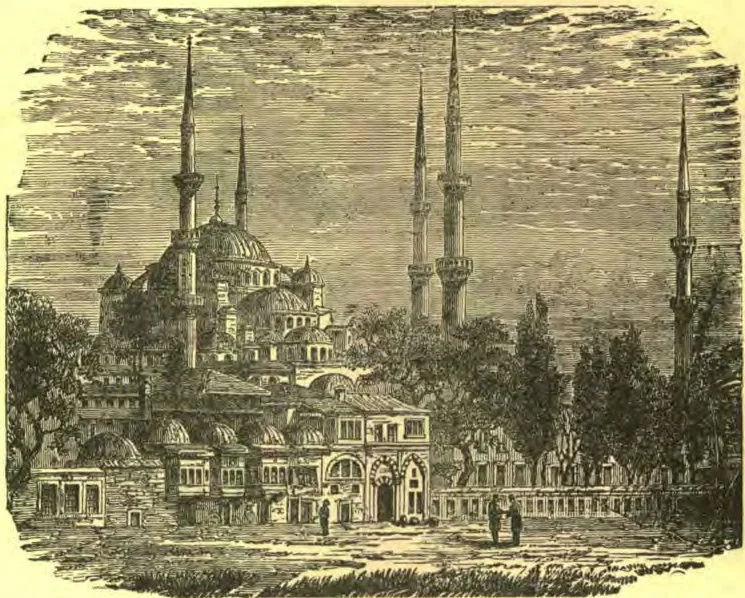
A few days ago we took the steamer for Scutari, on the opposite side of the Marmora, in Asia Minor.
THE MOSQUE OF ST. SOPHIA.
Such a strange crowd as we got along! The steamer, a dirty little affair, had a compartment for women and one for men, but we went to the upper deck. Upon our arrival on the other side, we took carriages, and after considerable squabbling between the drivers and guides, we started to visit the English and Turkish cemeteries.
The former contains the bodies of the officers and soldiers killed in the Crimean war. The officers have tombstones, but the privates are wrapped in their blankets, and laid twenty and thirty in a single grave. Queen Victoria and her subjects have raised a monument there to the fallen heroes. The hospital where Florence Nightingale was nurse is near by.
The Turkish cemetery, a strange, broken-down looking place, is shaded by cypress trees and filled with queer tombstones, shafts surmounted by turbans of every shape, and many with the fez often colored red, with a black tassel. We were told that the monuments were for the men and the flowers for the women, and that in all the cemeteries there were as many graves as twenty times the present population, which is estimated at six hundred thousand.
From there we drove to Mt. Bulgurlu to get the beautiful view; and it was magnificent, embracing the city, the Marmora, the Bosphorus, the Golden Horn, and the old road to Mecca, where the pilgrims used to wend their weary way. It took six months to walk there, and the treasure which they carried as offerings was put upon the backs of camels. Now all go by water. A pilgrim who has made this journey is known by his green turban. The trip to Scutari was most interesting, but it was very hot and very dusty.
In the evening a party of us, with two guides, went to evening service in the Mosque of St. Sophia, in Stamboul. Usually the whole city is closed up, and people are in bed, or out of sight, at seven o’clock in the evening, as they rise with the sun; but during the fast of the Ramadan they are up all night.
We drove over the dimly lighted bridge to the rear entrance of the mosque. The minarets were all lighted, as were all the minarets of the other mosques, making a strange, weird effect in the dark night. We were received by two Turks at the entrance, and we passed up a long incline, instead of stairs, turning again and again until we reached the gallery.
Here we sat on benches, and looked down upon the worshipers. At first we were dazed by the lights. We were told that there were twelve thousand inside and three thousand on the outside of the mosque.
There were queer lamps hanging in festoons, in rows, from huge bronze chandeliers, from dome to gallery, everywhere, which were merely glass tumblers suspended from wires, and half filled with water, on top of which was a little oil with two tiny wicks floating in it. On each side of the altar were enormous candles, all of twenty feet high and over a foot thick, and these candles were lighted.
The worshipers took off their shoes as they entered, and arranged themselves in rows along the width of the mosque, with their faces toward Mecca, standing on the edge of the big rugs, only one row of men on a rug, with their shoes on the space left for that purpose on the marble floor, between their rug and the one in front of them. There were as many rows of men as there were rugs.
In a small balcony were the chanters, and at certain parts of the service the whole congregation would bend over, then drop on their knees, and prostrate themselves twice, touching their foreheads to the floor; then all would rise simultaneously to their feet.
At intervals a voice arose in a weird, musical tone that would vibrate through the whole building like the wail of a lost soul, and that, with the dull thud and rushing sound produced by the prostrating of the worshipers, sent a thrill through one that was anything but pleasant; yet the whole service was solemn and impressive.
After remaining for about an hour, we took carriages for a drive about the city, as we wished to see the strange street scenes that can be witnessed at no other time of year. I shall never forget that drive. All the booths were open, everything exposed for sale. Music halls had crowds of people pouring in and out. The streets were so full of men that our carriages could with difficulty be gotten through; and strange to say, among this tremendous crowd we saw only five women, one attended by a slave, and four veiled ladies attended by the black guardian of the harem, with his insignia of office, a whip, which he would not hesitate to use if any one looked too closely at his charges, and the crowd would uphold him if he did use it.
As we drove along, we saw in many booths what looked like enormous cheeses, and one of our dragomans bought a piece of one, when much to our surprise we found it was almond candy. The Turks are very fond of sweets.
We saw in one place a very strange sight,—a large ring of men taking hold of hands and dancing a sort of shuffle, back and forth, but not going round, to the tune of a most doleful drum. They seemed to be in a dream. In all this strange crowd no one paid any attention to us, and we arrived safely at our hotel, feeling that we had seen a great deal.
On Friday afternoon our Greek dragoman took us to see an impressive service at the Greek church. It so happens that this year the Christian Lent and the Turkish Ramadan come together, so we have the unusual opportunity of witnessing the services at the Mosque of St. Sophia and also the Christian service of the Greek Church.
It was Good Friday, and early in the morning—so we were told—a large canvas, supposed to represent the body of Christ, was lowered into a tomb inside the church, and covered with flowers; people came and went all day, bringing flowers which they threw onto this canvas. In the afternoon, amid impressive services, it was raised, and carried in a solemn procession out from the church into the street. Everybody tries to get a spray of flowers from the body, as a talisman against bad luck for the coming year.
The church was so crowded we could not get in, so we were taken to a building opposite, where we could witness everything; and we were introduced to several prominent members of the church, who received us very politely. As the procession began to move from the church, a bell began to toll. The crowd of sight-seers filled the street, making it difficult for the procession to move.
First came altar-boys carrying gilded symbols; then others, with priests dressed in their strange, mournful garb, all chanting; then the archbishop, dressed in a magnificent robe of heavy white silk, embroidered with gold; then four black-robed priests, carrying the canvas covered with flowers.
The crowd surged and swayed, grasping for the flowers, till it seemed to us that half of them would be crushed to death. Happily no one was injured. As this is a Mohammedan country, we were surprised to see so many Greek Catholics.
Saturday morning we visited several mosques and tombs of sultans, and also visited the great cistern of “a thousand and one columns,”—in reality about four hundred columns. This cistern was formerly used to store the extra supply of water for the city, in time of siege.
In the afternoon we drove over the crowded bridge to Seraglio Point, where there are several palaces once occupied by sultans, but which are now preserved as museums. In one we saw the Divan of Justice, where the sultan sat to administer justice to his subjects, they standing outside a long window, on a balcony, and presenting their petitions through a prime minister, who in turn transmitted them to the sultan, as no one was allowed to approach him in person.
We next visited the royal treasury, another ancient palace. This contains the treasure of the dead sultans. When a sultan dies, all his personal effects, jewels, swords, etc., are placed here, and it requires a great deal of red tape to get in, through the triple iron doors, to see these wonderful and most beautiful treasures,—jewelled daggers heavily studded with gems, magnificent state robes, rubies, diamonds, and emeralds of enormous size. We saw the so-called emerald of Solomon, as large as my fist, and also his sword. I do not know how authentic this story is; but they pretend that the relics are the true ones.—Adelaide Turney, in Boston Commonwealth.

APRIL

April, at whose glad coming zephyrs rise With whispered sighs, Then on their light wings brush away, And hang amid the woodlands fresh Their aery mesh To tangle Flora in her way—
April, it is thy hand that doth unlock, From plain and rock, Odors and hues a balmy store, That breathing lie on Nature’s breast, So richly blest, That earth or heaven can ask no more!
April, the hawthorne and the eglantine, Purple woodbine, Streaked pink, and lily-cup, and rose, And thyme, and marjoram, are spreading, Where thou art treading, And their sweet eyes for thee unclose.
The little nightingale sits singing aye On leafy spray; And in her fitful strain doth run A thousand and a thousand changes, With voice that ranges Through every sweet division.
Sweet month! it is, when thou dost come again, That love is fain, With gentlest breath, the fires to wake That covered up and slumbering lay Through many a day.
— Belleau.

CUBAN AFFAIRS.

IT is impossible for the people of the United States not to be interested in the revolution now progressing in Cuba. In these days of rapid communication, countries that were once thought to be distant from each other are now neighbors. Cowper said that—
“Lands intersected by a narrow firth Abhor each other; mountains interposed Make enemies of nations, which had else, Like kindred drops, been mingled into one.”
But these natural barriers have been swept away by modern inventions. The steamship and the submarine telegraph have brought countries that are divided by quite a stretch of water into a closer relation to each other than any one years ago would have thought possible. Not long since, when the Hawaiian episode occurred, the press of this country spoke of Hawaii as an island near San Francisco, although there are fifteen hundred million of rolling billows between.
But Cuba is much nearer to the United States than is Hawaii, and for many years has been bound by business and social ties to the United States. In short, in every relation but the governmental relation, Cuba is American, rather than Spanish. A large number of Cubans reside in New York City and other cities of the eastern seaboard of the United States, and they are very generally enthusiastic in their desires for a union of Cuba with the country.
The Cuban people themselves seem very restive under Spanish control, and they have made several unsuccessful attempts to free themselves. It has cost Spain as much as the island is worth to keep it in subjection, if not more; but since it is the last of her once great possessions in America, which the genius of Columbus bequeathed to her, she is exceedingly reluctant to part with it, though it is a costly appendage.
The rebellion seems to be spreading all over the island, and the insurgent Cubans have won several victories. Twenty thousand men are now under arms, fighting for Cuban independence. General Campos, who has seen much service in Morocco, and who is considered to be the ablest Spanish general, will take command of the Spanish army in Cuba. Thus, the war seems to be closing in the East, it is opening in the West. Late reports state that a provisional government has been established by the revolutionists at some point in the interior of Cuba.
American sympathy is undoubtedly with the Cubans, but the government will remain entirely neutral, and will prevent as far as possible expeditions from leaving our shores for their help. Of one thing we may be reasonably certain: The United States will not allow any other nation than Spain to control the island, and if Spain loses Cuba, it will become an independent government, or a part of the United States, either as a territory or as one of the states of the American Union.
M. E. K.

Population Figures of British India

BRITISH INDIA contains two hundred and eighty-seven million people. The increase of population in a decade is twenty-seven million nine hundred thousand. There are forty-five million children under five years of age, or about as many as the entire population of the German empire. Of widows there are twenty-two million six hundred thousand, of whom two hundred and fifty thousand are not yet fourteen years of age.

THE WAR IN THE EAST.

Ever since the war between China and Japan commenced, Japan has forced the fighting, and the Chinese forces have almost invariably acted upon the defensive. The policy of each nation in this respect is in exact harmony with the national instincts of the two nations. Japan is all drive and activity; China is slow and reactionary; and in all her governmental and national affairs her motto seems to be, Delay, linger, and wait. It has been the declared intention of Japan to allow no armistice until a permanent peace was established. This is an unusual position; for nations at war generally enter into an armistice while negotiations for peace are discussed.
But China’s diplomacy is such a curious compound of tricks and equivocations, as the European nations have fully learned, and as Japan knows, that she thought it not safe to allow any cessation of hostilities until the full terms of peace were settled. So, while the negotiations were in progress, the armies in the field and the naval squadrons of Japan were ordered to press the battle, as it was thought that such a course would very materially hasten the willingness of China to grant the demands of Japan.
This plan has, however, been broken up by the attempt upon the life of Li Hung Chang. Of course the Japanese government did not sanction this act, and the man who attempted the life of the viceroy has been promptly sentenced to penal servitude for life; but at the same time there has been quite a change of feeling throughout the world in regard to the war, because of this dastardly attack upon the aged viceroy. To attempt the life of an accredited envoy of peace is considered by all civilized nations as a most atrocious crime. So great has been the feeling over this affair, that the Japanese government has felt that some concession on its part is necessary as a suitable expression of sorrow for the deed. To this end the mikado has proclaimed an unconditional armistice until April 20. This takes effect, however, only on the mainland of China, the island of Formosa being distinctly excluded from the terms of the armistice. It is to be hoped that by that time the conditions of peace will be arranged, and that the armistice is the beginning of the end of the war.
M. E. K.

NORTH AND SOUTH.

ONE of the most pleasing evidences that sectional feeling between the North and the South is dying out, is the earnest efforts that are made in the South to induce people from the North to settle there. The soldier who served in the Union Army, is especially welcome. It is a remarkable fact that none were so ready to fraternize at the close of the war, as were the officers and soldiers of the two armies. Now the governor of Georgia is endeavoring to secure a large number of former soldiers of the Union to colonize a tract of land in that state. Georgia has one hundred thousand acres in one body, upon which it is proposed to settle twenty thousand of the “boys in blue.” They are offered the privilege “marching through Georgia” again,—not as enemies, but as friends. There is one point, however, that seems to be forgotten: This has wrought great changes upon the “boys in blue” since ’61; many thousands of them have gone over to the majority, and the large portion of those who are left are by age and other causes incapacitated from making great changes; but the kindly feeling that prompts the offer may be reciprocated, even if the offer cannot be accepted. Georgia is the empire state of the South, and within her broad domain there is room for many thousands yet.
M. E. K.

THE KINGDOM OF GOD IS IN THE FUTURE.

When we speak of the kingdom of God as being future, we mean the kingdom of glory in the heavenly city and on the new earth. The kingdom of God in general is both past, present, and future. “The Lord hath prepared his throne in the heavens; and his kingdom ruleth over all.” Ps. 103 : 19. He is God from everlasting to everlasting. Ps. 90 : 2. His kingdom “is an everlasting kingdom.” Dan. 7 : 27. It has no beginning, and it will have no end.
We speak of a kingdom of grace because there is a throne of grace, and our dear Redeemer invites us to come boldly to this throne, that we may obtain mercy, and find grace to help in time of need. Heb. 4 : 16. In order to be interested in the future kingdom, we must be interested in the present. We must pray from our hearts, “Thy kingdom come!” and if we ever enjoy the future kingdom of God, a work of God must be wrought in our own hearts. Christ must dwell within, the hope of glory. “For the kingdom of God is not meat and drink; but righteousness, and peace, and joy in the Holy Ghost.” Rom. 14 : 17.
I am so glad that it is the privilege of every one to be a disciple of Christ. Christ says: “Behold, I stand at the door, and knock: if any man hear my voice, and open the door, I will come in to him, and will sup with him, and he with me.” Rev. 3 : 20. Let us then read and hear the word of God with reverence; for through this word Christ speaks to us, and let us never neglect to talk with our heavenly Father every day in prayer. Then we will overcome and obtain a glorious inheritance in the future kingdom. “To him that overcometh will I grant to sit with me in my throne, even as I also overcame, and am set down with my Father in his throne.” Rev. 3 : 21. The prophet Daniel speaks very plainly of the future kingdom in the following verse: “And in the days of these kings shall the God of heaven set up a kingdom, which shall never be destroyed; and the kingdom shall not be left to other people, but it shall break in pieces and consume all these kingdoms, and it shall stand forever.” Dan. 2 : 44.
These kingdoms are the ten divisions of the fourth universal empire,—Rome. They are symbolized by the ten toes on the image which Nebuchadnezzar, the great king of Babylon, saw. The whole image represents the Babylonian, Medo-Persian, Grecian, and Roman kingdoms. The last was divided into pagan and papal Rome.
The same kingdoms are symbolized in Daniel 7 by four beasts,—a lion, a bear, a leopard, and a terrible beast with great iron teeth. In this connection the papal power is represented by a little horn, speaking great things and making war with the saints. Dan. 7 : 8, 20, 21, 25. Very plain prophecies of the same power are found in 2 Thess. 2 : 3–8, and in Rev. 13 : 1–10. It is there called the mystery of iniquity, the man of sin, and a blasphemous power, worshiped by all whose names are not written in the book of life. One of the most remarkable signs of the times is the great homage paid to the pope at present, not only by Catholics, but also by a great many Protestants. For this reason we do well to give heed to the sure word of prophecy, that our feet may not be turned away from the narrow path that leads to the kingdom of glory.
In Daniel 8 we find a third class of symbols representing this kingdom; namely, a ram, a goat, and a little horn which waxed exceeding great. These kingdoms are the great kingdoms of Persia, Grecia, and Rome, which arose one after the other. This is so plainly stated by the prophet that none need misunderstand it. He says: “The ram which thou sawest having two horns are the kings of Media and Persia. And the rough goat is the king of Grecia.” Dan. 8 : 20, 21. The last kingdom, or king, he represents in this place is a king of fierce countenance, who shall destroy the holy people, and stand up against the Prince of princes. Verses 23–25. This is indeed applicable to Rome. Thus we see the four universal monarchies well represented in the book of Daniel by appropriate symbols.
J. G. Matteson.

BAY ISLAND.

IN TWO PARTS.—PART II.
Generally speaking, the people of these islands are industrious; certainly they are hindered somewhat by the warm climate which will not allow them to work as incessantly as will a cooler climate. For hard labor done by the creole he receives little value; not that he does not receive as many current dollars as laborers do in better lands, but because the dollar received by him is worth but fifty cents of good money. His dollar is the “sol.” Twenty-five cents are a shilling, eighteen and three fourths cents a ninepence, twelve and one half cents a sixpence or “real” (ral), six and one fourth cents a threepence. Such is the standard currency of Spanish Honduras.
The principal way in which the islanders receive money is by selling their fruit to schooners that ply between here and the United States. These vessels enter our little harbor on an average of one about every two weeks. Within a week or ten days after an arrival, all who have fruit which they desire to sell, hurry about to cut it. Some have plantations back some distance from the water, and often the road is rough and steep, which makes the labor hard indeed. After cutting a number of bunches of fruit, they “back” it to the landing. The load is so carried that it comes on the back and head. After fastening a strong strap (often made of polok bark) to the bunches in such a manner that the strap forms a circle, the man stoops down, passes the strap across his forehead, and takes hold of some solid object in front of him, by which means he is able to rise. Now adding to his load another bunch or two, he is ready to start; thus he bears his load up hill and down, until he reaches the beach where the boat is moored. If the distance is not too great, and if the trail is not too rough, a good “backer” will carry eight bunches, each bunch averaging twenty-five pounds.
The fruits referred to are bananas and plantains. There is even more work in preparing cocoanuts for sale. The planter goes into his “cocoanut walk,” as they term a number of cocoanut trees, and picks from the ground the fallen nuts. If the demand is great, he will pick from the trees. He deposits them all in some convenient place, and then goes about to husk them. This he quickly does by means of a sharpened stick, one end of which has been planted solidly in the ground. After this is done, they must be “backed” again to the beach, unless he did this at first, which is not probable, because the cocoanuts are much lighter after being husked. In doing this work, the planter uses a large basket which has attached to it a strap. Allowing the strap to pass across the forehead, he carries it in the same manner as he did the bunches of plantains and bananas. While husking the cocoanuts, he finds a few that have sprouted, which he tosses aside, and later brings to the cays, where the good-wife makes oil from them.
Finer oil I never saw. In it we fry our fish and plantain, and use it in every way that we would other fat. Nice cakes are made by using it in place of cream or butter. Much labor is required in making this oil. In the first place, the cocoanut must be “chipped,” which is done with a hatchet. A creole woman quickly frees the nut of its shell, leaving the meat a perfect sphere. This requires skill. Let a foreigner undertake it, and he will be sure to cut his hand, and break the nut into small pieces, making it difficult to grate.
After removing the shells of perhaps one hundred nuts, the woman places them in a wash-tub, and with her home-made grater, which is in some cases as large as a washboard, sets to work. When they are all grated, she turns over them a few buckets of warm water. With her hands she now extracts all the milk it is possible to squeeze out, and then repeats the process. This done, the milk is ready to be boiled until the oil rises to the top, when she skims it off, and boils it again, now getting the pure, clear oil. There are some who, in place of boiling the milk, allow it to stand over night. In the morning the oil, which has risen to the surface, is skimmed off. Others claim that the oil remains sweet longer if it is boiled.
Our dwelling here on the cay is a rude abode, but it is as good as this cay affords; and although it has blind windows, it is a comfortable little house for this tropical clime.
Cane is much grown here, and largely consumed, owing to the expense of buying sugar. A stick of sweet cane is Bay Island candy, and the children seem to enjoy it equally as well as American children do taffy. The young people are not alone in this; for the adults as well, including ourselves, enjoy this delicacy. A cane mill is employed to extract the juice from the cane, and is managed by two men. The stalk is first pounded, then put between the large rollers which cause the juice to pour out into a pan placed below. This liquid is then boiled to a rich syrup, which supplies the place of sugar. The people call this syrup “sweetening.” ADA B. MILLER.

“THERE WAS A GREAT CALM.”

Tumultuously on waves of anguish, leaps Sometimes our life-bark frail; and rising mountain high, Then plunges downward into depths before Untrod; and blinded with the ocean brine Of pent-up tears, we wildly toss about On seas of deep despair, o’ercome by darkness, storm. And night. The fiend of desolation reigns Despotic in the soul, where once there dwelt Fair forms of loveliness and grace. O, soul Of mine, why need you perish, tempest-tossed? Why have so little faith? The Lord doth save, The winds rebuke, the highest waves doth still. Why fearful be, O soul of little faith? What manner of man is this? He that doth Rebuke the human waves of bitterness, And calm the storm in hearts all tempest-tossed, And faint with battling, bleeding, sinking quite? He spoke; the winds and sea obeyed his will. He spoke, and calmed the tempest in the soul.
LORETTA REISMAN.

STUDIES ON THE FIRST EPISTLE OF JOHN.

THE WORD OF LIFE.

“That which was from the beginning, which we have heard, which we have seen with our eyes, which we have looked upon, and our hands have handled, of the Word of life; (for the life was manifested, and we have seen it, and bear witness, and show unto you that eternal life, which was with the Father, and was manifested unto us;) that which we have seen and heard declare we unto you, that ye also may have fellowship with us: and truly our fellowship is with the Father, and with his Son Jesus Christ. And these things write we unto you, that your joy may be full.” 1 John 1:1–4.

QUESTIONS ON THE TEXT.

From what time was the Word of life? Verse 1.
In how many ways was the Word of life manifested? Verses 1, 2.
What did the apostle say he did after knowing the Word of life? (Verse 2: We “bear witness.”) Verse 3.
What is the nature of this Word of life?—It is eternal.
Why did the apostle declare this Word? Verse 3.
Why did he write these things? Verse 4.
The Word.—“In the beginning was the Word, and the Word was with God, and the Word was God. The same was in the beginning with God.” John 1:1, 2. There was power in that word. “By the word of the Lord were the heavens made.” Ps. 33:6; Col. 1:16; Heb. 1:12. “He spake, and it was done; he commanded, and it stood fast.” Ps. 33:9. This was the word that was from the beginning. As far as God’s universe is concerned, this word was the beginning.
The Word of life.—It was the word of life because it was life itself. It gave life to all things which it spoke into existence. Every atom, every molecule, every chemical substance, every plant, as well as the animals and man, is possessed with activity that is life in its different organizations. These all came from the Word of life, which was from the beginning.
Beyond these is a life which, by preëminence, is called eternal life. Science may have no knowledge beyond the forces of nature, so-called, and may fail to discover any life but that which is revealed in material forms; but the Scriptures reveal to us a higher life, more perfect and enduring than any natural life. This is the life to which God, through his Word, proposes to lift mankind by a new birth, and by a resurrection from the dead. “Except a man be born again, he cannot see the kingdom of God.” John 3:3. “That which is born of flesh is flesh; and that which is born of the Spirit is spirit.” This is the life of which Peter says: “Being born again, not of corruptible seed, but of incorruptible, by the word of God, which liveth and abideth forever. For all flesh is as grass, and all the glory of man as the flower of grass. The grass withereth, and the flower thereof falleth away; but the word of the Lord endureth forever. And this is the word which by the gospel is preached unto you.” 1 Peter 1:23–25.
Witnesses of that life.—“For the life was manifested, and we have seen it, and bear witness, and show unto you that eternal life.” A witness is one who has a personal knowledge of that concerning which he testifies. We cannot be witnesses of that which we have received second-hand. The apostles declared Jesus to be the Prince of life, having power to forgive sins. “And we are his witnesses of these things.” Acts 5:31, 32. They were witnesses because they had received forgiveness of sins, and the life which came through the word of God. Receiving, they were ready to declare the good news to others. It was a fact with them. God had spoken, they by faith had received, and eternal life was theirs. There was no uncertainty in their testimony, because they knew in whom they believed.
Motives for witnessing.—“That your joy may be full.” It is a noble spirit to work for the good of others. We may do acts that are considered kind, and yet destroy all the force of those acts by the selfishness that underlies our motives. We may study hard to become laborers in the cause of truth, but have only selfish ends in view. It is one thing to have a desire to occupy a prominent position, that those to whom we minister may applaud us, and quite another thing to do the same work that others may have joy. When we work for the joy of others, we do not stop to consider our own hardships. We do not ask what will be said of our work, but, How happy can I make others?
Giving the word of life to others brings them life. It is the life of Christ; therefore it must bring joy. In witnessing of this life, we encourage others to become partakers of the same. As it gives us joy, so will it bring joy to others. Let us, then, be witnesses to declare to all around us the fellowship we have with our Lord and Saviour, and thus win precious souls to him. J. H. D.

OF ONE MIND.

The apostle Peter, after having given quite minute directions in regard to the varied relations that would affect Christians,—relations to kings, governors, men, brethren, and regarding the most intimate family relations,—describes the spirit that should actuate us, in the following manner: “Finally, be ye all of one mind, having compassion one of another; love as brethren, be pitiful, be courteous: not rendering evil for evil, or railing for railing: but contrariwise blessing; knowing that ye are thereunto called, that ye should inherit a blessing.” 1 Peter 3:8, 9. It might be thought, by a casual reader of this text, that it requires an impossibility. “What!” he would say, “can the minds of all be made alike? Will one mind be as clear, as quick to perceive, as retentive of what is learned, and as profound, as another?—No; and such a similarity of mind is not suggested in this text. This would indeed be an impossibility. The similarity,—the oneness of mind,—will be in the possession of the qualities referred to in the Scripture requiring it. These qualities are compassion, pitifulness, courteousness, which lead us to “love as brethren,” “not rendering evil for evil, or railing for railing,” but blessing those with whom we come in contact. Who can say that these qualities are not within the reach of all, and that God’s people, receiving them, may not thus become, as in the days of the early church, “of one heart and of one soul”?
The way it can be done is plainly taught in the Scriptures. It cannot be done by one person’s causing all others to accept his mind, for in such an action, even if it could be accomplished, the principles required (love and gentleness) would not be seen, for no one naturally has those qualifications. Again: if one can look into his brother’s heart, see what is there, and say: “You are all wrong and I am right; you must accept my mind.” There would be no righteousness in the one making such a requirement. The Scripture way is the right way, the only perfect way, beautiful in its simplicity, and uniform in its working upon every heart that submits to the plan—yes, submits to the plan; for it is accomplished by the submission of each heart and mind to Christ. “Let this mind be in you, which was also in Christ Jesus.” Phil. 2:5. If I submit my mind fully to Christ, and my brother does the same, will we not have one mind? We may vary in knowledge, in capacity, in judgment, because we were made with different powers, and our opportunities and experiences have been different; but in the spirit we have received, we are one, and that very oneness leads us to the mutual forbearance of the imperfections and failings of each other. Having the mind of Christ will not make us absolutely perfect in wisdom or utterance; if so, what opportunity to have compassion, to be pitiful, and to love the erring and wayward brother?
If we have the mind of Christ, it will be seen in us,—not always in great wisdom, but in Christlike actions. Compassion! Was not Jesus compassionate? Who ever had compassion like his? “Love as brethren.” Was there ever such a lover of his race as he who died that they might live? Courtesy! Who ever exhibited such perfect respect to all with whom he came in contact, as Jesus of Nazareth? and who, receiving evil and railing, granted in return such blessings as did the Son of God? With his mind in us, we will do the same, and then we will be of one mind, because the mind of Christ dwells in us by the Spirit, which he has given us. M. E. K.

BIBLE STUDY.

In our study of the epistle of John we desire to encourage the study of the word of truth. Our young people might, with profit, appoint one evening each week for a family study of these lessons, where convenient, small classes might be formed for this study. It is not expected that the questions and notes given will be the extent of the study. Let the suggestions open up the field for a more thorough investigation of this epistle. If each study be opened and closed with a season of prayer. We need wisdom from God to understand rightly his word. “If any of you lack wisdom, let him ask of God, that giveth to all men liberally, and upbraideth not; and it shall be given him.”
If there arise questions that seem obscure, and you would like further suggestions, we should like to hear from you, and we shall endeavor to assist you through the columns of the INSTRUCTOR, or by private correspondence. May the Lord help the young people to gain a saving knowledge of the word of life.
J. H. D.

Trusting the Most High Through Darkness

DARKNESS is only the forerunner of bright light to him who puts his trust unfalteringly in the Most High.
Continue reading: LESSON 5.—THE SOURCE OF POWER