The Youth’s Instructor, Vol. 49, No. 17.

CRATER LAKE

The Youth’s Instructor

Apr 25, 1901

Review and Herald Publishing Company · Battle Creek, Mich. · Apr 25, 1901

CRATER LAKE

Its Geological History

And God saw that the wickedness of man was great in the earth, and that every imagination of the thoughts of his heart was only evil continually. And it repented the Lord that he had made man on the earth, and it grieved him at his heart. And the Lord said, I will destroy man whom I have created from the face of the earth. . . . And God said unto Noah, The end of all flesh is come before me; for the earth is filled with violence through them. And, behold, I will destroy them with the earth. . . . And, behold, I, even I, do bring a flood of waters upon the earth, to destroy all flesh, wherein is the breath of life.”
In obedience to the commandment of God, Noah built an ark, and went out to warn the people of the destruction that was coming upon the earth. But the people would not heed him, and when it had been demonstrated to the universe that neither entreaty nor threat of punishment would turn them from their evil ways, God shut Noah and his family into the ark, and shut the rest of the world out.
Then “the fountains of the great deep were broken up.” The water that had been hidden in the bosom of the earth to feed the rivers that flowed from these great fountain-heads and went out to water the soil, rushed out upon the surface, and with the rain that fell from heaven, flooded the earth. Angels of God upheld the ark, else, stout as it was, it would never have withstood the terrible storm that swept the earth.
When the waters broke from the deep, great areas of the earth’s crust were thrown up and doubled back upon other portions of the surface. By the power of God’s word, other portions of the earth’s surface were broken up and thrown in heaps, to cover the slain, to hide the treasures of gold and silver and precious stones of which the antediluvians had made idols, and to bury the luxuriant forests that had covered the earth.
Many other changes took place, for “the world that then was, being overflowed with water, perished,” but as only the burying of the antediluvian forests has a direct bearing upon our subject, these other changes need not be mentioned here.
Years passed, and the buried forests slowly turned into vast beds of coal; for God has such a tender love for his creatures that he turns every curse into a blessing, so far as they will permit. Sometimes these coal beds became ignited by the spontaneous explosion of gases, and then great fires raged in the interior of the earth, until the surrounding rocks became a swollen, molten mass, that finally burst through the crust of the earth, and began the formation of a volcanic mountain.
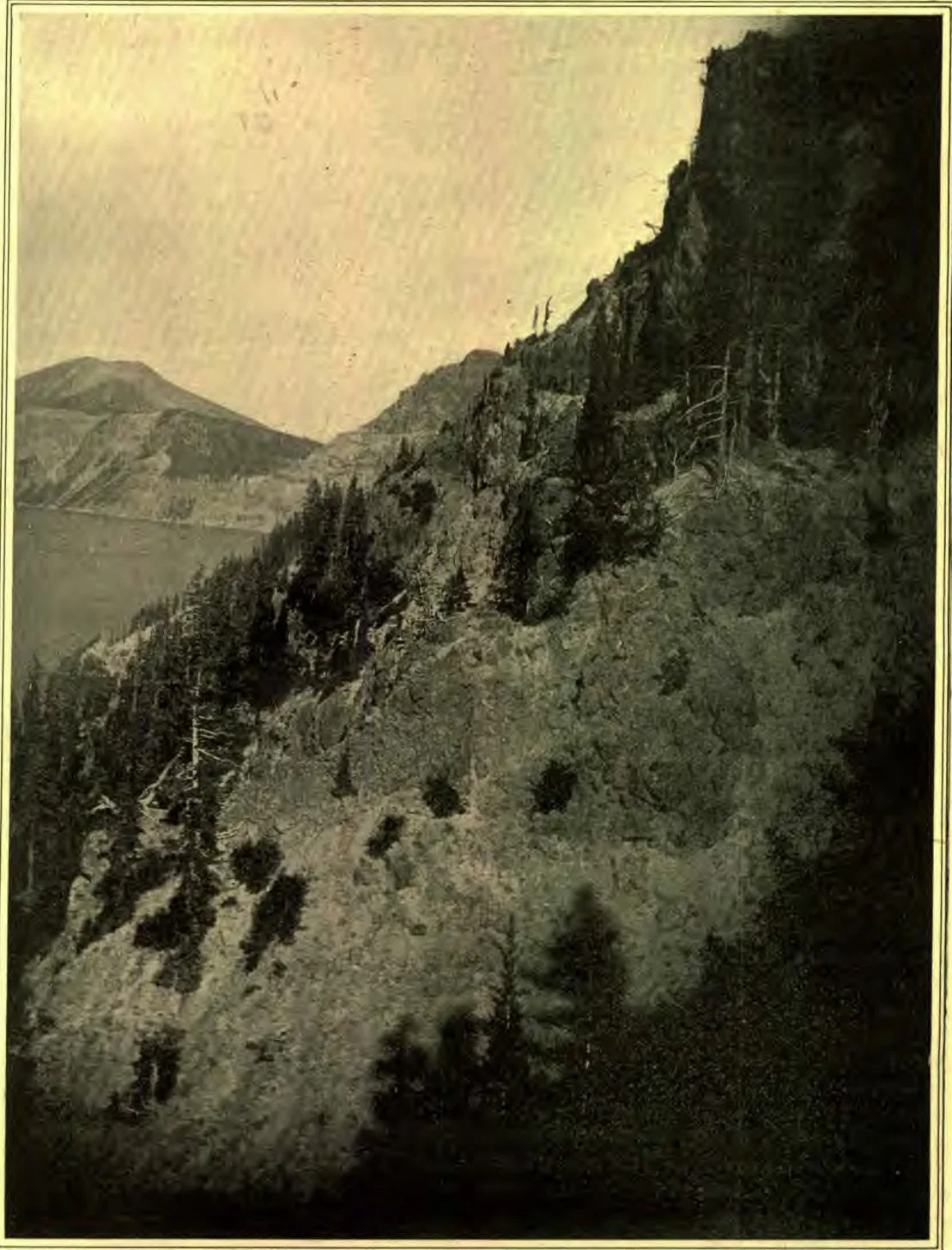
ALONG THE SOUTHEAST SHORE. CASTLE CREST TO THE RIGHT, AND MOUNT SCOTT TO THE LEFT.
Soon after the flood, one of these mountains began to form in what is now southern Oregon. It is quite impossible to estimate geological periods in years, so we can not tell how long it was forming, but it was probably among the first volcanoes the world had seen. The coal bed that fed the fires of this volcano was a large one, and was situated near the surface of the earth.
Years passed, and the fires raged with unabated fury. Mt. Mazama, as it is now called, grew higher and higher, until it overtopped all the peaks in the Cascade Range. But the fires burned back from beneath the mountain, and the lake of molten lava found lower outlets. Then Mt. Mazama became a semi-active volcano, whose crater emitted smoke and sulphurous gas, but no lava. Under the mountain was a vast cavity, at the bottom of which still surged the molten sea.
Snow fell upon the mountain top, and glaciers began to wear away the rough rocks of its sides.
Then the time was ripe for another act in this great drama.
The fuel near Mt. Mazama was well-nigh exhausted, but the fire, following one isolated vein of coal, suddenly burst into an underground lake, and let in a flood of water upon the molten sea. Then there was a terrific explosion, accompanied by an earthquake that could have been felt for hundreds of miles around. Mt. Mazama, or that part of it that lay over the principal cavity, was lifted bodily, just as you may have seen the lid of a kettle lifted to permit the escape of steam when the water boils furiously. The steam escaped, and the débris of Mt. Mazama fell back upon the seething mass below, leaving an elliptical hole more than six miles long, five miles wide, and fully a mile deep.
The molten lava burst through the débris, and another mountain began to grow up from the bottom of this great pit. But before it reached a height equal to the perpendicular walls that surrounded it, the pressure upon the lava below was relieved, the last fire burned out, and Mt. Mazama became a dead volcano.
The snow of winter and the rain of summer fell in this great basin in the mountain, and it gradually filled with water. Along some portions of the basin’s rim, where the conditions were favorable, the winter frosts and the summer thaws loosened the rocks, and they went tumbling down, grinding themselves and their fellows into powder, and forming soil upon the now sloping sides of the wall. Each year the soil in these spots became deeper; each year the water within the basin crept higher; each year the forests upon the mountain side grew denser. Then the wind, the birds, and the squirrels carried within the basin seeds of forest tree, shrub, and wild flower. Wherever they could find soil to take root, these seeds sprang up and grew, covering some portions of the crater’s wall with verdure.
And now the last act of this great drama has been played, and Crater Lake is ready to delight the eye, inspire the imagination, and thrill the very soul of all who gaze upon its deep-blue waters.
Many geological histories of Crater Lake have been written by far more learned men than the writer of this one, but all that I have read disagree with God’s word, and are consequently untrue. This objection can not be urged against the above, and in all probability it is a true history of the formation of Crater Lake.
J. EDGAR ROSS.

AFTER THE CRUCIFIXION

CHRIST was crucified. The Prince of life had been taken by wicked hands and slain. In his spotless purity he has been killed as a disturber of the peace. He was lying in Joseph’s new tomb. Christ descended into the grave as our sin-bearer, opening a grave for the sins of all who will accept him as their personal Saviour.
The night following the crucifixion was the darkest night the church had ever known. But the redemption price for a fallen world had been paid; the sacrifice for sin had been offered. All heaven was triumphant.
At the setting of the sun on the evening of the preparation day, trumpets sounded, signifying that the Sabbath had begun. The next day the courts of the temple were filled with worshipers. The high priest for Golgotha was there, splendidly robed in his sacerdotal garments. White-turbaned priests, full of busy activity, were preparing to perform their duties. The ceremonies of the Passover moved on with the usual routine. But the imposing dress of the high priest covered a heart that needed the molding of the Spirit of God. The ostentatious and ceremonious rites of the Jewish religion were mingled with selfishness, fraud, discontent, and unholy passions. The priests had chosen Barabbas, and Barabbas they would have as long as life should last. They had cried out against Christ, “Crucify him, crucify him.” “His blood be on us, and on our children.” The blood they had invoked upon themselves would indeed rest upon them. The characters they had chosen would forever be their characters. By their lives they contradicted the meaning of their ceremonies. Jesus never spurned the true penitent, but he hated hypocrisy cloaked by a garment of religion.
Some of the worshipers of the temple were not at rest as the blood of bulls and goats was offered for the sin of Israel. They were not conscious that type had met antitype, that an infinite sacrifice had been made for the sin of the world. But never before had the ritual service been witnessed with such conflicting feelings. The musical instruments and the voices of the singers were as loud and clear as usual. But a sense of strangeness pervaded everything. One after another inquired about the strange event that had taken place. Hitherto the most holy place had always been sacredly guarded from intrusion. Only once a year had it been entered, and then by the high priest. But now horror was seen on all countenances; for this apartment was open to all eyes. At the very moment when Christ had expired, the heavy veil of tapestry, made of pure linen and beautifully wrought with gold and scarlet and purple, had been rent from top to bottom. The place where Jehovah had met with the priest, to communicate his glory, the place which had been God’s sacred audience-chamber lay open to every eye, no longer recognized by the Lord.
Many who at this time united in the services of the Passover, never took part in them again. Light was to shine into their hearts. The disciples were to communicate to them the knowledge that the Messiah had come.
According to their custom, the people brought their sick and suffering to the temple courts, inquiring, Who can tell us of Jesus of Nazareth, the Healer? Some had come from far to see and hear him who had healed the sick and raised the dead to life. With persistent earnestness they asked for him. They would not be turned away. But they were driven from the temple courts, and the people of Jerusalem could not fail to see the difference between this scene and the scenes of Christ’s life.
On every side was heard the cry, “We want Christ, the Healer!” A world without a Christ was blackness and darkness, not only to the disciples, but to the sick and suffering, to the priests and rulers. The Jewish leaders and even the Roman authorities found it harder to deal with a dead Christ than with a living Christ.
The people learned that Jesus had been put to death. Inquiries were made regarding his death. The particulars of his trial were kept as private as possible, but during the time when he was in the grave, his name was on thousands of lips, and the report of his mock trial and of the cruelty of the priests and rulers was circulated everywhere.
By men of intellect the priests were called upon to explain the prophecies concerning the Messiah, and while trying to frame some falsehood in reply, the priests became like men insane. Upon many minds rested the conviction that the Scriptures had been fulfilled.
Entire justice was done in the atonement. In the place of the sinner, the spotless Son of God received the penalty, and the sinner goes free as long as he receives and holds Christ as his personal Saviour. Though guilty, he is looked upon as innocent. Christ fulfilled every requirement demanded by justice. God’s character as a God of holiness, a God of goodness, compassion, and love combined, was revealed in his Son. In the cross of Christ, God gave the world a mighty pledge of his justice and love. “For if the blood of bulls and of goats, and the ashes of an heifer sprinkling the unclean, sanctifieth to the purifying of the flesh; how much more shall the blood of Christ, who through the eternal Spirit offered himself without spot to God, purge your conscience from dead works to serve the living God?”
When Christ bowed his head and died, he bore the pillars of Satan’s kingdom with him to the earth. He vanquished Satan in the same nature over which in Eden Satan obtained the victory. The enemy was overcome by Christ in his human nature. The power of the Saviour’s Godhead was hidden. He overcame in human nature, relying upon God for power. This is the privilege of all. In proportion to our faith will be our victory. Mrs. E. G. WHITE.

HOW TO MAKE FRIENDS

The business of making friends is considered by many to be so small and unprofitable that thousands pass through this world without experiencing the blessedness that comes from having secured good and substantial friends.
The “confidence man,” as he is represented in our large cities, is the devil’s typical counterfeit of what every child of God should be in winning the confidence of others for the sake of the good that we may do them. The mechanical engineer is facilitated in his work by frequently consulting his various formulas. Even the skilled cook finds it advantageous to study her recipe book. Similarly, the man who wishes to secure friends will find it not only helpful but highly essential to follow out carefully the recipe which the Bible furnishes for the same. “A man that hath friends must show himself friendly.” Prov. 18:24. Just to the extent that we succeed in showing friendliness to others will our friendship be reciprocated, for “with what measure ye mete, it shall be measured to you again.”
One of the first problems to be solved is, how to love a man without loving his sins, and, what is much more difficult, how to hate his sins without hating him, and how to stand by a friend in spite of his faults. We must learn to assist our friends in stripping off the world. Only God, who is the great Master Workman, can teach us how to avoid being too superficial in this process, or how not to go too deep, thus causing unnecessary pain.
We shall never know until we get over on the other shore how in every apparently chance acquaintance in this life, God began to set in operation a train of circumstances, in some cases years before, so that we might have an opportunity to secure another friend; and from a human standpoint there will be an eternal loss if that opportunity is allowed to pass unimproved.
Some of our sublimest and never-to-be-forgotten experiences come to us while working for our friends. Job answered his wife’s sneering remark, hurled back into the faces of his visitors unanswerable arguments, and even ventured to contend with his Maker; but his personal miseries and troubles did not disappear until he prayed for his friends. “The Lord turned the captivity of Job, when he prayed for his friends.” Job 42:10. This only illustrates a proper rule of action. When a man is hungry, he needs bread more than he needs to be prayed for. When he has heartache, he needs to have the balm of Gilead applied in the way of friendly sympathy. If you have passed through similar experiences, you can show him that God still lives, that there are true hearts still beating, and that he is mistaken when he thinks that no one cares for his soul. There are some things in this world that are worth more than silver and gold, and they are things which all can give,—kind words, a cheery smile, and a hearty hand-shake.
If we wish to secure a permanent friend, we must seek to inspire him with something that has inspired us, rather than endeavor to fascinate him by our own personality; for if we choose the latter course, all that will be necessary to lose him is for us merely to make a few mistakes, and then all his respect for and confidence in us will instantly vanish.
A man who honestly desires friends will imitate Paul’s example: “I will very gladly spend and be spent for you;” and he may even pass through the same trying experience, “Though the more abundantly I love you, the less I be loved.” 2 Cor. 12:15.
We are all laboring under a terrible load of evil heredity, of which God alone can relieve us; and one of the means whereby he accomplishes this is by bringing together persons who are differently constituted, so that by beholding the strong points in one another they may acquire the same. Perhaps all that we shall see of God here below is what we discern of Him as manifested in nature, and more particularly in our fellow beings. There is scarcely a human soul that does not have something of the divine, which by proper cultivation may be developed; but it needs the touch of the Divine Architect; and who knows but that he may choose you as the humble instrument to touch that spot, and that you may be the means in his hands of changing the whole current of the after-life of that person?
DAVID PAULSON, M. D.

CONSECRATION

O Jesus Christ! most wonderful, Most precious, and most sweet, To thee I wholly yield myself, Low bending at thy feet, And ask that thou wouldst use me, Lord, Where’er thou deemest meet.
Not any strength of mine I bring, So weak I am and small, But thou canst give me needed grace, Who art my all in all, And I have but to haste to thee Oft as I hear thy call.
As to and fro on errands sent About my work I go, O blessed Jesus! fill my heart Until it overflow With love to those who know thee not, Whom thou art fain to know.
I serve thee in a little place, Obscure and out of sight, But in the brightness of thy face That little place is light; For thou art heaven on earth to me, And noonday in the night.
I would not choose, my gracious Christ, But ever seek thy will; Divinely good thy purpose is; I would thy aims fulfil. So bid me go, or bid me stay, Abiding with me still.
O Jesus Christ! most wonderful, Most precious, and most sweet, To thee I wholly yield myself, And am in thee complete. I pray that thou wouldst use me, Lord, As to thee seemest meet.
—Margaret E. Sangster.

Giving Up One's Way Gracefully and Cheerfully

It is one thing to give up one’s own way, or will, or preference, and another and often wholly different thing to give up so cheerfully and pleasantly that none shall guess the inconvenience or hurt in setting aside one’s own plans for another.
And the hard lesson of “giving up” gracefully — at least we often make it hard by our method of learning it — must be mastered by every one who would be happy himself, or would make his presence a delight to others. The root of the matter lies in unselfishness of heart — the casting out of every trace of the self-spirit, and the receiving into the heart, to control and guide all the life, of the Spirit of the Master himself.

SOMETIME

Sometime we shall not idle lie and still, And let the current bear us where it will; But with strong arm we'll grasp the unused oar, And bravely stem the tide, though breakers roar, In that good time,— sometime.
We'll give each breeze that gently fans our cheek, Some word of love or sympathy to speak; We'll send the glad hours singing on their way, Bearing rich record of good deeds, we say, In that blest time,— sometime.
When we have walked where pleasure's charms beguile, And toyed with folly for a little while, We'll scatter blessings then where'er we tread,— When comes that good time always just ahead, When comes that phantom,— sometime.
VIOLA E. SMITH.

THE PLANET MARS

No one who has been at all observant of our evening skies during the past few months, but has noticed that beautiful, ruddy star that has been apparently moving westward among the other stars, following nearly in the pathway of the sun. That star is the planet Mars. Mars is the fourth world in order, counting from the sun, being the next beyond us. We are better acquainted with this little world than with any of the others; for although Venus comes nearer to us than does Mars, yet when she approaches that part of the heavens where we chance to be, she always keeps her dark side toward us, while Mars always shows us his full illuminated face whenever we come near to each other.
Mars is a much smaller world than ours, having only two sevenths of the surface that our world has. Its diameter is only 4,230 miles. An object weighing here one hundred pounds would there weigh only thirty-eight pounds.
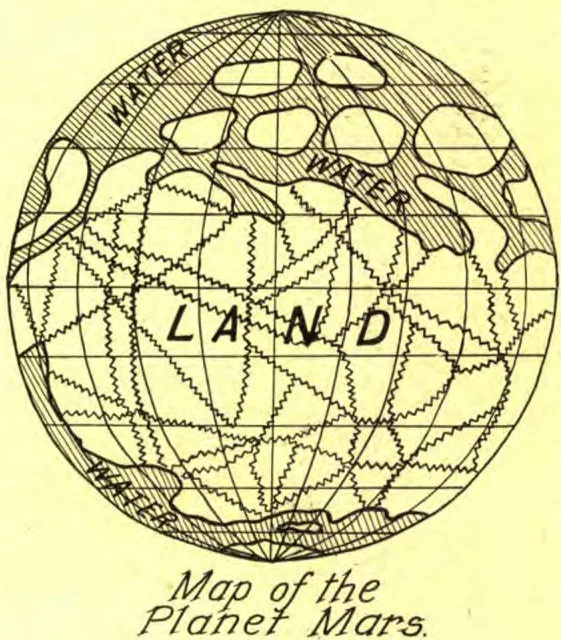
Map of the Planet Mars.
As we have already said, Mars has been for some months apparently moving westward among the stars; this movement has, however, been only apparent, and has been growing slower and slower, until on April 4 it seemed to stand still. It will seemingly remain in this position for a short time, when it will again resume its eastward journey around the sun. Study carefully the diagrams given in our last study, and see if you can not tell why this is so. Some evening we will study more fully this interesting phenomenon. Because of these changes, the ancients named the planets “wandering stars.” As we leave Mars behind in our rapid race around the sun, we shall find him growing dimmer and dimmer until at last we shall lose him behind the sun. When we again see him regaining his brightness, he will be a morning star, and will be found on the other side of the sun.
Mars reflects to us two distinct colors, red and green, the former reflected from the islands and continents; the latter from the oceans, lakes, gulfs, and bays. The greater portion of our earth has, since the flood, been covered with water; but with Mars this is not so; its surface being about five-eighths land and three-fourths water, more as we understand our earth was before the curse of the flood rested upon it. We present with this a drawing showing one of the hemispheres of Mars. One peculiarity of this planet, as will be seen, is the network of lines running in different directions across the continents. What they are we do not know. They were, for some time, supposed to be canals or artificial water-ways; but this can not be true, for they are from forty to fifty miles wide; besides, they change their position at times. Frequently a single one will spread out, and finally become double, the two lines running parallel for hundreds of miles, as will be seen on the map. Similar markings have lately been observed on Venus as well. Some have suggested that these markings may be the lines dividing the land among the different families, similarly to the dividing of the land of Palestine among the tribes of Israel. At times large portions of land become flooded with water, as Egypt is flooded by the River Nile. In 1902 the Earth and Mars will approach unusually near each other, and it is hoped that then, with our improved facilities for observation, we shall learn many new facts regarding this near neighbor of ours.
The climate of Mars seems to be, in the northern hemisphere, quite like that upon our earth, only more mild and even, the winters not being so cold and stormy as ours; but in the southern hemisphere the extremes of heat in summer and cold in winter are very marked. This is caused from the fact that the planet is fully 27,000,000 miles farther from the sun in the winter of the southern hemisphere than during the summer. During the winter time the poles of Mars are covered with a thick blanket of ice and snow, which as summer approaches gives way to green fields and sun-lit hills and dales.
Were it true that the amount of heat and light of a planet is dependent upon, and regulated solely by, its distance from the sun, then we would have to suppose that Mars was a much colder and darker world than the one on which we live; for according to this hypothesis, it would receive some less than one-half the light and heat that we receive; but since it has been proved that Mars has a much more dense atmosphere than we, we can readily understand why we find it to have even more light and heat than we enjoy.
Their seasons are nearly twice as long as ours. Swinging at the rate of 54,000 miles an hour, it accomplishes its yearly journey in 687 days of our time. Its day is known to be exactly 24 hours, 37 minutes, and 22.67 seconds long. The exactness of this data is calculated from observations that reach as far back as the days of Dr. Robert Hooke, 1666.
Another interesting feature of Mars is its moons. Until as recently as 1877 it was supposed to have no satellites; but in that year Professor Hall of the Naval Observatory discovered two, one being about six miles in diameter and the other about seven miles. The outer moon, which he named Deimos, is about 14,600 miles from Mars, and makes its monthly journey around its primary in thirty hours and eighteen minutes. The inner moon, which he named Phobo, is only 5,800 miles from the planet, and revolves about it in seven hours and thirty-nine minutes. Now think what a strange sight that must be: the planet itself revolves from west to east in a little more than twenty-four hours, which would cause the sun to rise in the east and set in the west, the same as with us; but this little moon travels so much faster than the planet revolves that he actually rises in the west and sets in the east, and does it so quickly that he passes through all the phases of new, full, quarter, old, and back to new moon again all in one single evening.
To give you some idea as to how carefully Professor Hall must have searched, even with his mammoth telescope, before finding these two moons, we will say that it would be the same as asking an astronomer in Chicago to turn his telescope upon the Tabernacle in Battle Creek, and determine whether some lady had not lost her gold watch upon the pavement that surrounds that building.
The landscape of Mars is supposed to be beautifully undulating, with hills and valleys, brooks and flowers, no ragged rocks having ever been torn from its bosom, as was the case with our earth at the time of the flood. Its heavy clouds refresh and gladden its hills and vales with dew and rain; while its snow-capped poles tell of its invigorating winters that come and go with its ever-varying seasons. Dew and sunshine, cloud and rain, all speak of the bow of God’s covenant promise of peace to them. We see, in the bow that has since the deluge spanned our heavens, the promise of God’s care and love to us; and while sin has never entered their beautiful world, while it has never felt the terrible curse that thrice has rested so heavily upon us, yet they certainly must look forward to that glad time when the accuser of their brethren shall have been destroyed; when sin with all its sad results shall have been forever wiped away, and Christ proclaimed forever King of kings and Lord of lords. They, with us, will some day join in that song of redemption that John records in Rev. 5: 13, where he says, “Every creature which is in heaven, and on the earth, and under the earth, and such as are in the sea, and all that are in them,”—showing that the worlds themselves, as well as their inhabitants, are represented as joining in this anthem,—“heard I saying, Blessing, and honor, and glory, and power, be unto him that sitteth upon the throne, and unto the Lamb for ever and ever.”
The storm-clouds that we see hanging over these unfallen worlds tell us too plainly that if one member suffers, all the members suffer with it; if one member is honored, all the members rejoice with it. 1 Cor. 12: 26. It is no wonder Paul says, “The creature was made subject to vanity, not willingly, but by reason of him who hath subjected the same in hope, because the creature [the created worlds] itself also shall be delivered from the bondage of corruption into the glorious liberty of the children of God. For we know that the whole creation groaneth and travaileth in pain together until now.” Rom. 8: 20–22. God grant that the time may soon come when his whole universe shall be forever free from the curse and mildew of sin and iniquity. OTHO C. GODSMARK.

Continued Indwelling of Christ Keeps Hearts Clean

As it requires the same power to sustain creation that it required to produce it, so it requires the same Saviour who cleanses hearts to keep hearts clean. Only through the continued indwelling of our Lord can Christians be kept holy, useful, and happy.—Clarke.

HOW WE LIVE

David thought much upon the wonderful and beautiful things in creation. At one time he was meditating upon the marvelous workmanship of the human body, and exclaimed, “I will praise thee; for I am fearfully and wonderfully made.”
The body is the citadel of life. Some have tried to explain what life is, but they can not do it. In life is manifest the working out of the thoughts and power of God; but who can understand his thoughts, and who can measure his power? “In whose hand is the life of every living thing.” Job 12: 10, margin. Wherever there is life, there is thought, there is intelligent activity. The thought of God is there. Even the plants show his thoughts. They do not themselves think, but the One who clothes the grass of the field thinks in them.
We will take a drop of water from this little pool, put it under a microscope, and see what is in it. We find a little creature which is called an ameba. It is merely a little sac of jelly. It has no hands, no feet, no eyes, no head, no mouth; yet it eats and drinks and moves about in its sphere with apparently much the same intelligence that we manifest in our lives. It is guided by the intelligence of God, in which it lives and has its being the same as we do. The difference between us and this little animal is that it has only one cell in its body, while we have many. Think of your body as a swarm of amebas floating in a fluid, the lymph, and held together by the skin and fibrous tissues; and you will have a true idea of its mechanism.
How wonderful to think of each little cell of the body as having a separate existence, living a little life of its own, eating, drinking, excreting the wastes of its body, and performing the various functions of life in a way that only an intelligent existence can. The life we live is not the life of one, but of millions of creatures, all working together to make up the one acting, thinking being. The life of the body is the sum of the life of its cells. If many of the cells are in a dead or dying condition, the vitality of the whole body is low; but if every cell is healthy and active, the whole body is full of health and vigor.
We will imagine the body to be a pool of water through which a little brook flows. Growing in the pool is a network of water vines, and among the water vines are swarms of little fishes swimming about. The water is the blood and lymph; the water vines are the fibrous tissues; and the fishes are the living cells of the body. The inflowing stream is the food and drink we take in; and the outflow is the waste substances that are carried away through the skin, kidneys, and other organs. What would happen if above this little pool there was a dumping place for garbage, filth, and slime?—The little creatures in the pool would get sick and die.
This illustrates what happens in our bodies, if through their inlets there flows a stream fouled with improper food and drink, or poisoned with drugs, as whisky, tobacco, tea and coffee, decaying food, dead animals, and the like. Would you wonder if under such conditions the fluids of the body—the blood and lymph—should get so impure that the delicate cells living in them would sicken and die, like the fishes in the pool?
The cells are made to live in pure surroundings; they can not thrive in the presence of filth. For this reason perfect health demands that not only the body itself shall be surrounded with a pure atmosphere, but that each cell—each little living unit of which it is composed—shall be bathed in a pure medium.
We can help to maintain this condition by guarding the inlets of the body, that nothing may enter to contaminate its living fluids, and that the food we eat, the water we drink, and the air we breathe may be of such quality that it can be converted into pure blood; by taking care also that the outlets of the body do not become choked up, preventing the poisons formed in it from being carried away. If to this we add plenty of exercise to keep the blood flowing briskly, carrying the purifying oxygen and life-supporting food to all parts of the body, health is the natural result.
God lives in the body that is the temple of the Holy Ghost. God is at work there, directing moment by moment all its activities. It is the Lord that keeps our hearts beating and gives us power to think and act. Realizing this, the body becomes sacred to us, and we will do all we can to co-operate with our Maker in keeping it pure and clean, a fit habitation for his Spirit. “Whether therefore ye eat, or drink, or whatsoever ye do, do all to the glory of God.”
ARTHUR W. GEORGE, M. D.
Continue reading: SEEING THE SPRINKLED BLOOD